Your First 90 Days at a High-Performance Tennis Academy
Start strong with a clear 90 day plan: day 1 fitness baselines, a stroke by stroke technique audit, three focused 4 week training blocks, sample school and work friendly schedules, coach communication routines, and milestone metrics.
 Tommy
Tommy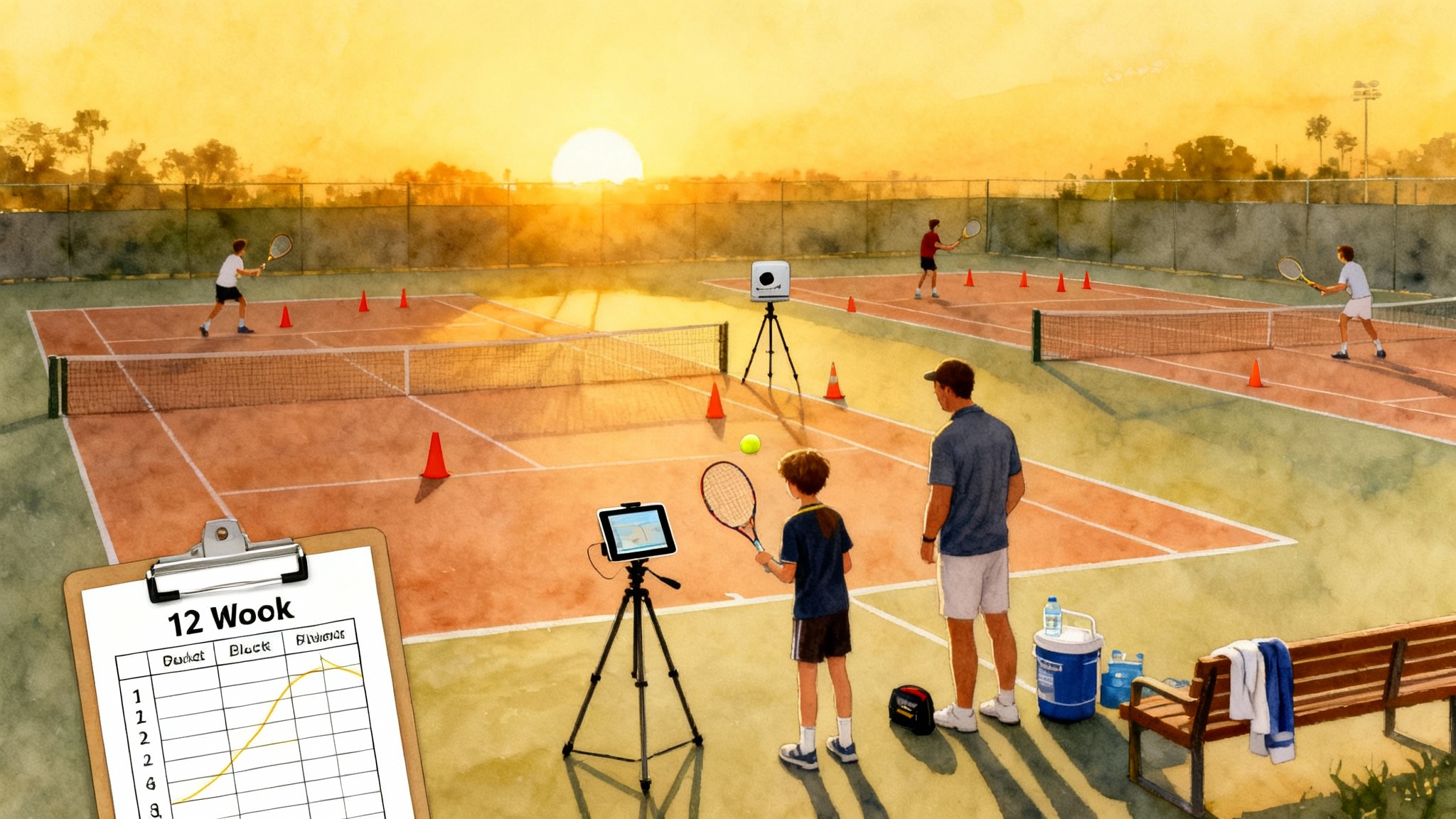
Why your first 90 days decide the rest of your season
The first three months at a high performance academy set your training rhythm, reveal limiting factors, and build habits that compound. A good plan gets concrete on day one, then organizes your weeks into clear blocks so you always know what to train, how hard to push, and how to prove improvement. This guide gives juniors, parents, and adult players a simple week by week starter plan with exact assessments, session targets, communication cadence, and milestone metrics.
Day 1: establish baselines you can trust
Think like a builder. Before you add floors, you test the foundation. Your foundation is movement quality, power, endurance, and current stroke mechanics.
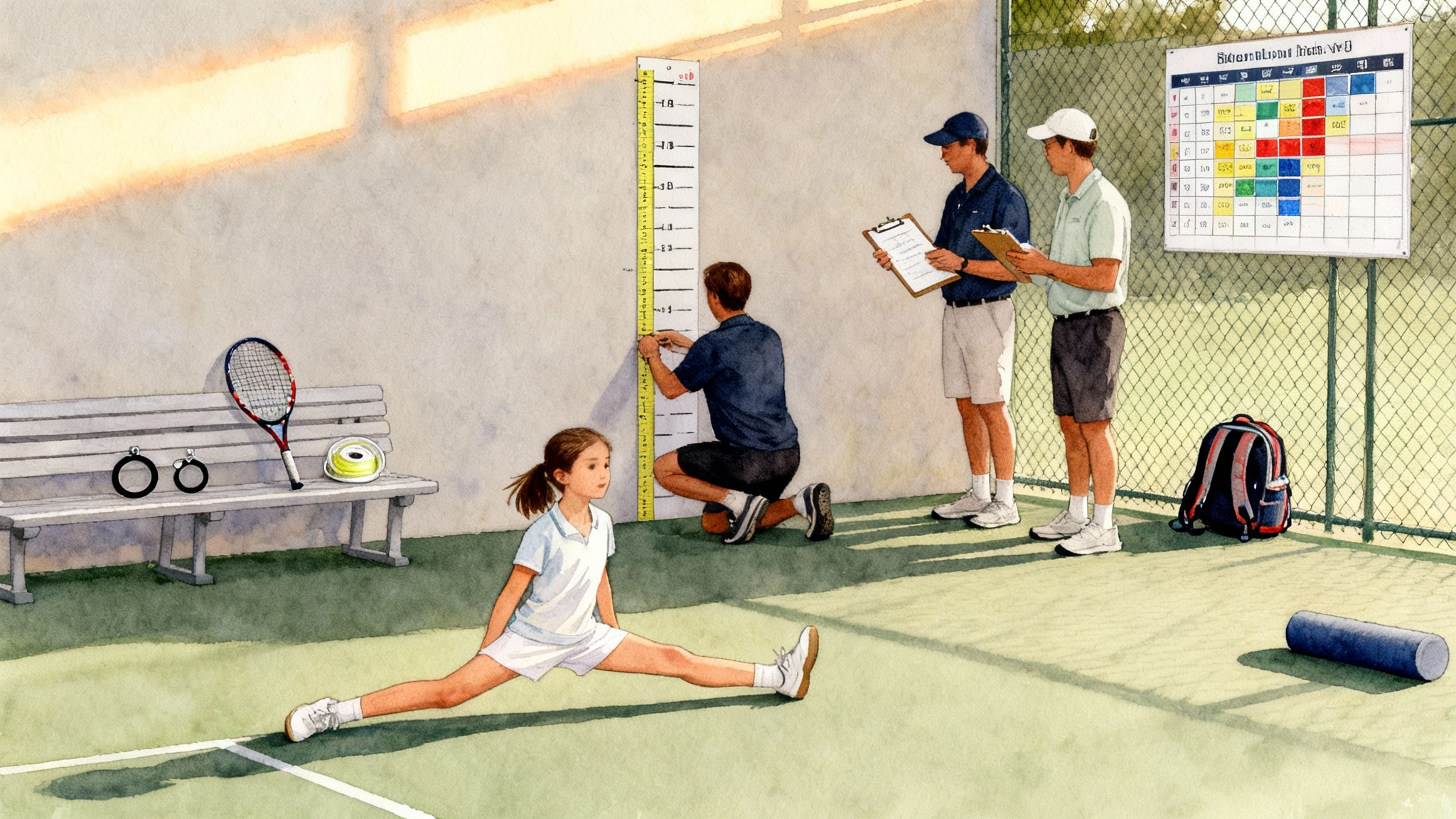
Mobility screen
Goal: identify bottlenecks that change stroke shape or stress joints.
- Overhead squat with camera front and side, 5 reps. Look for heel lift, knee collapse, lumbar extension.
- Ankle dorsiflexion wall test, measure distance in centimeters each side.
- Hip internal and external rotation seated, compare left and right.
- Thoracic spine rotation in half kneel, measure hand reach relative to shoulder line.
Record findings in simple language. Example: left ankle 7 cm, right ankle 11 cm. That gap can explain poor left side loading on forehands.
Power tests
Goal: quantify how fast you produce force.
- Countermovement jump, best of 3, measure height in centimeters.
- Seated medicine ball chest throw with a 2 kilogram ball, best of 3, measure distance.
- Standing lateral bound right and left, best of 3 each side, measure distance.
Endurance tests
Goal: estimate repeat sprint endurance for long rallies and long days.
- 10 by 20 meter shuttle on 20 seconds work, 20 seconds rest. Count completed reps with full line touch.
- Optional: Yo Yo intermittent recovery level 1 if you already use it.
- Racket in hand court intervals: 6 by 2 minutes crosscourt rally with coach feed, 1 minute rest, track total clean hits per interval.
On court technique audit by stroke
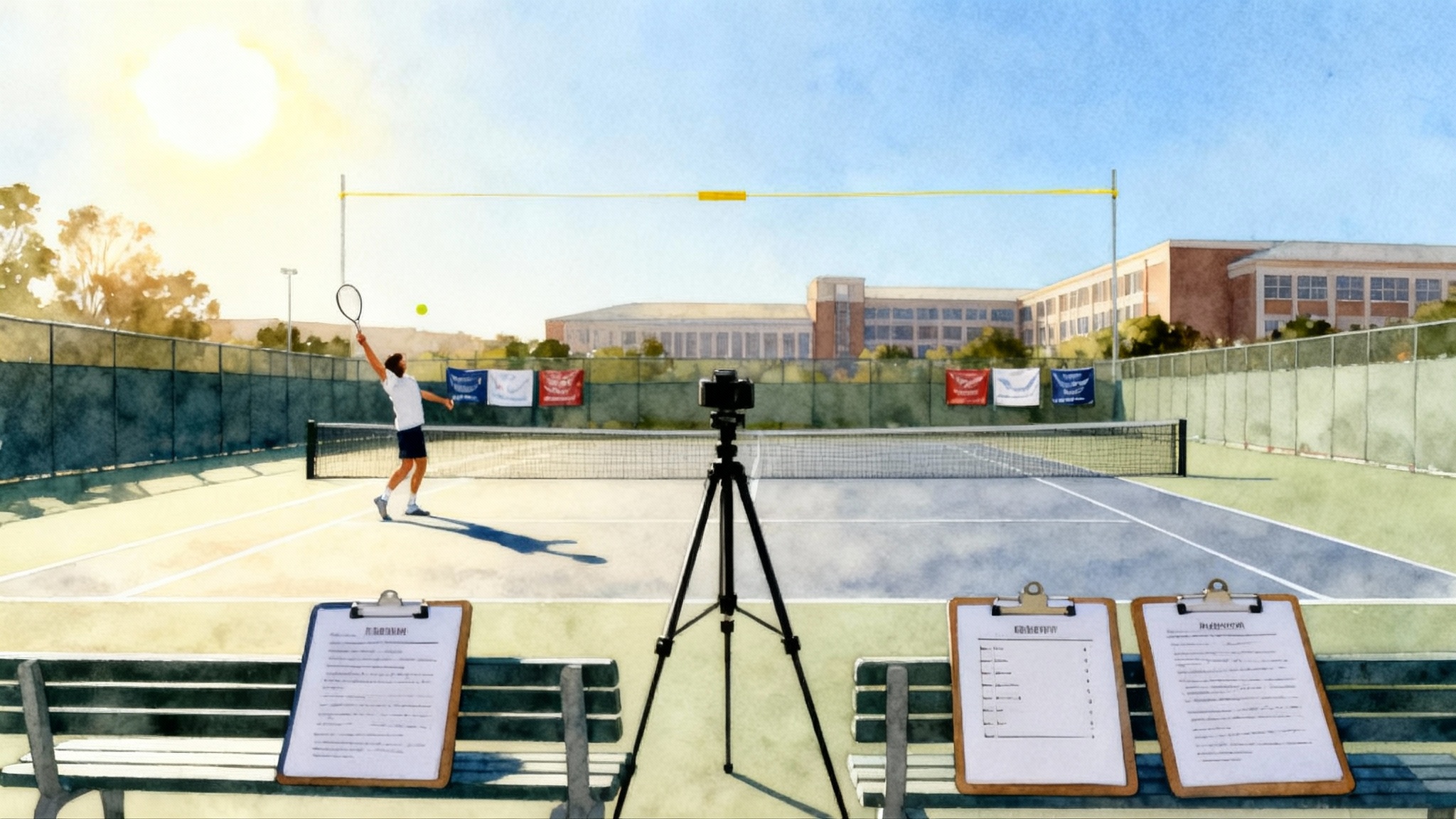
Goal: see the actual ball. Film at 120 frames per second if possible.
- Serve: 10 flat, 10 slice, 10 kick. Note trophy position, knee bend depth, contact height, and landing.
- Forehand: 20 crosscourt, 20 down the line. Note grip, spacing, contact point, finish height.
- Backhand: same counts, single or two hand as relevant. Note shoulder turn and wrist stability.
- Transition and net: 10 approach plus first volley sequences on both sides.
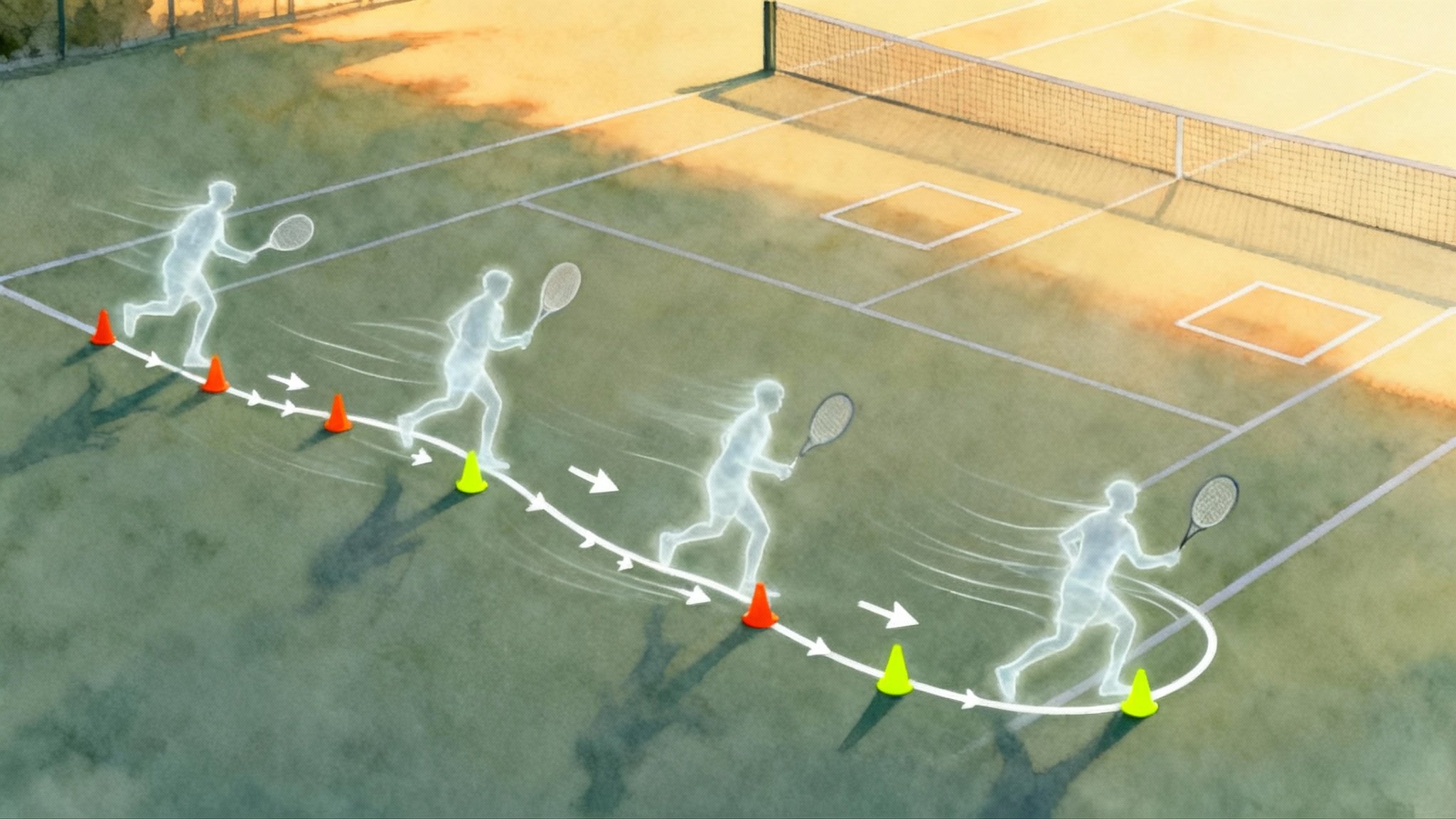
- Movement: 8 ball star drill with recovery to center, track time and footwork pattern.
Set initial reference metrics. For rating context, confirm your current Universal Tennis Rating using the official guide on how UTR works and updates.
What to track from day one
- UTR baseline and match count. Note whether your UTR is match starved. If you have fewer than 10 verified results in the last six months, plan early match play.
- TR baseline if relevant to your goals.
- Serve speed, average and peak, from 15 measured first serves and 15 measured second serves. Use radar when available, or video time over a marked distance if needed.
- Consistency percentage on a 50 ball drill per stroke. Count only balls that clear the net and land in target court.
- Movement time on the 8 ball star drill.
The 90 day structure: three 4 week blocks
Each block has one court theme, one strength and conditioning theme, and one recovery theme. Keep the work simple and repeatable so you can see progress.
Block 1, weeks 1 to 4: movement and clean contact
Court theme: spacing, balance, and contact height.
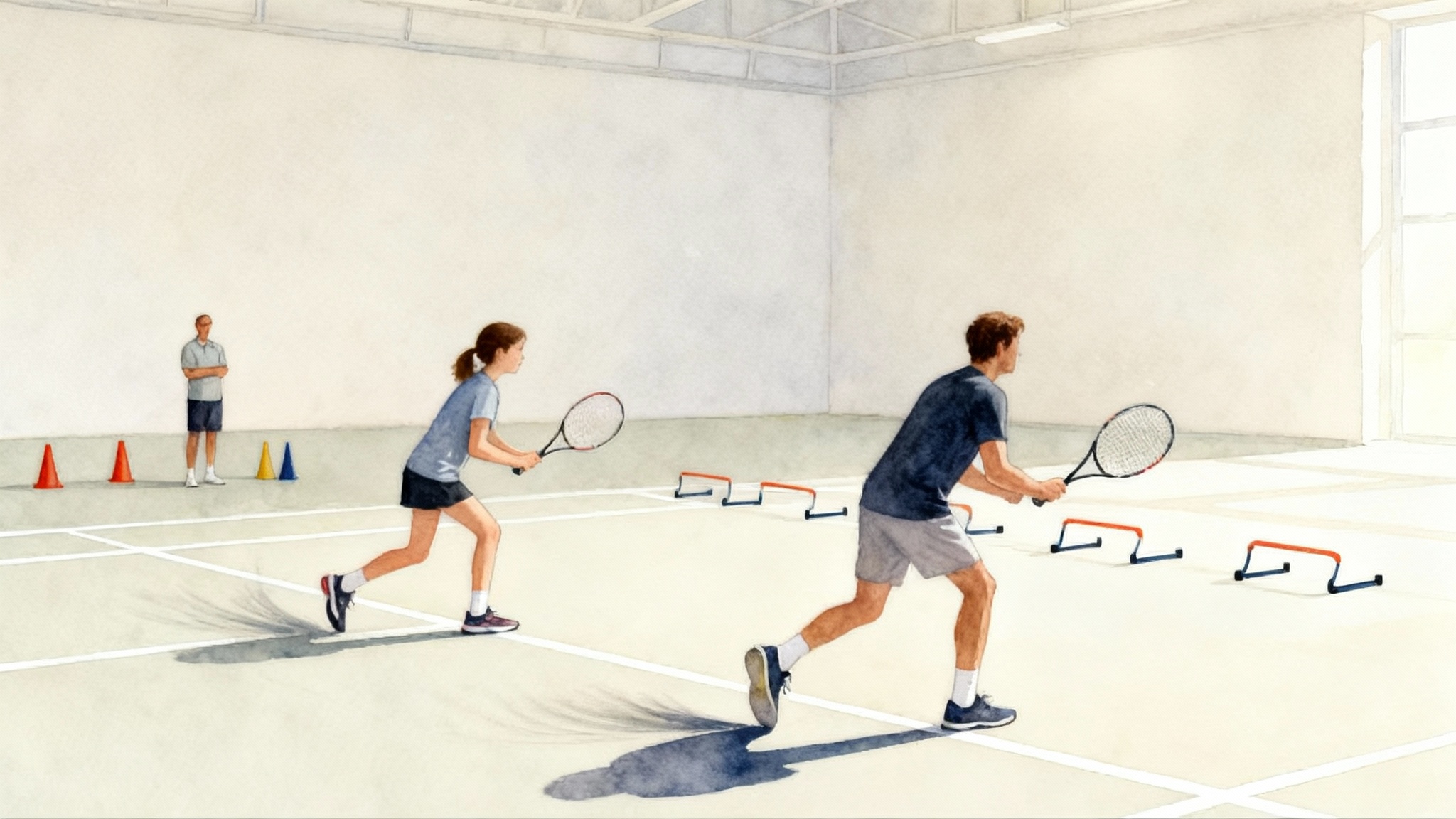
- Drills: crosscourt patterns with target cones, 50 ball forehand and backhand quality sets, approach plus volley sequences with fixed depth targets.
- Progression: add tempo only when you hold 80 percent consistency on 50 ball sets.
- Match play: 1 short set to 4 per week, format no ad, focus on first ball patterns.
For extra footwork detail, use our 30 day footwork plan.
Strength and conditioning theme: basic strength and landing mechanics.
- Two to three sessions per week, 45 minutes when in school or full time work, 60 minutes when open.
- Exercises: goblet squat, split squat, hinge with kettlebell, plank and side plank, band external rotation, pogo jumps, snap downs. Two to three sets of 6 to 8 reps on strength, short contacts on jumps.
Recovery theme: mobility gaps and sleep regularity.
- Ten minutes nightly of ankle and hip mobility plus thoracic rotation.
- Sleep target: consistent 8 hour window, same bedtime within 30 minutes.
Block 2, weeks 5 to 8: patterns and pressure
Court theme: serve plus one, return plus one, and depth control.
- Drills: serve to deuce wide plus forehand to open court; serve to body plus backhand crosscourt; return deep middle then rally neutral.
- Progression: raise the target speed of first serves by 3 to 5 miles per hour while holding double faults under 2 per set.
- Match play: 2 sets per week, one practice set, one verified match if UTR match count is low.
Sharpen reading and neutralizing with the return of serve mastery guide.
Strength and conditioning theme: rate of force and core anti rotation.
- Two sessions per week, 50 to 60 minutes.
- Exercises: trap bar deadlift or hex bar pull, split squat with rear foot elevated, rotational med ball throws, lateral bounds with stick, half kneeling pallof press. Three to five reps per set on power, six to eight on strength.
Recovery theme: fueling and soft tissue care.
- Pre session fuel: 30 grams of carbohydrate plus water 30 minutes before court sessions longer than 60 minutes.
- Post session: protein rich meal within 60 minutes and 500 milliliters of fluids for each body mass kilogram lost, measured by before and after body weight.
Block 3, weeks 9 to 12: match play and robustness
Court theme: winning patterns under scoreboard stress.
- Drills: 30 30 pressure games where all points start at 30 all, tiebreakers first to 7 with 2 clear points, and serve plus one targets with a punishment ball if the target is missed.
- Match play: two verified matches per week if scheduling allows, otherwise one verified match and one long set to 6.
Strength and conditioning theme: resilience and repeated acceleration.
- Two sessions per week, 45 minutes, taper in week 12.
- Exercises: contrast sets such as light trap bar deadlift 2 reps paired with hurdle hops 5 contacts, sled marches, deceleration repeats from cone drops, Copenhagen side plank for groin resilience.
Build smart volume with an in season strength routine.
Recovery theme: taper and readiness.
- Cut total volume by 30 percent in week 12 while keeping intensity on key hitting days.
- Add one extra off feet cardio flush of 20 minutes cycling after heavy match days.
Weekly schedules that fit real life
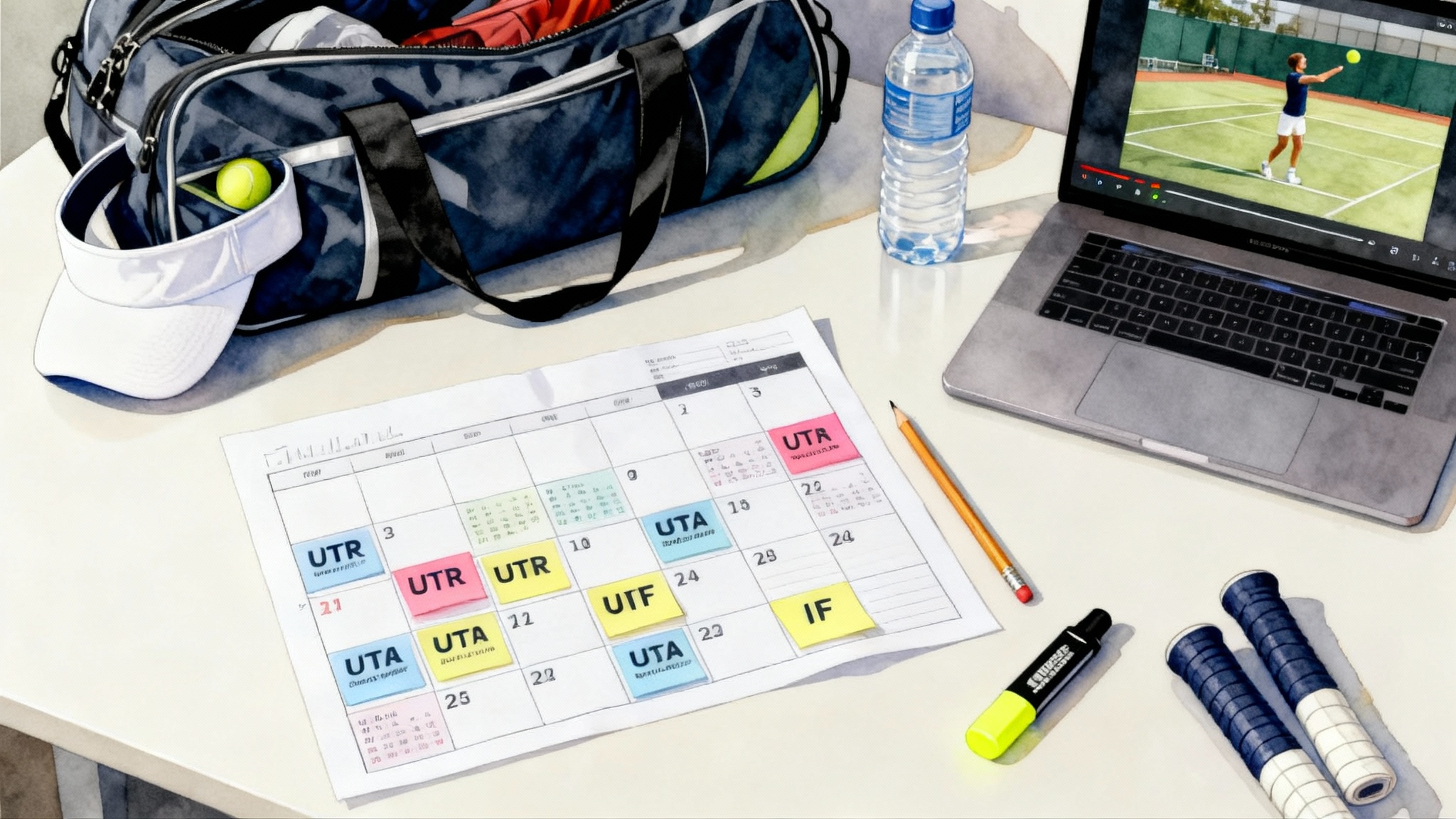
Here are two sample schedules you can copy and adjust. If you use a digital planner, drop these blocks into weekly templates. If not, print and post them somewhere visible.
Junior in school, Monday to Friday 8 to 3
- Monday
- 4:00 to 5:15 Court, Block theme drills, 15 minutes serve work at end
- 5:20 to 5:50 Strength and conditioning, lower body focus
- Homework and dinner, lights out by 10:00
- Tuesday
- 4:00 to 5:30 Court, rally tolerance plus approach sequences
- 10 minutes mobility before bed
- Wednesday
- 4:00 to 5:00 Strength and conditioning, power focus, med ball and bounds
- 5:10 to 5:50 Court, return and first ball patterns
- Thursday
- 4:00 to 5:30 Court, match play set to 4
- 10 minutes soft tissue and breathing
- Friday
- 4:00 to 5:00 Court, serving ladders and targets
- 5:10 to 5:30 Recovery, light bike or walk
- Saturday
- Morning verified match if scheduled, otherwise practice set to 6
- Sunday
- Off or 30 minute easy hit, prepare for the week
Working adult, Monday to Friday 9 to 5
- Monday
- 6:30 to 7:30 Court, Block theme drills and serve work
- Lunch break 15 minute mobility
- Tuesday
- 6:30 to 7:10 Strength and conditioning, full body
- Wednesday
- 7:00 to 8:00 Court, return and patterns
- Thursday
- 6:30 to 7:30 Court, practice set or point play
- Friday
- 6:45 to 7:25 Strength and conditioning, resilience and core
- Weekend
- One verified match and one skills session focused on weakest stroke
Tip: schedule the highest skill session early in the day and the highest intensity session after the most recovery. Many adults do best with skill mornings on Mondays and heavy hitting on Wednesdays or Saturdays.
Communication cadence with coaches and parents
Players make faster progress when everyone sees the same plan and the same videos. Here is a clean cadence that works across many programs.
- Day one: baseline report with the mobility, power, endurance, and technique clips, plus the week one schedule.
- Weekly, 10 minutes: coach text or call to confirm the plan for the next 7 days. Include a single clip of 20 to 30 seconds from the priority stroke.
- Every 4 weeks: formal review meeting, 20 minutes in person or video. Update all metrics and show side by side video from week one and the current week.
- Parents of juniors: a short email every two weeks summarizing attendance, focus score, and any schedule changes. The four week review includes a clip reel and the plan for the next block.
Keep messages short, concrete, and measurable. Replace vague comments with specifics like “backhand 50 ball consistency up from 68 percent to 79 percent.”
Checkpoint metrics and how to use them
Metrics guide decisions. They should be simple to measure the same way every time.
- UTR: note the rating and the number of recent verified matches. Plan your match calendar to keep UTR credible. Universal Tennis explains the rating and verification in its official guide.
- TR: for college oriented juniors, log your current TennisRecruiting ranking or star rating. Pair it with your UTR so you do not chase one at the expense of the other.
- UTT: clarify what your academy labels as UTT. Some programs use UTT to mean a unified technical test on a 100 point scale, others use it as an internal tournament score. Write the definition on your sheet so the number stays meaningful.
- Serve speed: measure 15 first serves and 15 second serves. Report average and peak for each. Aim for average first serve speed to improve by 3 to 5 miles per hour over 12 weeks while double faults remain low.
- Consistency: 50 ball drill per stroke into a defined target. Track percentage in, average rally ball height at the net, and depth relative to service line.
- Movement: 8 ball star drill in seconds, and a left right lateral bound distance symmetry check.
- Endurance: 6 by 2 minute rally count total clean hits. Try to hold counts within 5 percent from set 1 to set 6 by week 12.
Two caution flags to watch: - If serve speed rises but double faults or missed returns spike, rebalance volume from power to accuracy for a week.
- If consistency rises but match wins do not, add pattern work and return games. The issue may be first strike, not rally ability.
How Legend Tennis Academy runs reviews and parent updates
These examples show one clear way to do it. Adapt to your context. Read the full profile in our Legend Tennis Academy review.
- Week 0 baseline pack: a single page with mobility, power, endurance, consistency by stroke, serve speed, and current ratings. Three short clips linked by QR code. Color coding shows green for strengths and yellow for gaps.
- Week 4 review: a 20 minute meeting. The coach opens with 2 numbers that moved and 1 that did not. Example, forehand 50 ball from 72 percent to 84 percent, average first serve from 93 to 97 miles per hour, movement star drill still at 37 seconds. The next block swaps one court drill for targeted movement work.
- Parent note cadence: for juniors, a biweekly email with attendance, focus score out of 5, and next competition dates. When schedules change, parents see options by Wednesday for the following week.
- Dashboard: a simple shared sheet with green arrows when a metric improves and a clip next to each number. No jargon, just a note like “contact farther in front on forehand,” plus a 5 second side by side clip.
- Decision rules: Legend lists three rules at the top of each plan. One, no extra volume if sleep is under 7 hours for two nights. Two, replace heavy legs day with skill session if soreness is high. Three, add a rest day if morning heart rate is up 7 percent for two days.
Week by week, what to do
Use this simple map for your first 12 weeks.
- Week 1: full baseline day, start Block 1 drills, set your weekly schedule, confirm match days.
- Week 2: fix the biggest mobility gap, usually ankle or thoracic. Keep volume modest while you learn drills.
- Week 3: add one extra set of serve plus one. Film 10 serves from the side.
- Week 4: review. Update all metrics, show side by side clips, and adjust the next four weeks.
- Week 5: start Block 2 patterns. Add power lifts if technique is safe.
- Week 6: schedule a verified match. Track UTR match count.
- Week 7: raise first serve average by 2 miles per hour by improving toss location and leg drive. If double faults rise, pause speed push.
- Week 8: review. Update numbers and decide which pattern wins you the most free points.
- Week 9: start Block 3. Add pressure games. Film one full service game and one full return game.
- Week 10: back to back match days if recovery is solid, otherwise a match and a long set.
- Week 11: taper volume. Keep intensity on two quality hitting days.
- Week 12: final review. Record new baselines and plan the next cycle.
Testing and safety notes
Keep testing simple, repeatable, and safe.
- Consistency tests should be done fresh and at match speed, not at half speed.
- Strength and conditioning loads rise only when technique is stable. Quality first.
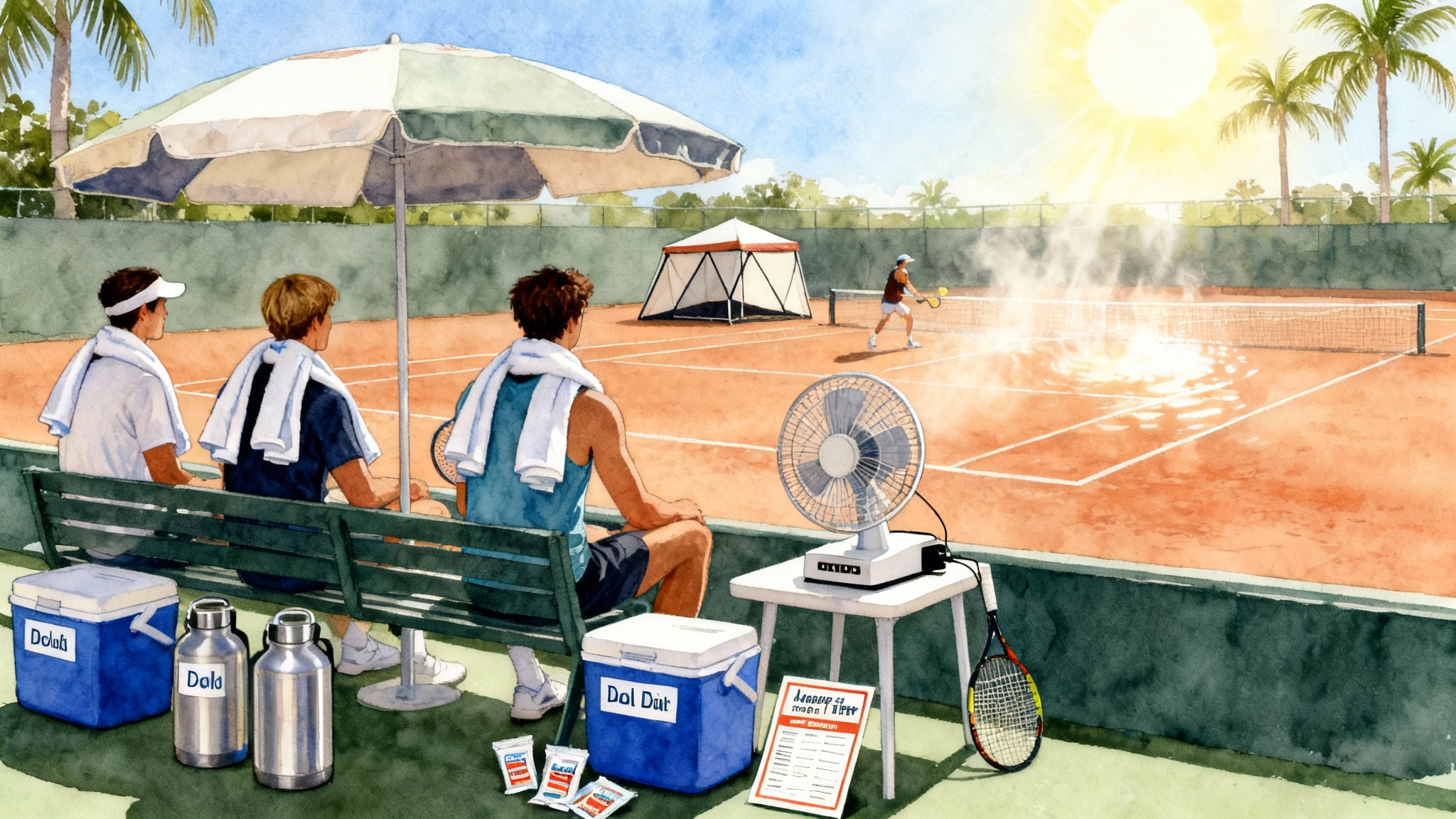
- Hydration and heat are real constraints in summer. Coaches can review the ITF heat and hydration guidance and adapt it to local rules.
Troubleshooting common roadblocks
- School or work crushes a week: do two short skills sessions of 30 minutes and one strength and conditioning maintenance of 25 minutes. Skip the extra hit, keep sleep.
- Chronic double faulting: drop speed targets for seven days, raise second serve spin, and play one set where second serves must clear a two meter target window.
- Pain flags: elbow or lower back pain means stop serve volume and check technique. Swap in return and pattern work until symptoms settle and a coach clears you.
Your 90 day finish line
By the end of week 12 you should show a before and after on video, on simple performance tests, and in match results. Your forehand or backhand consistency should be up at least 10 percentage points on the 50 ball drill. Your average first serve speed should be up several miles per hour with double faults stable or lower. Your UTR should be supported by recent verified matches rather than one hot month a year ago. Most important, you will know exactly what worked and what to do next.
Start with honest baselines. Focus one theme per block. Keep schedules practical. Talk to your coach weekly. Review every four weeks with video. Track the few numbers that matter. That is how your first 90 days create a season you can build on, not a month you forget.