The 2026 Footwork Playbook: 7 Patterns and At-Home Drills
 Tommy
Tommy
Why footwork decides matches in 2026
Footwork is not only about running fast. It is knowing which step to take, when to take it, and how to arrive balanced enough to swing. Think of it as a playbook of patterns. When the patterns are automatic, the brain is free to see the ball, decide early, and commit to a shot. When the patterns are missing, every rally feels like a scramble.
This guide turns the big five ideas coaches repeat on court into seven essential movement patterns that juniors and adults can train at home or in a small slice of court. Each pattern includes simple on-court and living room drills, micro-doses for fitness, and quick tests any parent can run without a stopwatch. You will also see adaptations for red, orange, green, and yellow ball, a time-saving track for busy adult league players, and a short case study from Legend Tennis Academy on how tracking a few footwork metrics can turn into match wins.
How to use this playbook:
- Pick two patterns per week. Train each pattern for 10 to 15 minutes, three times that week.
- Add the micro-dose at the end of your warm-up or after homework, never to fatigue.
- Run the quick test on Sunday to see if the work stuck.
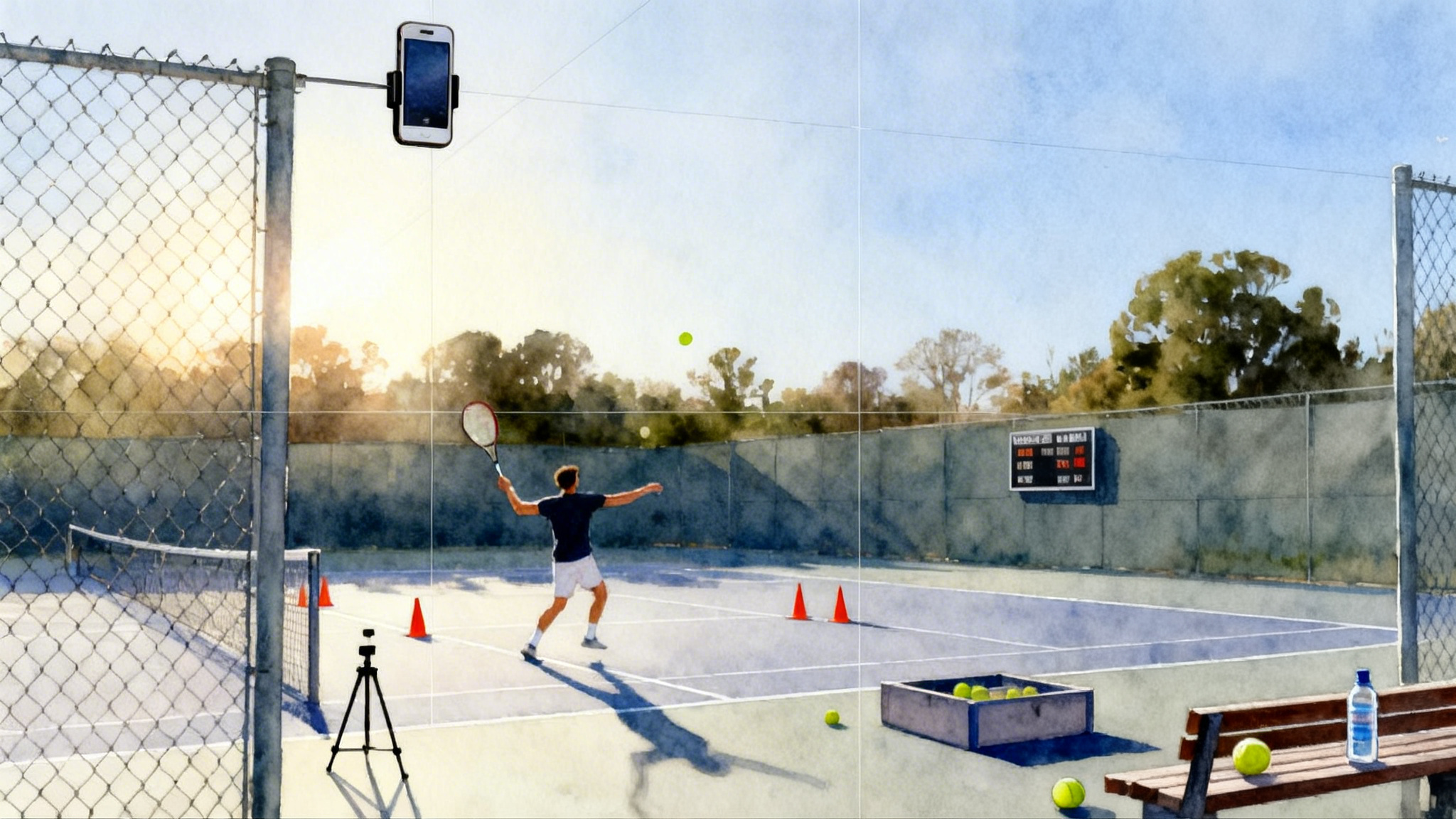
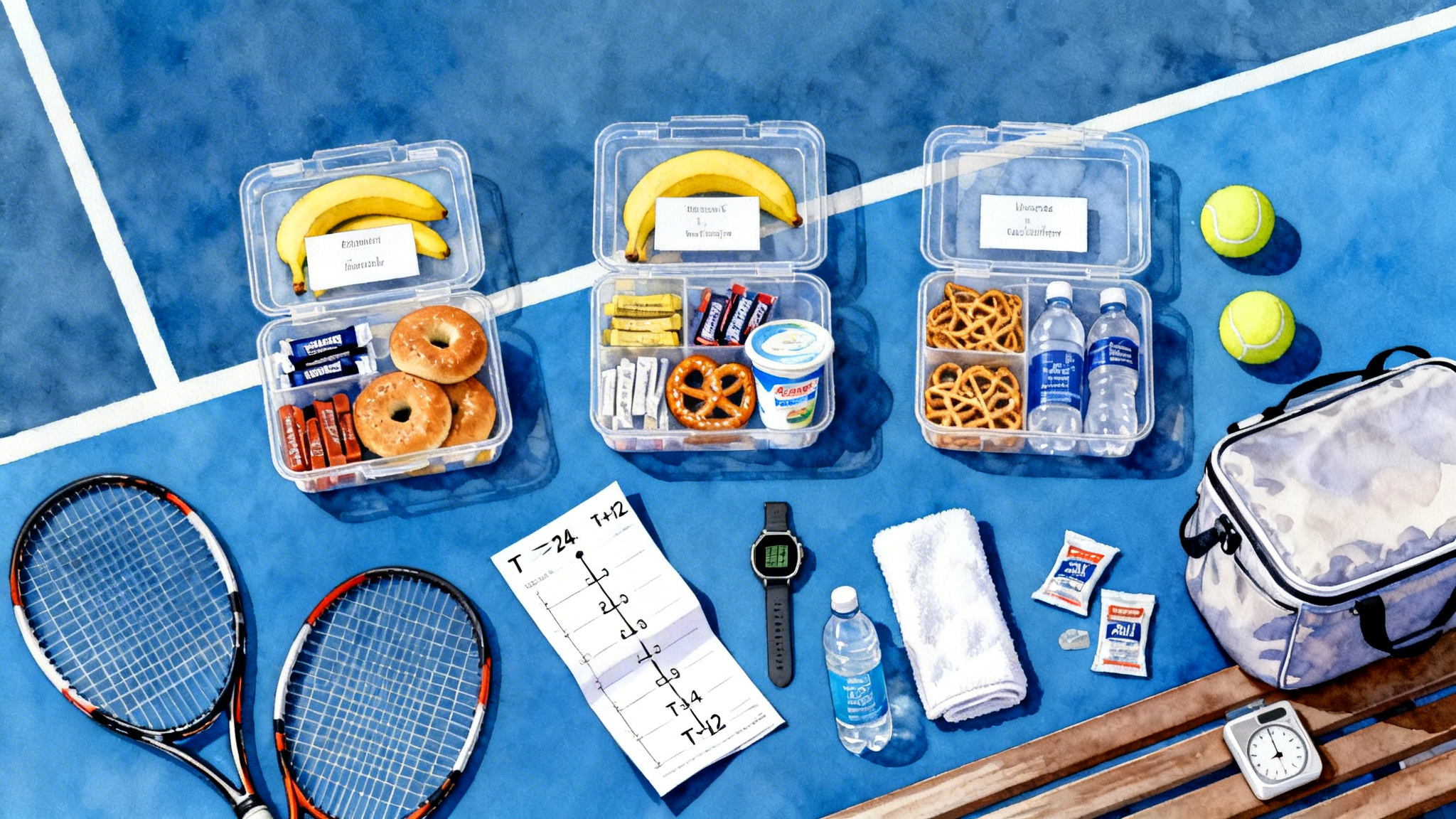
- If you want objective feedback, use our tennis video analysis guide to film 30-second clips.
The 7 essential movement patterns
The patterns are listed in the order that most players learn them. If tennis were a language, the split-step is the period at the end of every sentence. The first step is the capital letter at the start of the next one. The middle words are your lateral, diagonal, and crossover moves. The stutter steps are the commas that help you place the ball. Finally, transition patterns get you from baseline to net without losing balance.
1) Split-step timing
Goal: Land your split as your opponent makes contact so your feet store elastic energy and your eyes lock on the ball.
On-court drill
- Baseline Echo: Stand on the baseline while a partner softly tosses or feeds. Say “now” aloud when the opponent’s racquet or hand meets the ball. Land your split on “now,” then freeze. Do 3 sets of 10.
- Serve Return Shadow: Face a partner’s pretend serve motion. As the tossing arm reaches the top, rise to your toes. Land the split as the server “hits,” then shadow a return step.
Living room drill
- TV Rally Sync: While watching a tennis clip on mute, rise as the opponent starts forward and land your split as you see contact. Count correct landings to 20.
- Line Tap: Tape a small X on the floor. Hop lightly and land with feet on each side of the X in a soft split. Repeat 20 times.
Red, orange, green, yellow adaptations
- Red: Split on a clap cue from a parent. Keep feet no wider than shoulder width. Use sponge ball toss.
- Orange: Split on a slow feed. Cue “rise early, land on hit.”
- Green: Add a half step in the direction of the feed after the split.
- Yellow: Pair the split with a directional read. Call “F” for forehand or “B” for backhand midair.
Micro-dose fitness
- 3 sets of 6 low pogo hops, hands on hips, soft landings.
Quick parent test
- Contact Clap Test: Parent calls “hit” as the feeder strikes. Player must land both feet within one count of “hit” for 8 of 10 tries.
2) First-step acceleration
Goal: Turn the hips and push powerfully in the first two steps without standing up tall.
On-court drill
- Two-Step Burst: From split, react to a hand point right or left. Take two fast steps that direction and stop on a low base. 5 reps each side, 3 sets.
- Ball Drop Chase: Partner drops a ball a few feet to one side after your split. Beat the second bounce. 10 reps.
Living room drill
- Towel Push: In socks on a smooth floor, place toes on a small towel. From an athletic stance, push the towel 3 feet with one powerful drive. 6 drives each leg.
- Hip Turn Pop: From split stance, turn the back hip open like you are starting a sprint. Mini hop and freeze. 10 reps each side.
Red to yellow adaptations
- Red: Use stickers or paper plates as targets two big steps away.
- Orange: Shorten the burst to one step but demand a strong hip turn.
- Green: Add a low reach to touch a cone at the end of two steps.
- Yellow: Start from a moving split so timing and power combine.
Micro-dose fitness
- 3 sets of 4 squat jumps, hands on hips, quiet landing, full rest between.
Quick parent test
- Two-Step Line Touch: From a split on the center mark, point left or right. Player must touch the singles sideline with the second step and stop balanced 6 of 8 tries.
3) Lateral shuffle and balance
Goal: Cover width while keeping shoulders level and the head still enough to see the bounce.
On-court drill
- Tramline Shuffle: Place two cones two steps inside each sideline. Shuffle from cone to cone, touch with outside hand, and keep a steady rhythm. Four trips equals one set. Do 3 sets.
- Rally Box: Mark a rectangle at the baseline with four cones. Shuffle inside the box while tracking a slow rally feed. Stop and set when you would hit.
Living room drill
- Chair Touch: Stand between two chairs placed two to three steps apart. Shuffle to tap each seat with your outside hand. 6 taps each side.
- Book Balance: Balance a paperback on your head while shuffling side to side for 20 seconds.
Red to yellow adaptations
- Red: Chairs 2 small steps apart, no hand touches.
- Orange: Add the outside hand touch and a soft knee bend on each stop.
- Green: Increase distance. Add a shadow swing after each stop.
- Yellow: Time 20 second bouts with more intensity and a firm brake before the set.
Micro-dose fitness
- 2 sets of 10 lateral line hops, both directions, soft feet.
Quick parent test
- Quiet Head Check: Player shuffles 10 steps left and 10 steps right while keeping a coin balanced on the head for at least 8 steps. If the coin stays up for most of the trip, balance is improving.
4) Diagonal open-step to cut off
Goal: Take an open step on a diagonal to cut off a ball early rather than drift backward.
On-court drill
- V-Cut: From the center mark split, coach or parent feeds a medium ball to the forehand diagonal. Player takes an open step, cuts the angle, and sets to hit. Repeat to the backhand. 8 reps each side.
- Early Intercept: Self-drop a ball, let it bounce across your body, then use an open step to meet it in front. 10 reps each side.
Living room drill
- Tape V: Tape a small V on the floor. Start at the point and step to the open side of the V while turning hips. Shadow swing and recover. 12 reps.
- Pillow Reach: Place a pillow two steps forward and to the side. From athletic stance, reach it in two strides without crossing the feet. Reset. 8 reps each side.
Red to yellow adaptations
- Red: Use stuffed animals as targets one big step diagonally.
- Orange: Emphasize hip turn before the first step.
- Green: Add a split before the diagonal move.
- Yellow: Add a directional call midair to demand reading while moving.
Micro-dose fitness
- 2 sets of 6 diagonal bounds, right and left, stick the landing for one count.
Quick parent test
- Intercept Box: Place four cones in a square. Parent points to a front corner. Player must arrive and freeze in two steps 6 of 8 tries.
5) Crossover and hip-turn recovery
Goal: Use a crossover step to cover width quickly, then hip turn to face the court and re-center.
On-court drill
- Sideline Crossover: Start near the doubles alley. From split, crossover the outside leg in front to move fast toward the sideline, then plant and take two recovery steps back to the center. 6 reps each side.
- Figure-8 Recoveries: Place two cones a few steps apart. Crossover around one cone, drop step around the other, trace a figure-8 pattern for 20 seconds. 3 sets.
Living room drill
- Wall Crossover: Stand an arm’s length from a wall. Crossover step without scraping the toe on the floor and without hitting the wall. 10 smooth reps each side.
- Hip-Turn Pop: From a sidestep, rotate hips quickly to face forward again. 10 reps each side.
Red to yellow adaptations
- Red: Hands on hips, small crossover with no knee knock.
- Orange: Add a light touch to a cone before recovering.
- Green: Add a split before the crossover.
- Yellow: Combine crossover out, shuffle in recovery, and a final set step.
Micro-dose fitness
- 2 sets of 6 skater bounds, land quiet, hold balance for one count.
Quick parent test
- Three-Step Recover: Player starts two steps outside the singles sideline. On a go cue, crossover and recover to the center in three steps, then freeze. Must arrive balanced 4 of 5 tries each side.
6) Braking and stutter steps for contact set
Goal: Arrive on time and at the right distance by learning to brake smoothly and organize the last two steps.
On-court drill
- Two-Step Set: After any approach to the ball, finish with a small outside step to load and a final inside step to set. Call “load” and “set” out loud. 10 reps each side.
- Cone Brake: Sprint to a cone, then take three short, soft stutter steps to stop and shadow swing. 3 sets of 6.
Living room drill
- Carpet Stutters: Mark a target with tape. Jog two steps, then take three tiny stutter steps to stop exactly on the tape. 10 reps.
- Heel-Toe Rhythm: Practice outside foot heel plant then quick inside toe set. 10 slow reps each side.
Red to yellow adaptations
- Red: Walk and stop on a sticker using two small steps.
- Orange: Add the words “load” and “set” for rhythm.
- Green: Jog to the mark and brake with three mini steps without sliding.
- Yellow: Add a shadow swing and recover one step after the set.
Micro-dose fitness
- 2 sets of 8 calf raises and 8 short forward hops, focus on soft landing.
Quick parent test
- Tape Stop Accuracy: From five feet away, player must stop with the front foot exactly on a tape line 6 of 8 tries without wobbling.
7) Transition and net patterns
Goal: Go from baseline to net on balance, stop before the volley, and recover for the next ball.
On-court drill
- Split-Approach-Stop: Feed a short ball. Player splits, takes two approach steps, then stutter steps to a full stop before a shadow volley. Recover with a diagonal two-step.
- Two-Volley Pattern: After the stop, shadow a first volley to the open court, recover with a small crossover, then shadow a second volley. 6 sequences.
Living room drill
- Coffee Table Approaches: Use the space from couch to coffee table. Two purposeful steps, two stutter steps to a stop, soft catch of a tossed ball, then two recovery steps back.
- Wall Tap Volley: Soft toss a foam ball and volley it to yourself against a wall. Emphasize a stop before each contact.
Red to yellow adaptations
- Red: Approach two big steps to a target mat. Freeze, then catch the ball with two hands.
- Orange: Add a gentle toss from a parent to catch or volley with a foam ball.
- Green: Add a recovery step backward after each volley.
- Yellow: Link split, approach, stop, volley, recover without rushing.
Micro-dose fitness
- 2 sets of 6 low forward bounds into a quiet stop.
Quick parent test
- Stop Before Contact: On five approaches, the player must be fully stopped before catching or volleying a slow toss at the table line 4 of 5 times.
Weekly micro-doses for fitness and mobility
Micro-doses are small, frequent hits of plyometrics and mobility that add up without soreness.
- Monday: Pogo hops 3 x 6, calf raises 2 x 8, ankle circles 2 x 10 each way.
- Tuesday: Skater bounds 2 x 6, lateral line hops 2 x 10, hip flexor stretch 2 x 20 seconds.
- Wednesday: Squat jumps 3 x 4, diagonal bounds 2 x 6, thoracic spine openers 2 x 6 each side.
- Thursday: Rest or just mobility. Hamstring stretch, adductor rock backs, 2 x 20 seconds each.
- Friday: Mixed mini circuit. Two-step bursts 3 x 4 each side, stutter stops 2 x 6, ankle hops 2 x 10.
- Weekend: Light play or a family rally. If indoors, run the living room versions with low impact and lots of balance work.
Rules for micro-doses
- Stop if landings get loud. Quality beats quantity.
- Keep rests long. Jumping should feel springy, not like a conditioning circuit.
- Never stack micro-doses right before a long match.
Red, orange, green, and yellow ball adaptations at a glance
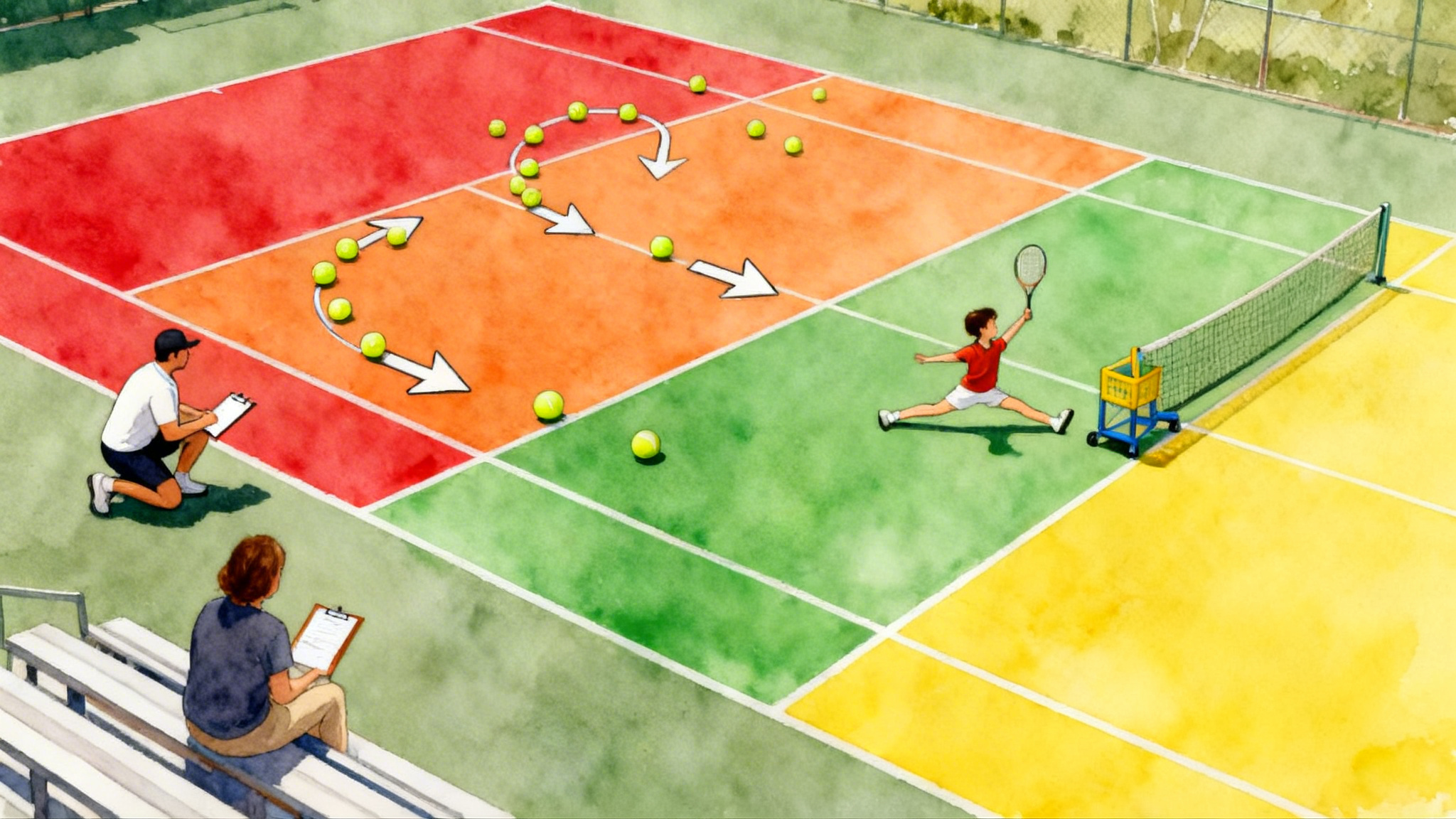
- Court space: Red uses short targets and two to four steps. Orange adds one extra step and a clear hip turn. Green uses full court patterns with reduced distance. Yellow uses full speed and linked combinations.
- Cues: Red hears one word per action. Orange uses two-word cues like “load set.” Green begins reading direction while moving. Yellow mixes read, move, and recover under light fatigue.
- Goals: Red builds rhythm and safe landings. Orange adds first step clarity. Green adds interception. Yellow adds continuity under pressure.
For a deeper walkthrough of color stages, see our ball color progressions checklist.
Busy adult league track
You have 20 minutes before work, and your match is on Thursday. Use this three-day plan.
-
Day 1: Prime and pattern
- 3 minutes of ankle and hip mobility
- Split-step timing 3 x 10 with a clap cue
- Two-Step Burst 3 x 4 each side
- Tramline Shuffle 2 trips, then 6 skater bounds
-
Day 2: Angles and recovery
- 3 minutes of dynamic warm-up
- V-Cut 3 x 6 each side
- Sideline Crossover 3 x 4 each side
- Two-Step Set 2 x 6 with a shadow swing
-
Day 3: Transition tune-up
- 3 minutes of easy jog and ankle hops
- Split-Approach-Stop 6 reps
- Two-Volley Pattern 4 sequences
- Finish with 2 x 20 second lateral shuffles
Between points cue card
- Rise early, land on hit
- Decide, then drive two steps
- Brake softly, set the last two
- Recover with the hips, not the shoulders
Quick tests any parent can run without tech
Use these after a week of practice.
- 10-Split Count: Player watches 10 feeds. Must land the split on contact at least 7 times.
- Two-Step Sideline Touch: From center split, touch sideline in two steps on 6 of 8 trials.
- 20-Second Quiet Shuffle: Move side to side for 20 seconds while keeping a book on the head or a coin balanced for most of the time.
- Intercept Square: Reach a front corner in two steps on 6 of 8 trials.
- Tape Stop: Stop with the lead foot exactly on a tape line 6 of 8 tries.
- Approach Freeze: On five short balls, be fully stopped before contact 4 times.
Progress rule
- When you pass a test two weeks in a row, make the target one small step farther or reduce your stutter steps by one.
Case study: Legend Tennis Academy
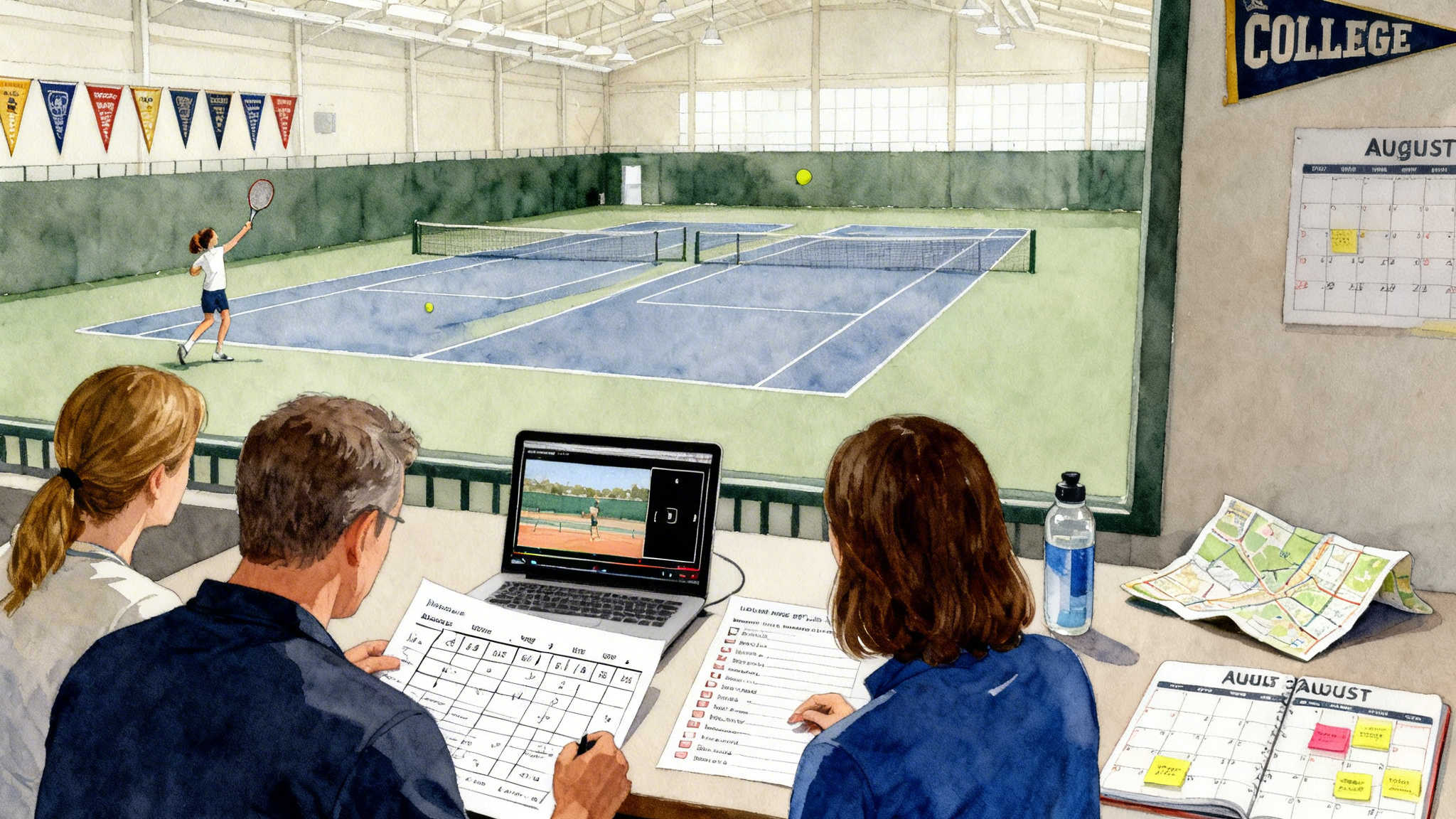
Legend Tennis Academy wanted match-day improvements without new gadgets. The staff chose three manual footwork metrics that any court supervisor could tally with a pencil over four weeks of spring competition.
- Split on Contact Percentage: Out of 50 opponent contacts per match, how many times did the player land the split within a count of contact?
- First Two Steps Won: On balls within reach, how many times did the player clearly win the first two steps to the ball rather than drift?
- Recovery Finish: After a wide ball, how many rallies did the player re-center to a playable position within three steps?
Intervention
- Two patterns per week, 10 minutes a day, five days per week. Staff used the drills in this playbook and required the Sunday quick tests.
Results after one month
- Split on Contact rose from about half to roughly three out of four by week four.
- First Two Steps Won improved by about a third, which meant more balls struck in front.
- Recovery Finish improved most on the backhand side, which cut down late, defensive swings.
Match impact
- Players reported cleaner contact on the rise and fewer rallies lost while off balance. Coaches saw shorter defensive rallies and more chances to attack short balls. The team converted those chances into more reliable hold games in adult league and steadier depth in junior events. No new analytics, no video, just consistent pattern practice and a pencil tally sheet.
Why it worked
- The metrics matched what wins points. Early split kept the eyes calm. First two steps won the strike zone. Efficient recovery guarded the open court. The drills made those three outcomes repeatable under simple constraints.
Putting it together: a four-week plan
Use this as a template, then recycle with slightly tougher targets.
-
Week 1: Foundation
- Patterns: Split-step timing, First-step acceleration
- Tests: 10-Split Count, Two-Step Sideline Touch
- Goal: Land on contact 7 of 10, touch sideline in two steps 6 of 8
-
Week 2: Width
- Patterns: Lateral shuffle, Crossover and hip-turn recovery
- Tests: 20-Second Quiet Shuffle, Three-Step Recover
- Goal: Keep the book up most of the set, arrive balanced on 4 of 5 recoveries each side
-
Week 3: Angles
- Patterns: Diagonal open-step, Braking and stutter steps
- Tests: Intercept Square, Tape Stop Accuracy
- Goal: Two steps to the corner 6 of 8, precise stop 6 of 8
-
Week 4: Net
- Pattern: Transition and net patterns
- Tests: Stop Before Contact
- Goal: Stop before contact 4 of 5 approaches
Layer micro-doses across all weeks and keep rest days for mobility.
Coaching cues that stick
- Keep landings quiet. Soft feet are fast feet.
- Turn the hips first. Feet follow faster when the hips lead.
- Organize the last two steps. Outside foot loads, inside foot sets.
- Recover with purpose. Do not drift back. Take clear steps to a home base.
Final word
Great footwork is not a guess or a gift. It is a small library of movement patterns that you can practice in a living room, a driveway, or a half court and then test with nothing more than a voice cue and a piece of tape. Start with two patterns this week, add the micro-doses, and hold yourself to the quick tests. When the split lands on time and the first two steps take charge, the rest of your tennis starts to look easy.