Best Tennis Academies 2026: Atlanta, Peachtree to Alpharetta
A decision-first guide for parents and juniors comparing Atlanta’s north-side academies on training intensity, surfaces, year-round access, match-play proximity, academics fit, and price bands. Deep dive on Life Time Peachtree Corners included.
 Tommy
Tommy
Start here: a decision-first shortlist
If you live anywhere from Peachtree Corners to Alpharetta, you have an unusual advantage. Within a 30 to 40 minute radius you can find year-round courts, clay and hard surfaces, frequent sanctioned matches, and multiple academies that understand college placement. Use this quick filter to form a two-option shortlist you can trial within two weeks. If you are also comparing nearby regions, scan our Carolina academies 2026 guide and our Florida academies 2026 guide for contrast.
-
Your player’s goal this year
- Serious college pathway in four years: target high-intensity groups with consistent match play and strength work.
- Competitive varsity or sectional play: prioritize balanced groups with two to four training days and multi-surface reps.
- Skill foundation ages 8 to 12: look for small coach-to-player ratios and high ball contacts per minute, not just long sessions.
-
Nonnegotiables
- Surfaces: at least some weekly clay if you want physical resilience and point construction; indoor or covered access for winter.
- Match-play proximity: the ability to play verified matches within 20 to 30 minutes two or three weekends a month. Start by checking the USTA tournament search for frequency and levels near your zip code.
- Academic rhythm: can the academy flex around school start and end times, block days, and exam weeks.
- Price band: set a ceiling now and work backward to the training cadence that fits it.
The rest of this guide breaks down the corridor’s big variables, then goes deep on Life Time Tennis Academy in Peachtree Corners, and finishes with comparables in Roswell, Johns Creek, and Alpharetta.
What matters most in North Atlanta
-
Training intensity
- Ask about points per hour, live-ball ratio, and planned deload weeks. High-performance days should feel like interval training with racquets: bursts of complex movement, decision making under fatigue, and short recovery.
-
Surface mix
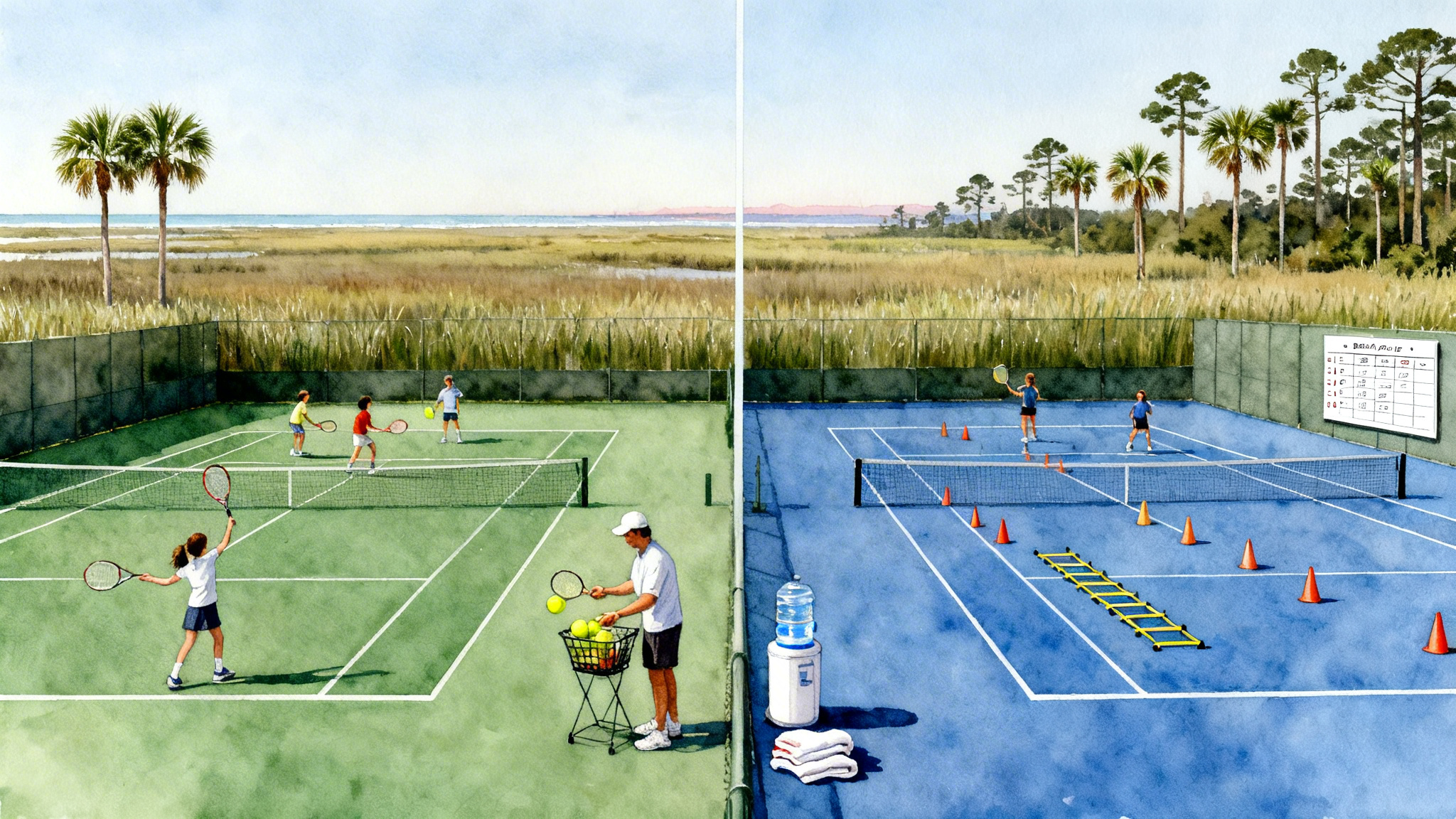
- Clay teaches length, patience, and lower-body loading; hard courts sharpen first-strike patterns and returns. A weekly mix builds versatility and reduces overuse risk.
-
Year-round court access
- The corridor’s mild winters still bring cold rain. Covered courts or indoor hard courts protect training volume when weather wobbles. Ask how many sessions were moved or canceled last January and February.
-
UTR and USTA match-play proximity
- Universal Tennis Rating, commonly called UTR, and the United States Tennis Association, commonly called USTA, provide verified match pathways. The area’s density of one-day events, progression tournaments, and junior circuits means fewer hotel weekends and more volume. Look for formats that mimic college: doubles starts, no-ad scoring, and quick turnarounds.
-
Academics integration
- Options range from classic after-school schedules to flexible daytime blocks for online or hybrid students. Good programs publish a sample week and adapt around midterms without losing training cohesion.
-
Price bands
- After-school, 2 to 3 days a week: often 300 to 600 dollars per month.
- After-school, 4 to 5 days a week: often 500 to 900 dollars per month.
- Daytime high-performance blocks for hybrid or homeschool: often 1,200 to 2,200 dollars per month.
- Private lessons: often 90 to 150 dollars per hour depending on coach pedigree.
- Tournament coaching: often 150 to 250 dollars per day plus shared expenses.
These are typical ranges for 2026 in North Atlanta and may vary by coach, facility, and group size.
Deep dive: Life Time Tennis Academy, Peachtree Corners
Life Time’s Peachtree Corners campus is a large, tournament-tested facility that attracts serious juniors along with committed multi-sport families. Read the Life Time Tennis Academy profile for facilities, staff, and program details. It sits close to Roswell, Johns Creek, and Norcross, which makes weeknight traffic manageable compared to crossing the city for training.
Who it serves best
- Juniors targeting college tennis within two to four years who want daily hitting partners across a wide range of levels.
- Middle school players who need consistent after-school structure and one weekend match most weeks.
- Families that value on-site fitness resources and recovery options alongside tennis.
Courts, surfaces, and weather resiliency
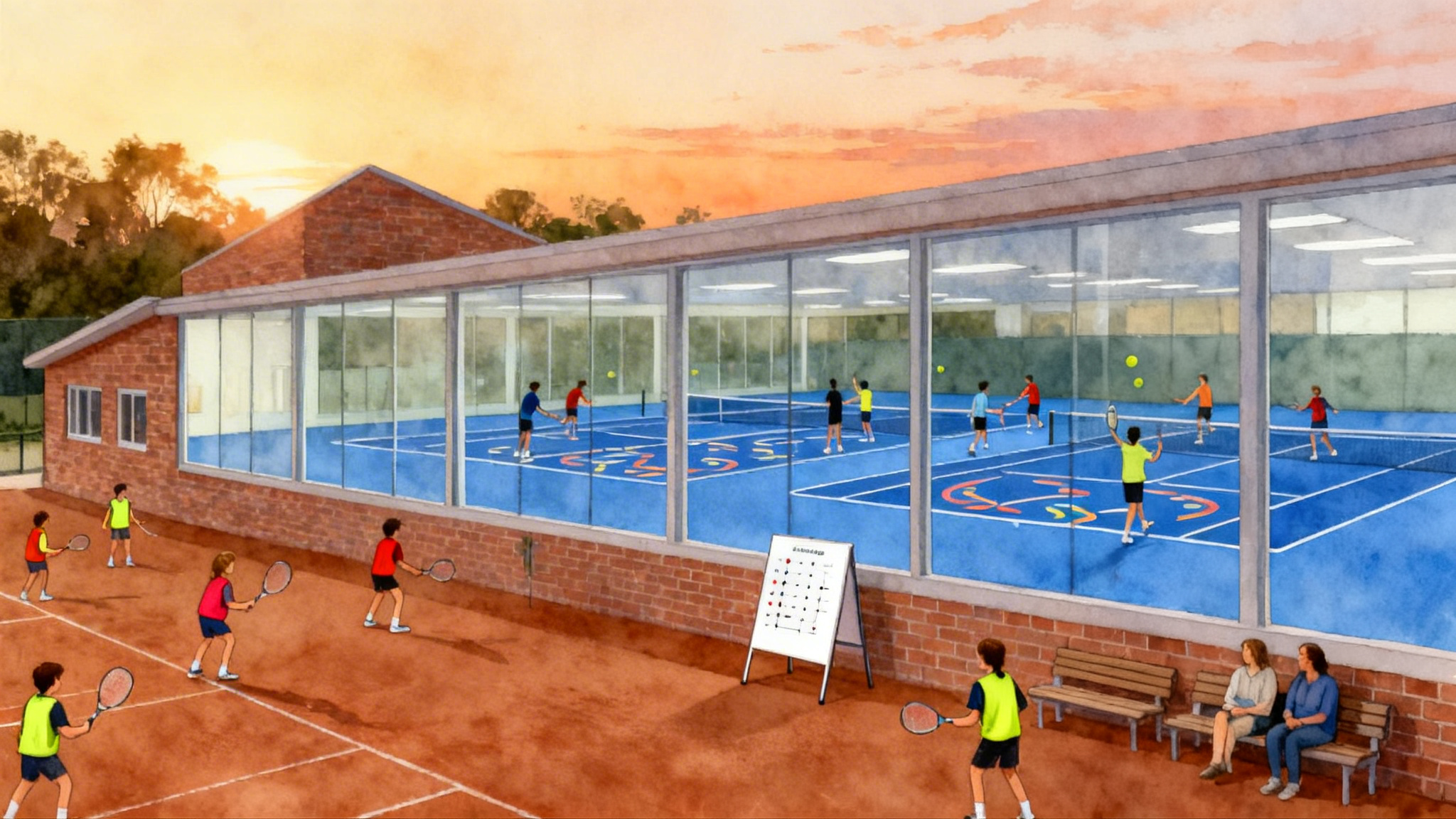
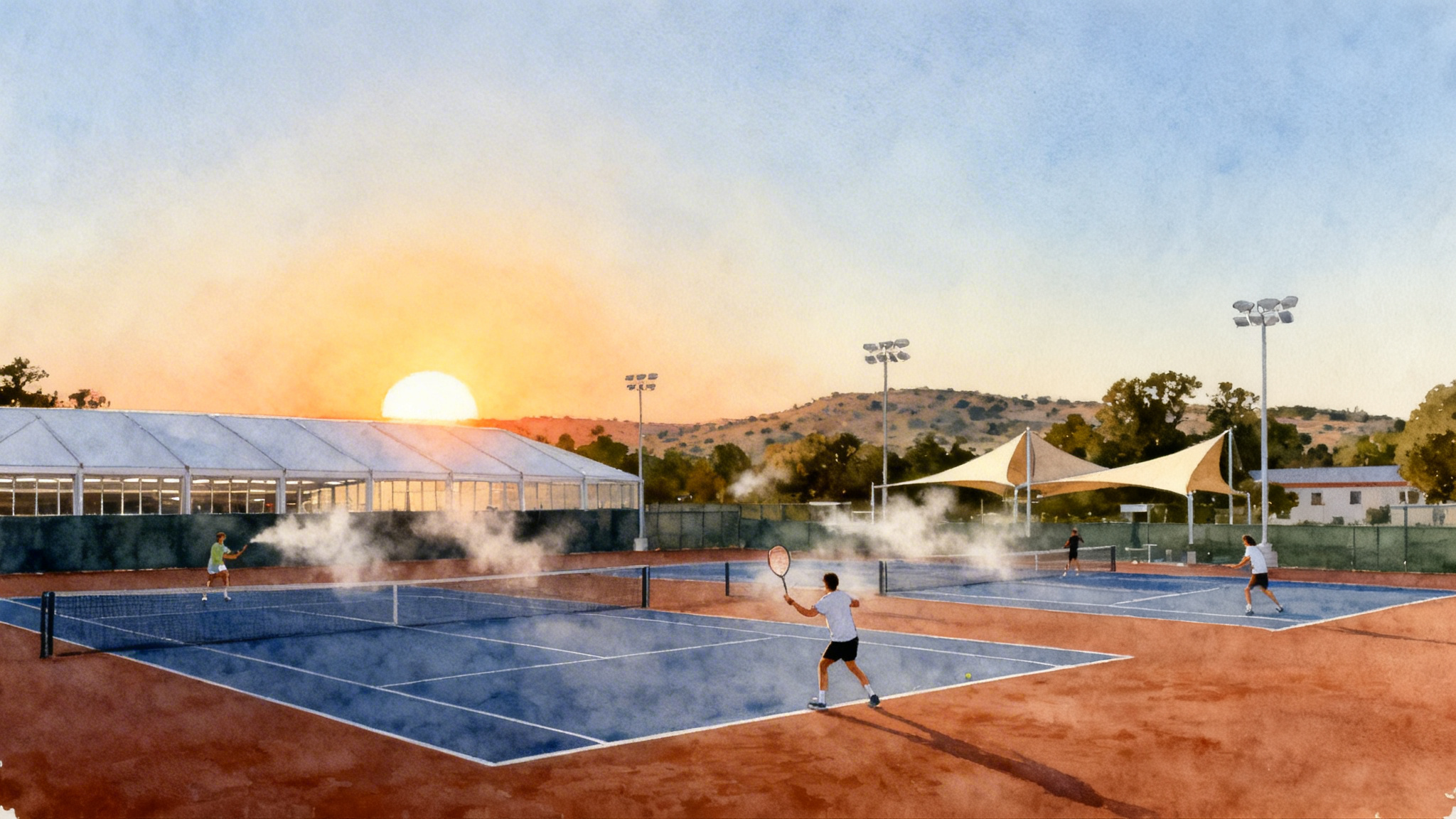
Expect a mix of outdoor hard and clay courts plus access to covered or indoor hard options during winter weeks. The advantage is not just protection from rain but also the ability to periodize surface exposure. A typical month might include two clay-heavy weeks for point construction and two hard-heavy weeks for pace and return work. Ask the director how they schedule surfaces by phase of the season.
Training intensity and structure
The academy organizes players by match level and movement quality, not just age. A representative high-performance session will start with dynamic mobility and first-step acceleration, shift into pattern play that rotates baselines and mid-court transitions, then finish with live-ball sets under constraints. Doubles work shows up more often here than in many programs, which mirrors college and makes weekend tournaments feel easier.
What to listen for on your tour: coaches calling out decision rules rather than just feeding volume. Example prompts you want to hear include, the first ball through the middle if return depth is short, or two neutral balls then take the inside forehand. That kind of specificity signals real game planning.
Match-play pipeline
Life Time Peachtree Corners hosts frequent in-house ladders, verified match days, and nearby one-day events. Combine that with the area’s weekend tournament calendar and you can build a twelve-month plan with two to three verified matches most weekends without a hotel. If your player tends to tighten up in tournaments, ask about Friday or Sunday match-simulation blocks to rehearse scoring and changeovers under time pressure.
Academic fit
Families use a mix of public and private schools, Georgia-based virtual options, and national online programs. The academy’s daytime blocks allow hybrid schedules for students who front-load academics in the morning. For after-school players, start times around 4 p.m. keep bus arrivals and homework plans realistic. Ask for a finals-week plan now, not in December.
Price band and add-ons
- After-school groups: commonly in the 500 to 900 dollars per month range for four to five days, with lower tiers for two or three days.
- Daytime high-performance: often between 1,400 and 2,200 dollars per month depending on hours.
- Privates: expect 100 to 150 dollars per hour for senior staff; skilled assistants may be less.
- Tournament coaching: plan for 150 to 250 dollars per day plus shared travel if off-site.
Confirm what is included: ball machine use, video analysis, fitness blocks, and whether match-play days count as a session or an add-on.
Sample weekly schedules
Two examples you can hand to a director and ask them to adapt.
-
Full-time hybrid student, high-performance focus
- Monday: 8:30 to 9:00 a.m. mobility, 9:00 to 11:00 on-court live-ball and patterns, 11:00 to 11:30 serve targets, 11:30 to 12:15 strength and movement, schoolwork after lunch.
- Tuesday: 9:00 to 11:00 clay court point construction, 11:15 to 12:00 video review; late afternoon 45 minute private focused on returns.
- Wednesday: 9:00 to 11:15 doubles patterns, 11:30 to 12:00 contrast sprints and footwork, afternoon recovery.
- Thursday: 9:00 to 11:30 live sets with constraints, 30 minute guided stretching.
- Friday: 9:00 to 11:00 match-simulation with exact scoring rules; 11:15 to 11:45 serve plus one.
- Weekend: one sanctioned tournament day or two verified UTR matches.
-
After-school player, varsity and sectional track
- Monday to Thursday: 4:00 to 6:00 p.m. technical and live-ball blocks, 6:00 to 6:20 fitness finisher.
- Friday: optional match-simulation or serve clinic.
- Weekend: one day of sanctioned play or in-house ladder, homework on lighter training days.
College pathway expectations
Programs in this corridor regularly place players into Division One, Division Two, and strong Division Three programs. A practical way to frame it for parents is by rating and weapons.
-
Boys
- UTR 12 and above with two reliable weapons and strong doubles skills can target many mid-major Division One rosters. Higher academic index opens more doors.
- UTR 10 to 11.5 with clear physical upside often lands at competitive Division Two or top Division Three programs.
-
Girls
- UTR 10 to 11 with athletic movement and a dependable first strike can compete for many mid-major Division One opportunities.
- UTR 8.5 to 9.5 with growth room aligns well with strong Division Two or top Division Three teams.
Translate this into action. Keep a twelve-month log of verified wins, especially against older opponents, and doubles results that mirror college formats. Ask the academy to run two college-style dual meets each semester so your player rehearses warm-up timing, court coaching rules, and pressure shifts after doubles.
Other strong options from Peachtree Corners to Alpharetta
You can build a full year with a primary academy and a complementary second site for surface variety or schedule flexibility. Here are north-side programs families often combine.
-
Windward Lake Club High Performance, Alpharetta
- Profile: country club setting with a history of strong juniors. Expect a clay presence and an emphasis on live-ball patterns.
- Best for: players who benefit from smaller training pods and who want a steady mix of clay and hard.
- Watch-for: clarify court access during large adult events and the exact weekly clay-to-hard ratio.
-
Roswell Area Park Tennis Center, Roswell
- Profile: city-run hub with broad programming and frequent junior ladders. Cost-effective on-ramps for new competitors.
- Best for: after-school players building match reps and families who want short drives and flexible sign-ups.
- Watch-for: ask about group composition to keep challenge levels appropriate as your player improves.
-
Johns Creek Tennis Center, Johns Creek
- Profile: active center with performance blocks and a reliable tournament calendar nearby. Often good doubles practice environments.
- Best for: students at nearby schools who need a consistent 4 p.m. to 6 p.m. rhythm.
- Watch-for: confirm how groups reshuffle each block so match level stays aligned.
-
Targeted private-coach pods along the corridor
- Profile: small groups of three to four players that meet two or three times weekly. Great for weapon building and accountability.
- Best for: players stalled at the same rating for six months who need focused pattern and serve returns.
- Watch-for: match volume. Pods need a clear plan to connect players into verified matches every one or two weeks.
Build a twelve-month plan you can actually run
-
Anchor tournaments first, then training
- Sit with the calendar and block twelve competition weekends you can protect from other commitments. Use the USTA tournament search for sanctioned events and the Universal Tennis events map later in this section for verified match days.
-
Add continuous verified match-play
- Layer biweekly Universal Tennis match days so your player tests patterns under real scoring. The frequency keeps confidence from yo-yoing after a bad weekend and gives immediate feedback on practice themes. Search by radius on the Universal Tennis events map.
-
Periodize surfaces
- Use clay blocks in the preseason and after hard stretches to restore legs and reinforce patterns. Use hard blocks leading into faster-draw tournaments or when returns need sharpening.
-
Plan fitness and durability, not just rankings
- Two 30 minute movement and strength sessions each week inside the academy rhythm moves the needle. Crossover steps, deceleration, anti-rotation core, and shoulder care protect volume. Ask for a written rotation of these blocks and how they change in tournament weeks.
-
Budget from the top down
- Decide a yearly ceiling. Example: 10,000 dollars. Allocate 55 percent to group training, 20 percent to travel and fees, 15 percent to privates, 10 percent to recovery and stringing. When the travel line threatens the ceiling, swap a distant event for a local verified match day.
Two realistic blueprints
-
Fifteen-year-old chasing mid-major Division One
- Weekly: four academy sessions, one private on returns or serve, one strength session, one to two verified match days every other week.
- Surfaces: two clay-heavy weeks each month from September to March; shift to more hard leading into summer.
- Competitions: one sanctioned tournament weekend monthly during school; two in June and July.
- Targets: doubles poaching reads, first-serve percentage under fatigue, return depth by zone.
- Why it works: the doubles and return focus maps exactly to college match flow, and frequent verified matches convert practice progress into rating movement.
-
Eleven-year-old building foundations
- Weekly: three academy sessions focused on footwork patterns and ball trajectories, plus one optional serve clinic.
- Surfaces: introduce clay every other week to groove balance and spacing.
- Competitions: one low-stress progression or orange ball event monthly, then move to green dot and open draws when ready.
- Targets: contact point stability, recovery steps, and second-serve toss consistency.
- Why it works: skill density per hour matters more than session length at this age. Frequent but light competition creates curiosity instead of anxiety.
How to trial and choose in two weeks
- Book two site visits that match your shortlist.
- Ask to drop in for a typical day, not a showcase. Stand where you can hear coaching cues.
- Use this five-point audit during the session:
- Ratio: actual coach-to-player count for at least half the practice.
- Language: specific decision rules rather than vague motivation.
- Live-ball count: minutes spent in patterns and sets, not just feeding.
- Transitions: time from drill end to next ball; dead time compounds.
- Recovery: built-in resets that mirror tournament pacing.
- Debrief with your player the same day. Ask which drills felt like matches and which cues clicked. Book a second trial only if the first did not meet two or more of the five checks.
Red flags you can spot early
- Groups rarely reshuffle as players improve.
- All hard court, no clay weeks in winter.
- No specific plan for doubles, serves, or returns.
- Weekend schedules drift or get canceled frequently without alternatives.
- Feedback stays motivational rather than actionable.
The bottom line
The north Atlanta corridor gives families rare flexibility. You can train on multiple surfaces most months, find verified matches within a short drive, and choose from academies that understand both school rhythms and the college pathway. Life Time in Peachtree Corners offers depth, structure, and weather resiliency that many families use as a primary base. Windward Lake Club, Roswell Area Park, Johns Creek Tennis Center, and targeted private pods fill in specific needs, from clay blocks to small-group precision.
Pick with intent. Protect two local match opportunities per month, periodize surfaces on purpose, and align training language with the patterns your player will use under pressure. If you do that, the decision is not just about where you train. It is about building a year that converts effort into results your family actually values.