Best Spain Tennis Academies 2026: Barcelona, Mallorca, Tenerife
A pre-summer, decision-focused comparison for juniors and adults: Barcelona’s high-performance hubs, Mallorca’s Rafa Nadal Academy, and Tenerife’s Tenerife Tennis Academy. We break down 2026 EUR pricing, boarding vs day options, clay-to-hard ratios, weather edges, U.S. travel logistics, schooling and visa notes, plus sample week plans mapped to UTR and college or pro goals.
 Tommy
Tommy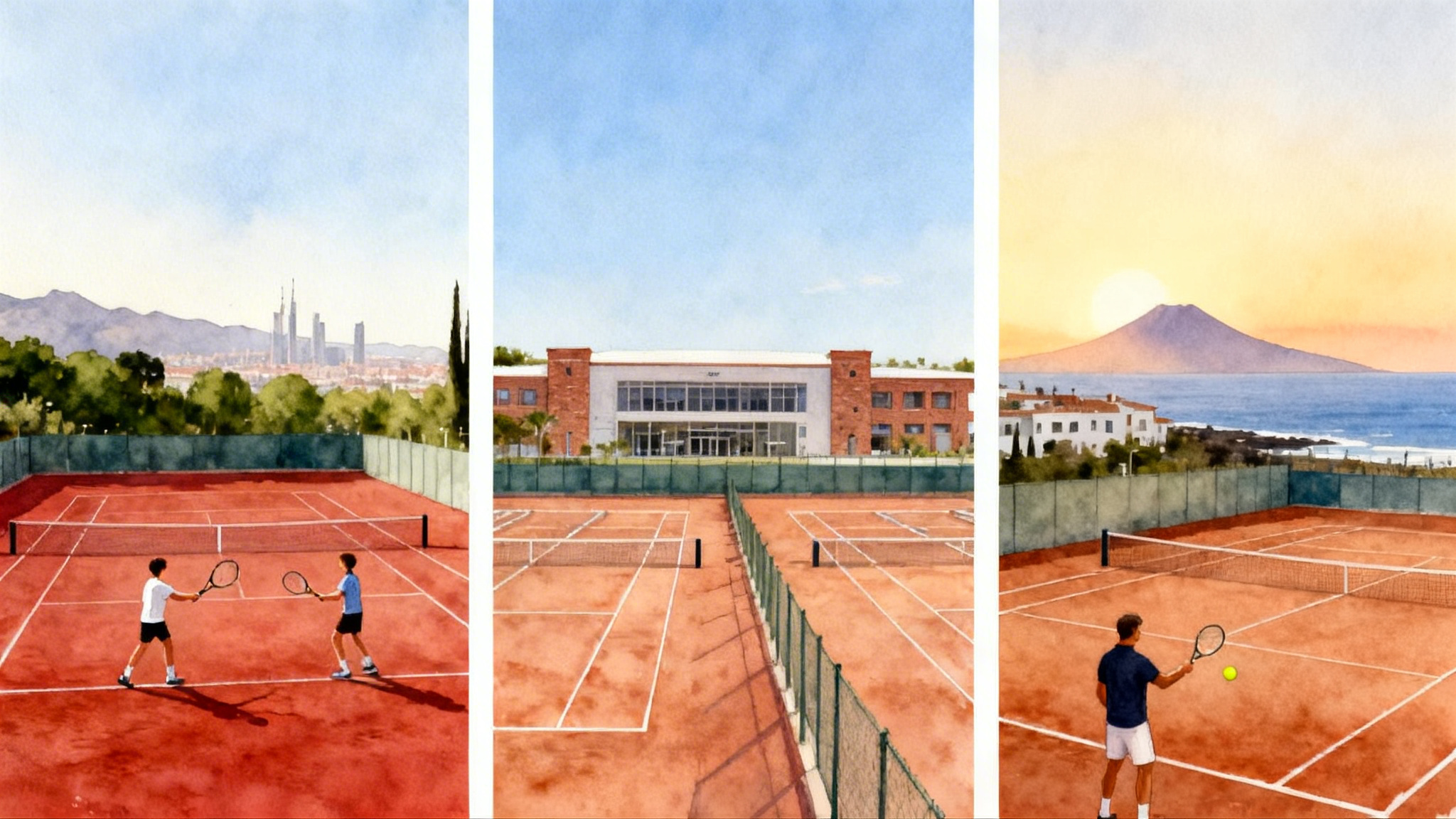
How to choose your Spain tennis base for pre-summer 2026
Spain offers three distinct high-performance ecosystems within a short flight of each other: Barcelona’s clay-first hubs, Mallorca’s all-in-one Rafa Nadal Academy in Manacor, and Tenerife’s winter-sun setup anchored by Tenerife Tennis Academy. This guide helps families and adult players decide before summer pricing and flights tighten.
Reader promise: specific euro price ranges, clear boarding vs day options, realistic clay-to-hard ratios, travel and weather advantages for U.S. families, schooling and visa notes, and sample week plans mapped to UTR goals.
Snapshot: what each hub does best
- Barcelona: Deep sparring culture on red clay, dense tournament access, multiple academies inside a major city region. Best if you want volume on clay and a big-city routine.
- Mallorca: A true campus model at Rafa Nadal Academy with tennis, fitness, physio, residence, and school in one place. Best for juniors who need structure and adults who want a polished, one-stop experience.
- Tenerife: Reliable winter and shoulder-season weather plus the easiest way to split a week between true red clay and quality hard courts without changing cities. Best for U.S. families who need mild weather and a practical clay-to-hard blend. See the Tenerife Tennis Academy profile for program details.
Pricing in euros for 2026, boarding vs day
Numbers reflect current public lists and quotes for spring and summer 2026. Final pricing varies by week, room type, and extras like privates or tournament travel.
-
Barcelona high-performance hubs (cluster view across leading programs such as Emilio Sánchez, Bruguera, and Barcelona Tennis Academy):
- Day training only: roughly €700–€1,300 per week.
- With boarding and meals: roughly €1,300–€2,200 per week.
- Typical inclusions: 4–5 training days plus fitness; add-on privates are common.
-
Mallorca, Rafa Nadal Academy (RNA):
- Weekly junior or adult camps with boarding: realistically €2,100–€2,800 depending on season and program.
- Tournament-week benchmark: families often use full-board day rates from official event periods as a planning anchor before adding tennis fees.
- Facilities context: the Manacor campus lists a near-even split of clay and fast courts. See the Rafa Nadal campus facilities and 45-court split.
-
Tenerife, Tenerife Tennis Academy (TTA):
- Day training only: about €650–€1,100 per week.
- With boarding via partner residences: about €1,200–€2,000 per week depending on season and room type.
- Notes: dual-base model makes a mixed-surface week straightforward.
Comparison tip: divide total price by supervised on-court hours plus fitness, then add a buffer for stringing, laundry, and airport transfers.
Clay-to-hard ratios you can actually expect
- Barcelona: plan on 70 to 90 percent of your hitting on clay, supported by local club culture and the spring clay swing. If you need hard-court reps, ask for one explicit hard-court block and confirm availability.
- Mallorca, RNA: close to a one-to-one split between fast and clay, so a three-days-clay and three-days-fast plan is realistic for U.S. players who compete primarily on hard courts.
- Tenerife: a natural 50–50 if you plan it. Mornings on clay and afternoons on hard make it easy to build footwork on clay and then check ball speed on hard in the same week.
Weather edges and when to go
- Barcelona and Mallorca: late May to early July brings long daylight, manageable mornings, and typically low rain. Book morning blocks to avoid mid-day heat.
- Tenerife south coast: winter and shoulder-season reliability with mild daytime temperatures and low rainfall make December through April popular for visiting squads.
If you are targeting pre-summer 2026, the sweet spot for families who need school days is late May to late June. Adults who want more space on court often pick early June or the last two weeks of August.
Travel logistics for U.S. families
-
Gateways and transfers
- Barcelona: nonstop options in peak season or easy connections via major European hubs. City-proximate academies keep transfers short for boarding students.
- Mallorca: connect to Palma de Mallorca, then 45 to 60 minutes by car to Manacor.
- Tenerife: target Tenerife South Airport for quickest access to Adeje, Arona, and La Caleta bases, typically 15 to 35 minutes by car.
-
Budgeting
- Build a total-trip view that includes stringing, laundry, airport transfers, and potential tournament travel with a coach. Ask for capped daily travel rates if weekend play is likely.
Schooling and visas in 2026
-
Short stays under 90 days: U.S. citizens can travel visa free under Schengen’s 90-in-180 rule. The European travel authorization system ETIAS is slated for late 2026 and is not required for spring or most summer 2026 trips. Always verify timing with the U.S. travelers in Europe guidance.
-
Full-time options and academics
- Barcelona: several academies operate on-campus American-school models with boarding and can advise on student-visa steps.
- Mallorca: Rafa Nadal School sits on the RNA campus, simplifying transitions between classes, training, and recovery. Families considering nine or ten months should start the Spain student-visa process several months ahead.
- Tenerife: secondary education pathways commonly include IGCSE and A-level routes, with SAT and IELTS prep aligned to U.S. college timelines.
How the daily rhythm actually feels
- Barcelona hubs: bigger player pools and dense clay blocks. Expect morning and afternoon sessions with footwork patterns, live-ball rallies, and structured points, plus gym circuits.
- Mallorca, RNA: tight campus logistics mean tennis, gym, lunch, match play, then spa or pool recovery, which helps younger players handle volume.
- Tenerife: mornings on one surface and afternoons on the other let you groove clay footwork and then calibrate pace on hard without breaking rhythm.
Sample week plans mapped to UTR and goals
-
Junior development, UTR 4–6, any hub
- Goal: reliable rally ball, first-serve percentage, basic clay movement.
- Mon–Sat mornings: 2 hours technical blocks emphasizing shapes, height, and depth with cross-court progressions.
- Three afternoons: 75 minutes fitness and 45 minutes video review or shadow swings.
- Friday: match-set focus with serve plus one and return plus one.
- Saturday: points day, grade on first-serve percentage and forehand depth.
-
College-aspiring, UTR 6–8, Barcelona or Tenerife
- Goal: add ball tolerance on clay, raise neutral rally speed, integrate patterns under pressure.
- Mon–Fri mornings: 2.5 hours live-ball and situational points on clay.
- Three afternoons: 60 minutes strength or mobility and 60 minutes serve reps on hard.
- Two afternoons: coached set play or UTR match day.
- Weekly add-on: one 45-minute private to fix a single pattern leak.
-
Division I track, UTR 9–11, Barcelona or Mallorca
- Goal: defend better on clay without losing first-strike identity.
- Mon–Sat: split 60–40 clay to fast. Use morning clay for patterns under fatigue and afternoon fast for serve-rep speed and return blocks.
- Two privates: one on return patterns, one on finishing at net.
- Conditioning: two anaerobic sessions and two mobility blocks.
-
Pro-circuit prep, UTR 12+, Mallorca or Tenerife
- Goal: integrate week volume with high-quality sets and tracked efficiency metrics.
- Six training days: 3 clay and 3 hard. Morning two-hour set blocks with targets for break points created, plus afternoon serve plus one and return-depth benchmarks.
- Fitness: three high-intensity blocks and three mobility or pool recovery sessions.
- Tournament simulation: one day with two matches and a recovery protocol.
-
Adults 3.5–4.5, Mallorca or Barcelona
- Goal: cleaner contact, smarter first-serve targets, one clear pattern to close.
- Five court days: 2 to 3 hours per day, mix drills and points, with one rest or sightseeing day.
- Add one private late week to lock a single feel change.
Boarding vs day: who suits which
- Boarding is usually best for: full-time pathway juniors, players needing tighter structure, and U.S. families seeking an immersion week where logistics do not siphon energy.
- Day is usually best for: adults pairing training with a city or island holiday and juniors who already have a local base in Spain or want to test a hub before committing to longer stays.
Concrete 2026 examples:
- Barcelona: models range from American-school plus residence to simpler shared guesthouses, often with three to five supervised meals per day in the structured setups.
- Mallorca, RNA: on-campus residence minimizes wasted steps and helps younger athletes stay in rhythm between tennis, school, and rest.
- Tenerife: partner residences or apart-hotels near the courts with academy transport for juniors; confirm whether laundry and meals are in-house or via stipend.
How to decide in one sitting
- Start with the surface split your player needs.
- Clay-heavy calendar and deepest clay ecosystem: pick Barcelona.
- One-stop campus control from wake-up to recovery: pick Mallorca and schedule a 3–3 split between clay and fast.
- Mixed-surface week and mild weather outside peak summer: pick Tenerife.
-
Check the real timetable and hours included before you compare prices. If an academy cannot provide a sample week, pause.
-
Confirm competition access for your level. Ask about UTR match days or local club matches and whether a coach can travel for tournaments with a capped day rate.
-
Lock travel early. Book flights and confirm transfer windows that match common Sunday check-in and check-out norms.
-
Sort paperwork with a calendar. Short-stay U.S. families should track Schengen’s 90-in-180 rule and ETIAS timing with the U.S. travelers in Europe guidance. Full-time students should begin visa steps with academy admissions four to six months before arrival.
Related planning reads
- Compare nearby options in our France academies 2026 guide.
- If you prefer to stay stateside for winter sun, see the Florida academies 2026 guide.
Bottom line
- Barcelona delivers the strongest clay immersion and deepest day-to-day player pool.
- Mallorca’s Rafa Nadal Academy offers a controlled campus that makes volume and recovery simpler, with a near-even clay-to-fast split on site.
- Tenerife makes winter and shoulder-season training practical and lets you build a true mixed-surface week without changing hotels.
Pick the surface split first, then price per supervised hour, then travel and school. Keep those three levers in order and Spain’s big three will each deliver what they promise.