Best Arizona Tennis Academies 2026: Phoenix, Scottsdale, Tucson
A 2026 buyer’s guide to Arizona’s best tennis academies across Phoenix, Scottsdale, and Tucson. Get heat-smart training tips, court types, coaching ratios, UTR and USTA access, college pathways, boarding vs day options, and price bands.
 Tommy
Tommy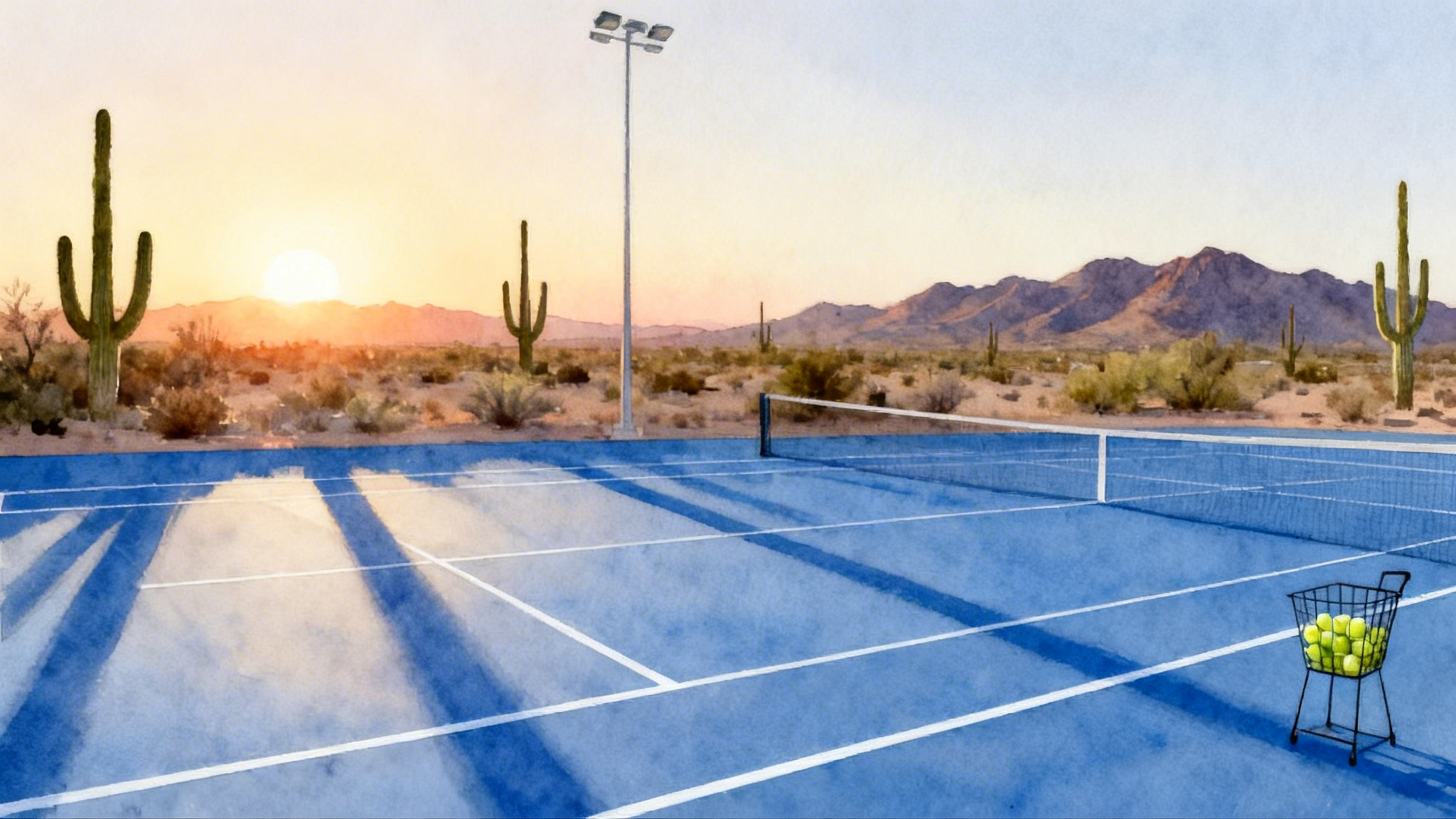
Read this first: why Arizona in 2026
Arizona stays a tennis magnet in 2026 for three practical reasons: competition density, reliable weather for much of the year, and easy travel across the Southwest. Phoenix Sky Harbor and Tucson International keep flight costs in check, while weekend drives between Phoenix, Scottsdale, and Tucson take two hours or less. That set of logistics matters to both families stacking USTA weekends and adults planning league seasons.
Heat is real here, so the state’s top programs build schedules around it. Expect sunrise starts, night sessions under lights, and midsummer blocks that shift to fitness, video, and classroom work during the hottest hours. If you want hard-court realism, tournament access, and year-round reps without the price of a boarding campus, Arizona belongs on your shortlist.
Quick take: which city fits your goals
- Scottsdale: multi-site programs that are easy to slot into family schedules; strong public-center ecosystems and plenty of adult leagues.
- Phoenix: a mix of elite-track academies and large public facilities that make it simple to add solo reps and match play.
- Tucson: tournament-friendly city with long-running junior pipelines, value pricing, and a quieter training rhythm that suits focused development.
Below, you will find a comparison-forward look at each market: coaching ratios, sample schedules, surfaces, competition access, and transparent price bands.
Scottsdale: multi-site convenience and steady player flow
What you notice first in Scottsdale is depth. Public hubs like Scottsdale Ranch Park and Indian School Park run full junior and adult menus, and private operators layer academy-style blocks on top of that public backbone. It creates a smooth on-ramp from red ball to match play without long drives across town.
Representative options
- Seth Korey Tennis Academy: multi-location footprint that covers after-school blocks and Saturdays. Typical junior clinic windows run 4:00 to 5:30 p.m. on weekdays and morning blocks on weekends. Published class pricing commonly ranges around 30 to 45 dollars per session, and monthly bundles run in the mid to high 400s for three-day mixes. The program lists a six-to-one pro-to-player ratio in core clinics, a practical ceiling for consistent feed-to-live transitions.
- City-run centers: Scottsdale Ranch Park has been recognized as a USTA Premier Facility and delivers a steady ladder of junior match play plus adult leagues and lessons. That city infrastructure makes it easy to add low-cost hitting windows around private lessons or academy classes.
Surfaces and facilities
- Expect hard courts almost everywhere. Clay exists in the Valley, but it is usually on private club rosters and not the default for academy blocks. Plan to harden feet and lower legs with progressive volume rather than chasing occasional clay days.
Heat-smart schedule example for a Scottsdale junior week
- Monday: 6:15-7:45 a.m. serves and first-strike patterns; 20 minutes of band work at home in the evening.
- Wednesday: 4:00-5:30 p.m. academy clinic with a six-to-one ratio; focus on backhand pattern plus transition volleys.
- Friday: 6:00-7:30 a.m. point play sets to eight; hydration and cooling towel on court.
- Saturday: 9:00-11:00 a.m. mixed levels match play; 30-minute mobility block after.
Price band snapshot for Scottsdale
- Group clinics: 30-45 dollars per class; monthly bundles 350-500 dollars depending on frequency.
- Private lessons: 95-140 dollars per hour depending on coach résumé and venue.
- Stringing and overgrips: 20-30 dollars labor plus strings; plan two string jobs per month in peak volume.
Who should choose Scottsdale
- Families that need multiple nearby locations, predictable schedules, and broad adult-league options.
- Players who benefit from structured city programming they can stack with private coaching.
Phoenix: elite pathway plus public-court flexibility
Phoenix pairs elite-track academies with big municipal facilities. The advantage is obvious. You can buy targeted coaching on academy days, then hit a ball machine or schedule UTR matches on off days without extra travel.
Representative options
- Gold Key Racquet Club, home to a Southwest-identity elite program: the junior pathway splits into recreational, pre-elite, and elite blocks. High school competitive sessions commonly run 90 minutes twice a week, while elite tracks step up to two-and-a-half hour blocks three to four days per week with integrated fitness and match play. Level-capped small groups in the pathway often top out at six players, which supports extended live-ball sequences and tracked patterns.
- Phoenix Tennis Center and other city venues: a reliable base for leagues, lessons, and self-scheduled practice. Use public-court hours for serve reps and match play to keep costs down between academy days.
Heat-smart schedule example for a Phoenix adult 4.0 week
- Tuesday: 6:00-7:30 a.m. serve plus first ball; 15 minutes of shoulder prehab.
- Thursday: 8:00-9:30 p.m. doubles patterns under lights; focus on return plus poach signals.
- Saturday: 7:00-9:00 a.m. league or ladder match; short cool-down jog and stretch.
- Optional: one 60-minute private lesson rotated every other week for targeted mechanics.
Price band snapshot for Phoenix
- Group clinics: 30-50 dollars; four-week blocks for competitive teens often 180-300 dollars.
- Elite track: variable by number of weekly sessions; budget 350-700 dollars per month for two to four days, plus fitness.
- Private lessons: 90-150 dollars per hour depending on seniority and tech features like smart-court video.
Who should choose Phoenix
- Juniors aiming for an elite track who also want public-court flexibility for extra reps and UTR matches.
- Adults who split weeks between league nights and targeted lessons without crossing the metro.
Tucson: tournaments, tradition, and value pricing
Tucson is the state’s most tournament-centric training ground. Longstanding centers run deep junior ladders and frequent events, which matters for match reps and confidence building.
Representative options
- Jim Reffkin Tennis Center: the city’s heartbeat for junior ladders and multi-tier programming. Its Smith-Perry Tennis Academy junior pathway runs after-school high-performance blocks with an emphasis on progression and supervised match play. See the posted structure for the Smith-Perry Tennis Academy junior program.
- Tucson Racquet and Fitness Club: full-spectrum junior pathway from red ball to junior excellence, plus integrated athletic development. The club’s long hours and multi-sport footprint make it easy to pair court time with fitness work.
- Southwest High Performance Tennis Academy: additional junior option near the University of Arizona, useful for players who want campus proximity and year-round clinics.
Surfaces and facilities
- Hard courts dominate public and academy blocks. Clay exists at several private country clubs in the foothills, but most academy sessions in Tucson still train on hard. If you value clay feel for joint relief or point construction, ask directly whether the program offers rotating clay days.
Heat-smart schedule example for a Tucson junior week
- Monday: 6:30-8:00 a.m. serve plus plus-one forehand; 15-minute footwork ladder.
- Wednesday: 4:30-6:30 p.m. academy practice with supervised sets.
- Friday: 6:30-8:00 a.m. return practice and transition volleys.
- Weekend: local UTR match or USTA draw if scheduled, then 20-minute recovery ride and mobility.
Price band snapshot for Tucson
- Group clinics: 25-40 dollars per class; multi-week blocks often under 300 dollars for two days per week.
- Private lessons: 80-130 dollars per hour; savings versus metro Phoenix are common.
- Tournament fees: similar to Phoenix and Scottsdale; weekend travel is lighter due to event density in town.
Who should choose Tucson
- Players who thrive with frequent match play in a tighter, less rushed training environment.
- Families seeking value pricing with credible high-performance blocks.
Competition access: USTA Southwest and UTR
The United States Tennis Association Southwest Section runs a full adult and junior slate in 2026 across Phoenix, Scottsdale, Tucson, and Surprise. Use the official USTA Southwest championship calendar to map league seasons and target championships, then fill gaps with Universal Tennis Rating events to keep match count steady.
How to translate this into a season plan
- Juniors: aim for two match days per week in season, one match day off season. Mix green or yellow ball ladders with one USTA or UTR event every three to four weeks.
- Adults: anchor a league night plus one weekend ladder or social; add a monthly doubles clinic focusing on returns and net movement.
College placement reality checks and the ASU or UA question
Parents ask about pipelines to Arizona State University or the University of Arizona. The most reliable path is not a promise. It is a process. In 2026, both programs recruit internationally and domestically, and they index heavily on match results and Universal Tennis Rating. Here is how to evaluate an academy on this front.
- Ask for a recent placement list with graduation years, programs, and current rosters you can verify.
- Request anonymized cohort data that shows typical UTR movement after six and twelve months of training.
- Confirm the program helps with film, coach outreach, and campus visit planning, not just sparring and workouts.
If you target Division One, you will need sustained results and a UTR that matches current rosters. If you target Division Two, Division Three, or NAIA, fit and academic alignment often beat marginal rating differences at the end.
Indoor or covered courts: what to expect in Arizona
Phoenix and Tucson do not have a deep roster of true indoor tennis venues as of March 2026. Plan accordingly.
- Summer training pivots to sunrise and night sessions under lights.
- Midday blocks shift to fitness, mobility, and video review in air conditioned rooms.
- Shade, evaporative cooling, and hydration are standard. A six-to-one group becomes an eight-to-one hydration station if players are not prepared, so ask programs how they manage cooling during June, July, and August.
Surfaces and why they matter here
- Hard courts: the default surface for public centers and most academies. Great for serve plus first-ball realism. Increase volume gradually to protect shins and feet.
- Clay courts: present, yet concentrated at private clubs. Clay is useful for pattern work and lower impact days. If clay is a must-have, ask explicitly whether your program schedules recurring clay blocks and where.
Coaching ratios and session architecture
- Six-to-one is a practical ceiling in academy settings for efficient switchovers from feeding to live-ball patterns. Scottsdale programs routinely publish that ratio in their clinic descriptions. Phoenix elite tracks often cap small groups at six for advanced levels, too.
- What to ask: maximum ratio, how many uninterrupted live-ball minutes per player per hour, and how often players change sides of the net in point-based drills. These details tell you more than a brochure.
Boarding vs day options, with quick comparisons to California and Texas
Arizona is a day-academy market first. If you need a true boarding model with integrated academics, California and Texas carry more options. For deeper comparisons, see our Best California tennis academies guide and Best Texas tennis academies guide. For a Florida boarding example with small-group ratios, review the Gomez Tennis Academy profile.
Cost and travel snapshots
- Arizona day academy path: expect 350-700 dollars per month for two to four weekly sessions in performance groups, plus 90-140 dollars per hour for private lessons. Annual spend often lands between 7,000 and 15,000 dollars once you add stringing, travel, and tournament entries.
- California boarding examples: well-known boarding programs commonly price total tuition and housing in the 45,000-70,000 dollar range per academic year, with flights or long drives for visits and holidays.
- Texas boarding examples: integrated school plus academy paths often sit in the 30,000-55,000 dollar range per academic year, with airfare and airport transfers on top.
Travel logistics
- From Phoenix to Los Angeles: about 1 hour 30 minutes by air; 6 hours by car if traffic cooperates. To San Diego: similar flight time; 5 to 6 hours by car.
- From Phoenix to Dallas: about 2 hours by air; 14 to 15 hours by car.
The implication is simple. If you live in Arizona and do not require 24-7 supervision, your cost per competitive hour is usually better with a day program plus targeted travel than with a boarding campus.
Transparent price bands at a glance
- Group clinics
- Entry and development: 25-40 dollars in Tucson; 30-45 dollars in the Valley.
- Performance teens: four-week packages frequently 180-300 dollars for two 90-minute sessions per week; three-day bundles in Scottsdale and Phoenix often reach 350-500 dollars per month.
- Private lessons
- Assistant or developing pros: 80-100 dollars per hour.
- Senior or specialist pros: 110-150 dollars per hour.
- Add-ons
- Strength and mobility: 15-30 dollars per small-group block if not bundled.
- Tournament entries: typical junior events 40-85 dollars; adult league fees vary by season and level.
- Stringing: 20-30 dollars labor plus strings; plan two jobs monthly during high volume.
Three sample weekly plans you can copy
Plan A: 10-and-under beginner who loves games
- Monday 4:30-5:30 p.m.: red or orange ball clinic with movement games.
- Wednesday 6:30-7:15 a.m.: serve toss and contact practice at home with foam balls; ten minutes of shadow swings.
- Saturday 9:00-10:30 a.m.: mixed play day or parent-child rally session.
- Goal: 150 minutes on-court weekly and one fun match set every other week.
Plan B: 13-15 performance junior targeting varsity and sectional events
- Monday 6:00-7:30 a.m.: serve plus first-ball depth; journal two targets for the week.
- Wednesday 4:30-6:30 p.m.: high-performance clinic with supervised sets.
- Friday 6:00-7:30 a.m.: returns plus transition; five minutes of positive self-talk reps.
- Weekend: UTR match or USTA event; Sunday active recovery and mobility.
- Goal: 6 to 8 competitive matches per month in season, 12 to 16 directed practice hours.
Plan C: Adult 3.5-4.0 who wants better doubles results
- Tuesday 8:00-9:30 p.m.: team drill night under lights; return plus poach choreography.
- Thursday 6:15-7:00 a.m.: serves and first volleys; five minutes of core work.
- Saturday 7:00-9:00 a.m.: ladder match; debrief one pattern that won and one that leaked.
- Goal: one technical lesson every other week until a single mechanical limiter improves, then maintain with team drills.
How to choose in one afternoon
- Watch the warmup. Do coaches standardize dynamic patterns or improvise aimlessly.
- Time the live-ball minutes. You want long, quiet drilling sets and clear scoring in point patterns.
- Ask about ratios, match counts, and tournament calendars. A posted ratio like six-to-one and a calendar that syncs to USTA Southwest or UTR signals organization.
- Look for data trails. Cohort UTR progress, placement lists, and video libraries show the program measures what it sells.
A note on links and schedules
For tournament planning, start with the championship calendar linked above. For a concrete example of a Tucson high-performance ladder that feeds junior events, review the Smith-Perry program link above. Then call your target academy to confirm current times and prices. Schedules shift seasonally in Arizona, especially in summer.
Bottom line
Pick the market that fits your week, not just your dream. Scottsdale excels at convenience and depth, Phoenix balances elite tracks with public-court freedom, and Tucson offers match-rich pathways with strong value. Use heat-smart schedules and honest ratios to judge programs. Stack USTA and UTR play on a consistent rhythm. If college tennis is your horizon, insist on data, not anecdotes. Done well, Arizona gives you an efficient, year-round runway from lesson court to real results without turning your life into a travel project.