Year-Round Boarding Tennis Academies in the USA: 2026 Guide
Choosing a live-in junior tennis program is one of the biggest decisions a tennis family will make. This guide breaks down what boarding academies actually deliver, how costs stack up, what the weekly schedule looks like, and how to spot the programs worth your investment.
 Tommy
Tommy
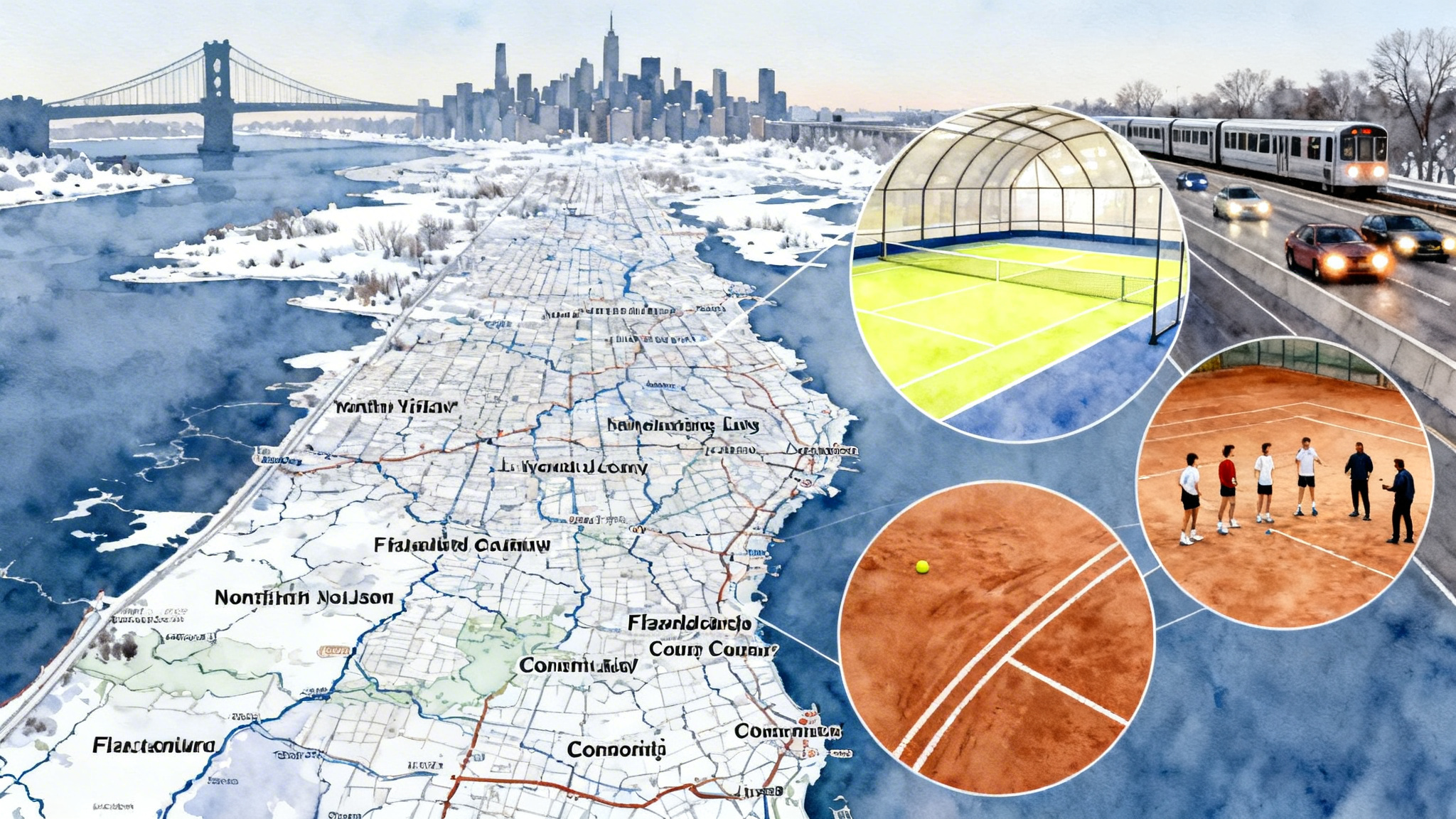
Regions mentioned in this article
Tennis academies mentioned in this article
What Makes a Boarding Tennis Academy Different from a Day Program
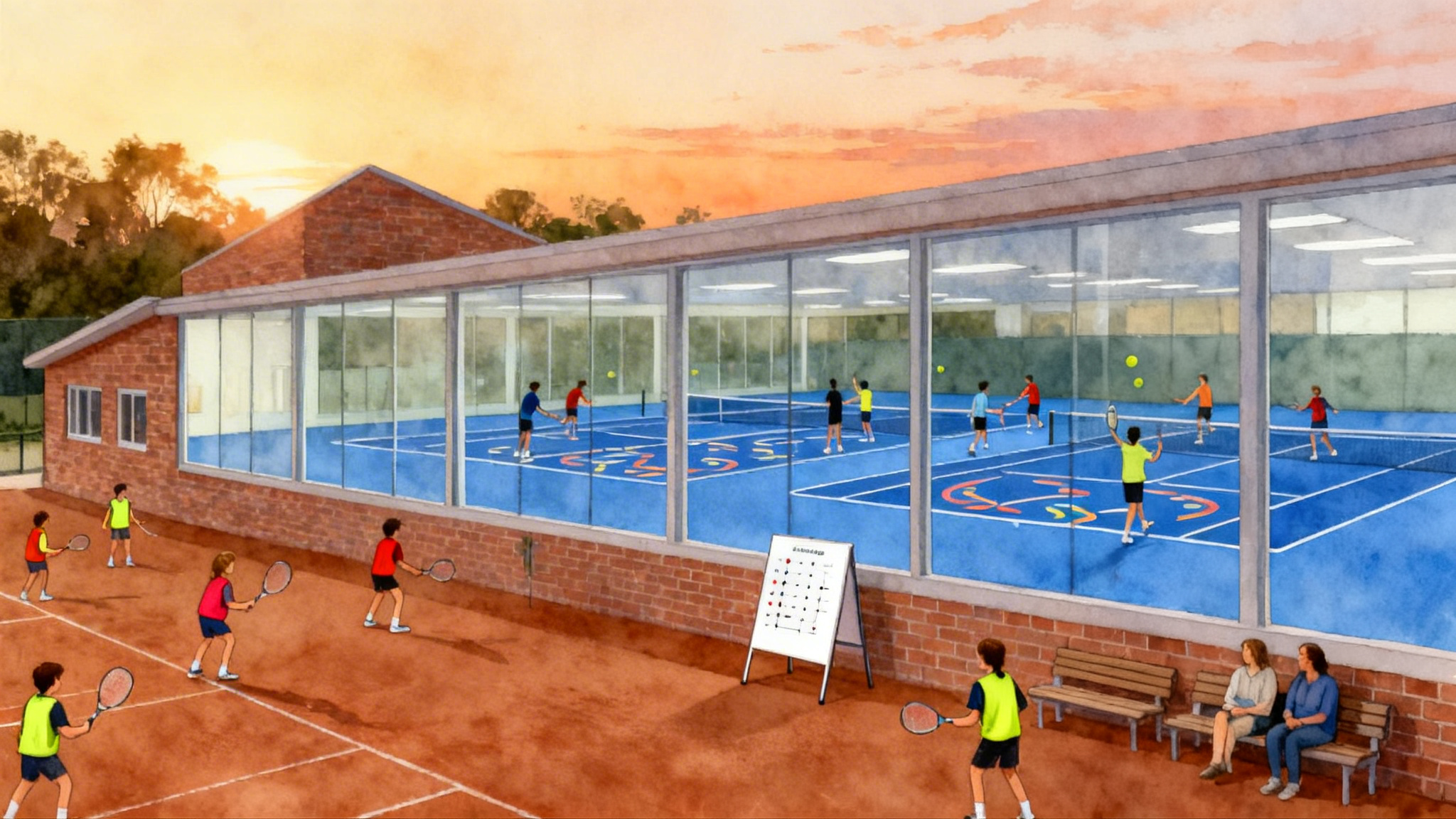
The word "academy" gets applied loosely. A day program, even an excellent one, sends players home at 5 p.m. A boarding academy keeps them on campus around the clock, which changes almost everything: recovery protocols, nutrition oversight, peer culture, and the sheer volume of deliberate practice a player can accumulate in a single month. When researchers study skill acquisition in racket sports, consistent high-volume repetition combined with immediate feedback is the clearest predictor of rapid improvement. A live-in structure delivers that in a way that a commuter schedule simply cannot.
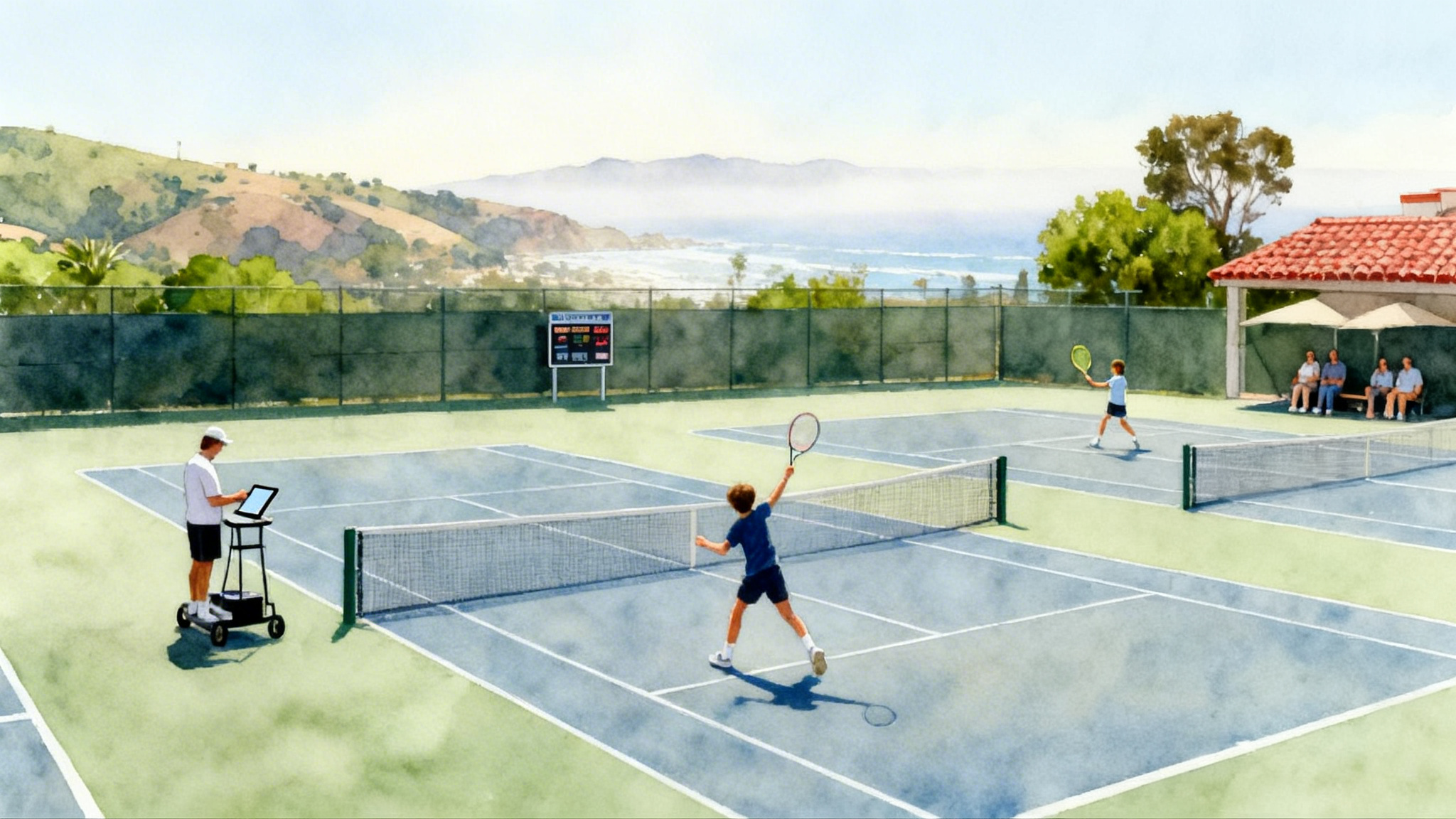
The practical difference is also visible in the numbers. A serious junior training at a day program might log 15 to 18 hours of tennis per week after accounting for travel, school pickup, and family logistics. A residential student at the same level routinely logs 25 to 30 hours, plus structured strength and conditioning, video review sessions, and match-play analysis. Over a full year that gap compounds into thousands of additional quality repetitions.
The Academies Worth Knowing Outside Florida and Texas
Florida and Texas get most of the attention because Bradenton and the Dallas corridor have housed famous programs for decades. For a deeper look at the Florida landscape, see our Best Florida Junior Tennis Academies 2026: Miami to Orlando guide, and for the Texas side, the Best Texas Tennis Academies 2026: City-by-City Guide covers the major programs in detail. But families who want strong alternatives with smaller cohorts, different climates, or regional convenience have real options across the country.
USTA National Campus (Lake Nona, Florida) sits technically in the Orlando metro and deserves mention as a reference point: it is the national governing body's own training base, and several smaller residential academies have positioned themselves nearby specifically to give players access to its courts and tournaments during off-seasons.
Revolution Tennis Academy is one such program. It operates as a residential alternative for players who want the Orlando competitive circuit without the size and cost structure of the largest Florida mega-academies. The program pairs daily on-court training with local schooling partnerships, making it accessible for families whose players are not yet at a full-academy investment level but want genuine year-round immersion.
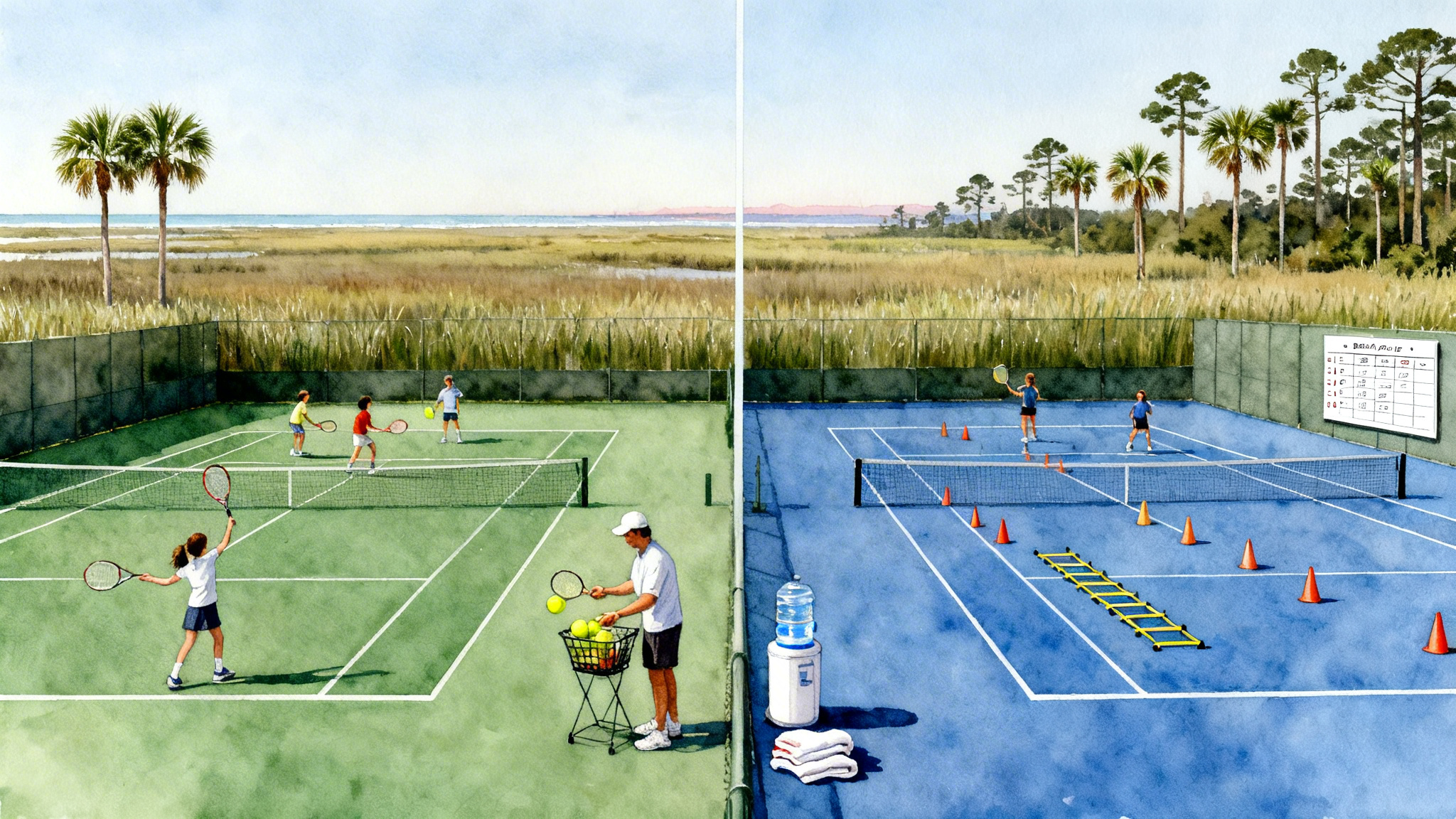
Gomez Tennis Academy serves as a concrete example of what a small-academy boarding model looks like in practice. Smaller cohorts mean that a coaching staff of three or four can know every player's biomechanics, competitive tendencies, and personal stress patterns in detail. When a junior at a 200-student program has a bad week, a coach may not notice until the next formal evaluation. At a program like Gomez, the same slip in footwork habits gets corrected within a session or two. That intimacy is the core argument for smaller residential programs, and it is an argument worth taking seriously.
John McEnroe Tennis Academy at Sportime is one of the few serious residential options in the Northeast. The location gives players access to a different competitive ecosystem, USTA Eastern Section events, and urban resources that pure-resort academies cannot offer. For a broader look at programs in that region, the Best Tri-State Tennis Academies 2026: NYC, NJ, CT Guide is a useful companion read.
Saddlebrook Tennis Academy (Wesley Chapel, Florida) has maintained a residential program for decades and is notable for its integrated schooling options, which matter enormously once parents start mapping out the logistics of keeping a junior academically eligible through middle and high school.
What a Realistic Weekly Schedule Looks Like
Parents sometimes imagine a boarding academy as tennis all day, every day. The reality is more structured and more sustainable than that. A typical week for a 14 to 17-year-old at a residential program looks roughly like this:
- Morning: On-court practice session, usually 7 a.m. to 9 a.m., focused on technical or tactical work
- Mid-morning: Schooling, either on-campus or at a nearby partner school, covering core academic subjects
- Afternoon: A second on-court block, often match-play oriented, followed by physical conditioning
- Evening: Homework, recovery (ice baths, stretching, nutrition protocols), and structured downtime
Weekends introduce tournament travel during the competitive season and longer practice blocks or rest during off-season training phases. The rhythm is demanding but it is not chaotic. The best programs build in recovery intentionally, because overtraining is a genuine risk at this age and a smart coaching staff knows it.
How Academics Are Handled
This is the question parents ask most urgently and investigate least thoroughly during campus visits. There are four common models:
- On-campus school: The academy operates its own accredited school, often with small class sizes and flexible scheduling that accommodates tournament travel. Saddlebrook's partnership with the Academy at the Lakes is a well-known example of this model working effectively.
- Partner school agreement: The academy buses or drives players to a nearby private or charter school. Quality varies considerably depending on the school's willingness to accommodate tournament absences.
- Online curriculum: Players complete accredited coursework through platforms like Florida Virtual School or Laurel Springs. This is common and can work well for disciplined students, but it requires genuine academic support staff at the academy, not just a room with laptops.
- Hybrid model: Some coursework is online, some is in-person. This is increasingly common and can be the most flexible for players whose travel schedules are unpredictable.
When visiting a campus, ask specifically: who monitors daily academic progress, what happens to a player's GPA when they miss two weeks for a tournament run, and how many of last year's graduates gained admission to four-year universities. Vague answers to those three questions are a yellow flag.
Total Cost Breakdown
Boarding tennis in the United States is expensive. Families should budget with clear categories rather than relying on a single headline number from an admissions brochure.
- Tuition (tennis training): Typically $30,000 to $60,000 per year at established programs, covering on-court coaching, conditioning, and program fees
- Housing and meals: $15,000 to $25,000 per year, depending on room type and meal plan structure
- Schooling: $0 if the academy includes it in the package; up to $20,000 per year if you are paying separately for a private school partner
- Tournament travel: $8,000 to $20,000 per year, depending on how aggressively a player pursues ITF (International Tennis Federation) junior points and national events
- Equipment and apparel: $2,000 to $4,000 per year, accounting for racket restringing, shoes, and clothing requirements
A conservative all-in estimate for a player fully committed to a residential program with active tournament travel is $60,000 to $100,000 per year. Scholarship and financial aid programs exist at several academies, and a few programs offer merit-based reductions for players who demonstrate measurable ranking progress. Ask directly about these structures; they are rarely prominent on admissions pages.
The Right Age and Competitive Level to Make the Move
The most common entry point is 13 to 15 years old, which corresponds roughly to the transition from junior sectional competition to national and international junior circuits. Players who are already competing at a United States Tennis Association (USTA) Level 1 or Level 2 event standard, or who hold any ITF junior ranking, are generally ready for a full residential program's training load.
Younger players, ages 10 to 12, can benefit from residential environments but the academic and emotional development considerations carry more weight at that age. Some academies accept players as young as 10; others have a firm minimum of 13. If a program takes very young children without a robust pastoral care structure, that is worth scrutinizing.
For older players, 16 or 17, the calculus shifts toward college recruiting. A residential program at this stage is often a deliberate strategy to build an ITF ranking quickly enough to attract Division I or Division II program interest before the National Collegiate Athletic Association (NCAA) recruiting calendar closes. The timeline is tight but achievable if a player enters with a strong sectional base.
Red Flags to Watch for During Campus Visits
A campus visit reveals more than any brochure. Specific things to watch for:
- Coaches who cannot speak to individual players by name: At any program with under 60 residential students, the coaching staff should know each player's game in detail. If a tour guide introduces you to a coach who refers to players by number or by their national ranking rather than by name, that tells you something about the culture.
- No clear injury protocol: Ask what happens when a player develops a shoulder impingement or stress fracture. A serious program has a sports medicine relationship, a return-to-play protocol, and a track record of managing injuries conservatively rather than pushing through them.
- Vague tournament scheduling: The program should be able to show you the planned tournament calendar for the upcoming year, including which events, approximate travel costs, and how players are selected for each event.
- No former player references: Ask for contact information for two or three families whose children graduated from the program within the last three years. Programs with genuine outcomes are happy to provide this.
- Isolation from normal social life: This is subtle but real. Some programs operate in ways that discourage players from maintaining friendships outside the academy. Adolescent development requires social breadth, not just tennis intensity.
How Year-Round Immersion Accelerates ITF Rankings and College Recruiting
The mechanics here are straightforward once you understand how the ITF junior ranking system works. Points are earned through a global circuit of tournaments graded from Grade 5 up to Grade A, with the higher grades awarding more points and attracting stronger fields. Accumulating meaningful points requires playing a high volume of international events, and doing that consistently requires a support infrastructure that a day program simply cannot provide: travel coordination, physical conditioning that peaks for specific tournaments, and tactical preparation against known opponents.
A player in a well-run residential program will typically play 20 to 30 competitive events per year versus 10 to 15 for a comparably talented day-program player. Over two years, that difference translates into substantially higher ranking and a much deeper match experience base, which is exactly what college coaches evaluate when they watch a recruit's competitive record.
For a detailed look at which programs have the strongest track records in placing players at Division I and Division II schools, see our Best Tennis Academies for USA College Recruiting in 2026 guide. The Tennis Recruiting Network's junior player profiles are also a widely used tool that college coaches consult when identifying prospects early.
Making the Decision Concrete
The question is never simply "is this program good?" The question is whether a specific program is the right match for a specific player at a specific moment in their development. A small boarding program like Gomez Tennis Academy suits a player who needs close individual attention and a tight-knit environment. A larger residential program suits a player who thrives in competitive peer culture and needs to benchmark against many different playing styles daily. Revolution Tennis Academy suits a family that wants Orlando's competitive density without committing to the largest program price points.
Before signing anything, build a comparison spreadsheet with five columns: total annual cost, academic model and accreditation, average weekly training hours, average number of tournaments per year, and the career outcomes of the last graduating class. Put every program you are seriously considering in those rows. The right choice will stop being abstract and start being obvious.
The families who regret boarding academy decisions almost always made them based on reputation and facility aesthetics. The families who look back satisfied made them based on fit, financial clarity, and a realistic understanding of what their player needed to grow. That is the framework. Use it.