Texas’s Best Tennis Academies 2026: Austin to San Antonio
A data-led scorecard and parent’s guide to Texas’s top tennis academies in 2026. Compare training models, surfaces, outcomes, college placement, cost bands, and facility upgrades. Spotlight on Legend Tennis Academy versus established standouts.
 Tommy
Tommy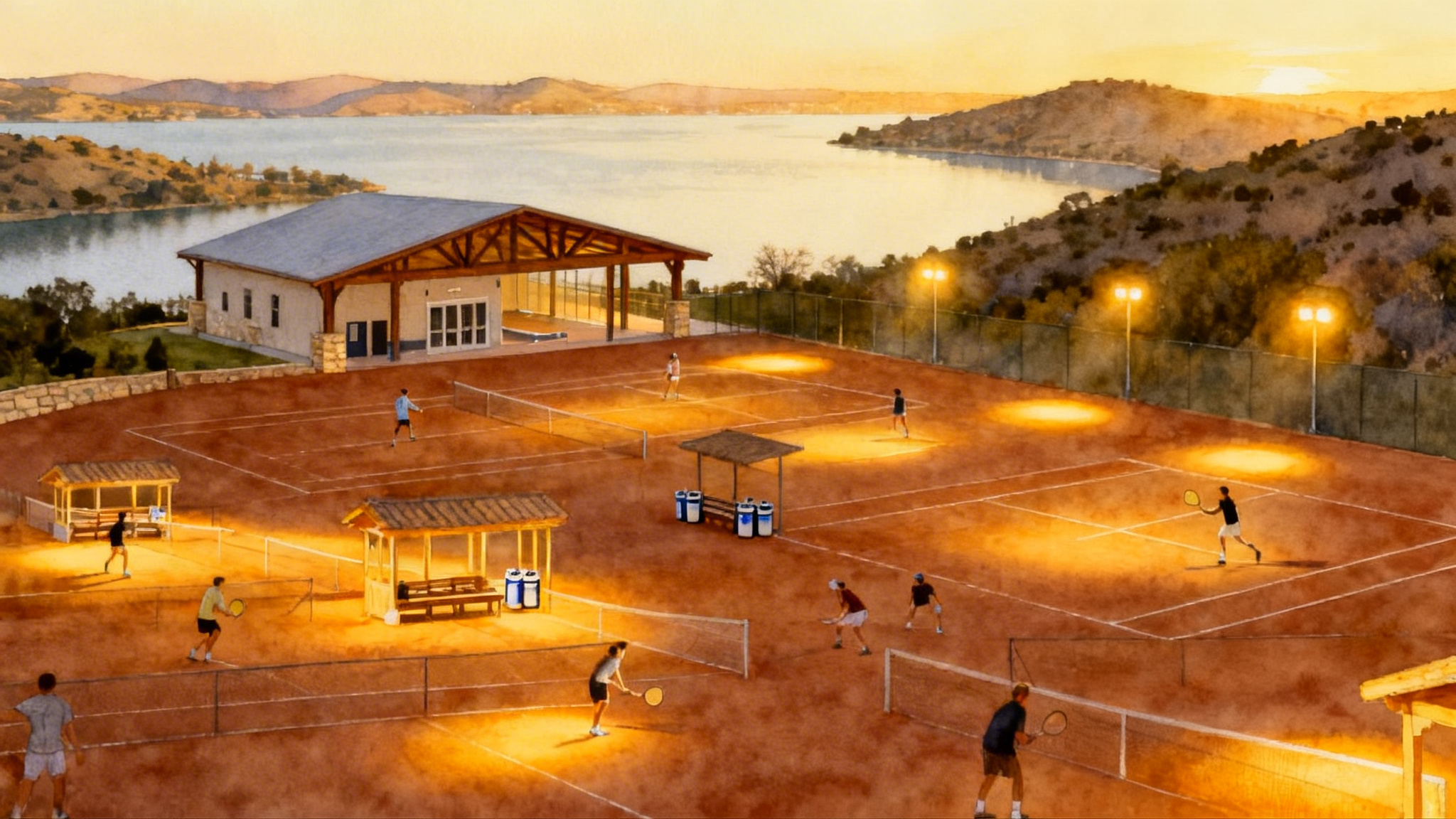
How we built this 2026 Texas scorecard
Parents asked for a clear, apples-to-apples view of the state’s top junior tennis academies. We built this guide around the decisions that matter when you choose a training home:
- Training model: after-school, full-time, or true boarding
- Surfaces and indoor or covered capacity
- Competitive outcomes: Universal Tennis Rating and United States Tennis Association results
- College placement: recent patterns, not just anecdotes
- Cost bands: what families actually pay in Texas metros
- Facility upgrades for 2025-2026 that change day-to-day training quality
Two quick definitions for clarity:
- Universal Tennis Rating is a global rating on a 1–16.50 scale that reflects match results and opponent quality. It moves with verified competition.
- United States Tennis Association results refer to the junior pathway of Level 7 to Level 1 tournaments. Outcomes here primarily reflect depth of competition and how often a player enters meaningful draws.
You will not find vague praise in this guide. Every conclusion either explains the mechanism behind performance or gives you a specific next step. For a warm-weather comparison, see our Florida Tennis Academies 2026 guide.
The 2026 leaderboard at a glance
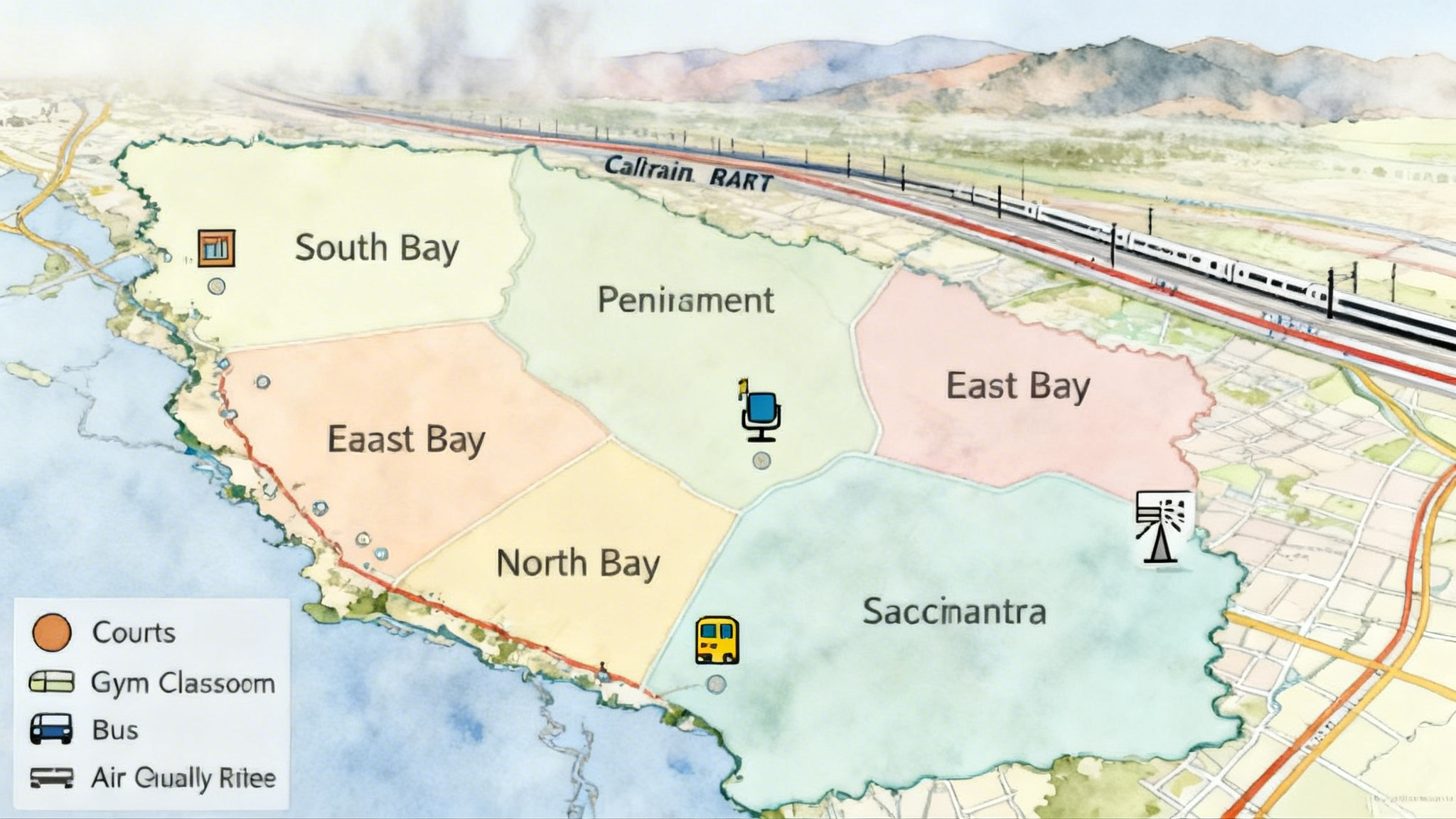
Texas is a big state with regional ecosystems. Here is the short list parents tend to compare in each metro, with a view to training model and day-to-day reality.
Austin area
- Legend Tennis Academy, Spicewood: After-school and camps with covered-court capacity for hot afternoons; progression-based junior pathway; compact campus that prioritizes reps over resort features.
- Austin Tennis Academy, Southwest Austin: After-school and full-time tracks with on-campus academics; consistent college placement pipeline.
- Polo Tennis and Fitness, West Austin: After-school performance groups; mix of fitness and on-court blocks.
- Austin Tennis Center and City centers: Public options that offer clinics at accessible price points and a low barrier to entry.
Training model mix: After-school is dominant. Full-time exists primarily at Austin Tennis Academy. Boarding is rare in Austin proper.
Surfaces: Mostly outdoor hard courts. Covered or indoor capacity is limited in the metro, which is why a covered court can be a difference maker during peak heat.
Dallas-Fort Worth
- T Bar M Tennis Academy, North Dallas: Large staff, deep pathway, and renovation-driven campus improvements; after-school and select full-time options.
- Brookhaven Country Club Junior Academy, Farmers Branch: Large racquet campus with clay and indoor availability; robust junior ladder and team formats.
- Lakes Tennis Academy, Frisco: After-school performance training in a family-club environment close to fast-growing high school and tournament circuits.
- City and Independent School District centers: Affordable clinics and USTA Junior Team Tennis entry points across the metro.
Training model mix: After-school is the norm, with a few programs offering homeschool or hybrid full-time schedules. Boarding is limited in DFW proper.
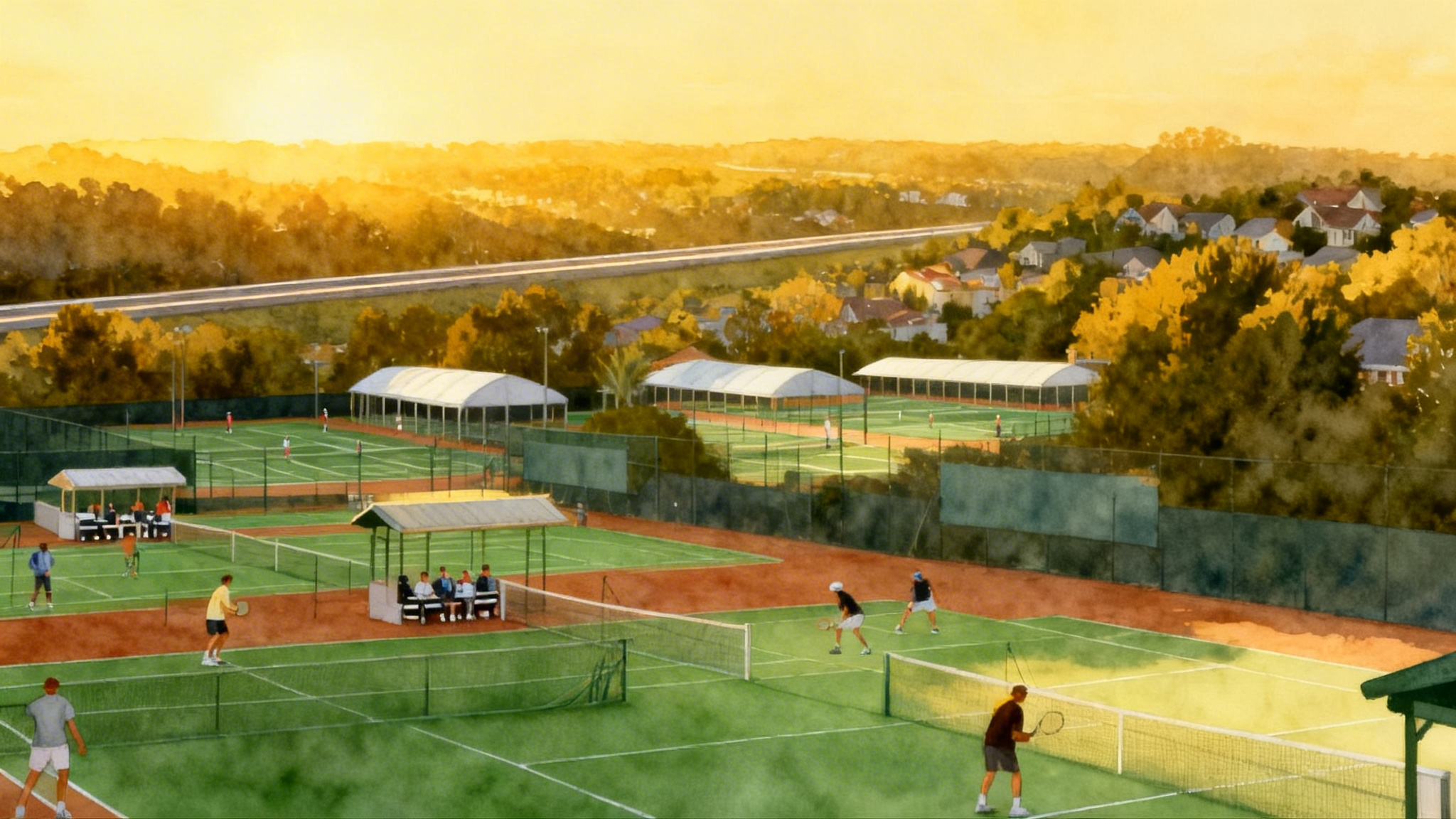
Surfaces: Strong variety. Several clubs offer indoor and clay in addition to lighted outdoor hard courts, which matters for year-round volume and tactical breadth.
Houston
- King Daddy Sports at Chancellors Family Center: Large, level-based after-school system with ample match play and weather-friendly court access.
- Giammalva Racquet Club and Elite Academy: Performance pathway with add-on housing support for out-of-area athletes.
- Lee LeClear Tennis Center and public sites: Deep slate of clinics and local tournament play at accessible costs.
- Life Time and other multi-sport clubs: After-school pathways with fitness integration.
Training model mix: After-school rules the day; boarding-style options exist in limited forms through club-affiliated housing.
Surfaces: A valuable mix of indoor and outdoor hard courts around the southwest and west side, which keeps volume up through summer storms.
San Antonio and Hill Country
- John Newcombe Tennis Ranch, New Braunfels: A classic Texas boarding and full-time option with a long track record; also runs camps for different ability levels.
- Dominion Tennis Center, San Antonio: After-school development and competitive groups.
- King’s Court Tennis Academy at Huber Ranch, Schertz: Development-first pathway for younger players moving toward tournaments.
Training model mix: This region is where true boarding becomes realistic without leaving Texas. After-school choices are healthy inside the city.
Surfaces: Mostly outdoor hard courts, with selective clay options at destination sites.
Facilities and 2025-2026 upgrades that matter
The most useful facility upgrades are the ones that increase ball contacts per week in Texas weather: covered or indoor courts, lighting, and smart campus flow.
-
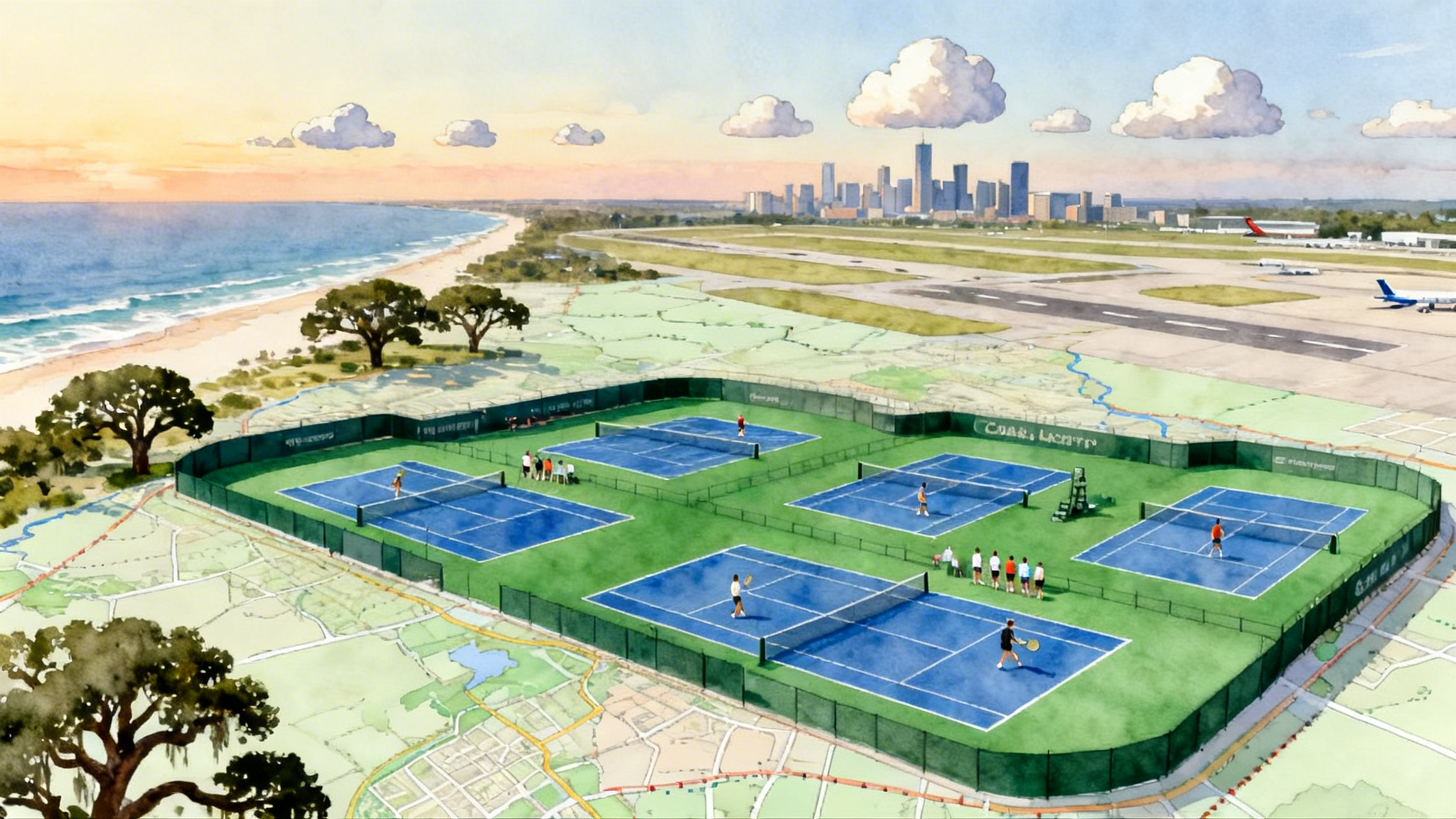
In Austin’s Hill Country, Legend Tennis Academy opened in 2025 with a covered court and plans for phase-two indoor courts, supported by United States Tennis Association venue services. The covered capacity keeps afternoon workouts high quality in July and August and protects match-simulation days when showers pop up. See the USTA feature on Legend’s Spicewood opening.
-
In DFW, Brookhaven Country Club completed a multimillion-dollar racquet complex transformation that now lists 68 total courts including indoor and five Har-Tru clay courts. For juniors, that translates into more reliable training windows and the tactical benefits of both clay and hard in the same week. Details are in the club’s Brookhaven reinvention updates.
-
Also in North Dallas, renovation cycles at private-club campuses continue to add covered courts, add fitness and recovery spaces, and reconfigure layouts so younger groups can move from fundamentals to live-ball courts quickly. The performance gain shows up when ratios hold steady, courts turn on time, and players spend less of a session waiting.
What the training models really mean in practice
- After-school academy: 6 to 12 hours per week across 3 to 5 days. Best for athletes in traditional school seeking consistent, progressive training. Look for posted coach-to-player ratios under 8 to 1 in performance groups and scheduled match play.
- Full-time academy: Morning practice, mid-day academics, and afternoon on-court or fitness. Best for athletes targeting national events or college recruiting windows who need more volume. Look for individualized plans, video checkpoints, and travel support.
- Boarding academy: Full-time training plus supervised housing. Best for out-of-area families or those who want an all-in campus environment. Look for sustained supervision, recovery resources, and clear weekend match plans.
A quick sanity check: if a program cannot show you a sample week, a published pathway, and how a player advances, your child’s progress is at risk of stalling during schedule crunches.
Outcome signals: UTR progression and USTA results
Outcome data is noisy, but a few patterns hold in Texas:
- Early pathway, ages 8 to 11: Expect gradual movement from entry-level events to Level 6 and Level 7 wins. Universal Tennis Rating typically sits below 3 until consistent rally skills and serve returns stabilize.
- Middle pathway, ages 12 to 14: Weekly live ball and regular match play often moves players into Level 5 to Level 6 draws. Universal Tennis Rating in the 4 to 6 range is a common waypoint when volume is steady and competition is chosen well.
- Performance track, ages 15 to 18: With 10 to 14 on-court hours plus two to three strength sessions, consistent Level 4 to Level 5 results and Universal Tennis Rating in the 7 to 9 zone are attainable for many committed varsity-bound athletes. Stronger competitors who travel to deeper draws, manage recovery, and build an efficient serve pattern may climb into 10 to 12.
Use these as planning ranges, not guarantees. The biggest predictor is sustainable weekly volume with meaningful match play and a coach who adjusts tactics, not just technique.
College placement: what Texas families can reasonably target
- Division III programs commonly recruit Universal Tennis Rating 7 to 9 for men and 6 to 8 for women, with academics and character carrying extra weight.
- Division II programs often look for 9 to 11 in men and 8 to 10 in women, plus tournament wins against peers headed to college.
- Division I mid-majors tend to recruit 11 to 13 in men and 9 to 11 in women, with video that shows decision making under pressure and a reliable first-serve percentage.
- Power-conference programs usually seek 13-plus in men and 10.5-plus in women, anchored by national or international results.
Every academy in this guide can place college-bound players when the player’s rating, academics, and habits line up. The work is daily. The process is planned. Ask to see a recent placement list and a sample recruiting timeline.
Cost bands in Texas metros
These are typical 2026 ranges in Austin, Dallas-Fort Worth, Houston, and San Antonio. Always confirm current schedules and discounts for siblings or club members.
- After-school development programs at public centers: roughly one hundred fifty to three hundred fifty dollars per month for two to three days weekly.
- After-school performance tracks at private clubs or academies: roughly three hundred to eight hundred dollars per month for three to five days weekly, sometimes more for added fitness or match play blocks.
- Full-time academy training with daytime academics: plan for a five-figure annual academic tuition plus training fees. Combined annual totals often run from the high teens to mid-thirties, excluding tournament travel.
- Boarding: a premium on top of full-time, reflecting supervised housing and meals. Families should ask for nine-month and twelve-month cost scenarios.
- Private lessons in major metros: typically seventy to one hundred forty dollars per hour depending on the coach’s certification and the facility.
The value question is simple: does your child get a predictable court each day, a consistent coach, meaningful live ball, and a clear plan? If yes, the dollars per hour of true development often beat cheaper but crowded options.
Spotlight matchup: Legend Tennis Academy vs established Texas standouts
Here is how the newcomer in Spicewood stacks up against Texas’s long-running programs, and when it makes sense for your family.
-
What Legend is: a purpose-built training home in the Austin Hill Country for players who want a clear pathway and the practical benefit of covered-court protection. The covered court and phase-two indoor plan are documented by the USTA feature noted above. The on-court culture is progression-based with small-group intensity and visible skill benchmarks.
-
What established standouts excel at: scale and depth. In Dallas, T Bar M Tennis Academy and Brookhaven deliver indoor or covered capacity and clay options that broaden point construction. In San Antonio’s orbit, John Newcombe’s boarding model offers an immersive environment that can harden daily habits for college-bound athletes. In Houston, King Daddy’s level-based system supplies thick local competition and frequent match play.
-
When to choose Legend: you live in West Austin, Bee Cave, Lakeway, or Spicewood and want a training plan that holds through summer heat, or you want a smaller campus where your child is never one of fifteen on a court. The covered court means fewer canceled match-simulation days and steadier technical work on serve and return.
-
When to choose a legacy program: you need multiple surfaces weekly, a larger peer pool at every level, or a boarding option. A deep staff and indoor choices tilt toward Dallas. A fully residential setup tilts toward New Braunfels.
Think of it like choosing a school. A smaller, well-run campus can accelerate learning through attention and consistency. A larger campus can offer more electives. The best choice fits your child’s current stage and next two years of goals.
Quick-pick recommendations by age, goals, and budget
-
Ages 6 to 9, brand new to tennis
- Goal: fun, sound fundamentals, and rhythm in clinics
- Pick: public-center beginners in any metro or entry groups at Legend in Spicewood or Lakes in Frisco
- Budget note: start with two days weekly and add a short private once or twice monthly to lock in grips
-
Ages 10 to 12, moving into tournaments
- Goal: rally tolerance, serve consistency, and first tournament wins
- Pick: after-school performance groups at Austin Tennis Academy, T Bar M, Brookhaven, King Daddy, or Dominion
- How: three training days plus weekend match play; ask for a Level 7 and Level 6 calendar for the next 90 days
-
Ages 13 to 15, varsity-bound in 12 to 24 months
- Goal: Universal Tennis Rating into the 6 to 8 range with reliable match routines
- Pick: performance groups with published advancement standards; in West Austin, Legend’s small-ratio court time can accelerate serve and return work; in DFW, mix indoor hard and clay weekly for tactical depth
- Budget note: consider one recurring private to target the biggest leak in your match stats
-
Ages 15 to 18, college curious
- Goal: film that shows decision making, a clear recruiting timeline, and Universal Tennis Rating that matches target conferences
- Pick: a program with full-time or near-full-time volume, travel support, and a staffer in charge of recruiting logistics; Dallas and New Braunfels are strong fits if you need boarding or multi-surface work
- Action: ask for a sample 18-month recruiting plan with dates for video, outreach, and campus visits
-
Budget-sensitive families at any age
- Goal: consistent touches without overspending
- Pick: city centers plus weekly match play, with a higher-ratio private monthly to correct form; layer in USTA Junior Team Tennis to build competitive comfort
- Action: protect two or three non-negotiable practice windows on the family calendar year round
Parent checklist: five questions that separate programs
- Coach-to-player ratios: What is the maximum ratio in my child’s group and on match-simulation days?
- Surfaces and weather plan: When it rains or hits 105, where do the players go and how is quality preserved?
- Pathway and advancement: What specific technical and tactical markers move a player from one group to the next?
- Match calendar: Who builds my child’s tournament plan and how do you balance development with results across the season?
- Injury prevention: What warm-up, mobility, and shoulder care are built into each week, and who oversees it?
Red flags: no published pathway, 12 kids on one court, ball-feeding replacing live ball for weeks, and silence when you ask how they will develop a second serve that holds up under pressure.
How to use this scorecard in one week
- Day 1: Shortlist two or three academies in your metro that fit your commute and training model. Use our internal pages for Legend Tennis Academy and T Bar M Tennis Academy as examples of the detail you want to see.
- Day 2: Email each with your child’s age, recent match history, and a 90-second rally video. Ask for the group that best fits and the coach-to-player ratio.
- Day 3: Book a trial session and arrive 10 minutes early. Observe whether coaches correct grips, footwork, and decision making, not just hustle.
- Day 4: Request a draft plan for 12 weeks that includes practice days, a tournament list, and one private lesson focus.
- Day 7: Choose the option that gives your child the most reliable reps and the clearest plan. Then protect those practice windows on the family calendar.
Bottom line
Texas offers a rare mix of volume, tournament depth, and increasingly weather-proof facilities. In 2026, families can choose between compact, progression-first campuses like Legend in Spicewood and the scale and surface variety of legacy hubs in Dallas, Houston, and the Hill Country. Use training model, surface access, outcome signals, and clear cost bands to make a choice that fits your calendar and your child’s goals for the next two years. Do that, and the results will follow the reps.