Best Northern California Tennis Academies 2026 Scorecard
A data-backed buyer’s guide to Northern California tennis academies by sub-region, with a clear scorecard rubric, example weekly schedules, commute and school-integration strategies, smoke and air-quality contingencies, and picks by player profile.
 Tommy
Tommy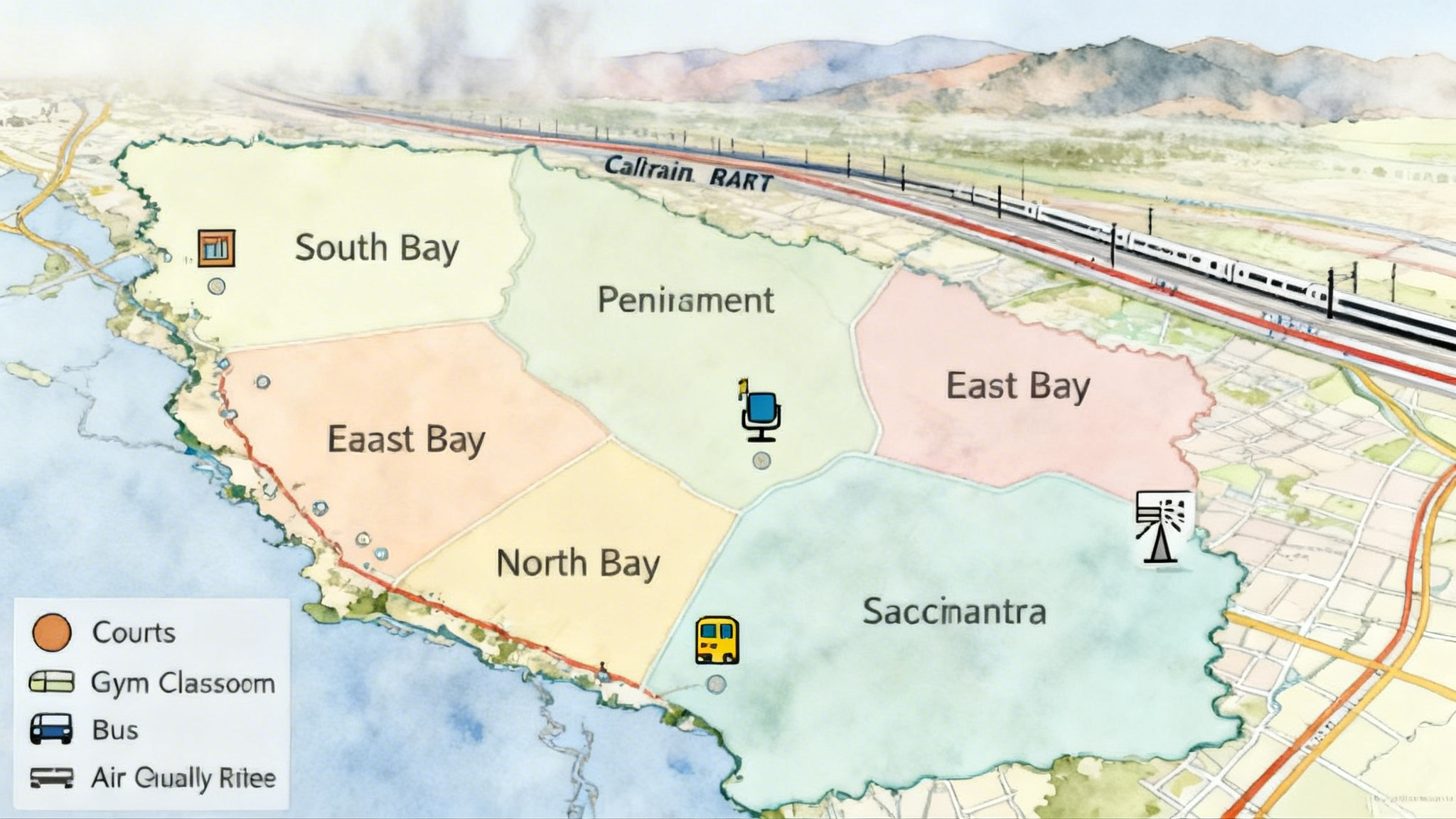
How to use this guide
If you are choosing a tennis academy in Northern California, you are balancing performance, school, commute, and safety. This guide gives you a practical scorecard, a sub-region map to narrow your search, sample week schedules for day and boarding models, and clear logistics checklists. It finishes with picks by player profile so you can get to a short list fast.
Two notes before you start:
- Treat marketing claims as hypotheses. Ask for numbers and proof, not anecdotes.
- Build a three to four week trial plan. Collect simple data daily, then decide with evidence.
The Academy Scorecard
Use this rubric to compare programs apples to apples. Score each category from 1 to 5, multiply by the weight, and sum to 100.
- Coaching ratio and expertise (weight 25)
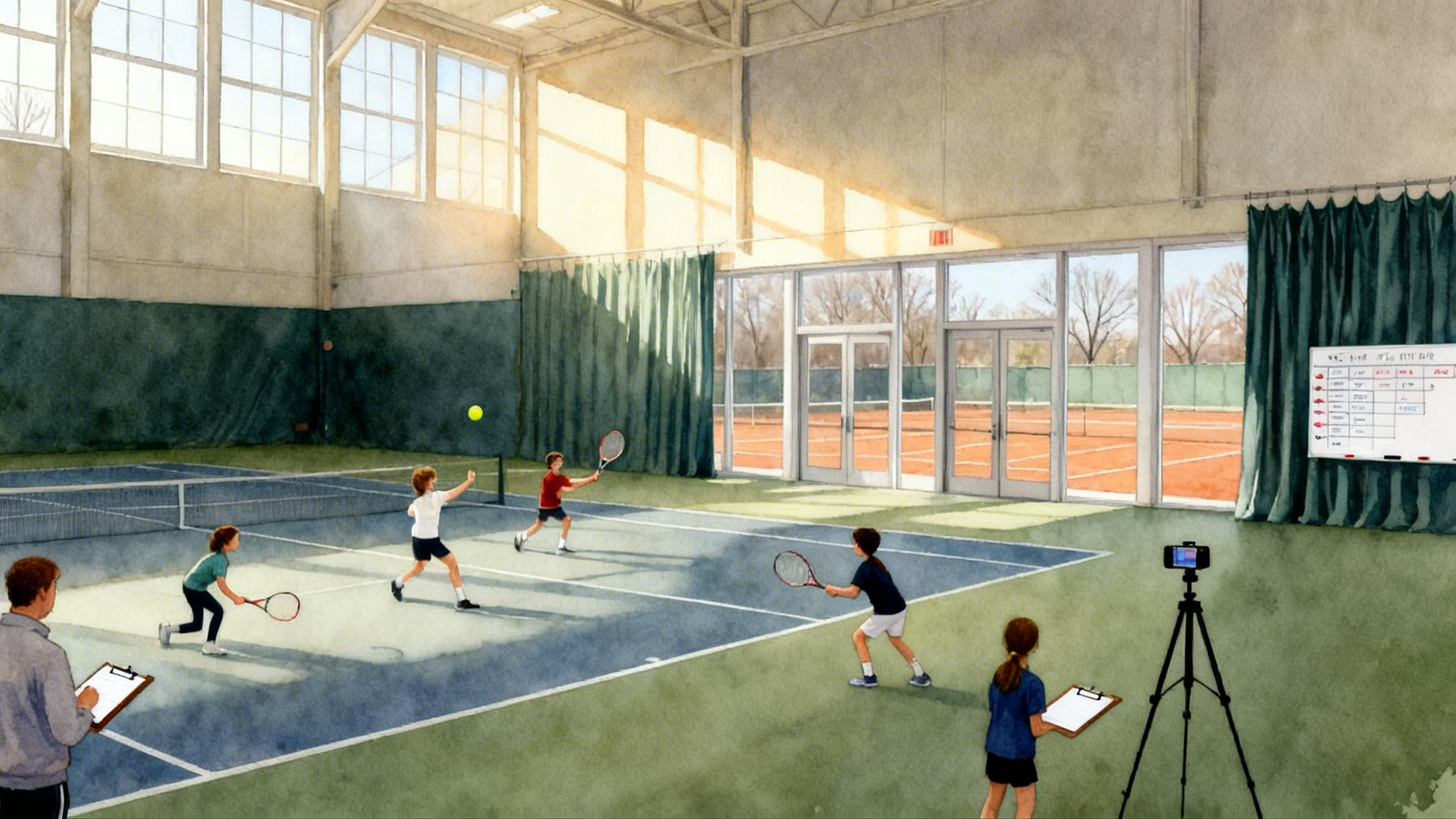
- What to measure: typical live-ball ratio at your level, not the advertised max. Ask to observe two practices. Count players per court and certified coaches on court. Note how often ball baskets appear versus live hitting.
- Benchmarks: 3:1 to 4:1 for performance and college-bound tracks, 5:1 to 6:1 acceptable for 10U green ball when stations rotate well.
- Evidence: session rosters for the last month and a written staffing plan during tournament weekends.
- Surfaces and indoor access (weight 15)
- What to measure: total hard courts available during peak after-school hours, year-round access to covered or fully indoor courts, and any clay exposure for footwork variety.
- Benchmarks: at least 8 courts for performance pods, rain or smoke backup inside a covered or indoor space, one to two clay courts as a bonus for variety.
- Verified match play pathway (weight 20)
- What to measure: frequency of Universal Tennis Rating events and United States Tennis Association tournament integration, plus internal match ladders with recorded results.
- Why it matters: ratings move with verified matches, so you want structured opportunities that count. Read how the rating is built in the official overview, then ask the academy how their events map to that logic. See UTR rating explained.
- Benchmarks: two to four verified matches per week in season for performance and college-bound, at least weekly internal ladder for 10U and early teens.
- Strength and conditioning, sports science, and recovery (weight 15)
- What to measure: periodized S and C blocks, jump and sprint testing, movement screens, on-court workload management, and recovery access such as foam roll protocols, cold water, or compression boots.
- Benchmarks: two to three S and C blocks per week in season, quarterly testing, and an age-appropriate injury prevention plan.
- College placement and progression transparency (weight 15)
- What to measure: last three graduating classes, where they went, and what their ratings and academic profiles looked like six to twelve months before signing.
- Benchmarks: a public or shareable anonymized list showing rating bands, majors, and scholarship type. The key is fit quality, not only Division One logos.
- Cost clarity and value (weight 10)
- What to measure: itemized tuition, S and C, tournament travel, match fees, and housing if applicable. Identify automatic renewals and refund windows.
- Benchmarks: written cost breakdown, trial or drop-in rates, and a clear family communications schedule.
How to score: multiply each category’s 1–5 score by its weight, then sum to 100. Anything above 85 is elite fit, 75–84 is strong, 65–74 is serviceable with tradeoffs, below 65 usually means deal breakers for your stated goals.
Map of Northern California training hubs
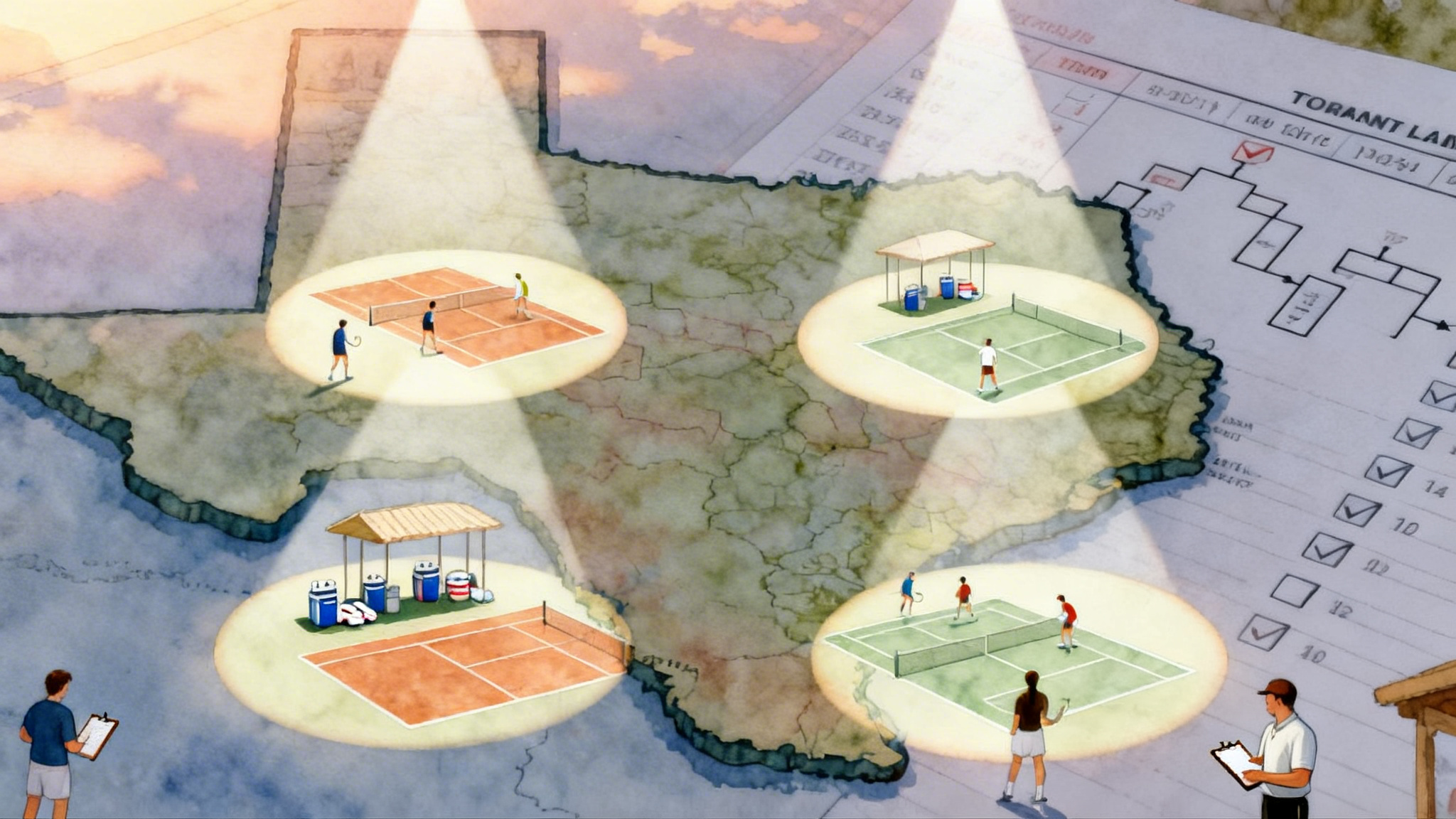
This region splits naturally into five sub-regions. Use this section to filter by commute reality first, then apply the scorecard inside your chosen zone. If you are also comparing other markets, see our SoCal academies 2026 guide and the Pacific Northwest academies 2026 for climate and travel contrasts.
South Bay
- Profile: volume of courts and players, deep weekday ladders, high density of after-school pods.
- Commute windows: northbound and southbound U.S. 101 and State Route 85 clog 7:30–9:30 a.m. and 3:30–7:00 p.m. A 12–14 mile drive can stretch to 45–60 minutes after school.
- Surfaces and indoor: almost entirely outdoor hard, sporadic access to covered courts. Rain plans lean on gym footwork and classroom sessions.
- Match play: strong weekly Universal Tennis Rating events and United States Tennis Association junior calendars, plentiful high-school match scrimmages in season.
- Cost band: upper tier for Bay Area, offset by lower tournament travel if you live nearby.
Peninsula
- Profile: boutique programs with smaller pods, proximity to private clubs, good academics integration.
- Commute windows: State Route 92 and U.S. 101 bottlenecks 7:30–9:00 a.m. and 4:00–6:30 p.m. Caltrain can help for teens comfortable with a walk or bike to courts.
- Surfaces and indoor: rare indoor in the Bay Area sits further north, so Peninsula programs rely on outdoor hard with wind patterns that sharpen ball control.
- Match play: steady weekend Universal Tennis Rating events, some weeknight verified play.
- Cost band: high tuition, but small pods and tight coach access raise value if used well.
East Bay
- Profile: broad spectrum from community-club performance groups to larger academies, easier parking and often more court inventory.
- Commute windows: Interstate 680, 580, and 24 corridors hit heavy traffic 4:00–7:00 p.m. BART helps for older teens heading to urban courts.
- Surfaces and indoor: almost all outdoor hard. Summer heat inland requires hydration and shaded recovery.
- Match play: strong access to weekend tournaments and weekday ladders, especially in suburban clusters.
- Cost band: moderate relative to Peninsula and South Bay, watch travel distances to tournaments.
North Bay
- Profile: smaller but growing performance nodes, tranquil settings, and room for fitness blocks.
- Commute windows: U.S. 101 north of the Golden Gate stacks up 4:00–6:30 p.m. Ferries and carpools are common for families coming from the city.
- Surfaces and indoor: outdoor hard dominates, fog and wind can affect evening play, which is great for developing heavy, high-percentage shapes.
- Match play: fewer weekly verified events than the South Bay, plan for targeted weekend travel.
- Cost band: moderate to high depending on club setting.
Sacramento area
- Profile: home to several nationally respected performance and college-pathway programs, with the best chance of housing or boarding options in Northern California.
- Commute windows: Interstates 50 and 80 are manageable compared with Bay Area corridors, but school pickup windows still slow 3:00–5:30 p.m.
- Surfaces and indoor: strong court inventory, extreme summer heat requires morning doubles blocks or late-evening singles.
- Match play: deep verified match play calendar, strong regional competition, and shorter drives to central valley events.
- Cost band: more value per training hour, especially if boarding reduces weekly travel and parent time costs.
Sample week schedules
Below are snapshots you can adapt. The idea is to integrate school, court, S and C, and recovery while protecting sleep and nutrition.
Day student model (Peninsula or South Bay)
- Monday: 7:00 a.m. mobility and core, breakfast, school 8:30–3:15, snack, commute buffer 3:15–3:45, on-court live ball 3:45–5:15, S and C 5:20–6:00, homework 7:30–9:00, lights out 10:15.
- Tuesday: school 8:30–3:15, verified match 4:00–6:00, post-match recovery 6:05–6:25, dinner, homework 7:30–9:30.
- Wednesday: 6:45 a.m. speed and footwork, school, technique and serve 4:00–5:00, match-play scenarios 5:00–6:00, optional coach office hours 6:05–6:25, study hall 7:30–9:00.
- Thursday: school, cross-training swim or bike 4:00–4:40, doubles patterns 4:45–5:45, mental skills circle 5:45–6:05, early night.
- Friday: school, team ladder 4:00–6:00, weekend tournament prep, pack bag and snacks by 8:00.
- Saturday: tournament or two verified matches, recovery bath or stretch 20 minutes, video review 30 minutes.
- Sunday: easy hit 60 minutes, S and C activation 30 minutes, plan week, lights out by 10:00.
Boarding or housing model (Sacramento area)
- Monday: 7:30 a.m. breakfast, academic block 8:30–11:30 with proctored study, on-court 1 1:45–3:15, S and C 3:30–4:15, on-court 2 4:30–5:30 serve plus returns, dinner, evening study hall 7:30–9:00.
- Tuesday: testing day, thirty meter sprint and jump testing 7:30–8:15, academics 9:00–12:00, verified match window 2:30–5:30, recovery 15 minutes, film tags 20 minutes.
- Wednesday: morning academics, tactical themes 2:00–4:00, small-group workshop 4:15–5:00, mentoring 6:30–7:00.
- Thursday: morning activation 7:30, academics block 9:00–12:00, doubles 2:00–3:15, circuits 3:30–4:10, resilience and breathing 4:15–4:35.
- Friday: match rehearsal 2:00–4:00 with chair umpire practice, pack and lights out 10:00.
- Weekend: tournament travel with coach, Sunday recovery and team debrief.
School integration options
- Traditional school with after-school training: best for 10U and 12–14U who benefit from social anchors. To make it work, protect a 45-minute commute buffer and pre-pack snacks and shoes.
- Hybrid or independent study: common for 15–18U aiming for college, lets you shift heavy training to late morning to avoid traffic and heat. Work with the academy to secure quiet study rooms and a proctor schedule.
- Fully online with boarding: efficient for post-grad gap years and international students. Demand a written weekly academic plan with teacher check-ins and a grade visibility portal for parents. Club-embedded models like the Life Time Tennis Academy overview show how on-site facilities can streamline training and academics.
Questions to ask:
- Who proctors assessments, and where do laptops or calculators live between sessions?
- What happens when a student falls behind, and which adult has accountability to call the parent within 24 hours?
- Are there quiet hours before critical tournament weekends, and what is the phone policy?
Smoke and air-quality contingencies
Wildfire smoke is a reality in late summer and fall. Build a plan before you enroll.
- Thresholds: ask for the academy’s specific Air Quality Index cutoff for moving inside or cancelling, and how they measure it on site. Review the simple government overview at AirNow AQI basics.
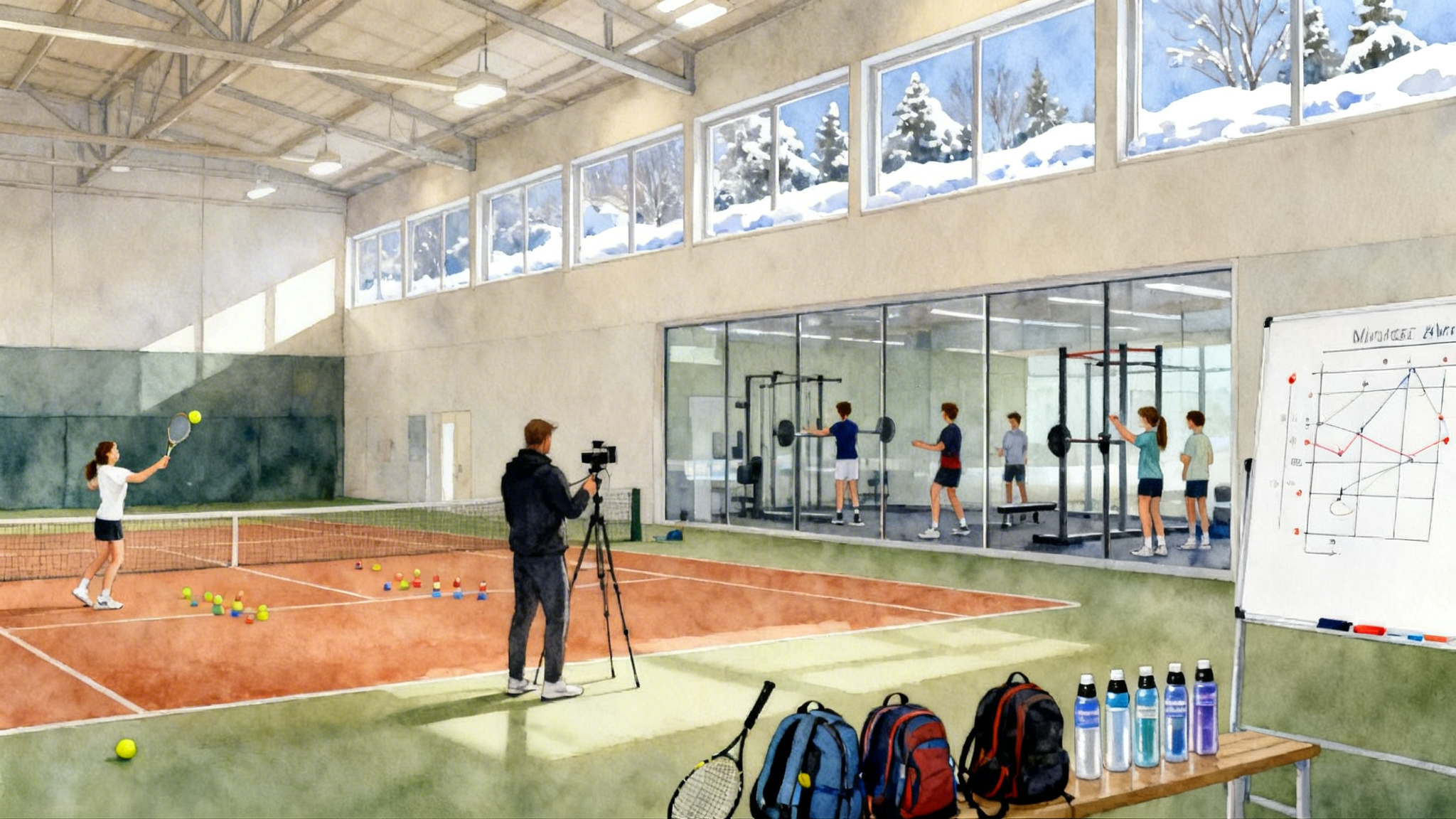
- Facilities: confirm access to covered or indoor courts, high efficiency air purifiers in fitness rooms, and clean air study spaces.
- Practice adaptations: when AQI is elevated but below cancellation, shorten intervals, lower volume, shift to technical serves, use ball-machine stand-ins to reduce rallies, and move S and C inside.
- Communication: you should receive a same-day text and email with the AQI reading, schedule change, and make-up plan.
- Travel: if your academy cancels early, many families drive to cleaner air corridors. Ask the academy whether they run pop-up match play or rent covered courts in adjacent counties. If you might relocate seasonally, compare conditions with the Pacific Northwest academies 2026.
Commute and logistics math
Time is a hidden tuition. Run the math like an operations manager.
- Drive time: measure three real afternoons per route. If the round trip exceeds 75 minutes on average, look for earlier training blocks or consider boarding for peak seasons.
- Transit: Caltrain and BART can work for 14 and up with a buddy system. Audit the walk from station to courts in daylight and at dusk.
- Carpool pods: form three to four family clusters with written pickup days and an emergency fall-back plan. Share a location pin during drives.
- Gear staging: keep duplicate shoes, socks, wristbands, and strings at the academy to avoid panic stops at home.
- Food and hydration: pack 500–700 milliliters of fluid per on-court hour, add a small protein and carbohydrate snack for sessions longer than ninety minutes.
Cost transparency checklist
Ask for an itemized pro forma for one full term. It should include:
- Base tuition by month or session count
- S and C add-ons and recovery use
- Verified match fees and tournament coaching fees
- Travel expenses and coach per diem when relevant
- Housing or boarding, including weekend supervision
- Stringing, grips, and extra court time
- Refund windows, weather credits, and smoke policy credits
Then run value math: divide total projected cost by verified match count and by total coached on-court hours. A lower dollar per verified match often correlates with faster rating movement, assuming coaching quality is strong.
Picks by player profile
These picks are structured by player goals and sub-region realities. Treat them as templates to narrow your search, then use the scorecard on your finalists.
10U green ball
- Best fit: small-pod Peninsula or North Bay groups that prize coordination, serve and return foundations, and playful scoring.
- What to prioritize: 5:1 or better ratios, lots of overhand serve reps, and weekly internal ladders that keep score. Parents can rotate carpools since sessions are shorter.
- Why not chase volume yet: more hours without high-quality attention builds habits that take double the time to unwind later.
12–14U performance
- Best fit: South Bay or East Bay programs with deep weekday ladders and frequent verified events. You want two to three competitive matches each week plus one technical day.
- What to prioritize: 3:1 to 4:1 ratio in live ball, structured S and C twice weekly, a coach who scouts your weekend matches, and a written theme for each practice block.
- Commuting tip: consider an early dismissal once a week to train 2:00–4:00 p.m. and miss traffic.
15–18U college-bound
- Best fit: Sacramento boarding or hybrid models with a clear college placement record and transparent data on prior classes. Add a Peninsula or South Bay day model if academics or family ties keep you local.
- What to prioritize: verified match density, doubles reps to help college readiness, and study hall with proctoring. Ask to see a template of the recruiting timeline, including target rating bands and sample emails to coaches.
- Parent action: schedule quarterly check-ins with the academy director. Track rating movement, serve speed, fitness testing, and academic benchmarks on one page.
Post-grad gap year
- Best fit: Sacramento housing or boarding with a workload that simulates college tennis. Morning court blocks with afternoon S and C, plus video review and nutrition support.
- What to prioritize: two verified match windows weekly, exposure to college level hitters, and life skills like laundry, food prep, and time blocking. Ask for a weekly expense sheet so you learn to budget.
Adult NTRP 3.0–5.0
- Best fit: East Bay or South Bay programs that run evening live-ball and weekend match blocks. Adults need honest ball tolerance work and a doubles-first mindset if they play league.
- What to prioritize: level-segmented courts, a short video assessment, and coach notes you can keep. Plan for one technique hour, one live-ball hour, and one match block each week.
- Commute hack: schedule sessions at 7:00 p.m. or later to cut traffic, then add a lights-out routine to protect recovery.
How to run a 30-day trial
- Week 1, observe: watch two practices, note real ratios, and time the commute. Ask for last month’s rosters, a sample S and C worksheet, and a verified match calendar.
- Week 2, participate lightly: attend three sessions, film ten minutes of live ball, and play one verified match. Log sleep and soreness.
- Week 3, full load: run your target schedule, including S and C and two to three verified matches. Confirm study hall quality if school is in session.
- Week 4, decide with data: plug scores into the rubric, compute dollar per verified match and dollar per coached hour, and compare to your second choice.
Putting it together
Pick a sub-region that your family can reach on tough days, not only on the best days. Use the scorecard to force clarity on ratios, match play, and cost. Demand receipts on college placement, not logos. Protect school by assigning a single adult to own grades, and protect lungs by pre-writing your smoke plan with thresholds and backups. If you are evaluating multiple states, pair this with the SoCal academies 2026 guide for a Southern California comparison. If you treat this like an engineering project for four weeks, the best fit becomes obvious and your athlete will feel both supported and challenged. Northern California offers the full menu, from small boutique pods to boarding powerhouses. With a clear rubric and a trial mindset, you can choose confidently and train with purpose.