Best Mid-Atlantic Tennis Academies 2026: DC, Maryland, Virginia
A practical, data-driven buyer’s guide for junior families in Washington DC, Maryland, and Virginia. Compare training models, indoor access, UTR growth, college placement, surfaces, tournament density along I-95, and transparent costs.
 Tommy
Tommy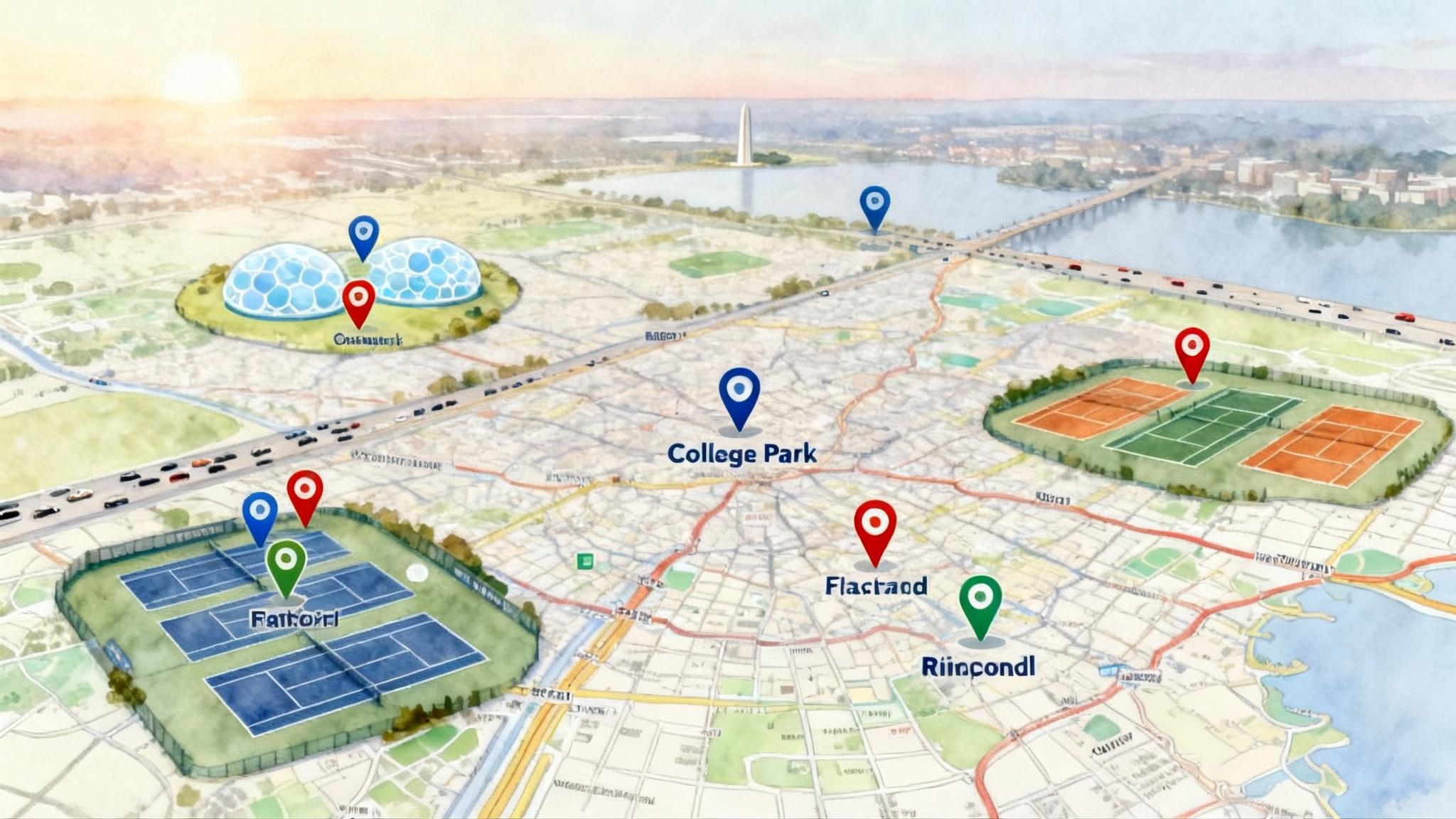
How to use this guide
Families in Washington DC, Maryland, and Virginia sit in a rare sweet spot for junior tennis. The I-95 corridor delivers dense tournament calendars, year-round indoor access if you plan well, and a deep field of players for match play reps. This guide helps you compare programs with the same rigor a college coach would use when building a lineup.
The promise is simple. If a program can deliver steady Universal Tennis Rating growth, credible college placement outcomes, consistent indoor winter training, and affordable logistics, it deserves a close look. Throughout this article, you will find the key metrics, example programs, and two seasonal plans that convert those ideas into action.
The metrics that matter
The best academies publish clear performance signals. When you evaluate, organize your notes around the following six categories.
- UTR growth and match volume
- What was the median UTR gain for players who were enrolled for at least 9 months, separated by age and baseline UTR band?
- Ask to see anonymized before and after charts, not just top outliers.
- Look for weekly match volume of 2 to 4 verified matches in season. Universal Tennis Rating is widely used in college recruiting. If you are new to UTR, start with the official overview of how the rating is calculated and why verified play matters: how the UTR Rating works.
- College placement outcomes
- Request a two-page placement sheet showing the past 4 graduating classes, with the player’s peak UTR senior year and final college roster landing spot.
- Separate men and women since the recruiting market behaves differently.
- Training model and daily design
- Ask for a weekday microcycle. The most effective weeks include 50 to 70 percent live ball and point play, 20 to 30 percent fed-ball constraints, plus a clear physical block tied to on-court themes.
- Quality academies publish sample practice menus. For example, a Tuesday “first strike and depth” day might use short-deuce games, serve plus one patterns, and cross to line cages.
- Indoor access in winter
- Indoor court time is the bottleneck in the Mid-Atlantic from November through March. Families should ask how many indoor courts the academy controls outright, and which hours are reserved exclusively for the academy.
- Confirm blackout dates for bubbles and club events.
- Surfaces and adaptation
- The region skews hard court, with patches of green clay especially in Northern Virginia and suburban Maryland clubs. Strong programs use at least 15 to 25 percent of weekly volume on slower courts during developmental phases to sharpen point construction and defense.
- Transparent costs and travel logistics
- Request written pricing for academy tuition, private lesson tiers, fitness add-ons, and indoor court surcharges. Ask for a sample winter invoice and a sample summer invoice.
- Map tournament density within 60, 90, and 120 minute drive windows. Time lost in the car is time not spent training or recovering.
The geography advantage: the I-95 tournament belt
Between Baltimore, Washington DC, and Richmond, you can play verified matches almost every weekend from late March through early November. The United States Tennis Association Mid-Atlantic calendar is the central hub for scheduling. When you interview academies, ask which events they prioritize and who coordinates entries. You can scan official dates via the USTA Mid-Atlantic tournament calendar.
Families who split time north or south of the region can expand their search with our Best Northeast tennis academies 2026 and this Southeast tennis academies guide.
Practical mapping tips
- 30 to 60 minute radius: ideal for day-trip events during school months. Expect Bethesda to College Park in 25 to 40 minutes depending on traffic, McLean to Fairfax in 15 to 30 minutes, and DC to Bowie or Laurel in 30 to 45 minutes.
- 60 to 120 minute radius: plan one overnight bag per player and a recovery day. Richmond to DC is about 105 to 120 minutes without construction.
- Use departure windows. The same 40-mile trip can swing by 30 minutes if you roll out before 7:15 a.m. or after 10:00 a.m. on Saturdays.
Why indoor access is the Mid-Atlantic tiebreaker
A Mid-Atlantic winter is not an off season. The best families buy reliable indoor hours and treat January and February as the engine of next summer’s jump. When comparing programs, get specific:
- How many indoor courts does the academy control during weekday prime time, 4:00 to 8:00 p.m.?
- What is the ratio of players to courts in winter blocks? Anything above 6 players per court in prime technical segments forces coaches to fake reps.
- Which days are dedicated to verified match play under the roof? One winter match night per week builds comfort with indoor tempo, lower bounce, and tighter space.
Training models you will see
Most Mid-Atlantic academies blend three well-known models. Understanding these will help you match your player’s needs.
- Volume and patterns model: high ball count, paced rallies, and constraints-based drills that build shot tolerance and length. Great for players who need more rally shape and depth before adding pace.
- Live ball and decision model: small court and full court games that force serve and return decisions and first strike patterns. Best for tournament-ready players who need more competitive reps with defined scoring systems.
- Physical and movement model: specific footwork patterns, acceleration and deceleration, and multi-direction court coverage. Useful in winter when outdoor running options are limited.
For technical work tied to live-ball goals, see our guide to build a consistent forehand.
Program snapshots
These snapshots highlight how to evaluate. Always ask each program to confirm 2026 schedules and pricing.
- JTCC, College Park, Maryland
- Who it fits: tournament juniors targeting Division One or strong Division Three, plus national level younger players who need a demanding training rhythm.
- Why it is respected: dedicated performance pathway, deep sparring pools drawn from the region, and a track record of moving juniors to top college rosters and, in some cases, into professional draws.
- What to confirm: winter indoor allocations by group level, the weekly matchplay block, and how fitness integrates with on-court themes. Ask for UTR entry and exit snapshots for players who stayed at least one full school year.
- 4 Star Tennis Academy, Fairfax County, Virginia
- Who it fits: competitive juniors who thrive in live ball environments and want structured tournament coaching around Northern Virginia and the DC beltway.
- Why it is respected: continuity of coaching, college placement guidance, and accessible commute for families in McLean, Vienna, Falls Church, and Fairfax.
- What to confirm: ratio of live ball to fed ball in your player’s specific group, indoor court control at partner clubs, and a sample four-week ladder of verified matches.
- WTEF Performance, Washington DC
- Who it fits: players who want a performance track on a city campus, with an education-forward environment and indoor access.
- Why it is respected: consistent mentorship, modern facilities, and a mission-driven culture that still puts competitive match play at the core.
- What to confirm: winter prime-time court blocks, tournament coaching at key Mid-Atlantic events, and the process for moving up training groups.
- Montgomery TennisPlex Performance, Boyds, Maryland
- Who it fits: families in upper Montgomery County who need reliable indoor capacity and structured UTR match nights.
- Why it is respected: large indoor facility footprint, predictable scheduling, and convenient access from Germantown, Clarksburg, and Gaithersburg.
- What to confirm: coach-to-court ratio during winter, summer outdoor options on adjacent courts, and verified match calendars.
These are not the only options in the region, but they illustrate the evaluation framework. Ask any academy for numbers, not slogans.
Surfaces, balls, and specificity
Surface variety teaches patience and creativity. Your weekly plan should show when and why you switch surfaces.
- Green clay blocks: 1 to 2 sessions per week during build phases teach defense, higher margins, and shape. Use lighter balls only if the academy explains the purpose, otherwise use standard championship balls to keep feedback realistic.
- Hard court blocks: 3 to 4 sessions drive first strike patterns, return depth, and serve variety. Use score-based games with serve targets and return plus one rules.
- Indoor hard in winter: the bounce plays lower and quicker. Build serve and return reps at the start of every session, then compress points to short-deuce games to mirror indoor tempo.
Cost transparency: how to price a real year
Prices vary by club partner and indoor demand. The useful move is to evaluate total cost of ownership for a full year, not just tuition headlines. Ask each program for two sample invoices.
- Winter sample invoice, January: academy tuition by hours per week, indoor court surcharge if billed separately, fitness block, one private lesson, plus two verified match entries.
- Summer sample invoice, July: academy tuition for extended hours, outdoor court fees if any, two private lessons, and two tournament entry fees with coaching.
Typical line items to expect in the Mid-Atlantic:
- Academy tuition, 3 to 5 days per week: often sold monthly or by seasonal block.
- Private lessons: usually tiered by coach designation. Ask for the ladder in writing.
- Indoor court fees: can be embedded or billed per session during peak months. Get it in writing.
- Fitness and recovery: small group strength, mobility, and prehab. Confirm staffing credentials and injury protocols.
- Tournament coaching fees: per day or per event, plus coach travel if the event is outside the metro area.
The most transparent programs will put all of this into a single sheet for you to compare apples to apples.
Two seasonal plans you can copy
Below are two example annual plans built for the Mid-Atlantic calendar. Adjust dates to match school breaks and academy schedules.
Plan A: UTR 9 to 11 junior chasing Division One
- January to early March: three weekday academy sessions, one winter match night, one private lesson every other week, one strength block. Aim for 2 verified matches per week under the roof.
- Late March to early June: shift to two weekday academy sessions, one long Friday mixed matchplay, one weekend tournament twice per month. Keep the private lesson cadence.
- Mid June to mid August: four-day summer training block, two tournament weekends per month. Schedule one light recovery week after every three tournament weeks.
- Late August to October: high school conflicts vary. Keep 1 to 2 academy sessions to protect technique and fitness. Use Sunday verified match play to maintain rating.
- November to December: rebuild block, focus on serve and return. Return to three indoor sessions and one winter match night. Review yearly UTR chart and build targets for January.
Plan B: UTR 5 to 7 junior building foundations
- January to early March: two weekday academy sessions with a fundamentals group, one technique private every week, one low-pressure match play night every other week. Use orange or green dot balls if the rally length is not stable with yellow.
- Late March to early June: two academy sessions, one weekend tournament per month at the right level, one private every other week. Goal is rally length to 6 balls crosscourt before opening the court.
- Mid June to mid August: three-day camp block or academy summer hours, weekly verified match night, and one tournament every three weeks.
- Late August to October: maintain two academy sessions, save one private lesson per month to tune serve.
- November to December: two indoor sessions per week, one fun formatted match event per month to keep confidence high.
Quick maps and commute planning
Families win by making commutes predictable. Try this three-zone approach and slot events accordingly.
- Zone 1, under 45 minutes door to door: weekday training and school-night match play.
- Zone 2, 45 to 90 minutes: weekend day events and select two day tournaments where draws justify the drive.
- Zone 3, 90 to 150 minutes: targeted summer events and winter three day blocks at facilities with reliable bubbles.
Draft your own map in five minutes. Pin your home, school, and two preferred academies. Add pins for three tournament venues you expect to visit often on I-95 and I-270. Time the drives at the exact hours you would leave for training or warm-ups. Record the worst case along with the median.
What to ask on your first visit
Use this checklist in the lobby. Bring a pen and write the answers.
- How many total academy hours per week can my player access in winter and in summer? Show me the schedule.
- How many indoor courts do you control from 4:00 to 8:00 p.m. on weekdays? Show me a court sheet.
- What is the average coach tenure and which coach will own my player’s plan?
- Which verified match opportunities will you organize each month? Who coordinates entries and how do you group carpools?
- Show me a sample UTR progress chart for players who stayed at least 9 months and trained 3 days per week.
- Which strength coach runs the program and what are their credentials?
- What is the process for moving up training groups? Is it time based, skill based, or both?
- Please provide a written winter invoice and a written summer invoice with all likely fees.
Reading the data you collect
Once you gather program sheets, build a simple scorecard with five columns: UTR growth track record, college placement record, indoor court control, training model fit, and total cost of ownership. Rank each category on a 1 to 5 scale. Use comments for commute friction and culture notes.
- If a program scores high on growth and indoor access but only moderate on cost, it may still beat a cheaper option that cannot secure winter courts.
- If a program has strong college placement but no recent success with players in your UTR band, ask for more data or a trial block.
Common pitfalls to avoid
- Overloading tournament weekends without enough practice quality. Two tournaments per month is plenty when combined with weekly verified match play.
- Chasing glamour over fit. The best academy is the one that can deliver the right practice density for your player, on the right courts, with the right peers.
- Ignoring recovery. Winter indoor blocks add stress. Commit to sleep, mobility, and a real off day every week.
Final word
The Mid-Atlantic is a high trust marketplace for junior tennis if you ask for the right numbers. Treat indoor court time as your winter currency, treat verified match play as your performance tracker, and select a training model that turns those resources into points on Saturdays. If you leave each academy visit with a sample invoice, an indoor court schedule, and a month-by-month match plan, you will be ahead of most families before the first ball is struck.