Build a Consistent Tennis Forehand: Mechanics, Drills, Fixes
 Tommy
Tommy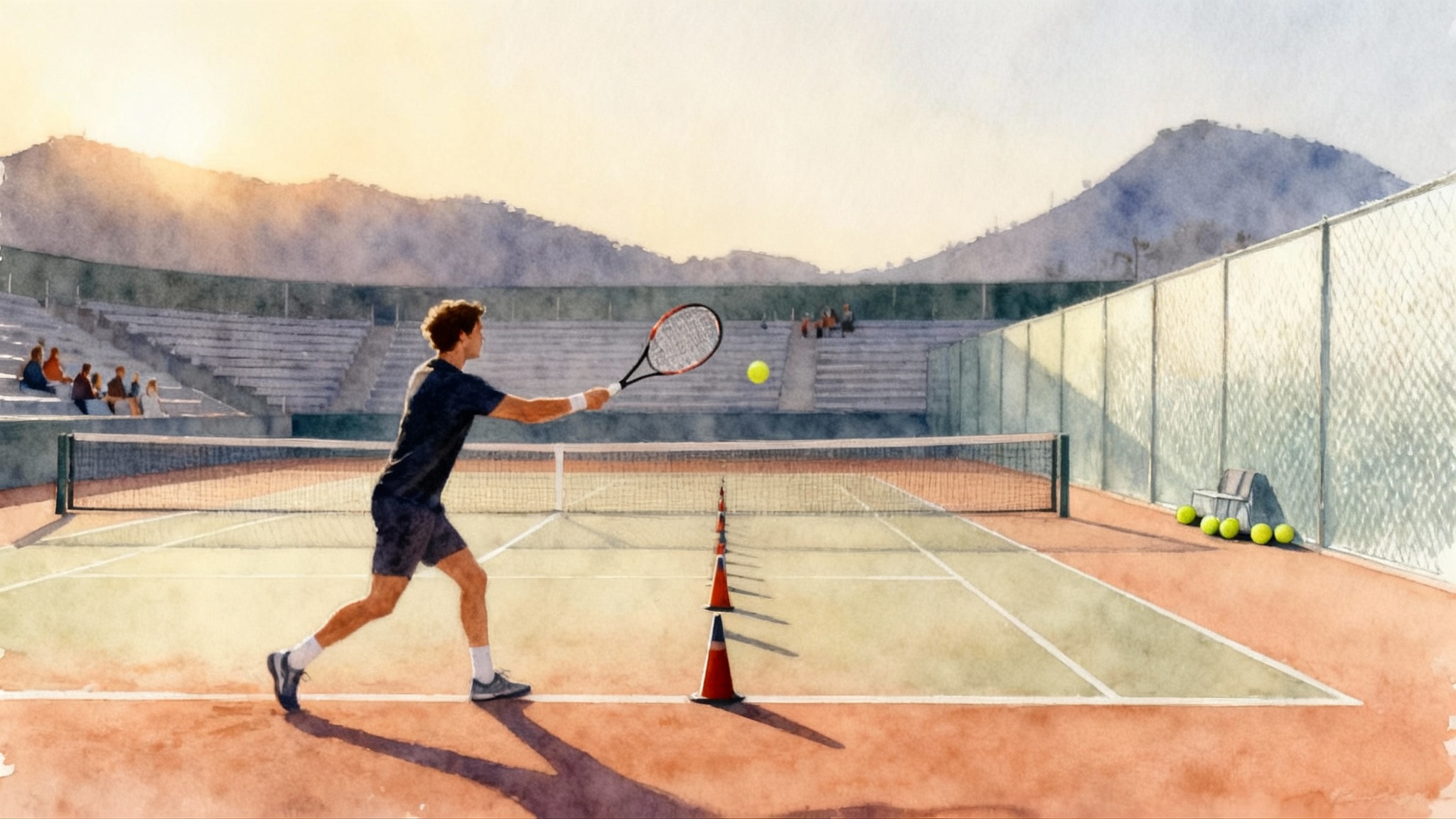
Why consistency beats power
Big forehands look great on highlight reels, yet most points are won by the player who puts the ball in the same quality spot again and again. Consistency means your contact, ball height, depth, and spin hold up when the score tightens. When your forehand is predictable to you, it becomes unpredictable to an opponent. The goal of this guide is to give you the mechanics and daily habits that make your forehand travel on a repeatable flight path, even when your heart rate is up.
The simple model of a repeatable forehand
Think of your forehand like a train on a track. The track is your swing path. The train is your racquet. If the track is laid in the same place every time, the train arrives at the same station, which is the contact point. To lay that track, build three pillars:
- Stable base: balanced stance and calm head
- On-time contact: early preparation and ball judgment
- Continuous path: swing that accelerates smoothly through the ball
Everything below supports one or more of these pillars.
Stance and balance that hold up under pressure
- Feet: Set your outside foot as the anchor. In an open stance, the outside foot plants slightly wider than shoulder width. In a neutral stance, allow your front foot to step along the baseline as you rotate. Either way, think knees soft, weight in the balls of your feet, not in your heels.
- Hips and torso: Coil as the ball travels, not after it bounces. Show your chest roughly sideways to the net during the unit turn, then rotate through contact so your belt buckle finishes facing the target area.
- Head: Keep your chin quiet. A steady head lets your eyes track the ball cleanly and reduces last second steering. If a friend filmed you, you would see your eyes lingering near the contact point just after the ball leaves.
Cue you can say out loud during shadow swings: Plant, turn, swing. Short, clear, and in order.
Grip and contact that reduce mishits
There is no one correct grip, yet two options dominate for consistency:
- Eastern forehand grip: Versatile, easy to flatten or add spin, great for lower bouncing balls. Consistency comes from a square face at contact and a level, slightly upward swing.
- Semi western forehand grip: Adds natural topspin for higher nets and heavier balls. Consistency comes from brushing up the back of the ball with a face that is slightly closed at contact.
Whichever you use, search for these checkpoints:
- Contact in front of your hip, not beside your body
- Arm relaxed, wrist laid back but not stiff
- Strings travel up the ball, not across it
A simple image: draw a vertical line on the back of the ball and wipe it from low to high. You are polishing that stripe, not carving across the equator.
The unit turn that starts you on time
The forehand gets late when the hands start late. Solve this with a unit turn that is automatic on the split step. As your opponent makes contact, perform a small hop that lands with both feet, then turn your shoulders and hips as a single piece while your racquet rides the turn. The racquet face should be above your hands and outside your body line, not jammed behind your back. This creates space and keeps the racquet on the outside of your swing arc so you can accelerate forward without detours.
Coaching cue: Turn with the ball. If the ball is fast, your turn is early and compact. If the ball is slow, you still turn early, then you wait with your body coiled instead of rushing late.
The loop and lag, made practical
Players hear about the drop and lag, then overdo it. Keep it simple. From the unit turn, the racquet tip traces a small oval as your hand relaxes. Gravity helps the racquet drop below the ball. The hand leads, the racquet tip trails, which creates the classic lag. You do not force it. You feel it. If your grip is relaxed and your elbow points down and out from your rib cage, the lag appears as a byproduct.
Two signs it is working:
- The racquet head is below the ball before contact
- Your forearm and racquet form a shallow angle that straightens as you swing through
Through-contact rules that never change
- Swing low to high. The low point sits roughly under your contact. Even on flatter balls, the path rises slightly.
- Drive through the ball for the first forehand of a rally. Add more upward path and arc when defending or when the ball is low quality from your opponent.
- Finish over your shoulder or around your ribs depending on ball height and intent. A higher finish raises net clearance and adds spin. A wrap around finish keeps the ball flatter when you have time.
Imagine you are throwing a frisbee with your strings. Your chest turns, your arm follows, and you release toward the target, not to the side fence.
Ball height, spin, and depth: the consistency triangle
Three variables control outcomes more than anything else.
- Height: Aim to clear the tape by three to five feet for rally balls. This margin forgives small timing errors.
- Spin: Topspin makes the ball curve down into the court. If you struggle with long misses, add more upward path and feel the strings grab the ball for a quarter second longer.
- Depth: When in doubt, land the ball in the deep middle third. Depth pushes opponents back and buys you time. Angles are for advantage, not for neutral rallies.
Track these with a simple rule during practice: if two out of three are good, the ball is probably playable. If all three are poor, pause and reset your swing tempo.
The three cornerstone drills
These drills build repetition without needing a ball machine.
1) Lane rally
Place two flat cones or water bottles to create a lane from the baseline to the opposite baseline that is two racquet lengths wide. Rally forehands crosscourt with a partner and score only the balls that land in the lane. First to twenty wins. This narrows your target and teaches you to work the height and spin knobs to keep the ball in your lane.
Progression: Make the lane narrower by half a racquet length each round. Then move it down the line.
2) Two heights, one target
Pick a crosscourt target triangle, the deep corner between the singles sideline and baseline. Alternate ball height on each shot while still aiming for the same triangle: one ball with a shoulder high finish, one ball with a rib cage finish. You will feel how a slightly steeper path adds safety without changing the aim.
Scoring: Ten successful pairs without an error. If you miss, restart the count.
3) The five ball pattern
Feed yourself or have a partner feed five balls of different speeds or heights. Your job is to hold the same contact point and finish position on all five. Slow your feet, not your hands. This trains you to adjust to the ball while keeping your swing geometry.
Progression: After the fifth, hit one controlled change of direction down the line, then recover crosscourt. The change of direction tests your balance and timing.
Common faults and fast fixes
- Late contact: If you are jamming yourself, set a visual marker one shoe length in front of your lead foot. You must see the ball cross that marker before you swing. Film for ten swings and check whether your racquet is striking in front of your hip.
- Wild long misses: Lower the height of your low point and brush more. Shadow swing with the racquet head a ball width below your intended contact, then repeat with a ball in hand. Feel the strings travel up the back, not across.
- Balls into the net: Add knee flex and raise your finish eight inches. If the finish rises, the launch angle rises. If that alone does not help, start your preparation earlier so you do not cut off your upward path.
- Frame hits: Create more space. During the unit turn, show the strings to the side fence, not to the back fence. This keeps the racquet outside your body line and clears your hitting shoulder.
- Overforcing the wrist: The wrist lays back naturally if your grip pressure is at a five out of ten. Squeeze at impact only as much as needed to keep the racquet stable. Overgripping kills feel and removes the natural lag.
A twelve minute daily forehand routine
You can make progress in less time than you think if you are deliberate. Try this at the start of any session.
- Minutes 0 to 2: Shadow swings without a ball. Ten slow swings where you freeze the finish for two seconds. Check chin steady, balanced feet, contact in front.
- Minutes 2 to 5: Drop feeds. Hit twenty balls to the deep middle, height three to five feet above the tape, finish over the shoulder. Focus on a smooth tempo, not speed.
- Minutes 5 to 9: Crosscourt rally. Lane drill scoring to ten, then switch sides.
- Minutes 9 to 12: Targeted changes of direction. Three crosscourts, one controlled down the line. Do not miss the down the line ball. If you do, repeat the pattern.
Log your results in a simple note: percentage made, average height, and whether your contact felt early, on time, or late. A written log turns feelings into data. If you want guided environments that reinforce this routine, see the Best Southern California tennis academies and the Best Florida junior academies.
What gear can do for your margin
Equipment will not replace technique, yet it can widen your window of safety.
- Racquet: A modern midplus frame from brands like Wilson, Babolat, Head, or Yonex provides a blend of stability and spin. Look for a head size in the one hundred square inch range and a string pattern such as sixteen by nineteen for easier spin.
- Strings: Polyester strings amplify spin but can be harsh. A hybrid with polyester mains and a softer cross, or a full bed of multifilament, adds comfort. Softer strings strung a couple of pounds lower raise launch angle slightly, which can lift balls over the net without extra effort.
- Grip size: If your hand strains, your grip is probably too small or too large. Proper grip size allows relaxed pressure so the racquet can drop and lag naturally.
If you change gear, change one variable at a time. Test the same routine as above and note differences in ball height and depth.
Match situations that break or build consistency
- Return of serve: On second serves, step in and use a compact forehand swing with extra height over the net. Your priority is depth and direction, not pace.
- Short balls: Do not swing bigger. Move your feet quickly so the ball arrives at your preferred contact. Use a slightly higher net clearance than you think, then let the bounce and forward movement create speed.
- Heavy incoming pace: Widen your stance and reduce your backswing while keeping a full follow through. Think absorb then release.
- Windy days: Aim bigger targets through the middle and raise your net clearance by a foot. Heavier topspin helps the ball dip inside the baseline when gusts push it long.
A coach’s checklist you can run yourself
Film from the side at chest height for ten forehands in a row. Pause each rep at these frames and check yes or no.
- As the ball bounces on your side, are your shoulders already turned and your racquet head outside your hands?
- Is the racquet head below the ball before you start forward?
- Is contact clearly in front of your lead hip?
- Do your strings finish pointing toward the target before your racquet wraps around?
- When the swing finishes, can you balance on your outside foot for one count without wobbling?
If you score four out of five yes, your forehand is on track. If you score below three, build two focused drills into your next two sessions rather than trying everything at once.
How to measure progress without a sensor
Fancy sensors and smart cameras help, but you can track progress with a few simple numbers.
- Rally tolerance: How many crosscourt forehands can you hit in a row at a comfortable speed without an error? Baseline goal is twenty.
- Net clearance: Ask a partner to hold a racquet above the net. Aim to clear the tip by two or three balls on rally balls.
- Depth control: Place a strip of tape three feet inside the baseline. Count how many balls land past the tape in a set of fifty. Thirty five is a strong benchmark.
Record these once a week. Consistency is the trend in your notebook, not a single good day.
A sample two week plan
You can slot these sessions into busy schedules and still move the needle.
- Day 1: Twelve minute routine, then twenty minutes of crosscourt play to the lane. Finish with ten changes of direction down the line.
- Day 3: Serve plus one. Every serve is followed by a forehand to the deep middle. Track serve location and whether the forehand cleared the tape by at least three feet.
- Day 5: Pattern day. Two crosscourts, one down the line, recover crosscourt. Repeat for twenty minutes at moderate speed.
- Day 8: Pressure sets. First to twenty in the lane rally, then a tie breaker to seven where every point starts with a forehand approach ball that must land past the service line.
- Day 12: Film and audit with the five frame checklist. Note two wins and one focus for the next two weeks.
If you train alone, use a wall. Mark a square that is three feet above the ground and two feet wide. Try to keep the ball inside that square for fifty consecutive hits. The wall gives instant feedback on height and direction.
Bringing it into your coaching or practice group
If you coach or play in a group, assign roles and metrics. One player feeds, one hits forehands, one tracks height and depth. Switch roles every five minutes. Give specific, observable feedback, such as “Your last five cleared the tape by three to four feet” rather than “Nice ball.” This builds a culture of measurable quality.
If your club uses video, set up one side camera for twenty minutes during peak forehand work. Facilities like the Life Time Tennis Academy make it easy to combine training, match play, and review within one campus.
The quiet power of a consistent forehand
Consistency is not a boring ceiling. It is the floor that lets you attack on purpose. When your base, contact, and swing path repeat, you spend less energy rescuing points and more energy creating them. Start with the unit turn, set your contact in front, and let the racquet travel on that same well laid track. Do the small things every session, log the results, and let the trend line rise. Reliable patterns win sets, and reliable sets make seasons. Your forehand can become the shot you trust most, not by adding mystery, but by repeating what works with calm, everyday precision.