Best Texas Tennis Academies 2025–2026: Dallas, Houston, Austin
A practical, side-by-side guide to Texas high performance tennis for 2025–2026. Compare Dallas, Houston, and Austin on junior and college-prep pathways, pro-track depth, surfaces, heat plans, boarding options, costs, and 2026 tryout timing.
 Tommy
Tommy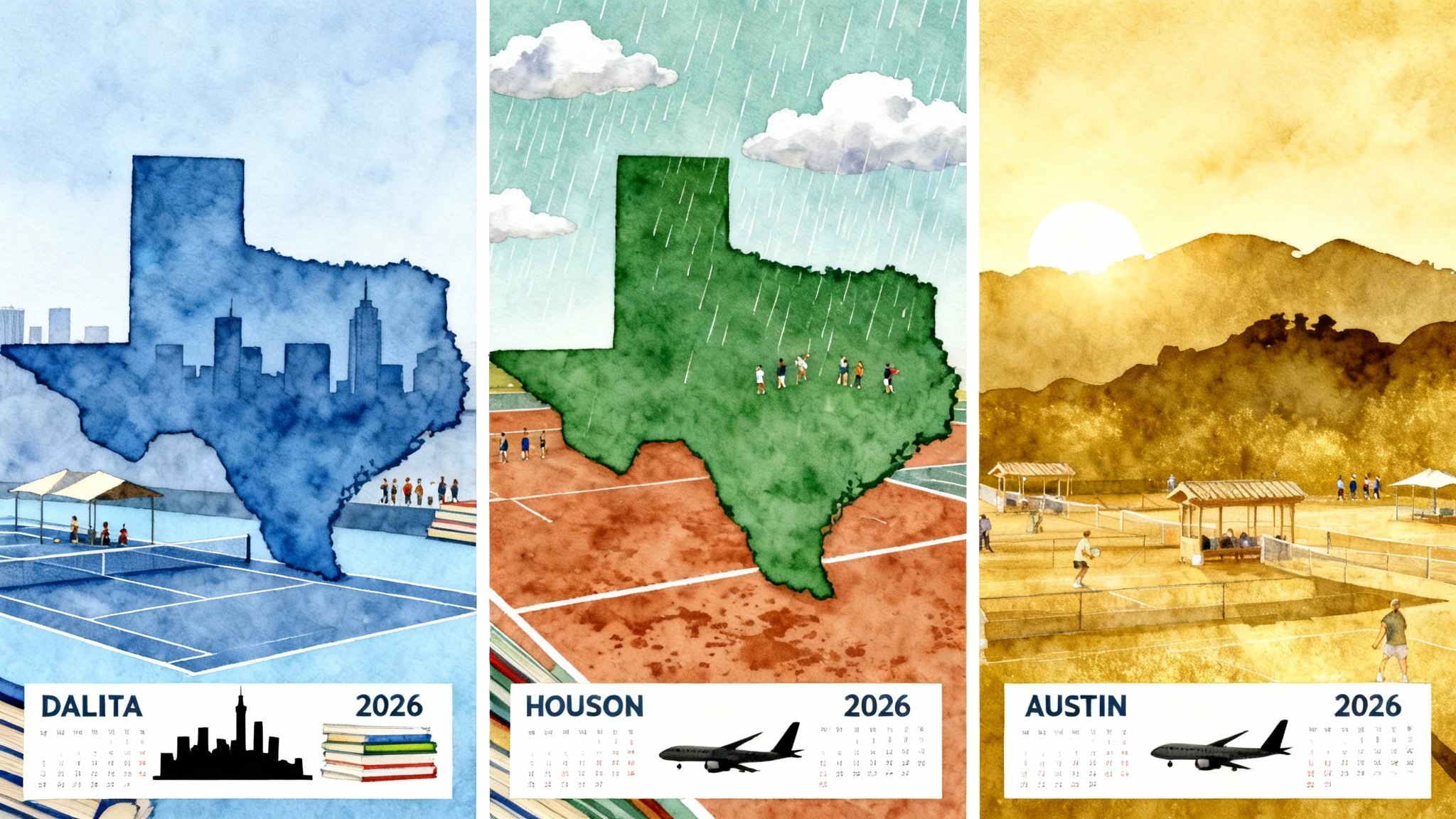
How to read this guide
Families choosing a Texas tennis base in 2025–2026 face a real-world tradeoff: where your player trains must match goals, school plans and a daily logistics map that actually works. This guide is a buyer’s comparison of the three major hubs in Texas: Dallas, Houston and Austin. We evaluate junior and college-prep pathways, pro-track options, surface mix, indoor or covered-court capacity for summer heat, boarding versus day structures, academic integration, match play cadence, costs, commute and access, and 2026 tryout windows. We also spotlight Legend Tennis Academy in Austin while keeping the lens wide across the state.
Before we dive in, two definitions that matter:
- Universal Tennis Rating, often written as UTR, is the global rating scale used by many academies to group practice and verify competitive level. See the fundamentals in this short overview, including how verified matches are counted: Universal Tennis rating explained.
- United States Tennis Association, often written as USTA, governs much of the sanctioned junior tournament structure in Texas. You will see divisions by level, points tables and tournament search tools that academies rely on to plan weekend competition blocks.
If you already know your city preference and want related comparisons, see our Best South Florida academies guide and our Best California academies guide.
The short version
- Dallas: deep player pool, strong college-prep pipelines, highly organized weekday drilling, mostly hard courts, some covered courts or bubbles in select sites, heavy emphasis on structured blocks and video analysis. Commute times can be significant but predictable if you train near the North Dallas corridor.
- Houston: diverse surfaces with more clay and Har-Tru than the other metros, strong weather-resilience plans and a history of producing physically robust baseliners. Rain is a factor, so scheduling flexibility and covered-court access matter.
- Austin: a growing high-performance scene with a new entrant, Legend Tennis Academy, alongside established programs. Emphasis on small-cohort technical work, early-morning summer schedules to beat heat and a vibrant local UTR ladder culture.
If your player’s goal is college tennis, all three metros can work. If your player is chasing professional points early, pick the program that offers the most weekday verified match play and individualized periodization for the next 18 months, then weigh surface fit and travel time.
Surface mix and why it matters
- Dallas: predominantly hard courts. Clay courts exist but are spread across private clubs. Hard-heavy training tends to reward first-strike patterns and crisp timing, so Dallas players often show aggressive plus-one patterns and serve development.
- Houston: the best metro in Texas if you want regular clay or Har-Tru. That shifts footwork and point construction. Expect heavier use of rally tolerance drills, height and shape, and cardio demands that matter for three-set stamina.
- Austin: hard courts dominate, though a handful of clubs run clay blocks. Coaches here increasingly schedule mixed-surface weeks in June through September to reduce joint load during heat spikes.
Actionable takeaway: if your player has a history of stress reactions in the shins or lower back, a clay-leaning plan in Houston or a split-surface week in Austin may prove more sustainable than five straight hard-court days in midsummer Dallas.
Indoor or covered-court capacity for Texas heat
Texas academies rely less on full indoor complexes and more on shade structures, fans, misting and staggered schedules.
- Dallas: more access to partially covered or bubble courts than Austin, especially around major clubs. Summer blocks often move to 7:00 a.m. to 11:00 a.m., then 6:30 p.m. to 9:00 p.m., with fitness in air-conditioned spaces midday.
- Houston: heat plus humidity, with frequent storms. Covered courts are prized. Programs that own or reserve covered time can keep volume steady when lightning rules suspend outdoor play.
- Austin: fewer covered courts, so academies optimize micro-schedules and hydration protocols. Expect heavy use of early morning technical work, afternoon video sessions and evening point play once the sun drops.
Ask to see the academy’s written heat plan, including Wet Bulb Globe Temperature (WBGT) thresholds, lightning protocol and rescheduling policy. A credible plan is a sign of a serious program.
Boarding or day, and academic integration
- Boarding: most in-city academies in Texas are day-first operations. Boarding exists through host-family networks or small, supervised residences rather than large dorm complexes. If you need boarding, confirm adult-to-athlete ratios, transportation and a quiet study environment.
- Day: if you live within 45 minutes of the site and can handle school logistics, day training reduces cost and lets families keep local support systems.
- School: the established path is a hybrid model. Mornings for court and fitness, afternoons for accredited online coursework, with in-person tutoring two to four days per week. Ask which accredited providers the academy supports and how accommodations are handled for tournament travel weeks.
Tip: request a sample weekly timetable that pairs a ninth grader’s academic load with the academy’s training blocks from August through May. The best programs provide it without hesitation.
Match play cadence that actually moves the rating
Colleges and selectors care about data. Verified competitive touchpoints matter more than practice highlights.
- Weekday: look for at least one internal ladder or match day per week that counts as verified. That could be a Universal Tennis team league, a verified singles block or inter-academy scrimmages.
- Weekends: in Texas, a realistic cadence for a healthy player is two USTA tournaments per month during the main season, supplemented by Universal Tennis events on off weekends. Use the state tool to build the calendar: USTA Texas tournament search.
- Data feedback: insist on a monthly progress review where a coach ties match video to rating movement. If the meeting produces two focus tasks per phase, your player will feel momentum.
Costs and what drives them
These are typical ranges for metro Texas high performance in 2025–2026. Exact figures vary by program and package.
- High performance day program, 5 day plan: 1,000 to 1,800 dollars per month. Add 150 to 400 dollars for strength and conditioning if billed separately.
- After-school performance block, 3 day plan: 450 to 900 dollars per month.
- Small-group or private technical blocks: 80 to 160 dollars per hour depending on coach tier, with 30 to 60 dollars for hitting partners.
- Boarding, when offered: 32,000 to 58,000 dollars per academic year, usually including housing supervision, transport and study hall. Food may be separate.
- Tournament travel with coach: day rate of 150 to 350 dollars per player plus shared costs.
What moves the price: coach-to-player ratio, covered-court access, video and analytics tools, college placement services and whether the academy operates on club courts with rental fees.
Commute and access, city by city
- Dallas: the North Dallas and Plano corridor clusters multiple training sites. If your school is north of Interstate 635, you can often keep a 25 to 40 minute drive each way. Dallas Fort Worth International Airport simplifies national travel. Traffic is predictable if you avoid 3:30 p.m. to 6:30 p.m. starts.
- Houston: programs concentrate from Memorial to Westchase and into Katy. Rain can compress schedules, so choose a site within 30 minutes in normal conditions. George Bush Intercontinental and Hobby make travel viable, though cross-town drives are longer on Friday afternoons.
- Austin: the Loop 360, Bee Cave and Westlake zones host much of the training. Morning blocks beat congestion. Austin Bergstrom International Airport is efficient for regional flights, with San Antonio as a backup for some families.
Use a mapping app to test two weeks of real routes at your chosen start times, not just the average. The best academy is the one you can reach calmly, five days per week, with time to eat before practice.
Spotlight: Austin’s new Legend Tennis Academy
Legend Tennis Academy enters the Austin market as a 2025 newcomer that aims for a high-performance, small-cohort model. Families report a focus on individualized periodization and targeted match play blocks that plug into the Central Texas tournament calendar. For deeper context, read our Legend Tennis Academy review before you visit.
Compare the following when you tour:
- Coach-to-player ratio during live ball and point play.
- Access to covered time in July through September, or a heat-optimized schedule with early starts and evening match play.
- Verified match opportunities built into the week. Ask how many Universal Tennis verified results a player at your rating typically logs per month.
- Academic support, especially proctoring and tutoring for Algebra and language courses.
- Transition plan for tournaments outside Central Texas during college showcase periods.
Because Legend is new, ask for pilot results: before and after video on two or three players, written training blocks for six weeks and a list of local partners for fitness and recovery. New does not mean unproven if the plan is transparent.
Where Dallas programs shine
- College-prep road map: Dallas programs tend to run orderly progressions from fundamentals to patterns to pressure sets. You will see weekly video breakdowns and targeted serve work.
- Depth: more high-level practice partners in the same time window means your player can find three competitive sets on a Tuesday without driving across town.
- Facilities: while not every site has indoor courts, select clubs manage weather with bubbles or shade structures. This helps keep volume steady in August.
Questions to ask in Dallas: how often will my player hit with stronger players, who schedules the sets and what is the weekly work on return of serve and second-serve patterns?
Where Houston programs shine
- Surfaces: if you want real clay volume, Houston is the most reliable Texas metro to find it. That matters for players targeting longer points and improved sliding mechanics.
- Weather resilience: covered courts and flexible scheduling keep training consistent during afternoon storms.
- Physicality: expect emphasis on fitness blocks that build endurance in heat and humidity. Many Houston coaches pride themselves on players who win late in sets.
Questions to ask in Houston: how many true clay sessions per week are realistic, what is the lightning policy and how are cancellations made up?
Where Austin programs shine
- Individualization: small-cohort academies are common, so technical changes can be more hands-on. Families often report feeling seen and heard.
- Culture: Austin’s player base buys into early mornings during summer and evening match play. This community pressure supports consistent training even on hot days.
- New energy: with Legend Tennis Academy entering, expect competitive pricing, coach recruitment and fresh ideas on analytics and video.
Questions to ask in Austin: which sessions are dedicated to live point play instead of feeding, how will we handle academic blocks during tournament weeks and what is the plan for travel to out-of-area events?
Pro-track options vs college-prep
Pro track in Texas often begins with the same foundation as college-prep, then adds volume and travel.
- Pro track: three to four hours on court daily, three strength sessions per week, verified matches midweek and frequent travel blocks aligned with the professional calendar. The key is managing body load in Texas heat.
- College-prep: two to three hours on court, targeted strength twice weekly and a reliable cadence of Universal Tennis and USTA play that moves the rating without overextending.
Ask for a written periodization plan that covers ten months. It should include taper weeks, testing days and criteria for moving up practice groups.
2026 tryout windows and how to prepare
Exact dates vary by academy, but Texas programs typically follow predictable rhythms. Use this checklist to hit windows without stress.
- January to February 2026: evaluation days for spring start and roster refresh. Best for seventh to ninth graders who want a February or March entry. Book a skills assessment and a sample day. Prepare two recent match videos and a one-page player profile with UTR and USTA history.
- April to May 2026: short tryouts to place players for summer camps and June training blocks. Reserve an academic plan meeting if you consider hybrid schooling next year.
- June to July 2026: summer camps double as extended tryouts. This is often the most transparent setting because coaches see players under volume and heat. Confirm that camp matches are verified whenever possible.
- August 2026: final placements for fall groups. Many programs set ladders and travel plans this month. If you miss August, you may wait until October breaks for a second placement.
- November to December 2026: small midyear adjustments. Useful if your player’s schedule shifts after high school tennis season or after a rating jump.
What to bring to every tryout: a recent injury summary, shoe model and string setup, three clear goals for the next three months and a parent commitment on commute and academics. Coaches make better decisions when the constraints are on the table.
A ten-day decision plan for families moving to Texas
Day 1 to 2: shortlist three programs per city that fit your commute envelope.
Day 3 to 4: call each program and ask for a sample schedule, heat plan and academic support summary. Note coach-to-player ratios and covered-court access.
Day 5 to 7: schedule two sample sessions in your top city. One should be a live ball or match day, not only feeding. Capture phone video for your own review.
Day 8: meet the academic coordinator. Confirm curriculum provider, testing windows and travel accommodations.
Day 9: price out the total monthly cost. Include tuition, fitness, private lessons, stringing, tournament travel and fuel or housing if boarding.
Day 10: choose. If the decision is tight, pick the program that guarantees one verified match opportunity each week and an adult who will own your player’s plan.
Red flags to watch for
- No written heat or lightning protocol.
- No verified match play built into the week.
- Vague academic support or no accredited partners.
- One-size-fits-all training groups that do not flex for growth spurts, injuries or rapid rating changes.
- Slow response to schedule changes or poor communication about canceled sessions.
The bottom line
Dallas, Houston and Austin each offer a credible route for serious juniors in 2025–2026. Dallas brings depth and structure, Houston adds clay access and weather resilience, and Austin combines small-cohort attention with the new energy of Legend Tennis Academy. Your best choice is the one that balances daily logistics with verified competition and a clear academic plan. Visit with a checklist, demand a written roadmap for the next ten months and measure programs by the quality of matches they deliver, not by slogans.
Pick the environment that your player can show up to, four or five days a week, through August heat and November rain. Consistency is the real competitive edge, and Texas gives you three distinct ways to build it.