Best Midwest Tennis Academies 2026: Chicago to Columbus
A parent-focused, data-backed winter guide to Chicago, Detroit, Minneapolis–St. Paul, St. Louis, and Columbus. We rank academies by indoor capacity, coaching ratios, match-play volume, college outcomes, cost bands, and boarding or commute options.
 Tommy
Tommy
How to read this winter guide
Indoor season is when Midwest families make the biggest training gains. Courts are scarcer, weekends are tournament heavy, and the right academy can turn cold months into a spring breakthrough. This guide ranks leading programs in Chicago, Detroit, Minneapolis-St. Paul, St. Louis, and Columbus using the factors parents tell us matter most in winter: indoor court capacity, coaching ratios, weekly match-play supply verified by the two main rating bodies, college placement outcomes, cost bands, and commute or boarding options.
We update our guidance for January 2026. Facility details and schedules can change within a season, so confirm the latest session plans before you commit. If you are weighing warm-weather alternatives, compare our Florida Junior Tennis Academies 2026 guide.
The metrics that matter in winter
- Indoor court capacity: In January and February, more courts usually means more reliable hitting windows and fewer cancellations. We categorize capacity as Large (10 or more indoor courts), Medium (6 to 9), or Small (5 or fewer).
- Coaching ratios: For high-performance sessions, a ratio near 1 coach to 4 athletes improves live-ball feedback. Ratios above 1 to 6 are fine for physical or patterns blocks but slow technical change.
- Match-play supply: Winter is about verified results. UTR means Universal Tennis Rating, a global match-rating system that verifies scores from a wide set of events. If you are new to it, read a clear explainer on what Universal Tennis Rating means. USTA means United States Tennis Association, which sanctions sectional and national draws that also verify results.
- College placement outcomes: Juniors targeting college need a program that teaches match habits, fitness standards, and the recruiting cadence. Ask for a three-year list of alumni placements and the coach who handled each recruiting file.
- Cost bands: We present typical winter pricing by band per month for a heavy-training junior. $ = under 400 dollars, $$ = 400 to 800 dollars, $$$ = 800 to 1,200 dollars, $$$$ = above 1,200 dollars. Private lessons, travel, and strength training are usually extra.
- Commute and boarding options: Most Midwest academies are commuter programs. A few have host-family lists or hotel partners for weeks with dense match-play.
Our Winter Readiness Score
We combine the metrics into a single Winter Readiness Score for 2026. We weight indoor capacity 30 percent, coaching ratios 20 percent, match-play supply 15 percent, college placement 15 percent, cost 10 percent, and commute or boarding flexibility 10 percent. We validate claims against posted schedules and tournament calendars when available, then adjust for winter-specific realities like snow closures and exam weeks.
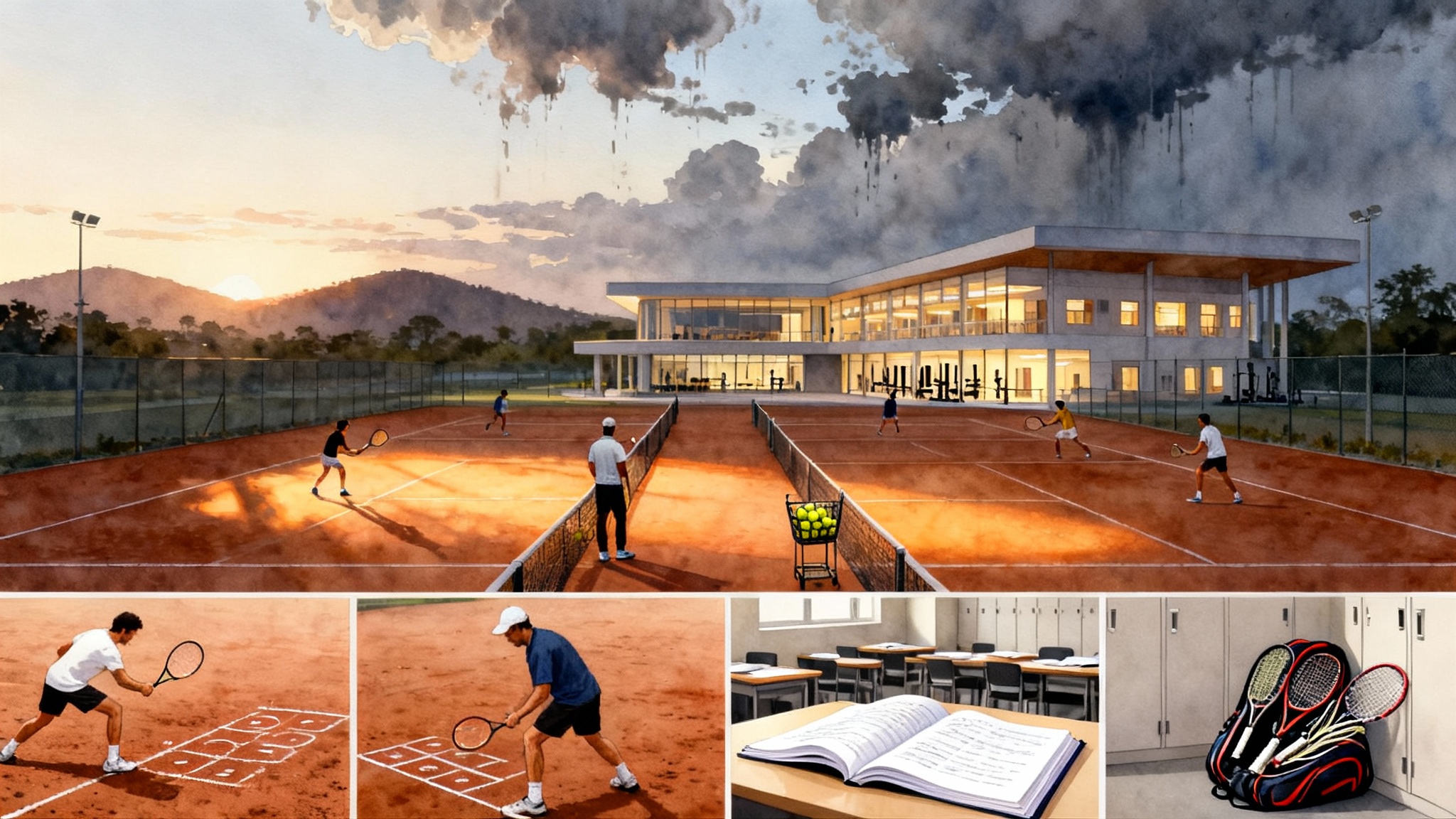
Think of it like this: if winter training is a school day, indoor capacity is the classroom, coaching ratio is the teacher count, match-play is the quizzes, college placement is the transcript, cost is tuition, and commute is the bus route. All six have to work for the day to go well.
Chicago: depth, density, and year-round match-play
- XS Tennis and Education Foundation, Chicago
- Capacity: Large
- Coaching ratio: 1 to 4 in high-performance blocks, 1 to 6 in development blocks
- Match-play supply: Strong, with weekly Universal Tennis events and frequent United States Tennis Association weekends within city driving distances
- College placements: Consistent pipeline to Division I and Division III programs; ask for the past three winter classes
- Cost band: $$$ to $$$$
- Commute or boarding: Primarily commuter; school-year academic support available
- Why it works: Big indoor footprint in the city, deep ball machine inventory, and a training culture that prioritizes live-ball reps and verified matches even in midwinter.
- Watchouts: Prime-time after school is crowded, so secure late-fall registration and be flexible on time slots.
- Midtown Athletic Club, Chicago High Performance
- Capacity: Large across club network
- Coaching ratio: 1 to 4 to 1 to 6 depending on block
- Match-play supply: Good in-house Universal Tennis match nights plus access to frequent sectional events
- College placements: Solid outcomes aided by structured practice planning and consistent strength sessions
- Cost band: $$$$
- Commute or boarding: Commuter, multiple urban locations reduce drive time
- Why it works: Reliable indoor availability and disciplined progression planning for juniors; adults find strong performance programming as well.
- Watchouts: The premium price reflects peak-time access and amenities.
- Score Tennis and Fitness Academy, Countryside
- Capacity: Medium
- Coaching ratio: 1 to 4 typical in elite sessions
- Match-play supply: Good, with frequent scrimmages and Universal Tennis events
- College placements: Positive regional placements; staff provide recruiting process support
- Cost band: $$$
- Commute or boarding: Commuter
- Why it works: Compact footprint with focused coaching blocks and a culture of frequent sets under pressure.
- Watchouts: Medium capacity means waitlists in January if you do not book early.
Chicago takeaway: If you want a pure high-performance environment with robust winter match-play, start at XS Tennis, then compare Midtown’s network access to Score’s focused format. For adult performance, Midtown’s structured clinics and late-evening court inventory are hard to beat.
Detroit: commuter-first with reliable weekend tournaments
- Franklin Athletic Club High Performance, Southfield
- Capacity: Large
- Coaching ratio: 1 to 4 to 1 to 6 depending on group
- Match-play supply: Strong, with steady Universal Tennis duals and easy access to southeast Michigan United States Tennis Association draws
- College placements: Consistent; families report transparent benchmarking and honest feedback on timelines
- Cost band: $$$
- Commute or boarding: Commuter; hotel partners used during tournament clusters
- Why it works: Deep junior ladder, capable sparring partners, and strength support during winter blocks.
- Watchouts: Popular Friday match nights sell out; book early.
- Huron Valley Tennis Club Academy, Ann Arbor
- Capacity: Medium
- Coaching ratio: 1 to 4 in performance blocks
- Match-play supply: Good, anchored by campus-area events and Universal Tennis verified sets
- College placements: Good track record into Division I and Division III
- Cost band: $$ to $$$
- Commute or boarding: Commuter
- Why it works: Close to a college environment, steady coaching continuity, and smart winter scheduling around school exams.
- Watchouts: Medium capacity requires calendars planned a month ahead.
- Life Time Rochester Hills Performance Tennis
- Capacity: Large across the club’s indoor network
- Coaching ratio: 1 to 4 to 1 to 6 depending on track
- Match-play supply: Good, with built-in Universal Tennis schedule and travel teams for United States Tennis Association weekends
- College placements: Solid outcomes; larger network helps families compare tracks
- Cost band: $$$ to $$$$
- Commute or boarding: Commuter
- Why it works: Predictable programming and network court access during the toughest winter weeks.
- Watchouts: Larger groups can feel less personal; ask for a named lead coach. For a deeper look at the brand’s pathway, see the Life Time Tennis Academy pathway.
Detroit takeaway: Franklin sets the pace for winter density. Huron Valley fits families who want a college-adjacent feel. Life Time’s network helps those who value predictable time slots over boutique coaching.
Minneapolis-St. Paul: university energy and dome reliability
- Baseline Tennis Center High Performance, University of Minnesota
- Capacity: Large
- Coaching ratio: 1 to 4 in performance blocks
- Match-play supply: Strong, with frequent Universal Tennis events and university-driven hitting culture
- College placements: Many alumni move into college rosters; the environment models collegiate training standards
- Cost band: $$$
- Commute or boarding: Commuter
- Why it works: University energy, deep sparring pool, and clean winter logistics under one roof.
- Watchouts: Game days and campus events can tighten parking and traffic.
- Fred Wells Tennis and Education Center, St. Paul
- Capacity: Medium
- Coaching ratio: 1 to 4 to 1 to 6 depending on session
- Match-play supply: Good, with Universal Tennis verified ladders and regular weekend sets
- College placements: Positive outcomes helped by strong academic support
- Cost band: $$ to $$$
- Commute or boarding: Commuter
- Why it works: Focused indoor footprint and a mission-driven culture that keeps attendance high even in heavy snow weeks.
- Watchouts: Prime-time capacity is limited; consider early morning blocks.
- Life Time Eden Prairie Performance Tennis
- Capacity: Large
- Coaching ratio: 1 to 6 typical, 1 to 4 in elite pods
- Match-play supply: Good internal Universal Tennis nights and access to metro tournaments
- College placements: Solid outcomes
- Cost band: $$$ to $$$$
- Commute or boarding: Commuter
- Why it works: Many indoor courts and consistent winter scheduling reduce late cancellations.
- Watchouts: Ask for clarity on which coach runs your athlete’s pod.
Twin Cities takeaway: Baseline leads on match-play density and college modeling. Fred Wells is the balanced option for families who want coaching continuity. Life Time wins on pure indoor availability.
St. Louis: compact footprint with smart scheduling
- Creve Coeur Racquet Club High Performance
- Capacity: Medium
- Coaching ratio: 1 to 4 in high-performance sessions
- Match-play supply: Good, with regular Universal Tennis events and reachable United States Tennis Association draws across Missouri and Illinois
- College placements: Solid regional placements
- Cost band: $$ to $$$
- Commute or boarding: Commuter
- Why it works: Tennis-first culture and a staff that protects live-ball time in midwinter.
- Watchouts: You will need to travel for some higher-level draws.
- Sunset Tennis Center Academy, Sunset Hills
- Capacity: Medium
- Coaching ratio: 1 to 4 to 1 to 6
- Match-play supply: Good, with intra-club league sets and Universal Tennis verification
- College placements: Positive local outcomes
- Cost band: $$ to $$$
- Commute or boarding: Commuter
- Why it works: Dependable indoor court blocks and coaches who prioritize set play over extended feeding lines.
- Watchouts: Weekend court demand spikes around tournament clusters.
- St. Clair Tennis Club, O’Fallon, Illinois (for Metro East families)
- Capacity: Medium
- Coaching ratio: 1 to 6 typical, 1 to 4 in performance sessions
- Match-play supply: Good, with local Universal Tennis ladders
- College placements: Emerging track record
- Cost band: $$
- Commute or boarding: Commuter
- Why it works: Value option with reliable winter set play east of the river.
- Watchouts: Smaller elite pool may require scheduled travel sets.
St. Louis takeaway: Expect solid coaching and dependable winter scheduling. For elite match-play density, build in occasional road trips to larger Midwest events.
Columbus: tournament hubs and big bubbles
- Elysium Tennis, Plain City
- Capacity: Large
- Coaching ratio: 1 to 4 to 1 to 6
- Match-play supply: Strong, with frequent Universal Tennis events and easy access to central Ohio United States Tennis Association weekends
- College placements: Consistent placements across Division I, II, and III
- Cost band: $$$
- Commute or boarding: Commuter; families often use nearby hotels during tournament clusters
- Why it works: Big indoor footprint and tournament culture that keeps verified matches flowing all winter.
- Watchouts: Popular time blocks with long waitlists if you inquire late.
- Racquet Club of Columbus High Performance
- Capacity: Large
- Coaching ratio: 1 to 4 typical in HP, 1 to 6 in development
- Match-play supply: Strong internal ladders and Universal Tennis duals
- College placements: Strong regional track record
- Cost band: $$$
- Commute or boarding: Commuter
- Why it works: Deep local ladder and consistent winter planning.
- Watchouts: For top-tier juniors, add periodic travel for stronger draws.
- Scarborough East Tennis Club Academy
- Capacity: Medium to Large
- Coaching ratio: 1 to 6 typical, 1 to 4 in elite pods
- Match-play supply: Good, with club league nights that feed into Universal Tennis verification
- College placements: Good outcomes with attentive recruiting support
- Cost band: $$ to $$$
- Commute or boarding: Commuter
- Why it works: Flexible scheduling and strong value for multi-day training.
- Watchouts: Make sure your athlete lands in a pod with appropriate hitting partners.
Columbus takeaway: Elysium sets the winter pace on match-play throughput. Racquet Club offers depth and continuity. Scarborough East is a smart value play for multi-day training without giving up verified sets.
Quick picks by goal
- High-performance juniors chasing national draws: XS Tennis, Baseline Tennis Center, Elysium Tennis. Large indoor capacity, tough ladders, and weekly verified sets.
- College-prep juniors targeting roster spots: Franklin Athletic Club, Huron Valley Tennis Club, Racquet Club of Columbus. Balanced coaching ratios, recruiting guidance, and consistent Universal Tennis verification.
- Adult performance players seeking winter gains: Midtown Athletic Club Chicago, Life Time Eden Prairie, Creve Coeur Racquet Club. Reliable prime-time indoor inventory and structured live-ball clinics.
If your search may shift east, use our Northeast Academies 2026 guide to compare.
A sample winter week that actually builds results
- Two performance practices: 120 minutes each, with a first hour on patterns and a second hour on live-ball, plus a short finisher on serve and return.
- One physical session: 60 to 90 minutes on footwork patterns, contrast sprints, and injury prevention for shoulders and hips.
- Two verified match sessions: Either a Universal Tennis dual or club ladder night midweek, then a weekend match or tournament block. Verified scores help the rating reflect real progress.
- One technical tune-up: A 30-minute private slot focused on one technical cue, then film that cue in the next practice to confirm transfer.
How to pressure-test an academy visit
- Ask for next month’s court map: You want to see where your athlete will stand at 4:30 p.m. on Tuesdays and Thursdays. Indoor season success is a calendar problem before it is a coaching problem.
- Request a ratio commitment in writing: 1 to 4 for high-performance blocks is the goal. If the academy says 1 to 6, ask what content changes on those days.
- Verify match-play: Look for a weekly Universal Tennis offering and a plan to enter United States Tennis Association events two or three weekends per month through March. If you need a starting point, check the USTA Midwest tournament calendar.
- Review college placement data: Ask for three years of placements with coach contacts and text two parents from last year’s class. You will learn in five minutes what the brochure cannot tell you.
- Confirm the winter weather plan: Who texts you about closures at 2 p.m., and when does that missed session get made up.
Tuition math for winter
If your athlete trains three days per week in January, February, and March, expect nine to ten weeks of sessions. A typical high-performance plan in the Midwest totals 12 to 18 group hours per month. In the $$ to $$$ band, that is roughly 400 to 1,200 dollars per month before privates and tournament travel. Add one 30-minute private per week and two tournament weekends per month and your winter budget often doubles. Setting the budget early helps you prioritize verified matches over extras that do not move the rating.
Final take
Winter in the Midwest rewards families who plan with precision. Pick an academy that proves it can deliver three things at once in January: a court when you need it, a coach who actually watches the ball you hit, and a verified match on the calendar. Use the Winter Readiness Score to compare options in your city, then book a month at the program that gives your athlete the most live-ball repetitions and the clearest match pathway. Spring results follow the families who solved the winter calendar first.