College Tennis Recruiting 2026-2027: A Grade-by-Grade Playbook
 Tommy
Tommy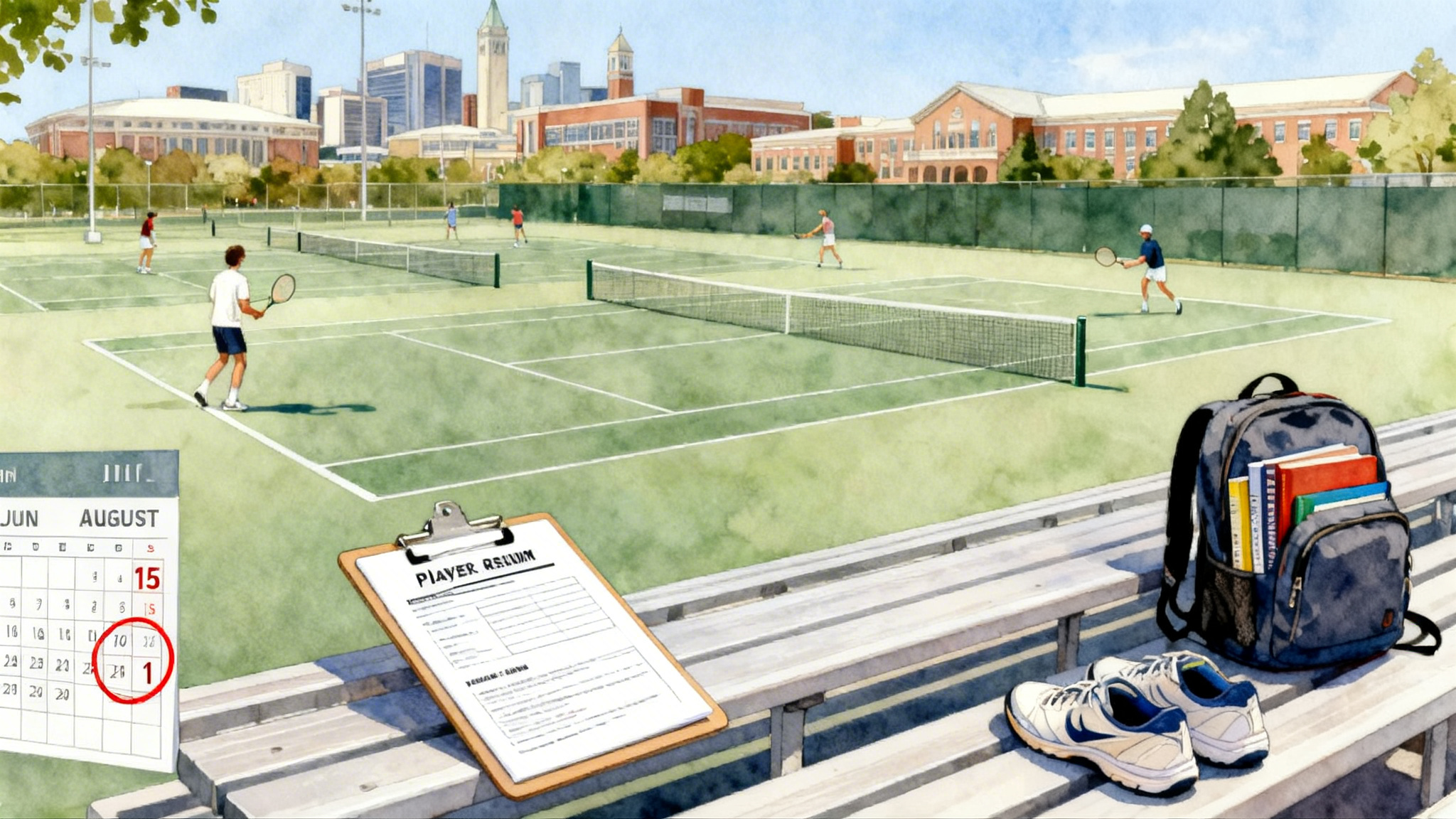
The big picture: what changes when and why it matters
If you learn one set of dates, make it these. For most Division I sports, including tennis, coaches can begin recruiting communication on June 15 after a prospect’s sophomore year, and on-campus visits with athletic involvement can start August 1 before the junior year. Those changes were adopted to curb early recruiting and standardize timelines across sports, and they remain the working baseline in 2026. See the NCAA’s plain-language summary of the NCAA recruiting contact dates.
One more foundation stone: academics. To compete and receive aid at an NCAA Division I or II school, you must meet core course, grade point average, and test score standards set by the NCAA Eligibility Center. Start with the NCAA’s initial eligibility toolkit and resources.
This playbook turns those fixed points into weekly actions from eighth through twelfth grade. You will not find a full ratings-system explainer or a smartphone video tutorial here. If you need them, read our guide to UTR vs WTN and this smartphone video guide.
Grade-by-grade playbook
Eighth grade: set the academic and athletic table
Eighth grade is about habits and inputs that pay off later. Think of it as leveling the court: if the court is sloped, every rally is harder. Your slope is time management, study skills, and consistent training weeks.
Focus
- Build the study routine you will keep in high school. Two quiet study blocks on school nights and a light review on Sundays.
- Audit your course plan. In the United States, Division I and II eligibility requires specific core courses. Work with your counselor now so your ninth grade schedule counts.
- Establish physical literacy. Twice-weekly strength and movement work under supervision. Good habits are hard to retrofit at 16.
- Start a simple performance log. Matches played, opponents, scores, notes on what broke down at 3-3.
Checklist
- Sketch a four-year high school course plan that meets NCAA core requirements.
- Choose one consistent fitness routine that fits tennis: mobility, footwork, and injury prevention.
- Set up a family calendar that blocks study, training, and recovery.
- Begin a results log in a shared document that parents and coach can see.
Ninth grade: build your transcript and your tennis resume
Ninth grade is your foundation year. Coaches will eventually study two things first: transcript and verified results. Ratings can lag reality. Verified results speak for themselves.
Focus
- Academics: aim for A and B grades in core classes. A strong freshman GPA gives you margin later.
- Competition: pick events that produce reportable results and a realistic win-loss arc against older players.
- Communication basics: create a recruiting email account that uses your name, not a nickname. Draft a one-page player resume.
Checklist
- Confirm your high school is on track with NCAA core courses and that you understand which classes count.
- Play at least one event per month that posts results publicly and can be searched by college coaches.
- Build a one-page resume: grad year, height, dominant hand, contact info, coach contacts, recent verified results, academic highlights, intended major interests.
- Ask one trusted coach to begin capturing verified match notes for top opponents you face.
Sample first introduction email (ninth grade)
Subject: 2028 grad: [Your Name], right-handed, Austin TX, verified results attached
Coach [Last Name],
My name is [Your Name], class of 2028 from [High School] in Austin, Texas. I am a right-handed baseliner with a heavy forehand and a developing slice backhand. I am interested in [Target Major or Academic Area].
- Recent verified wins: [Player Name], [event], [date], 6-4, 6-3; [Player Name], [event], [date], 7-5, 6-2
- Current schedule: [Event], [city], [dates]; [Event], [city], [dates]
- Academics: 3.7 unweighted GPA; Algebra I Honors; English I Honors
I know coaches cannot have recruiting conversations with me yet. I will send a short update each month with results and schedule. Thank you for your time.
Sincerely,
[Your Name]
[Phone] | [Recruiting Email]
[High School Coach], [phone]
[Private Coach], [phone]
Tenth grade: the hinge year
The date that changes everything is June 15 after your sophomore year. Before that date, treat every update as one-way communication. After that date, Division I and II coaches can respond and call. Use spring to build your file, then be ready to talk.
Focus before June 15 of tenth grade
- Academics: finish the year strong in core classes. Register with the NCAA Eligibility Center by late spring.
- Tennis: schedule matches against a mix of peers and older players. Doubles matters more than you think. Coaches value players who can win two points per game at the net. For specifics, study our doubles tactics playbook.
- Communication: send monthly updates with two to three bullets each. Keep everything verified and concise.
Focus after June 15 of tenth grade
- Conversations begin. Prepare a 60 second self-introduction and a few questions for coaches.
- Evaluate fit. Does the program’s playing style align with your strengths. Does the roster have your graduation year represented in singles and doubles.
- Plan your August and fall visits. Unofficial visits with athletic involvement can begin August 1 before your junior year in Division I. Book early and cluster visits by region to save time and cost.
Phone script for your first coach call
- Opener: Thank you for taking the time to speak with me. I have followed your team’s [recent result] and watched [player]’s match versus [opponent].
- 60 seconds on you: strengths, what you are working on, recent verified results.
- 3 questions: what qualities do your best competitors share; how do you develop doubles; what does your typical freshman fall look like for travel and class balance.
- Close: I will send you my fall schedule and would love your feedback after my next two events.
Eleventh grade: visits, evaluation, and offers
Junior year is where most of the real evaluation happens. You can schedule both unofficial and official visits now in Division I starting August 1 before junior year. Plan visits with intention, not tourism.
Campus visit strategy
- Build a visit deck. One page that lists your schedule, top three matches to review on video, two academic interests, and three questions you hope to answer on campus.
- Prioritize practice. Ask to observe a team practice and a lift. Coaches say a one-hour practice tells them more than a highlight reel.
- Meet people outside tennis. Admissions, a student in your intended major, and a faculty member if possible.
- Ask players smart questions. What surprised you when you got here. What do travel weeks feel like during midterms. How do freshmen earn doubles time.
Post-visit follow up
- Email within 24 hours. Thank the head coach, assistants, and the staff or students you met. Remind them of one moment from practice or a conversation that stuck with you.
- Send a two-month plan. Outline your next three events, one strength you are doubling down on, and one weakness you are addressing.
Official vs unofficial at a glance
- Unofficial: you pay your way, but you can meet the staff and tour the program. Take as many as you like within school rules.
- Official: the school can pay for allowable expenses. You will meet compliance, academics, and the team. Limitations on number of official visits can vary by sport and evolving legislation. Your host school will tell you what is permissible for tennis in 2026.
Twelfth grade: narrowing, numbers, and the finish
Senior year is about clarity. You will juggle school, competition, campus revisits, and financial discussions.
The calendar
- Many programs aim to finalize the bulk of their class during the fall of senior year. National Letter of Intent signing periods are governed by the NLI program. Your offer will specify the signing window once the period has opened for tennis.
Academics
- Keep your transcript clean. An academic dip can delay admission or shrink academic aid.
- Send updated transcripts and test scores to the Eligibility Center promptly.
Decisions and etiquette
- Communicate quickly. If you know you will not pursue a program, thank them and release them to recruit another player.
- If invited for a second visit or overnight, ask for the itinerary and expectations, then follow through on time.
What coaches weigh beyond ratings
Coaches recruit people, not profiles. Here is what repeatedly rises to the top in tennis.
- A body of verified results across surfaces and conditions, with trend lines that show you can win tight sets and rebound after losses.
- Doubles value. If you win two points per game at the net, you are a multiplier.
- Scheduling discipline. Do you chase points or do you schedule the hardest winnable matches to demonstrate growth.
- Feedback loop. Do you send succinct updates, incorporate feedback, and show change within six to eight weeks.
- Academic reliability. Fewer missed classes, on-time assignments, and a realistic interest in a major.
- Coachable habits. Eye contact in meetings, clear practice goals, and honest match debriefs.
- References who pick up the phone. A high school coach and a private coach who can provide specific examples of your resilience and team impact.
Scholarship math for tennis families
Two concepts drive tennis scholarships.
- Equivalency vs head count. In equivalency sports, the program has a pool of scholarship value that can be split among players in percentages. In head-count sports, each scholarship counts as a full award and cannot be divided. Policies can vary by school and conference, so confirm details with each compliance office.
- Stacking and fit. Athletic aid can often be combined with academic merit and need-based aid, subject to conference and institutional policies. The mix matters more than any single line item.
How to run the numbers
- Cost of attendance: tuition, fees, room, board, books, and travel. Use the school’s published cost and add your realistic travel costs for tennis.
- Athletic offer: if you hear 40 percent, clarify what base that applies to. Is it tuition only or full cost of attendance. Is it guaranteed for four years or subject to annual renewal.
- Academic merit: ask for the grid or rubric. Many universities publish automatic merit awards by GPA and test score. Clarify if athletic aid reduces merit.
- Need-based aid: file the FAFSA and, if required, the CSS Profile. Ask how outside scholarships affect institutional aid.
- Renewal terms: ask for the written policy on renewal, performance criteria if any, and what happens in case of injury.
Example
- Cost of attendance: 48,000 dollars
- Athletic offer: 30 percent on tuition only, which is 24,000 dollars tuition, so 7,200 dollars
- Academic merit: 10,000 dollars
- Need-based: 4,000 dollars
- Net before travel: 48,000 - 7,200 - 10,000 - 4,000 = 26,800 dollars
- Travel estimate: 2,200 dollars
- Final net: 29,000 dollars
This is why clarity on the base and the renewal terms matters. Percentages without a base create confusion. Written numbers with definitions create decisions.
Campus visits that move you forward
Before you step on campus
- Send a concise visit deck and your two most recent verified results.
- Ask for a practice observation, a lift, and a short meeting with academics or career services.
- Prepare three questions only you would ask. Examples: how do you integrate freshmen into doubles; what is your process for lineup challenges; who handles class conflicts for travel weeks.
During the visit
- Watch how players treat each other during a tough practice. That is the culture you inherit.
- Eat a meal with the team without parents. Players speak most freely to players.
- Take notes in the moment. You will forget details on a three-campus swing.
After the visit
- Send a 24-hour thank you and a 7-day follow-up with your next two competitions and one concrete improvement you are making.
NIL basics for tennis in 2026
Name, image, and likeness opportunities in tennis are often local and relationship driven. Think teaching clinics, club partnerships, local retailers, and social content tied to community events.
Principles to follow
- No pay for play. Your NIL deal must be in exchange for real deliverables such as appearances, posts, or clinics. Do not accept money only for enrolling or playing.
- School rules first. Every deal should be disclosed to your compliance office before you sign. Conflicts with school sponsors are common.
- Contracts in writing. Include deliverables, timelines, payment terms, usage rights, and an end date. Avoid perpetual rights and broad exclusivity.
- Taxes are real. Expect a Form 1099. Track income and expenses, set aside a tax reserve, and consult a tax professional.
- Reasonable value. Tennis deals are usually smaller than revenue sports. Prioritize fit and professional development over chasing inflated numbers.
Starter NIL ideas for tennis
- Host a youth clinic with a local club, with a revenue share and a clear deliverable list.
- Partner with a local stringer or retailer for in-store events and social posts.
- Create a beginner doubles series for community players, sold as a four-session package.
How a strong academy turns interest into roster spots
Legend Tennis Academy model in Austin offers a useful framework for families and coaches who want a structured recruiting pathway.
Competitive scheduling
- Year plan with four peaks: January indoor block, spring match-play series against older opponents, late June hard-court run, and October ITA-adjacent events where allowed.
- Each block ends with a verification day where match results are recorded, officiated when possible, and summarized for coaches.
Verified results and reporting
- Every match-day produces a one-page sheet: opponent, event, score by set, and two coach notes on patterns that worked at 4-4.
- A staff member curates a living results tracker and shares updates with college coaches who have opted in.
Coach connections with integrity
- Twice per year coach call days. Academy staff schedule 15 minute update calls with college coaches for juniors and seniors who have opted in, focusing on verified results and development, not hype.
- No mass emails. Each outreach references a coach’s roster needs, style of play, and academic profile.
Conversion sprints
- July and August after sophomore and junior years are conversion windows. Players block two weeks for visits, with travel grouped by region. Family receives a script and a checklist to ensure each visit yields clear action items.
Support tools
- A one-page resume template, a results log template, and a campus visit deck families can personalize. Internal versions live on TennisAcademy.app for enrolled families and coaches.
Sample messages and scripts you can use
Initial outreach email to a coach (tenth grade, spring)
Subject: 2027 grad: [Your Name], verified results and summer schedule
Coach [Last Name],
Thank you for the work you do with [Program]. I am a 2027 right-hander from [City], interested in [Academic Interest].
Recent verified results
- [Opponent], [Event], [Date], 6-4, 3-6, 10-7
- [Opponent], [Event], [Date], 7-6, 6-3
Upcoming schedule
- [Event], [City], [Dates]
- [Event], [City], [Dates]
I would value any feedback after these two events. I can share a short match clip if helpful.
Sincerely,
[Your Name] | [Recruiting Email] | [Phone]
[High School Coach], [phone] | [Private Coach], [phone]
Monthly update email (eleventh grade)
Subject: [Your Name] July update: two results, one question
Coach [Last Name],
Thank you again for your time during my unofficial visit. Two quick updates and one question.
- Results: [Opponent], [Event], [Date], 6-3, 6-4; [Opponent], [Event], [Date], 4-6, 6-3, 10-8
- Development: added a second-serve kick wide on deuce; won 8 of 11 deuce points last two matches
- Question: which two fall events would best help you evaluate me further
Best,
[Your Name]
Post-visit thank you
Subject: Thank you for the visit and practice observation
Coach [Last Name],
Thank you for hosting me on [Date]. Watching the doubles drills confirmed how much your team values first-strike returns and net pressure. I am working this month on second-volley depth in both alleys. My next events are [Dates]. I will send results and hope to stay in close touch.
With appreciation,
[Your Name]
Parent-to-coach etiquette note
Subject: Thank you for your guidance with [Student Name]
Coach [Last Name],
As a parent, I appreciate your time with [Student Name]. I encourage [him/her/them] to communicate directly and to own this process. If you need academic or logistical information, I am glad to help, but I will keep tennis conversations student-led.
Thank you,
[Parent Name]
Quick checklists by grade
Eighth grade
- Map four-year core courses with your counselor
- Start a results log and a two-day-per-week strength plan
- Set a family calendar for training, school, and recovery
Ninth grade
- Take core courses that count toward NCAA eligibility
- Play one event per month that posts verified results
- Build a one-page resume and a recruiting email identity
- Send a short quarterly update to five to eight target programs
Tenth grade
- Register with the NCAA Eligibility Center by spring
- Target matches against older players to test pressure points
- Send monthly updates before June 15; prepare your phone script
- After June 15, begin real conversations and plan August visits
Eleventh grade
- Schedule unofficial and official visits with practice observations
- Ask players and staff specific, respectful questions
- Send a 24-hour thank you and a 7-day improvement plan
- Keep a two-week competition cadence in the fall
Twelfth grade
- Clarify offers in writing with definitions and renewal terms
- Stack academic and need-based aid where allowed
- Confirm NLI signing steps and deadlines with compliance
- Maintain grades and submit final transcripts quickly
A closing rally: make your moves count
Most families overestimate how much the rating matters and underestimate how much the process matters. Verified results, clean communication, intentional visits, and clear scholarship math are the currency that converts interest into roster spots. As of March 25, 2026, the contact rules for tennis still hinge on June 15 after sophomore year and August 1 before junior year. Plan backward from those dates. Get your academics in order. Pick matches that prove who you are under pressure. Ask smart questions on campus. Then follow up with one concrete improvement every month. If you do, your recruiting story will read less like a scramble and more like a set you controlled from the first ball.