Dome Tennis, Zero Rainouts: Vilnius and Warsaw in Winter
Two indoor megacenters, SEB Arena in Vilnius and Tenis Kozerki near Warsaw, turn European winter into a high-volume training season with no rainouts, dense match play, affordable costs, and smooth spring clay transitions.
 Tommy
Tommy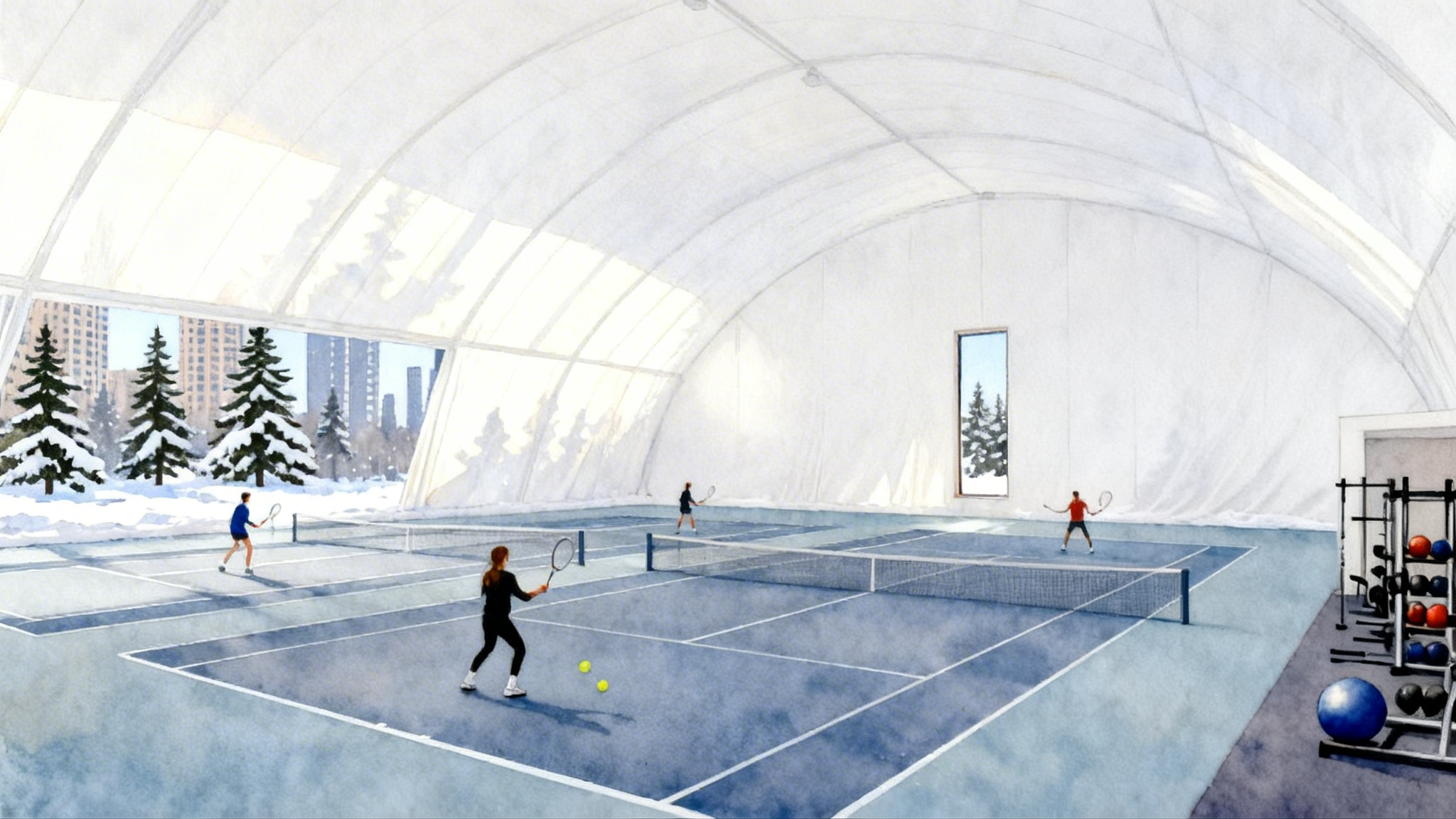
Winter tennis without weather drama
If your winter training plan lives or dies by a weekly radar check, you are wasting attention you could spend on your backhand. Vilnius and Warsaw solve that problem. Their dome ecosystems create a climate-proof routine where you can plan six to eight court hours per day, every day, and actually hit those numbers. The payoff is simple: more balls, more matches, and a smoother step into spring clay.
This guide shows how two megacenters, SEB Arena with Vilnius Tennis Academy profile and Tenis Kozerki academy page near Warsaw, deliver that reliability. You will see how to plug into programs in days, what a typical high-yield week looks like, and what it costs, with clear ranges for courts, coaching, housing, and transport.
The two megacenters at a glance
SEB Arena with Vilnius Tennis Academy
SEB Arena sits on the west side of Vilnius and anchors the city’s tennis scene. The indoor footprint is enormous, with hard and clay under roof, a modern gym, treatment rooms, and a cafeteria that serves practical training food. You do not need exact court counts to grasp the point; the scale is such that you can reserve practice blocks and still find same-day match play. For an official overview of surfaces and facilities, see the SEB Arena court inventory.
What makes Vilnius compelling in winter is how quickly you can stack volume. Starting times are distributed across early morning, midday, and late evening peaks, so athletes on school or remote work schedules can still assemble two-a-day or three-a-day court blocks. The Vilnius Tennis Academy runs junior and adult groups on both hard and indoor clay, which matters when you want to rehearse clay footwork while the weather outside remains uncooperative.
Tenis Kozerki near Warsaw
About 35 minutes west of central Warsaw, Tenis Kozerki functions like a campus. Courts sit next to a strength hall, a track oval, recovery facilities, and lodging options in the immediate area. The design ambition is clear, a place where players can sleep, train, compete, and repeat without long commutes. For specifics on layouts and programs, check the Kozerki Tennis complex details.
Kozerki’s edge is match density. Weeknights and weekends run full of ladders, league play, and interclub ties. Because Warsaw is a major hub, visiting teams rotate through all winter, which means sparring partners at most levels show up without you needing to scout far.
Why these centers guarantee volume
- Domes remove weather variance, so your training plan survives the week unchanged.
- The supply of courts allows both pre-booked drills and spontaneous match play.
- Multi-surface indoors enables your spring transition to clay without losing hard-court timing.
- On-site gyms compress logistics. You finish two hours of live ball, lift, then return for pattern play without a crosstown drive.
When your week has twelve to sixteen hours of hitting plus three lifts and two match nights, you accumulate what most outdoor winters can only promise on paper. The mechanism is unromantic: courts that actually exist, at times you can use, in buildings that ignore rain, sleet, and thaw cycles.
Access from the United States and the European Union
Both Vilnius and Warsaw are in the Schengen Area, which simplifies multi-country itineraries inside much of Europe. Warsaw Chopin Airport is a major European node with deep connections. Modlin Airport, north of Warsaw, hosts low-cost carriers that often cut weekend match-trip costs. Vilnius Airport sits close to the city center, so airport-to-dome transfers are short and affordable by rideshare or taxi. If you are already in the European Union, both cities link by frequent flights and rail. Travelers from the United States should always verify current entry rules and health insurance requirements before booking. If you want a domestic fallback for similar reliability, see our America's most reliable tennis base.
Cost picture: what a realistic week looks like
Prices fluctuate by season and time of day, so treat these as planning ranges rather than fixed quotes. The point is to map the order of magnitude and build a budget that will not surprise you.
Court time per hour, winter ranges:
- Vilnius, indoor hard or indoor clay: 18 to 35 euros off-peak, 28 to 45 euros peak
- Warsaw region, indoor hard or indoor clay: 22 to 40 euros off-peak, 32 to 55 euros peak
Coaching and groups:
- Private lesson, certified coach: 40 to 90 euros per hour depending on seniority
- Small-group technical session, 4 to 6 players: 12 to 30 euros per player per hour
- Hitting partner or sparring: 20 to 40 euros per hour, often flexible if you reciprocate matches later in the week
Strength, recovery, and extras:
- Gym day pass tied to the tennis center: 6 to 15 euros
- Sports massage or physio screen: 25 to 60 euros per session
Housing, one week:
- Vilnius, central apartment, one bedroom: 280 to 520 euros
- Warsaw, central apartment, one bedroom: 340 to 640 euros
- Near Kozerki, local hotel or guesthouse: 300 to 550 euros
Food and transport, one week:
- Groceries and two café meals per day: 120 to 220 euros
- City transit and local rideshare: 25 to 70 euros
Sample one-week totals, per player:
- Lean volume plan with groups and shared courts: 480 to 780 euros
- Hybrid plan, 4 private hours, groups, and match fees: 720 to 1,150 euros
- Max volume with daily privates and recovery services: 1,150 to 1,850 euros
These ranges fit both cities with slight drift higher near central Warsaw. Families can trim costs with two-player court shares, kitchen apartments, and weekly transport passes.
How to plug into programs within 72 hours
The fastest way to unlock match density is to treat the center like a university department. You are not waiting for an invite. You are requesting an assessment slot, a training group, and two match nights.
SEB Arena and Vilnius Tennis Academy, quick-start sequence:
- Reserve two open court blocks online for your first two days so you can hit on arrival, then email the academy for an evaluation slot. Include your age, level, injury notes, and a two-minute rally clip.
- Ask for placement in one technical group on hard and one on indoor clay. The dual placement ensures surface transfer without losing your aggressive patterns.
- Request introductions to the weekly ladders or league nights. Offer to fill in as a substitute to meet partners fast.
- Book one thirty-minute movement screen with the on-site physio so your lift plan matches what you do on court.
Tenis Kozerki, quick-start sequence:
- Email the Kozerki team with your availability windows and ask for group placement plus a one-hour hit on day one. Share your recent competitive history and your preferred patterns on serve and return.
- Request entry to the internal ladder and any weekend match blocks. Offer to play up a round the first week, then settle into your real band once partners see you.
- Use the track and strength hall on your off-court windows. A simple three-exercise plan twice per week, squat pattern, hinge pattern, and anti-rotation, will keep power up while volume increases.
Sample week plans you can run tomorrow
Below are three profiles. Swap times to taste; the point is the structure.
Profile A: Junior pathway, 15 to 17 years, tournament focused
- Monday: 08:00 mobility and activation, 09:00 live ball patterns on hard, 11:00 school block, 16:00 technical group on clay, 19:00 homework and video review
- Tuesday: 07:30 lift session, 10:00 serve and return reps, 12:00 match play set and tiebreaker practice, 17:00 homework
- Wednesday: 09:00 footwork circuit and approach volleys, 11:00 school block, 16:00 match night, two sets
- Thursday: 08:00 recovery jog, 10:00 private lesson on backhand patterns, 15:00 school block, 18:00 ladder match
- Friday: 09:00 cross-court forehand plus inside-out patterns, 11:00 gym mobility, 16:00 doubles drills
- Saturday: 10:00 practice set on clay, 12:00 group points, 16:00 recovery swim
- Sunday: 09:00 light hit and serves, afternoon off
Profile B: College player on winter break
- Monday: 08:30 lift, 10:00 baseline depth control set, 12:00 lunch, 14:00 return plus first-ball pattern play, 19:00 ladder match
- Tuesday: 09:00 serve spots and patterns, 11:00 doubles specialty drills, 16:00 live points
- Wednesday: 08:30 movement prep, 09:00 practice set, 12:00 gym posterior chain, 18:00 match night
- Thursday: 10:00 defensive to offensive transition drills, 12:00 lunch, 15:00 private tune-up, 19:00 scouting future opponents
- Friday: 09:00 approach and volley day, 11:00 doubles plays, 16:00 practice set
- Saturday: 10:00 round robin, afternoon recovery
- Sunday: 09:00 serves and returns, travel or rest
Profile C: Adult competitor, advanced level with remote work
- Monday: 07:30 hit, 09:00 work, 18:00 group drills
- Tuesday: 07:30 gym, 09:00 work, 19:00 ladder match
- Wednesday: 07:30 hit, 09:00 work, 18:30 practice set
- Thursday: 07:30 serve plus plus-one patterns, 09:00 work, 18:00 technical tune-up
- Friday: 07:30 light hit, 09:00 work, 18:30 match
- Saturday: 10:00 round robin, 13:00 recovery
- Sunday: 09:00 optional hit, afternoon off
Seamless transitions to spring clay
Hard-court habits can clash with clay unless you rehearse them properly. The fix is to use the indoor clay inventory in both centers to pre-build the skid, slide, and reset behavior.
Clay transition microcycle, two-week outline:
- Week 1 indoors on clay: reduce backswing on defense, add one split-step per rally, and finish points two feet farther inside the baseline than you would on hard. Install the heavy, high forehand as a pattern, not a bailout.
- Week 2 blend: one daily session on hard to keep first-strike depth, one on clay to build tolerance and rally shape. Alternate finishing with a drop shot on the ad side to short-circuit long exchanges before fatigue sets in.
Drill set to run twice per week:
- Serve wide on the ad side, recover to midcourt, absorb the high cross response with a heavy forehand, then change line on ball four. Keep the rally ball spin rate high enough to buy time for footwork recovery.
- Two ball pick-up and slide: feed two heavy topspin balls deep to the backhand, require a slide stop on the second, then drop a short neutral ball to force a forward sprint and soft finish.
Vilnius and Warsaw both bring clay online early in the spring and keep indoor clay available deep into the season, so your transition is not a calendar flip. It is an intentionally staged microcycle that you run inside, then carry outdoors when the sun arrives.
Choosing between Vilnius and Warsaw
Both deliver weather-proof repetition. The finer distinctions help you pick the right base.
- Match-magnet environment: Warsaw slightly ahead. Tenis Kozerki’s ladder and frequent visiting teams mean more organic match nights without extra logistics.
- Multi-surface indoors: Vilnius has an edge in the way hard and indoor clay are integrated in the training rhythm, which helps spring transitions.
- City experience and costs: Vilnius is compact, airport-close, and often a touch cheaper on housing. Warsaw has deeper flight schedules and a larger restaurant scene if you recover best with a long walk and a proper meal.
- On-site campus feel: Kozerki wins for a self-contained daily loop that reduces commute friction.
You will not go wrong in either place if your priority is volume and structured match play.
Practical booking scripts
Email template for first contact, copy and adapt:
Subject: Player placement and match integration for [Dates]
Hello, I will be in [Vilnius or Kozerki] from [date] to [date]. Age [xx], level [describe, recent results or Universal Tennis Rating], playing style [two sentences]. I am seeking one assessment session, placement in a technical group on hard and on clay, and entry into weekly ladder or league play. I can start as a substitute player if needed. I would also like a thirty-minute movement screen with a physio. Thank you for confirming options and times.
Attach a two-minute rally clip and list your available time windows. You will usually get a workable reply within a day.
A one-page budget to carry on your phone
- Courts: 8 to 12 hours, 250 to 500 euros depending on peak times and shares
- Coaching: 3 to 5 hours, 180 to 350 euros
- Match fees and ladders: 20 to 60 euros
- Gym and recovery: 20 to 60 euros
- Housing: 300 to 600 euros
- Food and local transport: 150 to 280 euros
- Contingency: 10 percent of the above
Write these numbers down before you fly. You will make better decisions about peak versus off-peak courts and whether to add that extra private lesson.
Common pitfalls and how to avoid them
- Overbooking privates: three targeted privates beat six unfocused hours. Use groups and match play for volume, save privates for technical bottlenecks.
- Ignoring recovery: a five-minute cool-down and ten minutes of mobility prevent the small stiffness that ruins day three.
- No plan for second serves: dedicate fifteen minutes daily to second-serve patterns. Doubles partners will thank you.
- Skipping return practice: build a six-ball return ladder, two from each return position, every training day. Your match days will feel easier.
What success looks like after two weeks
- Your contact point feels higher on clay, with clean balance through the slide.
- You finish points more often on ball three or four because serve and plus-one patterns are automatic.
- You have a phone full of new practice partners and a recurring ladder slot. That social graph is insurance against scheduling hiccups later in the season.
The bottom line
Winter becomes an advantage when you choose a base that treats weather as background noise. Vilnius and Warsaw do exactly that. SEB Arena with Vilnius Tennis Academy and Tenis Kozerki near Warsaw take your plan from calendar to court with dependable courts, year-round groups, and built-in match play. Pick the center that best fits your logistics, follow the 72-hour plug-in steps, and run the sample week. When spring arrives, you will not just be ready for clay. You will be ahead of everyone who spent winter waiting out the rain.