Austin Hill Country: The New Year-Round Tennis Base for 2025-2026
The Austin–Spicewood corridor is fast becoming a 2025–2026 tennis hotspot. Mild winters, new covered and lighted courts, easy travel through AUS, and a boutique training vibe make it a true year-round alternative to Florida.
 Tommy
Tommy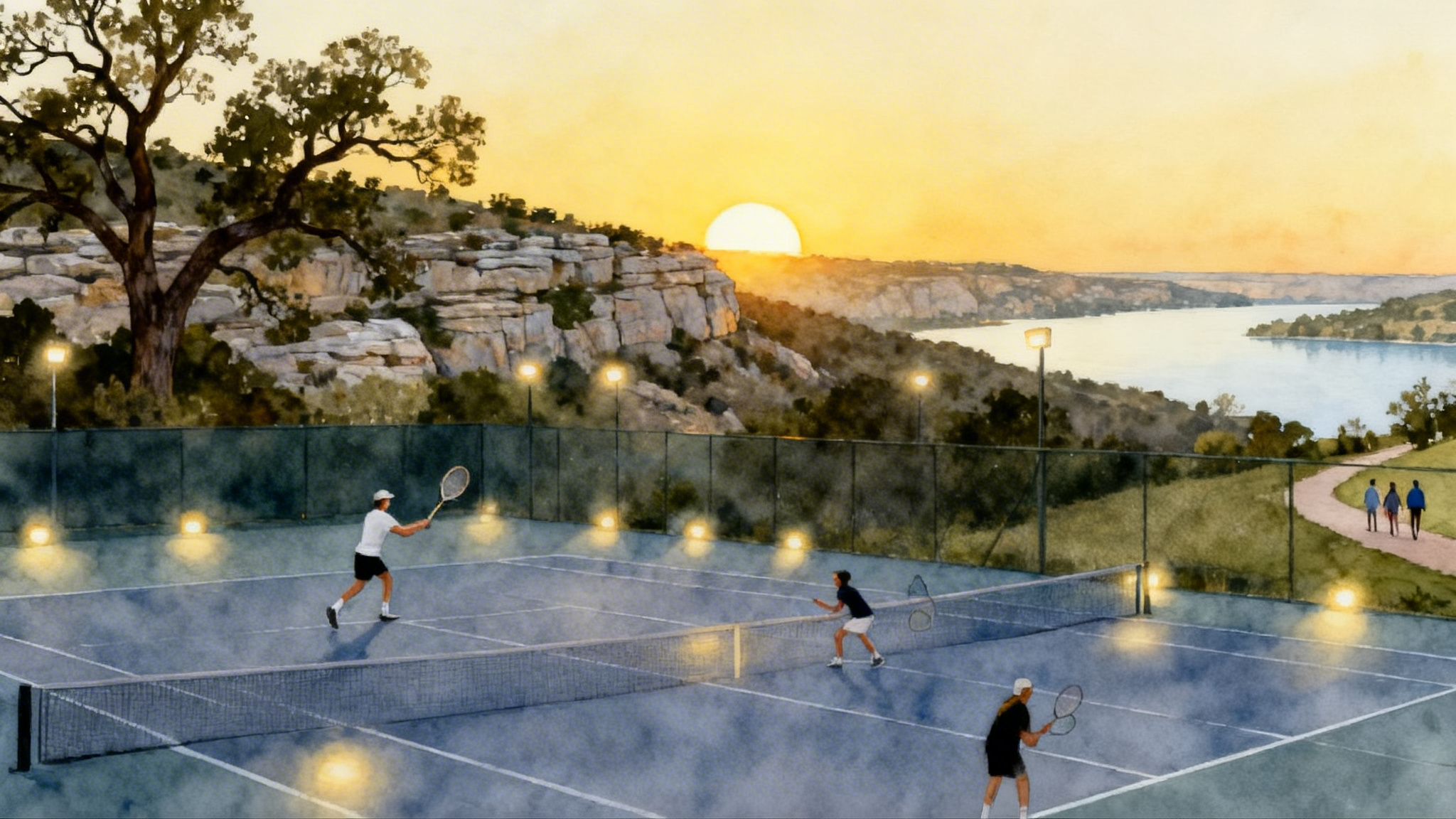
Why the Austin–Spicewood corridor is rising now
If you drew a line from the eastern edge of Lake Travis to the limestone bluffs west of Bee Cave, you would trace a tennis ecosystem that feels purpose-built for year-round development. Winters here are short and generally mild. Afternoons cool quickly on clear evenings. Storms pass in bands rather than linger for days. From October to April, most mornings start in hoodie weather and reach T-shirt temperatures by late morning. For players and coaches, that means more predictable reps, fewer indoor cancellations, and a longer match-play season.
The infrastructure is catching up to the climate. Across the Hill Country, programs are adding lights, shade, and pockets of covered play that keep training viable during a mid-afternoon drizzle or a warm spring sun. Because the area is stitched together by a tight network of towns — Lakeway, Bee Cave, Spicewood, Marble Falls — travel between courts, hotels, trails, and lakes rarely takes more than 30 to 40 minutes.
For families and adult players, the appeal is simple: you can plan a real training week without sacrificing the outdoors, food, or downtime that turns a camp into a vacation. And for coaches, Austin’s growing pro calendar and deep local competition raise the ceiling for on-court intensity. If you are weighing other warm-season hubs, compare options in our desert winter tennis guide.
The anchor: Legend Tennis Academy in Spicewood
At the western edge of the metro, Legend Tennis Academy has become the most talked-about new training site in the corridor. The facility at 4200 Crawford Road opened with four lighted hard courts and junior-to-adult programs, supported by grants from the United States Tennis Association and USTA Texas. That combination — fresh surfaces, night-light flexibility, and a curriculum that serves both families and competitive teens — explains why word of mouth has spread so fast. See Community Impact report on Legend.
Legend’s training model emphasizes measurable skill blocks and level-based match sets. For parents, that looks like a weekly plan with clear goals rather than a grab bag of drills. For players, it feels like a school day that stacks reading and math before a scrimmage. The academy also leans into boutique scale: visible coaches, small groups, and the ability to pivot sessions when weather shifts by an hour or two.
If you want a deeper look at programs, the Legend Tennis Academy profile summarizes the location, court setup, and training structure. The short version is this: lights on every court plus a covered option means afternoons are not lost to heat or a brief shower, and evenings become prime time for match play.
Nearby clubs and where they fit
A strong hub needs healthy spokes. Within a 15 to 45 minute drive, you will find:
- Austin Tennis Academy in Bee Cave: a long-standing junior powerhouse and a frequent host for high-level events and training blocks. The vibe is work-first with a strong collegiate pipeline.
- Courtyard Racquet Club in West Austin: a membership club with a deep court inventory, including indoor options, that often supports league play and winter match sets.
- The Hills of Lakeway athletic complex: a private-club environment near Lake Travis with a broad mix of courts and fitness facilities; useful for adults traveling with non-tennis family who still want health club caliber amenities.
- Horseshoe Bay Resort, northwest of Spicewood: an upscale resort setup with multiple hard and clay courts. Clay days here make a smart midweek change of pace for joint health and point construction.
- Public courts across Lakeway and Austin: affordable, lighted options that slot in for evening practice serves, family hits, or casual ladder play.
The mix matters. In Florida, density means access, but it can also mean long lines and homogenized training. In the Hill Country, variety plus manageable drive times creates a boutique circuit. You can spend the morning in a focused academy block, then choose your afternoon setting (a quiet public court for serves, a resort clay session, or a membership club round robin) based on what your legs and brain need that day.
Tournaments and the pro calendar
Competition is the heartbeat of a training trip. Austin’s tournament map makes scheduling easy:
- UTR Sports events: the Austin area runs frequent UTR singles and doubles draws year-round, with plenty of options from entry-level matches to tougher open-level fields. Expect regular weekend events within a 30 to 40 minute radius of Spicewood, plus flex leagues for players who want additional match volume.
- WTA tennis in February and March: each late winter, Austin hosts the ATX Open, a WTA Tour 250 tournament that converts Westwood Country Club into a pro venue. It is timed to be a springboard into the North American hard-court swing, which means motivated fields and excellent tennis. Preview the event on the ATX Open 2026 overview.
- Additional women’s pro week: the city also stages a WTA 125-level event around early March. For juniors and serious adult players, watching these matches between training sessions is a live masterclass in patterns, problem solving, and between-point routines.
The implication is practical: you can schedule a development week that includes live pro tennis, then bake those observations into your next morning’s practice menu.
Best months to train: October through April
The corridor’s sweet spot runs from October to April. Here is why and how to set your plan:
- October to early December: stable fall weather, warm afternoons, crisp evenings. Great for mechanical changes that need lots of ball reps.
- Late December to early February: cold fronts do appear, but they are short-lived. Covered and lighted options keep sessions on track. Use this window for serve tuning, footwork, and fitness blocks.
- February to April: prime match-play season. Pro events arrive, UTR draws are plentiful, and the air stays dry enough that two-a-days are realistic with mid-afternoon recovery.
Planning tip: schedule your longest sessions before lunch, then use late afternoon and evening lights for targeted work such as serves, returns, and situational points. That rhythm fits school schedules and keeps the whole family fresh. For stroke specifics, see our guide to master the modern forehand.
Sample week itineraries
Here are three plug-and-play itineraries. Adjust court times to your travel days and age group.
A. Junior tournament family, 7 days
- Sunday: Fly into Austin–Bergstrom. Forty to fifty minute drive to Bee Cave, Lakeway, or Spicewood, depending on lodging. Easy grocery run for breakfast and recovery snacks.
- Monday: Morning fundamentals block at Legend focused on contact height and spacing. Afternoon at a public court for serve ladders and return position games. Evening: barbecue picnic by the lake.
- Tuesday: Pattern day. Crosscourt forehand cages, backhand plus-one, and high-percentage rally math. Afternoon hike at Reimers Ranch or a short dip at Krause Springs. Light night hit under the lights.
- Wednesday: Match rehearsal. Two short sets with no-ad scoring and tight changeovers to build routine. Evening video review and a simple footwork ladder session at your rental.
- Thursday: Clay day at Horseshoe Bay Resort for variety. Emphasize neutral-ball patience and shape. Back early for homework and an early dinner.
- Friday: Pre-tournament light hit. Forty five minutes of serves and twenty minutes of drop feeds. Afternoon lake time or a walk through the Hill Country Galleria.
- Saturday–Sunday: UTR event. Stick to simple tactical anchors: 70 percent first-serve targets, deep crosscourt to start points, pick one change-up per set.
B. Adult doubles camp, long weekend
- Thursday: Arrive mid-afternoon. Evening situational doubles clinic at Legend or a nearby club: return team movement, first volley depth, and middle control.
- Friday: Morning session on serve plus first volley and the third-ball lob. Lunch at a local taco spot, then an easy paddle on Lake Travis. Evening social doubles under the lights.
- Saturday: Patterns that translate under pressure. Two-up net traps, I-formation with clear signals, and second-serve aggression zones. Afternoon winery stop or a trail loop at Pace Bend. Dinner at a classic Hill Country barbecue joint.
- Sunday: Round-robin morning with coached changeovers. Early afternoon checkout and flight.
C. High-performance tune-up, 6 days
- Monday: Baseline day. Heavier balls, high-contact spin, and depth windows. Afternoon strength circuit and mobility.
- Tuesday: Return day with serve variety. Targets by quadrant, body serves, and backhand chip depth. Evening film of a WTA or ATP match to model point construction.
- Wednesday: Forehand as a weapon. Inside-out and inside-in change-ups, then pattern building to the open court. Recovery swim and 30 minutes of contrast shower.
- Thursday: Match-play microcycle. Two set-play segments with charted unforced errors and winners. Afternoon mental skills block: breath cadence, between-point scripts, and score resets.
- Friday: Clay or slower-court variation to force patience and shape. Night serves under the lights with pressure ladders.
- Saturday: Local UTR draw to test the week. Evening debrief and travel home.
Play-and-stay: where to base your trip
- Bee Cave hotels for convenience: Business-friendly options near the Hill Country Galleria offer quick drives to Spicewood and Lakeway plus easy meals and shopping.
- Lakeway Resort and Spa for families: Waterfront setting with pools and kids’ activities, close to public courts and private-club options.
- Horseshoe Bay Resort for tennis-first travelers: Multiple courts, including clay, with resort dining and lake access. A strong fit for mixed groups where some want pure vacation while others chase reps.
- Lakeside rentals for teams: House rentals around Lake Travis or Spicewood let you set up a mini-training village. A driveway rebounder, a garage foam roll station, and a big table for video review go a long way.
Commute math: aim to keep daily one-way drives under 35 minutes. That target preserves energy and turns the car ride into a hydration and snack window rather than a stress point.
The infrastructure edge: lights, cover, and smart scheduling
What makes Austin’s Hill Country different is not stadiums. It is smart details:
- Lights on nearly every training court at Legend and many surrounding sites make 7 a.m. and 8:30 p.m. real options, which opens time for school, remote work, or family activities.
- Pockets of indoor and covered courts at membership clubs and select academies provide a backstop on days with wind, drizzle, or a sharp cold front.
- Clay nearby offers the change of surface that reduces joint pounding and forces point construction.
The result is reliability. You can plan a development week and actually complete it.
Hill Country recovery: lakes, trails, and barbecue
A great training base should help you bounce back between sessions. The corridor excels here:
- Water reset: Lake Travis coves, the spring-fed pools at Krause Springs, and calm morning paddles offer low-impact recovery and a mental reset.
- Short scenic hikes: Milton Reimers Ranch Park and parts of Pace Bend Park give you rolling trails, river overlooks, and soft footing for a 30 to 50 minute walk.
- Family add-ons: Mini-golf and kid-friendly green spaces, weekend markets in Bee Cave, and easy picnic spots by the water keep non-tennis hours fun.
- Barbecue and Tex-Mex: Think post-match protein and plenty of sides. Try a classic Hill Country smokehouse, then balance it the next day with a salad-and-bowl lunch near the Galleria.
Recovery rule of thumb: if you go hard on court in the morning, pick an afternoon recovery that is short, scenic, and keeps feet moving without spikes in heart rate. Save your heavy food for dinner and drink more water than feels normal.
Travel made easy
Austin–Bergstrom International Airport continues to add and upgrade nonstop routes across the United States, with frequent service from major hubs that make weekend and weeklong trips simple. The rental car center is straightforward, and the drive west puts you into Hill Country views within minutes. If you land after 5 p.m., book a lighted session that night or a mobility-and-serve block to shake off travel.
Packing tips for October–April:
- Bring layers. Mornings can be cool and afternoons warm. A light shell, a hoodie, and a sun shirt cover 90 percent of days.
- Use two pairs of shoes. Alternate daily to keep your knees and feet fresh.
- Build a simple hydration kit: squeeze bottle with electrolyte packets, and a small cooler for the car.
How to book and build your week
- Secure court time first. Lock your morning blocks at your primary base, then fill afternoons with match play or specialty sessions nearby.
- Check UTR draws two to three weeks out. Choose level-based events that match your current form, not your best day. The goal is many quality points, not one dramatic upset.
- If you are a family, rotate responsibilities. One parent handles snacks and hydration, the other handles video and notes. Switch the next day.
- For adults, write your doubles goals on a notecard. You will play better if you can say what you are trying to improve before warm-up.
Bottom line
Florida will always be a tennis institution, but the Austin–Spicewood corridor has quietly built a different kind of year-round base. The climate is kind, the courts are lit and increasingly covered, and the training culture prizes small groups and measurable progress. Add easy travel, real pro tennis in late winter, and a Hill Country backyard of lakes, trails, and barbecue, and you get a 2025 and 2026 hotspot that feels purpose-built for players and families who want work and play in balance.
If you want the reps without the crowds, and a setting that makes the hours between sessions just as restorative as the time on court, Austin’s Hill Country is ready. Book the flights, layer your week, and let the limestone and live oaks do the rest.