Master the Kick Serve: Biomechanics, Drills, Match Wins
A reliable kick serve changes how opponents return, how you hold under pressure, and how you attack second serves. Learn the simple mechanics, equipment tweaks, and a four week plan to build a kick that wins real points.
 Tommy
Tommy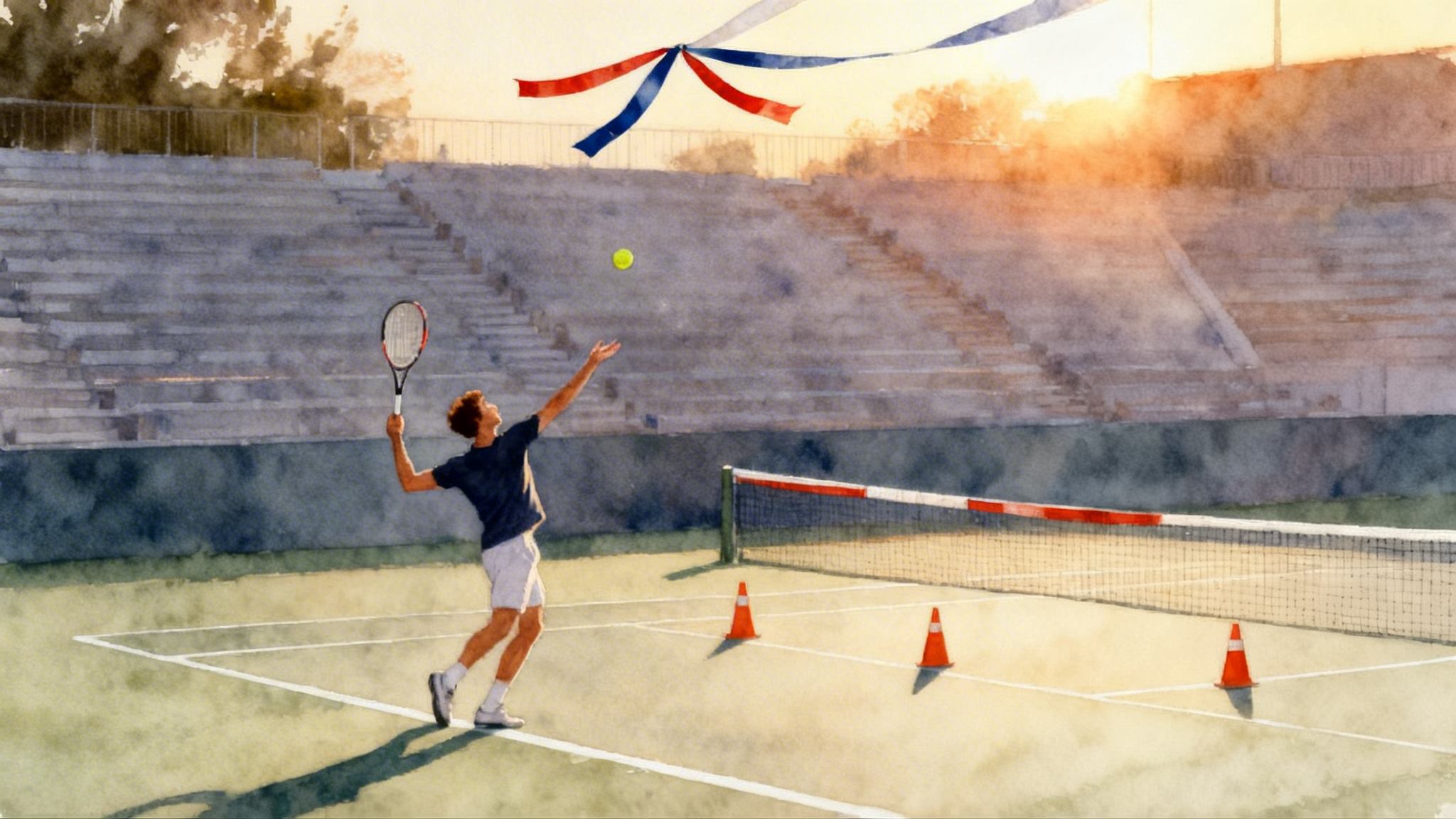
Why the kick serve is a pressure weapon
The kick serve is not about showing off a loopy second serve. It is about changing the geometry of the rally before it even starts. A good kick serve clears the net with safe height, lands deep, and then climbs above the returner’s strike zone. That bounce buys you one or two extra beats of time. It pushes the returner back or forces a late contact, which turns a neutral start into an advantage.
At club level and even in junior tournaments, the kick serve also protects your nerve. When the score tightens, a flat first serve can shrink your margin. A kick serve gives you spin based safety plus a heavy bounce, which is why so many tour players rely on it on big points. It is the closest thing tennis has to insurance you can practice.
The biomechanics made simple
You do not need a sports science degree to understand the kick. Picture brushing snow off a high car roof from left to right if you play right handed. Your hand moves up and across, not straight forward. That combination creates topspin and a touch of sidespin. Here are the main pieces in plain words.
The toss
- Location: Slightly above your head and a touch left of center for right handed players, a touch right for left handed players. Think 11 o’clock for righties and 1 o’clock for lefties if the clock sits above your head.
- Height: As high as your normal first serve, not exaggerated. A sky high toss delays contact and breaks rhythm.
The stance and shoulder tilt
- Stance: Start with your regular platform or pinpoint, whichever you already own. Keep your front hip aimed at the net post on your serving side. That keeps you from opening too early.
- Shoulder tilt: As you load, let your back shoulder drop slightly, like you are pouring water out of a bottle behind you. This stores energy that turns into upward drive.
The racket path and contact
- Up the back of the ball: Imagine the ball wears a backpack. Your strings brush up along that backpack and continue across your body. If you slice a pizza, you move sideways. For a kick, you move up first, then a little sideways.
- Edge first: Let the racket approach with its edge leading, then square up at contact. This keeps your wrist loose and your forearm ready to whip.
- Contact height: Slightly behind and above your head. If you reach forward like a flat serve, you will drive the ball too low and lose the jump.
The finish
- Across your body: Your strings should finish on the opposite side of your torso, not far across like a slice and not down by your hip like a flat. A compact, high finish is a good sign you brushed up.
Tempo and rhythm
- Same ritual: Use the same bounce count and breathing as your first serve. The best kick serves look calm. If you rush the toss or jab at the ball, you lose spin.
Equipment choices that make the kick easier
Equipment does not replace technique, but it can be a friendly tailwind.
- Racket pattern: A more open string pattern, like 16 by 19, helps the ball grip the strings. Players using dense patterns can still produce kick, but they may need a livelier string.
- Strings and tension: Shaped polyester strings enhance spin by grabbing the felt. If you prefer comfort, a hybrid with polyester in the mains and multifilament in the crosses gives spin without turning your arm into a tuning fork. Start with a medium tension, then drop two pounds if your ball feels heavy but not jumping enough.
- Grip tack: A fresh overgrip prevents micro slips on humid days, which protects your wrist action through contact.
If you want hands on string testing and structured serves practice, players training at Legend Tennis Academy in Austin often tune setups toward controllable spin before chasing power.
A four week plan to build a dependable kick
The fastest way to make the kick serve real is to isolate one variable each week. Keep sessions short and specific. Record with your phone from behind the baseline and from the side. Use cones or tape targets so you judge outcomes, not vibes. Pair this serve block with the 4-week footwork plan to win more first balls.
Week 1: Contact quality and spin
Goal: Learn to brush up, not push forward.
- Warm up, 8 minutes: Mini serve from inside the service line. Toss slightly over your head and exaggerate the up the back brush. Focus on height over pace.
- Drill 1, 3 sets of 12: Serve from the baseline into the deuce box if you are right handed, ad box if left handed. Land the ball inside a large taped rectangle in the back third of the box. Track how many jump above your partner’s shoulder at the bounce.
- Drill 2, 3 sets of 8: Shadow serves without a ball. Start in your trophy pose, swing with a loose wrist, and freeze the finish high and across. Build the feel of brushing quickly.
- Checkpoint: After every set, ask a partner or coach to rate your bounce height from 1 to 5. A 3 means chest high, 4 means shoulder, 5 means face level or above. The target is a consistent 3 or better.
Week 2: Net clearance and depth
Goal: Add safe height and land deep without floating long.
- Net tape targets: Clip two bright ribbons on the net 18 inches above the center strap. Clear that ribbon on every serve.
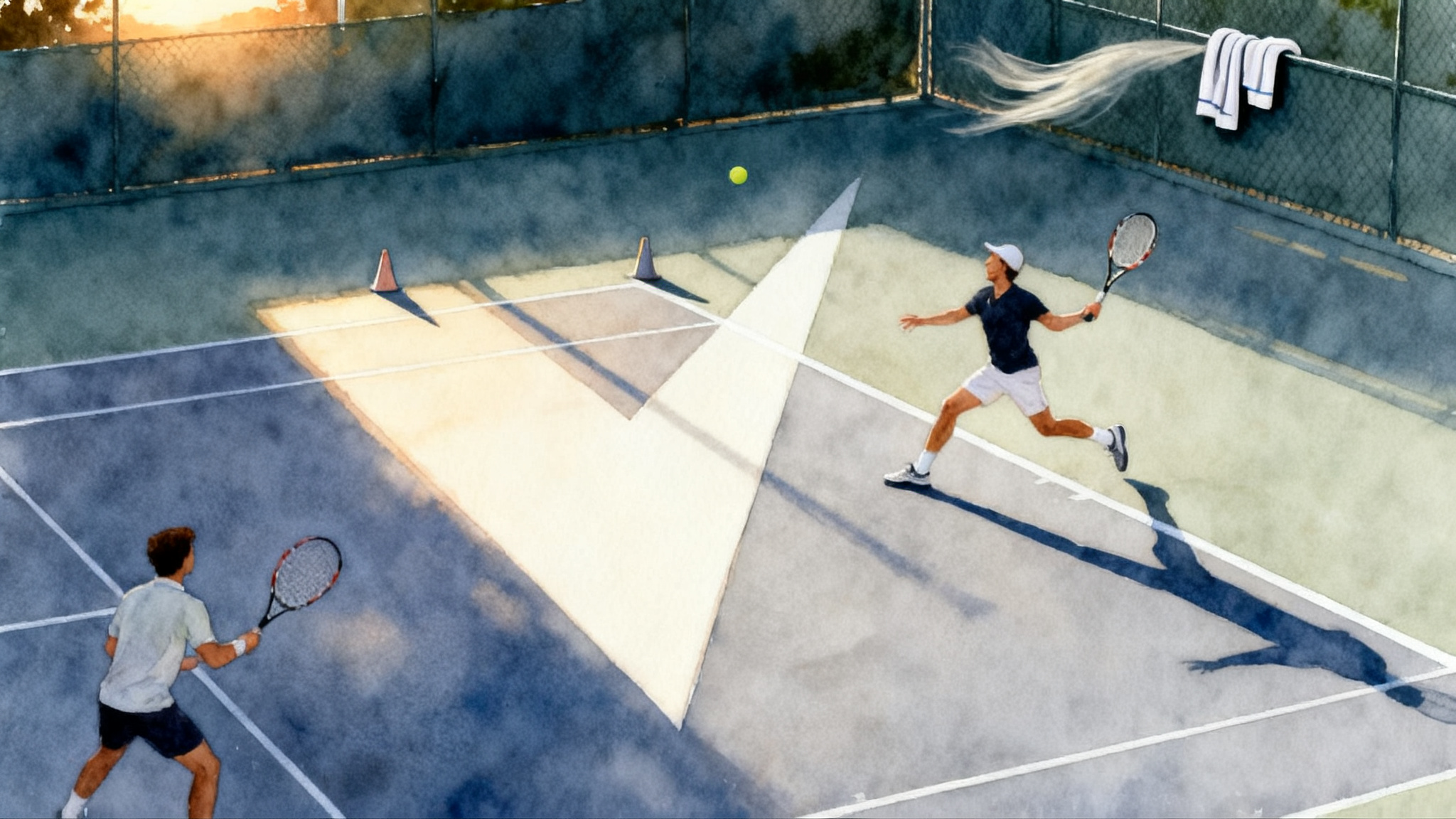
- Deep landing zone: Place two cones two feet inside the service line and four feet from each sideline. Aim to land between those cones.
- Drill, 4 sets of 10: Alternate deuce and ad courts. If you miss long, adjust the toss slightly less forward and brush more. If you miss into the net, drive up through your legs more.
- Checkpoint: Your miss pattern should skew long rather than into the net. Long misses confirm you are swinging up and creating lift, which you can then tune.
Week 3: Direction and disguise
Goal: Move the kick to different targets without changing your ritual.
- Three target game: Divide each service box into wide, body, and T lanes. Serve 6 balls to each lane. Change only your toss angle, not the speed of your motion.
- Bounce and rush: After each serve, recover inside the baseline as if you are stepping into a forehand. This builds the habit of using the extra time the kick creates.
- Checkpoint: Track first bounce locations and the second bounce depth. The best kicks land deep and second bounce near the baseline or beyond.
Week 4: Match patterns and score pressure
Goal: Integrate your kick with a first serve and a clear first ball pattern.
- Serve plus one: Alternate a flat or slice first serve with a kick second serve. Before each point, call your first groundstroke target out loud, for example backhand corner inside out. Serve, recover, and hit that ball.
- Pressure ladder: Play service games to three points with tiebreak scoring at 2 to 2. On second serves, you must hit kick to a called lane. Keep a tally of holds and double faults.
- Checkpoint: A realistic goal by the end of the month is one or fewer double faults per set and at least 60 percent of second serves producing a neutral or better first ball.
Faults and fast fixes
Even good servers fall into a few common traps. Here is what to watch and how to correct it quickly.
- Toss too far forward: You will drive the ball into the net.
Correction: Move the toss back above your head and keep your chest facing the side fence a touch longer. - Pushing the ball: If the serve looks slow and sits up, you are pushing instead of brushing.
Correction: Feel the edge first approach and accelerate the upward snap of the forearm and wrist. - Stiff wrist: A locked wrist kills spin.
Correction: Hold the handle just firm enough to keep control. Imagine the racket head lagging behind your hand, then cracking through. - Early opening: If your chest faces the net too soon, the ball sails.
Correction: Keep your front shoulder aimed at the net post through contact and let your hips uncoil later. - Falling right or left: If you fall sideways, your upward drive gets lost.
Correction: Push straight up through both legs and land inside the court on a balanced front foot.
Smart patterns that make the kick pay
A kick serve is valuable because it sets up the next shot, not because it wins aces. Build patterns you can repeat under stress.
- Right hander to right hander: Ad court kick to backhand, expect a crosscourt reply, step around for an inside out forehand to open court. If the returner chips down the line, your momentum forward covers it.
- Right hander to left hander: Deuce court kick to the backhand shoulder, then attack the open deuce corner. Left handers dislike shoulder height balls on the forehand in tight spaces.
- Left hander to right hander: Deuce court kick out wide, then drive a forehand into the ad corner. On break points, the ad court kick to the body jams the returner and forces a short block.
- Body kick to both sides: A heavy kick into the ribs or shoulder is undervalued. It removes swing space, which is deadly for big returners. Follow with a deep crosscourt ball to keep them on defense.
Planning a spring block on green clay to sharpen this pattern play? Use our spring Har-Tru training guide to map locations and sessions.
Handling different returner types
You will face four broad returner profiles. Plan your serve choices for each.
- Aggressive blocker: This player steps in and chunks the ball back early.
Tool: Add height and use the body kick. The ball that climbs into the shoulder blunts that early take. - Big swinger: Long backswing, tries to rip winners.
Tool: Serve to the backhand side and make the ball jump. Vary lanes so the contact point keeps changing. Move them with a wide kick, then go body. - Deep neutralizer: Stands three meters back and loops the return high.
Tool: Use the T kick for depth, follow with an approach, and force them to pass. A short wide kick drags them off the court and opens a lane. - Chip and charge: Blocks and runs in.
Tool: Kick to the shoulder and land the ball deep. Follow to the service line with a compact first volley target.
Measurable goals and simple data
You improve what you measure. Use clear metrics instead of guesses.
- Net clearance: Average of 18 to 24 inches above the tape. You can estimate by using ribbon markers or a phone with slow motion.
- Landing depth: At least half of your second serves land in the back third of the box. If most land short, either increase your upward speed or adjust your toss slightly less back.
- Return quality: Count how many returns land beyond your service line. Fewer than half means your kick is doing its job.
- Double faults: Aim for one or fewer per set. A dip below that often correlates with more holds and higher confidence on first serves.
Safety first, power second
The kick serve can be shoulder friendly if you load your legs and sequence correctly. The danger arrives when you muscle the ball with the arm only.
- Warm up sequence: Ten arm circles each way, ten scapular push ups, ten bodyweight squats, and five shadow serves at half speed. This takes three minutes and saves more.
- Use the legs: Think about jumping to touch a low ceiling. Your legs start the lift, your trunk transfers the energy, then the arm whips. If your back aches, reduce the knee bend a touch and avoid exaggerated lumbar arching.
- Volume control: Start with 40 to 60 kick serves in a session, not 150. Add 10 each week if your body feels fine.
If your shoulder pain lingers or your range of motion shrinks, park the kick work and get assessed by a qualified coach or clinician. Early tweaks prevent long layoffs.
Scouting the pros without copying blindly
Watch how different players create kick with their own bodies.
- Rafael Nadal often uses a deep knee bend and high finish to generate a ball that climbs ferociously on clay.
- Iga Świątek keeps her tempo smooth and toss consistent, which makes her kick hard to read.
- Carlos Alcaraz mixes a wide kick to pull opponents off court, then snaps a flat serve down the T from the same ritual.
Your body and racket speed are unique. Borrow the principles, not the exact shapes.
Troubleshooting checklist you can use mid match
When the ball stops jumping, run this 20 second audit between points.
- Was the toss above my head, not forward?
- Did I feel the edge first and brush up the back of the ball?
- Did I land inside the court with balance?
- Did I aim for height instead of power?
Fix the first item that was off and live with the rest.
Bringing it all together
A winning kick serve blends three ingredients. You create safe height with an upward swing, you locate the first bounce deep, and you plan the next ball before you toss. The mechanics are learnable and the progression is clear. Small daily reps compound. Use the four week plan, measure what matters, and protect your body with smart warm ups. By the end of a month, you will stop hoping your second serve lands and start looking forward to it. That change in posture is the real payoff. When your opponent watches your ball climb to shoulder height for the third time in a row, you will see it in their footwork. They start leaning back. That is your green light to take control from the very first strike.