2026 Tennis Pathways: UTR vs USTA and ITF Juniors, plus NTRP
A plain-English playbook for juniors, parents, and adults to choose and sequence the right competition ladder in 2026. Learn when to use UTR events, how USTA and ITF Juniors fit, where NTRP belongs, and plan 12-week calendars.
 Tommy
Tommy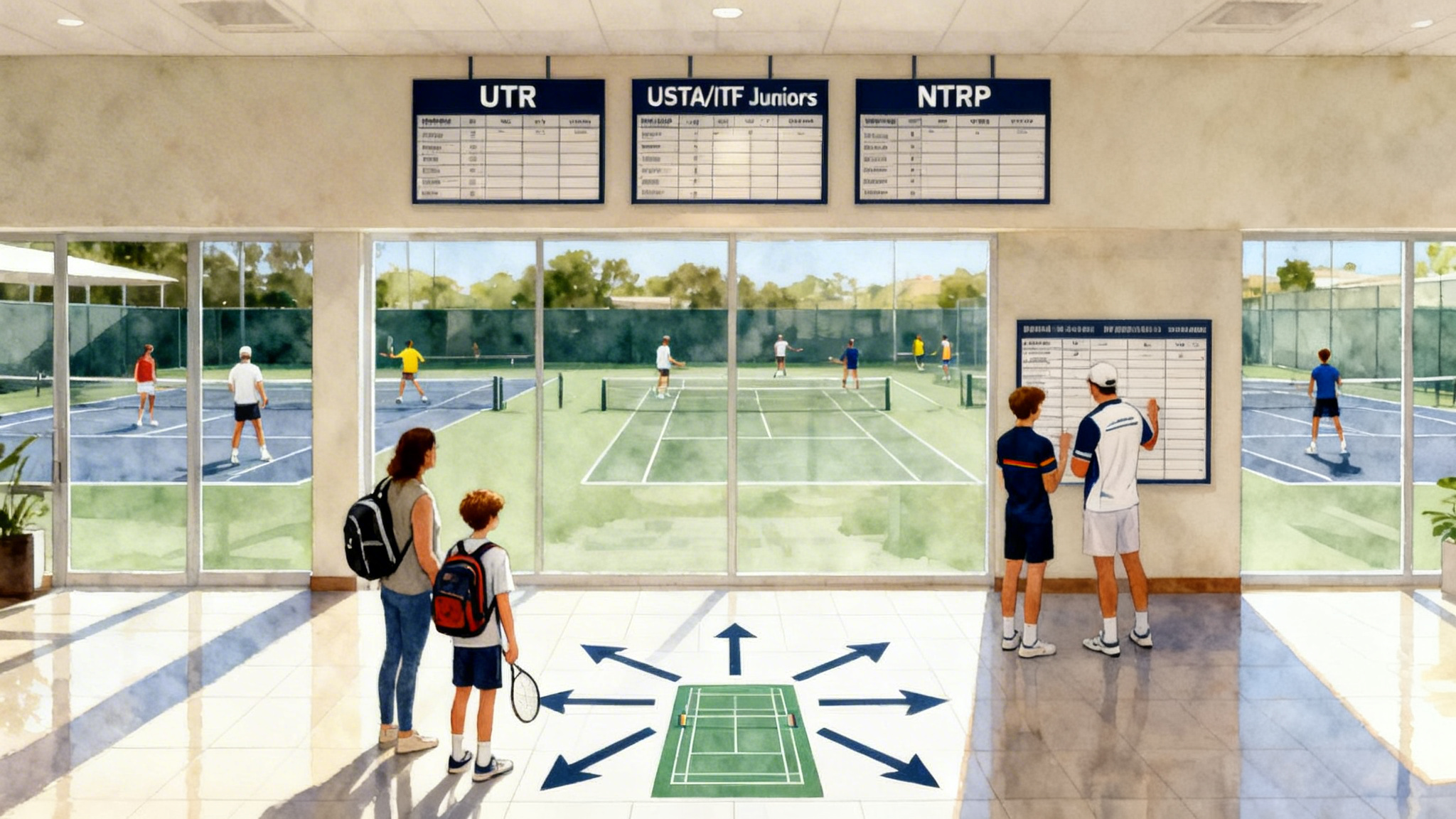
Why this guide matters in 2026
Picking the right events can feel like walking into a crowded airport with three departure boards. One shows UTR events. One shows USTA and ITF Juniors. Another shows NTRP for adults. Each board leads to real matches, real ratings, and real opportunities. This guide translates the options into a simple plan you can use this season.
We will cover who should play what, when to switch ladders, how age and eligibility work at a practical level, what ranking and rating actually mean, and how to build an actionable 12-week calendar. You will also get a one-week evaluation template and two case studies featuring real academy settings.
The three systems, explained in plain English
Think of tennis competition like three highways that sometimes connect at the same exits.
- UTR, by Universal Tennis, is a global rating scale based on performance against opponents. Events are often local, flexible, and open to mixed ages. Results feed into your rating, which helps estimate level and matchup quality.
- USTA Junior tournaments are the United States pathway. They offer levels of play, from local entry points to national events. Rules, rankings, and points are standardized across sections and the country. See the current structure at the official page on the USTA junior competitive structure.
- ITF Juniors is the international pathway for players aiming at high-level national and global competition, often with a college or pro trajectory in mind. These events have travel demands and strict acceptance rules. Learn the framework at the ITF World Tennis Tour Juniors overview.
Where NTRP fits: NTRP is the rating language of USTA adult leagues and many adult tournaments. Levels run from beginner through advanced, and dynamic updates reflect match results. If you are an adult learner or a former junior returning to the game, NTRP is your primary competitive lane.
Ratings and rankings without the jargon
- Rating is a number that describes your current playing level. UTR and NTRP are ratings. They are about skill today.
- Ranking is a list that orders players based on points earned in ranked events over time. USTA and ITF maintain rankings. They are about results over a period.
If you want precise match placement and level-based matchups, you care most about rating. If you want selection into certain draws or seeding, you care about ranking. Many motivated juniors use both: UTR for frequent, well-matched play, and USTA or ITF to build a ranking that opens doors.
When to choose each ladder
Use these simple rules of thumb.
- Start with UTR events when you are new to competing, returning from a break, changing technique, or moving up an age division. UTR brackets tend to be level-based, which means more close matches and faster learning.
- Layer in USTA Junior tournaments when you are producing competitive scores at your current level in UTR events and you are ready for ranking points. Start with lower-level local or sectional tournaments, then climb to higher levels as win rates and scorelines improve.
- Add ITF Juniors once you are succeeding in USTA sectional and selected national events, and your family is ready for travel and acceptance logistics. ITF can accelerate development due to deeper draws and surface variety.
- Adults should prioritize NTRP leagues and tournaments for a season-long schedule and strong local competition. Use occasional UTR events to fine-tune match skills or when you want quick, level-based reps outside league dates.
Age and eligibility checkpoints you can use
These checkpoints keep the choice simple, even if detailed rules vary by section or country.
- Age 9 to 10: Learn scoring, serve from a consistent toss, keep 4-ball rallies, and enter red, orange, or green-ball events as recommended by your coach. One match day every 2 to 3 weeks builds confidence without fatigue.
- Age 11 to 13: Mix UTR and entry-level USTA 12U and 14U events. Target weekly match play through practice sets or local UTR match days, then two ranked tournaments per month. Aim for competitive scorelines more than wins.
- Age 14 to 15: Lean into USTA 14U and 16U levels that match your results. Add targeted UTR events to stay sharp between ranked events. If you are winning two rounds or more consistently in quality draws, consider first ITF entries with coach approval.
- Age 16 to 18: Build a blended schedule. Use UTR for volume and confidence, USTA for ranking and exposure, and selected ITF for higher challenge and college visibility. Plan travel windows and recovery weeks well in advance.
- Age 18 plus: Transition to adult NTRP leagues and adult tournaments for structured seasons. Use UTR events to find quick tune-up matches before big league weekends. Former high school players coming back after college can self-calibrate with a few UTR matches, then choose the right NTRP level.
A simple decision tree you can memorize
Answer yes or no as you go.
- Are you getting routine, close matches at your current level? If no, play two to three UTR events to calibrate. If yes, go to step 2.
- Are you winning main-draw rounds in USTA Junior events at your current level at least half the time? If no, stick with current USTA level plus UTR tune-ups. If yes, go to step 3.
- Are you entering events with strong fields and still holding your serve more than 60 percent and breaking more than 30 percent? If yes, trial an event one level up or your first ITF J30. If no, focus three weeks on serve plus first-ball patterns, then retest.
- Are travel and academics manageable? If no, favor local UTR and sectional USTA. If yes, schedule selective ITF travel blocks.
Building a smart 12-week calendar
Twelve weeks is a sweet spot. It is long enough to measure progress and short enough to adjust.
12-week plan A: Emerging 12-year-old
Goal: gain match reps, learn to compete, and establish a reliable serve and return.
- Weeks 1 to 2: Two UTR match days with 2 to 3 short matches each. One technical session on serve and one on footwork. One rest day each week.
- Week 3: USTA local 12U event at an appropriate level. Track game margins and tiebreak performance.
- Weeks 4 to 5: One UTR event. One themed practice set day focused on crosscourt consistency. Add light fitness twice weekly.
- Week 6: Rest on weekend. Midweek match play only.
- Week 7: USTA 12U event again. Compare results to week 3. Note if losses are closer.
- Week 8: UTR event with slightly stronger flight. Film two sets for review.
- Week 9: Technical week on serve placement and second-serve shape. No tournament.
- Week 10: USTA 12U or first 14U entry if training partners suggest readiness.
- Week 11: Practice matches only. Sharpen returns and first four shots.
- Week 12: UTR event. Evaluate the 12-week block with the template below.
12-week plan B: 16-year-old aiming for college
Goal: blend UTR volume with USTA ranking points, trial an ITF J30 if acceptance is realistic.
- Weeks 1 to 2: One UTR event each week. Two heavy fitness days. One doubles session for return patterns.
- Week 3: USTA sectional event at a level where you can win rounds. Target 65 percent first-serve percentage with 60 percent hold rate.
- Week 4: Recovery weekend. Light UTR practice sets only.
- Week 5: Stronger UTR event flight. Film serve plus first ball. Track break points created and converted.
- Week 6: USTA event one tier up or same tier with deeper field. Debrief with coach on acceptance prospects for a first ITF J30.
- Week 7: Technical tune-up week. One fitness test. College email update with best wins and a short highlight clip. Use our college tennis recruiting playbook to format your outreach.
- Week 8: First ITF entry if accepted. If not, play a strong USTA or UTR event that weekend instead.
- Week 9: Rest or light event. Prioritize sleep and nutrition.
- Week 10: USTA sectional with doubles emphasis to build skills under pressure.
- Week 11: UTR event for confidence and specific pattern goals. Aim for 70 percent of returns in play.
- Week 12: Choose the best-quality event of the month. Review 12-week data and adjust.
12-week plan C: Adult 3.5 building a season
Goal: place correctly in NTRP, build match fitness, and avoid injury.
- Weeks 1 to 2: Two UTR match nights to calibrate level. One movement screen. Add light strength twice weekly.
- Week 3: NTRP tournament or in-house league opener at your likely level. Log serve percentage and double faults.
- Week 4: Recovery weekend. One doubles social hit.
- Week 5: NTRP league match. Scout future opponents if possible.
- Week 6: UTR event or challenge match to keep volume up.
- Week 7: NTRP tournament. Focus on second-serve reliability under pressure.
- Week 8: Rest. Book a 30-minute lesson to reinforce a single technical flaw.
- Week 9: League match. Add 20 minutes of agility twice this week.
- Week 10: UTR match play night with stronger opponents.
- Week 11: League match and optional doubles tournament.
- Week 12: NTRP event. Evaluate readiness to move up or consolidate.
The trial-week evaluation template
Run this in any training week to decide if you should level up, hold, or recalibrate.
- Match quality
- Play 6 short sets against three opponents at your target level. Aim for sets decided by 2 games or a tiebreak. If more than half the sets are lopsided, you are mis-seeded or mis-leveled.
- Serve and return targets
- First-serve percentage at 60 percent or better. Second-serve double faults at 2 or fewer per set. Returns in play at 65 percent or more.
- Physical readiness
- You can complete two match-equivalent days back to back without a drop in footwork accuracy or recovery between points.
- Mental habits
- Between-point routine used on at least 80 percent of points. One specific reset cue after errors. Two positive coaching cues written on your towel or water bottle.
- Data snapshot
- UTR: note current value and the quality of your last 10 opponents. NTRP: confirm current level or self-rating intent. USTA or ITF ranking: list your best recent wins by opponent level, not just by name.
Decision at week’s end
- Level up if serve and return targets are met, match quality is close, and you are not fading late. Hold if the data is mixed. Recalibrate if lopsided scores persist or your body is not recovering.
Case study 1: Legend Tennis Academy, Texas
Setting: Legend Tennis Academy in Texas.
Player: Maya, age 15, varsity starter, strong work ethic, minimal travel history.
Starting point
- UTR around mid 6.0, few USTA results, aggressive forehand but inconsistent second serve.
Plan
- Weeks 1 to 4: Two UTR events and one USTA sectional at an appropriate level. Serve-only technical block with targets on spin and height. Goal is 60 percent first serves, 3 or fewer doubles per set.
- Weeks 5 to 8: One stronger UTR flight. One USTA event with a deeper draw. Doubles every other week to build return patterns and net instincts.
- Weeks 9 to 12: Repeat USTA event at same level to measure improvement. Trial one ITF J30 entry if acceptance seems realistic based on recent wins.
Result snapshot
- By week 12 Maya had competitive scorelines in deeper draws. First serve at 62 percent, returns in play at 68 percent, and a few wins over players with stronger rankings. Coach recommended one more 12-week block before regular ITF travel. The program kept costs down, built confidence, and set a clear runway.
Case study 2: Life Time Tennis Academy, national network
Setting: Life Time Tennis Academy network.
Player 1: Jordan, adult 3.0 returning to tennis after a decade.
Plan
- Use two UTR match nights to calibrate level. Join the nearest Life Time NTRP 3.0 league. Add a monthly UTR singles event as a tune-up. One mobility session each week to reduce back stiffness.
Result snapshot
- After 12 weeks, Jordan had eight league matches completed, two UTR tune-ups, and a clear picture of strengths. Doubles return improved due to weekly reps. Jordan stayed healthy by honoring two planned rest weekends.
Player 2: Tiana, age 13, cross-training across two Life Time locations due to family travel.
Plan
- Use level-based UTR events when visiting other cities to keep match volume steady. Enter USTA 14U events at the home section on weeks with fewer school demands. Keep weekly doubles to build hand skills and footwork.
Result snapshot
- Tiana’s confidence grew with frequent close matches, while ranking points advanced through selected USTA weekends. Travel stopped being disruptive because match plans were in place before each trip.
Practical tips that save time and money
- Do not chase ratings. Chase close matches and clear skill goals. Ratings will follow.
- Schedule recovery. Every third or fourth weekend should be light to protect the body and the mind.
- Learn the scoring formats before you arrive. Many events use match tiebreaks for the third set. Practice them.
- Use doubles on purpose. Doubles adds returns, volleys, and pressure reps that make singles better.
- Log your numbers. Track serve percentage, returns in play, and break point conversion. Decisions get easier when you read your own dashboard.
A simple way to blend ladders
- UTR gives you volume and tight matches. Use it to test new patterns or to come back from injury with less pressure.
- USTA Juniors grows your ranking and places you in known draws. It shows how your game holds up under structure and travel.
- ITF Juniors stretches your ceiling with deeper fields and new surfaces once you are ready.
- NTRP provides adult seasons with teammates and playoffs. It keeps you motivated while work and family stay busy.
Turn this into your next 90-day plan
- Pick your primary ladder for the block. Juniors often blend UTR and USTA. Adults pick NTRP and sprinkle UTR.
- Mark two recovery weekends now. Protect them.
- Choose 3 to 5 target events that make sense for your level. Lock travel only after your trial week confirms readiness.
- Add one doubles event or weekly doubles practice. It pays off fast.
- Print the evaluation template and run it during week 4 and week 8.
- Keep one floating weekend to seize a good acceptance opportunity or a strong local draw.
Final checklist before you click Register
- Is the event aligned with your current level and goals for this block?
- Do you understand the scoring format and the surface?
- Is there enough recovery time before school exams or key work deadlines?
- Have you scheduled at least one practice session to rehearse patterns for the likely opponents?
Conclusion: Three boards, one journey
UTR, USTA and ITF Juniors, and NTRP are not rival languages. They are road signs that point to the same place, which is steady improvement through the right matches at the right time. Start with level-based confidence, add structured ranking events when your game is ready, and build seasons that respect your calendar and your body. Use the trial-week template, schedule with intention, and review data every 12 weeks. You will make better entries, spend less, enjoy more, and move forward with clarity in 2026.