2026 Year-Round Tennis Plans for Juniors, Parents, Adults
 Tommy
Tommy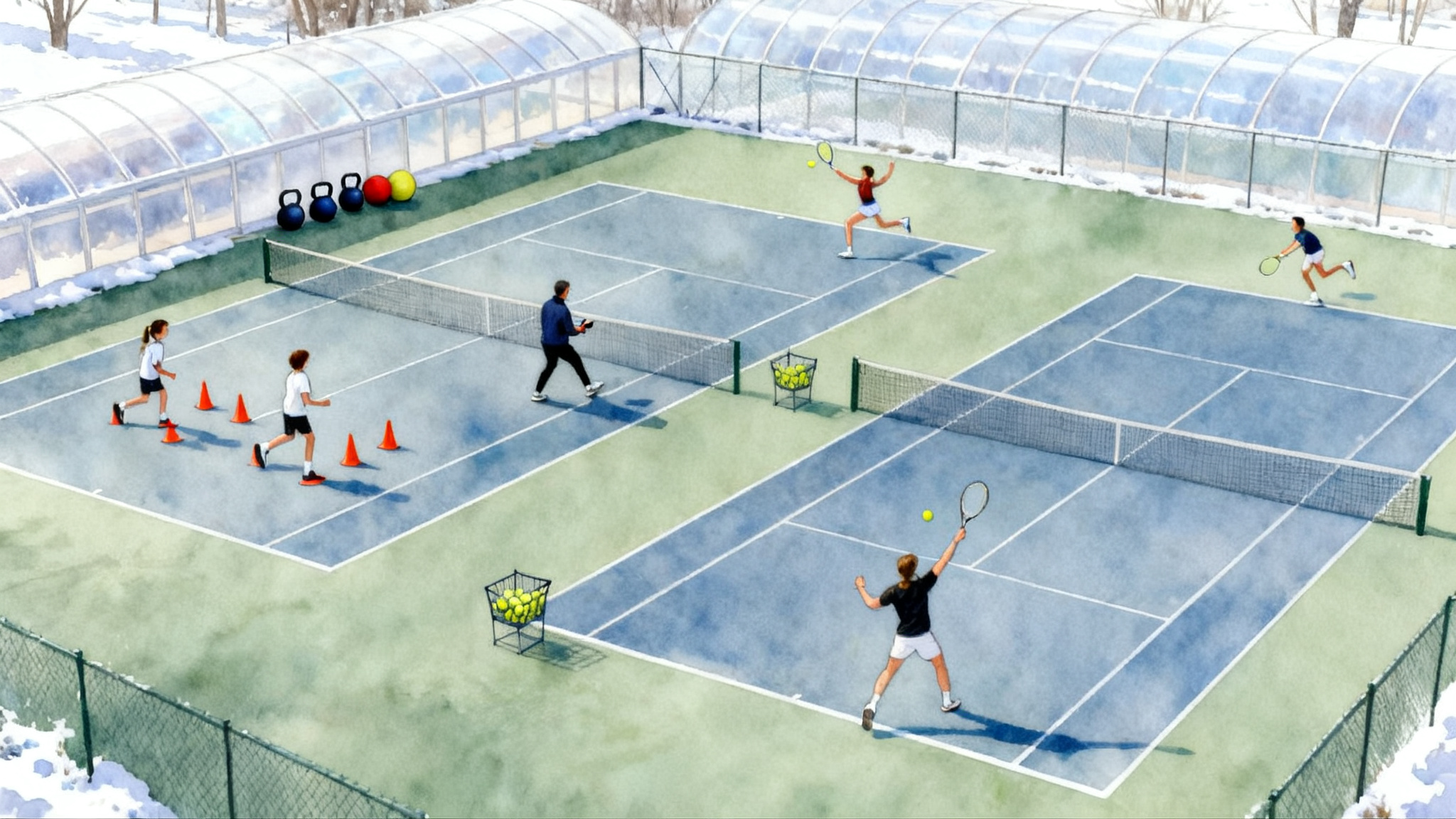
Why a year-round template works
Most players practice a lot, then compete a lot, but they rarely sequence those efforts. A simple periodized plan turns effort into progress by organizing the right work at the right time. Tennis is a skill-dominant, repeated-sprint sport. That means your plan must blend technical reps, tactical decision making, and energy system training. Coaches have used periodization for decades because structured training improves performance and reduces overuse risk when compared to random practice and play, a principle that also underpins periodized tennis planning.
This guide gives you four clear phases, three sample weekly plans for different players, concrete readiness benchmarks, parent roles that make a real difference, and printable checklists you can use on court and in the gym. No ratings calendar talk, only the work that moves the needle.
The four phases for 2026
Think of your year like a season of a great series with four arcs. Each one has a job.
Phase 1: Base
Primary goal: raise capacity. Build efficient technique, general strength, mobility, and aerobic base so you can tolerate more quality work later.
- Typical length: 6 to 10 weeks
- Court focus: high volume, lower intensity; groove fundamentals, add constraints that force good habits
- Physical focus: strength technique, mobility, aerobic intervals
- Mental focus: routines, goal clarity, journal setup
- Competition: light match play or practice sets only
Phase 2: Build
Primary goal: convert capacity into tennis-specific power and speed, sharpen patterns, and pressure-test skills.
- Typical length: 6 to 8 weeks
- Court focus: lower volume, higher intensity; add serve plus one patterns, return plus one, and transition play. For return timing ideas, see our return of serve blueprint.
- Physical focus: heavier strength lifts, power work, change of direction, alactic sprints
- Mental focus: pre-point routines, between-point scripts, pressure games
- Competition: local matches or a measured start to league play
Phase 3: Compete
Primary goal: play your best more often. Maintain qualities built earlier, manage freshness, and sharpen tactics.
- Typical length: 8 to 14 weeks depending on your schedule
- Court focus: specific point patterns, short competitive drills, scouting and match plans
- Physical focus: maintain strength in short sessions, keep speed, limit fatigue
- Mental focus: review plans, debrief matches, micro-adjust
- Competition: your chosen slate of events or league matches with recovery weeks penciled in
Phase 4: Transition
Primary goal: regenerate and audit. Reduce volume and intensity, fix small aches, and reset goals for the next cycle.
- Typical length: 1 to 3 weeks
- Court focus: fun games, light technique touch-ups
- Physical focus: deload strength, mobility circuits, gentle aerobic work
- Mental focus: reflection and next goals
- Competition: none
Tip for 2026 calendars: many juniors can run Base in January to mid February, Build from late February to April, Compete from May to July, Transition in early August, then repeat a shorter Base and Build for fall play. Busy adults can slide these windows around their spring and summer leagues.
Measurable readiness benchmarks
You improve what you measure. Use these as green lights before you move from one phase to the next. Test at the end of each phase.
Technical benchmarks
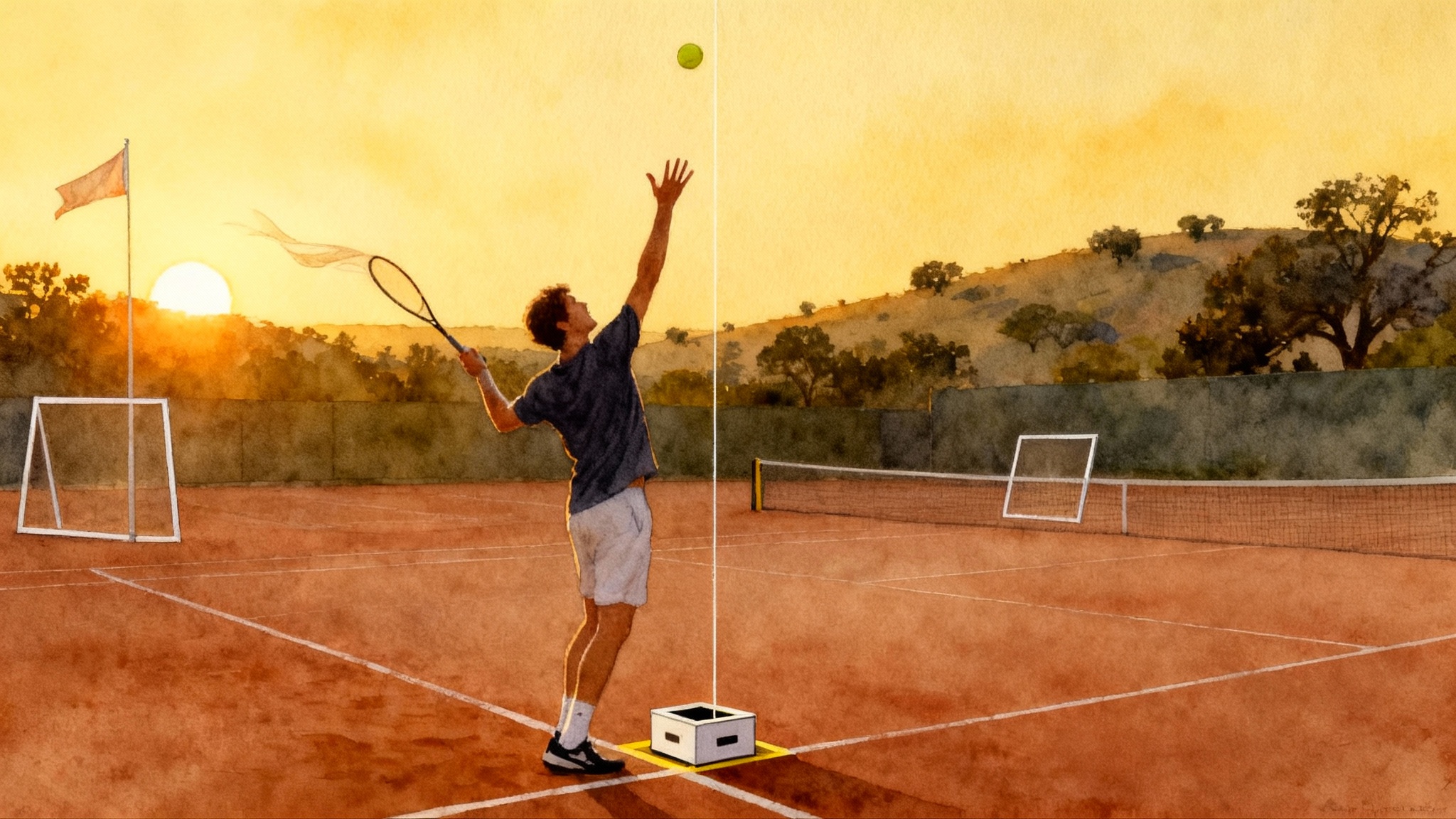
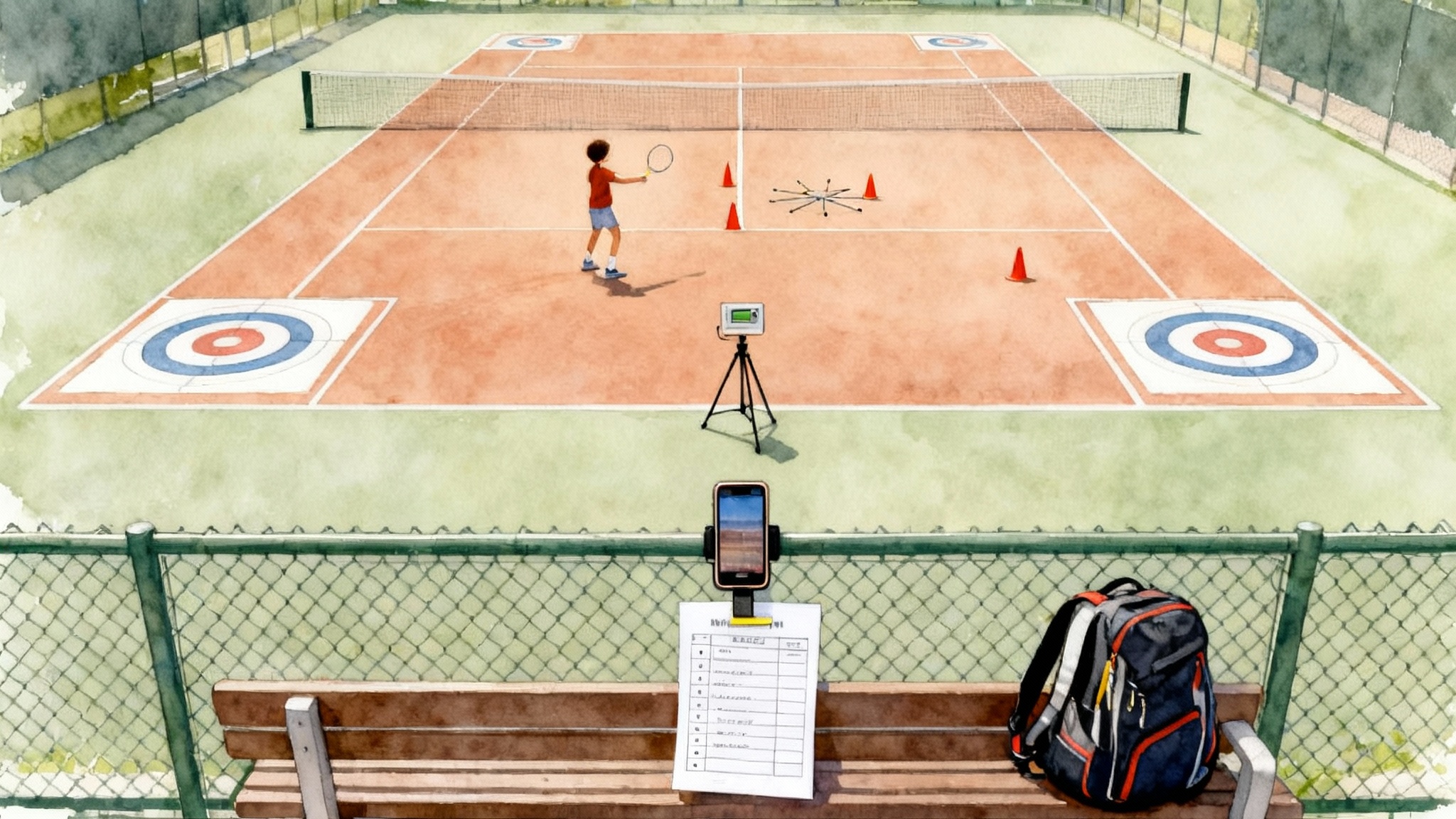
- Serve accuracy: 8 of 10 first serves landing in a 3 by 3 foot target in the deuce and ad boxes at a comfortable speed. Record with a phone for consistency. If your toss drifts, study our serve toss consistency blueprint.
- Rally stability: 30-ball crosscourt rally forehand side and 20-ball backhand side at medium pace without breaking shape. Reset if you leave the target corridor.
- Transition success: 6 of 10 approach-and-volley patterns end with a ball contacted inside the service box and a playable first volley.
Tactical benchmarks
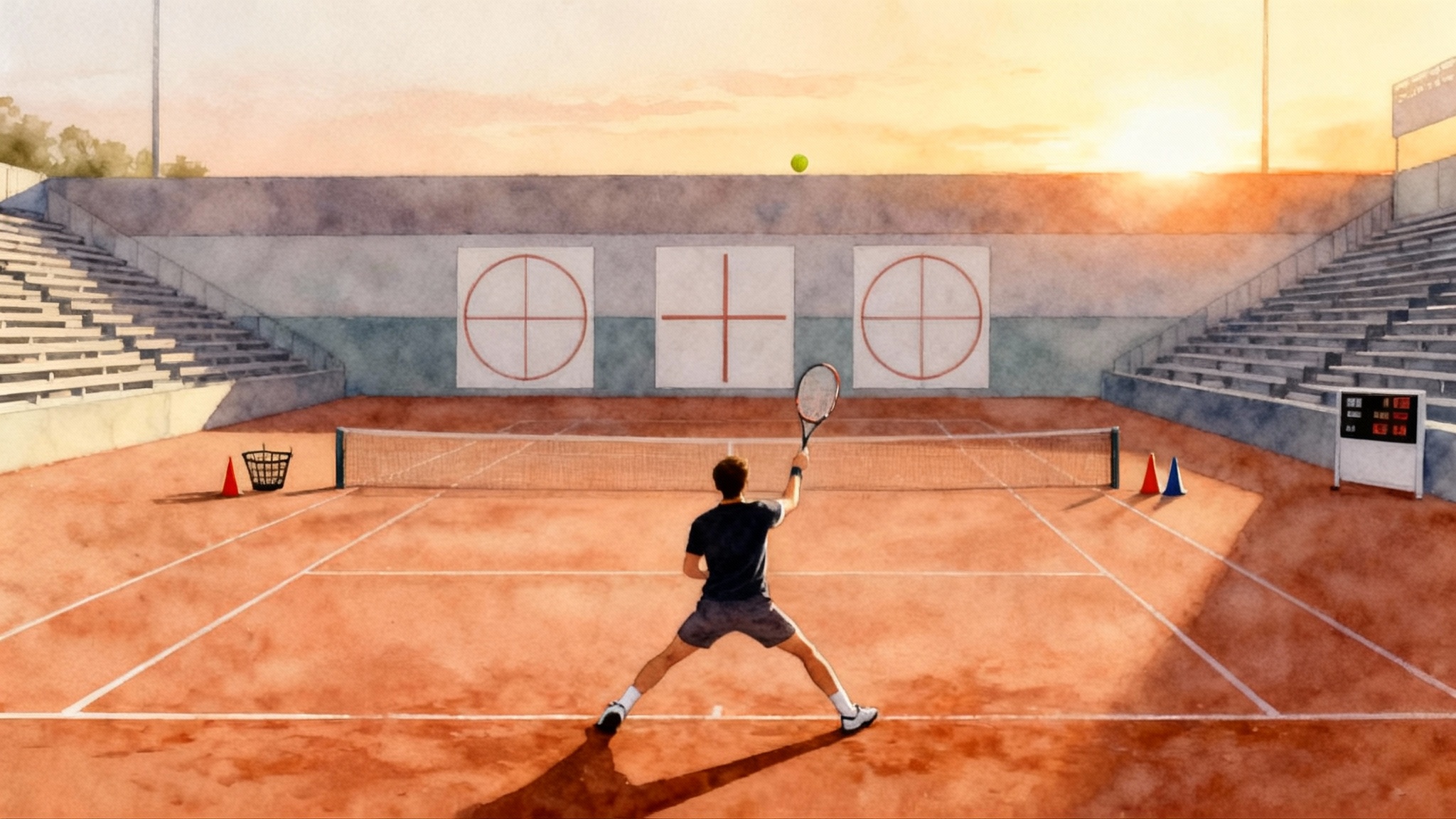
- First four shots: in a 10-ball basket, call the serve location, hit serve plus one to the planned lane 7 of 10 times.
- Return depth: against a cooperative first serve pace, land 7 of 10 returns past the service line with balanced recovery. Brush up your reads with the return of serve blueprint.
Physical benchmarks
- Sprint change of direction: 5-0-5 test under 2.70 seconds for trained high school boys, under 2.95 seconds for trained high school girls; adults can use their own baseline and aim for a 3 to 5 percent improvement by the end of Build.
- Medicine ball rotational throw: 3 kilogram ball, standing side throw average of three attempts; juniors aim for controlled mechanics first, high schoolers target body height plus half in distance measured in feet as a simple rule of thumb.
- Strength basics: 5 solid push ups with elbows at 45 degrees, 10 bodyweight split squats per leg without knee collapse, and a 30 second side plank per side. Progress to added load in Build.
- Mobility: fingertip-to-floor hamstring reach without lumbar rounding, ankle dorsiflexion knee-to-wall 4 inches each side without heel lift.
Readiness checks during Compete
- Rating of perceived exertion, also called RPE, of 6 or less the day after matches on a 1 to 10 scale where 10 is maximal effort.
- Morning heart rate variability, also called HRV, within 10 percent of your rolling 7 day average if you track it with a wearable.
Weekly plans that fit real lives
Below are three sample weeks that you can drop into any phase. Each day lists on-court themes and off-court work. Warm up and cooldown are implied. Use the minutes as guides, not laws.
A. Junior tournament player, ages 12 to 14
This player trains four to five days and touches everything a little more often than competing.
Base week
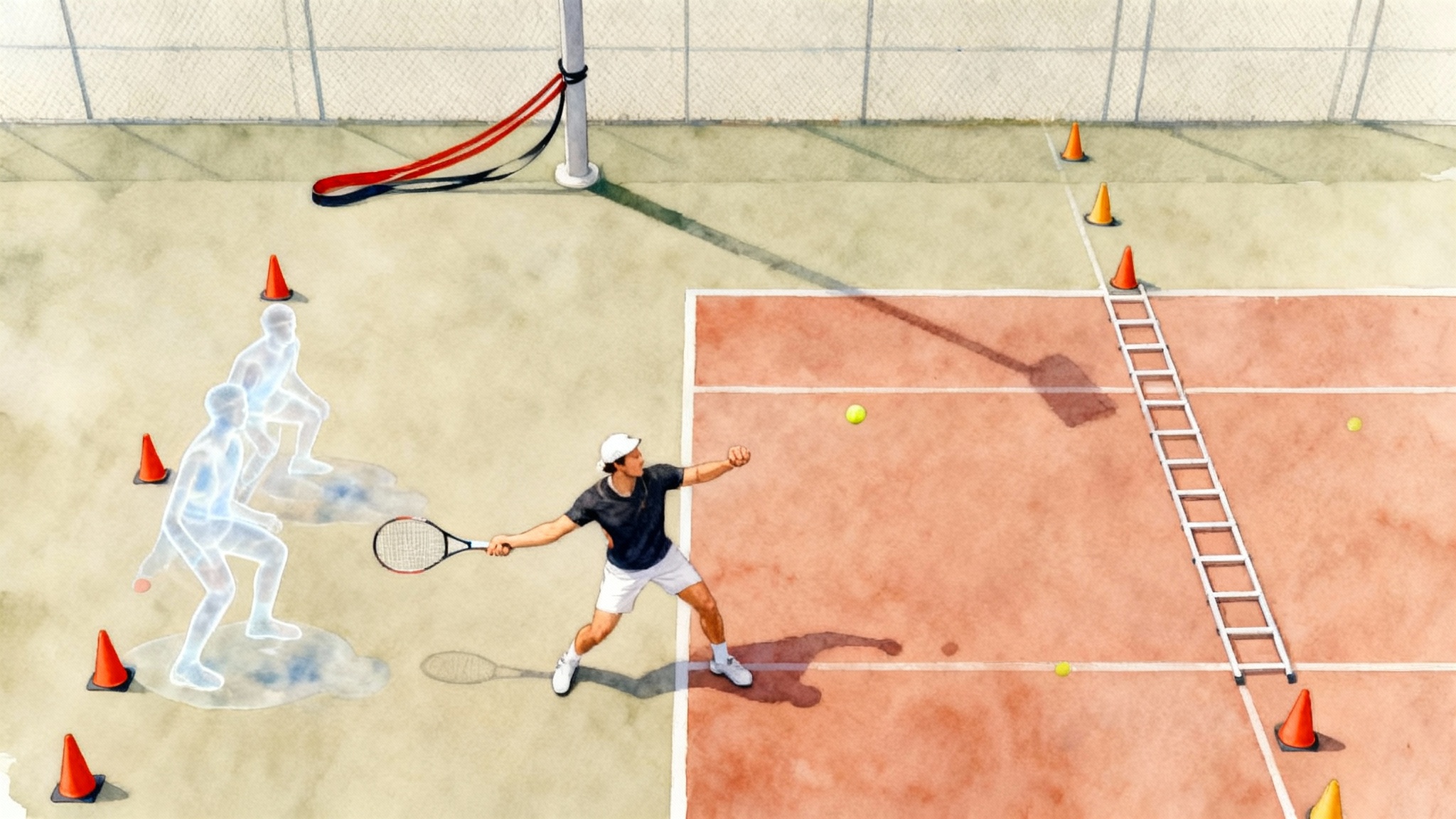
- Monday: 75 minutes technique circuit. Forehand spacing ladders, backhand contact point cones, serve rhythm. Off court 20 minutes mobility and breathing.
- Tuesday: 60 minutes rally tolerance and depth windows. Off court 25 minutes bodyweight strength and basic jump landings.
- Wednesday: Rest or school team practice at light intensity plus 15 minutes balance and footwork.
- Thursday: 75 minutes pattern building. Serve plus one to deep middle, two cross then line. Off court 20 minutes aerobic intervals like 5 by 2 minutes at conversational pace.
- Friday: 60 minutes games to 11, crosscourt only, then open play. Off court 15 minutes mobility.
- Saturday: Family activity day and 20 minutes of medicine ball throws and mini hurdles.
- Sunday: Off.
Build week
- Monday: 60 minutes live ball patterns with scoring. Off court 30 minutes strength technique like goblet squat, split squat, row.
- Tuesday: 45 minutes serve and return under time pressure. Off court 20 minutes sprint mechanics and 6 by 20 meter sprints.
- Wednesday: 60 minutes practice set with constraints such as second serve kick only. Off court 10 minutes mobility.
- Thursday: 60 minutes approach and volley ladders. Off court 25 minutes strength and 5 by 30 second bike sprints with full recovery.
- Friday: 45 minutes touch and feel, half court then full court, short points. Off court 10 minutes breathing and journaling.
- Saturday: Practice match if fresh or skill games if not. Keep total time under 90 minutes.
- Sunday: Off.
Compete week
- Monday: 45 minutes short, fast practice. Serve targets and 15 minutes returns. Off court 15 minutes mobility.
- Tuesday: Match day or tactical rehearsal 60 minutes with exact patterns.
- Wednesday: 30 minutes hit only if needed. If fatigued, rest entirely.
- Thursday: Match day. Off court 10 minutes mobility.
- Friday: 40 minutes skills and fun games.
- Weekend: One match or family activity. End with 10 minute reflection.
Transition week
- Three short 45 minute fun hits, no heavy drilling, plus two 20 minute mobility sessions. No matches. One mini session to relearn technique feels.
B. College-hopeful high schooler, ages 15 to 17
This player carries school, tougher academics, and possibly school tennis. The key is to protect quality sleep and make strength work non-negotiable in Base and Build.
Base week
- Monday: 90 minutes technique plus tempo rallying. Off court 35 minutes strength, hinge and pull focus, and 15 minutes aerobic work.
- Tuesday: 75 minutes serve plus one and return plus one. Off court 15 minutes mobility.
- Wednesday: 45 minutes skills then study block. Optional 10 minute mindful breathing.
- Thursday: 75 minutes pattern play and transition. Off court 35 minutes strength, squat and push focus.
- Friday: 60 minutes pressure games, king of the court. Off court 15 minutes mobility.
- Saturday: 40 minutes spin and height control in the morning, 20 minutes medicine ball work, then off.
- Sunday: Off.
Build week
- Monday: 75 minutes live ball patterns with scoring ladders. Off court 45 minutes strength with moderate loads and 4 by 20 meter sprints.
- Tuesday: 60 minutes serve and return under constraints, plus overheads. Off court 15 minutes mobility.
- Wednesday: 45 minutes tactical film review and 20 minutes light hit.
- Thursday: 60 minutes approach and finishing patterns. Off court 35 minutes strength, add jumps and throws.
- Friday: 50 minutes point scenarios, tiebreakers.
- Saturday: Practice match with post-match recovery walk and stretch.
- Sunday: Off.
Compete week
- Monday: 45 minutes crisp hit, serve locations and returns.
- Tuesday: Match day. Off court 10 minutes mobility.
- Wednesday: Recovery run or brisk walk 20 minutes and mobility 15 minutes.
- Thursday: Tactical hit 45 minutes. If another match, keep it short.
- Friday: Off or optional 30 minutes hit.
- Weekend: Match or two depending on health and academics.
Transition week
- Two easy 60 minute hits focused on feel. Two 25 minute mobility circuits. One 20 minute aerobic session. No heavy lifting.
C. Busy adult league player
This player needs to improve without crushing work and family. That means shorter sessions, consistent mobility, and strength that fits in a lunch break.
Base week
- Monday: 45 minutes technique blocks; forehand height control and backhand depth. Off court 20 minutes strength circuit.
- Tuesday: 30 minutes serves before work; 10 minutes mobility at night.
- Wednesday: 45 minutes live ball rally and approach work. Off court 15 minutes brisk walk.
- Thursday: 30 minutes returns and first volley. Off court 20 minutes strength circuit.
- Friday: Off or 20 minutes mobility.
- Weekend: One 75 minute practice set and a 30 minute recovery walk or ride.
Build week
- Monday: 45 minutes patterns with scoring. Off court 25 minutes strength plus 6 by 15 second bike sprints.
- Tuesday: 30 minutes serve and return quality.
- Wednesday: Off or 20 minutes mobility.
- Thursday: 45 minutes short points from feeds and live ball.
- Friday: 20 minutes easy hit or walk.
- Weekend: One match, not both days. If you play twice, make one social.
Compete week
- Monday: 30 minutes skills and serve locations.
- Midweek: League match. The next day do only 15 minutes mobility and a relaxed walk.
- Friday: Optional 30 minutes hit.
- Weekend: One practice set or rest depending on life load.
Transition week
- Two 30 minute fun hits, two 15 minute mobility sessions, and a local hike. No structured gym work.
Tennis-specific strength and mobility that scales
The gym keeps you healthy and turns technique into power. In Base, learn positions and own them. In Build, lift a little heavier and move a little faster. In Compete, protect qualities with short maintenance sessions.
- Base sample circuit, two rounds: goblet squat 8, split squat 8 per leg, hinge with kettlebell 8, half kneeling cable row 10 per side, push up 6 to 10, side plank 20 seconds per side.
- Build sample circuit, two to three rounds: trap bar deadlift 5, rear foot elevated split squat 6 per leg, single arm press 6 per side, horizontal row 8, rotational medicine ball throw 6 per side, low volume jumps 3 by 3.
- Compete maintenance, two rounds: trap bar deadlift 3, split squat 4 per leg, row 6, anti-rotation press 6 per side, 4 by 10 meter accelerations.
For youth athletes, the research consensus supports safe, coached resistance training that progresses with age and skill, as summarized in the National Strength and Conditioning Association long term athletic development. Keep technique as the limiter.
Competition pacing without ratings talk
Your body cannot absorb endless competitive stress. Pick a simple pattern and protect recovery.
- Juniors 12 to 14: two to three competitive weekends per month in Compete, never more than two in a row. If you play two straight weekends, the next weekend is off.
- High school hopefuls 15 to 17: two competitive weekends per month or a short league slate, with one full rest week every four to six weeks.
- Adults: one match per week in season, a second match only if you can still sleep seven hours and your rating of perceived exertion the next morning is five or less on the 1 to 10 scale.
Red flags that you need a downshift: morning soreness that lasts past breakfast, serve speed or depth dropping for three practices in a row, or motivation dipping even after a rest day.
Parent roles that actually help
Parents are a force multiplier when they focus on environment over instruction.
- Control the controllables: sleep routine, breakfast within an hour of waking, bag packed the night before.
- Drive the debrief: ask two questions after matches. What went to plan. What is the next tiny adjustment.
- Guard the calendar: no back-to-back-to-back weekends of travel. Hold the line when enthusiasm tries to outrun recovery.
- Fund the boring: balls, overgrips, basic gym gear, and two stringings per month in heavy play periods.
- Be the timekeeper: start drills on time, end on time. Reliability beats heroic marathons.
Optional spotlight: Legend Tennis Academy’s balanced week
Legend Tennis Academy runs a balanced microcycle that uses covered courts to protect consistency when weather turns. The typical Build phase week looks like this.
- Monday under cover: technical foundations 60 minutes, then 30 minutes return plus first ball. Short gym 30 minutes.
- Tuesday under cover: pattern play 75 minutes, court movement ladders 15 minutes.
- Wednesday light: 45 minutes feel hits and recover.
- Thursday under cover: serve and transition 60 minutes, finishing 30 minutes, plus 25 minutes power in the gym.
- Friday: tactical games 60 minutes with scoring ladders, 15 minutes serves.
- Saturday: practice match windows with staggered starts to keep court time tight. Recovery stations with mobility tools.
- Sunday: off.
Covered courts eliminate weather cancellations, which keeps skill learning on a predictable cadence. That small detail compounds across a season.
Printable checklists
Use these lists on your phone or print them. We host a ready-to-use set at 2026 training checklists.
Daily practice checklist
- Sleep 7 to 9 hours, drink water on waking
- 10 minute movement prep: hips, ankles, t spine
- Session focus written on the first ball can or on your phone
- Two priorities only, for example contact point and height over the net
- Post-session note: one win, one next action
Strength and mobility checklist
- Movement screen once per month: squat, hinge, lunge, push, pull, rotate
- Log loads for five key lifts and progress slowly
- Include one anti-rotation exercise per session
- Land before you jump higher and throw before you throw harder
- Finish with 5 minutes of breathing and mobility
Competition week checklist
- Match plan written the day before with two patterns and one adjustment
- Bag packed list: two towels, two grips, electrolytes, snacks you actually eat
- Warm up sequence: general 5 minutes, dynamic 5 minutes, hitting 10 minutes
- Between-point script: breathe, pick a target, commit
- Post-match debrief in 10 minutes or less
Transition week checklist
- Schedule your debrief call or journal entry
- Book one treatment if you have nagging pain
- Pick one technique theme for the next Base
- Review your last three benchmarks and set the next target
How to use this template month by month
Here is a simple 2026 overlay that respects school calendars and league seasons. Adjust to your climate and travel.
- January to mid February: Base. Two strength sessions per week, three to five on-court sessions depending on age and school.
- Late February to April: Build. Two to three on-court sessions, two strength sessions with more power, one sprint session.
- May to July: Compete. Two to three short, sharp practices, one maintenance strength session, planned recovery days after matches.
- Early August: Transition. Two or three fun hits, two mobility circuits, a full audit and goal reset.
- Late August to October: Second Base plus micro Build for fall play or school tennis.
- November to December: Short Build into a lighter Compete if your region has indoor leagues, or a longer Base if you prioritize 2027 spring.
Use a weekly planner to visualize the balance. We created a printable template at weekly tennis planner that matches the schedules in this article.
Troubleshooting and adaptations
- If school or work explodes this week, cut volume first, not intensity. Keep one high-quality session so your skill sharpness remains.
- If your body feels good but ball striking is inconsistent, add two constraint drills for 15 minutes each before live points.
- If your serve breaks down under pressure, spend 20 minutes on a variability ladder. Hit down the T, then wide, then body, repeat. Track makes and misses.
- If you cannot finish at the net, spend 10 minutes per session on approach footwork patterns with a target strip inside the service line.
Putting it all together
Great tennis seasons are built, not found. Pick your start date, mark the four phases, test the simple benchmarks, and run one of the weekly plans that fits your life. When in doubt, reduce the number of things you work on in a day and increase the clarity of each drill. The right work at the right time is the difference between a busy calendar and a better player.