College Tennis Recruiting 2026: Timeline, Targets, and Outreach
A month‑by‑month roadmap from 10th grade to signing day. Build a realistic target list, nail academic checkpoints, film a 4–6 minute highlight plus match reel, copy‑paste coach emails and DMs, and use visits and showcases wisely.
 Tommy
Tommy
The big picture in 2026
If you are aiming to play college tennis in the class of 2026, you have two jobs. First, stay on track academically so you clear initial eligibility. Second, show coaches what they need to project you on their lineup and inside their program culture. Registering with the NCAA Eligibility Center and matching your high school plan to the 16 core courses is the first non-negotiable step. The NCAA explains the core-course list and progression clearly on its site under the NCAA core courses overview.
On the recruiting side, a few anchors keep the process orderly:
- For Division I tennis, college coaches may send recruiting messages and speak directly with you starting June 15 after your sophomore year. Unofficial visits can happen earlier, but real recruiting conversations wait for that date.
- For Division I tennis, official visits generally begin August 1 before your junior year. You are typically allowed one official visit per school under standard rules.
- Division II allows more flexible coach communication after June 15 of sophomore year. Division III timelines are the most flexible, but coaches still prefer to see a complete academic picture before moving fast.
- The National Association of Intercollegiate Athletics runs its own Eligibility Center. International students must use InCred for credential evaluation, and the NAIA outlines those steps on its international students page.
Rules evolve, so confirm details with the compliance page of each school before you make travel plans.
Build a smart target list by tiers
Think of your list in three tiers. It keeps energy high and expectations realistic.
- Reach: programs where you would likely start lower in the lineup by year two, or need development to break in. For many recruits, these are top 40 to top 75 Division I teams, or top 10 to top 20 Division II powers.
- Fit: schools where your Universal Tennis Rating, match results, and physical metrics match recent freshmen and transfers. For many, this includes the middle of Division I, strong Division II, and high academic Division III programs.
- Foundation: options where you would contend for the lineup as a freshman, including many Division III and NAIA programs with strong academics and clear scholarship pathways.
How to make this real:
- Roster math: pull last season’s rosters and count seniors and graduate students. If three are graduating and no transfers are listed, that school likely has two to three open slots.
- Player comparables: compare your UTR trend line to the 4 through 7 players on that roster, not the number one. Include your last 20 verified results.
- Academic floor: match your GPA, rigor, and test plan to the school’s ranges. Coaches move quickly when they know you will clear admissions.
- Budget and geography: write a real travel and tuition budget for your family. Add driving radius notes if being within a day’s drive matters.
Update this list quarterly. If your UTR jumps, move schools up. If you have an injury or late start, keep extra foundation options warm.
Academies help here. Programs like Life Time Tennis Academy and Gomez Tennis Academy see where their alumni land year after year. Ask them for three comparable placements from the last two classes. That gives you real benchmarks for your list.
Month by month: 10th grade to signing day
Below is a practical timeline for a class of 2026 recruit. If you are slightly ahead or behind, slide the months but keep the order.
Tenth grade, January to March
- Start your Eligibility Center registration and talk with your counselor about your core-course plan.
- Film a baseline skills set for your own use. Save serves, returns, and two rally patterns.
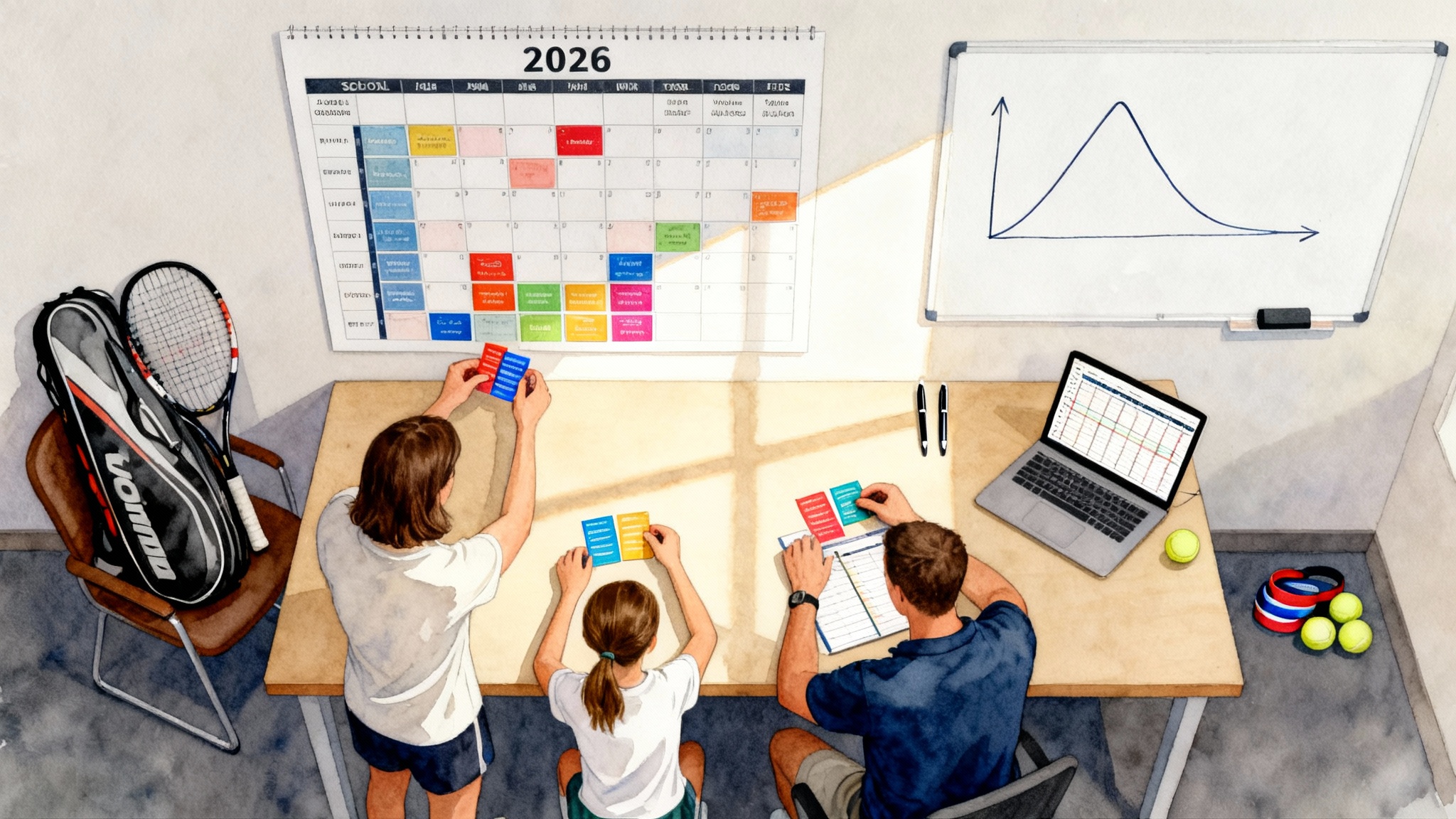
- Map tournaments for the next 6 months. Put school testing dates and big tournaments on one calendar.
Tenth grade, April to May
- Take a first pass at your target list with 5 reach, 10 fit, and 10 foundation schools.
- Ask your coach for a two sentence scouting report you can quote later.
- Draft your email and direct message templates. You will not send them to Division I or Division II coaches yet, but you will be ready.
Tenth grade, June to August
- After June 15, you may begin two-way recruiting communication with Division I and Division II staffs. Send your first outreach to 10 to 15 programs from your fit and foundation tiers.
- Film a clean highlight reel and one full set against a comparable player. See this smartphone filming checklist to capture angles coaches trust.
- Visit two to three local campuses for unofficial visits. Keep notes on facilities, academics, and team vibe.
Eleventh grade, September to November
- Update your film with two new match clips.
- Ask two teachers to be future references. Coaches care about reliability in the classroom.
- Schedule two to three unofficial visits at realistic fits. Meet the coaching staff if allowed by rules.
Eleventh grade, December to February
- Update your grades and test plan. If you are taking the SAT or ACT, put registration deadlines on your calendar. Many schools are test optional, but coaches still use scores as a fast read on academic preparation.
- Send a round of quick-update emails to every coach who engaged with you this fall. Include two bullet points and your upcoming tournament schedule.
- Ask your academy or private coach to make one well-timed introduction to a program where you are a strong match.
Eleventh grade, March to May
- Schedule spring visits. If you receive an official visit invite, confirm that you can bring your unofficial visit notes and questions into that conversation.
- Keep your match schedule strong enough to show level and fitness.
- Audit your target list. Add two schools for every one you remove.
Eleventh grade, June to August
- Use camps and showcases to create momentum. At academies like Life Time Tennis Academy or Gomez Tennis Academy, ask which coaches are expected and how they handle personal introductions.
- Expect roster movement. The transfer portal creates late openings. Keep your film and resume current so you can move quickly.
Twelfth grade, September to October
- Confirm your Eligibility Center status is complete. Ask your counselor to upload updated transcripts.
- If you have offers, ask for a sample scholarship breakdown that shows athletic aid, academic aid, and need-based aid.
- Arrange overnight stays or 48-hour official visits where permissible, and always prepare questions.
Twelfth grade, November
- National Letters of Intent and institutional aid agreements start flowing. Read everything carefully, ask questions, and involve your school counselor.
- Send appreciative notes to every coach who invested time, even if you are going elsewhere. Coaches remember professionalism.
Twelfth grade, December to May
- Keep grades strong and training consistent. Late spring changes happen.
- If you are still open, target schools that graduated seniors or had late transfers. Send a short new reel and two match scores only.
Coach outreach that gets read
Your subject line is the only gatekeeper for a busy staff inbox. Keep it factual and scannable.
Subject lines you can use:
- 2026 recruit, right-handed, UTR 10.5, 3.7 GPA, tournament schedule attached
- 2026 lefty, UTR 9.8, 6-2, 170, highlight link and spring results
- 2026 doubles specialist, UTR 10.2, 3.9 GPA, two quick questions
Copy-paste email template:
Hello Coach [Last Name],
I am a junior at [High School] in [City, State], class of 2026, and I am very interested in [School]. I project as a [singles line or doubles role] in your program based on my current level and style.
Quick facts
- Universal Tennis Rating: [number], 12-month trend [+0.5 since last spring]
- Academic: [GPA], [intended major or academic interests]
- Recent results: [two match scores with opponent UTRs]
- Video: [link to highlight plus full set]
Why your program
Two sentences tailored to their style, schedule, or academics. For example, I value your team’s fitness standards and the chance to study data science.
Upcoming schedule
[List 3 tournaments or duals with dates and locations]
Would you have 15 minutes for a call next week, or any feedback on my fit for your 2026 needs? Thank you for your time.
Best regards,
[Name]
[Phone]
[High school and academy]
Direct message template for social media:
Hello Coach [Last Name], I am [Name], class of 2026, UTR [X.X], [GPA]. I sent you an email with a 4 minute video and two current match results. I would value feedback on my fit for [School]. Thank you.
Follow-up cadence:
- Initial email with video and two results.
- Two weeks later, a five-sentence update with one new result and your next event.
- After live evaluation, a thank you and any clarifying questions.
- If no response after three touches over eight weeks, pause for 60 days and circle back with a clear new reason to reach out.
Your 4 to 6 minute video: what to film and how
Think like a coach with limited time. They want to see contact point, court coverage, patterns, and competitiveness. Build a two-part video.
Part 1, highlights, 2 minutes:
- Serves: 6 deuce side, 6 ad side. Show flat, slice, and kick if you have it. Include two second ball patterns.
- Returns: 4 deuce, 4 ad, on both first and second serves.
- Forehand and backhand patterns: 6 to 8 rally clips that show depth, direction, and recovery steps.
- Transition and net: 4 points where you finish at the net.
- Movement: 4 points that show change of direction and defense to offense.
- Lefty or specialty: include a pattern that highlights your unique edge, such as ad-side lefty slice wide to forehand open court.
Part 2, live set, 2 to 4 minutes:
- One continuous game from each player’s serve, plus two long points from the same set.
- Keep the camera high and centered behind the baseline or slightly off-center to show depth.
- Add a simple score overlay and match context at the start: surface, opponent UTR, date.
- No background music, no slow motion, no jump cuts inside points.
Recording tips:
- Use a phone on a fence mount or a tripod. Clean the lens.
- Shoot in 1080p at 60 frames per second if possible.
- Trim dead time, keep the total under 6 minutes, upload as unlisted.
- File name example: lastname_firstname_2026_highlight_set1_2026-03.mp4
Campus visits: what to see and what to ask
Unofficial visits are at your expense. Official visits are paid by the school within strict rules and usually last up to 48 hours. You are typically allowed one official visit per school. Plan both like interviews.
Unofficial visit checklist:
- Watch a team practice start to finish. Note tempo, coach voice, and player ownership.
- Meet academic support. Ask about class registration priority for athletes.
- Walk housing, training room, and study spaces.
- Eat where athletes eat and ask a player about the daily schedule.
- Note travel time to practice and academics.
Official visit checklist:
- Confirm the itinerary ahead of time and ask to meet position coaches and key players.
- Request a short meeting about scholarship structure and how multi-year aid is handled.
- Ask for a sample day in season and a sample off-season training week.
- Clarify redshirt philosophy and how injuries are supported.
- If you are international, ask about support for visas, banking, and housing over breaks.
Green flags and red flags:
- Green: players linger on court to hit extra balls, staff knows your film, everyone gives the same answer about team culture.
- Red: inconsistent answers about scholarship renewals, little academic support structure, or a team culture that runs on short term fear instead of long term accountability.
Eligibility basics for families
NCAA academic checkpoints:
- Register with the Eligibility Center during 10th grade.
- Build to 16 core courses that include 4 English, 3 math at Algebra I or higher, 2 natural or physical sciences with a lab if offered, 1 additional English or math or science, 2 social sciences, and 4 additional academic courses.
- Complete at least 10 core courses before your seventh semester, with 7 in English, math, or science.
- Maintain a core-course grade point average that meets the sliding scale if you submit SAT or ACT scores.
- Send test scores to code 9999 if you plan to submit them, and ask your counselor to upload transcripts at year end and after graduation.
NAIA checkpoints:
- Create your PlayNAIA account early in junior year.
- For international students, InCred is required and the NAIA outlines documents, translations, and fees on its international students page.
- Confirm what the school requires for admission beyond eligibility, such as English proficiency testing or specific course prerequisites.
International applicant notes:
- Transcripts: provide originals and literal English translations, plus grading scales.
- Timelines: start earlier than you think. Some ministries and schools close during holidays.
- Visas: the I-20 process requires proof of funding. Ask international students on the team how the school supports banking, Social Security number appointments, and housing during breaks.
How academies support showcases and introductions
The fastest way to your first real conversation is often through someone coaches already trust. Here is how to use an academy relationship the right way.
- Be recommendation ready: give your academy coach a one page profile with your UTR trend, two best wins with dates, a short clip link, academic summary, and three programs that match.
- Ask for targeted intros: one or two emails to realistic programs is stronger than ten generic forwards. Ask the coach to include one sentence on how you train and compete.
- Use showcases strategically: ask which staffs confirmed attendance, what format the points will be played, and whether there is time set aside for conversations. Life Time Tennis Academy often integrates showcases with tournament weekends so coaches can see both short format points and real matches. Gomez Tennis Academy is known for hands-on player development and can advise when to prioritize training blocks over events.
Etiquette matters. When your academy sets an introduction, follow up within 24 hours, copy the academy coach when appropriate, and close the loop after any call or visit.
Troubleshooting common scenarios
Injury during junior year
- Keep training logs for approved cross-training. Film short clips that show movement quality as you return. Send one concise update with a timeline, not daily recovery notes.
Late bloomer
- Stack your schedule with the right matches rather than more matches. Coaches prefer one clear win over a ranked opponent to five easy victories. Share your 12-month UTR trend and exact improvements in serve speed, return depth, or fitness.
No test score yet
- Many schools remain test optional for admission, but a solid score can help with merit aid and quick reads. Pick one test and one test date. Use two practice exams and one proctored full practice to remove surprises.
Academic dip
- Get ahead of it. Ask your counselor to outline a plan that preserves your core-course progression. Send coaches a short note that includes the plan and any early returns from re-tests or tutoring.
International timing
- Build one calendar that includes visa interviews, document procurement, and embassy closures. Share it with coaches so they see you are managing the process.
Walk-on interest
- Ask directly about roster size, practice players, and paths to scholarship in year two. Ask for two examples from the current staff who followed that path.
Financial clarity
- Ask for a cost of attendance sheet that includes tuition, fees, housing, meal plan, travel, and health insurance. Confirm whether aid is renewable annually and what performance or academic conditions apply.
A simple system you can stick to
Most families feel overwhelmed at first because the process feels like a fog. The way out is a calendar, clear film, and steady communication. Build a three tier list, send precise updates, and keep your academics on rails. Use your academy’s network for introductions when your fit is clear. Keep film short, visits intentional, and emails respectful of a coach’s time. If you keep showing your real level and your real self, the right program will see both and invite you to be part of their lineup and their locker room.