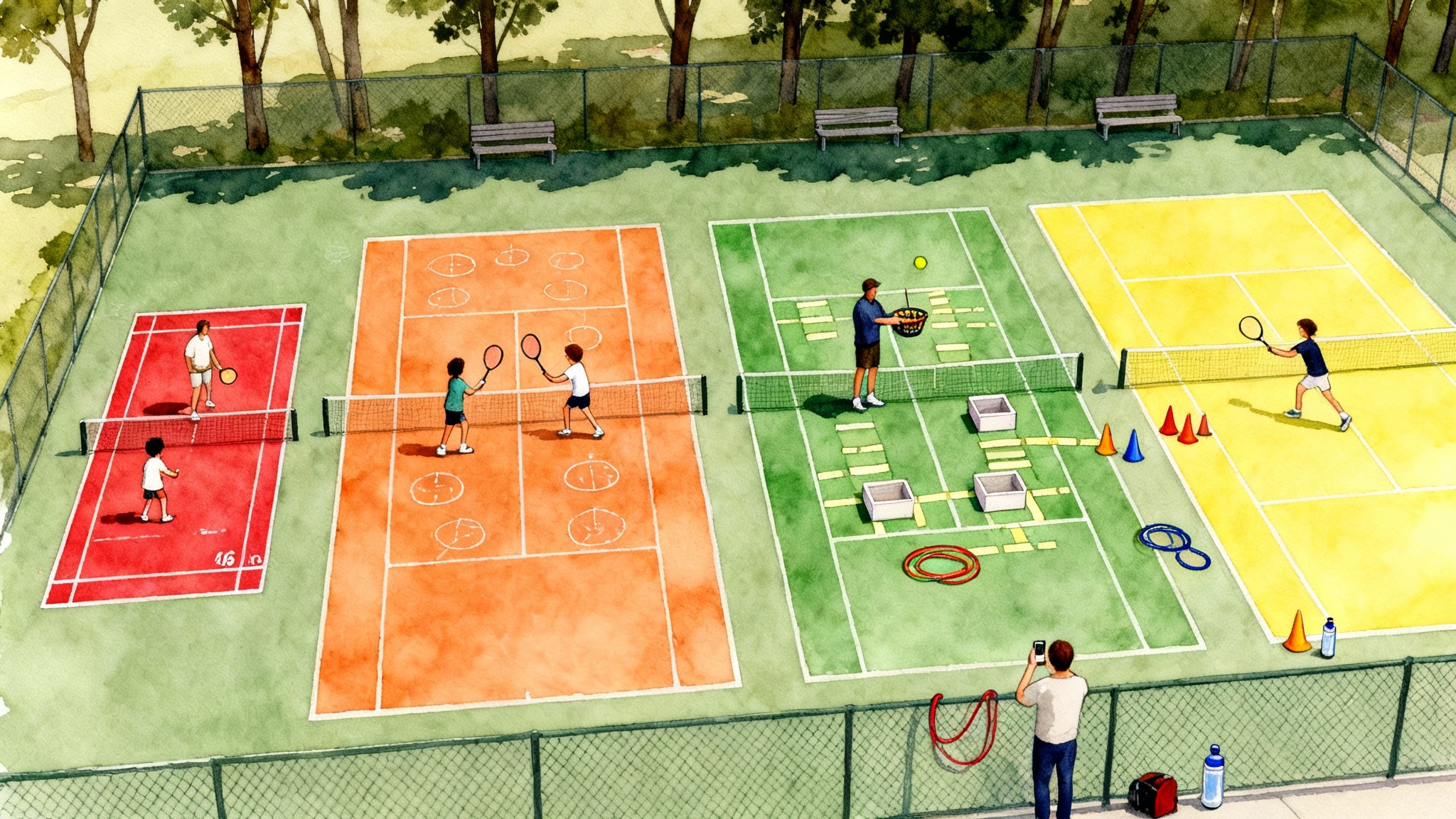
Serve Volume Blueprint 2026: Safe Loads for Juniors and Adults
A parent and player guide to safe serve counts, easy RPE tracking, warm-up and prehab, red flags, and simple microcycles for 10U, 12–16U, and adult returners. Includes a printable serve log and taper plan.
 Tommy
Tommy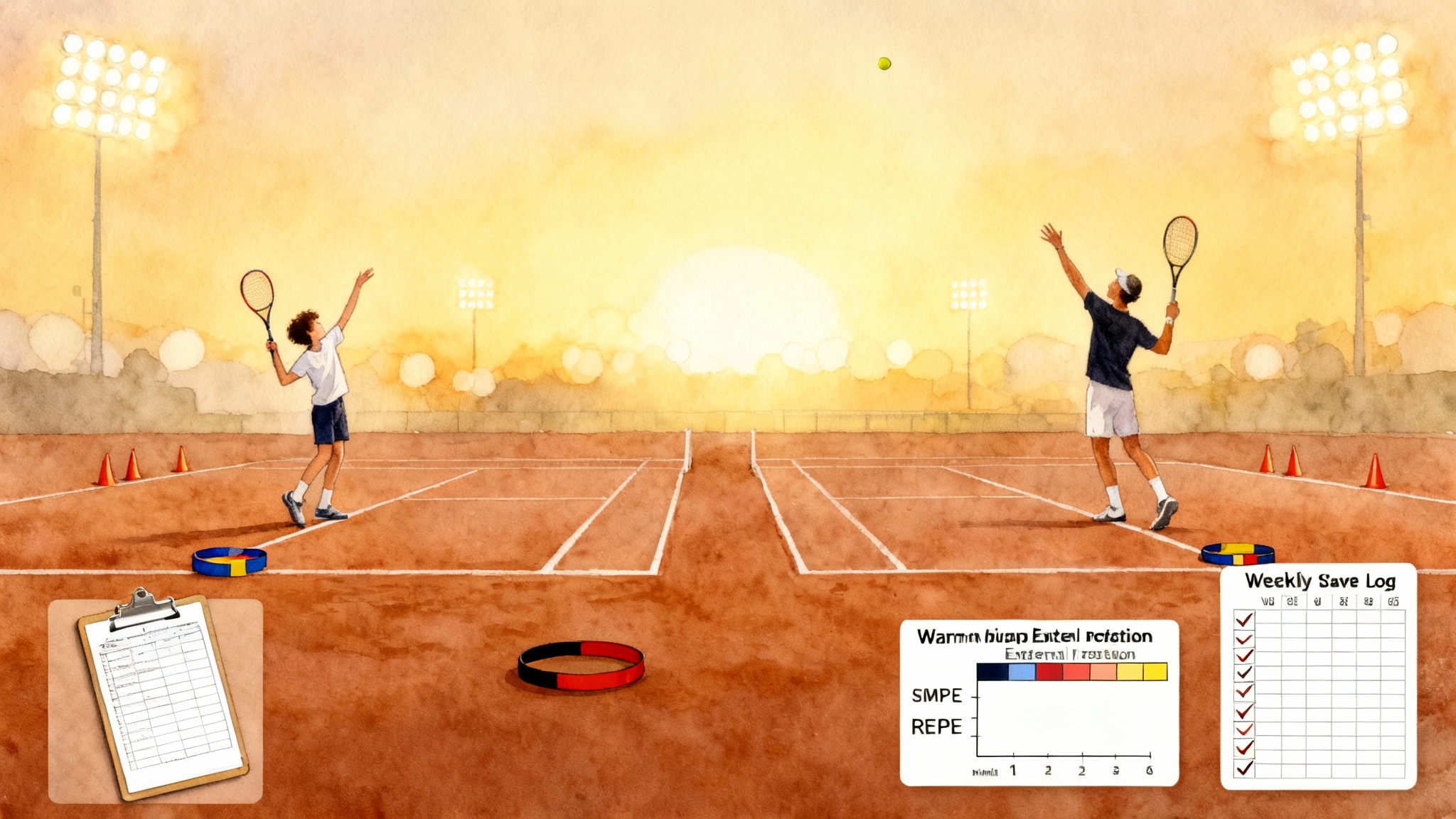
Why serve volume is your safety lever
The tennis serve is the most powerful and repetitive stroke on court. It is also the one that concentrates load on the shoulder, elbow, and forearm. That load is not just about how hard a player serves. It is about how many balls are served and how the body feels while doing it. When you control volume and intensity, you control risk. That is the core of this blueprint.
This article turns sports science into plain actions. You will get weekly serve counts for three groups (10U, 12–16U, adult returners), a simple way to track effort using rate of perceived exertion, clear warm-up and prehab, early red flags, and an easy taper plan before tournaments. You will also find a printable serve log you can use right away and a path to get personalized on-court screening in Austin.
The simple formula: serves × RPE = session load
We will use a very simple model you can track with a pencil. Count every serve that looks and feels like a real serve. Then multiply by how hard the session felt.
-
RPE stands for rate of perceived exertion. Use a 0 to 10 scale:
- 0 to 1 very easy
- 2 to 3 easy aerobic
- 4 to 5 steady but comfortable
- 6 to 7 challenging
- 8 very hard
- 9 near maximal
- 10 maximal effort
-
Session load = number of serves × average RPE for the serve portion of the practice. Example: 60 serves at RPE 6 equals 360 load units.
-
Weekly load = sum of all session loads for the week.
Two guardrails keep things safe:
-
Avoid spikes. Try to keep weekly load increases to about 5 to 10 percent. If an illness, travel, or break happens, restart at a lower base and build again.
-
Space serve days. Shoulder tissues like rhythm more than marathons. You will see two to four serve days per week based on age and status.
What counts as a serve for logging
- Count first and second serves.
- Count match warm-up serves.
- Count overhead warm-up serves if they are full speed. If they are gentle drills, count half.
- Do not count shadow swings or tossing without a hit.
Weekly serve counts by age and status
These ranges assume a healthy player with basic technique who also hits groundstrokes and plays points. If pain, stiffness, or a skill rebuild is in progress, stay at the bottom of the range and reduce intensity.
10U players
-
Off-season build: 100 to 180 serves per week
- Sessions: 3 serve days per week
- Per session: 20 to 40 serves
- Rest at least one day between serve days
-
In-season maintenance: 80 to 160 serves per week
- Sessions: 2 to 3 serve days per week
- Per session: 20 to 35 serves
- One short tune-up the day before a match
-
RPE guide: Most sessions RPE 4 to 6. Only one day per week at RPE 7 for better players. Avoid RPE 8 to 10 in this age group.
Why this works: young athletes need skill reps without fatigue debt. Fewer serves with better focus lowers elbow and shoulder stress while still improving consistency and toss timing.
12–16U players
-
Off-season build: 180 to 300 serves per week
- Sessions: 3 to 4 serve days per week
- Per session: 40 to 80 serves
- One day is technical focus at RPE 4 to 5, one day is speed focus with low volume
-
In-season maintenance: 150 to 280 serves per week
- Sessions: 3 serve days per week
- Per session: 35 to 75 serves
- Keep the heaviest day 4 to 6 days before tournaments
-
RPE guide: Mix RPE 4 to 6 for most work, one day at RPE 7 to 8 for speed and first-serve power. Avoid back-to-back high RPE days.
Why this works: these athletes can handle more volume and speed, but structure matters. Spreading load across the week reduces next day stiffness and preserves precision for matches.
Adult returners
-
Re-entry month 1: 120 to 240 serves per week
- Sessions: 2 to 3 serve days per week
- Per session: 30 to 70 serves
-
Months 2 to 3: 200 to 320 serves per week
- Sessions: 3 serve days per week
- Per session: 40 to 80 serves
-
In-season league play: 160 to 300 serves per week
- Sessions: 2 to 3 serve days per week plus matches
- If a match includes 60 to 100 serves, subtract from the weekly plan
-
RPE guide: Start at RPE 3 to 5 for two weeks, then allow one day at RPE 6 to 7. Adults often have desk time and prior shoulder history, so keep a larger buffer.
Why this works: tendons adapt slowly. Adults benefit from conservative ramps and consistent prehab so the shoulder cuff and forearm handle spin and speed.
Microcycles you can copy and post on the fridge
A microcycle is a simple 7-day plan. Use these as templates and move days to match school, travel, and league calendars.
Off-season microcycle
-
10U
- Day 1: Serve technique 30 serves at RPE 4, groundstrokes, prehab
- Day 2: Rest or athletic play, skipping rope, light band work
- Day 3: Serve speed and rhythm 25 serves at RPE 5 to 6, points on half court
- Day 4: Rest
- Day 5: Serve targets 30 to 35 serves at RPE 5, finish with 8 second serves to one spot
- Day 6: Fun games, no serving
- Day 7: Rest
-
12–16U
- Day 1: Heavy technique 60 to 70 serves at RPE 5, include 12 second-serve patterns
- Day 2: Sprints and strength, no serving
- Day 3: Speed session 35 to 45 serves at RPE 7 with full rest between sets
- Day 4: Rest or easy hit
- Day 5: Target session 50 to 60 serves at RPE 5 to 6, finish with 2 tie-breaks
- Day 6: Mobility and band circuit only
- Day 7: Optional match play, count match serves toward weekly total
-
Adult returners
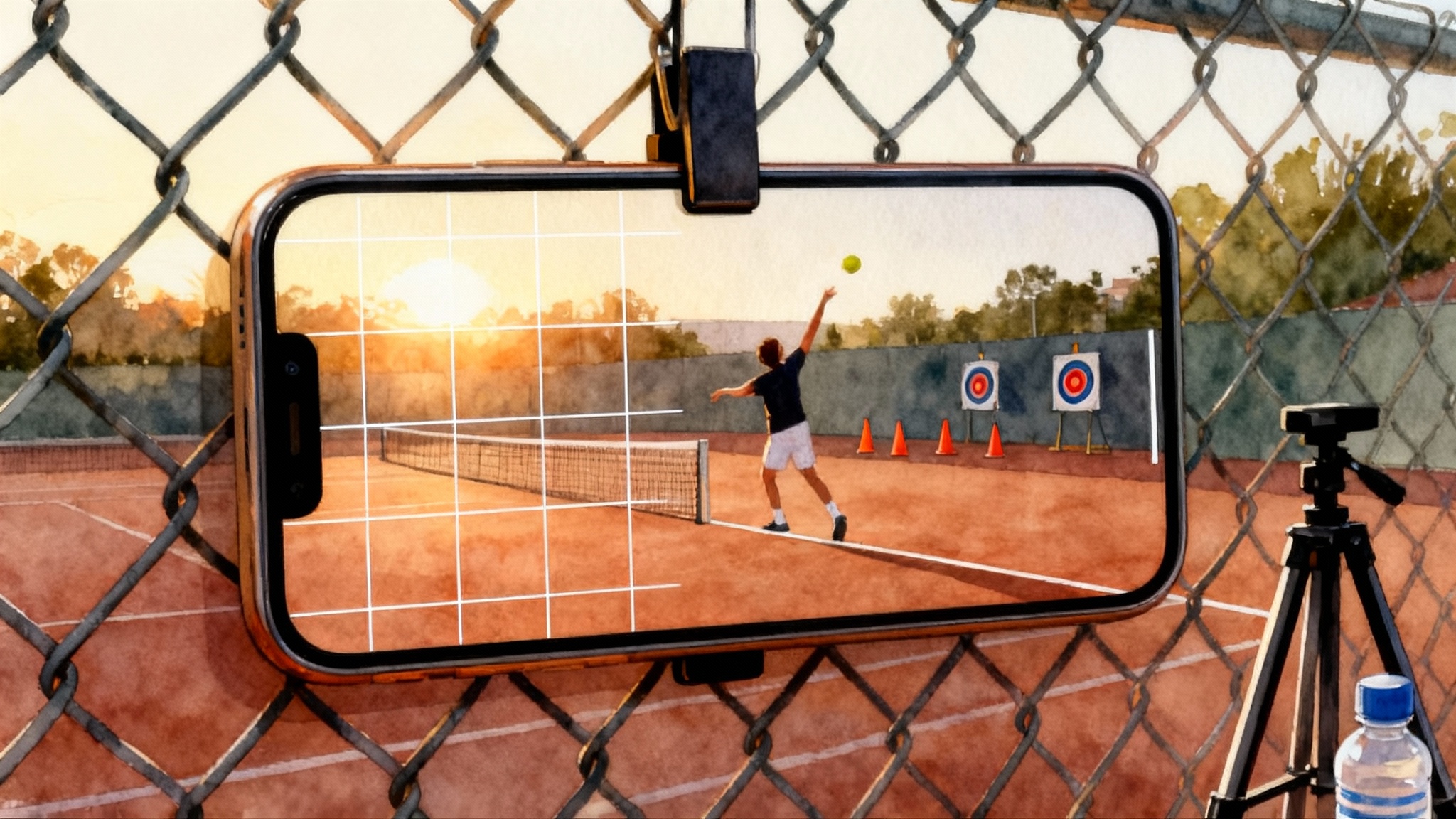
- Day 1: Technique rebuild 40 to 60 serves at RPE 4 to 5, video check if possible using DIY tennis video analysis
- Day 2: Strength and mobility, no serving
- Day 3: Speed and spin 30 to 40 serves at RPE 6 to 7 with high rest, finish with 8 slice seconds
- Day 4: Rest or easy hit
- Day 5: Target session 40 to 60 serves at RPE 5 to 6, 6 first serves to each target
- Day 6: Doubles match or points, log all match serves
- Day 7: Rest
In-season microcycle
-
10U
- Day 1: 25 to 30 serves at RPE 4 to 5, target work
- Day 2: Rest
- Day 3: 20 to 25 serves at RPE 5, second serve focus
- Day 4: Rest or easy hit
- Day 5: 15 to 20 serves at RPE 4, feel only
- Day 6 to 7: Match window
-
12–16U
- Day 1: 45 to 60 serves at RPE 5 to 6
- Day 2: Strength and mobility
- Day 3: 30 to 40 serves at RPE 6 to 7, speed emphasis
- Day 4: Rest or light hit
- Day 5: 25 to 35 serves at RPE 4 to 5, precision only
- Day 6 to 7: Matches, log serves
-
Adult returners
- Day 1: 40 to 60 serves at RPE 5 to 6
- Day 2: Mobility and band work
- Day 3: 25 to 40 serves at RPE 6, include kick or slice practice
- Day 4: Rest
- Day 5: 20 to 30 serves at RPE 4, feel and routine only
- Day 6 to 7: League or tournament matches
For a full competition prep across nutrition, warm-up, and recovery, see our Tournament Weekend Playbook.
Warm-up that protects the shoulder and elbow
Treat the warm-up like a savings account. Small, steady deposits add up and prevent costly withdrawals.
Total time: 10 to 12 minutes.
- Body temperature and rhythm, 3 minutes
- Skipping rope or brisk court lines run, 90 seconds
- Carioca and side shuffles, 60 seconds
- Mini band lateral walks, 30 seconds
- Mobility, 3 minutes
- Thoracic spine open books, 6 per side
- Scapular wall slides, 8 slow reps
- Wrist flexor and extensor stretch, 20 seconds each
- Activation, 4 to 6 minutes
- Band external rotation at side, 2 sets of 12
- Band scapular rows with squeeze, 2 sets of 10
- Serratus punches with band, 2 sets of 10
- Forearm pronation-supination with light hammer or racquet, 2 sets of 12
Then begin serving with 6 to 8 half-speed serves, tall posture, calm toss, and a smooth finish. Only after those feel clean should you move toward full speed.
Prehab essentials after practice
-
Rotator cuff strength
- Sidelying external rotation with light dumbbell, 2 sets of 10 to 12
- Standing band external rotation at 90 degrees of elbow bend, 2 sets of 10
-
Scapular control
- Prone Y T W series, 1 set of 8 each shape with 2 second holds
- Quadruped plus (cat plus), 2 sets of 10 for serratus
-
Forearm and elbow resilience
- Eccentric wrist extension with light dumbbell, 2 sets of 12
- Eccentric wrist flexion, 2 sets of 12
- Rice bucket or putty squeezes, 2 sets of 30 seconds
Finish with 2 minutes of easy bike or walk to cool down. If a match ran long, cut prehab volume in half but keep the key moves.
Red flags that mean pause and check
Use this checklist once per week and any time something feels off. If you answer yes to one item, downgrade the next serve session. If you answer yes to two or more, hold serving and book a screen.
- Pain above 3 out of 10 during or after serving
- Pain, catching, or clicking that changes the motion
- Night pain or morning stiffness that lasts more than 24 hours
- A sudden loss of 10 percent or more in speed or accuracy compared with normal
- Elbow tightness or tingling into the forearm or hand
- A shrugging shoulder or visible winging shoulder blade on video or in a mirror
What to do: stop serving for the day, switch to footwork or groundstrokes, use a short ice or compression window if swollen, and schedule an on-court screen.
Taper before tournaments
Goal: arrive fresh without losing feel.
-
Last heavy serve day: 4 to 6 days before the first match
- 12–16U and adults: 50 to 70 serves at RPE 5 to 6
- 10U: 25 to 35 serves at RPE 4 to 5
-
Tune-up day: 2 to 3 days out
- 12–16U and adults: 25 to 35 serves at RPE 4 to 5, precise targets
- 10U: 15 to 20 serves at RPE 4, toss and routine only
-
Day before the match
- All groups: 10 to 16 feel serves, no grinding, finish confident
-
During taper week
- Cut weekly serve volume by about 30 to 50 percent
- Keep strength and mobility light but frequent
- Maintain rhythm with short footwork sessions and dynamic warm-ups
How to use RPE to steer volume in real time
- If the first 10 serves feel like RPE 7 and technique breaks down, stop at 20 serves total and shift to returns or patterns.
- If the first 30 serves feel like RPE 4 and location is crisp, you can add 10 to 15 serves within your weekly cap.
- If yesterday’s session had a load above your weekly average, take today off from serving and do mobility with easy groundstrokes.
The printable serve log
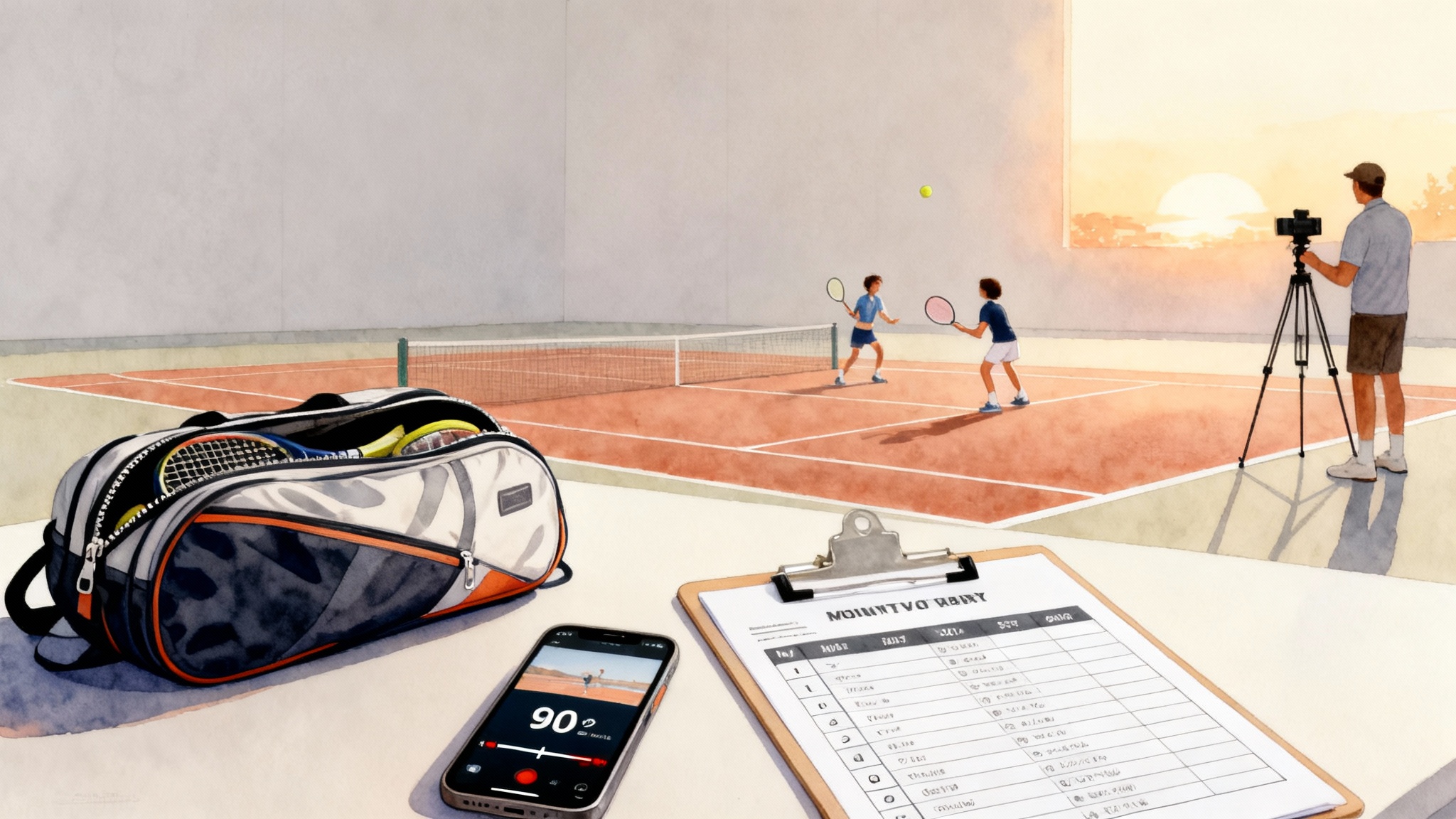
Print this, put it on a clipboard, and bring it to the court. One page covers a full week.
| Date | Session type | Serves completed | Average RPE (0-10) | Next morning soreness (0-10) | Session load (serves × RPE) | Notes |
|---|---|---|---|---|---|---|
| Week total |
How to summarize your week:
- Add up total serves and total session loads
- Compare weekly load to last week. Aim for no more than 5 to 10 percent increase
- Circle the highest RPE day. Place it earlier next week if it landed too close to a match
You can also download a ready to print version inside your free account: download the serve log.
Technique notes that reduce load without losing speed
- Toss consistency: a toss that drifts behind the head forces late contact and arching. That increases lumbar and shoulder stress. Practice 10 perfect tosses between serve sets.
- Knee and hip timing: push through the ground before the racquet drops. If the legs fire late, the shoulder does all the work.
- Second serve shape: use more spin and height over the net rather than forcing flat speed. This lowers peak elbow stress while keeping reliability.
For parents navigating 10U progressions, see our ROGY to Yellow parent guide.
Racquet and ball choices that quietly help
- Use a comfortable string bed at a moderate tension. Very high tension can increase shock to the elbow.
- If returning from pain, trial a softer string and slightly lower tension for four weeks. Re-evaluate with your coach.
- Junior balls that match age brackets reduce load and improve timing. Orange and green balls for 10U are not a step backward. They are a skill accelerator and a shoulder saver.
Personalize your blueprint with on-court screening
Serve counts and RPE tracking are the starting point. But your shoulder history, strength, and technique all shape the right plan. For a clear picture in 30 minutes, book an on-court screen with video and mobility checks at Legend Tennis Academy in Austin. You can also request a session through Life Time Tennis Academy.
In both screens you will get a personalized volume range, your top two prehab priorities, and a four week microcycle dialed to your calendar. We can then track progress inside your player profile and adjust before tournaments.
Frequently asked questions
- Should I count practice matches as part of weekly serve volume? Yes. Estimate 60 to 100 serves for a competitive best two of three set match depending on style and length, then subtract from the weekly plan.
- Do kick and slice serves count the same? Yes. The elbow and forearm still absorb load. If you are adding a new spin shape, lower volume by 10 to 20 percent for two weeks while the tissue adapts.
- What if I take a week off for travel? Restart at about 70 to 80 percent of your prior weekly serves and rebuild by 5 to 10 percent per week.
Your next three steps
- Pick your weekly range from the tables above. Write the numbers at the top of your printable log.
- Use RPE every serve day. If technique or feel slips, stop and save the shoulder for tomorrow.
- Get eyes on your motion. Book your on-court screen at Legend Tennis Academy in Austin and turn this blueprint into your plan.
A closing note
The serve rewards rhythm and restraint as much as power. When volume and RPE are managed, technique improves faster, matches feel easier, and the shoulder and elbow stay happy. Build your week, log your work, watch for early signals, and taper with intention. The result is not only fewer setbacks. It is a confident first ball that shows up every time you need it.