Desert Tennis Guide: Scottsdale, Palm Springs, Las Vegas Feb–Apr
Plan a late winter to spring tennis week in Scottsdale, Palm Springs, or Las Vegas. Learn the microclimates, morning wind patterns, altitude effects, ideal weeks by temperature bands, and where to find drop‑in clinics and public court clusters.
 Tommy
Tommy
Why the desert is tennis heaven from February to April
If you want consistent outdoor training when much of the country is still cold or wet, the American desert corridor delivers. From February through April, the Sonoran and Mojave deserts offer dry air, big blue skies, and a high probability of calm mornings. Hard courts play fast, balls fluff less, and you can stack efficient 90 minute sessions before breakfast while the rest of the day is open for recovery or spectating. If you like to split a trip between your own improvement and live professional tennis, the BNP Paribas Open schedule turns March into a tennis festival.
If you are mapping a full year of tennis travel, pair this with our Gulf Winter Tennis Triangle guide and target clay later using the Mallorca spring clay training guide.
This guide compares the three most convenient hubs for a February to April training block, then maps week by week temperature bands, and closes with practical itineraries and handpicked places to train without committing to a full time academy.
Three hubs, three slightly different deserts
Scottsdale, Arizona
- Altitude and air: The Phoenix and Scottsdale valley sits roughly 1,000 to 1,500 feet above sea level. The air is very dry, and mornings are typically still.
- Temperature feel: In February, expect cool starts in the high 40s to mid 50s Fahrenheit, with afternoons often in the low 70s. March usually climbs to the upper 70s or low 80s. April often hits the mid to upper 80s, sometimes touching 90 by late month.
- Court character: Acrylic hard courts here feel brisk. The low humidity means less ball fuzz, less drag, and a slightly longer ball flight. You get free depth, which rewards controlled swings and early contact. If you tend to sail forehands long at sea level, add one to three pounds of string tension or shift to a slightly thicker gauge for control.
- Wind habits: Mornings are the premium window. By midday, a light breeze is common, but gusts are less of a day ruiner than in Palm Springs.
Palm Springs, Indian Wells, Palm Desert, California
- Altitude and air: The Coachella Valley floor is lower, near 400 to 500 feet, rimmed by mountain walls. The San Gorgonio Pass channels air, which is why locals talk about afternoon wind.
- Temperature feel: February often sits in the low to mid 70s by afternoon. March leans mid 70s to mid 80s. April trends upper 80s and low 90s, but mornings stay comfortable.
- Court character: When the air is still in the morning, courts feel quick and true. As the breeze picks up, the ball can move a half foot off line at 70 miles per hour, which rewards players with a heavier, shape driven ball and good footwork between shots.
- Wind habits: Mornings, especially 7:00 to 11:00 a.m., are gold. By 1:00 or 2:00 p.m., expect a steady crosswind in many neighborhoods, although pockets in Indian Wells can be calmer than central Palm Springs.
Las Vegas and Henderson, Nevada
- Altitude and air: The valley sits near 2,000 feet. The air is even thinner and very dry.
- Temperature feel: February afternoons are often in the low to mid 60s, which is great for longer aerobic blocks. March moves into the low to mid 70s. April brings upper 70s to mid 80s.
- Court character: With altitude near 2,000 feet, the ball flies a touch farther and carries through the court. Topspin still bites, but the air offers less lift than at sea level. Players who like to take the ball early will love how returns and approach shots skid.
- Wind habits: Mornings are usually fine. Midday breezes are common, sometimes gusty after frontal passages. Schedule your heaviest technical work early, match play after lunch.
Altitude and desert air, simplified
Think of air as the water a swimmer pushes against. Thinner, drier air gives you less resistance and less lift. The result is a ball that flies a little farther on the same swing, and curves a little less for the same topspin. At roughly 2,000 feet in Las Vegas, the effect is noticeable but manageable. You can keep your trajectories on a leash by:
- Raising string tension one to three pounds, or using a slightly stiffer string in the mains for control.
- Aiming your net clearance an inch or two lower in dead calm, then adding margin when wind picks up.
- Using a heavier rally ball for depth rather than flat drives that can fly.
At Scottsdale’s modest elevation, the effect is subtle. In Palm Springs, elevation is not the factor; wind is. There, it is smarter to keep your toss lower, hit through the center of the ball, and play for big targets crosscourt.
Temperature bands and the best weeks, by city
Below are typical bands for comfortable outdoor training. The goal is two 90 minute sessions per day without overheating or shivering at first light.
Scottsdale
- 60 to 70 Fahrenheit: Best bet is the last ten days of February. Early mornings will still start in the high 40s or low 50s, so bring a light layer.
- 70 to 80 Fahrenheit: Most of March fits this sweet spot. That makes it the best month for back to back training days, especially if you want some afternoon hiking or golf without heat stress.
- 80 to 90 Fahrenheit: Early to mid April is reliable. Train early, then shift to an 8:00 a.m. and 5:30 p.m. pattern if you want two hits per day.
Palm Springs, Indian Wells, Palm Desert
- 60 to 70 Fahrenheit: Early to mid February is perfect if you prefer long base building sessions.
- 70 to 80 Fahrenheit: Late February through mid March is prime, and nicely aligns with the pro event calendar.
- 80 to 90 Fahrenheit: Late March into mid April works well with an early first session. Expect more wind after lunch, use that time for gym, stretch, or pro matches.
Las Vegas and Henderson
- 55 to 65 Fahrenheit: Mid to late February is a sweet spot for volume, especially if you are coming off a winter layoff.
- 65 to 75 Fahrenheit: Early to mid March is the money window for doubles patterns and match play blocks.
- 75 to 85 Fahrenheit: Early to mid April is warm but efficient for early morning live ball followed by afternoon recovery.
Pair your training with Indian Wells
The Coachella Valley turns into a tennis campus in March, when the BNP Paribas Open schedule runs across two weeks with day and night sessions. A smart schedule is to practice from 7:00 to 9:00 a.m., take a late breakfast, then head to the grounds for day matches, or switch and use a 5:00 p.m. practice followed by a night session. If you plan a 2026 trip, note that daylight saving time begins on Sunday, March 8, 2026. California moves to Pacific Daylight Time; Arizona does not change clocks but stays on Mountain Standard Time, which equals Pacific Daylight Time from March onward. In February, Scottsdale is one hour ahead of Palm Springs and Las Vegas; from March 8 through April, they share the same clock time. That matters when you are coordinating carpools, lessons, and reservations.
If you prefer to play rather than spectate, the Indian Wells Tennis Garden also runs public clinics, match play, and court rentals through its own programs. Check the latest options on the Indian Wells Tennis Garden clinics page.
Where to train without a full time academy
These are reliable hubs for drop in drills, short camps, and clusters of public courts. Always confirm seasonal schedules in advance; desert programs shift starting times between winter and spring.
Scottsdale
- Indian School Park and Tennis Center, Old Town: City operated, with morning adult drills across levels and easy online reservations. It anchors a cluster of courts along the Indian Bend Wash Greenbelt, which means you can find backup courts within a 10 minute drive if schedules are tight.
- Scottsdale Ranch Park and Tennis Center, Northeast Scottsdale: Multiple courts, regular drills, and match play nights. The adjacent park makes warmups simple, and parking is easy even during spring break weeks.
- Phoenix Tennis Center, Northwest Phoenix: Fifteen to twenty minutes from Scottsdale neighborhoods, but worth it if you want a larger menu of clinics and a deeper player pool for match play.
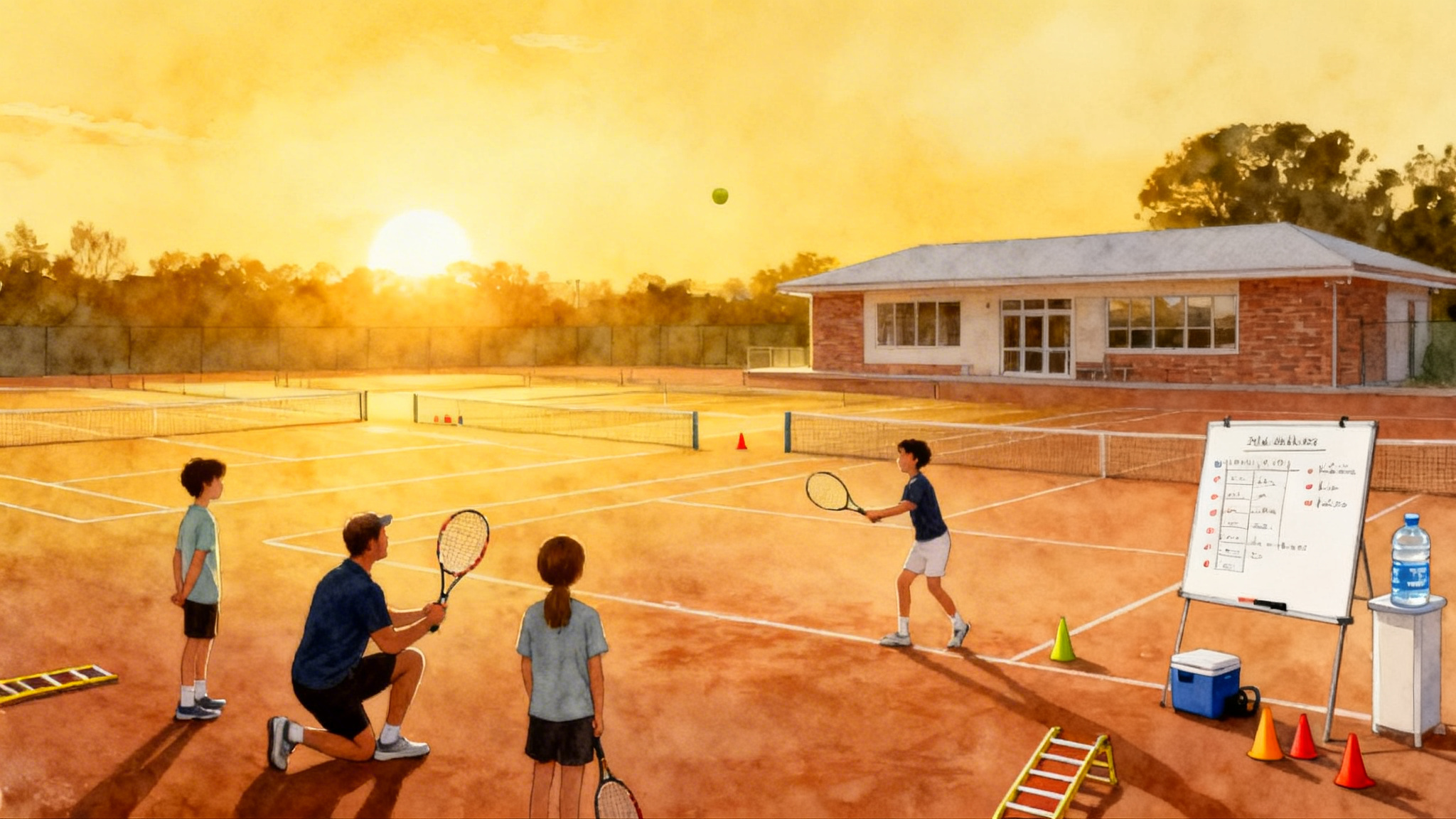
How to use these: Book two 90 minute group drills early in the week to groove timing, then add individual hitting or a lesson on Wednesday, and finish with a Thursday or Friday match play block. If you are traveling with a partner, you can secure a court every morning 7:00 to 8:30 a.m., then drop into a 9:00 a.m. drill at the same facility.
Palm Springs, Indian Wells, Palm Desert
- Indian Wells Tennis Garden, Indian Wells: Public clinics, Live Ball, and ball machine sessions; excellent if you want to combine training with pro matches in March.
- Palm Desert Tennis Center, Palm Desert: City run facility with adult programs, a friendly staff, and easy reservations. Morning drills here pair well with afternoon recovery at nearby pools.
- Demuth Park Courts, Palm Springs: A large cluster of public hard courts that works well for self run hitting windows. They are wind exposed, so make this your morning base.
How to use these: Lock a court from 7:00 to 8:30 a.m. at Demuth for warmup and patterns, drive twenty minutes to Indian Wells for a 10:00 a.m. clinic, take a long lunch, then watch afternoon matches. On a non spectating day, use Palm Desert Tennis Center for a 9:00 a.m. drill and return at 5:30 p.m. for point play as the wind eases.
Las Vegas and Henderson
- Darling Tennis Center, Northwest Las Vegas: The biggest public complex in town with deep programming and a reliable drop in scene. It is the easiest place to find competitive partners on short notice.
- Henderson Tennis Complex at Whitney Mesa, Henderson: City facility with clinics across levels, often less crowded than center strip options. The mesa gives a great sunrise backdrop and cooler morning feel.
- Sunset Park Courts, Southeast Las Vegas: A sprawling park with multiple hard courts that is ideal for self organized sessions before the day warms up.
How to use these: Aim for a 7:00 to 9:00 a.m. training block, lunch and recovery, then a 4:30 to 6:00 p.m. live ball or match play. If you plan a show or dinner on the Strip, keep the evening hit close to your hotel to cut down on traffic.
Sample weeklong plans you can copy
Plan A: Indian Wells plus improvement
- Sunday: Travel and easy 45 minute shakeout hit at Demuth Park, stretch, and early sleep.
- Monday: 7:00 to 8:30 a.m. patterns and serves; 10:00 a.m. clinic at Indian Wells Tennis Garden; afternoon pro matches; dinner and lights out by 9:30.
- Tuesday: 7:00 to 8:30 a.m. controlled live ball; noon recovery swim; 5:00 p.m. match play set indoors or at a calmer pocket.
- Wednesday: Morning lesson focused on second serve and return; afternoon off feet; night session at the pro event.
- Thursday: 7:00 to 8:30 a.m. doubles patterns; early lunch; light mobility; sunset walk.
- Friday: 8:00 to 9:30 a.m. low error drill, then a 60 minute set; afternoon semifinals at the tournament.
- Saturday: 7:30 to 9:00 a.m. final hit; travel or rest.
Plan B: Scottsdale skills week with two a days
- Monday to Wednesday: 7:00 to 8:30 a.m. technical block at Indian School Park; breakfast; 3:30 to 5:00 p.m. live ball or practice set at Scottsdale Ranch Park.
- Thursday: Single hit day; 8:00 to 9:30 a.m. lesson to recalibrate grips and contact point; afternoon recovery and light hike at sunrise or sunset.
- Friday: 7:00 to 8:30 a.m. match play ladder at your home base; post match film review or stats if you track on court.
- Saturday: Optional 8:00 a.m. doubles drill; travel.
Plan C: Las Vegas long weekend tune up
- Friday: Land by midday; 4:30 to 6:00 p.m. live ball at Darling Tennis Center.
- Saturday: 7:00 to 9:00 a.m. patterns plus serve targets; 4:30 to 6:00 p.m. set play at Henderson Tennis Complex; evening show.
- Sunday: 7:30 to 9:00 a.m. match tiebreaks and return games; late checkout and head home.
Tactics and gear that work in desert conditions
- String and tension: If your ball flies a little long, increase tension slightly or move to a control oriented string in the mains. If you are already on firm polyester, consider a hybrid to keep your arm fresh across a high volume week.
- Balls: Dry air keeps balls lively, then they drop off quickly. Open a new can for each 90 minute session. If you train twice a day, keep separate sleeves for morning and afternoon so you do not mix dead balls into a good basket.
- Grip and feel: Dry air and sweat do not mix like in humid climates. Overgrips last longer, but palms get slick fast once the sun is up. Pack extra overgrips and a rosin bag if you use one.
- Hydration and electrolytes: Think in hourly units. A good baseline is 0.5 to 1.0 liter of fluid per hour on court, with 300 to 600 milligrams of sodium, more if you are a salty sweater. For long days, add 30 to 60 grams of carbohydrate per hour to avoid late session fade.
- Sun and skin: Broad spectrum SPF 30 or higher, applied 20 minutes before you play, reapplied every two hours. Lip balm with SPF belongs in your bag. A light colored hat and polarized sunglasses make tosses and high balls easier.
- Recovery: Use a five minute cool down walk, a stretch, and a five minute legs up wall. If you have access to a cold plunge or simply a cool pool, a five minute immersion cuts the edge off desert fatigue.
For ball striking quality in these fast conditions, revisit the checkpoints in Build a forehand that holds up under pressure.
Booking and timing logistics that save stress
- Morning priority: Book morning courts first. In Palm Springs, that means 7:00 to 9:00 a.m. to beat wind. In Scottsdale and Las Vegas, 7:00 to 8:30 a.m. is the highest quality window, with a backup at 5:00 p.m. if you want two hits.
- Time zones: In 2026, daylight saving time starts on March 8. California and Nevada move clocks ahead one hour, Arizona does not. In February, Scottsdale is one hour ahead of Palm Springs and Las Vegas. From March 8 through April, they share the same local time.
- Travel distances: In the Coachella Valley, most courts sit within a 25 minute drive of Indian Wells. In Scottsdale, allow 15 to 25 minutes between major centers. In Las Vegas, Darling Tennis Center is 20 to 30 minutes from most Strip hotels without rush hour.
- Backup plans: Pick two facilities per city and keep their reservation portals handy. If a clinic fills, you can still run a focused session with a partner on a nearby public court.
Quick microclimate comparison and how to adapt
- Cool and still mornings: All three hubs, but especially Scottsdale in February and March. Use this time for technical work and serve mechanics.
- Breezier afternoons: Most noticeable in Palm Springs. Prioritize footwork ladders, return depth over pace, and big crosscourt targets.
- Slight altitude effect: Most noticeable in Las Vegas, mild in Scottsdale, minimal in Palm Springs. Control the flight with a little more string tension and disciplined net clearance.
The bottom line
If your winter game needs reps on true hard courts, the desert triangle of Scottsdale, Palm Springs, and Las Vegas gives you exactly that from February to April. Pick your temperature band, reserve your morning windows, and build a simple plan around two crisp sessions a day. In March, you can thread those sessions through a day at Indian Wells and watch the best in the world model what you just trained. The dry air and quick courts reward clarity, so travel light, hydrate on a timer, and give every swing a purpose. Do this for a week, and you will return home with a cleaner contact point, better depth on rally balls, and the kind of confidence only the desert sun seems to unlock.