Monsoon-Smart Tennis: India Thailand Manila Bali Guide
 Tommy
Tommy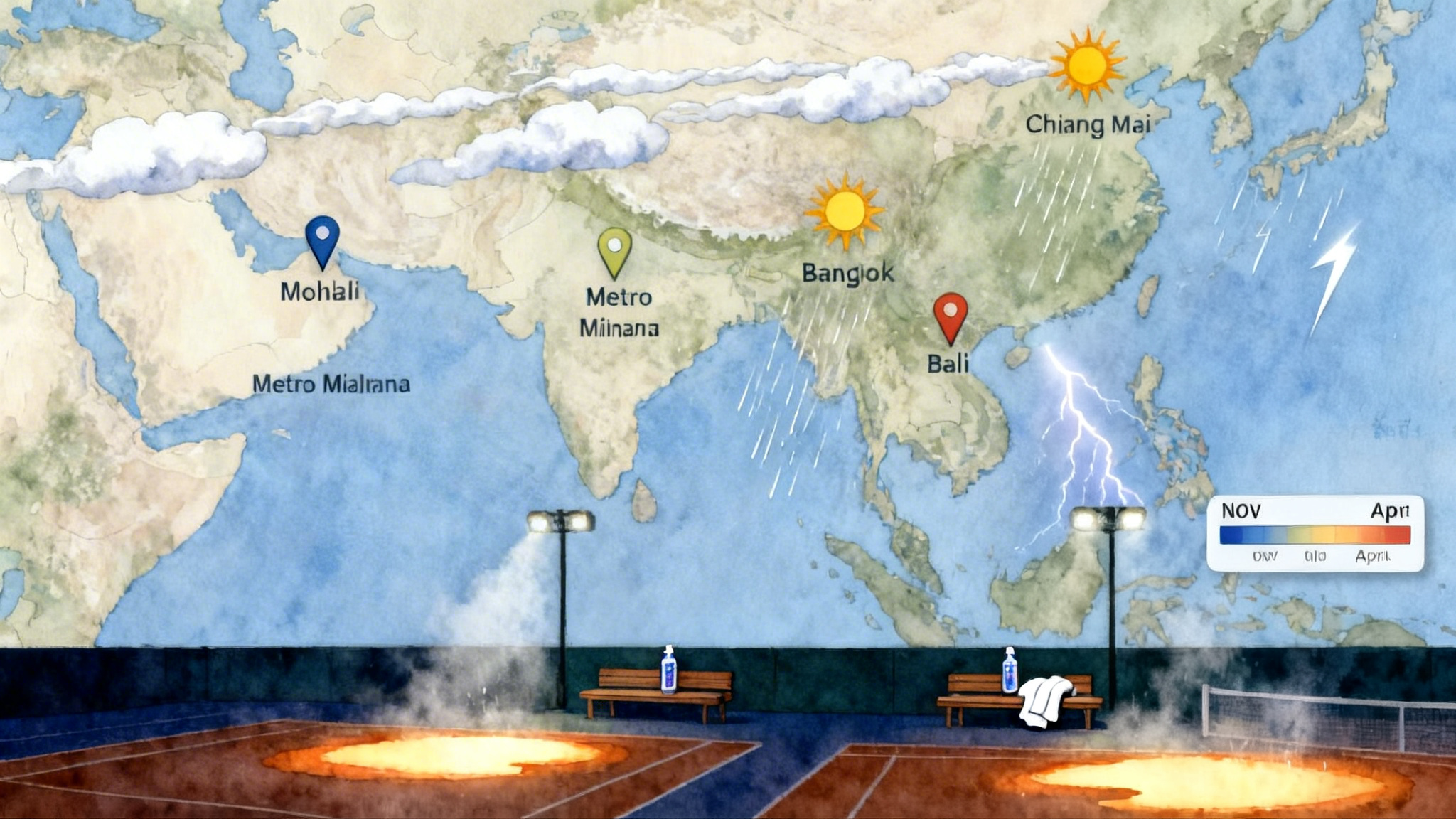
A climate-first playbook for dependable winter court time
If you plan your training calendar around rainfall rather than school holidays, South and Southeast Asia unlock a long, stable stretch of hard-court hours from November through April. The trick is to follow the retreat and pause of the monsoon. North India dries out and cools, Thailand enters its crisp season, and the Philippines settles into reliable blue-sky mornings. Bali bucks the trend and stays wet through much of this window, but slides into a playable shoulder by late March. Make these patterns your compass and you can train daily, string smarter, and schedule night sessions that dodge heat and humidity.
The backbone of this guide is simple: match your location to the month. Monsoon timing is well documented and surprisingly consistent year to year, especially the withdrawal that clears northern India and the dry-season ridge that sits over Thailand. For a primer on how the monsoon retreats across the subcontinent, see the IMD monsoon withdrawal map. That one picture explains why Mohali feels like tennis gold from November to February.
Four hubs that make winter blocks work
Below are the hubs that balance reliable weather, airport access, night-lit courts, and training ecosystems where you can find sparring partners and coaches quickly.
Mohali, India: RoundGlass Tennis Academy and the cool-season edge
In the northern plains, post-monsoon skies open up by late October. From November to February, Mohali and the Chandigarh Tricity sit cool and dry, with midday highs friendly for heavy drilling and longer point play. Mornings can feel brisk, which lets you push volume without the thump of tropical heat. By March the thermometer climbs, and April ushers in early summer, so you shift to early starts and night sessions if you stay that late.
- Anchor venue: RoundGlass Tennis Academy in Mohali
- Surfaces: mostly acrylic hard; bring two pairs of hard-court shoes rotated daily for outsole longevity
- Air quality: winter inversions can trap pollution on some mornings. Use a portable monitor and set your hardest work for clear afternoons
- String note: in cool dry air, consider lowering tension 1 to 2 pounds for easier depth on slower balls
Metro Manila, Philippines: steady dry season and lights everywhere
From December through April, Metro Manila offers the most predictable combination of dry mornings and abundant night-lit courts. November can still feel like shoulder season with leftover tropical systems, but by mid December reliability jumps.
- Anchor venue: Philippine Tennis Academy in Manila
- Court access: private clubs and school facilities rent by the hour; many light up until late evening, ideal for doubles blocks after the heat breaks
- Climate tactic: schedule two-a-days with a 6:00 to 8:00 a.m. drill block and a 7:00 to 9:00 p.m. match block; keep the middle of the day for recovery and video work
- String note: in warm humid air, raise tension 1 to 2 pounds to keep trajectory down as balls fly more
Thailand: Bangkok for depth, Chiang Mai for a cooler option, islands for morale
Bangkok’s dry season runs roughly November through February with March and April hotter but still playable under lights. Court density is high, hitting partners are easy to find, and coaching options range from junior high performance to adult rebuilds.
- Anchor venues: city clubs and academies cluster near Nonthaburi and Sukhumvit; a good starting point is Impact Tennis Academy in Bangkok
- Night play: many complexes run lights until 10:00 or 11:00 p.m. Book the latest prime slots for match play when humidity eases
- Northern option: Chiang Mai is cooler, but take note of seasonal haze from agricultural burning that can spike from February to April. If you choose Chiang Mai, prioritize December and January
Phuket and Krabi add scenery and recovery value. Courts exist but are more scattered. Treat the islands as a taper block or morale boost rather than your highest-volume grind.
Bali, Indonesia: wet through March, then a playable shoulder
Bali lives on a different rhythm. The November to March period is the wet season with frequent afternoon downpours, slick courts, and unpredictable windows. From late March into April, rain eases. That shoulder can still be steamy, but with careful scheduling and lights you can stack enough sessions to justify a block.
- Anchor venues: Liga.Tennis Center and Academy in Sanur plus resort courts around Sanur and Nusa Dua
- Microclimates: inland areas like Ubud see more rain; the southeast coast often catches earlier breaks in the cloud deck
- Plan B: build rest days into your schedule and keep one flexible indoor gym day for each tennis day, so a storm does not derail your week
- Visa practicality: Indonesia’s e-VoA and extension process is widely used by travelers. For current rules, start with official Indonesia immigration e-VoA guidance
Month-by-month reliability window, November to April
Every month below includes where to base, how to schedule, and one gear or health tweak that matters.
-
November
- Best bets: Mohali; Bangkok; Manila improves mid month
- Schedule: mornings for longer drills in Mohali; late afternoons and evenings in Bangkok; keep a wet-weather fallback in Manila the first two weeks
- Tweak: bring a light shell for cool mornings in Mohali and a microfiber towel for tropical sweat management elsewhere
-
December
- Best bets: Mohali prime; Bangkok prime; Manila prime
- Schedule: build volume blocks. Two-a-days are realistic across all three. Book night-lit courts in Manila and Bangkok for match play
- Tweak: start electrolyte habit. Target 500 to 700 milligrams of sodium for each hour in heat and humidity to prevent late-set fade
-
January
- Best bets: Mohali remains excellent; Bangkok excellent; Manila excellent
- Schedule: this is your big mileage month. Add doubles to sharpen returns and first volleys without compounding impact volume
- Tweak: rotate two identical frames. Heat and humidity swing stringbed response; restring more frequently than at home
-
February
- Best bets: Mohali still solid but warming; Bangkok solid; Manila solid
- Watchouts: Chiang Mai’s haze can start. If air quality rises, shift to Bangkok or Manila
- Schedule: keep drills in the morning and matches under lights as temperatures climb
- Tweak: increase grip replacement frequency. Overgrips saturate faster; carry more than you think you need
-
March
- Best bets: Manila strong; Bangkok playable with heat-aware scheduling; Mohali moves to early mornings and evenings; Bali begins to transition
- Schedule: shorten sets and increase rest ratios in Bangkok and Manila if heat peaks. Use four-game mini sets to preserve quality
- Tweak: raise string tension 1 to 2 pounds to control trajectory as courts heat up
-
April
- Best bets: Manila still workable; Bali shoulder now realistic; Bangkok is very hot so use dawn and night windows; Mohali becomes a heat-management project
- Schedule: play at dawn or under lights. Place strength work on cooler days and recovery work when the mercury spikes
- Tweak: cooling protocol. Cold face cloth on the back of the neck in changeovers plus ice slurry sips can drop perceived exertion quickly
How to schedule training that beats heat and humidity
-
Build a split day
- Morning block: 90 to 120 minutes of drilling and serve patterns
- Night block: 90 to 120 minutes of match play under lights
- Midday: video review, mobility, nap, and strings
-
Use the light switch
- Bangkok and Manila have plentiful lighted courts. Book two weeks ahead for 6:00 to 8:00 p.m. or later prime-time slots. If you like late-night blocks, borrow ideas from our Tokyo night tennis guide.
- In Mohali and other north Indian cities, evenings are calmer in winter. If you are sensitive to morning chill, flip your main block to afternoon
-
Hydrate with intent
- Weigh yourself pre and post. Replace 150 percent of body mass lost to sweat over the next four hours
- Use sodium on court, not just water. Target a steady trickle rather than a single chug at changeovers
-
Play the string game
- Heat makes balls jump. Nudge tension up 1 to 2 pounds in Bangkok and Manila by March
- Cool dry air in Mohali can deaden response. Nudge down 1 to 2 pounds to keep defensive depth comfortable
-
Respect the sun
- Sun sleeves and a light-colored hat buy you 30 extra quality minutes. So does a white towel on your neck during changeovers
Getting there, staying there, and how much it costs
Budget ranges vary with exchange rates and booking timing, but the ballpark figures below help you map a two to six week block. Prices are for typical city locations near major courts.
-
Flights from the United States or Europe
- To Delhi or Chandigarh for Mohali: often mid to high four figures round trip in peak holiday weeks, lower outside Christmas and New Year
- To Bangkok: generally competitive with many one-stop options
- To Manila: sometimes slightly higher than Bangkok but often similar
- To Bali: seasonal swings are larger. Late March and April can be more affordable than December and January
-
Accommodation per night
- Mohali and Chandigarh: good midrange hotels or serviced apartments in the 40 to 80 United States dollars range
- Bangkok: wide spread from 35 to 100 United States dollars depending on neighborhood and pool access
- Manila: 45 to 100 United States dollars in business districts with easy rides to courts
- Bali: 40 to 120 United States dollars, with villas pricing higher but sharing well across a group
-
Court fees per hour
- Mohali: academy packages vary; pay-per-hour municipal courts are inexpensive when available
- Bangkok: roughly 5 to 10 United States dollars daytime; 10 to 20 with lights at private clubs
- Manila: roughly 8 to 15 United States dollars, lighting extra at many venues
- Bali: 12 to 20 United States dollars with lights at resort or academy courts
-
Coaching and hitting partners per hour
- Across hubs: expect 30 to 80 United States dollars depending on coach pedigree and whether you bring your own balls
- Add a ball kid or feeder for 5 to 10 United States dollars where available to keep tempo high
-
Stringing
- 7 to 20 United States dollars for synthetic gut or polyester, more for natural gut if stocked. Carry favorite strings in case local inventory is limited
-
Local transport
- Ride-hailing apps operate widely in Bangkok and Manila and cover airport transfers and court commutes reliably
- In Mohali, taxis and rides are easy to arrange. In Bali, scooters are common but only ride if you have experience and proper gear
-
Food
- Street and casual dining can be a training ally. Prioritize rice, lean protein, vegetables, and plenty of safe fluids. Bring electrolyte tablets to standardize intake
Visas, entries, and the long-stay puzzle
Rules change, so always check official government sources before booking. The notes below describe patterns many United States and European Union passport holders have encountered in recent years, but do not assume they are current without verification.
-
India
- Many nationalities use an e-visa pathway for tourism and sport training. Lead time matters. Print copies of approvals and keep accommodation details handy for arrival
-
Philippines
- Many travelers receive a visa-free entry period on arrival that covers a typical four week block. Longer stays often require an extension at a Bureau of Immigration office in Manila or other cities
-
Thailand
- Visa exemption policies and durations have varied by season. If you plan more than four weeks, check whether an online e-visa or pre-arranged tourist visa is the better route for your dates
-
Indonesia
- Bali travelers often use a Visa on Arrival or electronic Visa on Arrival. This is commonly extendable once, which covers many training blocks. Confirm the current process using official immigration guidance before you fly
Tactics for longer blocks
- Split your stay: two to three weeks in Bangkok plus two weeks in Manila fits common visa-free or visa-on-arrival windows without paperwork strain
- Plan an exit leg: if you need to reset your days, add a short hop to a different country rather than relying on risky same-day turns
- Keep paperwork tidy: onward ticket, accommodation proof, and a training plan on paper reduce questions at check-in
Health, safety, and air you can trust
- Heat adaptation takes 7 to 14 days. Reduce intensity the first week and increase volume slowly. By week two, you can push quality under lights
- Air quality is a real variable in north India winters and northern Thailand from February. Use an air quality app and a small monitor. If levels rise, move your session later in the day or cross-train indoors
- Water safety varies. Use sealed bottles and hotel kettles. Sweat losses are higher than you think, so build an electrolyte plan before you arrive
A sample week that works across hubs
- Monday
- 6:30 to 8:00 a.m. serve plus first-ball patterns
- 7:30 to 9:00 p.m. two out of three mini sets
- Tuesday
- 7:00 to 8:30 a.m. defensive depth and transition volleys
- Afternoon gym: strength lower body and trunk
- Wednesday
- 6:30 to 8:00 a.m. return plus plus-one patterns
- Evening doubles with set plays on second serves
- Thursday
- Morning recovery ride or pool plus mobility
- 7:30 to 9:30 p.m. singles ladder match
- Friday
- 6:30 to 8:15 a.m. cross-court patterns into open court
- Afternoon stringing and video session
- Saturday
- 7:00 to 8:30 a.m. tempo drills, high ball defense
- Evening team games: first to five; tie-breakers
- Sunday
- Off or light hit under lights if heat is lower
Picking your hub by goal
- Volume and technical rebuild: Mohali in December or January. Cool air allows long, focused blocks with fewer heat breaks
- Match toughness plus partners on demand: Bangkok November through February, with lights pushing quality late into the evening
- Reliable dry mornings and big-city convenience: Manila December through March, with easy access to stringing and coaching
- Shoulder-season finish with beach recovery: Bali late March through April if you want a softer landing at the end of your block
One more climate lens before you book
Think of the region like a moving weather window. The monsoon retreats across India, settles out of Thailand for a few months, and leaves the Philippines in a dry pocket through early summer. Bali trails behind, turning the corner just as your winter block ends. If you keep that picture in your head and make friends with night-lit courts, you can piece together six months of dependable tennis without chasing sunshine across continents.
Plan your route, reserve the lights, and pack extra overgrips. The weather will do the rest.