Build a Forehand That Holds Up Under Match Pressure
 Tommy
Tommy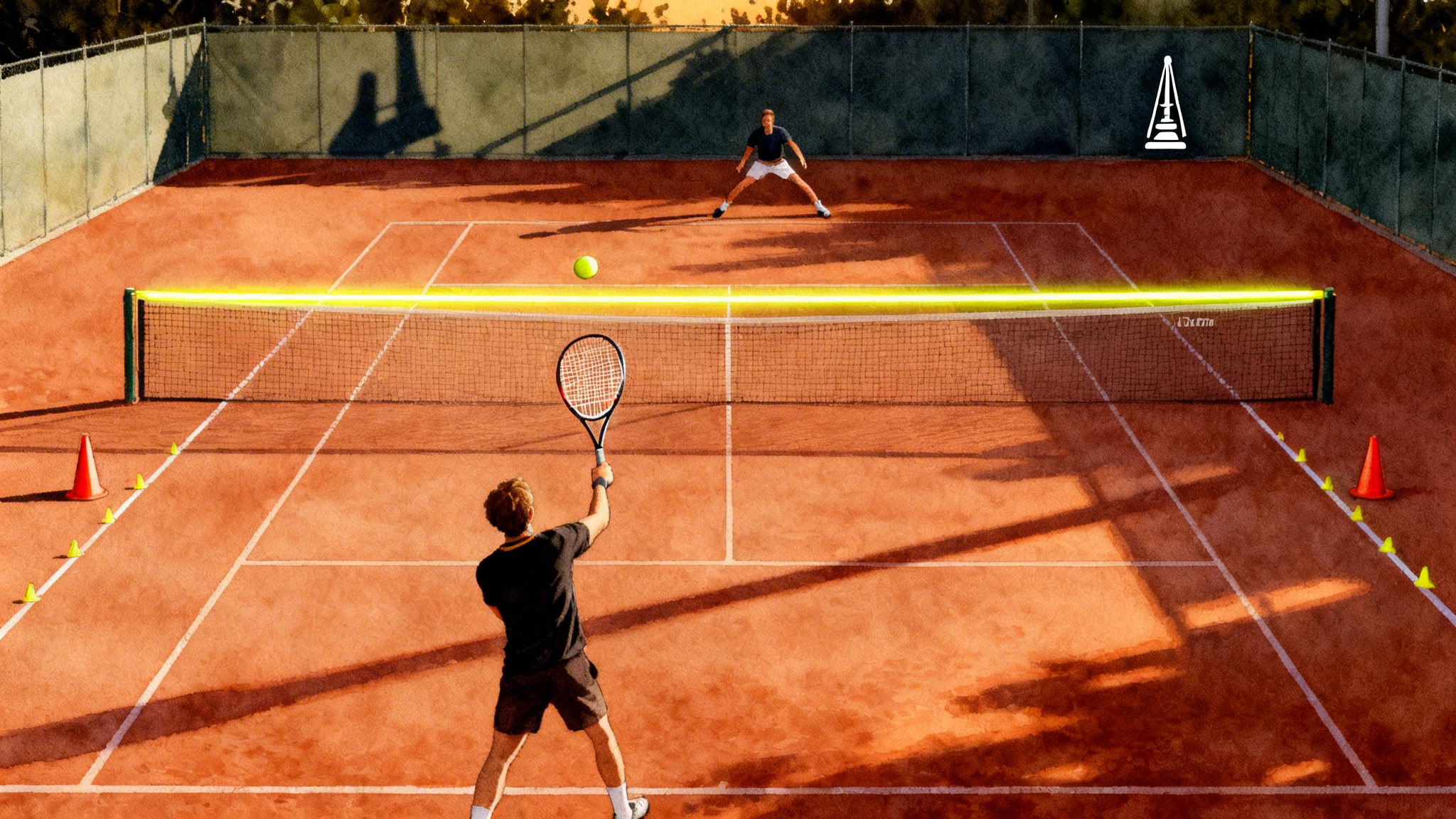
Why good forehands collapse when the score gets tight
You rip forehands in the warmup, float them long at 5–all, and then ask the same question on the ride home: why does my best shot disappear when I need it? Pressure does not invent new flaws. It simply amplifies small ones you carry into the match. The forehand fails for three main reasons:
-
Contact drifts. Under stress your eyes chase the target and your contact point slides late or too close to the body. That steals space from the swing path and sends the ball sailing or into the net.
-
Shape flattens. You try to hit winners and the ball loses height and spin. A flat ball is fast but fragile. One mistimed contact and it misses by a foot.
-
Decisions rush. You overhit a neutral ball or guide a short ball back to the middle. Bad choices feel like bad swings, but the root is tactical, not technical.
Think of the forehand like a tripod with three legs: Contact, Shape, Decision. When one leg shortens, the whole picture tilts. We will fix all three, in order, with tests and drills that mirror the match.
A simple model you can remember under pressure
When the score tightens you do not need a paragraph. You need one sentence you can repeat. Use this:
Contact in front, lift the inside edge, choose the lane.
- Contact in front: Meet the ball where your front hip faces the net. You should feel you could freeze mid swing with your strings already aligned.
- Lift the inside edge: Imagine your racquet’s inner frame leading the ball up and over the net. This gives your shot spin and margin without forcing you to swing slower.
- Choose the lane: Before the ball crosses the net, pick left, middle, or right lane. Decision first, swing second.
This is not poetry. It is a checklist you can say between points. If you only remember one thing today, remember that sentence.
The 12 minute baseline diagnostic
Before building anything, measure. Set a timer for twelve minutes and run this sequence with a partner or a ball machine. Use regular match balls.
- Minutes 1–3: Crosscourt rally to your forehand. Target a one meter window above the net and two meters inside the baseline. Count how many balls in a row you keep in that box. Reset the count after any miss, short ball, or ball hit long.
- Minutes 4–6: Down the line rally from your forehand corner. Same target, same rules. Record your best streak.
- Minutes 7–9: Short ball attack. Feed yourself a ball that lands around the service line. Approach and finish to the open court. Tally the percentage of clean finishes, not just balls that land in.
- Minutes 10–12: Defense to neutral. Start two meters behind the baseline. Partner sends a deep ball. Your job is to loop crosscourt with height, then step forward on the next ball to neutral. Track how many times you make the transition without error.
Write the numbers in your phone. The goal is not a perfect score. It is an honest baseline so you can see progress over four weeks.
Constraints based drills that force the right swing
You cannot lecture your body into a reliable forehand. You must set constraints that make the correct swing the easy choice and the wrong swing almost impossible. Here are the three drills that give the fastest return for club players and juniors.
Drill 1: Boxed lanes for automatic height and margin
Set two cones three meters inside the baseline and six meters apart, forming a lane. Place a rope or strap across the net about one meter above the tape, or imagine a belt line on the net. Your rules:
- Every forehand must clear the belt line.
- Every forehand must land in the lane.
Why it works: The belt line demands lift without thinking about topspin mechanics. The lane narrows your aim so you stop guiding the ball. You create a repeatable swing shape that sends the ball up first and forward second.
How to score: Play two sets of twenty balls. Your goal is sixteen or more makes per set. If you miss high, accept it. If you miss low, pause and exaggerate the lift of the inside edge on the next two balls.
Coaching cue: Finish with your strings facing the sky, not the side fence. This prevents the dreaded wraparound that yanks balls wide under stress.
Drill 2: Tempo ladder for timing and spacing
Use a metronome app or count in your head. Hit in patterns of three with a clear tempo: one slow rally ball, one medium rally ball, one fast but heavy rally ball, repeat. Think slow, medium, fast with the same swing path and only small changes in speed.
Why it works: Players often change contact point when they change swing speed. This drill teaches you to speed up while keeping contact in front. It also builds a gear shift you can use in points. Pair this with split step timing and drills so you arrive on time and in balance.
How to score: Five ladders of nine shots without breaking the pattern. If you rush contact on the fast ball and miss long, take two neutral breaths, go back to slow, and climb again.
Coaching cue: Keep the same follow through height across all three balls. The difference lives in the legs and core speed, not in chopping down on the ball.
Drill 3: Red light, yellow light, green light
Partner calls the color just before you hit:
- Red light: Send a high looping ball crosscourt with two meters of margin above the net.
- Yellow light: Send a neutral rally ball deep crosscourt or deep middle.
- Green light: Drive to the open court with height over the net tape and land at least two meters inside the baseline.
Why it works: Decision precedes action. The color call forces you to decide a lane and height before contact. You stop reacting and start choosing.
How to score: First to fifteen correct responses. A miss or a wrong ball type is zero.
Coaching cue: Say the color out loud as you swing. It ties the choice to the move.
Tactical templates that reduce guesswork
Technique keeps the ball in. Tactics put the ball where the opponent is weakest. When your mind spins, default to proven patterns.
Two serve plus one patterns
- Deuce court: Serve wide. Recover to the middle. Forehand to the open court or at the opponent’s weaker wing. If the return floats, step in and drive the ball through the lane you chose early.
- Ad court: Body serve to jam the backhand. First forehand deep middle to push the opponent back, second forehand to the outside lane.
The idea is simple. Use the serve to create a forehand, then play to space, not to the line. Lines are for finishing, not for starting the exchange.
The neutral rally template
- Ball above hip height: Lift with shape, two meters over the net, heavy crosscourt.
- Ball at hip or below: Drive higher through the middle third first, then redirect on the next ball.
You do not need an exotic playbook. You need the same safe choice repeated until the opponent breaks shape.
Defense to offense in two balls
- First ball: Get the ball up with height and spin crosscourt. Reset your position.
- Second ball: Step forward and aim deep middle or deep crosscourt, whichever side is open earliest.
This sequence is how elite players turn trouble into neutral, then into advantage. If you try to go from defense to winner, you feed errors.
Build match hardness: add stakes, heart rate, and recovery
A reliable forehand is a physical skill, a mental skill, and a recovery skill. You must practice all three together. If you train near Austin, Legend Tennis Academy in Spicewood offers covered courts and structured sessions that fit these blocks.
Scoreboard constraints
Play a game to eleven points with these rules:
- You only score if you initiate the point with a forehand crosscourt that lands past the service line.
- If you miss the first forehand in the net, you lose two points. Long is minus one.
Why it works: The penalty reflects match reality. Net misses kill confidence. Margin becomes your friend.
Heart rate sandwich
Sequence: 30 seconds of fast footwork shuffles, then a six ball forehand drill, then walk and breathe until your heart rate drops. Repeat for five sets.
Why it works: Most forehand failures happen at elevated heart rate. Training quality at that heart rate is the shortest path to match transfer. The walk down trains recovery, which lowers pressure late in sets.
Between point routine
Copy a simple routine and use it every practice and match:
- Turn away from the net.
- One slow breath in through the nose, out through the mouth.
- Say your one sentence checklist: Contact in front, lift the inside edge, choose the lane.
- Visualize the next ball path for one second.
- Step up and bounce in.
Consistency in the routine breeds consistency in the swing.
What to track so you know it is working
Measurement turns hope into a plan. Track three items weekly:
- Forehand unforced errors per set in practice points. Write the number, not the feeling.
- First ball height. Ask your partner to call out loud if a ball travels less than one meter over the net. The goal is fewer than four low balls per set.
- Short ball conversion. Out of ten attackable forehands inside the baseline, how many do you either finish or force a short reply on the next ball? Aim for seven or better.
If numbers stall for two weeks, adjust your drill time, not your identity. Usually the answer is more lane work and more height, not a grip overhaul.
Equipment and string choices that support margin
You cannot buy a reliable forehand, but your setup can help. Three principles guide most players well:
- Strings: A lower string tension within the manufacturer’s safe range adds comfort and a touch more launch. If you spray long, raise tension two pounds at a time, not ten.
- Racquet weight: If your racquet feels like it twists on off center contact, add a small amount of weight at 3 and 9 o’clock positions with lead tape, or consider a slightly heavier frame. Stability breeds confidence.
- Grip size: If your hand strains to keep the racquet face stable, you may be between sizes. An overgrip can solve this. A stable face at contact is a stable ball.
None of these should be dramatic changes mid season. Small, reversible tweaks help you learn what your forehand likes without starting over.
Common faults and fast fixes
- Late contact: Place a cone just in front of your lead foot. Your rule is to contact the ball even with or in front of the cone. If you keep hitting the cone, stand farther from the bounce.
- Collapsing wrist: Think about the strings lifting the ball rather than the wrist flicking it. Use the belt line constraint so the whole arm solution replaces the wrist only solution.
- Sideways finish: Record ten forehands in slow motion. If your finish wraps around your body, rehearse three shadow swings where your strings face the sky at finish. Then hit three balls. Repeat.
- Over aiming to lines: Use the lane drill every practice day for at least five minutes. Lines are finishers after advantage, not standard aim points.
A four week blueprint you can follow
You will practice three times per week for 45 to 60 minutes. If you play matches, swap one practice for match play and keep the routine between points. If you want a warm, year round base for training blocks, see the Austin Hill Country tennis base.
Week 1: Build shape and contact
- Warm up: Five minutes mini tennis with height and spin.
- Boxed lanes: Two sets of twenty balls crosscourt, two sets down the line. Goal is sixteen or more per set.
- Tempo ladder: Three ladders. Focus on the same follow through height.
- Red, yellow, green: First to fifteen with partner.
- Scoreboard game: To eleven with the double penalty for net misses on the first forehand.
- Note your best rally streak and low ball count.
Week 2: Add decision speed
- Warm up: Five minutes with the belt line back on the net.
- Red, yellow, green: Two short races to eleven, then to fifteen.
- Serve plus one patterns: Ten points each side, always start the point with a wide or body serve that sets up a forehand.
- Heart rate sandwich: Four sets. Notice your first two swings after the footwork block.
- Tally short ball conversions.
Week 3: Build match hardness
- Warm up: Tempo ladder for six minutes.
- Live ball lanes: Play a game where you only score if the first two forehands land in your lane. To eleven.
- Defense to offense: Coach or partner feeds deep, you loop crosscourt, then step in. Fifteen reps.
- Between point routine: Practice it during every changeover of drills, even if it feels corny.
- Track unforced errors per set in practice points. Target a twenty percent drop from Week 1.
Week 4: Test week
- Run the full twelve minute diagnostic and compare numbers.
- Film a short baseline rally. Check for contact in front and finish to the sky.
- Play one practice match where your only tactical rule is choose the lane first. Record how many times you said the sentence between points.
- If your numbers improved, keep the plan. If not, add five minutes of boxed lane work to every session and reduce highlight chasing in point play.
Putting it all together
A forehand that holds up does not look flashy. It looks repeatable. The ball gets over the belt line. The contact stays in front. The decision is made before the swing begins. You will feel less like a genius on your best ball and more like a metronome on every ball. That is the point.
Pressure does not reward the player with the prettiest follow through. It rewards the player with a clear checklist, a few smart constraints, and habits that survive a racing heart. Give yourself twelve minutes to measure, fifteen minutes of lanes to build shape, and twenty minutes of decision training to choose the right ball. In four weeks you will not just own a stronger forehand. You will own a way of practicing that makes your best tennis show up when the match asks for it.