Green to Yellow Ball: Readiness Checklist for Ages 8-12 in 2026
An action-first guide to timing the move from orange or green to yellow ball in 2026. Use simple rally and spin benchmarks, sprint and overhand-throw targets, and match-play milestones, plus a printable checklist and a 2x/week at‑home routine.
 Tommy
Tommy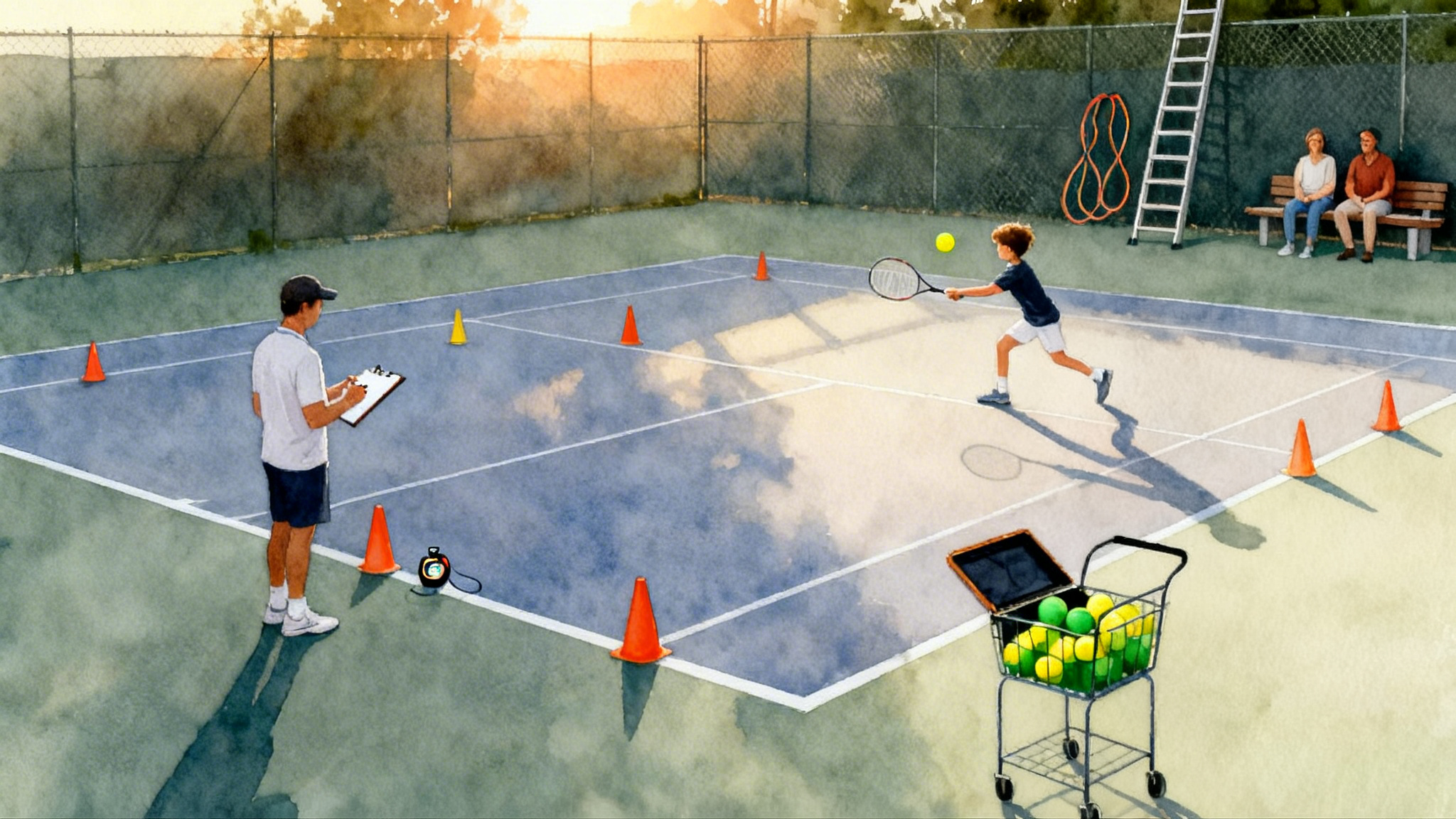
The moment every junior and parent asks about
When should my child move from green to yellow ball? In 2026, the best answer is still not an age; it is a set of observable skills, fitness markers, and match behaviors that travel well from one court to the next. This article gives you a practical checklist to make the decision clear and calm. You will get rally and spin benchmarks you can test this week, age‑appropriate fitness targets that predict success with the heavier and faster ball, match‑play milestones that reduce guesswork, a printable checklist, and a repeatable at‑home routine you can run in 30 minutes, two times per week.
We will also share how the Legend Tennis Academy transition model structures this move year‑round in small groups, so you can borrow their blueprint whether you are a parent, a junior athlete, or a coach building a program.
Why the yellow ball move matters now
Yellow ball tennis is a different game. The ball is faster off the strings, carries deeper through the court, and punishes late contact. Players who jump too soon often shorten strokes, push the ball, and avoid spin. Players who wait too long can plateau and lose motivation. The right timing preserves mechanics, protects confidence, and accelerates tactical growth.
Think of the change like shifting from a city bike to a touring bike. The balance is familiar, but the gearing and speed ask more of your legs and lungs. You want your rider stable before the first long downhill.
Action‑first benchmarks you can test this week
Use these on‑court skill checkpoints with a green ball first. If a player meets or beats these, run the same tests with a yellow ball. Passing on yellow means the athlete is ready to compete and train primarily with yellow ball, even if some green‑ball drills remain useful.
A. Rally control and length
- Crosscourt forehand rally: 14 balls or more, waist to chest height over the net, landing past the service line on at least 10 balls.
- Crosscourt backhand rally: 10 balls or more with the same height and depth targets.
- Change‑of‑direction control: from a crosscourt rally, redirect down the line once every 4 balls without missing more than 2 of 6 attempts.
- Short‑ball conversion: from a coach feed that lands inside the service line, attack to a deep target twice in a row on both forehand and backhand sides.
How to score: Pass when 3 of 4 tasks meet the target, with at least one backhand task passing.
B. Spin and height management
- Topspin window: clear the net by 3 to 5 feet on neutral balls while keeping depth beyond the service line. Hit 8 of 10 on the forehand, 6 of 10 on the backhand.
- Shape change on command: from the baseline, hit 5 neutral balls, then 3 higher, then 2 flatter, without a miss in the sequence. Do this twice per side.
- Second‑serve spin: from the deuce side, land 6 of 10 second serves with visible topspin and bounce above an opponent’s knee at the baseline. Repeat on the ad side.
How to score: Pass when two of three spin tasks meet the numbers and the second‑serve test is one of them.
C. Serve start line
- First‑serve landing zone: 6 of 10 first serves in the correct box per side, with at least half landing past the service line. No more than 2 net misses per side.
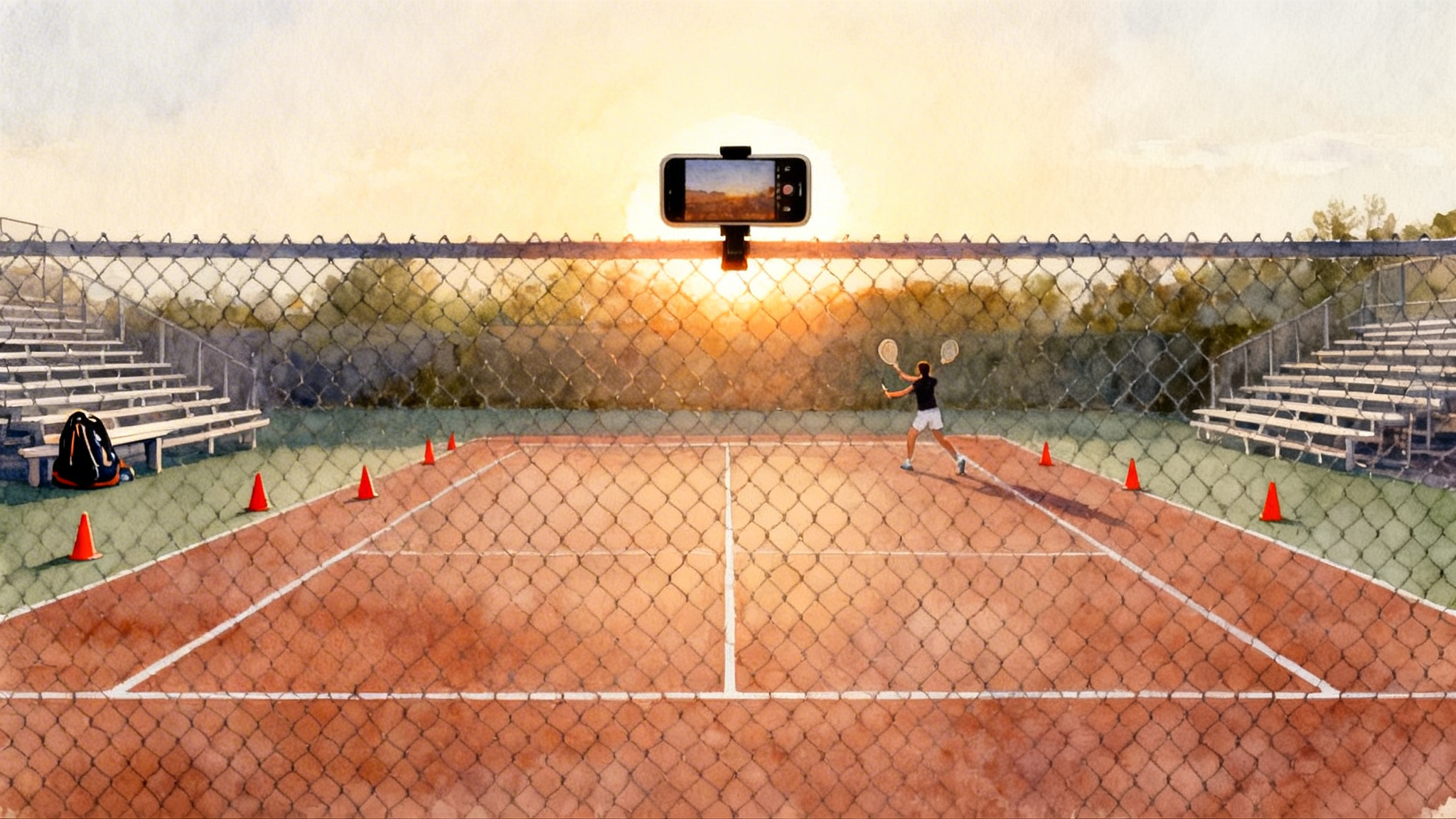
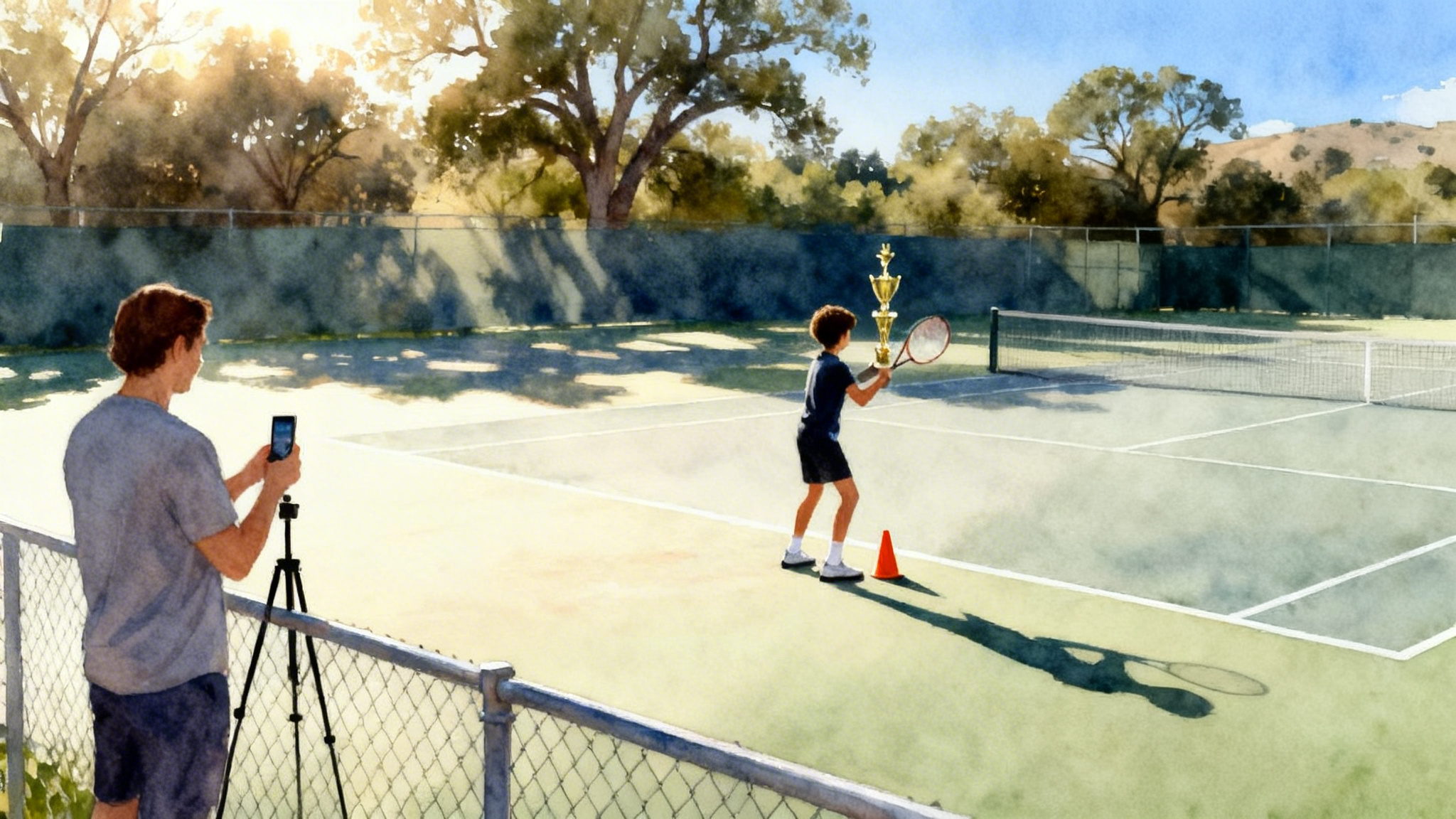
- Toss discipline: toss reaches peak between front shoulder and hitting shoulder on at least 8 of 10 attempts. Use the phone video setup checklist to film from the side or mark a small target zone with cones.
For deeper mechanics, see the 2026 serve blueprint checkpoints.
How to score: Pass when both serve tasks meet the numbers.
D. Net readiness
- Approach and first volley: from a short‑ball approach on forehand and backhand, make first volley deep 7 of 10 times, split step visible on every entry.
- Overheads: from a coach’s lob inside the service line, put away 6 of 8 overheads with feet set before contact.
How to score: Pass when both net tasks meet the numbers.
Fitness that predicts success with the yellow ball
You do not need lab tests. Use repeatable field checks that reflect the specific demands of yellow‑ball points: short high‑speed bursts, quick stops, and shoulder‑friendly power.
Repeat sprint ability
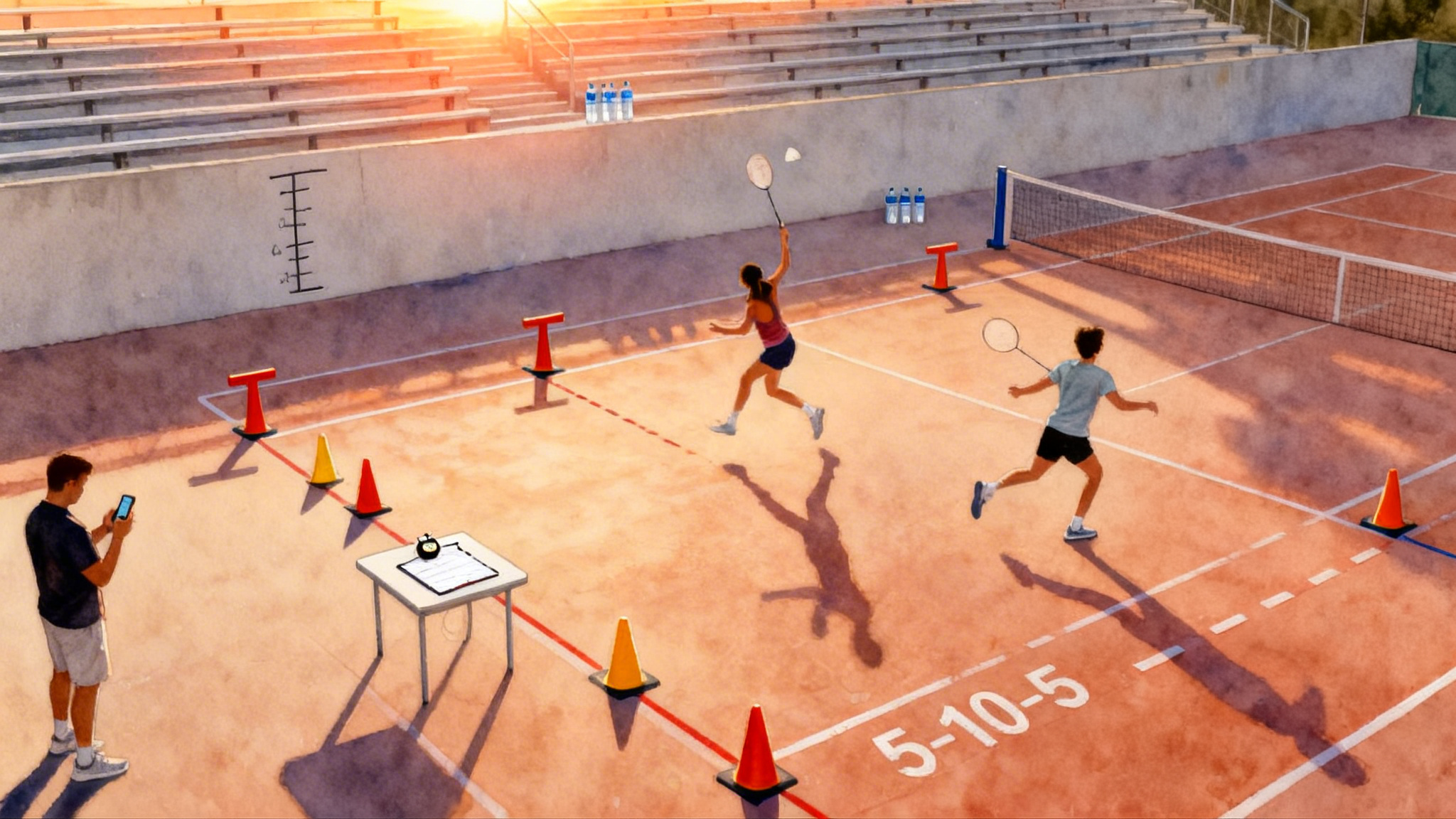
- 6 x 10 meter shuttles, touch a line at 10 meters and return to start each rep.
- Rest 20 seconds between reps.
- Target times and consistency:
- Ages 8 to 9: first rep in 5.0 to 5.5 seconds, no rep slower than first rep plus 0.7 seconds.
- Ages 10 to 12: first rep in 4.6 to 5.1 seconds, no rep slower than first rep plus 0.6 seconds.
Why it matters: yellow‑ball exchanges are more explosive, so the ability to repeat short sprints with small drop‑off signals readiness to handle deeper balls without breaking form.
Overhand throw as a proxy for serve‑readiness
Use a standard tennis ball. Throw with the dominant hand, using a service‑style motion from behind a line.
- Ages 8 to 9: 25 to 35 feet for a solid baseline, 35 to 45 feet signals strong readiness.
- Ages 10 to 12: 35 to 50 feet for a solid baseline, 50 to 65 feet signals strong readiness.
Why it matters: overhand throwing correlates with shoulder sequencing and force transfer. You are not training velocity here; you are checking if the body can organize power without strain.
Jump rope control
- 2 sets of 60 jumps without a miss, or 1 set of 120 with no more than two misses. Rest 60 seconds between sets.
Why it matters: rhythm and footwork endurance protect technique later in long games and tiebreaks.
Simple mobility screen
- Deep squat with heels down, arms overhead, hold for 30 seconds without pain or collapse.
- Lunge and rotate, five per side without wobble.
Why it matters: if mobility is missing, players compensate under the faster ball. That is when technique unravels.
Match‑play milestones that reduce guesswork
Before going full yellow, the athlete should already be hitting these marks in green‑ball matches:
- Competes in best‑of‑sets or timed formats without emotional drop‑offs after errors in back‑to‑back games.
- Double faults at 6 or less across 6 service games.
- Wins at least 55 percent of service points over two matches when facing peers of similar level.
- Can track and call score correctly, can change ends on time, and can recompose within 20 seconds after a long rally.
- Can execute one favorite rally pattern on both sides, for example crosscourt heavy ball then change line to finish.
If three or more of these are not present on green, do not rush to yellow. Fix the gaps with focused practice and a short run of level‑appropriate match play, then retest.
Parent cues that the timing is either right or not yet
Right now looks like:
- Your child is creating height and spin under mild pressure, not just blocking balls back.
- They win most green‑ball points by building patterns, not by waiting for errors.
- Their backhand holds up in 8 to 10 ball rallies without visible steering.
- They ask for tougher opponents or want to hit with older kids.
Not yet looks like:
- They serve with a straight arm and a low toss, or cannot land second serves reliably.
- They avoid backhand exchanges, or change to slice at the first sign of pace every time.
- They show shoulder or elbow soreness after sessions, even light ones.
- They have large mood swings during green‑ball matches or stop using legs when tired.
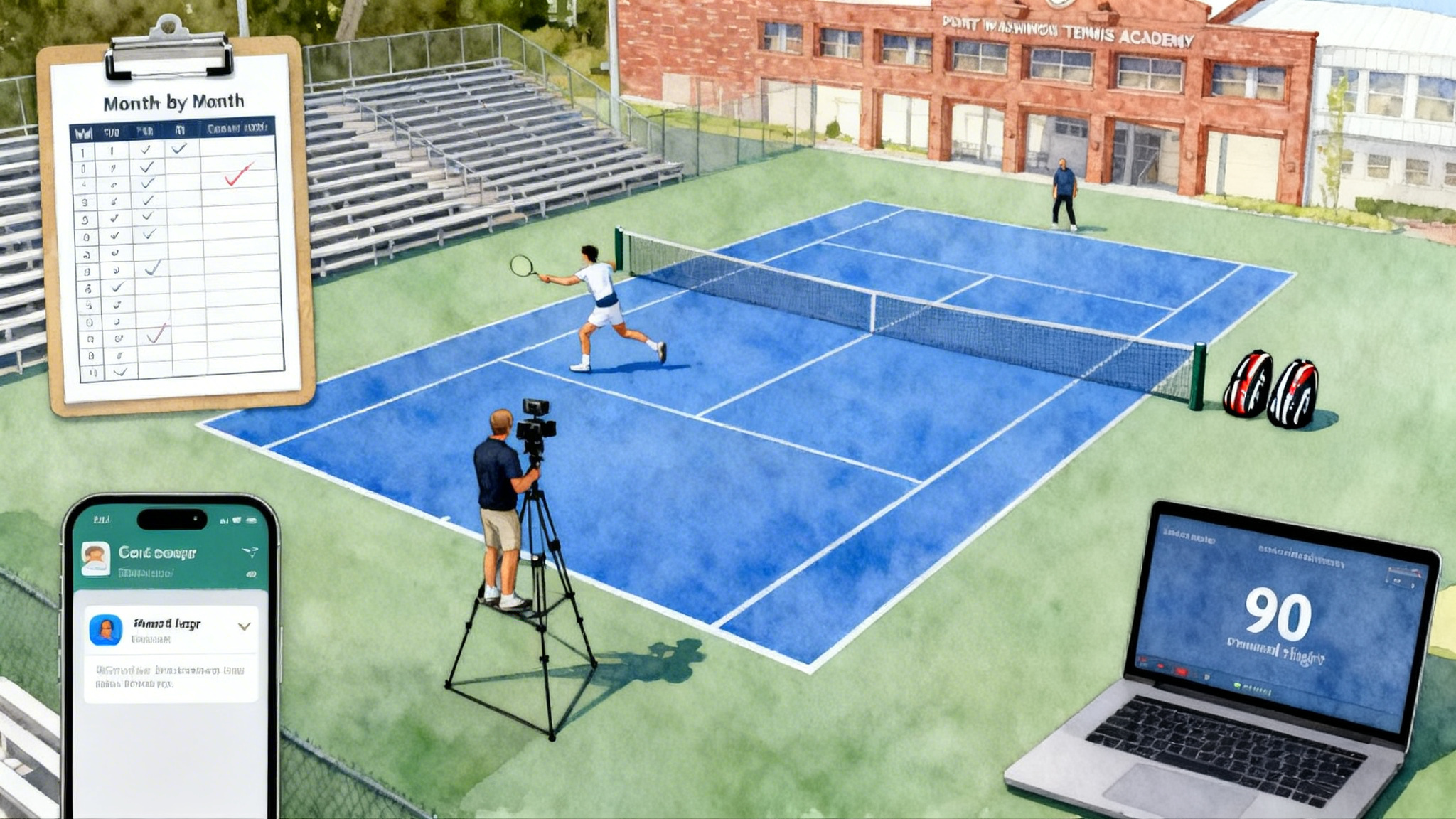
A printable readiness checklist
Print this section and bring it to practice. Use one sheet per player and date it.
- Rally control
- Forehand crosscourt 14 in a row beyond service line
- Backhand crosscourt 10 in a row beyond service line
- Change direction 3 of 6 tries in a crosscourt rally
- Short‑ball conversion twice in a row both sides
- Spin and height
- Net clearance 3 to 5 feet with depth, 8 of 10 forehands
- Net clearance 3 to 5 feet with depth, 6 of 10 backhands
- Shape change sequence complete on both sides
- Second‑serve spin, 6 of 10 each side
- Serve start line
- First‑serve 6 of 10 in, each side, half past service line
- Toss peaks in target zone, 8 of 10
- Net readiness
- Approach plus first volley deep, 7 of 10
- Overheads, 6 of 8 with set feet
- Fitness
- 6 x 10 meter shuttles within time and consistency targets
- Overhand throw distance meets age target
- Jump rope 2 x 60 without miss or 1 x 120 with 2 or fewer misses
- Mobility screen passes without pain
- Match play
- Double faults 6 or fewer across 6 games
- 55 percent or better service points won over two matches
- Scorekeeping and pacing consistent
- One pattern per side executed in matches
Pass when at least 80 percent of boxes are checked and the three bolded areas for serve, spin, and fitness are all marked complete. If you are within two boxes, retest in two weeks and run the at‑home routine below.
A 2x per week at‑home routine, 30 minutes each
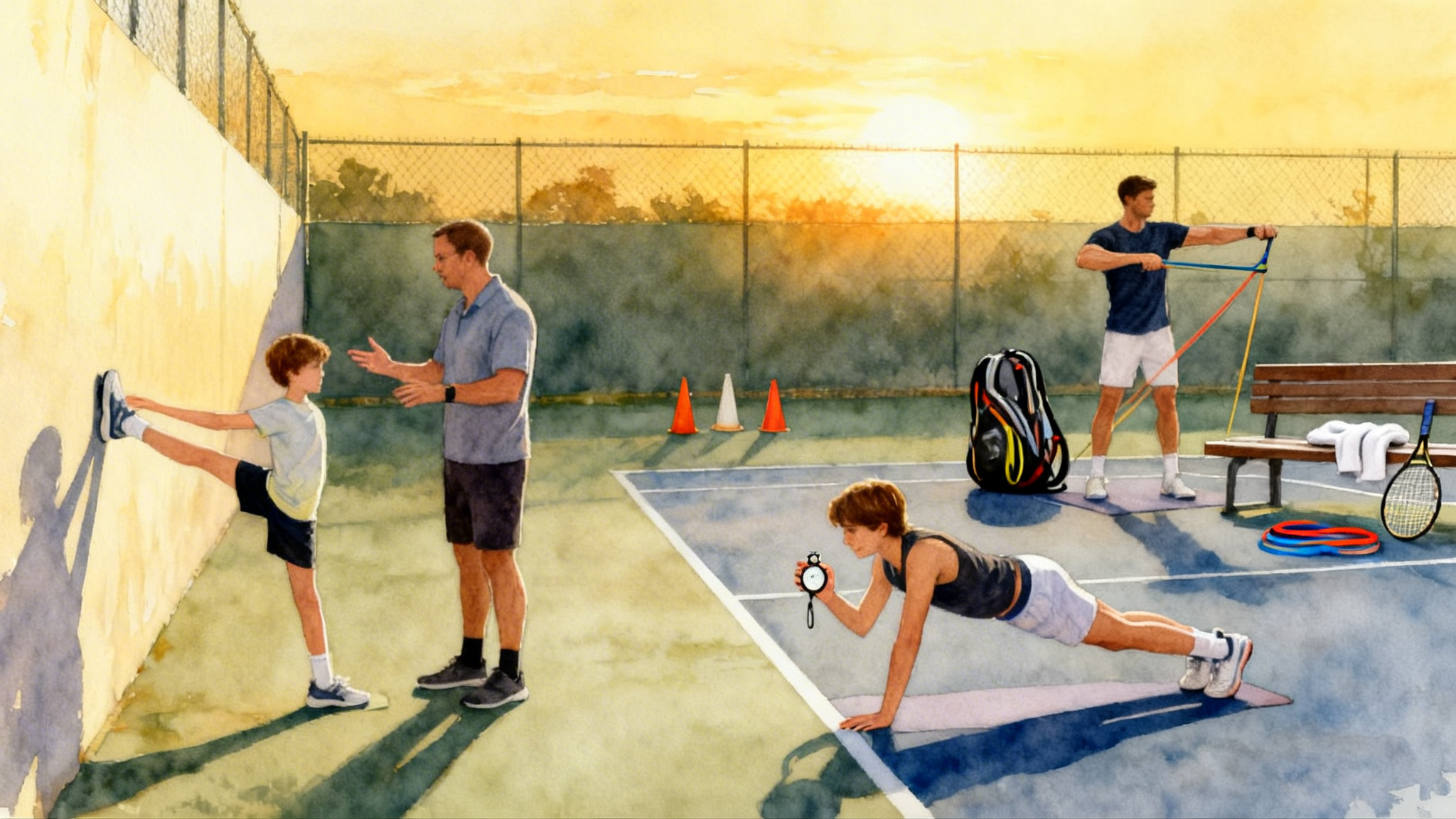
You can run these sessions in a driveway, a park, or a safe open space. Use a phone timer, two cones, a jump rope, and 10 tennis balls.
Day A: Serve and first step
- Warm up, 5 minutes: brisk walk or light jog, 10 arm circles each way, 10 bodyweight squats, 10 lunges each side.
- Throwing ladder, 10 minutes: 10 overhand throws at 25 feet, 8 at 35 feet, 6 at 45 feet. Focus on a stable front side and full follow through. Rest 20 seconds per throw.
- Shadow serve to target, 10 minutes: mark a small square on the ground with chalk. Do 3 sets of 10 shadow serves. On every third rep, pause at trophy position and check that toss arm is up and shoulder is tilted.
- First step burst, 5 minutes: from ready position, sprint 5 meters to a cone, recover with a side shuffle, repeat 8 times with 20 seconds rest.
Day B: Spin shape and repeat sprint
- Warm up, 5 minutes: jump rope easy for 2 minutes, then 8 jumping jacks, 8 inchworms, 8 lateral lunges each side.
- Topspin wall drill, 10 minutes: from 12 to 15 feet, brush up on the back of the ball so it lands above an imaginary net line on the wall, then drops in front of you. Aim for 40 quality contacts, rest as needed. Repeat on backhand for 30 contacts.
- Change shape on command, 5 minutes: alternate 4 rally‑height wall hits and 2 higher arc hits, repeat 6 cycles per side without a miss.
- Repeat sprints, 10 minutes: 6 x 10 meter shuttles with 20 seconds rest. Record times. Stop if technique or posture degrades.
Progression rules: add no more than 10 percent volume per week. If elbow or shoulder tightness appears, cut throwing volume in half for one week and replace with shadow serves only.
How Legend Tennis Academy runs the transition year‑round
Legend Tennis Academy organizes readiness in small, focused groups rather than by birthdays. Here is a snapshot you can adapt.
- Group size and format: 4 to 6 athletes per court, 75 minute sessions, two days per week.
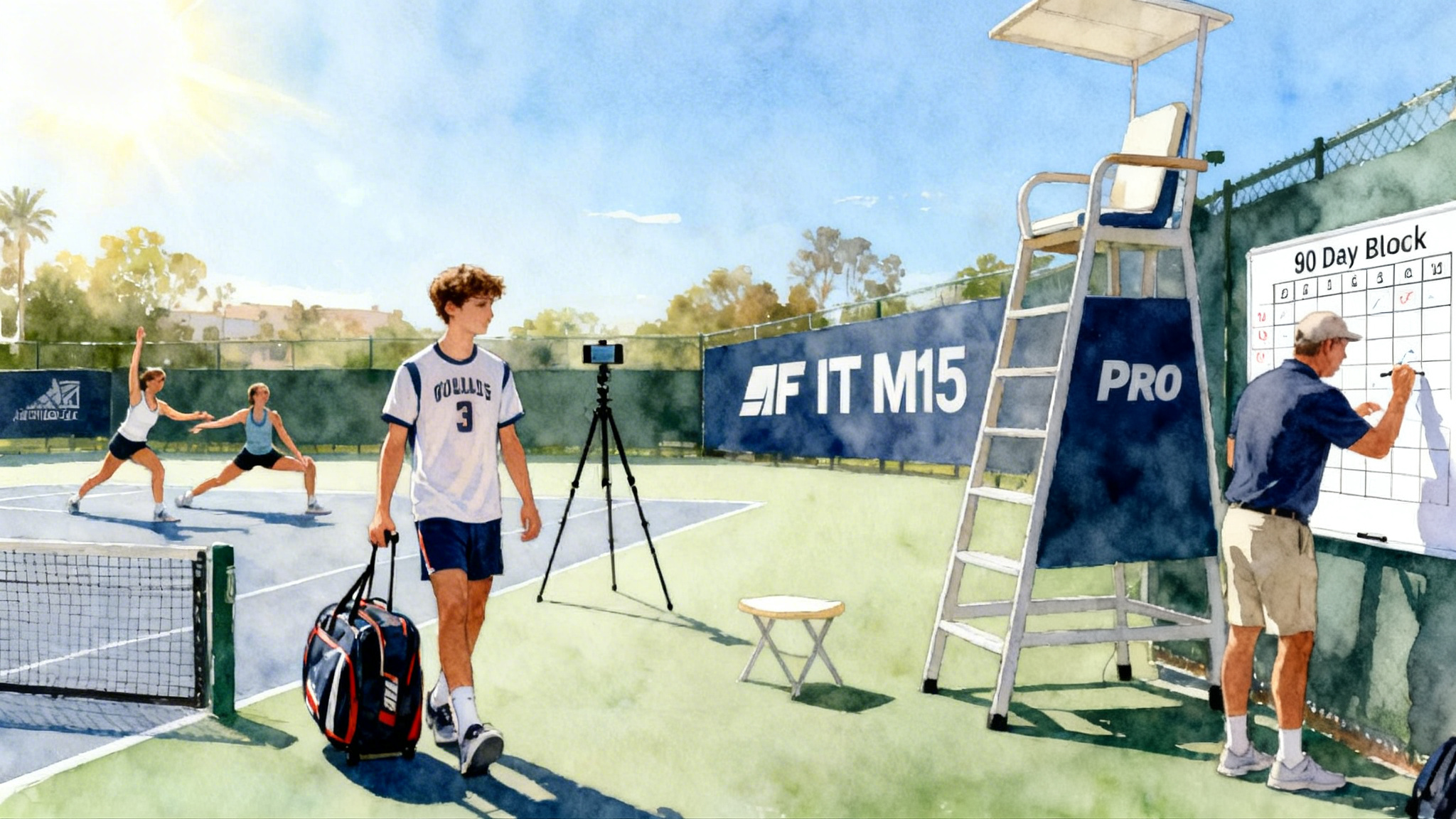
- Block design: 12 week training blocks with baseline testing in week 1, check points in weeks 4 and 8, and a promotion window in weeks 11 and 12.
- Pod identities: each pod has a color tag and a theme, for example Green Control or Yellow Launch, to keep goals visible.
- Session structure:
- 15 minutes of movement, throws, and activation.
- 25 minutes of rally construction with target zones and spin windows.
- 20 minutes of serve plus first ball patterns including return quality.
- 15 minutes of constrained points, for example serve plus two, approach points, or crosscourt games with a single change allowed.
- Match play: weekly 60 minute league matches that mix green and yellow conditions such as first four games with green, next four with yellow. Coaches track double faults, depth percentage, and rally length.
- Promotion rule: athletes move up when three consecutive weeks at or above the checklist standards are logged, with no pain and stable match behavior.
- Parent connection: a 10 minute coach‑parent debrief every four weeks with a simple traffic light system, green for on track, amber for close, red for not yet and a clear plan.
Why this works: smaller groups mean more touches per hour, block training gives time for real adaptation, and staggered match conditions keep progress measurable and honest.
Equipment and setup tips that smooth the move
- Racquet length: many strong green‑ball players at ages 10 to 12 do well with a 26 inch frame as a stepping stone, then a 27 inch frame when they are meeting the spin and sprint targets. Heavier is not always better. Choose the heaviest racquet the player can swing fast for 10 forehands in a row without elbow wobble.
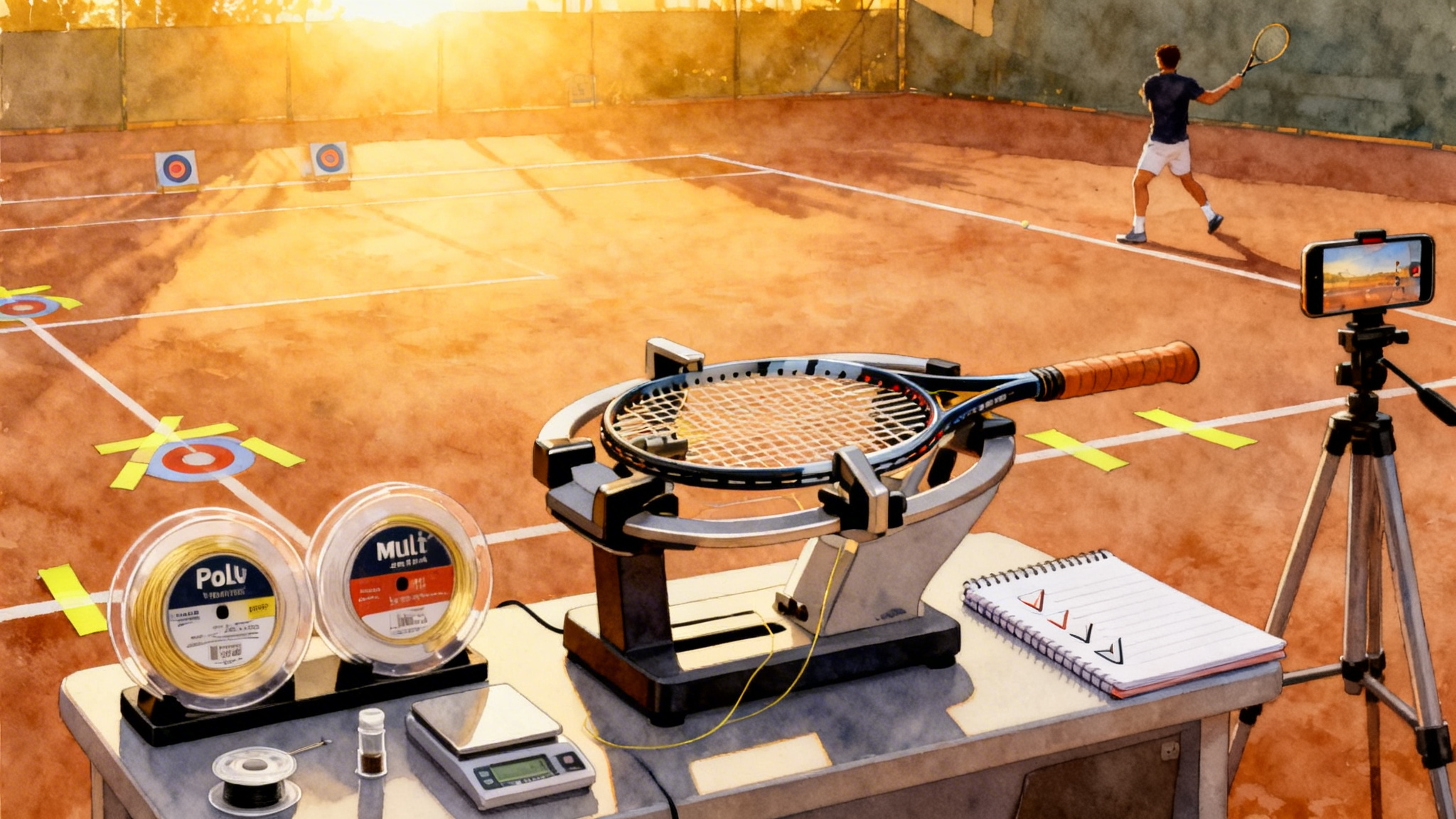
- Strings and tension: a softer string or a hybrid at moderate tension, often mid to high 40s in pounds for junior frames, can help create spin and reduce shock while technique improves. Re‑string by play hours, not by months.
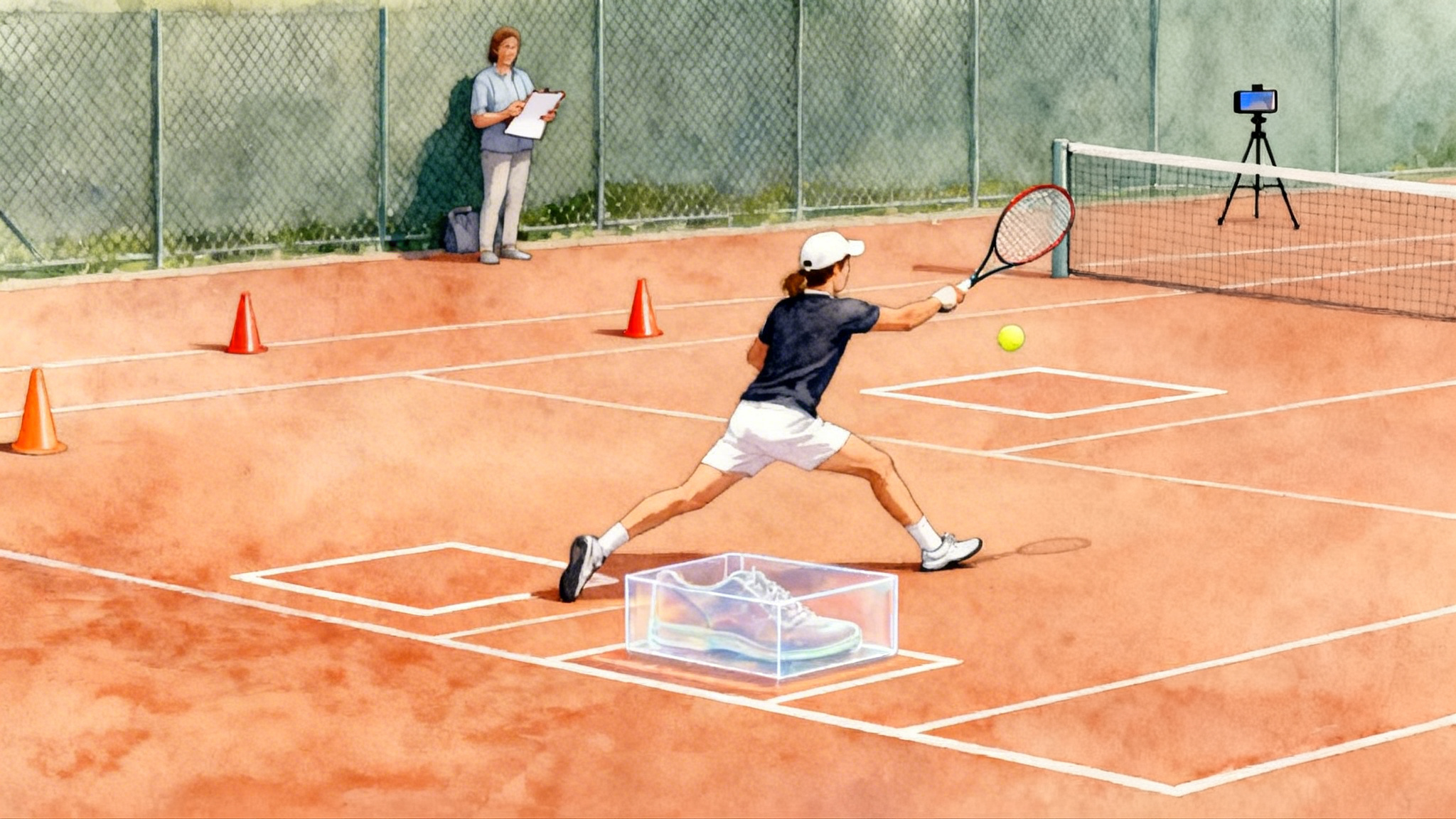
- Court setup: use tape or throw down lines to draw two deep target rectangles three feet inside each baseline. Mark a net height ribbon 3 to 5 feet above the tape on a fence for visual spin windows. Visual targets cut the number of words a coach must say, which keeps sessions moving.
Troubleshooting common speed bumps
- The player meets rally targets on forehands but not backhands: spend two weeks where every point starts with a backhand, or where a player must hit two backhands before a forehand is allowed. Keep serves at 70 percent pace to protect confidence.
- The player serves hard but misses often: slow down and chase a percentage standard for two weeks, 6 of 10 first serves per side, with a higher net clearance and deeper landing. Film from behind to check toss drift.
- The player tires and technique falls late in sets: shorten points during training by starting more balls in attack positions, but keep repeat sprint and jump rope work in the week. Fatigue reveals gaps, it also responds quickly to two disciplined sessions.
- Parents feel nervous after the first yellow event: agree in advance to a three tournament window. Use event one to learn, event two to stabilize, and event three to validate. Track your checklist between events rather than judging by a single win or loss.
When to go back to green temporarily
There is no shame in toggling conditions week to week. If serves lose shape, if a player reports elbow ache, or if backhand rally length falls under 6 consistently, return to green for a short block. Keep attacking patterns and spin windows, then reintroduce yellow with a serve plus two focus.
Your next three steps
-
Print the checklist and run the skill tests within seven days. Be honest, film if you can, and circle the two biggest gaps.
-
Start the 2x per week routine for four weeks. If you already meet all targets, still run the routine for two weeks to consolidate.
-
If you coach, pilot a small group transition pod like Legend Tennis Academy. If you parent, share the checklist with your coach and ask for a four week plan that ends with a re‑test.
A timely move to yellow ball pays off in cleaner mechanics, braver patterns, and steadier match habits. Use the benchmarks, keep the routine simple, and let the data, not anxiety, make the call. The game feels faster at first, then, very quickly, it feels like home.