2026 College Tennis Recruiting: Roadmap, Emails, Video, NIL
A practical month by month plan from grade 9 to grade 12 that covers coach outreach templates, a 90 second highlight video checklist, visit strategy, scholarships and NIL fundamentals, level by level fit, and how to build a smart match schedule.
 Tommy
Tommy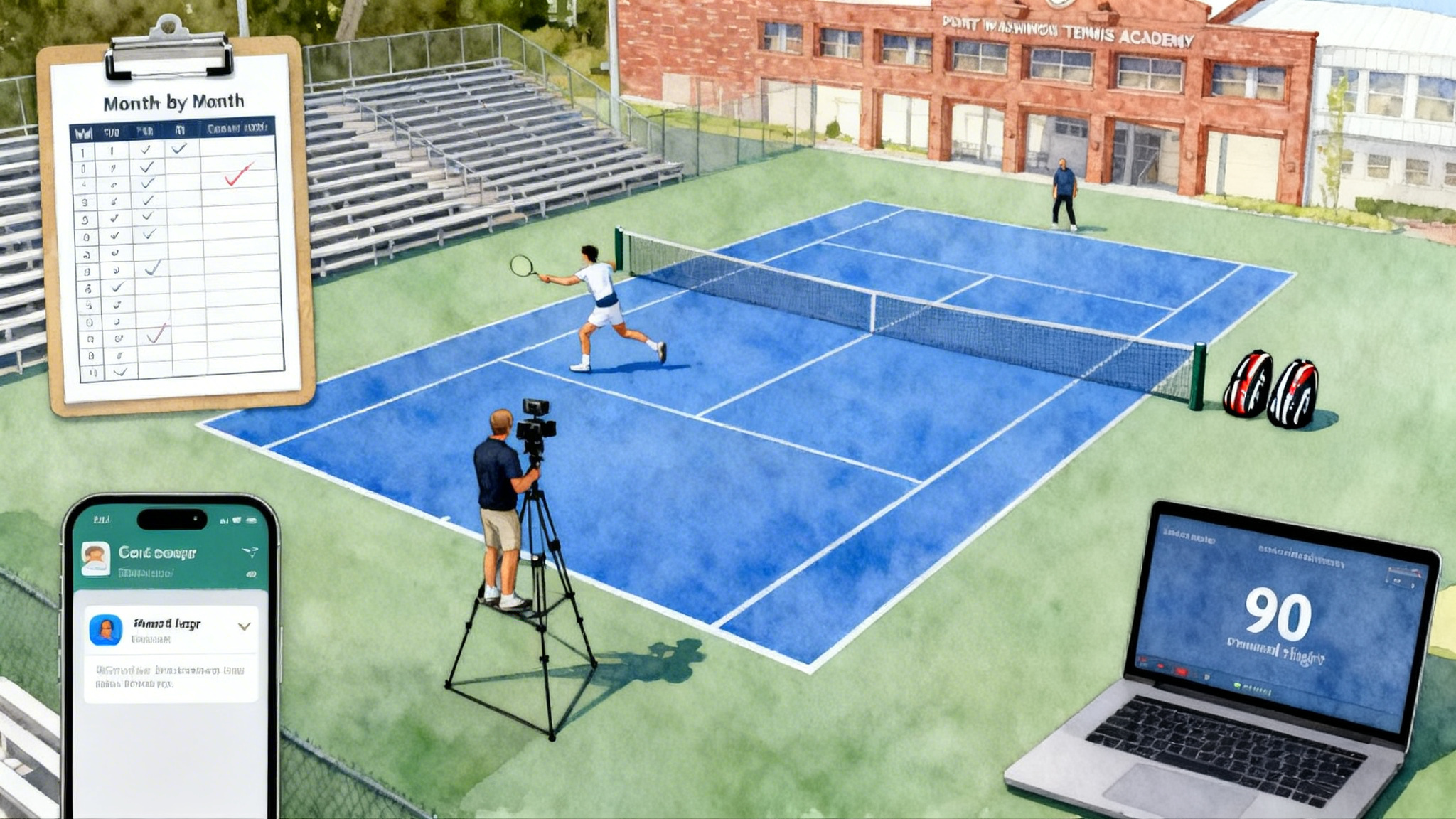
Why this playbook
College tennis recruiting rewards families who act early, track progress, and communicate with clarity. This guide gives parents and juniors a concrete month-by-month plan from grade 9 through grade 12. You will find ready-to-use coach outreach templates, a 90 second highlight video checklist, visit guidance, scholarship and Name Image Likeness basics, a level-by-level fit guide across Division I, Division II, Division III, National Association of Intercollegiate Athletics, and junior college, plus a simple way to build a results-driven match schedule without living on the road.
Before we dive in, a reminder: rules and calendars can change. Always confirm current deadlines with your school counselor and each program’s compliance office. For eligibility and timelines, start with the NCAA Eligibility Center and, if you are targeting NAIA programs, the NAIA Eligibility Center. Use this playbook to drive action, then verify the details for your year.
The month-by-month roadmap
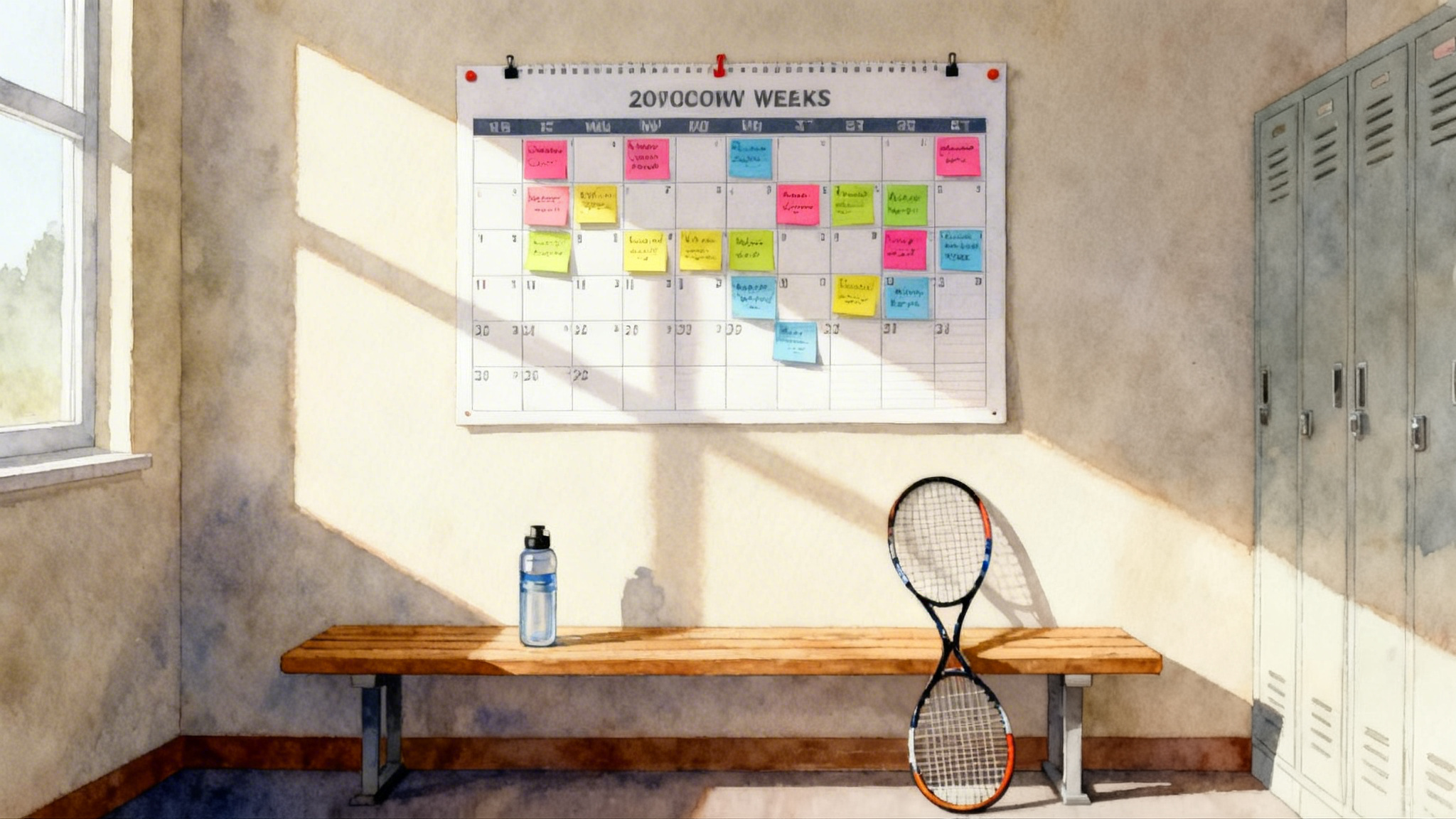
To make this simple, treat each school year as August through July. Your aim each month is to improve either your game quality, your match results, or your recruiting visibility. Do not try to improve all three at once every month. Rotate the focus.
Grade 9
-
August to October
- Set your baseline. Record current Universal Tennis Rating and match record. For a deeper understanding of rating systems, see our UTR and WTN 2026 roadmap.
- Choose two priority skill projects for the fall. Examples: first serve speed and depth on the backhand. Tie each project to a measurable outcome such as first serve percentage.
- Start a simple results log. For every match, capture opponent level, score by set, and three learning points.
-
November to January
- Build comfort in match play. Play one local event each month. Focus on shot tolerance and between point routines.
- Create a private folder with your best practice clips. You are not contacting coaches yet, but you are building the raw material for a future highlight video.
- Begin light research on schools. Make a first pass list of twenty programs across multiple levels and regions.
-
February to July
- Add strength and mobility basics two times per week. Quality movement keeps you healthy through growth spurts.
- Play two stretch events by July. Choose events that are slightly above your current level to learn how your game holds under pressure.
- Visit a campus or two informally if travel takes you nearby. Walk past the courts, see the neighborhood, and note the commute from campus housing to the athletic facilities.
Grade 10
-
August to October
- Narrow your school list to fifteen programs across Division I, Division II, Division III, National Association of Intercollegiate Athletics, and junior college. Group them into reach, match, and safety based on academics and tennis level.
- Start your academic preparation. Confirm core course progress and map the classes required for eligibility.
- Build your first 90 second highlight draft from practice clips. You will update it once you add match points.
-
November to January
- Plan a winter match block. Three events across eight to ten weeks is enough. One local, one regional, one stretch if budget allows.
- Draft your introductory email and a short player resume. Keep the files easy to read and under one page each.
-
February to July
- After your sport’s contact start date, begin coach introductions. Contact dates can change, so confirm on the NCAA Eligibility Center and with each program’s compliance office. Keep your first note concise and personal.
- Update your highlight video with match points and post it unlisted. Include your name, graduation year, contact info, and basic academics in the opening slate.
- Ask two trusted coaches to give you a realistic level fit across divisions. Note their reasons, not just the label.
Grade 11
-
August to October
- Increase coach outreach. Send targeted updates every six to eight weeks with new results, video, and upcoming events.
- Schedule unofficial visits on or near fall tournament weekends. See a practice, watch a dual match if in season, and meet academic advisors when possible.
- Begin financial planning. Ask each program about typical scholarship packaging and how academic aid stacks with athletic aid.
-
November to January
- Build a winter development microcycle. Four to six weeks of focused work on a pattern you will need in college, such as serve plus first ball or neutralizing deep returns.
- If test scores are part of your target schools’ admissions, register early and plan a retake window.
-
February to July
- Take official visits when eligible and invited. Prepare specific questions about developmental plans, travel loads, redshirt options, and typical freshman year course loads.
- Identify your top three programs by June based on coaching fit, roster pathway, academics, and finances. A program that loves developing players like you is more valuable than a famous name with a blocked lineup.
Grade 12
-
August to October
- Keep the communication cadence. Share updated results, a refreshed 90 second video, and your fall course load.
- Revisit your school list if coaching staffs changed over the summer. Fit is dynamic.
-
November to January
- If you sign a National Letter of Intent in the fall or winter period, celebrate, then do the small things right. Send thank you notes to the coaches who helped along the way.
- If you are still open, keep options alive at multiple levels. Many strong outcomes happen late when rosters shift unexpectedly.
-
February to July
- Maintain grades and integrity in competition. Coaches watch how you carry yourself in the final months as closely as they watch your forehand.
- Close the loop with every coach who recruited you. Leave doors open for the future.
Coach outreach templates that work
Short, personal, and useful beats long and generic. These templates are easy to adapt. Keep the subject line specific and readable on a phone.
Subject lines to copy:
- 2026 right handed baseliner with heavy forehand, 3.8 GPA
- Match film update from Austin showcase, May 12
- Unofficial visit request for April 20 weekend
Initial email template:
Coach [Last Name],

My name is [Full Name], Class of 20[XX], from [City, State or Country]. I play [right or left] handed and my strengths are [two short strengths]. I am interested in [University Name] because of [specific academic or team reason].

Recent results: [two recent wins or tight losses with opponent level].
Highlight video: [private link]
Upcoming events: [list one to three with dates and locations].
Academics: [GPA, rigorous courses, intended major if known].

Could I send you full match film and, if it fits your calendar, schedule a quick call to learn about your program’s player development focus for [position or style]?

Thank you for your time.
[Full Name]
[Phone] | [City, State or Country]
[Coach reference if applicable]
Update email template:
Coach [Last Name],

Quick update since we last connected. I played [event] on [date] and went [record]. Here are two points that show progress on [specific skill].

New 90 second video: [private link]
Next events: [dates and locations]
Academics: [recent grade or academic note]

If helpful, I can share full match film from [opponent name or event].

Appreciate your guidance,
[Full Name]
Post visit thank you:
Coach [Last Name],

Thank you for hosting me on [date]. I enjoyed [practice session detail] and our conversation about [development or academics]. The team culture felt [specific observation].

Please let me know the best next step. I am excited about the possibility of contributing as a [projected role or position].

Best regards,
[Full Name]
The 90 second highlight video checklist
A great highlight is fast, honest, and shows college patterns. Think of it as a movie trailer for your game. For filming and editing details, see our Film-to-Feedback video guide.
Shot list
- Ten to twelve live points from matches, not dead ball drills. Use two to three points per pattern: serve plus first ball, return plus first ball, baseline defense to offense, transition with a split step and first volley, plus one or two pressure points at deuce or tiebreak.
- Two short sequences that show movement and balance. Example: three neutral forehands into a high heavy ball, then a balanced backhand change of direction.
- One slow motion clip of the serve from the back and one from the side for contact height and leg drive.
Production
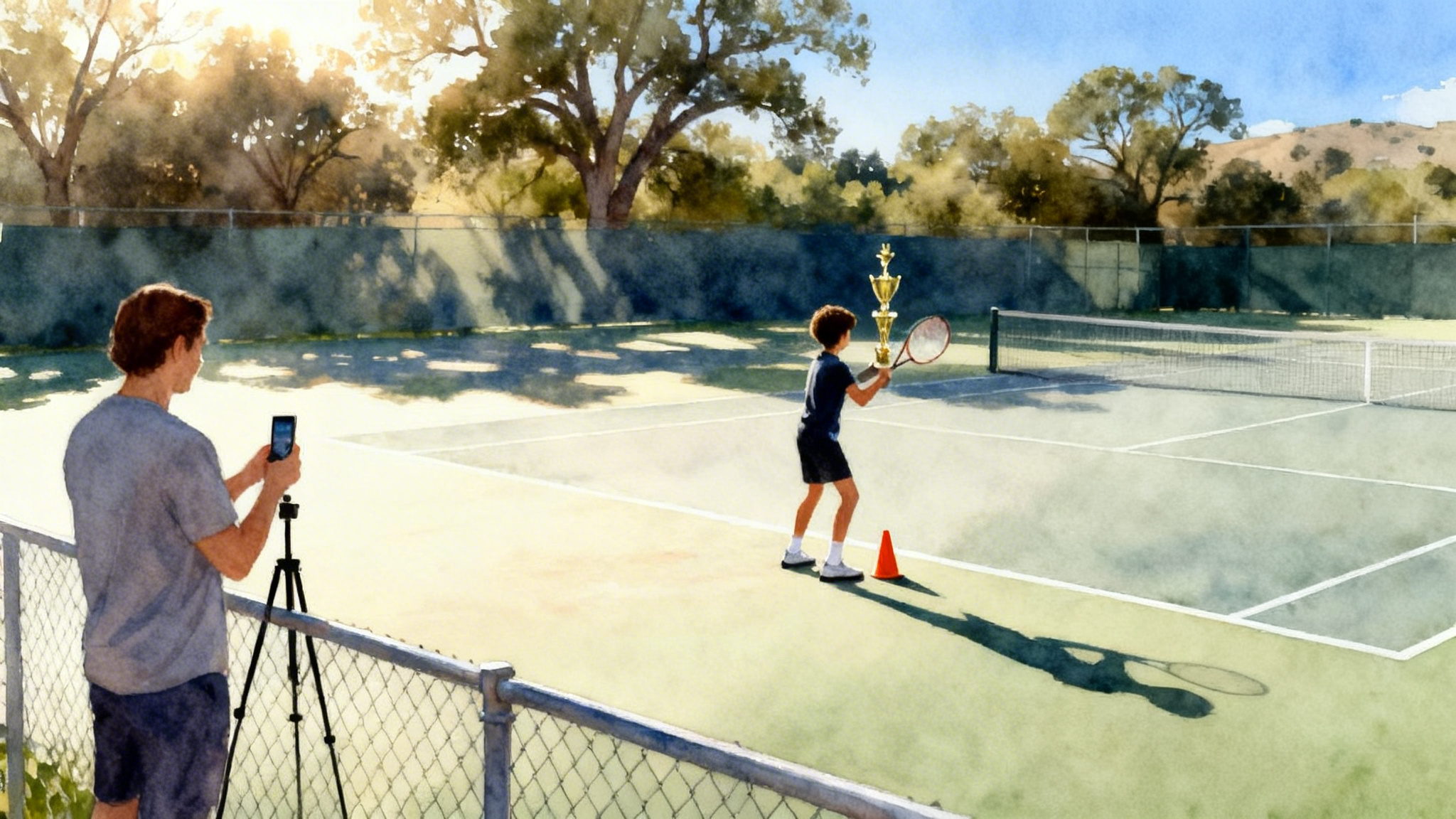
- Film from a stable elevated angle near the back fence or balcony. Keep the whole court in frame. No music that competes with ball sound.
- Use a clean opening slate: name, class year, height, handedness, email, phone, school, city, key metrics such as first serve percentage if tracked.
- Add lower third labels sparingly. Example: “Return plus first ball” for two seconds at the start of that pattern.
- End with a one line call to action: “Full match video available upon request.”
Keep it to 90 seconds. Put full match links in the email, not in the highlight.
Unofficial vs official visits in plain English
-
Unofficial visit
- You pay your own way. You can tour campus, meet the staff if allowed, and watch practice. Pair it with a tournament weekend to keep costs down.
- Best use: early feel for campus and team culture; confirming that your academic interests are supported.
-
Official visit
- The program covers allowable expenses. You experience a day or two as a student athlete. There are rules about timing and frequency, so confirm specific dates with the staff.
- Best use: late stage decision making when both sides see a possible roster fit.
Questions to bring on any visit
- Player development: How will you help me win points I lose today. What is the plan in month one, month six, and year one.
- Roster pathway: What skills do your top six singles players share. Where do you see my early contribution coming from.
- Academics: Which majors are most compatible with the team’s practice and travel. What support is typical for freshmen.
- Culture and travel: What are the expectations for summer tennis. How many class days are missed in spring.
Scholarships and NIL basics for tennis
-
Scholarships
- Tennis scholarships are limited and often divided among players. Many rosters combine athletic aid with academic and need based aid. Ask directly how aid is typically packaged for your position and class.
- Learn the vocabulary. Headcount means a program can split aid only as full scholarships. Equivalency means a program can divide a fixed amount of aid across multiple athletes. Tennis often involves equivalency scenarios, so small percentage awards are common.
- Academic leverage matters. Strong grades and test scores, where required by admissions, can open doors and allow coaches to stretch team aid further.
-
Name Image Likeness
- Student athletes can earn compensation for the use of their name, image, and likeness in many contexts such as camps, private lessons, social media, and brand deals where permitted by school and state policy. It is not pay to play, and offers tied to enrollment decisions can create compliance issues.
- Build a simple, transparent approach. Keep records, use written agreements, and clear any activity with your school’s compliance office. Think of NIL as a supplement, not a plan to fund college by itself.
Level-by-level fit guide
These are practical signals, not hard rules. Coaches recruit whole people, not just ratings.
-
Division I
- Typical profile: national level junior results, strong athleticism, and a weapon that holds at college speed. For men, a serve or forehand that finishes points. For women, the ability to take time away on the rise and transition when invited.
- Competitive indicators: consistently deep runs in strong sectional or national events, wins over players already committed to Division I. Ratings often sit at the top of your region, but growth trend matters as much as the number.
-
Division II
- Typical profile: strong results with a couple of signature wins and clear upside. Many programs develop players into Division I level performers over time.
- Competitive indicators: steady results against older players, proof that your patterns work against pace and spin variety.
-
Division III
- Typical profile: academic drivers who love training and competition. Top programs are excellent and recruit players with national level results. Depth across programs varies widely, so do not generalize.
- Competitive indicators: leadership on your team, consistent tactical discipline, and evidence you can handle both singles and doubles responsibilities.
-
National Association of Intercollegiate Athletics
- Typical profile: competitive juniors seeking smaller campuses, flexible transfer paths, or late blooming development arcs.
- Competitive indicators: a track record of improvement and the ability to play aggressive percentage tennis without excess risk.
-
Junior college
- Typical profile: players who want two years to grow physically and academically, with a plan to transfer to a four year program. Great option for late starters and international students adjusting to the United States system.
- Competitive indicators: rapid month-to-month improvement and hunger for match volume.
Build a results-driven match schedule without a 52 week grind
Use the 3 by 3 by 3 framework. It keeps you playing enough without burning travel time and money.
-
Three anchors per season
Choose three priority events each season that fit your game style and goals. That gives you roughly twelve anchors per year. Build training around these, not around every possible tournament. -
Three tune ups per anchor
Schedule one light event four weeks before each anchor to test patterns, a match play day two weeks out to sharpen decision making, and a final short set session the week of the event to touch the first serve and returns. -
Three stretch events per year
Add three higher level events across the year for growth. Enter knowing that results may be rough. The goal is to learn what breaks first at the next level and to bring that lesson back to training.
Measurement that matters
- Track first serve percentage, returns in play, break point conversion, and errors in the net tape zone. One spreadsheet, updated after each event, tells you where your next one to two percent lives.
- Aim for a healthy mix: about seventy percent of your matches where you have a real chance to win, twenty percent stretch, ten percent very hard. That ratio builds confidence and resilience.
Budget tips
- Cluster events by geography to cut costs. Car trip loops beat fly in one offs.
- Use practice matches with scorecards and a chair umpire when possible. Some of your best learning comes from low travel, high focus environments.
Domestic checklist vs international checklist
Domestic families
- Register with the appropriate eligibility system on time and keep transcripts updated.
- Keep coaches posted on academic honors that can improve your financial package.
- Build a short list of references who can vouch for your work habits and character.
- Confirm driver of the recruiting process. Parents manage logistics. Players send emails and hold the conversations.
International families
- Translate and standardize transcripts early. Provide grading scales and class rank context.
- Keep a simple calendar of time zones for coach calls. Offer multiple windows each week.
- Clarify visa timelines and proof of funding requirements with target schools.
- Share match video filmed from a consistent elevated angle, since coaches may not be able to see you live.
Smart visit planning in four steps
- Calendar: pair visits with tournaments or school breaks. Two visits in a single trip can save thousands.
- Purpose: every visit needs a goal. Examples include seeing a practice theme, meeting the strength and conditioning coach, or sitting in a class related to your intended major.
- People: ask to meet a freshman and a senior. Different perspectives reveal culture.
- Debrief: write a two paragraph summary the same day. What excited you. What concerned you. What would make the program a yes.
A clean communication cadence
- Initial intro
- Update every six to eight weeks
- Pre event heads up one week before a nearby tournament
- Post event note with one or two clips when you have something new to show
- Thank you and next steps after every call or visit
If a program stops replying, reduce touchpoints to once per quarter. Keep doors open without crowding their inbox.
Book a showcase evaluation
If you want an expert eye on your level, movement, and college fit, book a showcase evaluation at Legend Tennis Academy in Spicewood. You will leave with clear strengths, priority projects, and a simple training and recruiting timeline you can execute.
Final thoughts
College tennis recruiting is not a mystery. It is a series of small, timely, well organized actions. Pick a focus each month, track what the numbers say about your game, and communicate with coaches like a future teammate. Momentum beats perfection. If you follow this roadmap and iterate, the right level and the right program will see you, understand your game, and know exactly why you belong on their court.