2026 Return of Serve Game Plan: Read, React, Neutralize
Build a reliable return of serve in eight weeks with clear drills, visual toss cues, split step timing, contact zones, and measurable benchmarks. Includes parent checklists, at‑home reaction work, and a Legend Tennis Academy case study.
 Tommy
Tommy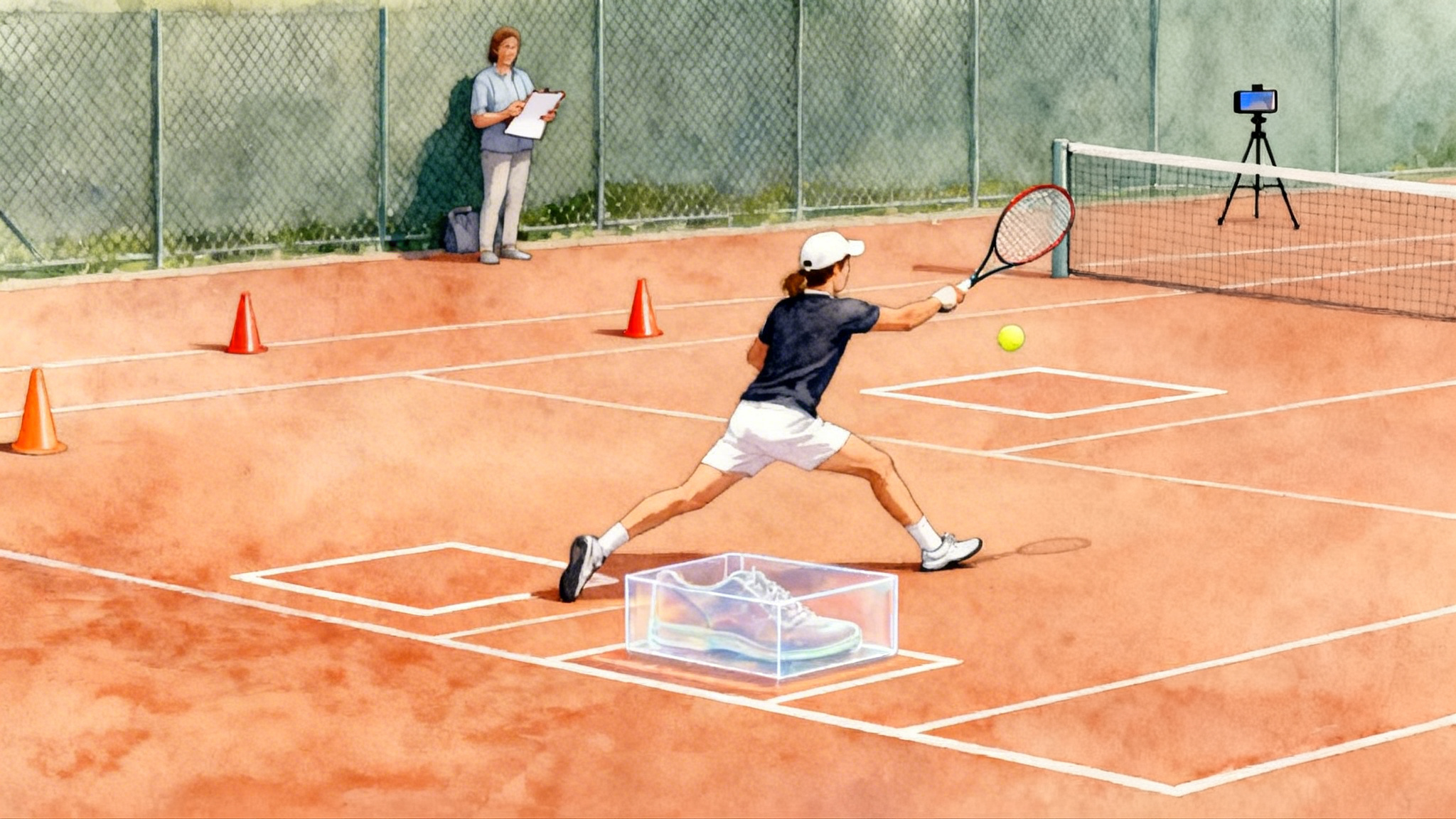
Why the return matters more in 2026
Servers are hitting heavier, flatter, and smarter. Ball tracking on tour shows higher first-serve speeds and smarter second-serve targets, which means the returner’s job is not to rip a winner but to neutralize the server’s advantage within the first two shots. A reliable return shifts momentum immediately. On the scoresheet, the return looks like one stroke, yet it blends reading, footwork, and compact contact under pressure. That is the game plan you will build here in eight focused weeks.
This article gives juniors, parents, and adult players a practical system. You will learn what to watch in the toss, how to time your split step, where to set your contact zone, and how to train it all in daily 15-minute blocks. You will also get parent-run checklists, at-home reaction options, and a case study from Legend Tennis Academy with benchmarks that connect to on-court assessment sessions. If you want to test your progress formally, you can book an on-court return assessment inside TennisAcademy.app.
The returner’s simple model: Read, React, Neutralize
- Read: Extract early information. The server’s toss height, toss line, and shoulder rotation hint at spin and direction. The racquet path gives a last-second cue.
- React: Time your split step so your feet land just as the server makes contact. That timing lets you push in your chosen direction without hesitation. For better movement quality, review footwork first training.
- Neutralize: Choose a high-percentage target that resets the point. Deep middle is your default, with crosscourt and body targets used to jam or stretch the server’s next shot.
Think of this like catching a fast train. You read the schedule board early, position your body at the right platform mark, and take a small hop to match the train’s arrival. You do not leap across the tracks. You connect cleanly and ride with it.
Contact zones that scale for every level
- First serves: Set a contact zone slightly behind your usual baseline position, waist height, compact swing. Aim deep middle or body to remove angles. If the court is quick, take an extra half step back to buy reaction time.
- Second serves: Step forward to a higher strike zone, aim deep crosscourt or heavy body. Shape the ball with more net clearance. Use a short backswing, think “punch and hold” instead of “pull and whip.”
A “zone” is a box in space where you want the ball, not just a point on the string bed. Visualize a shoebox that travels with the ball. Meet the ball inside that box and you will reduce mishits.
Split step timing that actually works
Two simple rules:
- Start your hop when the server’s tossing arm begins to rise.
- Land the split as the ball meets the server’s strings. If you hear the pop and feel your feet hit at the same instant, you are on time.
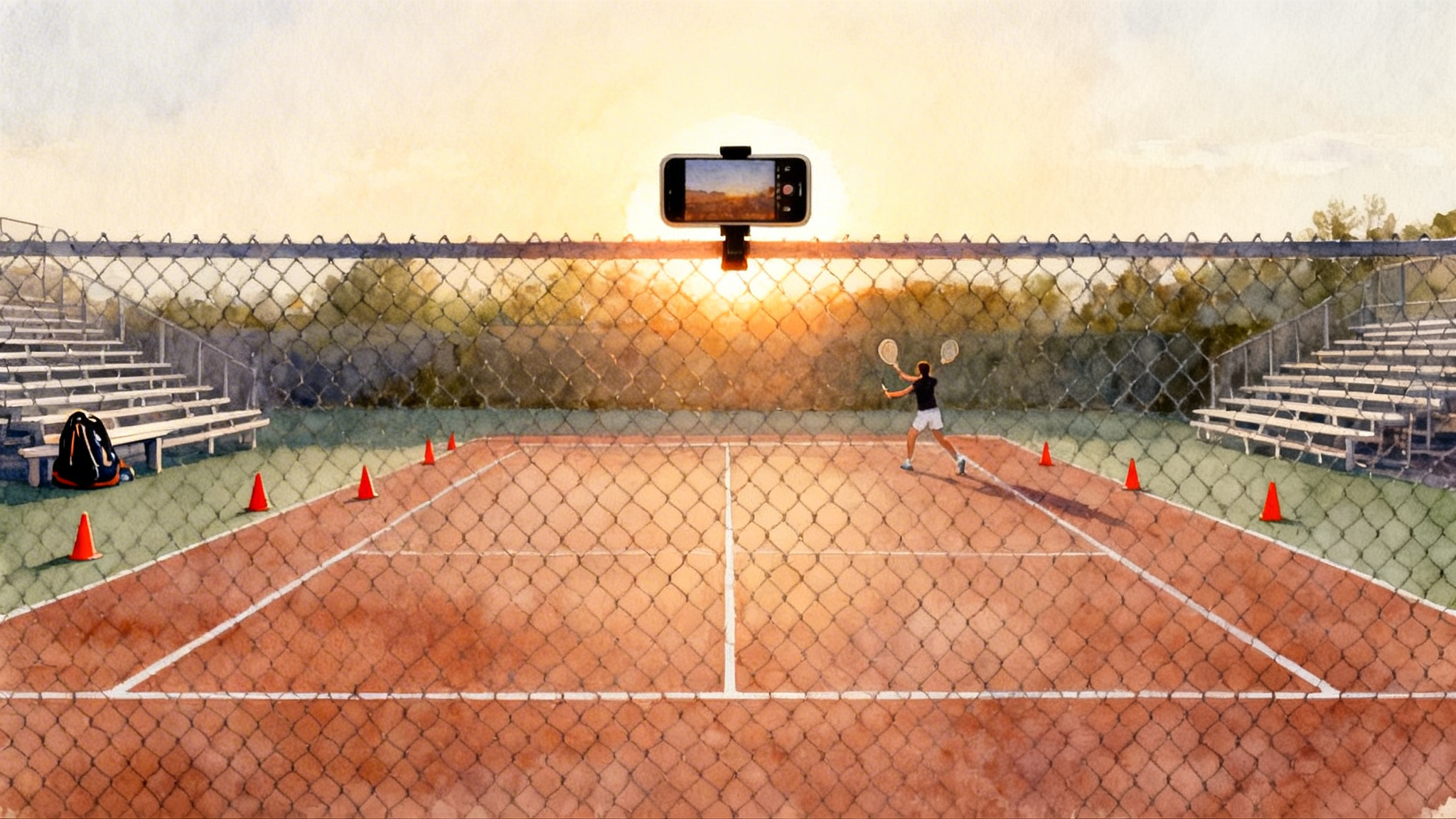
If you land too early, you must jump again and you lose the first step. If you land too late, the ball is already flying and you will feel rushed. Record a few serves on your phone and slow them down frame by frame. Use the smartphone tennis video guide for angles and frame rates.
Visual toss cues that short-circuit guesswork
- Toss line: A toss that drifts to the server’s right (for a right-hander) often signals slice wide from the deuce court or slice body from the ad court. A toss that stays over the head or shifts slightly left can signal kick.
- Shoulder line: If the chest opens early toward the sideline, look for wide. If the chest stays square longer, expect body or T.
- Racquet tip: A vertical tip and upward path on second serves suggest kick. A more level path with a carve suggests slice.
You do not need to predict perfectly. You only need to narrow options from four to two, which cuts your reaction problem in half.
The eight-week return of serve progression
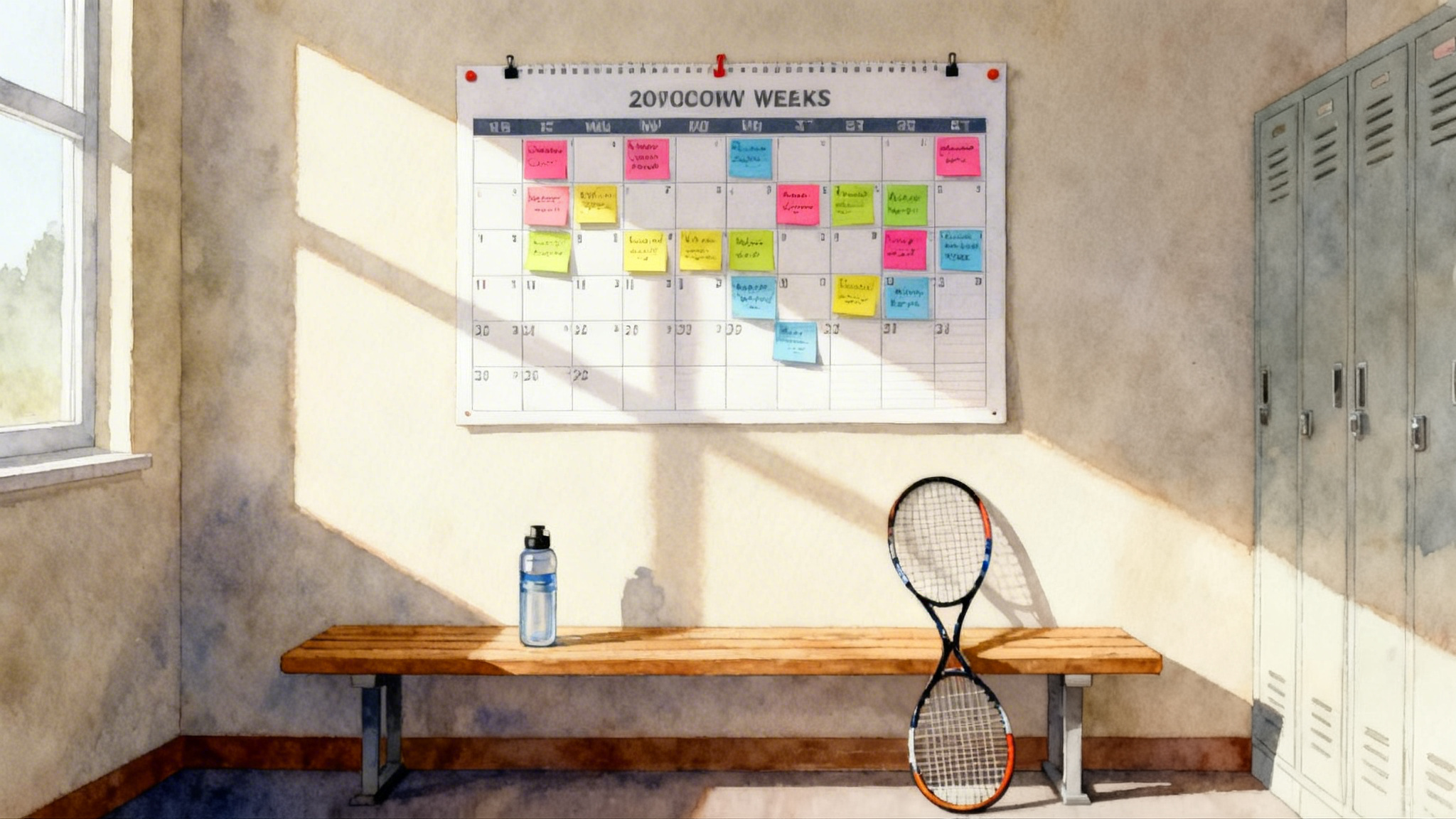
Each week includes three parts: a focus theme, a 15-minute daily micro-session, and a benchmark you can test in an on-court session. Juniors get parent-run cues. Adults get self-coaching prompts.
Week 1: Set your base and your eyes
- Theme: Ready stance, eye discipline, and the default deep-middle target.
- 15-minute daily:
- Posture and bounce, 3 minutes: Athletic stance, racquet up, soft heel kiss, eyes on the server’s toss hand. Two sets of 90 seconds with 30 seconds rest.
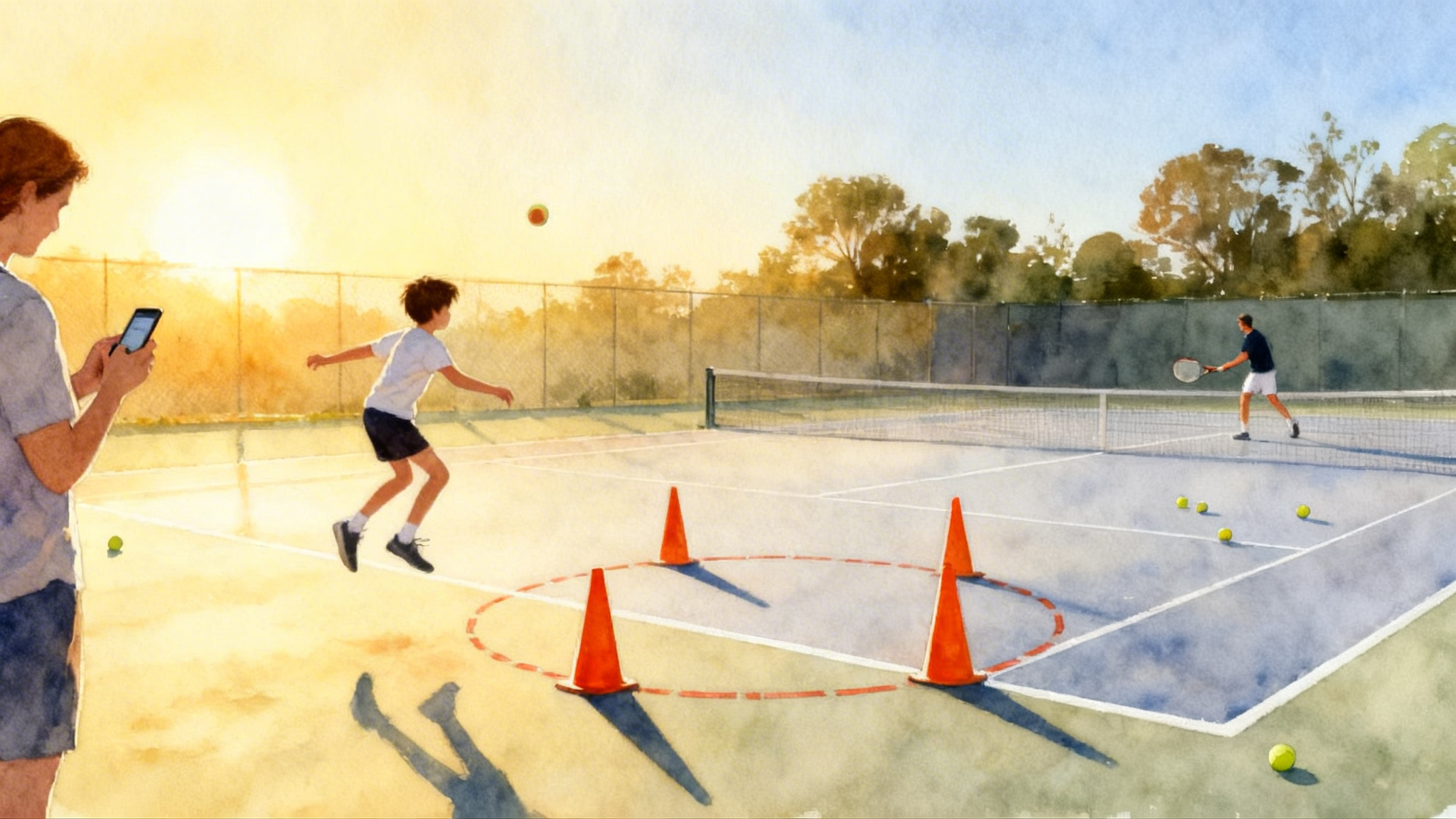
- Toss-only reads, 6 minutes: A partner or parent mimics a toss without hitting. You call “wide,” “body,” or “T” based only on the toss line and shoulders. No swing, only a small step in the called direction.
- Shadow returns, 6 minutes: Split step on a clap. Step and punch to deep middle, hold the follow through 1 count. Alternate deuce and ad sides.
- Benchmark: In a basket session of 20 first-serve feeds, achieve 15 clean neutral returns past the service line, at least 10 to deep middle.
- Parent checklist: Feet bounce, eyes on the toss hand, call the direction, hold the follow through.
Week 2: Split step that lands with contact
- Theme: Contact-synchronized split and first step.
- 15-minute daily:
- Metronome land-to-push, 5 minutes: Use a phone metronome at 60 beats per minute. Clap on the beat to mimic contact and land your split exactly on the clap, then push into a shadow step.
- Serve-board reads, 5 minutes: Parent tosses and air-swings with a racquet. You land with the mock contact and take a small step in the read direction.
- Mini-court returns, 5 minutes: From inside the service box, coach feeds from the opposite service line. Compact blocks to deep middle with 8 feet of net clearance.
- Benchmark: Record slow motion. In 10 live serves, your feet should land within a single frame of the racquet-ball contact in at least 7 attempts.
- Adult self-scan: Did you hear contact and feel land at the same time? If not, start your hop earlier.
Week 3: Contact zone discipline
- Theme: Meeting the ball in the shoebox.
- 15-minute daily:
- Wall blocks, 5 minutes: Stand 12 feet from a wall. Toss, bounce, and block to hit a chalk square 3 feet above the floor. Fifty contacts.
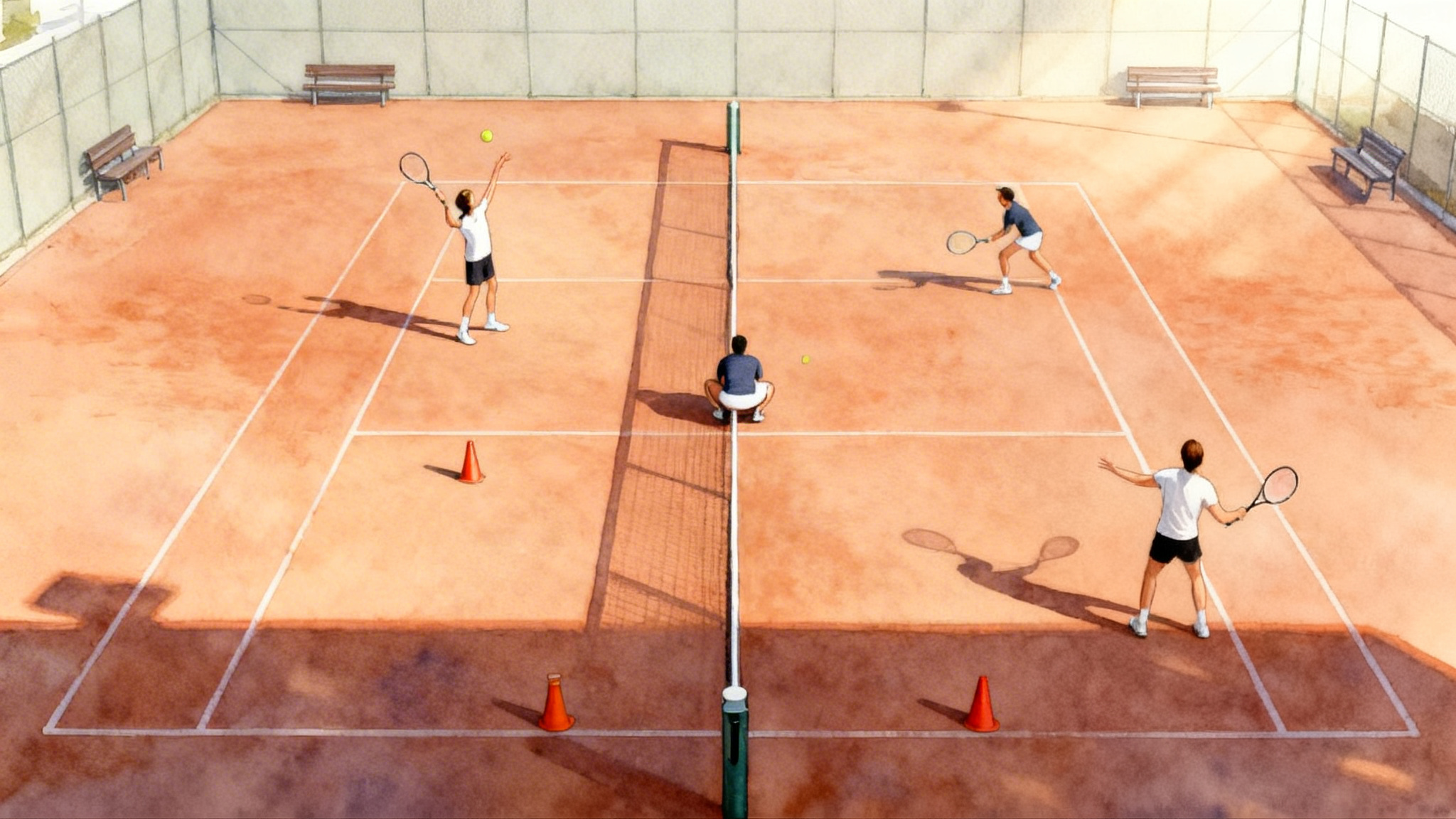
- Target ladder, 5 minutes: Cones mark deep-middle, deep crosscourt, and body. Coach feeds. You must hold a compact backswing and finish with strings to target.
- Second-serve step-in, 5 minutes: Start one step behind the baseline. On the toss, step in and punch crosscourt with shape.
- Benchmark: On 30 second-serve feeds, land 24 in with a miss long count under 3. Long misses signal over-swing.
- Parent checklist: Racquet head starts above the wrist, small turn, no wraparound follow through.
Week 4: Directional reads from the toss and shoulder
- Theme: Shrink the decision tree before contact.
- 15-minute daily:
- Two-choice call, 6 minutes: Parent serves only wide or body. You must call it early, then commit your first step.
- Freeze and point, 3 minutes: On the toss, freeze at the top of your split and point your front hip where you expect the ball.
- Live returns, 6 minutes: Alternate deep middle and jam body off first serves. No winners allowed.
- Benchmark: In a set of 16 returns against a consistent server, correctly call direction on 12 tosses and make 10 neutral returns.
- Adult self-scan: If your first step is sideways, you are late. Aim for a forward-angled first step.
Week 5: Second-serve aggression that is still safe
- Theme: Own the second serve without donating errors.
- 15-minute daily:
- Step-in punch, 6 minutes: Coach hits kick serves. You step in with a short hop, take the ball at waist to chest height, and send heavy crosscourt with margin.
- Body jam, 3 minutes: Aim hard through the server’s hip pocket. Compact swing, firm wrist.
- Pressure ladder, 6 minutes: Two in a row to target before you can move to the next cone.
- Benchmark: Against 20 second serves, win 12 points outright or gain a short ball within two shots on at least 14.
- Parent checklist: Step in, no backpedal, high strike, finish forward.
Week 6: First-serve survival and depth control
- Theme: Turn heavy serves into neutral rallies.
- 15-minute daily:
- Deep-middle machine, 6 minutes: From a half step back, block first-serve pace to a large target zone in deep middle. Count only balls landing past the service line.
- Wide stretch save, 3 minutes: Coach serves wide. You load outside leg, plant, and send the ball high crosscourt. No line attempts.
- Body escape, 6 minutes: Coach serves at your hip. Practice a hop-back or small pivot to create space, then block to deep middle.
- Benchmark: On 24 first serves at match pace, neutralize 14 with depth past the service line and fewer than 3 short middle sitters.
- Adult self-scan: If you are late, start your hop earlier, not bigger.
Week 7: Patterns and placement
- Theme: Playbook based on the server’s habits.
- 15-minute daily:
- Scouting card, 3 minutes: Note which side the opponent serves wide on big points and which side they go body on second serve.
- Pattern practice, 6 minutes: Alternate your default deep middle with one changeup per four returns: a body jam or a deep crosscourt roller.
- Point starts, 6 minutes: Each rally begins with a serve and return. Your only job is to make ball three through the baseline corner.
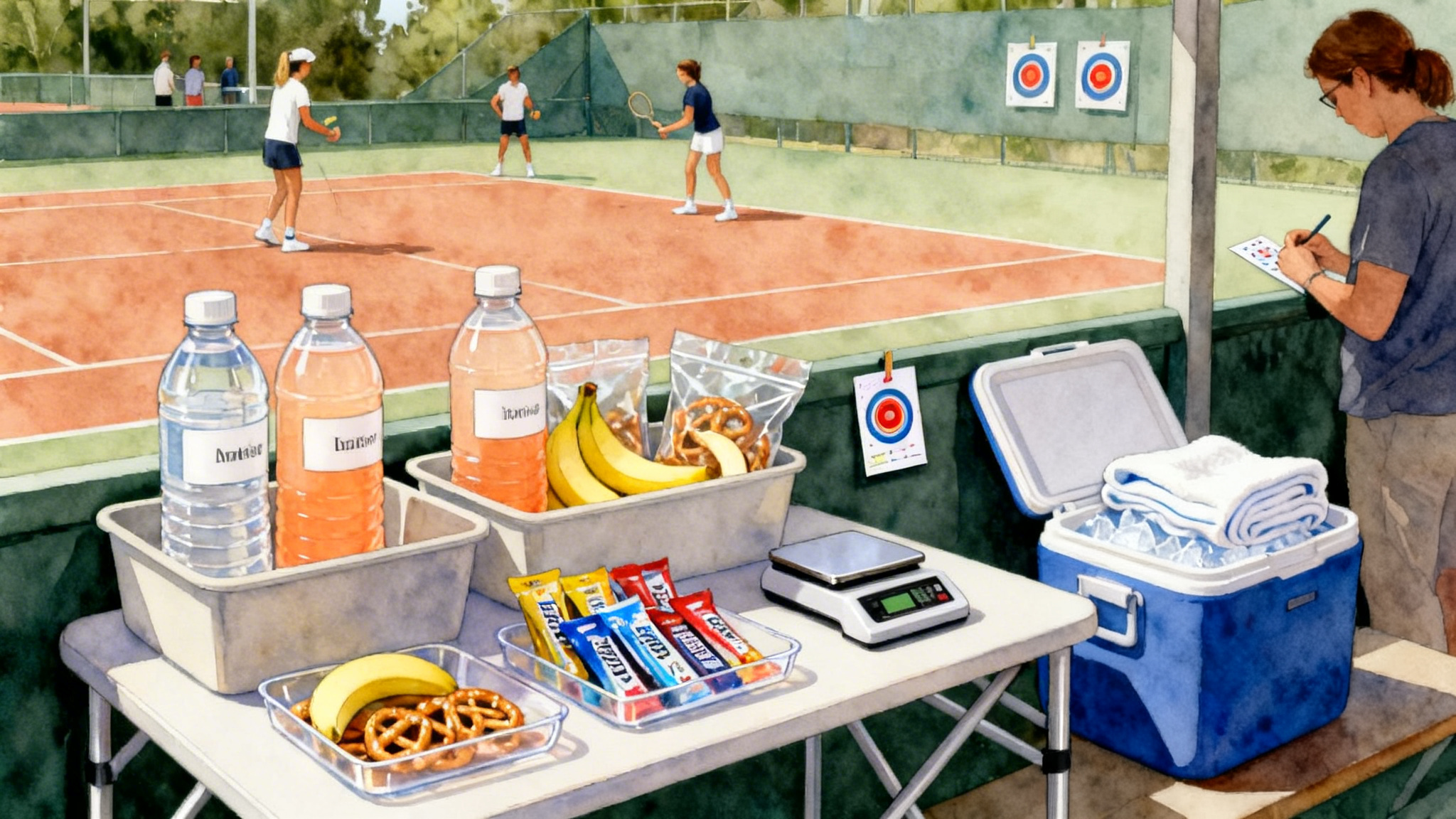
- Benchmark: In a practice set, reduce return errors on big points by 30 percent versus Week 3 baseline. Track with a tally sheet on the bench.
- Parent checklist: Remind the player of one default and one changeup, not five options.
Week 8: Pressure rehearsal and assessment
- Theme: Test, adjust, and anchor confidence.
- 15-minute daily:
- Twenty for twenty, 7 minutes: Two sequences of 10 returns. Sequence one is all first serves. Sequence two is all second serves. Goal is 8 of 10 neutral on firsts and 9 of 10 aggressive but safe on seconds.
- Serve-plus-one defense, 4 minutes: After your return, the coach feeds a ball to simulate the server’s plus-one. Your job is to send it deep crosscourt and reset.
- Breathing and routine, 4 minutes: Inhale through the nose for four counts as the server sets, exhale for four as the toss rises, eyes soft and wide, then split on contact.
- Benchmark: Full assessment with video. Mark three metrics: return in-play percentage, depth past the service line, and target accuracy by quadrant. Upload your notes to your profile after an in-app return assessment.
At-home reaction work that takes 15 minutes
You can build return qualities without a court.
- Ball drop race: A partner holds a ball at shoulder height. When they release, split and catch after one bounce. Start 8 feet away, progress to 10 feet.
- Wall number call: A parent flashes a number with fingers as they toss against a wall. You must call the number and volley the rebound to a chalk box.
- Light or sound cue: Use a phone app with random beeps. On the beep, split and step to touch a cone. Add a forehand or backhand shadow.
- Towel swings: Tie a small towel to a wooden spoon to reduce mass. Practice compact blocks while keeping the face stable through the imaginary ball.
- Reaction ladder: Three cones in a line. Parent calls left, right, or middle after the clap. Split on the clap and step to the called cone with the racquet set.
Keep these crisp. You are training the brain to start early and move without flinch, not to grind for an hour.
Parent-run courtside checklist
Between points, pick one cue from each row. Speak in simple, positive terms.
- Eyes: “Watch the toss hand.”
- Feet: “Bounce, then land on the hit.”
- Target: “Deep middle is on.”
- Commit: “First step forward.”
- Breathe: “In on the set, out on the toss.”
If a player misses two returns in a row, switch them to deep middle for the next three points. Reset the pattern before adding changeups again.
Adult self-coaching prompts
- When was my last on-time split? If you cannot remember, you are late.
- Was my miss long or into the net? Long means swingy. Net means late or contact too low.
- Did I hold a compact finish facing my target? If the racquet wrapped behind my head, I tried to hit too much.
Case study: Legend Tennis Academy
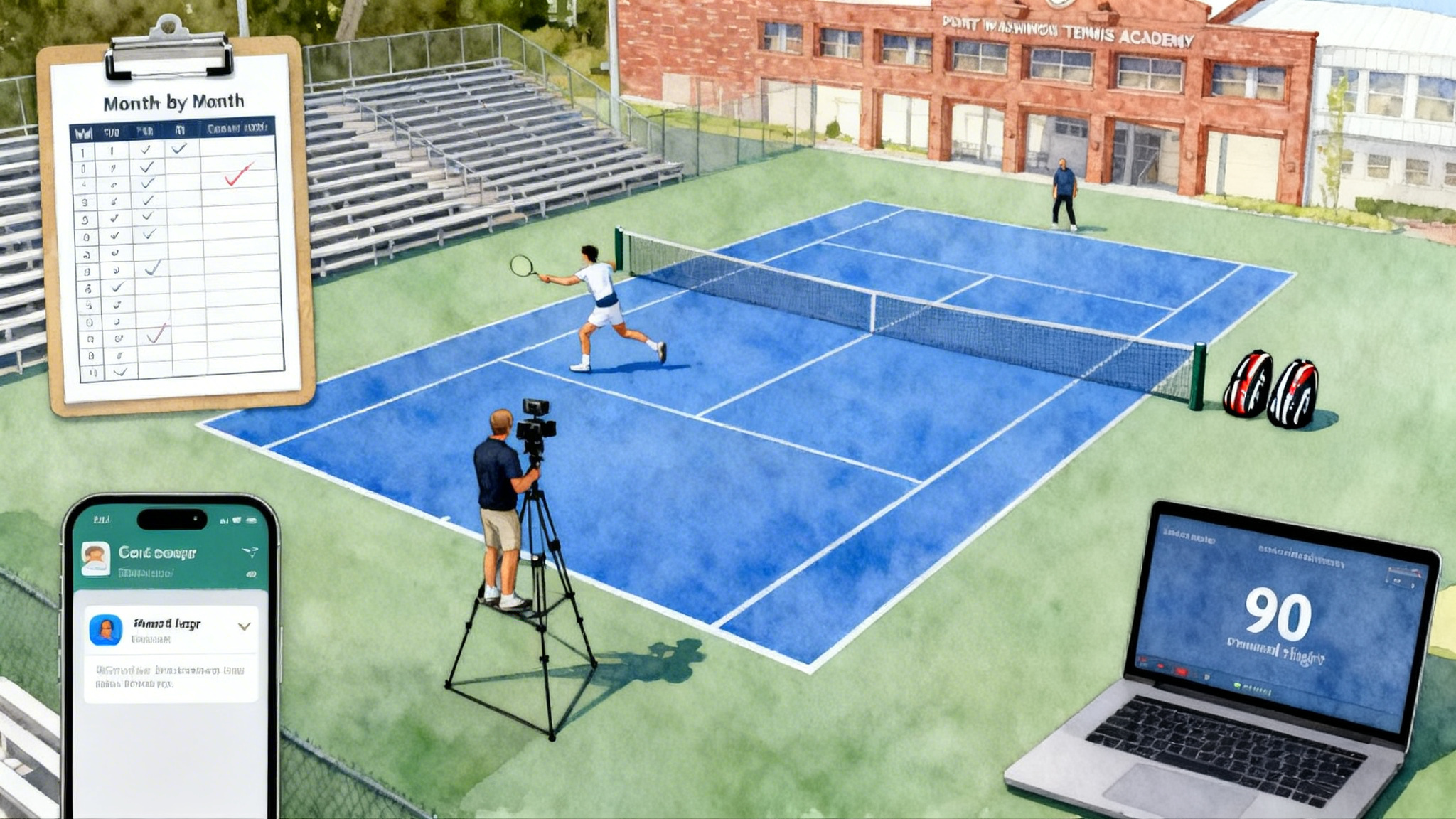
The Legend Tennis Academy profile ran this eight-week progression with three cohorts in January and February 2026: 12 juniors ages 11 to 15, 10 high school players, and 14 adults rated 3.0 to 4.0 on common club scales. Baseline testing used 40 live serves per player, filmed at 120 frames per second. The assessment captured three metrics: in-play percentage, depth past the service line, and target accuracy to deep middle.
- Week 0 baseline:
- Juniors: 54 percent in-play on first serves, 67 percent on second serves, 38 percent past the service line.
- High school: 61 percent first, 74 percent second, 42 percent depth.
- Adults: 58 percent first, 70 percent second, 36 percent depth.
- Week 8 results:
- Juniors: 72 percent first, 86 percent second, 57 percent depth. Target accuracy to deep middle improved from 41 percent to 63 percent.
- High school: 76 percent first, 89 percent second, 61 percent depth. Plus-one neutralization rate improved by 19 percent in match play.
- Adults: 73 percent first, 88 percent second, 55 percent depth. Reported perceived pressure decreased as pre-serve routine adherence increased.
Coaches noted that the fastest gains came from two habits: landing the split on contact and aiming deep middle far more often on first serves. The academy packaged these benchmarks into short on-court checks every two weeks so families could see objective progress without guessing. The same protocol powers the in-app report that follows our return of serve assessment.
Troubleshooting by miss pattern
- Net tape misses: You are late or your contact is too low. Solution: Take a half step back on first serves and raise your contact zone. Cue a higher finish.
- Wide into the alley: You started your step before reading. Solution: Pause your first step until you hear contact, then push with commitment in one direction.
- Long and flat: You are swinging instead of blocking. Solution: Shorten the backswing and aim higher over the net. Think “punch and hold.”
- Shank off the frame: Your eyes jumped from the ball to the target too soon. Solution: Keep your gaze on the back of the ball through contact, then transfer your eyes down the line of flight.
Building the return playbook
Default does not mean predictable. Think 3 to 1. For every three deep-middle returns that force a rally, add one changeup based on the server’s pattern: a jam to the hip, a deep crosscourt roller, or a slow ball through the middle to take time away. This ratio keeps your error rate in check while still asking new questions.
How to measure progress without guesswork
Use these simple session formats:
- The 20 by 20: Ten first serves and ten second serves. Track in-play, depth, and target. Aim for 8 of 10 in on firsts and 9 of 10 on seconds with at least half of each landing past the service line.
- The quadrant card: Divide the return half into four boxes. Spend one basket trying to hit only the deep-middle box. A second basket goes to deep crosscourt. Compare percentages. Your match default should mirror your practice strength.
- The tempo test: Play a set where you must say your target out loud before the toss. If you cannot decide by the toss, choose deep middle. This pressure test exposes indecision.
Equipment and environment tips
- Grip: Use your standard forehand or backhand grip. For pace absorption on first serves, keep a firm wrist and do not choke up past your normal hand placement.
- Strings and tension: If you struggle to keep returns in, ask a stringer to try two pounds higher tension. It slightly shrinks the trampoline effect and rewards compact blocks.
- Positioning: On faster courts, start a half step back for first serves and a half step in for seconds. On high-bouncing surfaces, slide an extra half step forward on second serves to meet the ball higher.
The fifteen-minute blueprint you can repeat all year
When time is tight, run this universal micro-session:
- Two minutes of bounce and breath, eyes on the toss hand.
- Four minutes of toss-read calls with a partner.
- Five minutes of live or fed returns to deep middle only.
- Four minutes of second-serve step-ins to crosscourt with height.
Log the session in your training journal with three numbers: in-play percentage, depth count, and target accuracy. Small numbers repeated often beat long sessions with no record.
Conclusion: Confidence comes from timing and choices, not hero shots
A great returner rarely looks spectacular. They look early, land on time, choose simple targets, and make the server hit one more tough ball. Over eight weeks you can build that skill at any age. Start with the eyes, anchor the split on contact, keep the swing compact, and own deep middle as your default. Use clear benchmarks and short sessions so progress is visible. Then bring your playbook to match day and let the server do the hard work. Neutralize the first blow, and you will own the rally that follows.