Naples Florida Har-Tru Season: Nov to Apr Tennis at Gomez
Southwest Florida’s cool, dry months are ideal for clay-court volume. Use this guide to anchor a week or multi-month block at Gomez Tennis Academy, dial in training times, and plug into match play, recovery, and lodging.
 Tommy
Tommy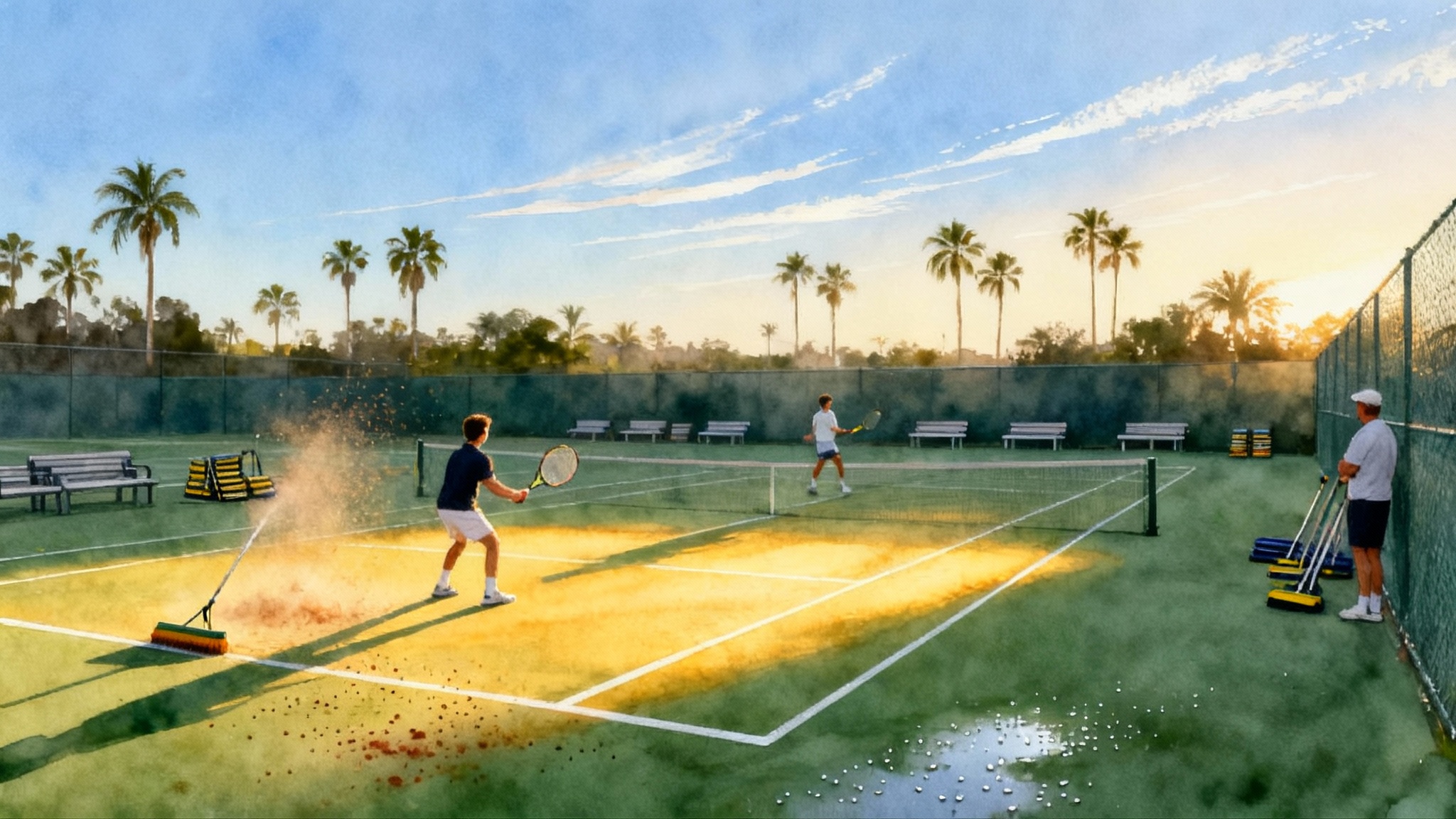
Why November to April is Naples clay season
From early November through April, Southwest Florida settles into a cooler, drier rhythm that rewards players who want to stack quality hours on clay. Mornings often sit in a comfortable range, humidity eases, and rain is less disruptive than in the summer wet season. For a quick weather primer, the National Weather Service outlines the region’s pattern in its South Florida dry season overview.
Har-Tru is the dominant surface in Naples, and that matters. Clay plays a touch slower, points last longer, and the surface encourages sliding and thoughtful point construction. For players building a base, this means you can increase training volume without taking the same pounding as on hard courts.
Why anchor at Gomez Tennis Academy
Gomez Tennis Academy in Naples focuses on high-repetition drilling and live ball on Har-Tru, a combination that fits the season perfectly. You get the joint-friendly volume of clay plus coaching that helps you manage load and progress. To plan sessions, start with the Gomez Tennis Academy profile for schedules and contact details.
What makes a November through April block at Gomez compelling:
- Surface specificity: Har-Tru rewards footwork economy and height over the net. A winter on clay often translates to more margin and shape when you return to hard courts.
- Morning density: Two to three quality morning hours most days across several months add up to real change in patterns and conditioning.
- Match ecosystem: Naples has deep league and social play in winter, so you can drill in the morning and compete later.
A one-week template to test the waters
Use this seven-day outline to sample the season and stress-test your routine before committing to a longer stay. Adjust durations to your fitness and current playing volume.
- Day 1, Monday: Arrival shake-out. Easy 60 to 90 minutes of movement patterns on Har-Tru. Prioritize footwork ladders, short-court, and height-based rally games. Early dinner and lights out.
- Day 2, Tuesday: Morning academy session focused on heavy crosscourt patterns, serves, and first ball. Afternoon 30 to 40 minutes of mobility and a 20-minute walk. Hydration target: one clear bottle per on-court hour.
- Day 3, Wednesday: Morning live ball and point construction. Afternoon optional doubles set. Evening recovery: 8 to 10 minutes of contrast water or a cool pool dip; calf raises and tibialis work.
- Day 4, Thursday: Technical morning with video review if available. Afternoon aerobic zone two for 25 to 30 minutes.
- Day 5, Friday: Match play rehearsal. Two fast sets in the morning with serve routines between points. Afternoon physio or massage if needed.
- Day 6, Saturday: Local league or social doubles. Keep rallies honest with height and depth instead of chasing speed.
- Day 7, Sunday: Rest, beach walk, and packing. Note what felt sustainable and where loading needs refinement.
Key principle: on clay, the temptation is to chase volume for volume’s sake. Cap the first week at four intense on-court days and one moderate day, with two lower-load days for tissue recovery.
Building a multi-month base from November through April
A multi-month block benefits from simple periodization. Think in six-week arcs with a lighter seventh week.
- Phase 1, Foundation (mid November to late December): Emphasize movement patterns, serve foundations, and rally tolerance. Three to four academy mornings per week, one strength session, one easy aerobic day, and one play day. Keep match play low-stress doubles or practice sets.
- Phase 2, Build (early January to mid February): Increase long rallies. Add one conditioned match session per week. Maintain two short strength sessions focused on posterior chain, single-leg stability, and shoulder external rotation.
- Phase 3, Sharpen (late February to late March): Preserve volume but add intensity controls. More serve plus one, more return plus one, and tiebreak sets that force decisions under mild fatigue.
- Phase 4, Consolidate (late March to April): Taper intensity modestly and play targeted matches. Protect freshness as daytime heat creeps up in April.
Simple weekly structure during the Build and Sharpen phases:
- Monday: Academy 2 hours, mobility 20 minutes
- Tuesday: Academy 90 minutes, strength 30 to 40 minutes
- Wednesday: Off or light skills, 45 minutes of hand feeds and serves
- Thursday: Academy 2 hours, aerobic 25 minutes
- Friday: Match rehearsal 90 to 120 minutes
- Saturday: League or social play
- Sunday: Off, soft tissue care
Progress marker: by late March you should manage 10 to 12 quality return games in a session with consistent height and depth, not just first-strike winners.
Optimizing session timing as heat returns in May
Naples starts to feel stickier in late April. Make three tactical shifts as you approach May:
- Start earlier. Book 7 a.m. to 9 a.m. court blocks. If breakfast timing is tight, use a small pre-court snack and plan a full meal afterward.
- Split sessions. Do 75 minutes at sunrise for high-cognitive drills, then return near sunset for 45 minutes of serves or situational points. Different sun angles and wind profiles are useful practice.
- Plan hydration and sodium. One bottle per on-court hour plus a small sodium supplement if you are a heavy sweater. Avoid chasing deficits; start hydrated.
Other practical tools:
- Use a white or light hat and a light long-sleeve for sun management.
- Keep two towels courtside. One stays dry for grip; one is for face and neck.
- Cool water on wrists between games can lower perceived exertion without disrupting play.
How to translate Har-Tru hours into skill gains
Clay punishes shortcuts, which is good for your tennis. Focus on these specifics:
- Height over the net: Aim two to three feet above the tape on rally balls. On Har-Tru, height is control.
- Neutral to open stances: Develop comfort sliding into a neutral or open base, then loading through the outside leg.
- Serve patterns: Practice serve plus crosscourt forehand first, then serve plus change. Record make rates and look for week-over-week repetition.
- Return depth: On slower bounce, a deep neutral return hurts more than a flat slap. Measure depth with cones two to three feet inside the baseline.
Plugging into USTA match play
The fastest way to add meaningful reps is to join local leagues and sanctioned events that spike your focus. Start by self-rating and searching active options via USTA Florida adult leagues. You can filter by level and region, then contact captains or directors. For singles specialists, flex leagues and weekend events pair well with a weekday academy schedule.
Practical steps:
- Self-rate honestly the first time. Under-rating slows growth because you will not see enough neutral-ball rallies.
- Ask staff for captain intel. Academy coaches know which captains communicate clearly and post lineups early.
- Use doubles for volume and singles for specific patterns. Doubles returns and first volleys carry well back to singles serve and transition decisions.
For a complementary U.S. spring base tied to the March swing, see our Indian Wells to Palm Springs training guide. For a year-round domestic option with covered courts, explore Austin Hill Country training at Legend.
Recovery that fits clay volume
Recovery should be boring and consistent. Keep it simple:
- Sleep: Aim for a regular lights-out and wake time, even on rest days. Short naps of 20 to 30 minutes work well.
- Feet and lower legs: Daily calf raises, tibialis raises, and foot doming. Ten minutes is enough if you do it every day.
- Contrast water: Short cool-water immersion or alternating warm and cool showers to calm soreness without spiking stress.
- Mobility: Hips, thoracic spine, and shoulders each get five minutes. Use a timer so you do not rush.
- Nutrition: About one gram of protein per pound of target body weight is a useful high-level target. Increase gradually if that is new for you.
Signal you are on track: heart rate and perceived exertion return to baseline within two games after a tough rally, and grip does not fade in the last 20 minutes of a session.
Lodging that supports training
Being close to the courts reduces friction and protects sleep. When you choose a base:
- Aim for a 20-minute radius to the academy. Less drive time makes early starts easier.
- Look for a washer and dryer, a quiet bedroom, blackout curtains or an eye mask, and a small kitchen. Cooking two meals per day keeps you steady.
- For multi-month stays, ask about minimum rental periods. Many Southwest Florida communities have monthly rules during peak season. Book early.
- Noise matters. A ground-floor condo near a pool can be busy. Higher floors or units set back from community centers are safer for sleep.
For families or working travelers:
- Seek reliable internet and a desk in a separate room so work calls do not invade recovery time.
- A community gym with basic free weights helps with short strength sessions between court days.
Travel logistics to start strong
- Airports: Southwest Florida International Airport in Fort Myers is the most convenient for Naples. Tampa, Fort Lauderdale, and Miami also work with longer drives.
- Rental cars: Book early in peak months. Choose a vehicle with a trunk that hides gear.
- Groceries: Plan a first-day stop for water, fruit, yogurt, eggs, oats, and simple sandwich ingredients. Keep breakfast quick to make early courts.
Gear checklist for Har-Tru
- Shoes: Clay-specific outsole if possible. Rotate two pairs so uppers dry fully between sessions.
- Racquets: Two or three matched frames. Clay lengthens points and strings notch faster.
- Strings: Fresh set every 10 to 15 hours of play for full polyester; hybrids may last longer.
- Grips: Extra overgrips and a rosin bag for humid days.
- Sun kit: Hat, sunglasses, and sunscreen you will actually reapply.
- Towels: Two per session. One lives in your bag, one courtside.
- Hydration: Reusable bottles with volume marks to track intake.
A simple daily flow that works
- 6:00 a.m.: Light breakfast and 10 minutes of ankle and hip prep.
- 6:45 a.m.: Arrive early, set cones for depth targets, check string tension feel.
- 7:00 to 8:30 a.m.: Academy drills or structured practice. Emphasize crosscourt rally tolerance, then serve plus one.
- 8:30 to 8:45 a.m.: Serve buckets and returns against a partner’s second serve.
- 9:00 a.m.: Smooth cooldown walk, light stretch, snack, and home.
- Noon: Short nap or quiet time, then a balanced lunch.
- 3:30 p.m.: Optional light doubles or a 25-minute aerobic flush if the morning was heavy.
- Evening: Mobility and planning for the next day. Early bedtime.
Common mistakes in Naples and how to avoid them
- Cramming late mornings: The sun climbs fast. Book the first court. If you must play later, shorten sessions and increase recovery.
- Hard-court habits on clay: Flatter balls die in the short court. Aim higher, shape crosscourt, and attack when you drag a ball short.
- Overloading match play: Two league matches plus three hard academy mornings can spiral into fatigue. Pick one match focus per week during a build phase.
- Ignoring grip and shoes: Wet overgrips and worn treads equal lazy footwork. Rotate both.
Putting it all together with Gomez
The most successful winter routines in Naples are simple. Anchor your mornings at Gomez Tennis Academy so the highest-value work is fixed on the calendar. Use early league or social play to keep decision-making sharp. Place recovery where it will not be skipped, usually right after lunch or just before dinner. Choose lodging that cuts your commute and supports sleep.
Your final checklist before booking:
- Confirm a start date in November or early December.
- Block out six to eight weeks if you want lasting changes in rally tolerance and serve patterns.
- Book early morning courts through April. Shift to sunrise and sunset slots as May approaches.
- Join at least one league or flex schedule for match reps.
- Build a repeatable daily flow and track it in a small notebook.
Conclusion: a base that travels with you
A winter on Har-Tru in Naples builds tennis that holds up anywhere. The surface teaches you to value height and depth, the season offers long morning windows, and the match ecosystem gives you honest feedback every week. Tie those pieces together by anchoring mornings at Gomez Tennis Academy, respecting the spring heat as it approaches, and living in a routine that protects sleep and recovery. When you pack up in April, you will leave with a stronger base, clearer patterns, and a game that travels as well as you do.