Trade-Wind Tennis: Aruba, Bonaire, Curaçao’s Jan to May Triangle
A climate-first guide to training January to May on the ABC islands. Learn how steady trade winds and low rainfall deliver reliable outdoor sessions, where to find hard and clay courts, wind-smart drills, and two sample 7-day plans.
 Tommy
Tommy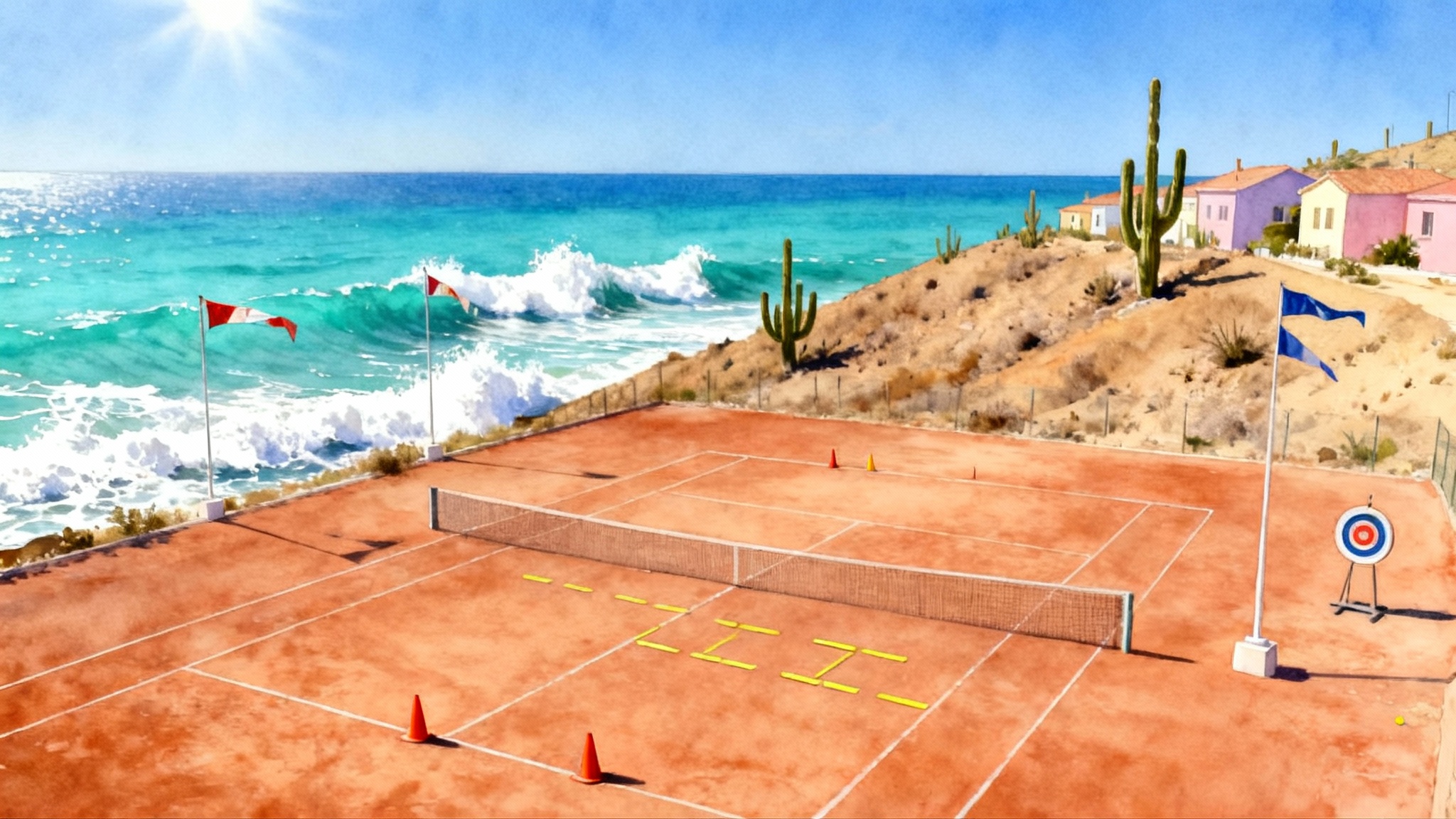
Why the ABC islands are a dry-season tennis triangle
Stand on a baseline in January on Aruba, and the first thing you feel is the breeze on your hitting arm. That easterly wind is not a quirk of the day. Aruba, Bonaire, and Curacao sit in a semi-arid belt where the dry season overlaps peak trade winds from roughly February through June, with January already trending dry. The combination means fewer rain-outs and more repetitions in real outdoor conditions. Aruba’s meteorological service classifies the island as tropical steppe with sustained easterlies and a dry season beginning in February, which matches what tennis travelers experience on court in late winter and spring. See the official notes on Aruba climate and winds.
Think of the trade winds as a giant ball machine set to breeze. They rarely stop, they are mostly steady, and they shape the way rallies play. For training, that is an asset. Players get thousands of reps in live wind without losing days to heavy rain. Courts dry quickly after passing showers. Strings and grips last longer than in tropical rain belts. On the ABC islands, reliability is not a lucky week; it is the baseline expectation from January through May.
What the wind gives you, and why January to May works
- Mechanism: The easterly trades blow across warm water and over low, arid terrain. With limited topography to wring out moisture, clouds often pass without downpours. Temperatures stay in the eighties Fahrenheit, but the wind moves heat off the skin, which helps you manage long sessions.
- January to May: The rainy season tapers off by January. The drier stretch aligns with the strongest, most consistent trades in late winter and spring. That blend yields predictable windows for two sessions per day and efficient match play blocks.
- Practical effect: When you plan a training camp, the biggest hidden cost is canceled court time. On the ABC islands, your schedule usually holds. That matters most when your goal is repetition and match-specific learning.
Where to play: hard versus clay on each island
Before booking, decide what surface supports your goal. Most island courts are hard. If you want clay footwork and shape, Curacao offers a reliable option.
Aruba
- Aruba Racquet Club, Noord: A multi-facility club with six well-maintained tennis courts, lights, and a full fitness setup. It runs local programs and rents courts to visitors. Expect hard courts and steady crosswinds that build serve discipline and first-ball tolerance. Call ahead for current surface details, court rental windows, and guest access.
- Resort courts: Several properties maintain on-site courts that are ideal for early-morning drilling. Surfaces are generally hard and play medium-fast in the wind. Confirm maintenance days and reservation rules when you book lodging.
Why pick Aruba for volume: The wind is consistent, the rain risk is low, and the island’s compact northwestern corridor makes it easy to stack court time, gym work, and recovery meals without long drives.
Bonaire
- Community courts and private-club access: Bonaire’s tennis scene is smaller and community-driven. The island regularly organizes activities through local associations and private courts in neighborhoods like Hato and Sabadeco. If tennis is your primary reason to visit, ask your hotel to connect you with local organizers for guest sessions or sparring. Most play is on hard courts.
- What Bonaire adds: Uncrowded courts and the best ocean-based recovery in the Caribbean. A post-session snorkel in calm water works like a gentle ice bath for legs and a reset for the nervous system.
Curacao
- Blue Bay Curacao, near Willemstad: If you want clay in the Caribbean, this is your anchor. The resort maintains two Canada Tenn clay courts and floodlit hard courts, which lets you schedule a morning clay block and an evening hard-court match without changing venues. See current details on the Blue Bay Curacao tennis facility.
- City clubs: Curacao hosts active local clubs in and around Willemstad, where you can find weekly match nights and tournaments. Surfaces skew hard. The wind is a touch gentler in some sheltered urban pockets, which is useful for progression work after a blustery day.
Tip for all three islands: Bring a small roll of painter’s tape and a marker to lay down temporary targets and service box goals. Clubs welcome visiting players who keep sessions tidy and purposeful.
Wind-smart drills that turn gusts into gains
Training with wind is not a compromise. It is a multiplier if you set constraints that match the breeze.
- Serve stabilization ladder
- Set four targets inside the deuce box, from T to sideline. Into-the-wind: reduce toss height by a palm’s width, aim higher over the net, and drive legs through contact. With-the-wind: add spin and aim lower over the tape. Score 1 point for any target hit and 2 points for a first-serve make that lands past the service line. Play to 15.
- Crosswind forehand lanes
- Place two strips of tape one racket length inside the upwind sideline. Feed crosscourt into a left-to-right wind. The goal is to start balls one foot inside the inside lane and let the wind bring them back toward the sideline. Emphasize shape over speed. Ten in a row earns a level up; advance the lane closer to the line.
- Two-bounce depth game
- Into-the-wind baseline rally where each player must land the ball past the service line and make it bounce twice before the fence. This magnifies height, spin, and body acceleration through contact. Alternate two minutes on, one minute off. Three rounds.
- Volley anchor drill
- Stand at the service line with a cone between your feet. Partner fires chest-high balls in a gusty crosswind. The rule is simple: volley through the middle third of the court while keeping the cone still. This builds a stable base, compact swing, and quiet eyes on contact.
- Slice versus topspin flight test
- Feed alternating low skids and high kickers from midcourt with the wind at your back. Measure how early you must set your strings to keep depth without sailing long. Track with ten-ball sets and note grip pressure on a scale of one to ten. Goal is consistent depth with grip pressure under six.
- Wind window returns
- Draw two tape windows on the deuce-court baseline: one centered, one one-step upwind. Returner must choose the window based on toss drift. This teaches a quick pre-return step upwind or downwind and commits the eyes to the ball rather than the server’s shoulder.
- Transition steals
- Coach feeds short balls into a crosswind. Player rule: approach up the middle unless the wind is pushing the ball away from the opponent’s backhand, then approach there. Finish with one volley. Score only if the approach lands inside a taped middle lane and the volley is directed away from the wind.
Match-play formats that teach the wind
-
Upwind breaker
Play first to seven upwind points. Winner stays upwind; challenger rotates in from the downwind baseline. Short, high-value points force you to learn the heavy ball and use margin. -
Crosswind singles alley bonus
Standard one-set match to six. Each time a player shapes a ball that lands in the crosswind alley and then curves back into the singles court, award a bonus point. This turns wind reading into a scoring advantage instead of a hazard. -
Serve-and-protect sets
Race to four games with no-ad scoring. Server must announce body, T, or wide before each first serve. The returner earns a bonus point for guessing correctly and making a neutralizing return. This accelerates serve pattern awareness when tosses drift.
Two sample 7-day training and recovery plans
These plans assume sunrise starts, a mid-day recovery window, and a lighter evening block. Adjust volumes for your level and the week’s wind strength.
Week on Aruba: reliable hard-court volume
- Day 1, Arrival and reset: Easy 60-minute hit at Aruba Racquet Club focusing on rhythm and height over the net. Late afternoon mobility and a 20-minute ocean float for legs.
- Day 2, Serve and first ball: Morning serve stabilization ladder, then 30 minutes of first-ball patterns crosswind. Evening doubles set with serve-and-protect rules.
- Day 3, Baseline shape day: Into-the-wind forehands and cross-court backhands using lane tape. Finish with two-bounce depth game. Afternoon gym pull session and soft-tissue work.
- Day 4, Speed and finishing: Mid-court transition steals in a gusty window. Short overhead clinic into the wind. Evening tiebreak set play; emphasize percentage second serves.
- Day 5, Endurance and patterns: Two 75-minute blocks. Morning singles points up the middle, short angles only when the wind helps. Evening crosswind singles alley bonus set.
- Day 6, Doubles systems: Poaching in the wind, body serve patterns, and middle-first rules. Finish with three 15-minute doubles sprints. Optional easy bike spin for recovery.
- Day 7, Competitive wrap: Match of the week, recorded on a smartphone from the back fence. Post-match, write three wind adaptations that produced free points and one you will keep at home.
Recovery habits in Aruba: Prioritize early starts to beat midday sun, drink to a plan rather than by thirst, and add a tablespoon of electrolyte mix to at least one liter of water per session. Use the sea as a daily cool-down and the gym for light posterior-chain work that balances wind-loaded shoulders.
Week on Curacao: split-surface learning
- Day 1, Clay footwork primer: Blue Bay clay, 90 minutes of split-step timing and cross-step recoveries. Short down-the-line finishers with higher net clearance.
- Day 2, Hard-court serves at dusk: Floodlit session for serve patterns when tosses drift. Score first-serve targets, then play a tiebreak set.
- Day 3, Clay rally heaviness: Build height and RPMs into the wind. Ten-ball sequences finishing with high-margin crosscourt. Afternoon stretch and a calm snorkel as a leg flush.
- Day 4, Hard-court transition: Approach on body-depth balls, then one volley to the bigger side. Add the crosswind singles alley bonus.
- Day 5, Clay situational points: Start every point with a short ball feed into the wind. The rule is depth before angle. Track unforced errors under the tape.
- Day 6, Mixed doubles: Use serve-and-protect and middle-first rules. Finish with downwind lobs over aggressive poachers to teach touch.
- Day 7, Combined-surface exam: Morning clay set, evening hard-court tiebreaks. Note which patterns transfer and which need different margins.
Recovery on Curacao: Clay mornings reduce joint load and build patience; hard-court nights sharpen pace acceptance. Keep evening meals lighter to sleep well in warm conditions. A short beach walk after dinner helps downshift.
Week on Bonaire: precision and calm volume
- Day 1, Orientation hit: Connect with local organizers for court access. Start with 60 minutes of rhythm rallies and footwork ladders.
- Day 2, Wind window returns: Build the upwind and downwind step-in decision. Afternoon snorkeling for cooling and diaphragmatic breathing.
- Day 3, Serve plus one: Short, repeatable patterns that start with a body serve. Track first-ball depth with tape targets.
- Day 4, Point-building: Crosswind lane forehands and middle-first backhands. Finish with a 20-minute volley anchor drill.
- Day 5, Match play: Two short singles sets. Emphasize shape over pace when the wind gusts.
- Day 6, Doubles local night: Join community play for reads and reflexes in live conditions.
- Day 7, Reflection and recovery: Light hit, then ocean soak. Write down three wind cues you now see sooner than on Day 1.
When the ABC triangle beats Florida or Spain for dependable reps
-
Weather volatility: In January and February, Florida can deliver great tennis days, but cold fronts bring abrupt shifts in temperature, gusty north winds, and showers that can wipe out a morning block. By May, Florida’s humidity and afternoon thunderstorms often shorten sessions. In Spain, classic destinations like Barcelona and Mallorca are cooler and wetter in January through March, and daylight can be short for evening work. The ABC islands, by contrast, stay warm with limited rain across January to May, and the wind is a known quantity rather than a surprise. For a stateside option in similar months, compare with Naples to Sarasota winter tennis. For spring clay planning in Europe, see French Riviera spring clay prep.
-
Travel friction: From the East Coast of the United States, direct flights to Aruba and Curacao are common in winter and spring, with short connections elsewhere. Time zone shifts are small, which preserves circadian rhythm. Equipment rules are straightforward, and clubs are used to visiting players asking for morning blocks and match evenings. If you like wind-savvy microclimates, the Canary Islands are another benchmark in our Tenerife winter tennis guide.
-
Training value: If your goal is dependable outdoor volume with real-world wind, the ABC triangle gives you more bankable hours and more specific adaptations per hour. That is the simplest, most practical metric of a productive camp.
Practical packing and setup checklist
- Two string setups: One half set two pounds tighter for downwind days, one standard for into-the-wind control.
- Extra overgrips and a rosin bag: Dry hands make better contact when gusts hit.
- Low, consistent toss routine: Practice a compact toss with a count or keyword. Record it on video on Day 1 and Day 7 to check drift.
- Targets and tape: Painter’s tape, four cones, and a Sharpie. Targets make windy sessions measurable.
- Hydration plan: A liter per hour of court time is a good starting point in warm wind. Add electrolytes at least once daily.
- Sun protocol: Early starts, light long-sleeve training top, and reapply sunscreen every 90 minutes. The wind can hide how much sun you are getting.
Booking smarter with a partner network
Wind is a teacher, but a good sparring partner accelerates the lesson. Post your dates, level, target volume, and preferred surfaces in our community to match with hitters and coaches who already use wind-specific progressions.
The takeaway
January through May on Aruba, Bonaire, and Curacao offers something rare in outdoor tennis: consistency with purpose. The climate delivers more keepable sessions and a steady wind that hardens skills many players only meet in tournaments. Choose your island and surface, bring simple tools, and run formats that turn gusts into free points. Then carry those habits home. The next time a match day blows up, you will already have the answers on your strings.