Orlando Spring 2026 Tennis Guide: Revolution Academy and USTA
Build a tennis-first Spring Break in Orlando with morning high-performance at Revolution Tennis Academy in Maitland and afternoon match play at the USTA National Campus. Smart weather timing, surface choices, booking windows, and family downtime inside.
 Tommy
Tommy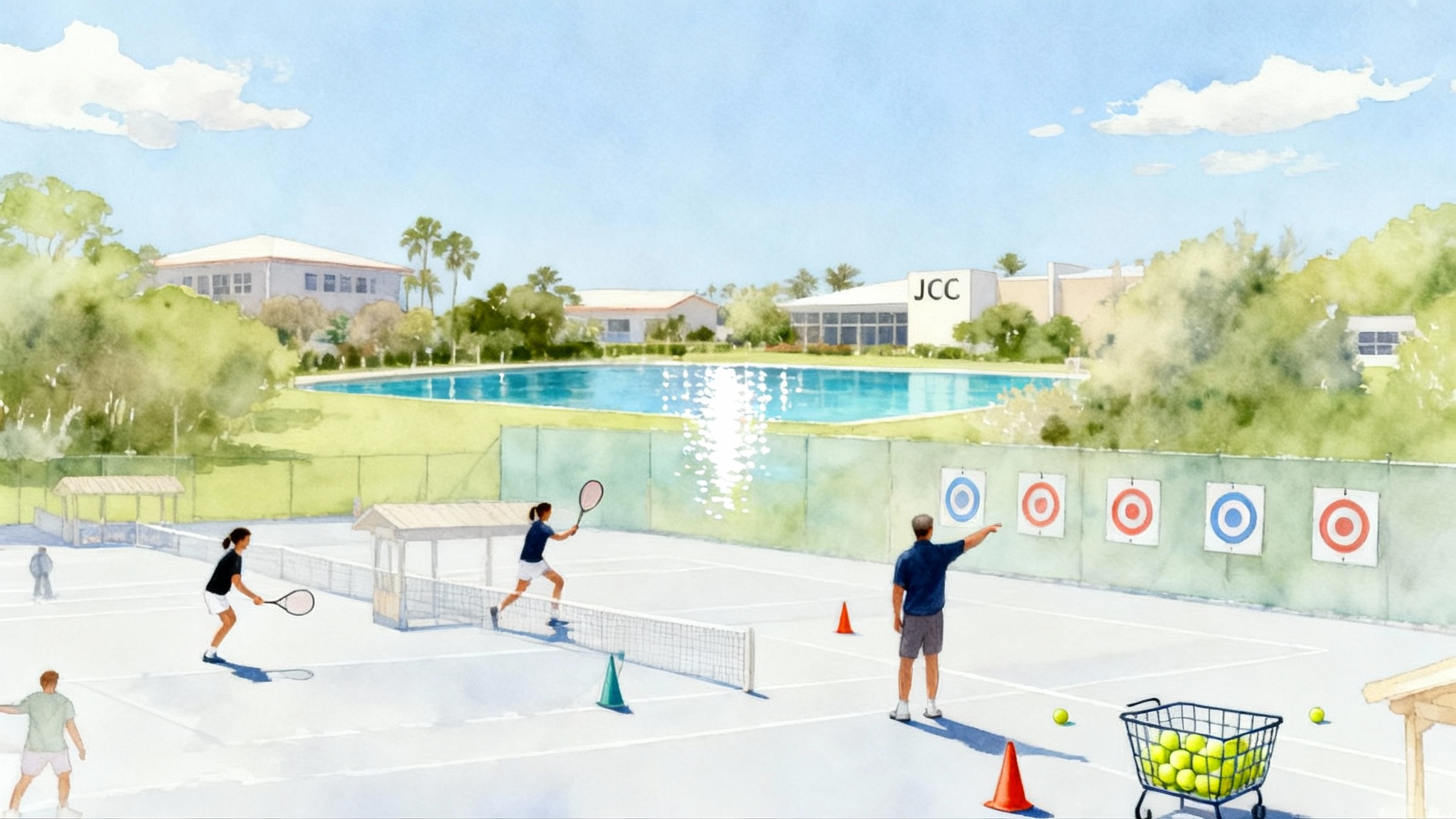
The plan at a glance
This guide builds a tennis-first Spring Break in Orlando for March and April 2026. Your mornings are high-performance drilling at Revolution Tennis Academy in Maitland. Your afternoons are match play at the United States Tennis Association National Campus in Lake Nona. Between sessions you hydrate, recover, and let the family enjoy Orlando without derailing your training rhythm. The choices below show what to book, when to play, and how to keep progress intact while traveling.
Why March and April favor serious training
- Temperatures are cooperative. Typical highs sit in the upper seventies in March and low eighties in April, with comfortable mornings and warm afternoons. Humidity begins to rise as April progresses, which rewards early starts.
- Daylight works in your favor. Daylight saving time begins on Sunday, March 8, 2026 in the United States, which shifts sunrise later and gives you cooler first balls. Plan morning courts in the 8:00 to 11:00 window and save matches for mid to late afternoon.
- Storm timing is predictable. While the classic summer pattern of daily thunderstorms is not yet in full force, brief showers can still pop up. Book your competition window earlier than sunset so you can adjust if a shower passes.
The implication for players is simple. Schedule technical work when the air is cooler and your focus is sharp. Use warmer, brighter hours for the grit of sets and tiebreakers. Save the late evening for mobility, nutrition, and sleep.
Your training base: Revolution Tennis Academy in Maitland
Revolution Tennis Academy operates at The Roth Family Jewish Community Center in Maitland, a short hop north of downtown Orlando. The facility includes five lighted outdoor courts, a heated pool, a cross-training field, a weight room, and space for yoga or Pilates, which is a strong mix for a travel week focused on improvement. Confirm details on the official page for the Revolution Tennis Academy in Maitland, and skim our in-house Revolution Tennis Academy profile for coaching focus and practical tips.
What the morning block looks like
- 8:00 to 8:20: Dynamic warmup and movement prep on the field. Include carioca, A-skips, lateral bounds, and three 20 yard acceleration runs.
- 8:20 to 9:20: Fundamentals under fatigue. Ball baskets with clear, measurable targets: 30 crosscourt forehands landing beyond the service line; 25 backhand line drives to a three by three foot cone; 20 serves to deuce T with a toss discipline cue.
- 9:20 to 10:10: Pattern building. For example, forehand plus backhand line, then recover with a split step at the center mark. Rotate in two-minute intervals to keep heart rate high without sloppiness.
- 10:10 to 10:30: Serve plus one and return plus one. Track first serve percentage and first ball depth. Stop when quality drops, not when the clock runs out.
- 10:30 to 11:00: Mobility and breath work. Ten minute reset in the shade, five minutes of hip CARs and thoracic rotations, then cool down in the pool if available.
Coaching approach to request
- Ask for a diagnosis session on day one with one priority per stroke. Over a travel week you have four to five mornings to engrain one or two changes, not seven. Pick the highest leverage mechanics and repeat them daily.
- Tell your coach you will compete at the United States Tennis Association campus in the afternoon. They will pace morning intensity to keep your legs fresh for sets.
Practical booking steps
- Contact the academy four to six weeks ahead for March and April weeks. Ask for a morning high-performance block and one or two private sessions to target a key technical change. If you are traveling with a partner or junior player, request semi-privates to lower cost and add live ball volume.
- Share your planned afternoon match schedule at the time of booking. The staff can adjust drill selection to complement your match play rather than duplicate it.
Afternoon match play at the United States Tennis Association National Campus
Lake Nona’s public tennis campus is purpose built for volume. It offers multiple court neighborhoods, including hard and green clay, with a family zone for younger players. Hours and public reservation rules are clearly posted, including online booking 48 hours in advance. Review the current details and surface layout on the campus page for visit information and 48 hour reservations.
How to use the campus well
- Book match play blocks two days ahead at the moment new times appear. If you want a 2:30 p.m. slot on Wednesday, log in by 2:25 p.m. on Monday. Set alarms for each day of your trip.
- Size your group for two adjacent courts. Two doubles courts or two singles courts give you sparring options without reshuffling reservations.
- Pick a surface with a purpose. If your goal is depth and decision making, schedule a green clay day for longer points. If you are preparing for a hard court tournament, keep three of five days on hard.
- Use the on-site amenities. Fill bottles, buy extra grips, and if the sun is high, cool down in shaded pavilions after sets. Ten minutes of shade between sets can salvage the quality of the next hour.
Surface choices and why they matter
Hard court days
- Goal: first strike and court positioning. On hard courts the ball stays true and points compress. Emphasize serve plus one patterns, deep returns to the body, and inside-out forehand pressure.
- How to structure: two sets to six with a ten-point tiebreak play-off. Keep rest to ninety seconds on changeovers to mimic tournament tempo.
Green clay days
- Goal: lengthen rallies while sharpening defense and neutral patterns. The slightly higher bounce and slower court speed amplify margin discipline.
- How to structure: one pro set to eight games, then two first-to-four short sets starting at 30 all to reset pressure with every point.
Red clay or indoor hard when available
- Red clay rewards height and spin. If you find red clay on the campus schedule, use it to train heavy crosscourt forehands and drop shot disguises.
- Indoor hard removes wind from the equation. Use it for serve accuracy tests and return short hops that are usually masked by breeze outdoors.
Booking windows and how to lock the week
- United States Tennis Association National Campus: reserve courts online 48 hours in advance. Mark your calendar so every afternoon of your trip appears in your account two days before.
- Revolution Tennis Academy: treat the academy like your anchor. Secure coaching blocks four to six weeks out. Ask for a written session plan that maps to your match afternoons.
- Theme parks and attractions: if you plan to visit, choose evenings after a shorter tennis day. Book timed entries that begin after 5:30 p.m. to protect recovery.
If a preferred slot is gone, search for nearby public courts in Winter Park, Baldwin Park, and Maitland community parks. Slot a lighter hit, not a full match, on backup courts to keep the day’s training quality high without overreaching.
A seven day training forward itinerary
Day 1, Sunday
- Arrival, light hit at 5:00 p.m. on hard court for forty minutes. No scoring. Focus on feel and depth.
- Dinner within walking distance of your lodging. Hydrate and set two alarms for the next morning.
Day 2, Monday
- 8:00 to 11:00 a.m.: Revolution Tennis Academy high-performance morning.
- 2:30 to 4:30 p.m.: United States Tennis Association campus match play on hard. Two sets and a ten-point breaker.
- Evening: gentle family activity near water, such as Lake Eola or a neighborhood splash pad, plus ten minutes of calf and hip mobility before bed.
Day 3, Tuesday
- 8:00 to 10:30 a.m.: Pattern building and serve plus one at the academy.
- 3:00 to 4:30 p.m.: Green clay match play. One pro set to eight games.
- Evening: recovery dinner and lights out by 10:00 p.m. Avoid late park nights on training doubles.
Day 4, Wednesday
- 8:00 to 9:30 a.m.: Private lesson targeting one technical change identified Monday. Video two before and after reps.
- 2:30 to 4:00 p.m.: Hard court point play. King of the court with two up, two back rotation to increase ball touches.
- Evening: choose a family feature that requires more walking only if legs feel fresh. If not, opt for a movie night and foam rolling.
Day 5, Thursday
- 8:00 to 10:30 a.m.: Academy session with return plus one emphasis and approach volley work.
- 3:00 to 4:30 p.m.: Green clay match play with tiebreak starts at 3 all to train pressure.
- Evening: short theme park session or Winter Park stroll and gelato. Off your feet by 9:30 p.m.
Day 6, Friday
- 8:00 to 10:00 a.m.: Sharpeners only. Forty serve targets, forty second serve kick placements, twenty return deep middle drills.
- 2:30 to 4:30 p.m.: Test match. Two out of three sets. Track first serve percentage and unforced errors.
- Evening: celebratory dinner. Sleep.
Day 7, Saturday
- 8:30 to 9:30 a.m.: Recovery hit or pool-based movement. No open chain jumping or heavy lifts.
- Midday: family choice. Use sunscreen and shade breaks.
- Evening: pack with care so racquets and shoes travel safely.
Family friendly downtime that fits training
- Morning spectatorship: family can watch the first forty minutes of your academy session, then move to the pool or café on site.
- Half day attractions: Orlando Science Center in Loch Haven Park, Leu Gardens, Gatorland, Winter Park boat tour, or the Lake Nona Sculpture Garden. Each delivers a sense of place without the twelve hour theme park marathon.
- Theme parks, trimmed: choose evenings with Genie style line planning or single rider lines. Cap yourself at three headline rides and one show, then leave.
Recovery rules to keep everyone happy
- Build a thirty minute quiet block after every match for a snack, rehydration, and a shower. Family can plan their next stop during this window.
- Wear UV protective layers and a brimmed hat. Reapply sunscreen every two hours.
- Hydration target: one half ounce of water per pound of body weight per day, plus electrolytes during matches.
Where to stay and how to drive it
You will commute between Maitland and Lake Nona. The drive is about thirty five to fifty minutes depending on traffic. Pick lodging based on your priorities.
- Priority on training: stay in Maitland or Winter Park so your morning commute is ten minutes. Drive to Lake Nona after lunch when roads are steadier.
- Priority on afternoon matches: stay near Lake Nona’s Medical City area so you can arrive early for warmup and avoid afternoon backups.
- Split the difference: a midtown stay near Baldwin Park or Mills 50 keeps drives tolerable both ways.
Driving strategy
- Use State Road 417 to bypass Interstate 4 congestion when going south. Build fifteen minutes of buffer into every cross-town move.
- Park close to your afternoon court and cool down in the shade before you sit in the car. Cooling first prevents back tightness.
Packing and recovery checklist
- Racquets: bring three if you have them, two minimum. Fresh strings at a higher tension if you expect warm, lively afternoons.
- Shoes: one hard court pair and one clay pair if you will play green clay; otherwise two hard court pairs. Rotate daily to let midsoles rebound.
- Grips, dampeners, and overgrip roll: heat and sweat will chew through supplies faster than at home.
- Sun and heat kit: SPF 30 or higher, zinc for the nose, brimmed hat, breathable long sleeve, and a cooling towel for changeovers.
- Hydration and fuel: electrolyte packets, soft flask, easy carbs like rice bars and bananas. Keep saltier snacks for the drive back.
- Recovery tools: mini band, lacrosse ball, and a compact roller. Ten minutes nightly makes the next morning’s footwork crisp.
- Documentation: written focus for the week. One sentence per stroke. Read it before every session so you do not drift.
Keep your progress when you get home
- Export two practice patterns and two match routines from the week into your home plan. For example, keep Monday’s serve plus one ladder and Thursday’s return deep middle drill. Log them into your weekly planner and repeat them for three weeks to lock changes.
- Ask your Revolution Tennis Academy coach for a two minute video summary of your key adjustment. Save it to your phone. Watch it before local matches the next month.
- Schedule a local match on a similar surface within three days of returning. Familiarity fades fast; repetition keeps your new cues alive. For a Florida follow-up later in the season, see our Naples winter tennis guide. For a broader southeast option, skim the Greater Atlanta tennis hub.
Troubleshooting common travel snags
- Courts sold out at the campus: reserve a shorter slot, such as 60 minutes, then use a second 60 minute slot later in the afternoon. The split still yields match quality.
- Afternoon heat feels heavy: shorten points with serve plus one schemes on hard, or move to green clay and commit to high net clearance and deep middle. Do not play lazy defense on hard in heat; it teaches bad footwork.
- Family fatigue: swap Friday’s test match window with a pool hour. Add a Saturday morning hit to compensate. Recovery is training.
Booking, in two moves
- Lock your morning anchor with the academy. Confirm dates and share your single technical priority.
- Reserve your afternoon match play 48 hours in advance at the campus. Set repeating phone reminders so nothing slips.
Final word
Most tennis trips become vacations with a few hits sprinkled in. This one flips the script. Start with purpose in the morning at a facility built for development, then compete in the afternoon at a complex designed for volume. Use Orlando’s spring conditions to your advantage, protect your recovery, and give the family a good time without bloating the schedule. When you fly home, you will not only have souvenirs. You will have a sharper forehand, a tested return plan, and proof that travel and progress can live together in the same week.