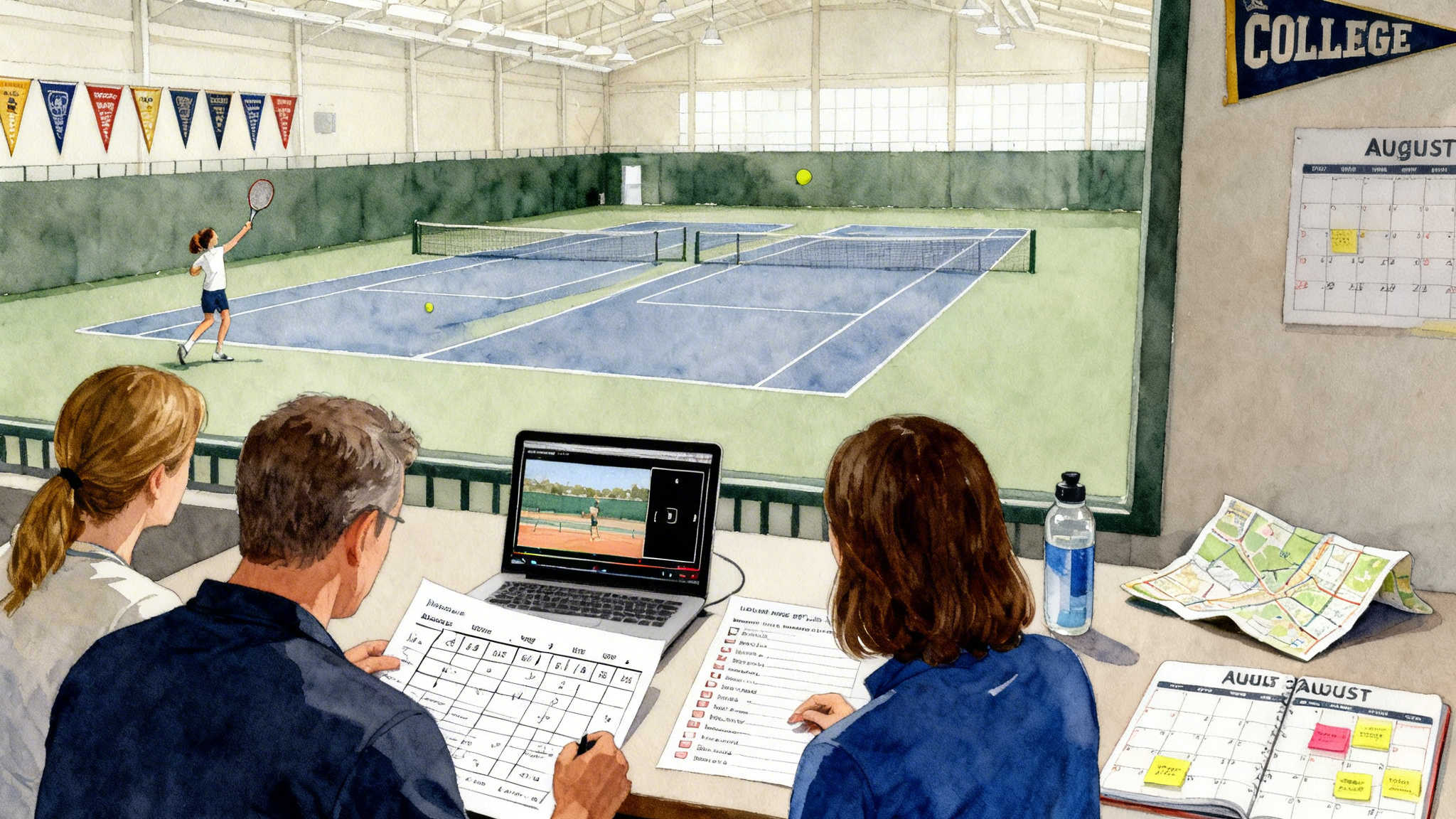
UTR and WTN 2026: A Parent and Player Roadmap to Rise
A clear, step by step guide to grow UTR and WTN in 2026 the right way. Build weekly microcycles, choose rating friendly matches, hit skill and fitness benchmarks, and use progress trackers without falling into ratings chasing.
 Tommy
Tommy
Why ratings matter in 2026, and what they actually measure
If you or your junior has goals that point toward college tennis or simply better weekend matchups, ratings do matter. They help tournament directors seed draws, guide college coaches in recruiting, and give players a common language for level. But ratings are not trophies. They are models that estimate your current playing strength from the evidence you create in verified matches.
Two models dominate the global picture in 2026: Universal Tennis Rating and the International Tennis Federation World Tennis Number. For a plain language starting point, read the official UTR rating explained by Universal Tennis. Then compare it to the ITF World Tennis Number overview. Those pages show the levers you can actually control: opponent quality, score lines, and volume of recent, verified play.
How UTR and WTN move: the levers you control
Both systems reward competitive matches against quality opponents and care most about what you are doing lately. Here are the shared themes that matter in practice:
- Opponent strength: Results against higher rated players carry more information. Close scores against slightly stronger opponents help more than blowouts against much weaker ones.
- Game spread and competitiveness: A 7-6, 7-5 loss can be more valuable than a 6-0, 6-0 win over a weaker player. Ratings watch the games you win, not only the match outcome.
- Recency and reliability: More recent, verified results weigh more. A thin history makes the model uncertain and can swing more after each match.
- Volume with intent: Not endless volume. A steady stream of two to four verified matches per week is usually enough to show growth without creating fatigue.
The key implication: train to play better tennis against the right level of opponent, at the right cadence, and your rating follows.
The anti ratings chase plan
Chasing points or avoiding tough matches backfires because you mis-train the skills that actually win under pressure. Instead, build your plan around three pillars: training microcycles, smart event selection, and measurable skill blocks.
- Establish a baseline
- Write down your current UTR and WTN for singles. Note date and source. Add your last ten scores with opponent ratings.
- Capture two performance markers: average first serve percentage and average unforced errors per set from your last three matches.
- Build a weekly microcycle you can repeat
- The goal is two to three high quality practices, one to two targeted fitness blocks, one tactical rehearsal, and one to two verified matches.
- Keep one true recovery day. Tennis development is an adaptation race, not a grind contest.
- Schedule events that guarantee matches
- Choose formats with back draws or round robins, so a bad first round does not wreck your week. Verified league play with multiple lines is also ideal.
- Choose opponents by probability, not by ego
- Target matchups where your win probability sits between 30 and 70 percent. That range drives learning and rating stability at the same time.
- Track what you can control
- Serve accuracy to three targets, plus one patterns off first ball, and rally tolerance on defined patterns. Count them in practice and then watch them show up in matches.
- Review every two weeks
- Adjust opponent selection and practice focus based on what actually changed in your scores and benchmarks.
The weekly microcycle template
Use this structure as a base. Adjust days to your reality.
- Day 1 Technical: serve and return block, 75 minutes. Serve 60 first serves and 40 second serves to three targets each side. Track first serve percentage and double faults. Return 40 first serves and 40 second serves with depth targets. For extra structure, use the 6-week serve plan.
- Day 2 Tactical: pattern play, 90 minutes. Two patterns only: serve plus one to open deuce lane, and backhand cross build then forehand inside in. Finish with 20 minutes of tie break rehearsals.
- Day 3 Fitness: speed and repeat sprint, 45 minutes. Eight by 20 meter sprints with 30 seconds rest, then six court shuttles from doubles alley to doubles alley touching lines. Stop when form breaks.
- Day 4 Match play: one verified singles match or a two hour ladder session that will be recorded.
- Day 5 Technical: transition and net, 75 minutes. Approach off short ball patterns, then 30 minutes of first volley plus overhead.
- Day 6 Fitness and recovery: 30 minutes strength circuit, 25 minutes mobility. Finish with ten minutes nasal breathing walk.
- Day 7 Off: real rest or light mobility.
Add film once a week for 20 minutes. Clip three points that show good decisions and three points that show a pattern you want to change.
Sample 8 week plan for juniors ages 13 to 17
Assumptions: school schedule, two to three practice windows weekly, one parent available on weekends, current UTR between 3 and 8, WTN between 35 and 20.
Week 1 Baseline and build
- Two practices, one fitness block, one verified ladder match.
- Benchmarks: first serve 55 percent, 12 ball backhand cross rally tolerance by week end.
Week 2 First event in a learning format
- Enter a round robin or compass draw. Target two to three matches. Opponents within minus 0.5 to plus 0.75 of your UTR; WTN two to four numbers lower is a healthy stretch if accessible.
- Tactical focus: serve plus one. Avoid new tactics during event days.
Week 3 Consolidate and adjust
- Review match film. Add 15 minutes return depth drills twice.
- One verified match night, one technical session, one fitness session.
Week 4 Second event with clear goals
- Goal one: 60 percent first serves in. Goal two: hold serve three times per set on average. Goal three: no more than two double faults per set.
- Select draw where you are not the top seed. Seek at least two matches.
Week 5 Raise fitness floor
- Two practices and two short fitness blocks. Add eight minute repeated shuttle test: down and back service line to baseline pattern, count reps.
- One match night against close peers.
Week 6 Stretch opponents and add pressure rehearsal
- Two practice windows plus one verified match. Seek at least one opponent 0.3 to 0.8 UTR higher.
- Tie break ladder: first to seven, losers rotate, no coaching. Goal is six tie breaks in 40 minutes.
Week 7 Third event with a back draw
- Use a format that guarantees play if day one goes poorly. Keep goals to process: first serve percentage and return depth beyond service line on 50 percent of returns.
Week 8 Review, recover, plan next block
- One light match, two short technique touch ups, mobility focus. Compare ratings from Week 1 and Week 8, then schedule the next eight weeks without changing what is working.
What improvement to expect: if you hit the volume, the right opponent window, and the serve plus one metrics, juniors often see a 0.3 to 0.8 bump in UTR across eight to twelve weeks, with WTN moving two to five numbers. Your exact change depends on your starting reliability and the quality of opponents.
Sample 8 week plan for busy adults
Assumptions: three sessions per week tops, one weekend window every other week, current UTR between 4 and 9, WTN between 30 and 18.
Week 1 Setup
- One 90 minute hit with serve plus one focus, one 45 minute fitness block, one verified ladder match.
- Benchmark: 20 second serve targets to backhand corner, record makes.
Week 2 Event lite
- Join a local verified league or a one day round robin. Two matches in one day is fine if you manage recovery.
Week 3 Skills with intent
- Two focused hits and one mobility day. Add 15 minutes return plus first ball neutral each session.
Week 4 Measured stress
- One verified match against someone up to 0.7 UTR higher. Keep the score close with high percentage patterns. Hide your second serve by mixing kick and body.
Week 5 Consolidate
- Two sessions: volley and transition, and serve location. One match play night.
Week 6 Tournament weekend
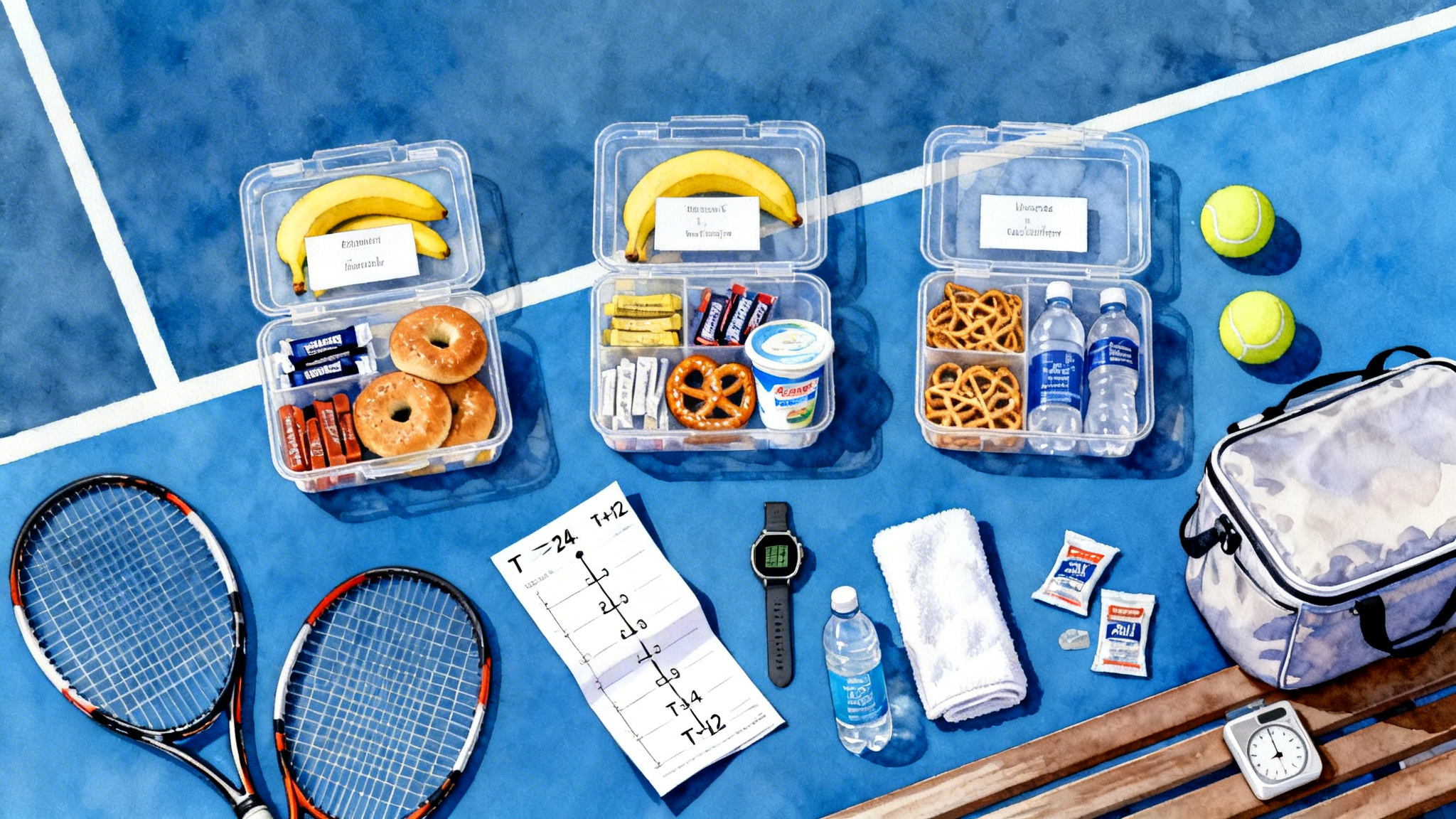
- Choose a draw with two matches guaranteed. Keep hydration and between match nutrition simple and repeatable. For return frameworks, study our return system for 2026.
Week 7 Recovery and tune
- One light hit, one mobility session, one short match.
Week 8 Review and reset
- Log your UTR and WTN change since Week 1, plus three most common point patterns you win. Plan the next block.
Adults who target the right window and protect recovery commonly move 0.2 to 0.5 UTR and two to three WTN numbers in eight to ten weeks.
Opponent selection heuristics that protect growth
Use these rules of thumb to pick matches that teach and still help your rating profile.
- The 70-30 rule: If you expect to win more than 70 percent of the time, the match is probably too soft. If you expect to lose more than 70 percent of the time, it risks a confidence drain and does not showcase your real level.
- UTR window: aim for opponents within minus 0.75 to plus 0.75 of your rating most weeks. Sprinkle one opponent up to plus 1.0 every other week to stretch.
- WTN window: since WTN counts down from 40 toward 1, a lower number means stronger. Seek opponents two to four numbers lower for a stretch, and within one to two numbers either side for stability.
- Verified first: choose formats that send results to rating providers. Friendly hits are great, but verified matches move the number.
- Scoreline matters: if you step up to a higher rated player, aim to keep game scores tight. Compete for every return game. That keeps the signal strong.
Skill and fitness benchmarks that actually move ratings
Instead of vague goals like play more aggressive, anchor your next eight weeks to benchmarks that show up in ratings friendly scorelines.
Serve and first ball
- First serve percentage: 60 to 65 percent for juniors, 65 to 70 percent for adults. Track by set, not only by match.
- Second serve double faults: two or fewer per set. Use a second serve routine with a clear target and the same bounce pattern.
- Plus one conversion: when you land a first serve, you should win at least 65 percent of those points by Week 8. Track with a simple tally. For a structured build, use the 6-week serve plan.
Return and neutral
- Return depth: 50 percent of returns land beyond the service line against peers. Against stronger servers, accept 40 percent in Week 1 and target 50 percent by Week 8. For patterns and drills, see our return system for 2026.
- Rally tolerance: 12 ball backhand cross, 16 ball forehand cross in practice. Then measure in matches by counting points where you reach ball six or more.
Transition and finishing
- Approach discipline: only come in from inside the baseline with depth or height. Target 60 percent success on first volley plus next ball in practice.
- Overhead reliability: 18 out of 20 overheads made from the mid court in practice before you add complex lobs.
Fitness anchors
- Repeat sprint ability: eight by 20 meters with 30 seconds rest, all reps within 5 percent of best time.
- Court shuttles: six down and backs from doubles alley to doubles alley in two minutes, rest two minutes, repeat three sets.
- Mobility: pain free deep squat for 30 seconds and a 45 second single leg balance each side with eyes open.
Progress trackers you can print
Use two pages and update weekly.
Page one: match facts
- Date, opponent, UTR or WTN, result, set scores.
- First serve percentage by set, double faults by set, returns beyond service line by set.
- Two notes: one decision you want to repeat, one decision you want to change.
Page two: practice and fitness
- Serve target grids with checkboxes for deuce wide, deuce body, deuce T, ad wide, ad body, ad T.
- Rally tolerance ladders: 8, 12, 16 balls crossed off as you hit them inside target boxes.
- Fitness: log sprint times and shuttle counts. Circle personal bests.
You can keep this in a notebook or print simple sheets and store them with your racquets.
Spotlight: how Legend Tennis Academy accelerates without chasing
The Legend Tennis Academy has built its junior and adult pathways around measurable skill blocks and rating friendly match play nights. The goal is to create the exact evidence that UTR and WTN interpret as growth, while protecting player health and confidence.
The skill block system
- Four week blocks with two focal skills only. For example, Block 1 is serve location and backhand cross rally tolerance. Block 2 is return depth and transition first volley. Players test in and test out with clear thresholds.
- Each block begins with a 20 minute standardized test. Players serve 30 balls per target and hit a rally tolerance ladder. Results set practice difficulty.
Rating friendly match play nights
- Twice weekly evening sessions run as verified round robins capped at 90 minutes. Staff groups courts by rating windows so most matchups sit in the 30 to 70 percent probability band.
- Score reporting is handled by staff before players leave. No lag, no missing results.
College and tour pathways
- For college bound juniors, the Academy adds a twelve week calendar that overlaps school seasons, with two travel events that offer back draws. Coaches share monthly reports that translate skill block progress into expected rating changes and recruiting notes.
- For aspiring ATP and WTA players, the same framework scales up: heavier fitness loads, tougher windows for opponent selection, and scheduling around pro circuit events that still feed match counts.
What makes it work is not magic. It is the ruthless fit between what the rating models weigh and what players measure in practice. The Academy keeps patterns simple and tracked, pairs players with the right opponents, and ensures that every week creates verified evidence of progress.
Your first 14 days, step by step
Day 1: write down your current UTR and WTN, plus the last ten scores.
Day 2: testing session. Serve 60 first serves and 40 second serves to three targets each side. Log makes. Run the rally tolerance ladder: 10 ball backhand cross and 12 ball forehand cross. Record where it breaks down.
Day 3: rest and mobility, 25 minutes.
Day 4: pattern session, 90 minutes. Serve plus one and backhand cross build are the only goals.
Day 5: verified match night. Choose an opponent within minus 0.5 to plus 0.5 UTR or within one to two WTN numbers either side.
Day 6: fitness, 45 minutes. Eight by 20 meter sprints and a short mobility circuit.
Day 7: off.
Day 8: return and depth day. Two sets of 40 returns, log how many land past the service line.
Day 9: light hit, then 20 minutes of tie breaks.
Day 10: verified match against a slightly stronger opponent. Focus on keeping each set within two games of parity.
Day 11: mobility and film review, 20 minutes. Clip three decisions to keep and three to fix.
Day 12: transition and net, 75 minutes. Measure first volley success.
Day 13: fitness, 45 minutes. Court shuttles and breathing walk.
Day 14: rest and plan the next two weeks. Set three process goals only.
Common pitfalls to avoid
- Playing only down: if most wins are lopsided against weaker players, your rating stalls and your decision making softens.
- Over scheduling: cramming six matches in a weekend with no recovery creates noisy data and injuries. Two to three matches are enough.
- New tactic every week: changes need four to six weeks of repetition. Pick two, measure them, and stay the course.
- Ignoring doubles entirely: WTN tracks doubles separately, and working the net can sharpen transition skills that also help singles.
A smart conclusion you can act on
Ratings move when your tennis improves against the right people, on the right schedule, with proof in the scoreline. Build an eight week block that blends repeatable microcycles, verified match play inside the 30 to 70 percent window, and skill blocks you can test. Keep recovery real. Track the serve, the return, and one pattern. If you do those simple things, you will not need to chase numbers. The numbers will come find you.