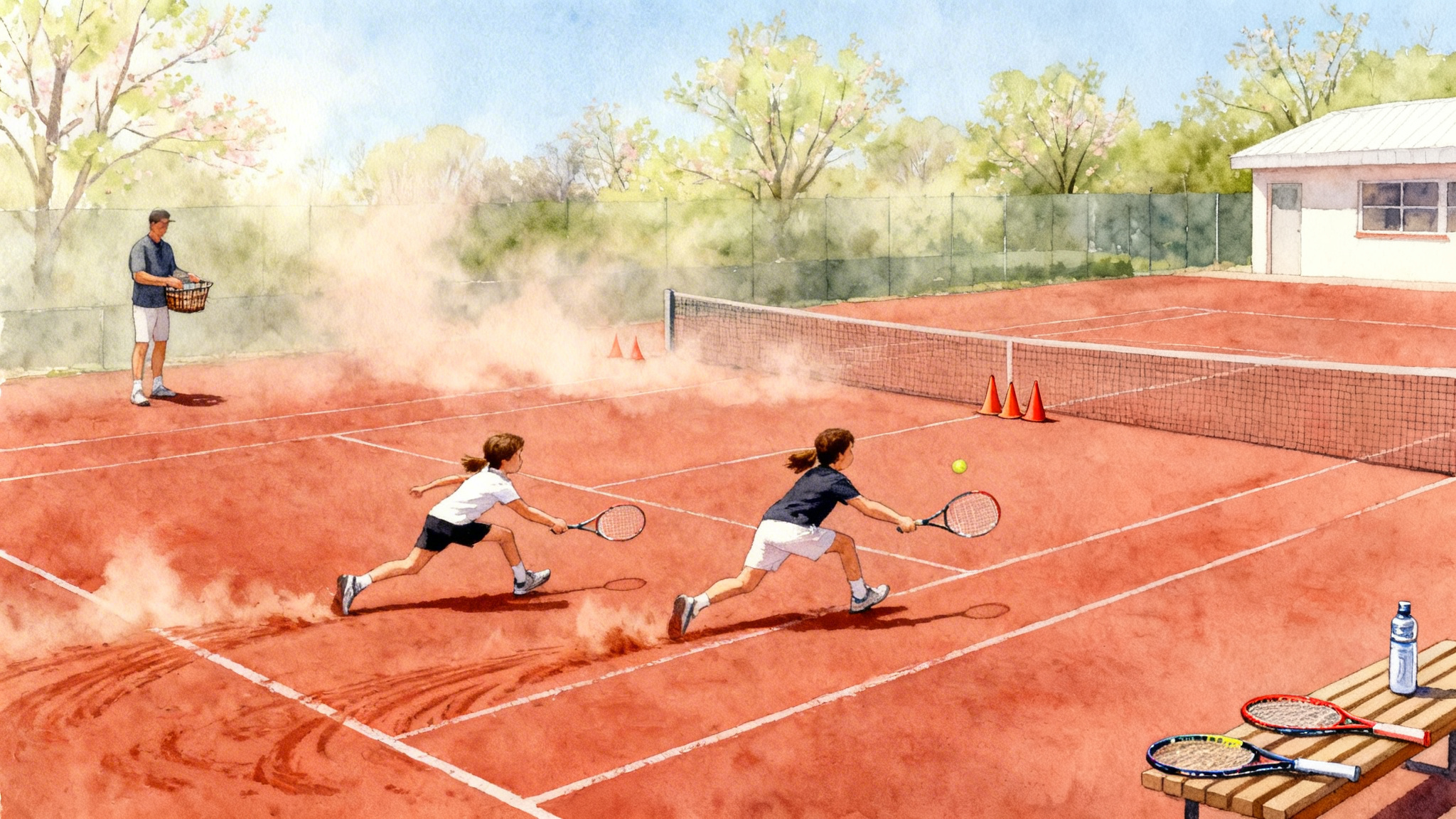
2026 Tennis Fitness Toolkit: Step-by-Step At-Home Tests
Turn your living room, driveway, or court into a mini performance lab. This step-by-step tennis fitness toolkit shows you how to run six key tests, read your scores by age and level, and build an 8 week plan from the results.
 Tommy
Tommy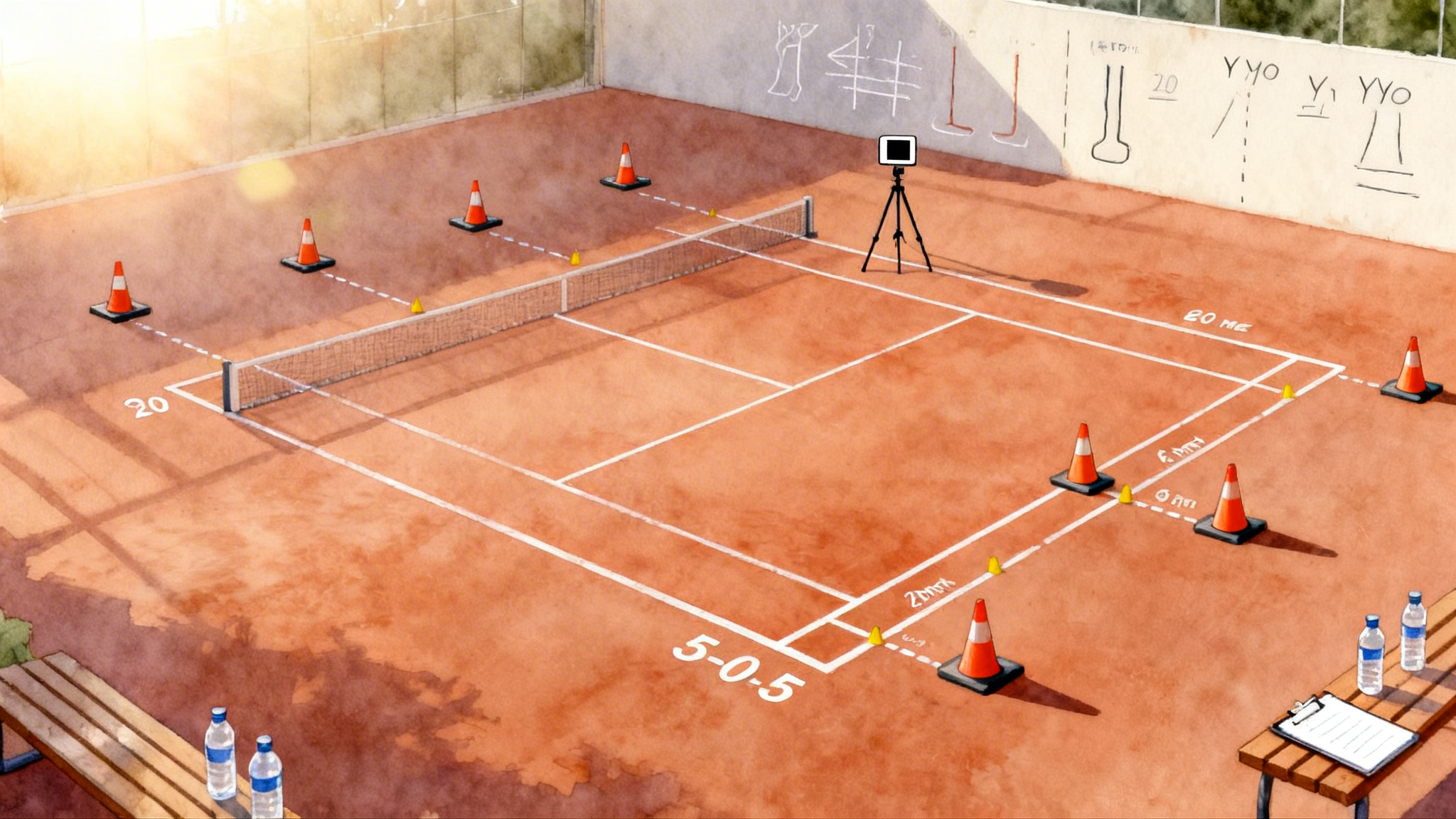
What this toolkit covers
Use six simple tests to profile your tennis fitness, then follow an 8 week plan that targets your biggest gaps. You will get clear setup steps, scoring, starter target bands, a printable tracker, and retest checkpoints at Weeks 4 and 8.
- Tests: 20 m sprint, 5-0-5 change of direction, lateral shuffle, countermovement jump, Yo-Yo Level 1, simple serve speed check
- What you need: flat shoes, tape or chalk, 4–6 cones, 30 m of space, measuring tape, smartphone stopwatch or timing app
- Warm-up: 8–12 minutes of mobility and ramps. For a full routine, see our smart warm-up and fueling.
Before you start
- Test on the same surface and in similar shoes each time. Hard court or smooth asphalt is ideal.
- Avoid heavy training 24 hours before testing.
- Film your attempts if possible for timing and technique notes.
The six at-home tennis fitness tests
1) 20 m sprint
Measures: first-step acceleration and linear speed
- Setup: Mark a start line and a 20 m finish line. If solo, start from a two-point stance and use a phone stopwatch or sprint timing app.
- Protocol: 3 attempts with full recovery. Start from a still position. Record the best time.
- Target bands to start:
- Adults NTRP 3.0–3.5: 3.40–4.10 s
- Adults NTRP 4.0–4.5: 3.10–3.60 s
- Adults 5.0+: 2.90–3.20 s
- Juniors U18: 2.90–3.50 s depending on age and training
2) 5-0-5 change of direction
Measures: braking and re-acceleration off a single cut
- Setup: Mark a start line 15 m from a turnaround line. Time the 10 m split from the 5 m entry to the 5 m exit around the turnaround.
- Protocol: Approach at speed, plant the outside foot at the turnaround, cut, and sprint out. 4 total reps, 2 per side. Record the best time. For background and variations, see the 505 agility test procedure.
- Target bands to start:
- Advanced: 2.40–2.70 s
- Trained: 2.71–3.00 s
- Developing: 3.01–3.40 s
3) Lateral shuffle test
Measures: side-to-side shuffle speed and footwork efficiency
- Setup: Place cones 3 m left and 3 m right of center. Start at center.
- Protocol: On go, shuffle right to touch cone, back through center, left cone, back to center. That is 1 cycle. Count cycles completed in 20 seconds. Keep feet and hips low, no crossing steps.
- Target bands to start:
- Advanced: 8–10 cycles in 20 s
- Trained: 6–8 cycles
- Developing: 4–6 cycles
4) Countermovement jump
Measures: lower-body power
- Setup: Use a wall and tape. Stand side-on, mark standing reach, then jump for max height with an arm swing. Measure jump height above reach.
- Protocol: 5 attempts with 45–60 s rest. Record the best.
- Target bands to start (jump height):
- Advanced: 40 cm and above
- Trained: 30–39 cm
- Developing: 20–29 cm
5) Yo-Yo Intermittent Recovery Level 1
Measures: repeat-sprint endurance with short recovery
- Setup: Two lines 20 m apart plus a 5 m recovery zone. Use official audio or an app that controls shuttle pace. See the Yo-Yo Level 1 protocol for details.
- Protocol: Run 20 m out and back to audio beeps. After each 40 m shuttle, walk or jog 5 m during the 10 s recovery. Test ends when you miss two lines in a row. Record total distance.
- Target bands to start (total distance):
- Advanced: 1600–2000 m and above
- Trained: 1200–1600 m
- Developing: 600–1200 m
6) Simple serve speed check
Measures: ball speed proxy and consistency under light fatigue
- Setup: Use a radar device if you have one, otherwise film from behind and focus on consistent, center-contact serves. Mark a wide and T target.
- Protocol: 2 sets of 10 flat serves to the deuce side with 2 minutes rest between sets. Record average speed if using radar, or make a note of makes out of 10 and contact quality from video.
- Target bands to start:
- Adults NTRP 3.0–3.5: 55–70 mph average or 5–7 accurate makes of 10
- Adults NTRP 4.0–4.5: 80–95 mph or 6–8 makes of 10
- Adults 5.0+: 100–115+ mph or 7–9 makes of 10
- For power and health, see our arm care speed progression.
How to read your numbers
- Compare like with like. Same surface, shoes, time of day, and weather.
- Retest schedule: Baseline in Week 0, mid-check in Week 4, final in Week 8.
- Minimal worthwhile change guidelines:
- 20 m sprint: faster by 0.06–0.10 s
- 5-0-5: faster by 0.06–0.10 s
- Lateral shuffle: plus 1 cycle in 20 s
- Countermovement jump: plus 3–5 cm or 8–12 percent
- Yo-Yo Level 1: plus 160–320 m
- Serve speed: plus 3–5 mph or plus 1–2 accurate makes of 10
Pick a track and follow this 8 week plan
Choose the track that matches your weakest test. Each week has 2 focused sessions, 1 support session, and match or drill play. Keep 48 hours between hard lower-body days. Use the smart warm-up and fueling on testing and speed days.
Track A: Acceleration and speed
- Session A1: Sprint mechanics, 6–8 x 10–20 m sprints, 3–4 minutes rest
- Session A2: Resisted starts or hill sprints, 6–8 reps, full recovery
- Support: Lower-body strength circuit, 30–40 minutes
Track B: Change of direction and agility
- Session B1: 5-0-5 cuts, 6–10 total reps, walk-back rest
- Session B2: Lateral shuffle intervals, 6 x 20 s on and 40 s off
- Support: Eccentric strength and deceleration drills, 30 minutes
Track C: Repeat-sprint endurance
- Session C1: Shuttle sets at Yo-Yo pace, 3–4 sets of 6–10 reps, 1–2 minutes rest
- Session C2: Court-based intervals, 6–10 x 30 s on and 30 s off, racquet in hand
- Support: Aerobic tempo, 20–30 minutes easy run or bike
Example combined plans
- If sprint and Yo-Yo are low: do Track A on Monday, Track C on Thursday, support work on Saturday.
- If 5-0-5 and lateral shuffle lag: do Track B twice per week and add short accelerations after one session.
- If serve speed stalls or the shoulder feels tight: keep one upper-body strength day light and follow the arm care speed progression.
Printable tracker
Copy this table into your notes app or print it.
| Date | Surface | 20 m sprint | 5-0-5 | Lateral shuffle cycles | CMJ height | Yo-Yo L1 distance | Serve avg or makes | Notes |
|---|---|---|---|---|---|---|---|---|
| Week 0 | ||||||||
| Week 4 | ||||||||
| Week 8 |
Optional pro-grade testing in Austin
If you want timing gates, force plates, or supervised Yo-Yo sessions, book with Legend Tennis Academy in Austin. They can replicate these tests and translate results into on-court drills.
FAQs and quick fixes
- Can I split tests across days? Yes. Keep the same order within a day and finish power and speed tests early while fresh.
- What if space is tight? Run a 10 m sprint and double the volume, or reduce the Yo-Yo distance but keep the beeps and rest structure.
- How should I breathe on shuttles? In through the nose when possible on the walk-back, steady exhales during efforts.
- Hot weather plan? Shift to mornings or evenings, shorten sets, and increase breaks. For full guidance, see our hot-weather tennis guide.