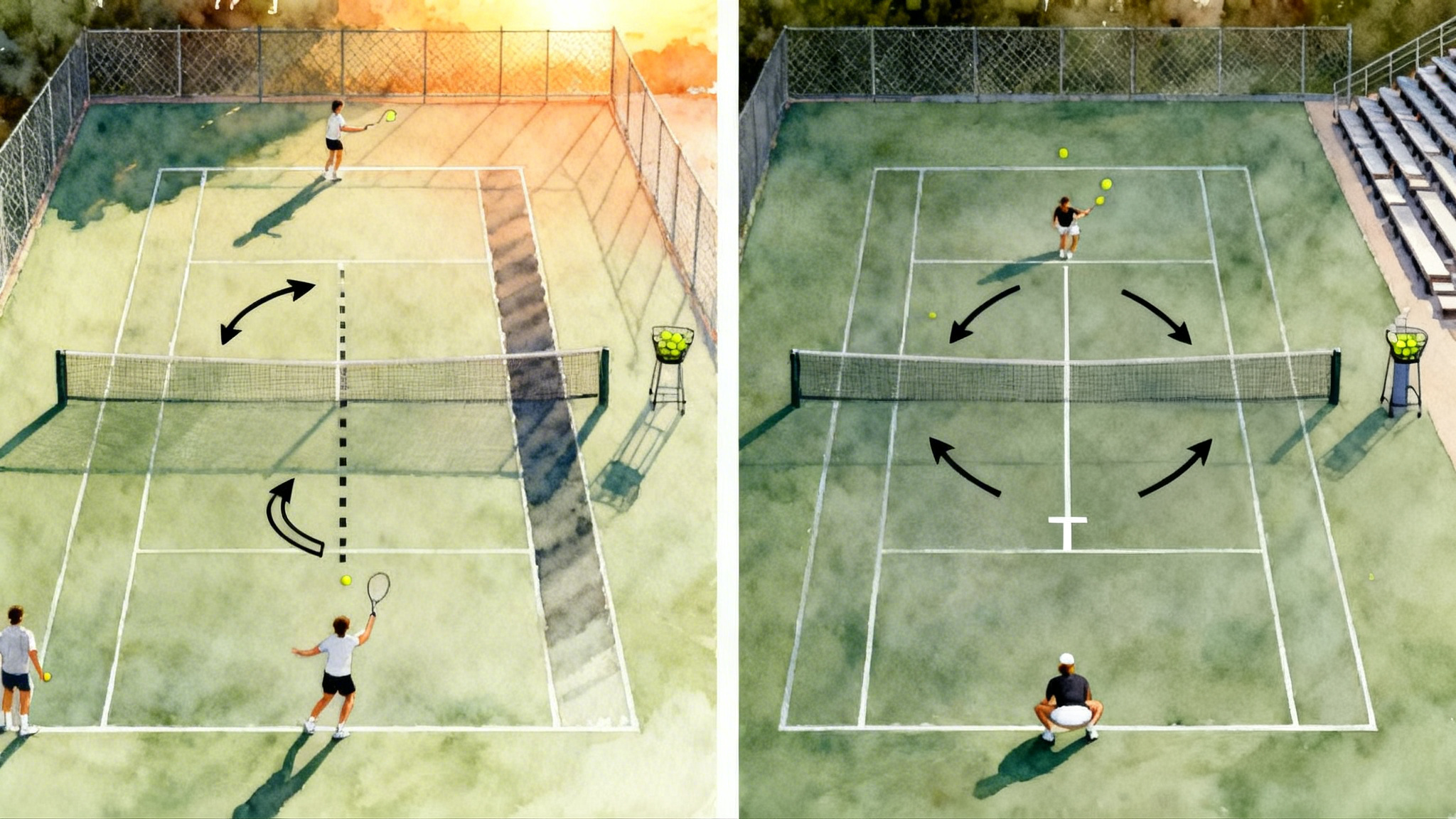
One-Handed vs Two-Handed Backhand: A 2026 Guide for All Ages
Stop guessing your backhand. Use this age-specific framework to match body, technique, and goals. Includes at-home screens, junior-to-adult progressions, a six-week commit or transition plan, filming checklist, and when to book in-person help.
 Tommy
TommyThe backhand decision in 2026: what really matters
Choosing between a one-handed and two-handed backhand is not about style or tradition. It is about which motion your body can repeat under pressure, which skills college coaches actually value, and how you will win points against the balls you face most. In 2026 that means heavy topspin, higher bounce, faster incoming pace, and frequent backhand exchanges. The right choice blends three lenses:
- Fitness: mobility, strength, and injury-risk flags
- Technique: grip, swing slot, spacing, contact point, and footwork patterns
- Pathway: what matters to college coaches and what Association of Tennis Professionals and Women’s Tennis Association trends imply for juniors and adults
This guide gives you at-home tests, junior-to-adult progressions, a six-week commit or transition plan, a filming checklist, and clear cues for when in-person evaluation is the fastest path forward. We also spotlight Gomez Tennis Academy in Naples for court assessments and drill progressions.
A practical, age-specific framework
The default is simple: younger athletes usually benefit from a two-handed backhand for stability and ball control, while a one-handed backhand is a strong option later if mobility, timing, and shoulder strength are above clear thresholds. Use the sections below as decision gates, not labels.
Ages 8 to 11: build control and sides
Primary goal: develop left-side skill for right-handed players and right-side skill for left-handed players. The two-handed backhand helps organize the torso and keeps the racquet face steady while growth and coordination are changing.
- Start with a two-handed backhand as the working stroke for topspin
- Mix in one-handed slice backhands early for variety and feel
- Emphasize spacing and contact out in front over racquet speed
Decision cue: continue two-handed unless the athlete shows exceptional shoulder mobility, smooth timing on high balls, and no wrist tension.
Ages 12 to 14: speed arrives, habits harden
Primary goal: handle higher bounce and faster feeds while protecting the wrist and elbow.
- Keep two-handed as the primary topspin stroke for most players
- Add one-handed slice as a compulsory second backhand
- Test a one-handed topspin backhand only if the athlete passes the mobility and strength screens below and consistently contacts 18 to 24 inches in front without framing
Decision cue: if rally tolerance drops on high balls or the athlete compensates with a bent wrist, stay two-handed for now.
Ages 15 to 18: identity and recruiting
Primary goal: show a backhand that holds up in college-style points and on video. Coaches value outcome over style.
- If two-handed: develop crosscourt depth, down-the-line change, on-the-rise drives, and a dependable slice
- If one-handed: prove high-ball competence, passing shots on the run, and returns that do not float
- Either way: learn to disguise the down-the-line change off a crosscourt exchange and to defend heavy forehands to your backhand without coughing up short balls
Decision cue: if your down-the-line change breaks down at a 1-in-3 attempt rate or worse in live rally film, your backhand identity is not ready for recruitment and needs targeted work. For a bigger-picture plan, see our College Tennis Recruiting 2026-2027 playbook.
Adult learners and returners
Primary goal: choose the motion that your joints tolerate and that you can practice often. Many adults default to a two-hander for predictability, then keep a one-handed slice for variety.
- If you struggle with high balls or late contact, a two-hander is usually more forgiving
- If shoulder mobility is great, you enjoy carving slice, and you like reaching wide, a one-hander can shine with good spacing habits
Decision cue: if the stroke produces wrist or elbow soreness the day after play, pivot to the other option or get in-person help before it becomes an injury pattern. If pain history is a concern, pair your practice with the Serve Power Without Pain arm care plan.
Fitness and injury-risk screens you can do at home
Use these quick checks to choose a safer starting point. No weights or fancy gear required. Warm up first.
- Shoulder external rotation wall test
- Setup: stand with your back against a wall, elbows at shoulder height and bent 90 degrees, upper arms on the wall
- Goal: backs of hands touch the wall without arching your lower back
- Pass: both sides touch comfortably
- Flag: if the top hand cannot reach the wall, a one-handed topspin backhand may stress the shoulder
- Wrist extension tabletop test
- Setup: place palms on a table with fingers pointing at you, gently lean in
- Goal: at least 70 degrees of extension without pain
- Pass: you can lean your shoulders over your wrists while the palms stay flat
- Flag: pain or stiffness suggests caution with an extreme one-handed grip
- Thoracic rotation sit test
- Setup: sit tall on a chair, squeeze a towel between your knees, arms crossed on chest
- Goal: rotate chest at least 45 degrees each way without the knees moving
- Pass: easy 45-degree turn both sides
- Flag: limited rotation will make a one-handed backhand late on high balls
- Split squat iso hold
- Setup: rear-foot split squat, back knee two inches from the floor
- Goal: 30 seconds hold each side, balanced torso
- Pass: no wobble and steady breath
- Flag: if you shake at 15 seconds, two-hander stability will likely outperform a one-hander in rallies
- Backhand isometric hold
- Setup: grip your racquet at your intended contact, freeze for 30 seconds
- Two-hander pass: minimal shaking for 30 seconds with the racquet face vertical
- One-hander pass: 20 seconds minimal shake at full reach, racquet head above the hand
- Flag: early shaking or wrist collapse suggests the other option or a slower build
If you fail two or more screens, start with a two-handed backhand for topspin and keep your one-handed slice as your variety tool.
Technique fundamentals that drive the choice
Grips that work under pressure
- Two-handed for right-handed players: top hand (left hand) in a semi-western forehand grip, bottom hand (right hand) between continental and eastern backhand. This gives stability and a square strings-to-ball relationship without forcing the wrists.
- One-handed: eastern backhand grip with the index knuckle on the top bevel. This aligns the string bed for high balls without extreme wrist bend. Add a slice grip variation that slides toward continental.
Swing slot and contact zones
- Two-hander: swing slot travels from outside the back hip to inside the front thigh, up through the chest. Best contact is 12 to 18 inches in front of the front hip, closer to the body than a one-hander.
- One-hander: swing slot traces further away from the body with a longer radius. Best contact is 18 to 24 inches in front of the front hip and slightly higher on heavy balls.
Spacing and footwork patterns
- Spacing cue: if your belt buckle can face the ball at contact without crunching the elbow, spacing is right.
- Neutral stance step-in: outside foot plants, inside foot steps through the ball.
- Semi-open stance load: outside leg loads, inside leg recovers; common under time pressure.
- Wide ball rescue: drop step, crossover, last step lands outside the sideline, recover with a crossover.
Two-hander advantage: handles shoulder height and above more easily and shortens time to contact. One-hander advantage: reach, slice disguise, and on-the-run flicks if spacing is early and clean.
How college coaches evaluate backhands in 2026
Coaches do not care which style looks prettier. They watch for repeatable outcomes in college patterns. Build your footage and training around these checkpoints:
- Crosscourt tolerance: can you hit 10 balls crosscourt that land at least three feet inside the baseline with consistent height over the net
- Down-the-line change: can you change direction off a neutral ball once every three crosscourts without a miss and then recover to neutral
- On-the-rise drive: do you step inside the baseline and take a shoulder-high ball early without floating
- Passing shot: from a defensive position outside the doubles alley, can you roll the ball crosscourt under the tape or knife it down the line
- Return of serve: can you block or drive second serves deep through the middle under pressure
- Variety: is your slice a weapon to move the opponent or just a reset that sits up
Video that shows these five boxes checked will beat a fancier stroke that breaks on high balls. A two-hander that lives above the net tape is fine. A one-hander must prove it handles pace and height.
What tour trends mean for you
The clear majority of Association of Tennis Professionals and Women’s Tennis Association players use a two-handed backhand because of incoming pace and height. One-handers remain but are rare, and they succeed with exceptional timing, spacing, and backhand variety. For juniors and most adults, this means two-handed as the default for topspin with a strong one-handed slice, and a one-handed topspin option only when mobility, strength, and spacing prove ready.
At-home tests: pick your backhand in 20 minutes
Set a timer for four minutes per test. Record quick notes.
- High ball wall test
- Feed yourself shoulder-high balls off a wall and hit five topspin backhands in a row
- If only your two-hander keeps the ball down the line of flight without popping up, lean two-handed
- Close-range reaction test
- Stand 12 feet from a wall, toss and hit ten quick backhands
- If your one-hander sprays or contacts behind your body, that is a spacing red flag
- Isometric retest under fatigue
- After the wall rounds, repeat the isometric hold for 20 seconds
- If fatigue collapses the wrist in one style but not the other, choose the steadier one for now
- Slice rescue
- Toss a low ball and hit a firm one-handed slice to the wall five times in a row
- If the slice floats, devote a week to fixing it regardless of your topspin choice
- Tempo shadow swings
- With a metronome at 60 beats per minute, perform ten slow shadow backhands, matching unit turn on beat one, contact on beat two, finish on beat three
- The motion that stays balanced is your better candidate
Score yourself: if three of five favor two-hander, decide two-hander topspin plus active slice. If three of five favor one-hander and you passed the mobility screens, you can explore a one-hander track with discipline.
Junior-to-adult progressions
Under 10 pathway
- Red to orange ball: two-handed topspin, one-handed slice games, left-hand-only forehand drills for right-handers
- Target windows: knee to waist over the net, two bounces inside service line
Ages 11 to 14 pathway
- Green to yellow ball: two-handed as the staple, slice approach and passing drills, return blocks off the body
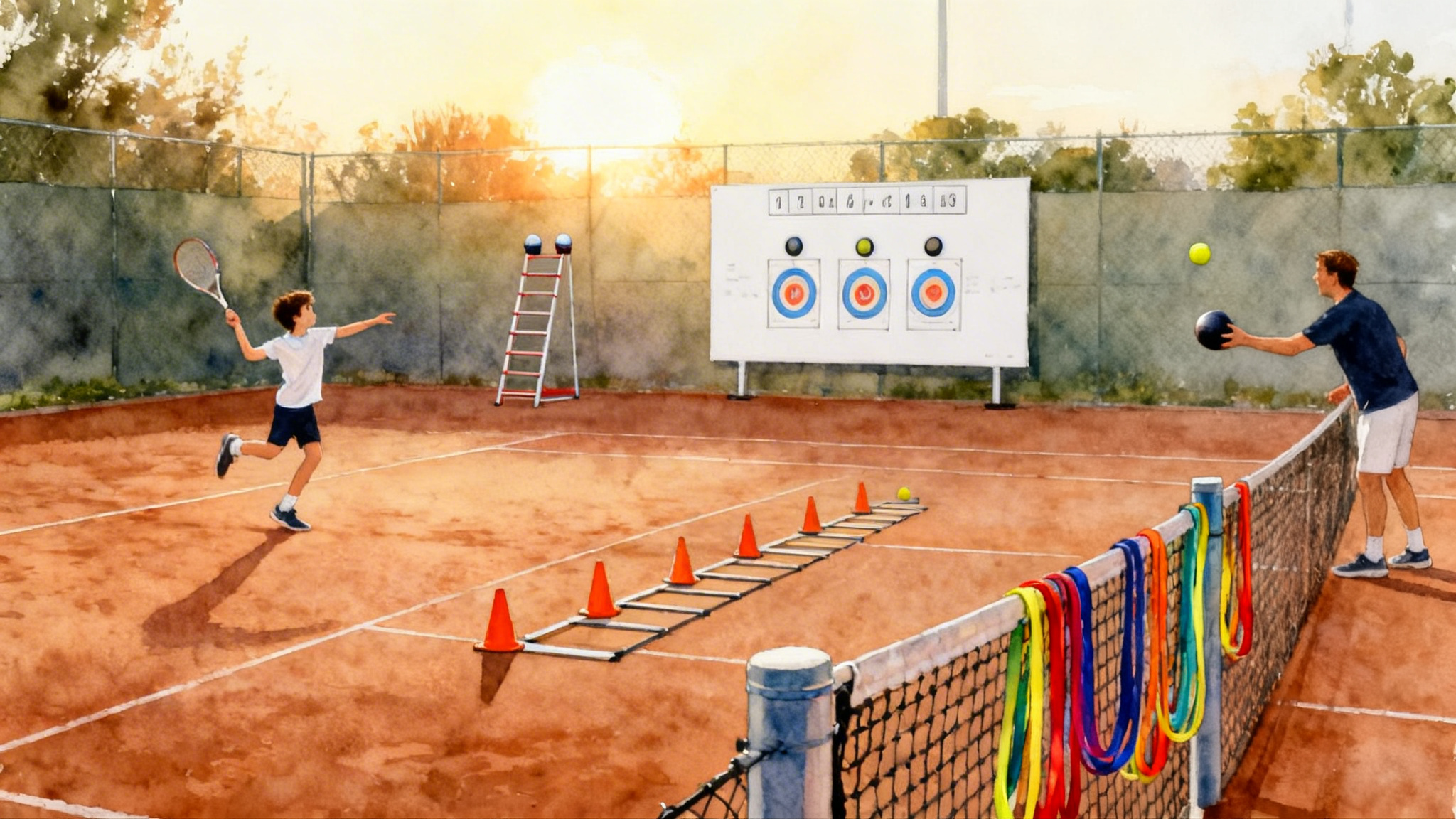
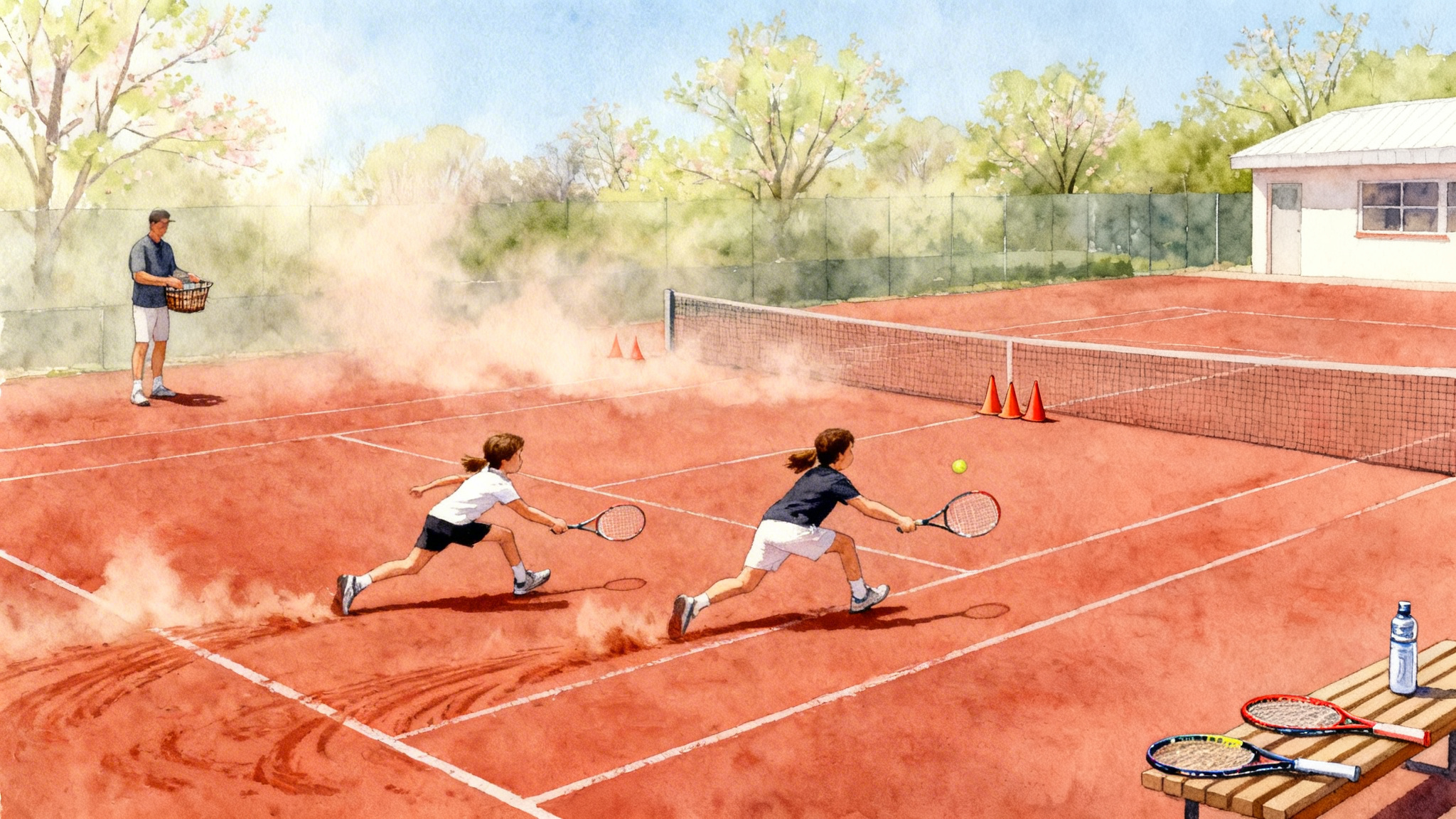
- Add a weekly spacing circuit: cone outside the backhand corner, shuffle out, set the distance, hit, recover
Ages 15 to 18 pathway
- Two-hander track: rise-in-the-court drills, down-the-line disguises, return plus first ball patterns
- One-hander track: high-ball ladders, on-the-run drives, slice to topspin transitions
Adult pathway
- Four-week foundation of spacing, then two weeks of pace
- Twice-weekly strength microdoses: split squat holds, banded rotations, wrist extensor work
Six-week commit or transition plan
The plan assumes three on-court days and two short strength days per week. Swap in a wall if you lack a partner.
Week 1: Assess and set grips
- Film two sessions. Choose your grip combination and lock it in for six weeks
- Drills: 3 by 8-minute crosscourt rallies at medium pace; 50 shadow swings to a metronome; 3 by 10 down-the-line changes from coach feeds
- Strength: split squat holds 2 by 30 seconds each side; banded rows 2 by 15; wrist extension 2 by 15
Week 2: Spacing and contact
- Drills: cone spacing ladder from sideline, 6 cones at 18-inch steps; 3 by 6-minute ladder rallies keeping contact in front
- Add five-minute high-ball set where feeds aim shoulder high
- Strength: thoracic rotations 2 by 8 each side; anti-rotation holds 2 by 20 seconds
Week 3: Height and pace
- Drills: 3 by 6-minute crosscourt at shoulder height; 2 by 10 on-the-rise from inside baseline; serve plus backhand first ball to deep middle
- Strength: med ball or backpack rotational throws 3 by 6 each side
Week 4: Direction change and defense
- Drills: 2 crosscourts then one down the line pattern for 12 minutes; wide-ball rescue with drop step and crossover, 2 by 8 each side; slice approach plus volley
- Pressure set: play first-to-10 crosscourt points on deuce side only
Week 5: Returns and finishes
- Drills: return series vs second serves, 20 block returns deep middle; 20 drive returns crosscourt; 12 down-the-line passes
- Match play: two sets focusing on backhand decisions, chart unforced errors, depth, and direction changes
Week 6: Decision week
- Film two full sets and repeat the at-home screens from Week 1
- Criteria to commit: error rate at or below your forehand, high-ball rally tolerance of six or more, down-the-line change at 40 percent success or better
- If the new style does not hit those marks, return to the previous backhand for match play and keep the other as a skill block once per week
Self-filming checklist and benchmarks
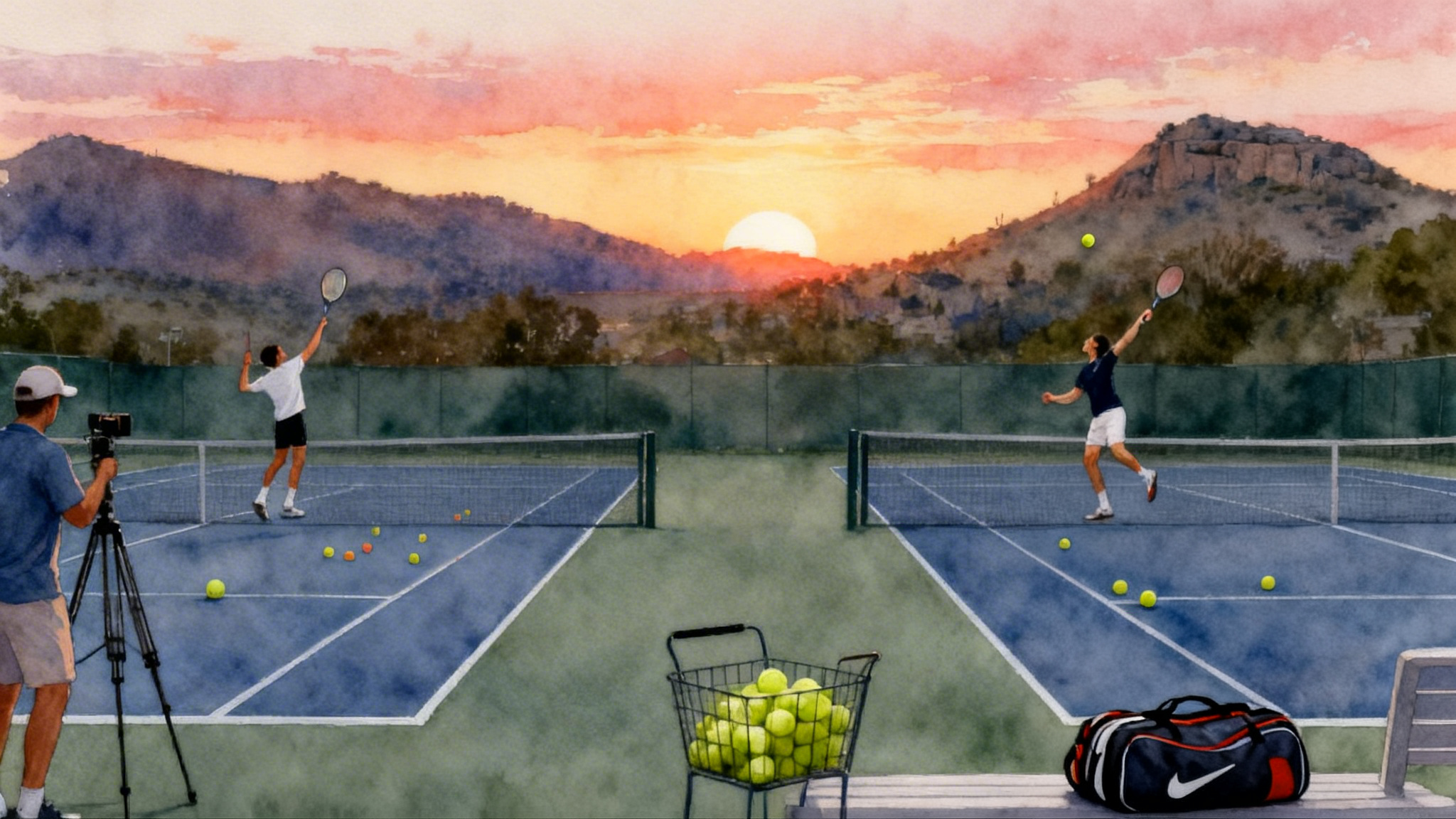
Good video answers more questions than opinions. Use a smartphone. If you can, record at 120 frames per second or higher.
Angles
- Side view on the backhand side at net height to see contact point and swing slot
- Rear view centered behind the baseline to see spacing, alignment, and ball flight
- Optional front corner to review preparation
What to capture
- Ten neutral crosscourts
- Ten down-the-line changes
- Five on-the-rise drives
- Five wide-ball rescues
- Five returns vs second serves
Benchmarks to check
- Contact location: two-hander 12 to 18 inches in front; one-hander 18 to 24 inches in front
- Racquet face: vertical or a few degrees closed at contact, not open
- Pelvis: turning through contact without excessive side bend
- Finish: two-hander finishes shoulder high or higher with elbows away from ribs; one-hander finishes high with a relaxed wrist and long arm
- Ball flight: consistent net clearance of two to three feet on rally balls
Label your files with date, court type, and ball type. Note how the backhand holds up late in the session when you are tired.
When to seek in-person evaluation
Do not wait on these red flags:
- Pain in wrist, elbow, or shoulder during or after the session
- Frequent framing on high balls or on wide balls
- A floating slice that gets attacked
- A down-the-line change you avoid in matches
If two weeks of focused work do not fix these, book an in-person assessment. Gomez Tennis Academy in Naples is a strong option for a structured evaluation and drill progressions that match your body to a backhand identity.
What a focused two-hour session can include
- On-court movement screen: spacing and footwork under time pressure
- Grip audit: small changes that stabilize the wrist without making the stroke feel foreign
- High-ball ladder: progressive feeds to test whether your current style holds up
- Direction-change builder: teach the down-the-line contact window and recover pattern
- Take-home drill plan: three court drills, two wall drills, and one strength microdose
What to ask for
- A clear yes or no on your chosen style for this season
- Specific reps and constraints that force the right spacing
- A simple pain monitoring plan and rules for backing off
Frequently asked tradeoffs
- Returns: a two-hander blocks and drives returns more easily on faster serves. A one-hander benefits from early split step and a shorter backswing.
- High balls: advantage two-hander, unless the one-hander has outstanding spacing and preparation.
- Wide defense: advantage one-hander for reach, provided the contact is early and the finish is high.
- Slice integration: both paths need a firm, low, skidding slice. Practice short-backswing slices to avoid floaters.
- Doubles: two-hander helps against body serves; one-hander helps at net on quick reflex flicks.
Quick reference cues
Two-handed backhand
- Top hand drives, bottom hand guides
- Unit turn before the ball bounces
- Contact in front of the front hip
- Elbows away from ribs on finish
- See the strings travel up through the ball
One-handed backhand
- Long arm with a calm wrist
- Shoulder turns the racquet, not the hand
- Contact further out and slightly higher on heavy balls
- Finish high with chest up, not leaning back
- Slice feel grows the topspin feel
For outdoor adjustments on wind and glare as you practice these skills, see our spring checklist inside Indoor-to-Outdoor wind and sun playbook.
The final word
Pick the backhand that your body can repeat and your match play can trust. Use the screens, film your key patterns, and run the six-week plan without hedging. If you meet the criteria, commit for the season. If you miss, pivot early and protect your joints. When in doubt, a short, targeted in-person session at a trusted academy like Gomez Tennis Academy in Naples can save months of guesswork and give you a stroke that survives high balls, pressure points, and the next level of play.