2026 Tennis Strength Standards and 12-Week Plans for All Ages
A practical, evidence‑informed strength and conditioning blueprint for tennis in 2026. Use age‑banded tests, good‑better‑best targets, 2–3 day gym templates, tournament‑week tweaks, and recovery checklists to lift serve speed and resilience.
 Tommy
Tommy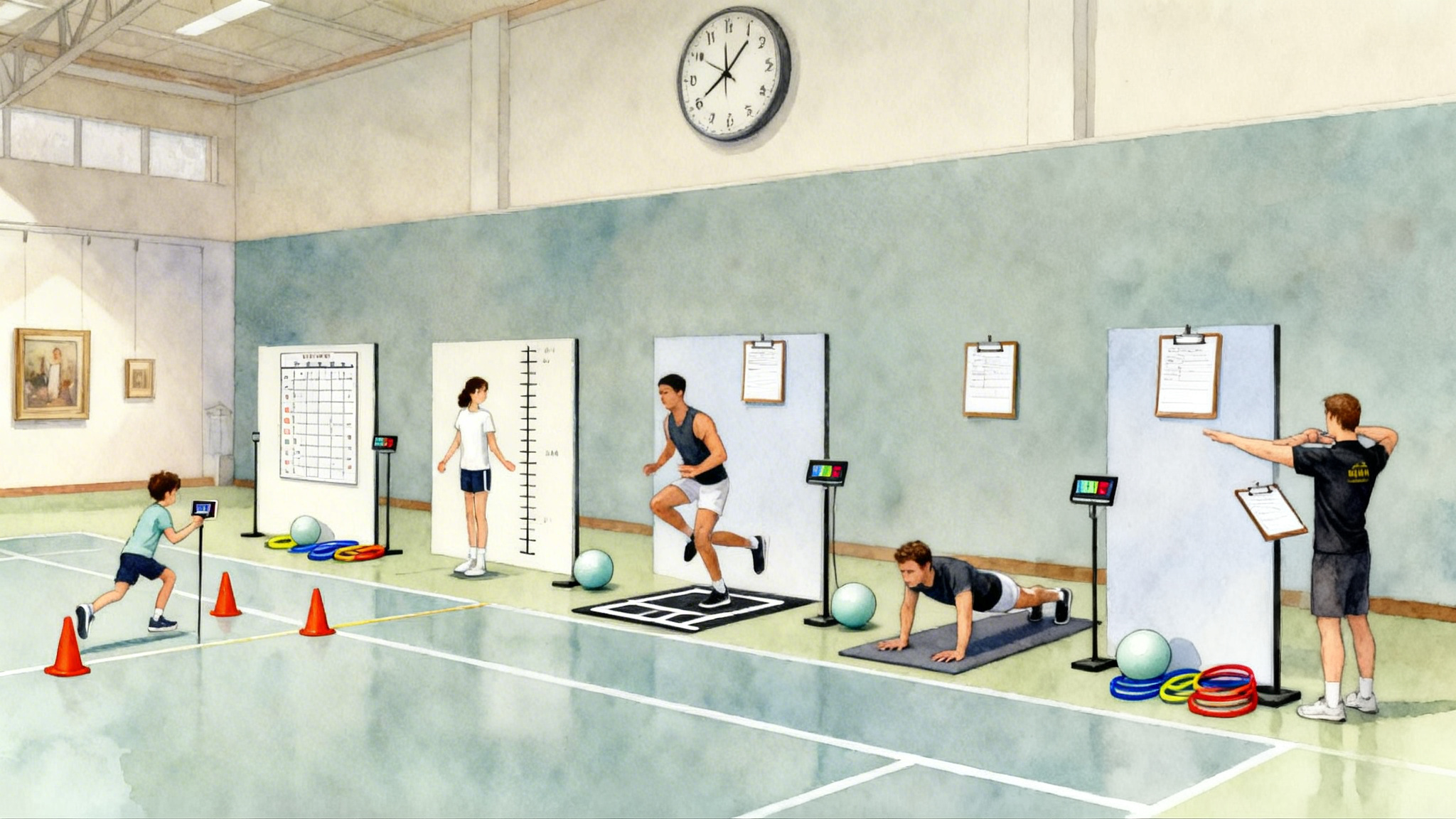
Why strength standards matter for tennis in 2026
Strength is the quiet engine behind serve speed, lateral coverage, and how fresh you feel late in the third set. Tennis is a multi-direction, stop-start sport that rewards elastic lower bodies, stable cores, and mobile but strong shoulders. Without clear standards, players and parents guess. With standards, you can test, train, and retest. This article gives you five baseline tests, age-banded targets, and 12-week templates that connect gym work to better tennis. If you are planning the whole season, pair this with our 2026 year-round tennis plans.
We built this blueprint to be practical on a school court or in a basic gym. The five baseline tests are simple to set up, repeatable, and safe for all ages with proper warm-up:
- 20 meter sprint for acceleration
- Countermovement jump for elastic lower-body power
- Lateral bound for change-of-direction power and symmetry
- Forearm plank for trunk endurance
- Shoulder mobility for overhead health
Use the good-better-best targets to set goals. Train for 12 weeks. Retest. Then adjust. It is that simple and that effective.
The five baseline tests: exactly how to run them
The protocols below assume a thorough warm-up: five minutes of light movement, dynamic mobility for hips, ankles, and shoulders, and three progressive build-up runs or jumps before the first real attempt.
1) 20 meter sprint
- Setup: Two cones 20 meters apart on a flat surface; a phone timer works if you start on first step rather than reaction to "go." If you have timing gates, even better. Take three attempts and record the best time.
- Coaching cues: Forward lean from ankles, punch the ground behind you, fast arms cheek to hip. Stop safely after 25 meters.
- Common errors: Standing too tall in the first five meters, overstriding, no arm drive.
2) Countermovement jump
- Setup: Use a marked wall or a jump mat. If neither is available, video and estimate height from freeze-frames, but be consistent when you retest. Hands can be free. Take three attempts and record the best height.
- Coaching cues: Tall posture, quick dip through hips and knees, jump vertically, land softly and stick the landing.
- Common errors: Deep, slow dip; collapsing knees; unstable landings.
3) Lateral bound
- Setup: Stand on the outside foot, bound laterally to the other side, and stick the landing for two seconds. Measure the distance from the starting toe to landing heel. Test both directions. Take three per side and record the best controlled stick.
- Coaching cues: Load the hip like a coiled spring, push the ground away sideways, hips and shoulders face forward, quiet landing.
- Common errors: Spinning on landing, knee collapse, hopping after landing.
4) Forearm plank
- Setup: Forearms on floor, elbows under shoulders, legs straight, feet hip width. Hold a straight line from ears to ankles. Time stops when hips sag or you need to rest.
- Coaching cues: Lightly tuck ribs, squeeze glutes, breathe through the nose.
- Common errors: Holding breath, hips pitched high, low back arc.
5) Shoulder mobility
Use a simple behind-the-back reach test inspired by common field screens. Make fists with both hands. One hand goes over the shoulder from above, the other behind the back from below. Measure the shortest distance between the two fists. Test both sides.
- Setup: Measure the length of your hand from wrist crease to tip of middle finger. That is your "hand length." Compare the fist-to-fist gap to this reference.
- Coaching cues: Stand tall, do not crank or bounce, keep ribs down.
- Common errors: Flaring ribs, shrugging shoulders, forcing range.
Scoring rules for shoulder mobility
- Best: fists within half a hand length
- Better: fists within one hand length
- Good: fists within one and a half hand lengths
- Red flag: gap larger than two hand lengths or a left-right difference larger than one hand length; prioritize mobility and technique before adding heavy pressing or serving volume.
Age-banded good, better, best targets
These are field targets for healthy players. Use them to guide training decisions. If you sit comfortably above "best," your priority becomes maintenance and skill speed rather than more load. If you sit at "good" or below, build capacity.
Juniors 8 to 10 years
- 20 meter sprint: good 4.2 s; better 4.0 s; best 3.8 s
- Countermovement jump: good 20 cm; better 26 cm; best 32 cm
- Lateral bound: distance equals 60 to 70 percent of body height per side; less than 5 percent difference left to right
- Forearm plank: good 45 s; better 60 s; best 90 s
- Shoulder mobility: at least within one and a half hand lengths on both sides
Juniors 11 to 13 years
- 20 meter sprint: good 3.9 s; better 3.7 s; best 3.5 s
- Countermovement jump: good 28 cm; better 34 cm; best 40 cm
- Lateral bound: 70 to 80 percent of body height per side; less than 5 percent difference
- Forearm plank: good 60 s; better 90 s; best 120 s
- Shoulder mobility: within one hand length on both sides
Juniors 14 to 17 years
- 20 meter sprint: good 3.6 s; better 3.4 s; best 3.2 s
- Countermovement jump: good 34 cm; better 40 cm; best 48 cm
- Lateral bound: 80 to 90 percent of body height per side; less than 5 percent difference
- Forearm plank: good 90 s; better 120 s; best 150 s
- Shoulder mobility: within one hand length; aim for half a hand length by 17
Adults 18 to 29 years
- 20 meter sprint: good 3.3 s; better 3.1 s; best 2.9 s
- Countermovement jump: good 40 cm; better 48 cm; best 55 cm
- Lateral bound: 90 percent of body height per side; less than 5 percent difference
- Forearm plank: good 90 s; better 120 s; best 150 s
- Shoulder mobility: within one hand length; best is within half a hand length
Adults 30 to 39 years
- 20 meter sprint: good 3.4 s; better 3.2 s; best 3.0 s
- Countermovement jump: good 36 cm; better 44 cm; best 50 cm
- Lateral bound: 85 to 90 percent of body height per side; less than 7 percent difference
- Forearm plank: good 90 s; better 120 s; best 150 s
- Shoulder mobility: within one hand length
Adults 40 to 49 years
- 20 meter sprint: good 3.6 s; better 3.4 s; best 3.2 s
- Countermovement jump: good 32 cm; better 40 cm; best 46 cm
- Lateral bound: 80 to 90 percent of body height per side; less than 8 percent difference
- Forearm plank: good 75 s; better 105 s; best 135 s
- Shoulder mobility: within one to one and a half hand lengths
Adults 50 to 59 years
- 20 meter sprint: good 3.8 s; better 3.6 s; best 3.4 s
- Countermovement jump: good 28 cm; better 34 cm; best 40 cm
- Lateral bound: 75 to 85 percent of body height per side; less than 10 percent difference
- Forearm plank: good 60 s; better 90 s; best 120 s
- Shoulder mobility: within one to one and a half hand lengths
Note on safety: If you have pain with any test, stop and substitute. For example, if jumping bothers your knees, use a seated medicine-ball chest throw to test power and train within tolerance.
From test to training: a 12-week plan that fits your life
Tennis calendars are messy. You need a plan that survives rainouts, school plays, weekend leagues, and tournaments. Use this three-phase structure. Each phase is four weeks long.
- Weeks 1 to 4 Foundation: learn positions, own the landings, and build basic capacity. Keep sets shy of failure. Effort target is a rate of perceived exertion of 6 to 7 out of 10.
- Weeks 5 to 8 Build: add load and speed in small steps. Progress to low-volume plyometrics and heavier single-leg strength. Effort target is 7 to 8 out of 10.
- Weeks 9 to 12 Sharpen: reduce volume, keep intensity, and add more speed and medicine-ball work. Effort target returns to 6 to 7 out of 10 to preserve freshness for tennis.
Two-day gym template
Day A Lower body strength and power
- Warm-up: five minutes easy movement; hip and ankle mobility; two build-up skips; two submaximal jumps
- Power: 3 sets of 3 to 5 countermovement jumps; stick the last rep
- Strength: 3 sets of 6 to 8 goblet squats or kettlebell deadlifts
- Unilateral: 3 sets of 8 per side split squats
- Accessory: 2 sets of 10 to 12 calf raises; 2 sets of 8 to 10 lateral band walks
- Core: 3 sets of 20 to 30 seconds side plank each side
Day B Upper body strength, rotation, and trunk
- Warm-up: thoracic spine mobility, band pull-apart, two easy medicine-ball slams
- Power: 4 sets of 4 medicine-ball rotational throws each side; light to moderate ball
- Strength: 3 sets of 6 to 8 one-arm row; 3 sets of 6 to 8 half-kneeling dumbbell press
- Scapular control: 2 sets of 10 Y-T-W on bench or with bands
- Core anti-rotation: 3 sets of 20 to 30 seconds per side pallof press
- Shoulder care finisher: 2 sets of 8 to 10 external rotation with light band
Progression by phase
- Foundation: choose loads that feel like you could do two to four more reps at the end of each set
- Build: add 2.5 to 5 percent load or one rep weekly if technique is perfect; keep jumps crisp and low in number
- Sharpen: cut back total sets by 20 to 30 percent; keep power work fast; replace heavy goblet squats with lighter front squats or tempo split squats
Three-day gym template
Add a speed and mobility micro-day between A and B or after B.
Day C Speed and mobility micro-day
- Acceleration: 6 by 10 meter sprints with full walk-back recovery
- Lateral power: 4 by 3 per side lateral bounds; stick each landing
- Mobility: 10 minute shoulders and hips sequence focused on the specific limits found in testing
- Trunk: 2 sets of 8 slow dead bug per side, 2 sets of 8 bird dog per side
Age-specific coaching notes
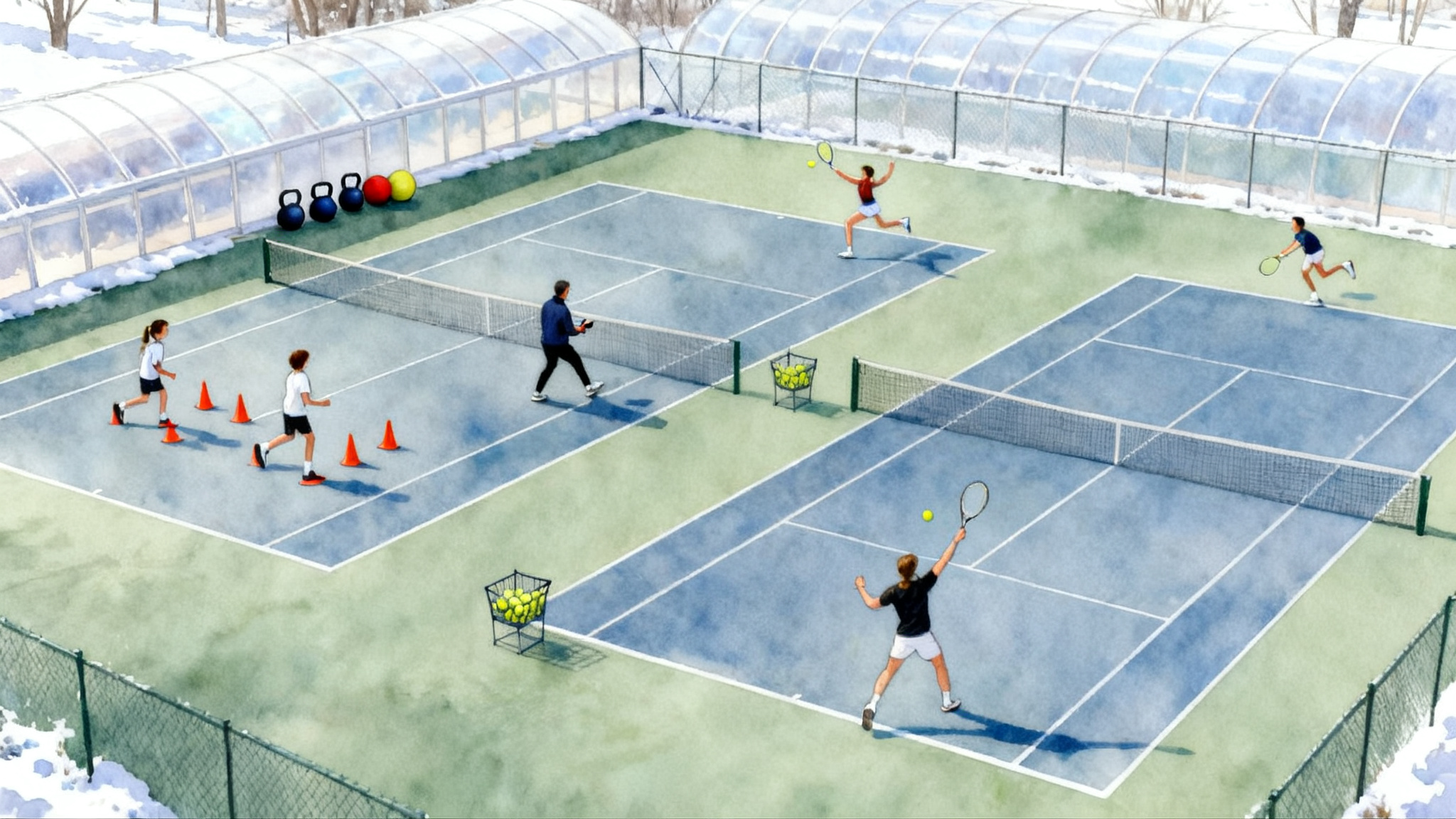
- Juniors 8 to 13 years: keep loads light; chase perfect positions, rhythm, and fun. Use games like medicine-ball relay races and cone hops. The wins you want are great landings, quiet knees, and even bounds.
- Juniors 14 to 17 years: teach hinge, squat, push, pull, and split stance under moderate load. Progress one exercise at a time. If technique degrades, hold the load steady for another week.
- Parents returning to play: own the warm-up and mobility. Mix isometrics, controlled tempo lifts, and short power sets. Your job is to have great joints first, then stronger muscles.
- Adult competitors: build single-leg strength, rotational power, and anti-rotation endurance. Avoid chasing fatigue. The goal is to leave a little in the tank so you can hit balls with pop.
Tournament week adjustments that keep your pop
When you have a tournament Saturday and Sunday:
- Seven to eight days out: normal week
- Five to four days out: one strength session with 3 sets of 3 on your main lower-body lift at about a challenging but safe weight; medicine-ball throws for speed; light shoulder care
- Two days out: micro session of 15 to 20 minutes; 3 by 3 countermovement jumps, 2 by 3 lateral bounds per side, 2 by 10 second plank holds with strong form; five minutes focused mobility
- Match day: five to seven minute primer before warm-up hit; mini band lateral walks, two smooth 10 meter accelerations, four easy shadow swings with a pause overhead to feel shoulder position
The rule is simple: preserve intensity, slash volume. You want to feel springy, not sore.
Recovery checklists that actually move the needle
- Sleep: aim for 7.5 to 9 hours for teens and adults; 9 to 10 for younger juniors. Protect the hour before bed from screens; use a consistent wind-down.
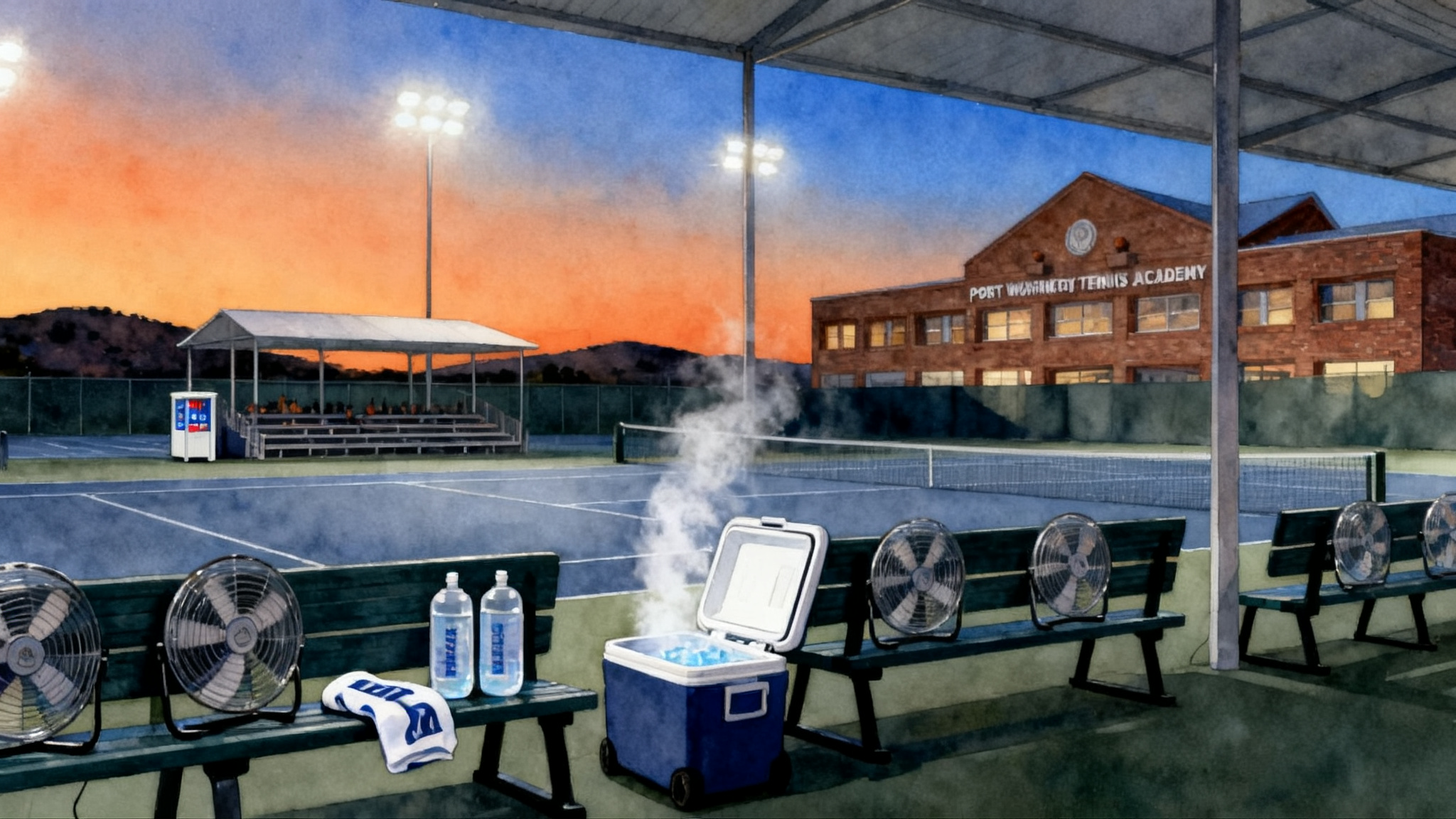
- Hydration: drink enough that urine is pale straw by midday; a simple guide is about 30 to 35 milliliters per kilogram across the day for most active players, adjusted for heat and match length. For summer tournaments and long matches, see our heat-ready hydration guide.
- Protein: target roughly 1.4 to 1.8 grams per kilogram body weight daily, split across meals and a post-practice snack. Juniors can simply include a protein source at each meal and a dairy or soy snack after training.
- Carbohydrates: place the bulk around practice and matches; fruit plus yogurt, a bagel with peanut butter, or rice and eggs work well.
- Mobility and tissue care: five to ten minutes daily on your limiting joints; think little and often.
- Readiness check: each morning rate sleep quality, mood, and soreness 1 to 5. Two days in a row of low scores means you reduce that day’s training by 20 to 30 percent and lean into recovery.
How Legend Tennis Academy runs quarterly testing
Here is the quarterly rhythm from Legend Tennis Academy that you can copy at your club or school.
- Week 0: planning and communication. Players and parents receive the exact tests, targets, and the retest date three months later. Coaches assign time slots to avoid congestion.
- Testing day flow: five stations that loop every 10 minutes; one coach per station. Station 1 warm-up and sprint; Station 2 countermovement jump; Station 3 lateral bound; Station 4 plank; Station 5 shoulder mobility and shoulder care demo. Each player carries a scorecard and a pencil.
- Data entry: one volunteer enters results into a simple spreadsheet with color coding for good, better, best and flags any asymmetry beyond thresholds.
- Translation to court work: each player leaves with two pages. Page 1 is the scorecard. Page 2 is a mini prescription that links test results to on-court drills and specific gym work.
Examples of translation to the court
- Need faster first step: add 6 to 8 reps of split-step to first stride acceleration at the start of two practices per week; place two cones 3 meters apart and react to a coach’s hand signal.
- Lateral bound asymmetry: add lateral shuffle with controlled decel to the weaker side; two sets of five reps between points in practice sets; finish with a single-leg stick and hold for two seconds.
- Low plank endurance: add anti-rotation rally constraints. For two games per set, the goal is clean posture between shots and no bending at the waist on recovery steps; coach watches and cues.
- Limited shoulder mobility: add two overhead positioning drills in the warm-up and reduce serve volume by 20 percent for two weeks while you earn range and control. Replace with shadow serves and light medicine-ball overhead throws.
Serve speed connection
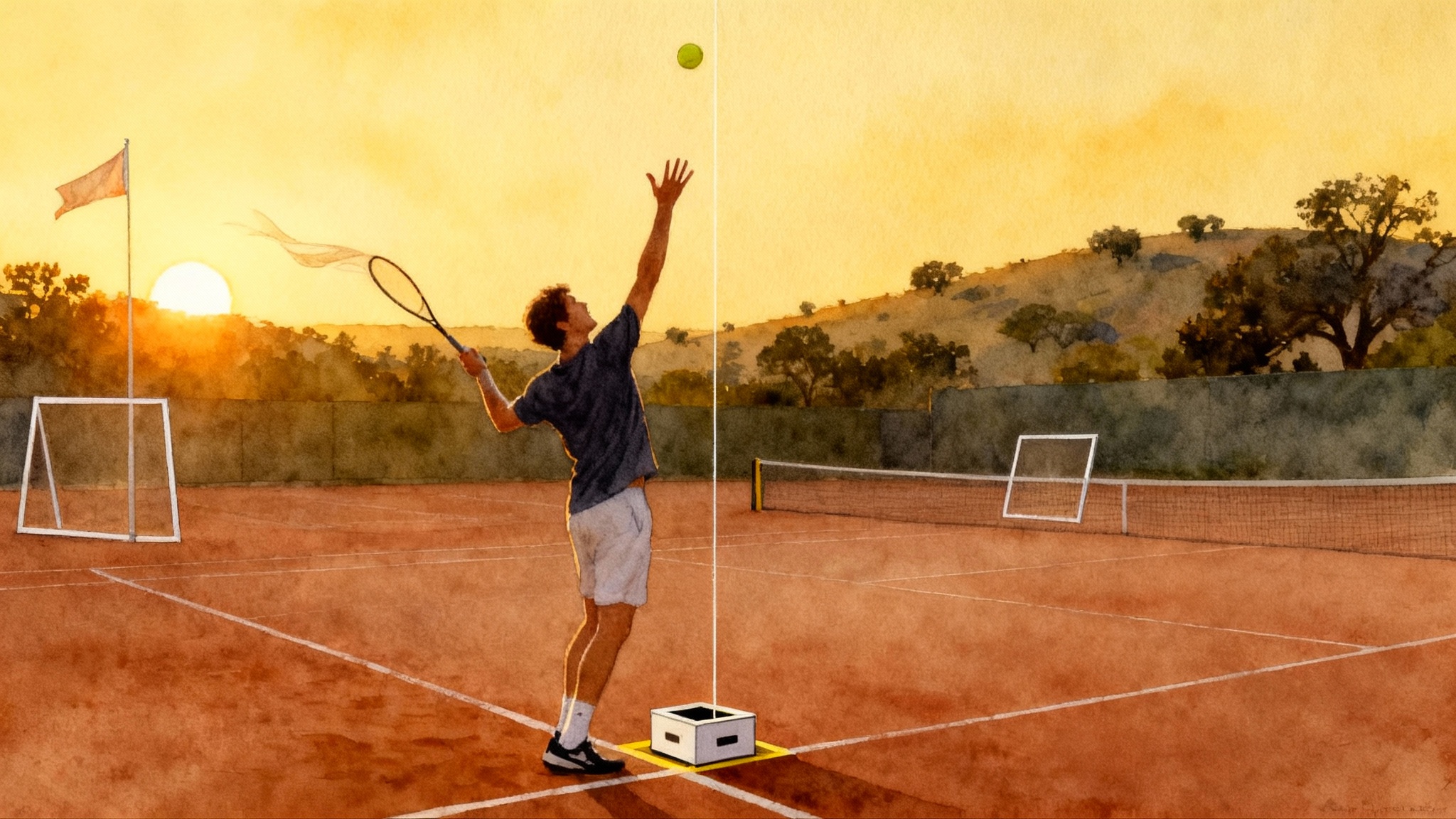
- Power comes from the ground up. The countermovement jump and lateral bound are your proxies for elastic lower-body power and how well you transfer force side to side. If jump height or bound distance improves 10 percent, you can expect a small but real bump in serve speed once your timing adapts. Protect the shoulder by earning overhead mobility and scapular control first, then layering in medicine-ball throws.
Printable scorecards
Print this section, or copy it to a single page and leave space to write. The good-better-best boxes make progress visible and motivating.
Athlete info
- Name:
- Date of birth:
- Testing date:
- Dominant hand:
20 meter sprint
- Best time:
- Good [ ] Better [ ] Best [ ]
Countermovement jump
- Best height:
- Good [ ] Better [ ] Best [ ]
Lateral bound
- Left best distance:
- Right best distance:
- Left-right difference:
- Good [ ] Better [ ] Best [ ]
Forearm plank
- Best hold time:
- Good [ ] Better [ ] Best [ ]
Shoulder mobility
- Right over-under gap:
- Left over-under gap:
- Symmetry within one hand length [ ]
- Good [ ] Better [ ] Best [ ]
Priority focus for the next 4 weeks
- 1)
-
On-court add-ins
- Drill A:
- Drill B:
Gym plan
- Two-day [ ] Three-day [ ]
Retest date
- Day:
Troubleshooting and smart guardrails
- Pain is information. Swap the exercise that hurts for a similar pattern that does not. For example, replace deep squats with a box squat or a hip hinge.
- Quality beats quantity. Stop your jump sets when height or landings drop off. Cut a set early if your next rep would be sloppy.
- One progression at a time. Do not raise load and volume in the same week. Pick one dial and turn it slightly.
- Juniors grow fast. Growth spurts can create temporary awkwardness. During these weeks, emphasize technique, mobility, and lighter loads. Retest after the growth spurt settles.
- Older shoulders deserve respect. Keep pressing volumes lower, pulling and external rotation volumes higher, and serve smarter rather than simply more.
Sample weekly schedules for real players
Junior, 11 years, two practices and one match
- Monday: Day A lower body; finish with 5 minutes of throwing games
- Wednesday: Practice; add split-step to first stride accelerations
- Friday: Day B upper body; finish with 2 sets of 6 medicine-ball rotational throws per side
- Saturday: Match
- Sunday: Family walk and shoulder mobility
Adult competitor, 32 years, two league matches this week
- Monday: Day A lower body strength and power
- Tuesday: Hitting session with 6 by 10 meter accelerations; light shoulder care
- Thursday: Day B upper body with rotational throws
- Saturday to Sunday: Matches; primer before warm-up both days
Parent returning to tennis, 47 years, time-crunched
- Tuesday: Day A shortened to 35 minutes; isometrics and tempo control
- Thursday: Day C micro-day; sprints, bounds, mobility
- Weekend: Hit for 45 minutes; finish with 5 minutes of shoulder care
When to change the plan
- If three consecutive practices feel flat: reduce gym volume by 30 percent for one week and add sleep time
- If soreness lingers beyond 48 hours: cut the heaviest lift and replace with a lighter single-leg version; keep power sets low and snappy
- If test asymmetry flags persist for two cycles: add a dedicated five minute correctives block to warm-ups and reduce live-ball volume to protect movement quality
A final word
Standards do not make you rigid; they make you clear. The five tests tell you what to train first. The age-banded targets keep goals realistic. The 12-week plans fit around real calendars. The quarterly rhythm that Legend Tennis Academy uses turns testing into a habit, not a hoop to jump through. Print the scorecard, pick your focus, and get to work. The next time you light up a serve up the T or slide to a wide forehand and fire a winner, you will know exactly which small, repeatable choices put that ball on the line.