UTR vs WTN in 2026: Smart Match Planning and Training
Confused by UTR and WTN? Here is a clear, practical guide to turn ratings into court actions. Get quick checklists, event rules of thumb, and 6-week training microcycles for UTR 3–5, 6–8, and 9+. Parents and adults included.
 Tommy
Tommy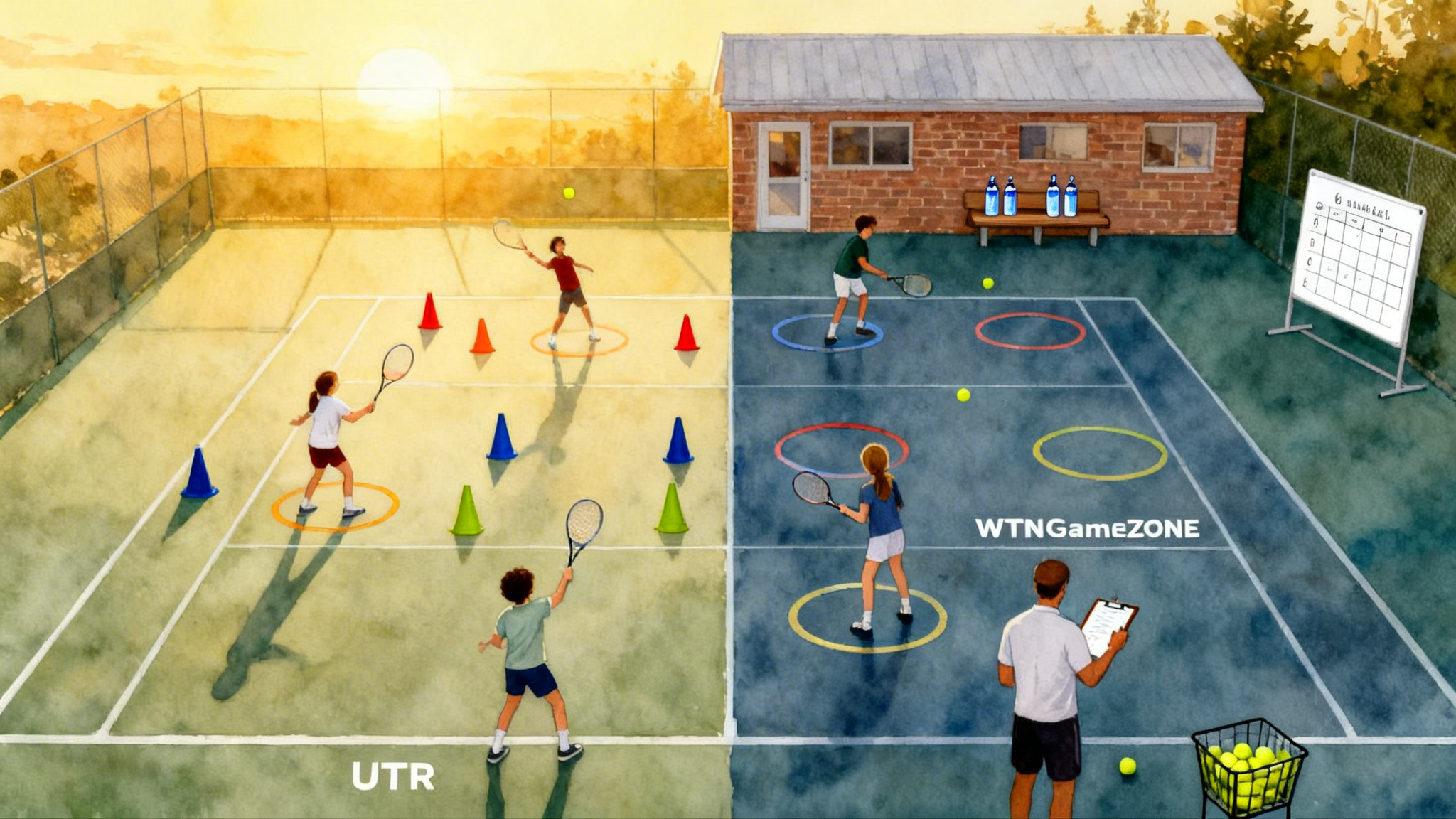
Why ratings matter in 2026
Ratings are not trophies. They are dashboards. Used well, Universal Tennis Rating and World Tennis Number tell you what kind of opponents you should face next week, what you should rehearse at practice tomorrow, and how to measure progress across a season. Used poorly, they push players into rating chasing and burned weekends.
Here is how to make ratings work for you in 2026.
- Universal Tennis Rating is a continuous scale for singles and doubles that uses opponent strength and score margins to estimate your level. Think of it like a speedometer for your competitive pace. You can read more in the official primer from Universal Tennis: how Universal Tennis Rating works.
- World Tennis Number is produced by the International Tennis Federation and national bodies, also using recent match results and opponent strength. It gives a number per discipline and introduces features like GameZone to suggest suitable opponents. See the ITF overview: ITF World Tennis Number explained.
You do not need to choose a side. Both ratings estimate your competitive readiness. The trick is to translate each number into training choices and match entries you can act on this week.
Turn ratings into actions: three quick checklists
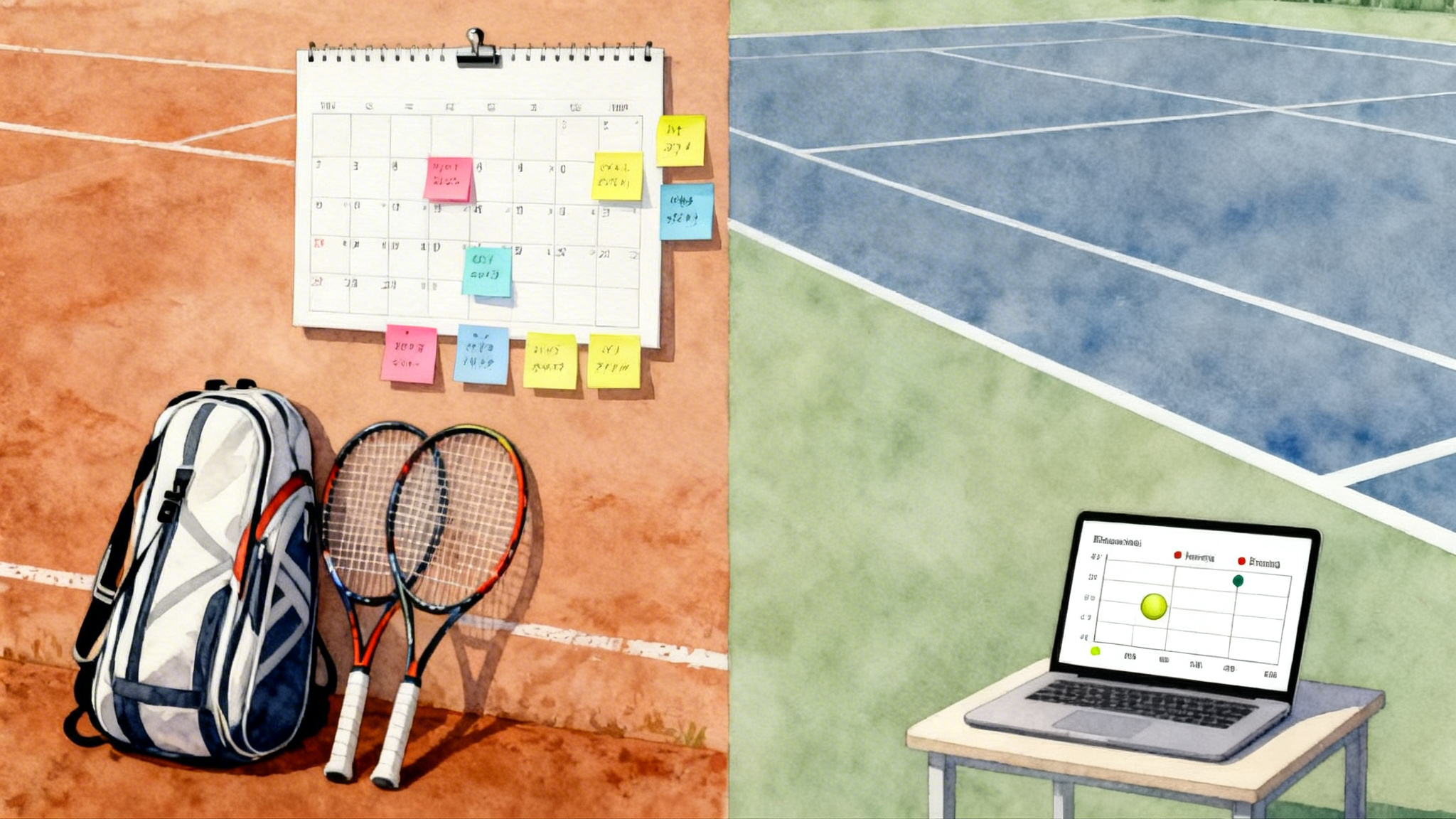
Use these one-minute checklists once per week. Screenshot them to your phone and review every Sunday.
For juniors
- My rating check: note your UTR and WTN. Circle which moved last week.
- My match target: schedule one match where the opponent is within a competitive band of your rating and one stretch match slightly above your level.
- My skill focus: pick one skill to raise by a measurable notch, like first serve percentage or rally tolerance.
- My mental cue: set one match habit, like a 5-second reset after errors.
- My reflection: record one sentence after each match about what broke down at 3 all.
For parents
- Volume rule: one official match per week on average, plus one practice match with coaching oversight.
- Opponent mix: 50 percent in-range, 30 percent slight underdogs, 20 percent clear favorites.
- Travel gate: do not drive more than 90 minutes unless the event provides at least three competitive matches.
- Energy budget: protect sleep before finals day. No late start the night before.
- Debrief script: start with the player’s view, then pick one video clip to discuss, then agree on one training adjustment.
For adult players
- League anchor: keep your league or ladder as the season anchor, then fill gaps with two rating-relevant matches per month.
- Fitness constraint: cap hard singles to twice per week unless you can dedicate two recovery days.
- Skill slotting: assign one 20-minute block per practice to serve plus first ball patterning that fits your typical league pressure.
- Scouting habit: track two opponent tendencies per match, like return depth and backhand defense.
Event selection rules of thumb
These rules convert a number on a screen into a calendar entry.
-
If your UTR is 3 to 5: choose events where most entrants sit from one point below to one point above your number. Your stretch match should be about 1.5 points higher.
-
If your UTR is 6 to 8: live in the plus or minus 1.0 window, with one deliberate stretch at plus 1.5 each month.
-
If your UTR is 9 and above: aim for fields where you have at least two coin-flip matches. Avoid events where you would be a heavy favorite for three rounds in a row unless it offers ranking points you specifically need.
-
For WTN GameZone: if it suggests a band of suitable opponents, build your week with two matches in the middle of the band and one near the top.
-
Scoring formats: shorter formats increase volatility. If you need match reps under stress, short-format events are useful. If you need reliable rating movement, prefer full scoring where available.
-
Travel filter: a long trip is justified only by at least three matches against in-range opponents or by video and officiating quality you cannot get locally.
Six-week microcycles by rating band
Each microcycle is six weeks long and repeats with minor tweaks. Each week lists 4 tennis sessions and 2 strength and conditioning sessions, plus match play. Adjust volumes for age and schedule. All drills are examples you can swap with your coach.
UTR 3 to 5: build foundations you can repeat under stress
Goal: improve ball quality, reliable serves, and basic patterns so that in-range opponents cannot wait you out.
-
Weekly structure
- Tennis 4 sessions: 2 technical, 1 patterning, 1 live play.
- Strength and conditioning 2 sessions: movement fundamentals, trunk control, landing mechanics.
- Match play: 1 official match, 1 practice set with coaching feedback.
-
Weeks 1 to 2 focus
- Serve: 100 first serves per session, targets at deuce and ad T, 55 percent in, 8 of 10 clearing the net tape by at least a racket head.
- Rally ball: 2 crosscourt lanes, 8-ball tolerance goal per rally at shoulder to waist height.
- Movement: split step on opponent contact, recover to center mark with a simple shuffle pattern.
- KPI sample: average rally length in neutral drills at 6 to 8 balls, 2 double faults or fewer per set.
-
Weeks 3 to 4 focus
- Serve plus one: deuce court serve wide, forehand to open court; ad court serve T, backhand crosscourt.
- Return: block return deep middle on second serves, no more than one unforced error per game in practice.
- Transition: approach on short ball to body target, volley deep middle.
- KPI sample: first serve percentage up to 60 percent, make 6 of 10 approaches stick with a playable first volley.
-
Weeks 5 to 6 focus
- Pattern pressure: play first to four points live drills that start with serve plus one.
- Competitive sets: one full set against in-range opponent, chart unforced errors by pattern.
- KPI sample: in a set, 60 percent of points last 4 or more balls, and you win at least half of those neutral exchanges.
-
Event choice rule: enter two local events across six weeks with likely in-range rounds. Seek opponents one point higher at least once.
UTR 6 to 8: sharpen a weapon and build a plan around it
Goal: upgrade one shot to a true advantage under pressure, while tightening serve and return patterns.
-
Weekly structure
- Tennis 4 sessions: 1 technical on the weapon, 1 serve and return, 1 patterns under stress, 1 live play.
- Strength and conditioning 2 sessions: acceleration, deceleration, and rotational power.
- Match play: 1 official match, 1 practice match with constraints.
-
Weeks 1 to 2 focus
- Weapon choice: pick the shot that most often creates time for you, like inside out forehand or slice backhand to change pace.
- Serve: 65 percent first serves in, zero double faults in any game twice per set.
- Return: aggressive second serve position with a clear target, like deep to backhand middle third. For a deeper plan, see the return of serve blueprint for every player.
- KPI sample from Legend Tennis Academy: 12-ball crosscourt on weapon side with height above net cord by at least one ball, and 4 out of 6 forehand run-around winners created per set in practice scenarios.
-
Weeks 3 to 4 focus
- Patterns: build two baseline patterns that end at the net. For example, backhand crosscourt to draw height, then forehand to the open lane and close.
- Serve plus one: track first ball depth to the 60 to 80 centimeter landing zone inside baseline on 50 percent of points.
- Movement: split timing tied to opponent contact, first step to the outside foot plant, recover in 2.5 seconds or less on long diagonals.
- KPI sample: 70 percent of approaches on short ball produce a volley within two shots, hold serve at least 70 percent in practice sets.
-
Weeks 5 to 6 focus
- Pressure sets: start each game at 30 all. Practice tiebreaks with the constraint that every second serve must land deep middle.
- Video review: tag three points where the weapon was available but unused, then script the trigger cue.
- KPI sample: on tiebreaks, win at least 55 percent with two or fewer double faults total.
-
Event choice rule: select events where the draw includes at least two likely coin-flip matches. Aim for one stretch opponent 1.5 points higher during this block.
UTR 9 and above: refine reliability and decision speed
Goal: build point patterns that stand up to heavy pace, reduce decision latency, and extract value from serve and return patterns under scouting.
-
Weekly structure
- Tennis 4 sessions: 1 pattern speed and anticipation, 1 serve and return targeting, 1 live pressure, 1 match simulation.
- Strength and conditioning 2 sessions: max speed change of direction, posterior chain power, contrast training.
- Match play: 1 or 2 high-quality matches, depending on recovery.
-
Weeks 1 to 2 focus
- Serve: 68 to 72 percent first serves in on neutral days, hold above 80 percent against in-range hitters. Mix body serves to disrupt rhythm.
- Return: downgrade opponent strength by forcing second serves with deeper position on key points.
- KPI sample from Legend Tennis Academy: on ad points, land 7 of 10 first serves to the T, win rate on those points at 65 percent or higher. Return depth inside the service line on 6 of 10 second serves.
-
Weeks 3 to 4 focus
- Anticipation: live rally drills where the coach calls change on ball 3 or ball 5 to train decision speed. Try these anticipation drills that win points.
- Transition defense: win 50 percent of points after defending a drop shot by creating a lob then reloading middle.
- KPI sample: neutral-to-offense conversion on short backhands at 60 percent, plus one error or fewer per game across two sets.
-
Weeks 5 to 6 focus
- Clutch reliability: simulate pressure by starting games at deuce with no ad, then with full ad. Serve targets are called two seconds before toss.
- Scouting execution: pick two opponent patterns and deploy counters by point number.
- KPI sample: break percentage at 30 percent or above against in-range players across four sets, with rally error differential no worse than minus two.
-
Event choice rule: build the block around two events that guarantee three matches against true peers. Skip soft draws that do not improve your decision speed under pressure.
Legend Tennis Academy skill KPIs that map to rating goals
At Legend Tennis Academy we use skill key performance indicators that link to rating jumps. You can adapt these targets with your coach.
-
Serve targets
- UTR 3 to 5: first serve in at 60 percent, double faults capped at 2 per set, 6 of 10 serves land past the service line midpoint.
- UTR 6 to 8: first serve in at 65 percent, location accuracy 6 of 10 to T or wide on call, second serve depth within 1.5 racket lengths of baseline on 50 percent.
- UTR 9 and above: location clusters at 7 of 10 on called quadrant, break point first serve at 60 percent or better.
-
Rally ball quality
- UTR 3 to 5: 8 neutral balls crosscourt at medium pace, height window a ball or more above net cord.
- UTR 6 to 8: 12-ball crosscourt on weapon side, 8-ball crosscourt on weaker wing, 50 percent of neutral landings between baseline and 80 centimeters inside.
- UTR 9 and above: 10-ball neutral to offense conversion with height change on command by ball 5.
-
Movement splits and recovery
- UTR 3 to 5: split step at opponent contact 80 percent of points in charted practice, recover to center mark inside 2 small steps after wide ball.
- UTR 6 to 8: first step out in under 0.4 seconds on coach clap drills, recover inside 2.5 seconds on long diagonals.
- UTR 9 and above: time to first balanced strike under 1.2 seconds after wide serve, re-center speed that allows contact on ball 3 within shoulder-to-hip window.
-
Point building and conversion
- UTR 3 to 5: two named patterns that end with a neutral ball to deep middle, convert 50 percent on short balls.
- UTR 6 to 8: two patterns that end at net, 60 percent conversion on attackable balls inside the service line.
- UTR 9 and above: three patterns with clear counters, conversion above 65 percent on scripted opportunities in pressure games.
-
Matchcraft habits
- Between points: 5-second reset, towel at every changeover, two deep breaths before serve.
- Score awareness: plan for 15 all and 30 all patterns in advance.
- Video tags: mark only three kinds of points each match, such as plus one miss, return short, or late split.
Parents: schedule match play without rating chasing
Parents hold the calendar. The best safety check is a template you reuse.
-
Six-week cadence
- Weeks 1, 3, 5: local one-day events or verified practice matches with an umpire or coach present.
- Weeks 2 and 6: rest or training-only weekends with a Saturday two-hour match simulation.
- Week 4: a two-day event that promises three competitive matches.
-
Opponent spread
- Half the matches should be in-range opponents.
- Three of the remaining should be slight underdogs to practice closing.
- Two should be stretch matches.
-
Debrief script
- Ask your player to name the first pattern that broke under stress.
- Watch one clip together, no more than 90 seconds.
- Translate to one practice change, like adding 30 minutes of serve targets. For better filming and tags, see AI tennis video 2026: what to film, tag, and train next.
-
Red flags that signal rating chasing
- Traveling for events that offer only one likely competitive match.
- Avoiding strong local opponents to protect a number.
- Playing short-format events every weekend without time for training.
Adults: make UTR and WTN work with leagues
Adults often balance leagues like USTA NTRP with ladders and weekend tournaments. Use ratings to sharpen preparation without overextending.
- Adjust volume to reality: two tennis practices, one strength and conditioning session, and one match per week are plenty for progress.
- Pattern your practice to your league pressure: if most big points are second serve returns on the ad side, script that.
- Use UTR or WTN to pick sparring partners: once a month, invite someone a notch higher for two sets, then spend 20 minutes replaying two key games.
- Recovery is a skill: after late league nights, skip morning high-intensity work. Replace it with mobility and 20 minutes of serve targets.
Putting it all together in one page
Here is your single-page routine.
- Sunday rating check: write down UTR and WTN. Highlight which moved last week.
- Schedule two practices and one match that fit the band rules above.
- Choose one skill KPI from serve, rally quality, or movement, and track it.
- Confirm the event gate: at least two competitive matches, reasonable travel, and a clear purpose like pressure reps or pattern rehearsal.
If you coach or manage a team, post the microcycle on the wall. If you are a parent, keep it on the fridge. If you are an adult player, share it with your hitting partners so everyone shows up knowing the plan.
A closing word from Legend Tennis Academy
At Legend Tennis Academy we set rating goals the way pilots set flight plans. We define the destination, load the instruments with clear KPIs, and then adjust course by the week. That keeps players improving without the stress cycle of protecting a number.
If you want help turning your UTR or WTN into a training map, join us for a trial week. We will test your serve targets, rally-ball quality, and movement splits, then place you in a microcycle that fits your goals and schedule. Bring your current rating. Leave with a plan.