Adriatic Island Tennis 2026: Ljubicic Academy on Veli Lošinj
Train where sea breezes and pine forests shape your sessions. This climate-first guide explains how Bora and Jugo winds keep Veli Lošinj temperate in summer, when to book, how to get there, and a 7‑day plan to peak.
 Tommy
Tommy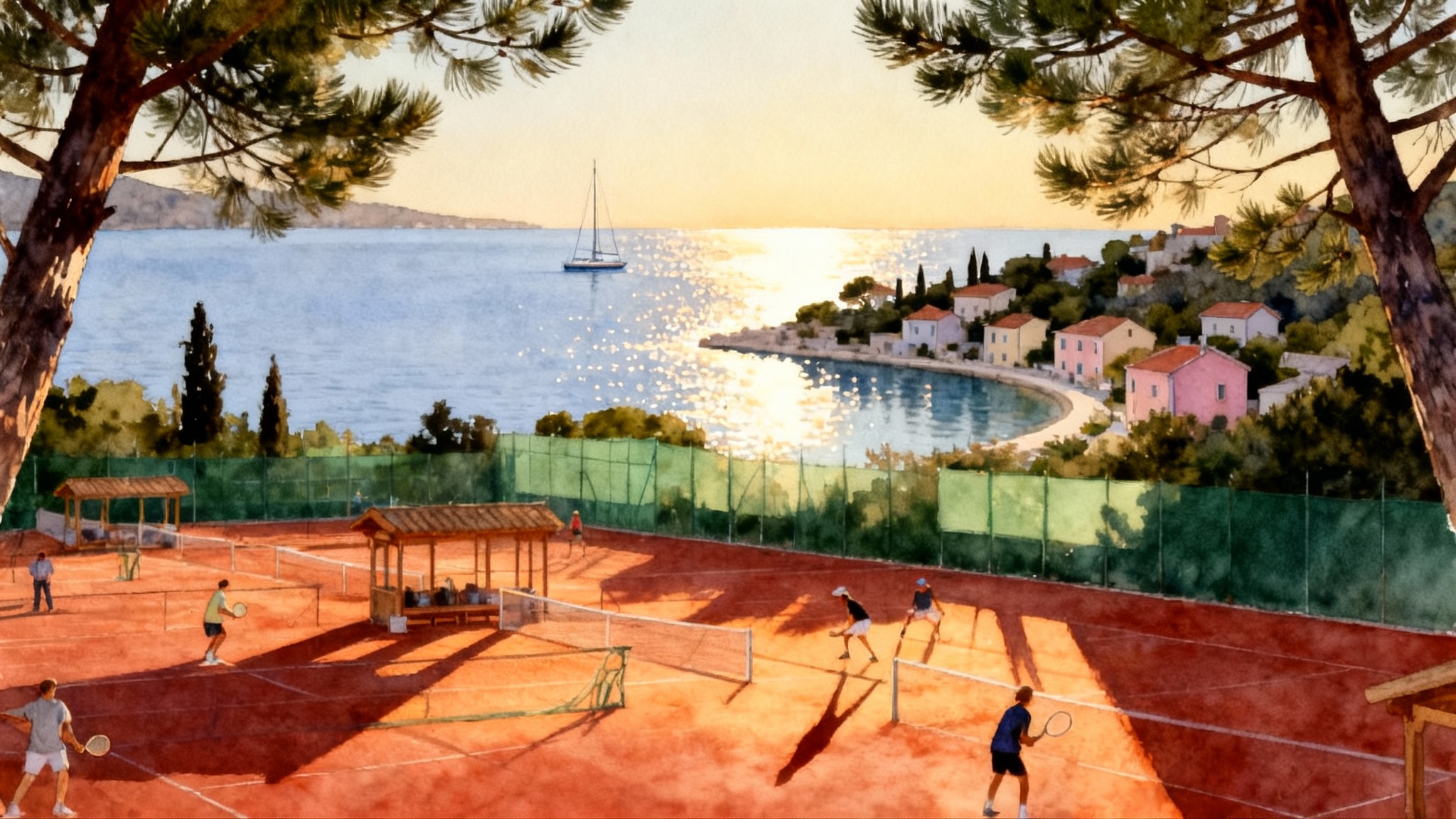
Why Veli Lošinj is a climate-first tennis base
Picture a narrow, sunlit inlet on Croatia’s Kvarner Gulf where pine forests meet cobalt water and the afternoon wind gives your serves a natural lift. That is Veli Lošinj. The island sits at the hinge of the northern Adriatic, exposed to open water on one side and protected by the silhouettes of Cres, Krk, and the Istrian Peninsula on the other. This position matters to tennis players because it shapes temperature, humidity, and wind in your training window from May to September.
Two regional winds define how the island breathes. Bora, a cool, dry northeasterly, arrives in gusty spells after frontal passages and clears the sky with crisp visibility. Jugo, a warm southeasterly, brings moisture, gentle swell, and a softer, more humid feel. On Veli Lošinj, the tug of these winds plus maritime exposure keeps midday highs more temperate than many inland courts on the continent, and the afternoon breeze is reliable enough to plan footwork and ball-flight drills that simulate match turbulence. For a quick primer on these winds and why they feel so different on court, see the Croatian meteorological guide to Bora.
From late spring through high summer, the sea acts like a thermal flywheel. May feels like a light jacket in the morning and short sleeves by lunch. June is reliably warm without the sharp heat spikes common in inland Europe. July and August are comfortably hot, yet a late afternoon session usually enjoys a cross-court breeze that keeps the baseline playable. By September, the island settles into golden hours, warm seas, and evenings that reward a walk through the port after recovery.
Where you will train
Ljubicic Tennis Academy profile operates in Veli Lošinj with a mix of red clay and hard courts, so you do not have to choose between learning how to slide and learning how to brake. The academy’s clay work dials in balance and patience, while hard-court blocks teach acceleration, first-step speed, and aggressive court positioning. The site has the essentials players want for productive weeks: well kept surfaces, modern ball machines, basket-fed repetitions without distractions, and coaches who can translate Ivan Ljubicic’s blend of timing, economy of motion, and problem solving into actionable drills.
The physical environment helps. Look around during changeovers and you will see Aleppo pines framing the courts and the sea beyond. The setting is not just postcard pretty. The shade keeps the surface temperature manageable during July and August, and the sea breeze trims the edges off humidity that would otherwise sap your legs late in a set. That is why a climate-first island can be a performance-first base.
The Bora and Jugo advantage, explained simply
Think of your match as a sailboat race.
- When Bora is active, the air is drier and crisper. Balls travel a touch faster, your legs feel lighter, and topspin kicks a bit higher. This is a great window for serve plus one patterns, deep crosscourt forehand targets, and the fast footwork that supports taking time away.
- When Jugo edges in, the ball can feel a fraction heavier and the bounce a bit fuller. This favors clay work: high-arc rally tolerance, touch volleys, and return-of-serve depth control. It also rewards endurance and patience.
Training through both winds on the same island builds adaptability without the travel fatigue of switching regions. For a useful comparison in another wind-influenced location, see our San Diego marine layer tennis.
Month-by-month: when to book and what to expect
Here is a practical booking guide for May through September 2026. Temperatures are typical ranges, but plan for breezy afternoons and seawater that warms steadily into mid summer.
- May: Book 8 to 12 weeks out. Expect mild mornings and warm afternoons, with sea temperatures still fresh. Ideal for clay fundamentals, aerobic base, and footwork patience. Hard-court sprints feel snappy in the drier air after a Bora spell.
- June: Book 10 to 14 weeks out, especially if you want a weekend arrival. Air is warm, seas inviting, and the day length generous. Alternate clay pattern work with hard-court acceleration. Evenings are perfect for mobility and light jogs along the waterfront.
- July: Book 12 to 16 weeks out and lock your court times. Warm to hot, but the afternoon breeze often saves the second session. Use early mornings for high-intensity intervals. Afternoons can be live-ball points or serve plus return blocks with long rest.
- August: Book 12 to 16 weeks out and consider a Monday or Tuesday arrival to dodge peak weekend flows. Expect similar warmth to July. Clay in the morning for precision and legs, hard court in late afternoon for speed and first-strike rhythm.
- September: Book 6 to 10 weeks out. Days are warm, seas still pleasant, and the island exhale begins. Great for a consolidation block before autumn tournaments or a technical reset after the summer swing.
How to get there: ferries, flights, and smooth transfers
You have two practical gateways: Rijeka and Zadar. Both connect you to Veli Lošinj without complicated hops.
- Via Rijeka: Fly into Rijeka Airport on the island of Krk or into Zagreb then transfer by road to Rijeka. From Rijeka, you can take a fast catamaran or a combination of road and short ferry across the Kvarner islands before driving over the small swing bridge at Osor to Lošinj. The catamaran lands at Mali Lošinj, a short transfer to Veli Lošinj.
- Via Zadar: Fly into Zadar, then ride a seasonal catamaran north to Mali Lošinj or drive up the coast to the ferry connection for Cres, continuing by road to Lošinj. Buses also connect coastal hubs with island towns in summer.
Summer sailings sell out on popular days. As soon as you book the academy, reserve your catamaran or car-ferry segment through Jadrolinija’s official booking. Pack a soft duffel rather than a hard suitcase, since catamarans and island buses handle soft luggage more gracefully. If you are traveling with a racquet bag, fit it with a simple name tag and a bright ribbon so it is obvious on the dock.
A 7-day train-and-recover plan that uses clay and hard courts
This plan blends Ljubicic-style tactical clarity with climate-aware scheduling. Adjust the start day to fit your ferry or flight.
- Day 1, Arrival and activation: Afternoon 60 minutes light mobility, band work, and shadow swings in the pine shade. Evening 45 minutes on clay, half-court patterns, crosscourt forehands, and neutral backhands. Finish with 10 minutes of easy serves to 3 targets. Swim 8 to 12 minutes in the sea before dinner to cool core temperature and improve sleep.
- Day 2, Clay foundation: Morning 2-hour clay session. Themes: depth over the middle, rally tolerance to 30-ball ladders, and drop-shot disguise. Add return of serve from body targets. Afternoon 45 minutes footwork ladders and split-step timing, then an easy jog along the waterfront. Mobility in the evening.
- Day 3, Hard-court speed: Morning 90 minutes on hard court. Themes: first-step acceleration, 1-2 combinations off the serve, and redirecting pace on the backhand line. Finish with 20 minutes of basket serves, 40 total with full routine. Afternoon 60 minutes of guided recovery: contrast shower, light stretch, and a pine-forest walk with nasal breathing. Short swim if seas are calm.
- Day 4, Clay matchcraft: Morning 2-hour clay session. Themes: patterns to break symmetry, forehand inside-out to backhand corner, and short-angle creation to bring opponents forward. Afternoon 60 minutes point play on clay, first to 11 with serve starts alternating. Finish with 10 minutes of volleys and overheads. Evening legs up, hydration, and calm breathing.
- Day 5, Hard-court power and precision: Morning 90 minutes on hard court. Themes: flatter forehand drives through the middle, return plus stretch volley, and second-serve aggression. Serve targets to all corners, 60 reps. Afternoon 45 minutes hill strides up from the waterfront, then a long easy swim along the rocks to flush the legs.
- Day 6, Mixed-surface rehearsal: Morning 2.5 hours, first hour on clay for control, second on hard for pace, final 30 minutes alternating every 5 games to force adaptation. Afternoon matchplay on the surface that matches your next tournament. Film 30 minutes for coach review.
- Day 7, Taper and test: Morning 75 minutes test set on your primary surface with a focus on routines. Measure consistency with a simple metric: balls over the middle third to a deep target. Afternoon off. Sunset walk through Veli Lošinj and easy dinner.
Session notes: Keep carb intake steady at lunch between doubles of training. Use shaded areas for changeovers. When the afternoon breeze picks up, embrace it as a feature, not a bug. Practice body serves into the wind and slice serves with the wind at your back to learn how it shapes the kick.
Sea-and-pine recovery that actually improves performance
Recovery here is tangible, not theoretical. The sea is your on-demand ice bath with better scenery. After high-intensity mornings, spend 8 to 12 minutes in the water at a comfortable but bracing temperature, focusing on calm nasal breathing and a long exhale. This lowers perceived exertion for the afternoon and improves sleep quality. On windier days, pick a sheltered cove on the leeward side of the inlet and keep your immersion short and steady.
The pine forest is your natural aromatherapy chamber. Walk 20 to 30 minutes under the Aleppo pines in the late afternoon. Keep the pace conversational. Inhale through the nose for four counts, exhale for six, and let the resin scent do the rest. Finish with 10 minutes of ankle and hip mobility on the shaded court or a quiet stretch deck. If you bring a light snorkel and mask, a gentle look at the seabed after practice is the most enjoyable cooldown you will ever fit into a training plan.
Aligning academy blocks with your 2026 tournament calendar
- Preparing for late spring clay: Book a May block that is clay heavy with one hard session every other day. Emphasize rally tolerance, serve placement over power, and sliding into the hit rather than through it. Use Bora spells to add a bit of zip to serves and to rehearse defense-to-offense transitions in faster air.
- Transitioning after grass: If your grass swing ends in early July, take a 7 to 10 day block in mid July with half your work on hard court. Keep first-step acceleration and serve returns crisp. Retain some clay rhythm by opening sessions on red clay where the ball sits up and rewards full swings.
- Building for the summer hard-court swing: July and early August are your window to harden the legs for back-to-back matches. Keep mornings fast and technical on hard court, with refined patterns like serve plus deep backhand, then forehand attack to space. In the afternoon, use either shorter point play on hard court or long diagonals on clay to maintain control. Two weeks out from your main event, taper volume and hold intensity.
- September consolidation: After the hard-court peak, a September week on Veli Lošinj can knit technique back together. Use clay to rebuild feel and reduce joint load. Keep hard-court touches small but sharp, focused on serve rhythm and first ball.
You get the best of both worlds. A Mediterranean base that teaches you to handle wind, and a surface menu that lets you switch without leaving the complex.
Avoiding the French Riviera crowds without sacrificing quality
Veli Lošinj is an answer to a familiar dilemma. You want Mediterranean weather and water, but you do not want to queue for every court hour or weave through overcrowded promenades. In peak weeks you will still feel summer energy, but you can find an empty morning path through the pines and book late afternoon courts without a week-long wait list. For context on a busier coast, compare our French Riviera tennis 2026 guide. Accommodation, meals, and transfers tend to be simpler to confirm here, and coach attention stretches further because the academy is built around purposeful sessions, not constant spectacle.
Practical packing for an Adriatic training week
- Footwear: One clay-specific pair and one all-court pair. Rotate daily to keep midsoles responsive.
- Strings and tension: Bring at least two pre-strung frames and your preferred string for on-island restringing. Clay blocks pair well with a touch lower tension, hard blocks with your match tension.
- Sun and wind: A light cap with a secure back strap, wraparound sunglasses, and a breathable long-sleeve for midday walks.
- Hydration: Electrolyte packets with a clean ingredient list for morning and afternoon sessions. Plan one packet per hour on court in July and August.
- Recovery: Compact massage ball, light resistance bands, and a quick-dry towel that can live in your daypack for sea dips.
- Travel: Soft duffel with a small racquet bag that fits overhead on most regional aircraft and catamarans.
Sample day using the wind to your advantage
- Morning when it is calmer: Technical accuracy on clay. Work through crosscourt depth with 20-ball ladders, then serve targets.
- Afternoon when the breeze builds: Hard-court serve and return. Practice into-the-wind body serves and with-the-wind wide sliders. Finish with 15 minutes of improvised points where you can call “wind switch” mid rally to rehearse adjustments.
That simple habit builds match resilience. You will leave with a clear sense of how to aim higher over the net tape into the wind and how to flatten drives when it stiffens behind you.
Booking checklist in three lines
- Pick your month and lock courts 2 to 4 months ahead depending on July or August demand.
- Reserve ferries or catamarans once your academy dates are set through the national operator’s site.
- Set a surface ratio that matches your next tournaments and stick to it.
Final thoughts
Tennis players talk about training smart. Veli Lošinj lets you feel what that actually means. You wake to pine shade and mild air, train on clay to build control, switch to hard court to harden your first step, then cool down in clear water that keeps your next session honest. The winds add texture without chaos. The logistics are simple enough to execute, and the crowds are light enough that your focus stays on the ball. If 2026 is the year you build a summer block that carries into real results, book the week, trust the breeze, and let the island turn your practice into confidence.