Austin Hill Country Tennis 2026: Mild Winter Base at Legend
Trade Florida and Arizona for Austin’s Hill Country. In Spicewood, Legend Tennis Academy offers covered, lighted courts and a junior pathway, mild winter training windows, Central Texas tournaments, and Lake Travis plus Austin perks.
 Tommy
Tommy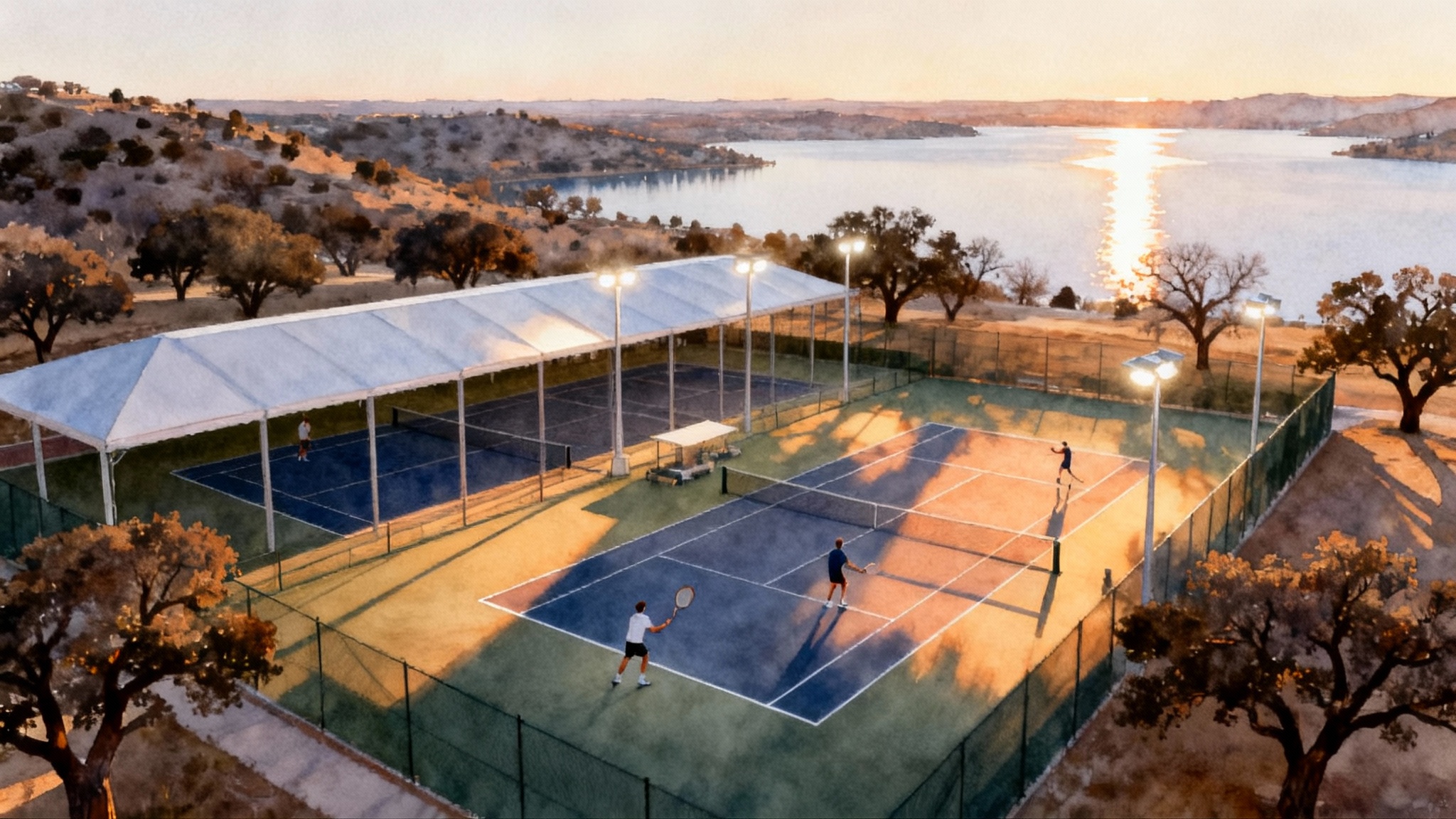
Why the Hill Country belongs in your winter tennis plan
If you want crisp, dry air, fast courts, and fewer crowds from November through March, Austin’s Hill Country is a smart pivot from Florida and Arizona. For desert-season specifics, see our Phoenix and Scottsdale winter playbook. Spicewood sits on the western edge of Lake Travis, where limestone hills hold heat during the day and the nights cool enough for refreshing recovery sleep. Winter high temperatures often land in the low to mid 60s Fahrenheit with low humidity, while the rainiest stretches cluster in spring and early fall, not in the dead of winter. For a data check, scan NOAA Austin climate normals.
The new hub for players who want to turn that weather into a true training block is Legend Tennis Academy in Spicewood. Legend’s covered, lighted courts keep your sessions rolling through a midday sprinkle or an early evening chill, and its junior pathway makes the calendar simple for families who care about both skill development and verified match play.
Climate windows that work for training
Think in windows, not just months. Tennis performance depends on temperature, daylight, and wind, and the Hill Country gives you predictable ranges that you can plan around.
- Late October to early December: Daytime highs often reach the 60s, with cool mornings in the 40s. Humidity is low compared to Gulf Coast locations. Courts play quick in the afternoon once the surface warms.
- Early December to early March: The core mild winter block. Expect many bluebird days in the upper 50s to mid 60s. Cold fronts do arrive a few times each month, but they are short. Covered, lighted courts at Legend protect both training volume and quality when the forecast flips.
- Mid March to mid April: Shoulder season. Temperatures rise into the 70s, and wildflowers line the roads. Thunderstorms begin to pop up more often later in the spring, so keep a flexible session order.
Practical planning tips:
- Book doubles blocks for the chilliest mornings and shift singles intensity to midafternoon when the courts and muscles are warm.
- Keep a wind plan. If gusts pick up, move to serve plus first ball patterns on the most wind-sheltered court and save high-toss rhythm work for calmer days.
- Pack layers. A thin merino base layer and a midweight jacket will cover 90 percent of mornings. Peel down by noon.
Meet Legend Tennis Academy, Spicewood
Legend Tennis Academy is built for high-usage winter training. The covered, lighted courts extend playable hours into the evening without the glare or slickness that can wreck footwork. Courts drain quickly, so a passing shower does not erase your day. The staff runs a clear junior pathway that actually connects the dots:
- Red to Orange to Green Ball progressions with objective skill benchmarks and on-court evaluations every six to eight weeks.
- Yellow Ball transition squads that introduce six to eight game set play and structured point patterns, not just open hits.
- Verified match play aligned with Universal Tennis Rating. Universal Tennis Rating is the global scale that rates a player’s competitive level based on results and opponent strength. Legend schedules weekly counts-for-rating matches so families do not spend every weekend in the car.
- Tournament travel support to key United States Tennis Association events. United States Tennis Association governs much of the official junior and adult competitive calendar in the United States. Staff help with event selection, entries, and warm up courts.
For adults, the academy runs technical tune ups, point play ladders, and shoulder health sessions that fit around work hours. The covered and lit setup makes 7 a.m. and 7 p.m. equally realistic.
A sample Legend training week
Use this template as a starting point. Adjust volumes by age, training age, and current match load.
Monday
- 8:00 a.m. Movement prep and mobility. Hinge and ankle work, mini-band series, three ten second acceleration buildups.
- 8:30 a.m. Technique block. Serve foundations, toss height calibration, second serve shape, and ad court slice.
- 10:00 a.m. Neutral ball drilling. Crosscourt patterns with depth targets, two up one back timing.
- 3:30 p.m. Strength and recovery. Split squat and pull patterns, isometric external rotation, ten minutes of diaphragmatic breathing.
Tuesday
- 8:30 a.m. Patterns of play. Deuce court first strike, inside out forehand plus transition, approach and first volley.
- 10:30 a.m. Match play. Two sets to four with tiebreaks, live charting of first serve percentage and plus one location.
- 4:00 p.m. Video review. Forty five minutes on serve rhythm and return starting positions. Upload notes to your player folder.
Wednesday
- 9:00 a.m. Conditioning. Court intervals with change of direction. Ten by twenty seconds on, sixty seconds off.
- 10:00 a.m. Doubles systems. I formation signals, front court poach cues, and return side selection.
- Afternoon off. Lake Travis walk, light mobility, and hydration.
Thursday
- 8:30 a.m. Live ball point construction. Two cross one line. Transition volley targets. Overhead footwork on short lobs.
- 10:30 a.m. Serve plus two. Deuce and ad patterns under time pressure. Ten point super tiebreaker at the end.
- 3:30 p.m. Strength. Push patterns and triceps tendon care. Finish with sled drags or hill walks.
Friday
- 8:00 a.m. Pre tournament hit. Sixty minutes of serve and return, twenty minutes of point starts, no grinding.
- 10:00 a.m. Flex slot. If there is a cold front, use Legend’s covered courts for the entire block.
- Early night. Pack bags and snacks and set navigation for the venue.
Saturday and Sunday
- Tournament play or in house verified matches. Warm up at Legend or the event site, compete, and cool down. If you go out early, schedule a light Sunday hit that focuses on the weakest pattern from the match.
That rhythm keeps total weekly court hours near the sweet spot for winter blocks without grinding into fatigue. Parents appreciate that the heaviest lifting sits Monday to Thursday, so weekends can flex between tournaments and rest.
Central Texas tournaments within a morning’s drive
Spicewood is a hub. Within ninety minutes you can reach a web of United States Tennis Association and Universal Tennis Rating events across Austin, Lakeway, Cedar Park, Round Rock, Georgetown, San Marcos, New Braunfels, and San Antonio. That means you can keep level-appropriate match play without flying or crossing half a state.
How to make the calendar work for you:
- Set your four week arc. Pick one primary event weekend and one backup weekend. Use Universal Tennis Rating verified matches at Legend on the other Saturdays.
- Enter early. United States Tennis Association draws in Texas often fill days ahead. Start with the statewide listings at the USTA Texas tournament calendar and filter for Central Texas.
- Map your drives. Spicewood to Round Rock is roughly one hour with normal traffic. Spicewood to San Antonio north side venues sits around ninety minutes. Plan a spare route that avoids downtown Austin at peak times.
- Track ratios. If you are under twelve years old, aim for two training days for every competition day. If you are under sixteen years old at a performance level, try a three to one ratio in winter to bank technique gains.
Where to stay near Lake Travis
Your choices cluster around water and hillside neighborhoods where mornings are quiet and evenings get pink skies.
- Lakeway and Bee Cave. Access to groceries, coffee, and casual dining, with short drives to Legend. Many rentals include outdoor grills, which helps food cost control.
- Briarcliff and Spicewood proper. Closer to the academy and often tucked among oaks. You may trade walkability for space.
- Resort style stays. Properties above Lake Travis offer pools and hot tubs. That is recovery gold after a cold front day. Ask for a unit with a washer and dryer so you can travel with fewer layers.
Booking advice:
- Look sixty to ninety days ahead for January and February. Rates are lower than spring break and summer lake season, but the best floor plans go first.
- Ask hosts about parking and storage for ball baskets, portable nets, and a foam roller. A small garage or secure storage closet is worth it.
- If you plan to split housing with another family, match bedtime and wake times. A 5:45 a.m. alarm and a midnight musician do not mix.
Getting there and getting around
Austin Bergstrom International Airport is the main gateway. Nonstop flights connect most major hubs in the United States. Spicewood sits to the west of Austin, so budget extra time when landing during rush hour. A compact sport utility vehicle with winter tires in good condition handles Hill Country roads well, and the extra cargo space makes tournament days simpler.
Tips for smooth travel days:
- Pack two racquets, twelve new balls for warm ups, and a small hand pump if you like a specific pressure feel.
- Keep a foldable chair and a blanket in the trunk for parents and players between matches.
- Save a pin for the nearest supermarket to every venue you plan to visit. Re stocking fuel and water becomes a non event.
Cost and crowd comparisons: Austin vs Florida vs Arizona
Families often ask for numbers. Prices move with the calendar, but winter in the Hill Country usually delivers strong value against the coastal and desert magnets. The ranges below reflect typical quotes we have seen as of January 2026. Always confirm current rates when you book.
Training and court time
- Legend group training block per week: often in the 450 to 700 dollar range depending on age group and hours. Private lessons typically 85 to 120 dollars per hour.
- Public court access in surrounding towns is widely available and often free or very low cost, which is rare in many Florida beach towns and resort corridors in Arizona. For a beach-front winter comparison, read our Naples winter tennis guide.
Lodging
- Lake Travis area winter rentals often list below their March to May rates. Many two bedroom homes run in the 110 to 180 dollars per night range in January, with higher rates as you approach spring break.
- Florida beach properties and Phoenix Scottsdale golf corridor units often command higher winter premiums. Similar square footage can price higher, and parking fees are more common.
Flights and cars
- Winter fares into Austin are often competitive because capacity is spread across business and leisure traffic. Many players can keep roundtrip tickets near 150 to 350 dollars from central United States hubs when booked early.
- Rental cars at Austin usually run 45 to 70 dollars per day in winter for a compact sport utility vehicle. Island or resort markets in winter may run higher.
Crowds and time cost
- Venue congestion is the hidden tax on training. In Florida and Arizona winter peaks, many clubs run at capacity, which can push matches into late evenings. Hill Country venues and Legend’s covered courts give you more consistent start times and fewer schedule dominoes.
- Traffic time matters. A thirty minute drive to a venue that actually starts on time beats an hour in heavy traffic to a court that sits behind schedule.
How to convert those comparisons into action:
- Book the training block first, then build the tournament map around it. Let the technical plan drive the calendar.
- Reserve housing with a flexible cancellation window. Watch airfare for seven to ten days, then lock in when you see a reasonable fare.
- Budget a small contingency for extra private lessons or a backup tournament entry. That keeps your week bulletproof if weather or draws change.
Food and music between sessions
Part of the point of winter tennis travel is the recovery time outside the fence. Austin gives you easy wins.
- Breakfast tacos after the early session. Look for spots that open before seven. Eggs, potatoes, and salsa hit the macro targets without slowing the next hit.
- Texas barbecue for a protein forward lunch on recovery day. Keep portions moderate if you practice in the afternoon.
- Live music on South Congress or in warehouse districts on weekend nights. Book early sets so players can stay on schedule.
- A scoop of Hill Country ice cream on a Sunday after the last match if you hit your process goals for the week.
How Legend fits into a winter block
Legend’s advantage is predictability. With covered, lighted courts, your core hours sit on the calendar and stay there. The junior pathway organizes progress across months, not days, so you can spend less time chasing events and more time building skills that convert inside points. Parents get a clear sequence of benchmarks to review every six to eight weeks.
If you build a three to six week block, think in themes:
- Week one: rebuild foundations. Serve rhythm, return base, neutral rally height.
- Week two: add pressure. First strike patterns and transition footwork.
- Week three: solidify. Serve plus two under time pressure and doubles systems.
- Week four and beyond: rotate in higher volume match play on weekends and keep two targeted technical sessions midweek.
Quick checklist for a mild winter base
- Training: reserve Legend group block and two private lesson slots per week.
- Match play: enter one United States Tennis Association event and one backup weekend, plus two in house verified matches.
- Housing: book a Lake Travis rental with washer, dryer, and space for recovery gear.
- Gear: two racquets, twelve new balls, bands, lacrosse ball, and a small cooler for match days.
- Logistics: map drive times to likely venues and save a spare route for each.
- Health: pack hydration tabs and a light jacket for morning warm ups. Central Texas mornings can be crisp even on sunny days.
The bottom line
Winter training works best when weather, courts, and calendar add up to a week you can repeat. Austin’s Hill Country delivers dry, temperate days that make strokes feel crisp and recovery feel easy. Legend Tennis Academy in Spicewood turns that weather into reliable court time with covered, lighted courts and a junior pathway that simplifies match play choices. Add Lake Travis mornings, short drives to Central Texas tournaments, and a food and music scene that keeps families smiling, and you have a base that holds up across the whole season. If you want a mild winter plan that trades chaos for clarity, set your calendar to the Hill Country and let Legend carry the load where it matters most: time on court and progress you can measure.