Belgrade to Munich: How Niki Pilic Academy Forged Djokovic
From Jelena Gencic’s fundamentals in Belgrade to the Pilic Academy’s grind near Munich, this is the real pathway that sped Novak Djokovic’s jump to the ITF and ATP levels, plus a practical checklist families can use today.
 Tommy
Tommy
The road from Belgrade to Munich
Every great player has a stretch of road where the scenery changes and the engine starts to purr. For Novak Djokovic, that stretch ran from the cracked public courts and converted indoor spaces of Belgrade to a structured, competition-dense academy near Munich. Before the Grand Slam trophies and the record weeks at number one, there was a simple progression: foundational craft with Jelena Gencic in Serbia, then a family decision at age 12 to enter the disciplined world of the Niki Pilic Academy in Germany. That move did not sprinkle magic dust. It plugged a talented junior into systems that multiplied his repetitions, exposed him to older and stronger sparring partners, and taught him to live like a professional long before his first ATP point.
This article maps the pathway and then translates it into practical criteria any family can use to decide when a player has outgrown local training and what to demand from an academy.
The Gencic foundation: craft before complexity
Jelena Gencic built Djokovic’s early game around simple, repeatable ingredients. Think of it like learning to play a violin in tune before tackling the concerto. The cues were clear and concrete: balanced ready position, long rally tolerance, and a love of the ball. Sessions mixed high volumes of controlled rallying with competitions that looked and felt real, with ball kids, linespeople, and a final that mattered. Djokovic learned to treat every ball as an event. He learned to focus through noise and logistics, since Belgrade courts in the 1990s were not luxury facilities. This early scarcity sharpened attention and built a bias toward problem solving.
Two other Gencic fingerprints show up in Djokovic’s adult game. First, the insistence on complete strokes and footwork patterns before power. An elegant takeback, early preparation, and a two-handed backhand that stayed stable under pressure. Second, the integration of mind and body in every session. Gencic famously treated practice as a full person exercise, not just grinding forehands. That habit becomes critical when a player later faces long academy days and a travel-heavy schedule.
The family pivot at 12
By 12, Djokovic had essentially drained the local pond. He needed denser match play, stronger opponents, and better access to competition. The family chose the Pilic Academy near Munich. This was not a romantic decision. It was a trade, exchanging comfort for structure. The timeline is not guesswork. The official ATP biography confirms that he attended Niki Pilic Academy at 12. The move aligned the realities of high-level junior development with the family’s appetite for sacrifice.
Why age 12 matters: growth curves in tennis tend to bend sharply between 11 and 15. If a player has the basics and discipline to handle more volume, these years pay compound interest. You do not need perfection to make the leap. You need the right inputs in the right dose.
What the Pilic Academy added
Picture four levers that matter for the jump from local success to ITF Juniors and eventually to ATP or WTA: volume, variety, velocity, and verification.
- Volume: More balls struck and more sets played per week, with minimal downtime. Academy schedules push total on-court hours forward and create multiple practice windows each day.
- Variety: Surfaces rotate, sparring partners change, and the practice menu includes drills, constrained point play, and full sets. Variety simulates the unpredictability of tournaments.
- Velocity: The speed of ball, speed of decision, and speed of recovery are all higher when you train with older, stronger players. That forces technical efficiency.
- Verification: Constant internal competition and frequent external tournaments supply feedback. Results and video tell the truth. Coaches cannot hide behind stories.
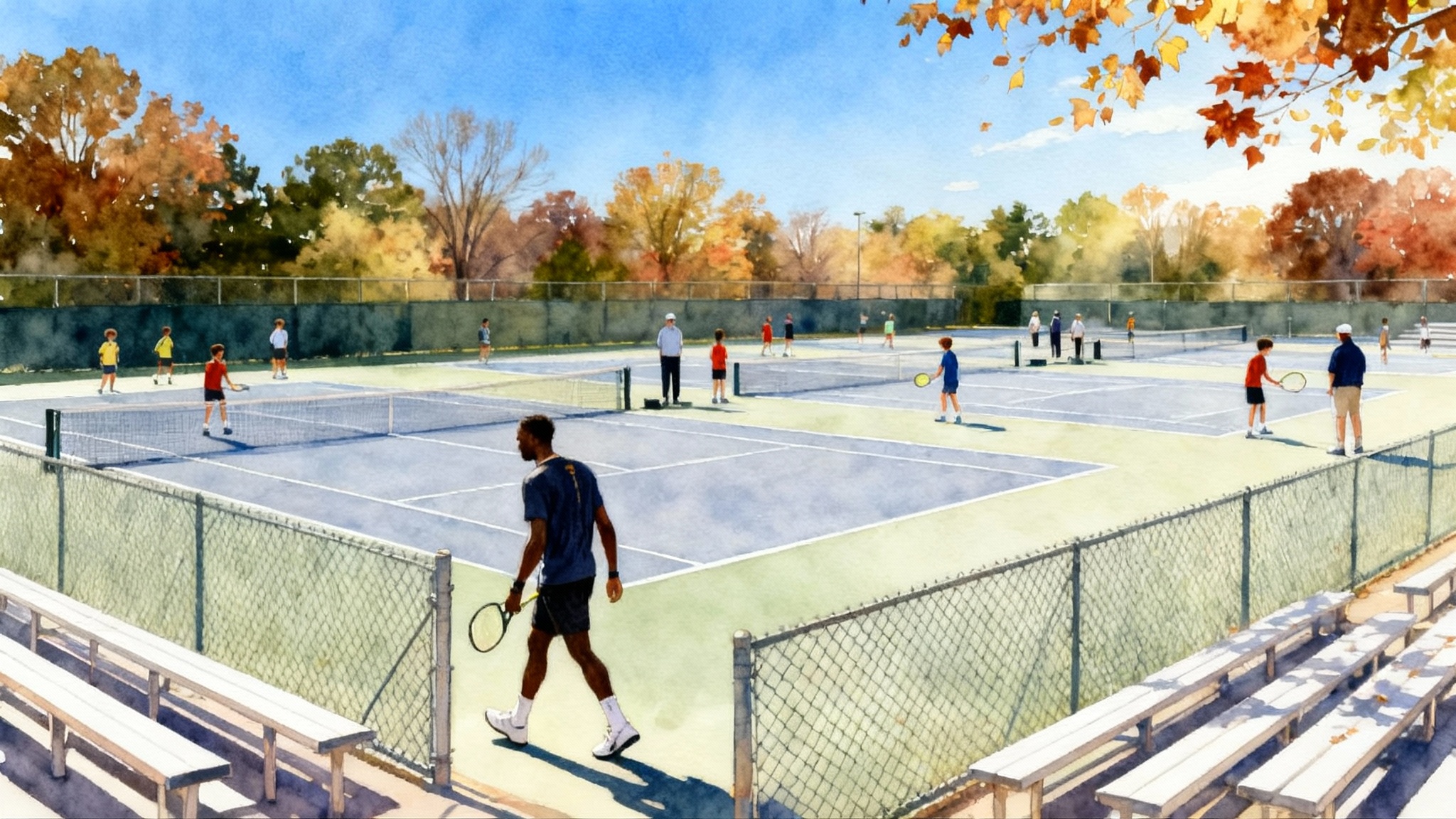
The Pilic Academy was a lever house. Djokovic trained with players several age groups above him. Coaches set up multi-surface sessions that cycled between clay and hard. The weekly pattern favored a high number of live points, not just basket feeding. On-court work plugged into a gym program that cared about mobility, durability, and sprint mechanics as much as strength. This did not just build shots. It built habits: how to warm up, how to cool down, how to show up each day ready for load.
The hidden accelerators
Environment matters. Moving to Germany dropped Djokovic into a different day-to-day culture. Punctuality was nonnegotiable. Training blocks started on time and ran to completion. That reliability compounds performance. So does logistics. Access to nearby national events and cross-border tournaments meant fewer dead weeks and more purposeful competition. Families exploring German training options today can find compact, high-touch programs like ToBe Tennis Academy in Germany that echo these cultural advantages.
Language was another accelerator. Djokovic picked up working German and improved his English. That unlocked more coaching perspectives and prepared him for global travel. Players who can think and receive feedback in more than one language adapt faster to new coaches and match environments.
Finally, older sparring partners did not just hit bigger balls. They modeled professionalism. How to handle a small injury without drama. How to plan practice to peak on a match day. How to travel with a simple kit and still meet every performance need.
Pivotal choices and how they work
- Leaving home young: This choice increases exposure to higher-quality inputs at the cost of comfort. Mechanism: neuroplastic windows during early adolescence let movement patterns and tactical heuristics set deeply. The earlier you see adult pace and spin, the less your body treats it as foreign.
- Embracing a travel-heavy calendar: This teaches energy budgeting and matchday routines under variable conditions. Mechanism: frequent transitions create stress, which forces better recovery strategies and mental flexibility.
- Prioritizing holistic fitness and mental work: Elite academies integrate strength, mobility, conditioning, nutrition, and sports psychology into the week. Mechanism: the body can only express skill at the speed that movement quality and energy systems allow, and the mind unifies those systems under pressure.
You can see the same developmental logic in other top-case pathways, including how Piatti built No. 1 Sinner.
Repeatable patterns families can use
These are the signs your player has likely outgrown local training:
- Practice quality stalls because suitable sparring partners are scarce. Sessions feel like a clinic rather than a contest.
- The player wins local 14 and under tournaments routinely or holds a 70 percent win rate against older regional opponents.
- Surface exposure is limited to one or two courts, usually the same indoor hard, and the player struggles when traveling to clay or faster hard.
- There is no integrated fitness or recovery plan. Gym sessions are random and do not reflect the match calendar.
- Tournament weeks are separated by long, unstructured gaps that waste momentum.
When you see three or more of the above for a full season, it is time to evaluate academies.
What to look for in an academy’s daily program
Use this checklist to interrogate the program. Ask for specifics, not brochures.
- Coaching continuity: Who is the lead coach on court with your player most days and how many athletes do they carry? What is the coach-to-player ratio in live ball sessions and in technical blocks?
- Surfaces and scheduling: How many surfaces are available weekly and how often does the program rotate your player across them? A simple standard is two to three surfaces per month for juniors targeting international play.
- Match play density: How many live sets per week, recorded and charted? Look for two to four competitive set blocks across the week, with varied scoring formats that simulate tiebreakers and deciding sets.
- Integrated strength and conditioning: Is there a written plan that periodizes strength, power, speed, and mobility? Ask how they test movement quality at intake and at six-week intervals.
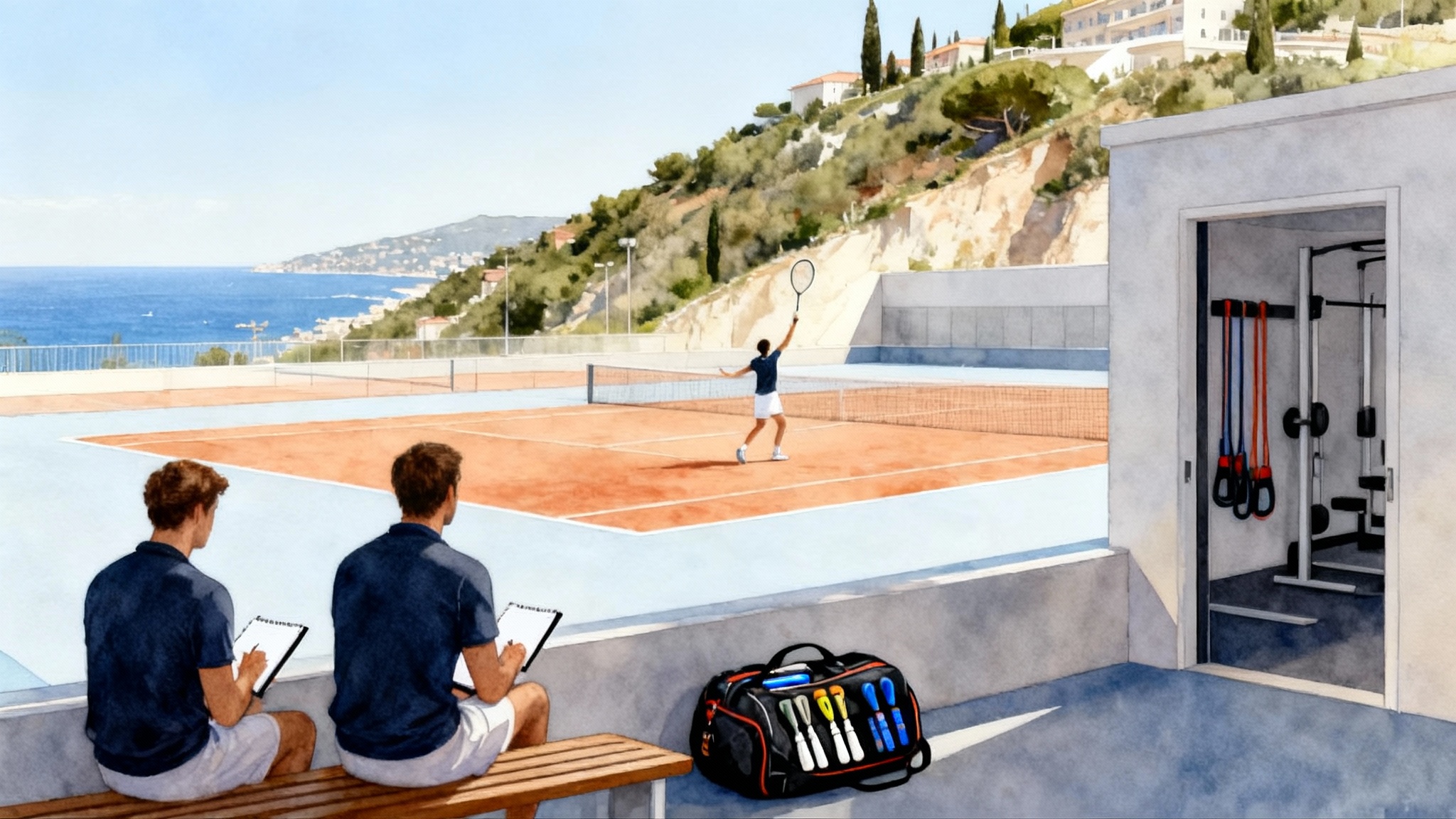
- Prehab and medical support: Do they screen shoulders, hips, and spine proactively? Is there access to a physio who understands tennis loads and travel scheduling?
- Video and data: Are practice sets and matches recorded and reviewed with the player? What tactical metrics do they track, such as first strike patterns, return depth, and rally length buckets?
- Education and life structure: For younger athletes, how do they integrate schooling with training and travel? What is the policy on study spaces, tutors, and exam schedules?
- Communication cadence: How often will you receive objective updates, not just adjectives? A monthly report should include data, video clips, and a clear next block focus.
Building the right competition calendar
Effective calendars group tournaments to preserve energy and capture momentum. This is a simple model for a 13 to 16 year old hoping to transition to ITF Juniors:
- Cluster by surface: Two to three tournaments in a row on similar surfaces so technical adjustments stick. For inspiration on sequencing, study how successful teams like those behind Carlos Alcaraz staged progress in Equelite built Carlos Alcaraz.
- Plan buffer weeks: After a three-week cluster, run a reload week with lower on-court volume and targeted gym work. Do not drift into two full off weeks with no purpose.
- Step up the level gradually: Mix national events with entry-level ITF J tournaments, then add higher J grades as results warrant. Keep confidence builders in the plan.
- Travel logistics: Use transit days wisely. Short hit after arrival, then a full practice day, then match if possible. Protect sleep at all costs.
Structure like this is visible in Djokovic’s early timeline. His own site recounts the back-and-forth between Serbia and Germany across his early teens, which kept progress steady without overexposing him to burnout. See Djokovic’s 1999 timeline for how the family phased stays in Munich with returns to Belgrade.
A sample academy week that works
Use this as a template to evaluate schedules. It is not perfect for every athlete, but it reflects the demands of international junior tennis and the habits Djokovic built in Germany.
- Monday: Morning 90 minutes technical block on clay, focusing on depth and height. Midday gym with movement prep, acceleration work, and posterior chain strength. Afternoon 60 minutes of live points starting plus one patterns and return plus one. Ten minutes of serves at the end.
- Tuesday: Morning indoor hard, 75 minutes of serve and first ball drills, then 45 minutes of tiebreaker sets to seven. Gym with upper body push pull balance, shoulder care, and trunk rotation. Recovery with mobility and soft tissue.
- Wednesday: Morning fitness circuit emphasizing change of direction and repeat sprint ability. Afternoon two fast sets with an older sparring partner, then 30 minutes of video review and tactical debrief.
- Thursday: Morning clay again for defensive skills and transition offense. Gym with power emphasis using medicine ball and light Olympic derivatives appropriate to age. Evening mental skills session that includes match routines, between-point resets, and journal work.
- Friday: Match rehearsal. Best of three sets with full changeovers, officials if possible, and strict equipment protocols. Post match recovery and light mobility.
- Saturday: Tournament or off-site friendly matches. If no competition, run a short hit, then 45 minutes of serve plus return games, then recovery.
- Sunday: Rest or light walk, optional flexibility work, goal setting for the coming week.
Key notes:
- Every on-court block ends with a micro habit like serves to targets or return depth ladder. This adds thousands of extra key reps across a year.
- The week alternates surfaces so footwork adapts. Djokovic’s academy years leveraged this rotation to make his movement universal rather than surface-specific.
- Video review is short but frequent, which is more effective than occasional long sessions.
Bridging to ITF and ATP
Two ingredients help the jump from academy sets to international points. First, exposure to older, higher level sparring partners. These players deliver ball speeds and patterns that force anticipation and compact technique. Second, a clear performance dashboard. Track hold percentage, break points generated per set, and rally length distribution. Juniors ready for entry-level ITF events typically post hold percentages over 70 percent on hard and over 60 percent on clay against local opponents, with returns producing at least three break chances per set in practice.
Families should also plan for logistical basics that trip up juniors. Travel with a stringing plan, hydration and fueling routine, and a simple jet lag protocol. Multilingual comfort helps at check-in desks, in transport, and on the practice court. Djokovic’s ability to learn languages early lowered these frictions and let him focus on tennis.
The first 90 days if you make the move
Treat the first 90 days like a controlled experiment.
- Intake and baselines: Demand a technical, physical, and tactical assessment in week one. Capture video of every stroke from multiple angles, a movement screen, and a match play baseline.
- Define three priorities: One technical, one physical, one tactical. For example, backhand return depth, ankle mobility, and first strike patterns on second serve points.
- Build a repeatable day: Set wake time, meal plan, pre-practice warmup, and post-practice recovery. Consistency beats intensity.
- Schedule early tests: Two internal match blocks by week three and the first external tournament by week five to six. Use results to adjust the plan.
- Establish communication: Agree on a monthly report with data and next block goals. Parents are partners, not passengers or drivers.
If an academy resists this structure, consider it a red flag.
Cost, scholarships, and sustainability
High quality programs cost money, and travel multiplies that cost. The right question is not only how to pay, but how to pay sustainably. Ask if the academy offers partial scholarships tied to clear expectations on effort and results. Budget for stringing, physio, and travel insurance. Plan school arrangements that prevent academic panic. A stable routine is part of performance.
What this means for you
Djokovic’s story is not a template for genius. It is a template for alignment. When a player’s foundations are strong and local conditions limit growth, structured environments can unlock the next step. Look for density of competition, multi-surface reps, consistent coaching, and a calendar that learns from results. Ask for proof in schedules, sets played, and video, not in marketing language.
The principle is simple. If your player thrives on real sets, adapts fast between surfaces, and gets stronger in body and mind across a busy calendar, the academy is doing its job. If weeks go by without measurable improvement or meaningful competition, you are paying for a label, not a program.
Conclusion: momentum, not miracles
Djokovic did not become Djokovic in a single decision. He and his family stacked small, specific choices. Keep the craft simple and honest. Move when the local ceiling arrives. Choose a place where the day itself teaches you to be a professional. The Pilic Academy did not invent his talent. It gave that talent a highway. Families do not need miracles. They need momentum, measured one session, one set, and one smart calendar choice at a time.