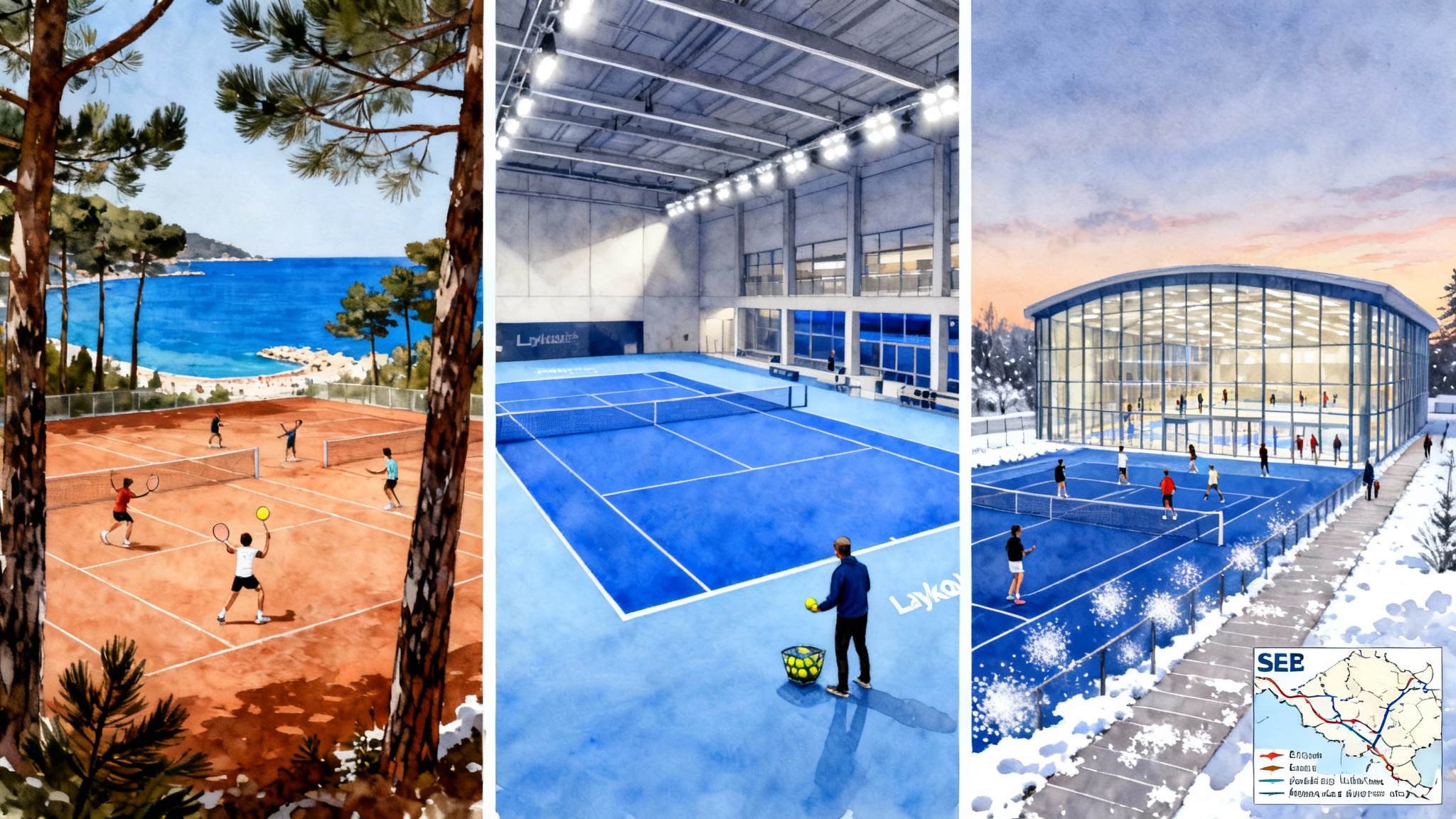
Best Texas Tennis Academies 2026: Austin, DFW, Houston, San Antonio
A parent-focused buyer’s guide to Texas junior tennis in 2026, comparing Austin, Dallas Fort Worth, Houston, and San Antonio. We spotlight newcomer Legend Tennis Academy and outline coaching, surfaces, academics, match play, prices, and outcomes.
 Tommy
Tommy
How to use this 2026 guide
You want a program that fits your child’s goals, your family schedule, and your budget, without sacrificing coaching quality or match play. This guide translates academy marketing into plain language so you can compare Austin, Dallas Fort Worth, Houston, and San Antonio with confidence. DFW in this article means Dallas Fort Worth.
What we cover for each market:
- Coaching quality and on-court ratios
- Court surfaces and why they matter
- Day versus boarding options
- Integrated academics and NCAA eligibility
- UTR and United States Tennis Association match-play access
- Pricing tiers and scholarships
- College and pro placement outcomes
- What is new in 2026 and how to verify it
Throughout, use the checklists and questions to frame your tours, trial practices, and coach meetings. For heat strategy comparisons, see our Southern California academies 2026 guide.
What changed in 2026
Texas academies kept building around three realities: more year-round match play, heat management, and college placement pressure.
- More verified rating events: Verified events tied to the Universal Tennis Rating, often called UTR, remain the default currency for measuring progress, college coach interest, and competitive fit. If you are new to the concept, start with the official overview from Universal Tennis on the UTR rating basics.
- Heat strategies: Shade structures, misting fans, and earlier start times are now common. Parents should ask how summer schedules adapt from June through September.
- Clay expansion: A growing number of programs now train at least one day per week on clay to build point construction and footwork, then translate that to hard courts for tournaments. For clay-first training case studies, compare the Florida academies 2026 guide.
Use these trends to probe any “2026 update” claims you hear on tours.
Coaching quality and ratios: what good looks like
A strong academy is a coaching system, not a single star coach. Look for these indicators:
- Ratios: High performance live-ball should be 4 to 1 or better. Technical drilling can run at 6 to 1 if the coach is actively feeding, correcting, and filming. Anything beyond 8 to 1 for extended periods is conditioning, not skill acquisition.
- Progression: Players are grouped by level and tactical goals, with clear criteria to move up. Ask to see the rubric that defines each training band.
- Feedback cycle: Your child should receive specific feedback during reps, a short debrief after practice, and weekly targets logged in a shared document or app. Video should be routine, not a special event.
- Tournament integration: Coaches should watch critical tournament matches in person or by video and fold that back into the next week’s practice plan.
Surfaces and scheduling
- Hard courts: Most Texas tournaments are on hard courts. Players must log enough hard-court hours to train the first strike and movement patterns that decide points in two to four shots.
- Clay courts: Green clay, sometimes called Har-Tru, slows the ball and rewards shape, margin, and endurance. Clay blocks build rally tolerance and defensive skills. One to two clay sessions per week is a solid target for developing players.
- Indoor or covered options: Even a few covered courts can keep technical work consistent during summer storms or extreme heat. Ask how the program protects repetitions when the weather turns.
Day versus boarding
- Day programs: Best for families with stable school schedules and frequent local tournaments. Day programs work well when parents can manage transportation and recovery routines.
- Boarding: Useful for out-of-area players or those who need a fully integrated schedule. Boarding costs are higher but add time on task and remove commute fatigue. For boarding, tour the dorms, meet the residential staff, and see the study hall in action.
Integrated academics and NCAA eligibility
Families often pair high-volume training with nontraditional school options. The model that works best keeps guardrails around time, accountability, and social development.
- Traditional partner school: Some academies partner with local private schools for midday tennis blocks. Ask about shuttle logistics and how missed classes for tournaments are handled.
- Accredited online school: Common for full-time players. Confirm accreditation, graduation requirements, and NCAA core course alignment. Ask for a written four-year plan with testing dates and counselor check-ins.
- Study hall and tutoring: Look for proctored study halls, subject tutors, and weekly grade checks. Academics should be visible on your tour, not just a brochure bullet.
Match-play access: UTR, USTA, and beyond
- Verified UTR events: Aim for regular, short-format verified events that slot into training weeks. Small, frequent matches reduce travel stress and give fresher data for seeding and college outreach.
- USTA pathway: In Texas, the schedule includes Level 7 through Level 3 events, with sectional championships anchoring the calendar. Confirm how the academy plans your child’s year, including rest windows, peaking for key events, and doubles blocks. Find the current Texas competition slate via the USTA Texas tournaments page.
- ITF Juniors and Pro: For national-level players, ask when to sample International Tennis Federation Juniors and how the team handles travel, coaching at events, and costs.
Pricing tiers and scholarships
Every academy prices differently, but these ranges are common in Texas in 2026:
- Developmental and orange or green ball: 200 to 500 dollars per month for two to three sessions per week.
- Performance day program: 600 to 1,200 dollars per month, typically three to five days per week, two to three hours per session.
- Full-time high performance: 1,200 to 2,500 dollars per month for five to six days per week, often with morning fitness or extra serve reps.
- Boarding: 3,500 to 6,500 dollars per month once room, board, and academics are included.
Scholarships may include need-based aid, merit awards tied to ranking or rating, sibling discounts, and work-study roles like ball pickup for younger groups. Ask for a written schedule of fees that includes coaching at tournaments, private lesson rates, fitness, mental performance, and video analysis.
College and pro placement outcomes
Do not accept a collage of alumni logos as proof. Ask for:
- A recent three-year list of college placements, with graduating class, player name, and scholarship type.
- Clarity on the academy’s role versus a private coach or outside consultant.
- A sample two-page player profile the academy would send to college coaches, with academic data, video links, and recent match results.
- A standard outreach calendar for college recruiting that begins by Grade 9 and aligns with official contact dates.
For players on a pro track, ask about summer pro blocks, travel teams for 15 thousand and 25 thousand dollar events, and how the academy navigates amateur status if your child wants to preserve college eligibility.
Austin: spotlight on Legend Tennis Academy and Austin Tennis Academy
Austin keeps growing as a junior tennis hub because families can combine serious tennis with strong academics and the city’s deep sports culture.
- Legend Tennis Academy in Austin: A 2025 newcomer, Legend positions itself as a boutique high performance option with small cohorts and individualized planning. Parents should verify the staff’s most recent college placements and pro coaching experience, since the program is new compared to Austin stalwarts. On the facilities side, ask how Legend balances hard-court repetitions with any available green clay sessions, and how it schedules verified match play each week. For academics, clarify whether Legend partners with a local private school, supports accredited online pathways, or offers an in-house study hall with tutors. Because it is new, request a detailed 12-week development plan before you commit.
- Austin Tennis Academy: A long-standing program with an emphasis on culture, peer leadership, and year-round match play. Expect structured training blocks, a clear grouping system, and frequent tournament coaching. Parents consistently report robust college advising and a deep contact list. Ask about 2026 updates to any covered training space for summer afternoons and how ATA calibrates clay work within a hard-court schedule.
Action for Austin families: Book one-week trials at both programs across the same week of the month. Track three metrics in a simple spreadsheet: coach-to-player ratio during live ball, minutes of video use with feedback, and number of high-quality match points played. Choose the program that wins two of the three.
Dallas Fort Worth: Brookhaven and The Lakes
The Dallas Fort Worth market blends scale with specialization. Larger clubs provide huge player pools and tournament hosting, while academy directors carve out high performance tracks inside that scale.
- Brookhaven Country Club junior high performance: Known for large draws and deep ladders, which helps players find daily practice sets across levels. Ask to watch the top performance group and confirm the ratio, the use of video, and how coaches rotate through courts to prevent drift. Because DFW often has the densest tournament calendar, ask the staff to map your child’s next eight weeks across verified events and United States Tennis Association levels.
- The Lakes Tennis Academy, Frisco: A popular North Dallas option with a reputation for live-ball intensity and strong doubles development. Parents should ask about fitness periodization, in-house physio referrals, and how the program protects shoulders during serve blocks in the summer. Confirm whether clay time is available each week and how that integrates with the weekend tournament choices.
Action for Dallas Fort Worth families: Look beyond the brand. Ask for three recent examples of players who started at your child’s current level and made measurable gains over six months. Request to see their initial plan and the later update. This proves the system works for players like yours, not just for the top few.
Houston: big-club energy with targeted performance tracks
Houston’s size gives families many choices, from club-run academies at multi-site facilities to specialized squads that operate inside those clubs. Typical examples include competitive programs hosted at major facilities in the Westchase and Memorial corridors, as well as strong junior offerings in The Woodlands and Spring.
How to evaluate Houston options:
- Pool depth: Insist on regular ladder play with peers near your child’s UTR band, not sporadic sets against much stronger or weaker players.
- Travel load: Houston traffic can turn a 20-minute trip into 45. Pick a program that is logistically easy four days per week rather than perfect on paper but impossible in practice.
- Tournament rhythm: Many Houston programs host or travel to events across the metro. Ask to see a month-by-month plan that includes rest and school testing weeks.
Action for Houston families: Before you tour, write down your non-negotiables. For many families these include a 4 to 1 live-ball ratio, weekly verified match play, and a study hall that actually starts on time. Take that list to each program and score them.
San Antonio and the Hill Country: John Newcombe Tennis Ranch and regional choices
San Antonio’s scene is anchored by well-known destination training plus club-based juniors in the city. The John Newcombe Tennis Ranch has long combined boarding and camp energy with serious year-round development. Parents should look for clarity on how boarding students balance school with tournament travel, and how day students plug into that environment without losing continuity.
In and around the city, club-based programs can be a match for families who want stability and a shorter drive. Ask about cross-play with nearby clubs to broaden the practice set pool, and how many coaches are assigned to the top performance group each afternoon.
Action for San Antonio families: If you are considering a boarding option, schedule an overnight stay that includes dinner, study hall, morning fitness, and the next day’s practice. Observe everything, from lights-out routines to breakfast timing. The details around training tell you if the program runs on time and with purpose.
A side-by-side checklist for your tours
Bring this list to every visit and ask for written answers.
- Ratios and staffing
- What are the minimum and maximum ratios for each training block this season?
- Which coaches are full-time and on-court daily, and which are part-time specialists?
- Player grouping
- How are groups formed, how often are players re-evaluated, and what are the criteria to move up?
- Surfaces and facilities
- How many hard courts and clay courts are in regular rotation? Are any courts covered for summer or storm days?
- Video and data
- How often is video used? What platform stores clips and notes? Can parents access the files?
- Match play
- How many verified UTR events or practice matches are scheduled weekly? Who enters tournaments and who attends to coach?
- Academics
- What is the academic pathway, who supervises study hall, and how is NCAA eligibility monitored?
- Health and performance
- Who leads fitness, what screenings are used, and which sports medicine partners handle injuries?
- Cost clarity
- What is included in tuition versus billed separately? Are there sibling discounts, scholarships, or work-study roles?
- College advising
- What does the outreach plan look like for Grades 9 through 12, and who owns each step?
Score each category 1 to 5. Two visits that reach 35 points or higher on the same scale will both work. Pick the one that fits your family calendar and commute.
Trial week game plan
Do a one-week trial at your top choice and, if possible, at a close runner-up.
- Monday: Baseline filming of forehand, backhand, serve, and return.
- Wednesday: Match play or set play with a peer in the same band; record the first four games.
- Friday: Debrief and plan for the next four weeks. Ask for two written technical priorities and two tactical priorities.
- Weekend: Play a short verified event or an in-house match set, and compare the film with Monday’s notes.
If you cannot schedule a full week, compress the plan into two practices and one match day.
The bottom line by city
- Austin: Choose between the boutique feel of a newcomer like Legend Tennis Academy and the established track record of Austin Tennis Academy. Let the numbers tell the story: ratio, feedback minutes, and weekly match points.
- Dallas Fort Worth: Scale is your friend if it comes with structure. Brookhaven and The Lakes can provide deep practice sets and robust doubles, with the right questions and accountability.
- Houston: Convenience and cohort fit matter most. A program that you can reach reliably will beat a perfect program you cannot attend four days per week.
- San Antonio: Destination training works when day-to-day systems are tight. Verify boarding routines and academic support before you commit.
A closing word to parents
Great academies share the same habits. They put your child on the right court with the right peers, they deliver precise feedback and film it, and they test progress with meaningful match play every week. If you hold programs to those standards in 2026, your decision in Austin, Dallas Fort Worth, Houston, or San Antonio becomes straightforward.
If you want to compare how other regions structure similar choices, scan our Northern California academies 2026 buyer’s guide. Visit, watch, measure, and then choose the team that earns your child’s best effort, day after day. That is how development turns into results and how an academy becomes a home.