Build Your Tennis Week: Microcycles for Juniors and Adults
A practical 7-day blueprint for 10U foundations, performance juniors, college-aiming players, and adult 3.0-4.5 competitors. Get clear court plans, RPE targets, volume caps, what to film, and two sample weeks from Legend Tennis Academy.
 Tommy
Tommy
Why a level-based microcycle works
Tennis rewards consistency across weeks, not just one epic session. A microcycle is a 7-day plan that organizes high, moderate, and low sessions so skills and fitness rise while injury risk stays low. When we fit training to the player’s level and schedule, we make smarter use of court time, protect joints, and build habits that hold up during tournament blocks and busy school or work weeks.
This guide gives you a clear, science-informed 7-day blueprint for four groups: 10U foundations, 12-16 performance juniors, college-aiming juniors, and adult 3.0-4.5 players. For each level you will see court-time focus, strength and conditioning, mobility, recovery, simple RPE targets, and volume caps that steer you away from overuse. You will also get what-to-film checkpoints and two real-world sample schedules modeled on programming at Legend Tennis Academy in Spicewood, so you can see how footwork, stroke reps, live-ball, and match play fit together in a modern week.
RPE and volume caps made simple
Rate of Perceived Exertion (RPE) is a 0 to 10 self-rating of how hard a session feels overall. Use it to balance your week.
- RPE 2: very easy mobility or a walk
- RPE 3-4: easy technical drilling and light lifting
- RPE 5-6: moderate footwork and live-ball
- RPE 7-8: hard live-ball, point play, heavy legs in the gym
- RPE 9-10: match-level stress. Use sparingly
Volume caps are maximums that reduce the odds of nagging pain. Think in total ball contacts, serve attempts, and minutes of live-ball or match play. The caps below are conservative starting points. If a player is growing fast, coming back from time off, or has pain, cut volume by 20-40 percent until you build capacity.
The 7-day microcycle at a glance
Use a simple rhythm. Adjust days to your school or work schedule, but keep the pattern.
- Day 1 High: speed footwork, stroke reps, serve work, gym lower body. RPE 7-8
- Day 2 Moderate: technique, live-ball, upper body. RPE 5-6
- Day 3 Low: mobility, light skills, video review. RPE 3-4
- Day 4 High: point construction, match play, lower body strength. RPE 7-8
- Day 5 Moderate: serve plus one, patterns, upper body. RPE 5-6
- Day 6 Low: mobility, prehab, optional short hit. RPE 3-4
- Day 7 Off or very light: recovery, walk, stretch. RPE 1-2
Keep at least two low days each week. Never stack three high days in a row.
10U foundations
Primary goal: build clean fundamentals, coordination, and fun. Keep it short, crisp, and varied.
- Court focus
- 60-75 minutes per session, 3-4 days per week
- Technical blocks 10-12 minutes each: forehand, backhand, volleys, overhead footwork, serve toss and rhythm
- Live-ball games that reward spacing and contact in front
- Strength and conditioning
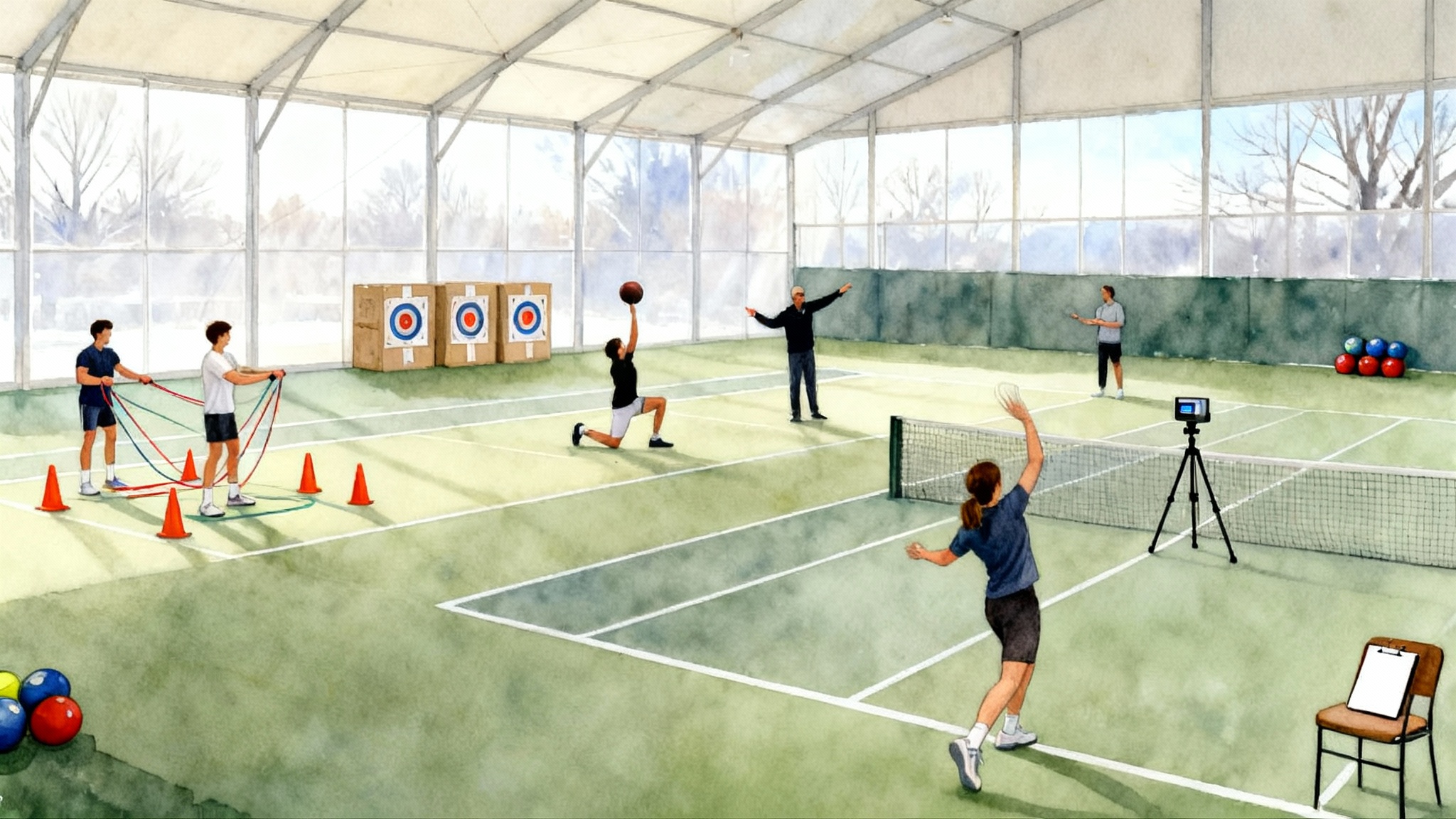
- Bodyweight only: hops, skips, ladders, medicine ball throws with light balls
- Speed play: 10-15 meter accelerations, relay games
- Mobility and recovery
- 5-7 minute dynamic warm-up: ankle rocks, leg swings, arm circles, skips
- 5 minutes after: breathing, calf and hip flexor stretches
- RPE targets
- High days at RPE 7, moderate at 5, low at 3
- Volume caps
- Serves: 30-40 total per session, max 2 sessions per week focused on serve
- Groundstroke contacts: 200-300 per session
- Overheads: 15-20 per session
- Live-ball: 15-25 minutes per session
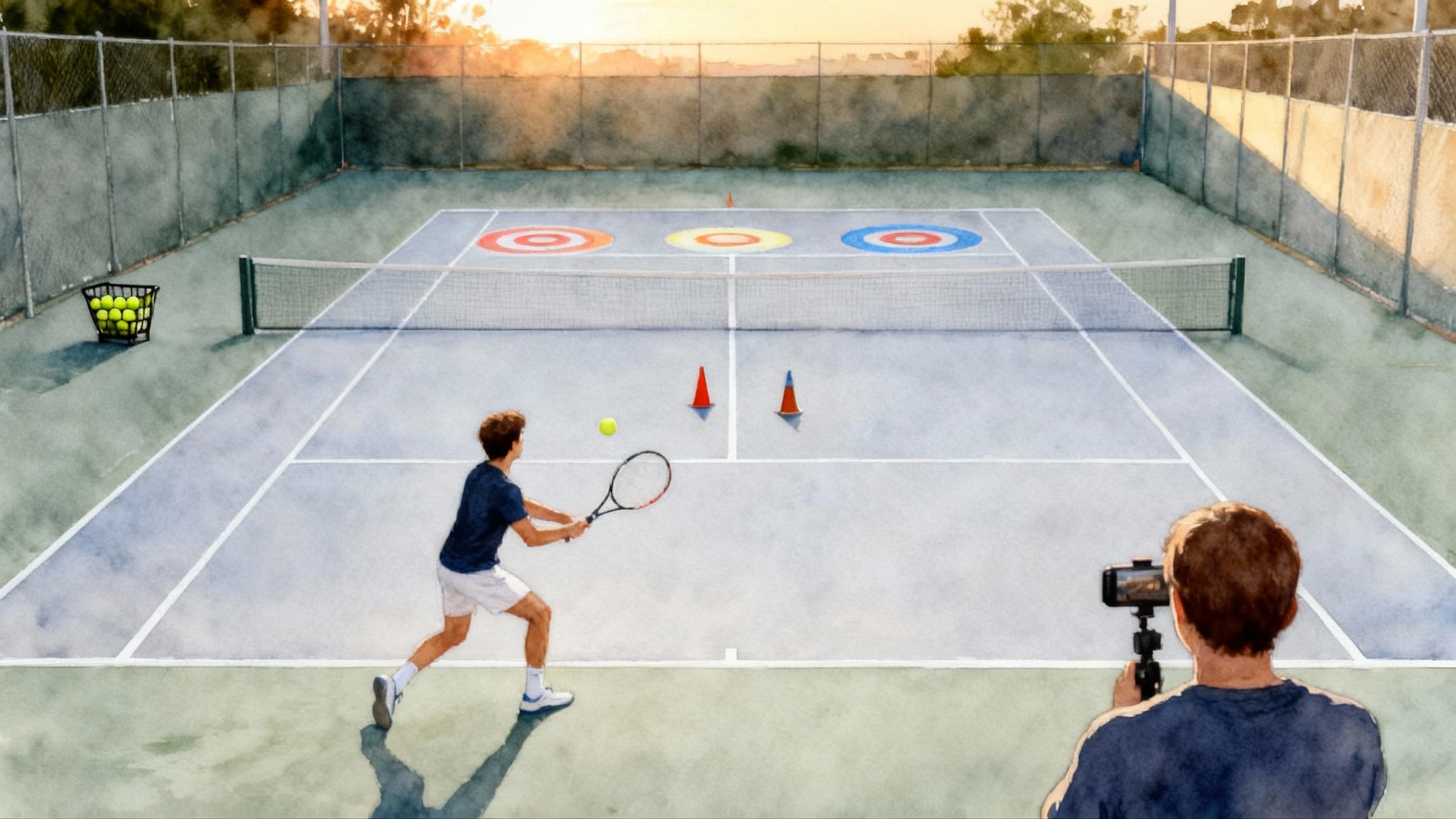
- What to film
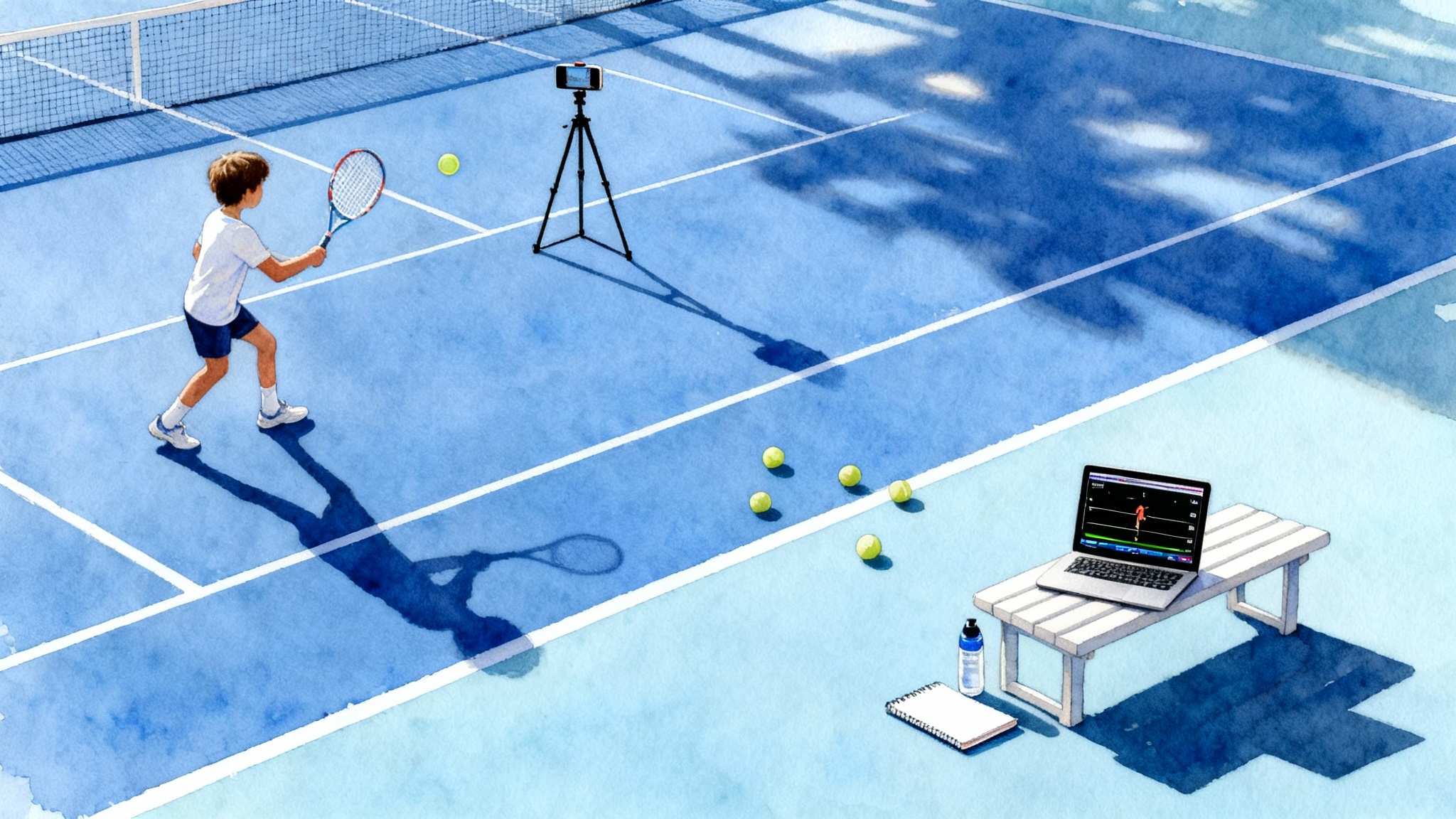
- Camera at baseline center, hip height
- Forehand: unit turn by the first bounce of the feed, racquet head below ball before contact, contact in front, balanced finish
- Backhand: early shoulder turn, left hand guide on two-hander, contact in front, recovery steps
- Serve: front view to check ball toss location and full extension, 3-5 attempts only
12-16 performance juniors
Primary goal: upgrade patterns and fitness while protecting growth plates and tendons.
- Court focus
- 90-120 minutes per session, 4-5 days per week
- Pattern themes: serve plus one, cross to line, high heavy crosscourt, transition and first volley
- Two high-intensity days that include live-ball and point play
- Strength and conditioning
- Two gym days plus one speed day
- Emphasize movement quality: split step timing, deceleration into open and semi-open stances, single-leg strength (see our split-step timing guide)
- Lifts: goblet squat, trap bar deadlift light to moderate loads, half-kneeling press, pull-ups or assisted rows, resisted band work
- Mobility and recovery
- 10-minute daily micro-mobility: ankles, hips, thoracic spine, wrist flexors and extensors
- Sleep goal 8-9 hours, hydration plan set before practice
- RPE targets
- High 7-8, moderate 5-6, low 3-4
- Volume caps
- Serves: 60-80 per high day, 30-40 per moderate day, weekly total 220-280
- Groundstroke contacts: 350-550 per session on high days, 250-350 on moderate days
- Live-ball and match play: 35-60 minutes on high days
- What to film
- Rear baseline view for patterns: serve plus one spacing and recovery
- Side view on forehand: racquet drop height, contact at lead hip, torso rotation to finish
- Backhand: hip-shoulder separation, non-dominant hand release timing, height of contact on high balls
- Transition footwork: last two braking steps before volley, contact out in front by a forearm’s length
College-aiming juniors
Primary goal: compete at match speed, sharpen weapons, and build durable strength.
- Court focus
- 120-150 minutes per session, 5-6 days per week depending on calendar
- Two high days with structured point play and fitness finishes
- Serve and return windows separated from heavy lifting by at least 6 hours when possible
- Strength and conditioning
- Two lower body sessions and one upper plus total-body power
- Lifts: front squat or trap bar deadlift, rear foot elevated split squat, hip hinge variations, bench or incline press, chin-ups, cable rows, anti-rotation core
- Power: box jumps, medicine ball rotational throws, approach jumps after a split step
- Mobility and recovery
- 12 minutes daily: ankles, hips, thoracic rotation, forearm tissue care with light massage ball
- One weekly flush ride or easy jog 20-30 minutes
- RPE targets
- High 8, moderate 6, low 3-4
- Volume caps
- Serves: 80-100 per high day, 40-60 per moderate day, weekly total 300-400
- Groundstroke contacts: 500-750 on high days, 350-500 on moderate days
- Live-ball and match play: 45-75 minutes on high days
- What to film
- Serve from behind receiver’s view: toss location relative to hitting shoulder, knee bend depth, racquet drop, contact height, landing inside baseline on first serves
- Return: split timing as server tosses, first step angle, contact depth relative to baseline
- Pattern play: two-ball patterns, posture during recovery, time from contact to split at center
Adult 3.0-4.5
Primary goal: raise win percentage with clean patterns, movement efficiency, and tendon-friendly strength.
- Court focus
- 75-120 minutes per session, 3-4 days per week
- One hard live-ball day, one technique day, one match play or league night, one optional low day
- Strength and conditioning
- Two short lifts 30-45 minutes: hip hinge, split squat, push, pull, carry
- Elastic circuits for the shoulder and forearm, single-leg balance, calf capacity work
- Mobility and recovery
- 8-10 minute warm-up: ankle rocks, adductor groin movements, T-spine rotations, shoulder external rotation with bands
- 5 minutes post: diaphragmatic breathing, calf and forearm mobility
- RPE targets
- High 7-8, moderate 5-6, low 3-4
- Volume caps
- Serves: 40-70 per session, weekly total 180-250
- Groundstroke contacts: 300-500 on skill days, 200-300 on match days
- Live-ball: 25-45 minutes on high days
- What to film
- Forehand and backhand from behind baseline at shoulder height: check spacing and balance at finish
- Serve side view: shoulder-hip separation, contact in full reach, smooth deceleration
- Net play: first volley contact well in front, recover with a split step before the opponent hits
How to build each day
Repeatable structure makes sessions easier to run and easier to improve.
- Warm-up 8-12 minutes
- Dynamic patterns: skips, carioca, ankle hops, leg swings, shoulder circles
- Racket feel: mini-tennis, short court, shadow swings
- Skill blocks 10-15 minutes each
- Technical drill with 1-2 cues only
- Pattern drill that forces footwork choice
- Live-ball 15-45 minutes
- Constraint scoring to target patterns
- Serve or return 10-20 minutes
- First serve tempo and targets, then second serve spin and height
- Strength or speed 20-45 minutes
- Done either after court work or later in the day
- Cooldown 5-10 minutes
- Mobility and breathing reset
Two sample weeks from Legend Tennis Academy, Spicewood in Austin
These sample weeks show how a modern program sequences footwork, stroke reps, live-ball, and match play. Times and blocks reflect a typical in-season rhythm.
Sample Week A: 12-16 Performance Group
- Monday High
- 4:00-4:10 Warm-up and splits timing
- 4:10-4:25 Footwork ladder to open and semi-open stance accelerations
- 4:25-4:45 Technical block: deep crosscourt forehands, backhand line, 2 cues total
- 4:45-5:10 Live-ball cross to line with recovery targets
- 5:10-5:25 Serve plus one patterns, 50-60 total serves cap
- 5:30-6:00 Gym lower body: trap bar deadlift moderate, split squats, core anti-rotation
- RPE 7-8
- Tuesday Moderate
- 4:00-4:10 Warm-up and mini-tennis
- 4:10-4:30 Return and first ball depth control
- 4:30-5:00 Live-ball doubles alleys to narrow targets
- 5:00-5:20 Serve second serves, 30-40 attempts
- 5:20-5:40 Upper body strength: pull-ups or assisted, half-kneeling press, band external rotations
- RPE 5-6
- Wednesday Low
- 4:00-4:15 Mobility circuit and video review
- 4:15-4:45 Light technique: approach and first volley, 15 overheads cap
- 4:45-5:00 Breathing and recovery
- RPE 3-4
- Thursday High
- 4:00-4:10 Warm-up
- 4:10-4:30 Point construction: short ball attack, one up one back
- 4:30-5:00 Match play sets to 4, receive first
- 5:00-5:20 Serve locations to corners, 50-60 total serves cap
- 5:30-6:00 Gym lower body and power: box jumps, split squat, hamstring bridge
- RPE 7-8
- Friday Moderate
- 4:00-4:10 Warm-up
- 4:10-4:30 Pattern rehearsal at medium pace
- 4:30-5:00 Live-ball with time pressure scoring
- 5:00-5:20 Second serve kick above shoulder height, 30-40 attempts
- 5:20-5:40 Upper body strength and shoulder care
- RPE 5-6
- Saturday Low or tournament travel
- 10:00-10:30 Mobility, ankles and hips plus forearm care
- Optional 30-minute hit, no more than 250 contacts
- RPE 3
- Sunday Off or very light
- Walk or easy bike 20 minutes, breath work 5 minutes
Sample Week B: Adult 3.5-4.0 Evening Program
- Monday Technique Moderate
- 6:00-6:10 Warm-up, band prep for shoulders
- 6:10-6:30 Forehand and backhand technical cues
- 6:30-6:55 Live-ball crosscourt only with recovery to center
- 6:55-7:10 Serve rhythm and targets, 40-50 serves
- 7:15-7:45 Strength 30 minutes: hinge, split squat, row, farmer carry
- RPE 5-6
- Wednesday High Live-ball and Points
- 6:00-6:10 Warm-up
- 6:10-6:25 Footwork and short sprints 10-15 meters
- 6:25-7:00 Live-ball open court, constraint scoring to the backhand corner
- 7:00-7:25 Point play to 7 with serve plus one focus, 50-60 serves total across the night
- RPE 7-8
- Friday League or Match Play Moderate to High
- 6:00-7:30 Doubles or singles. Keep serve total under 70
- RPE 6-7
- Saturday Low Reset
- 9:00-9:30 Mobility, ankles and thoracic spine, optional 20-minute easy hit under 250 contacts
- RPE 3
- Sunday Off
- Walk 20 minutes, calf and forearm mobility 5 minutes
Technique checkpoints to film each week
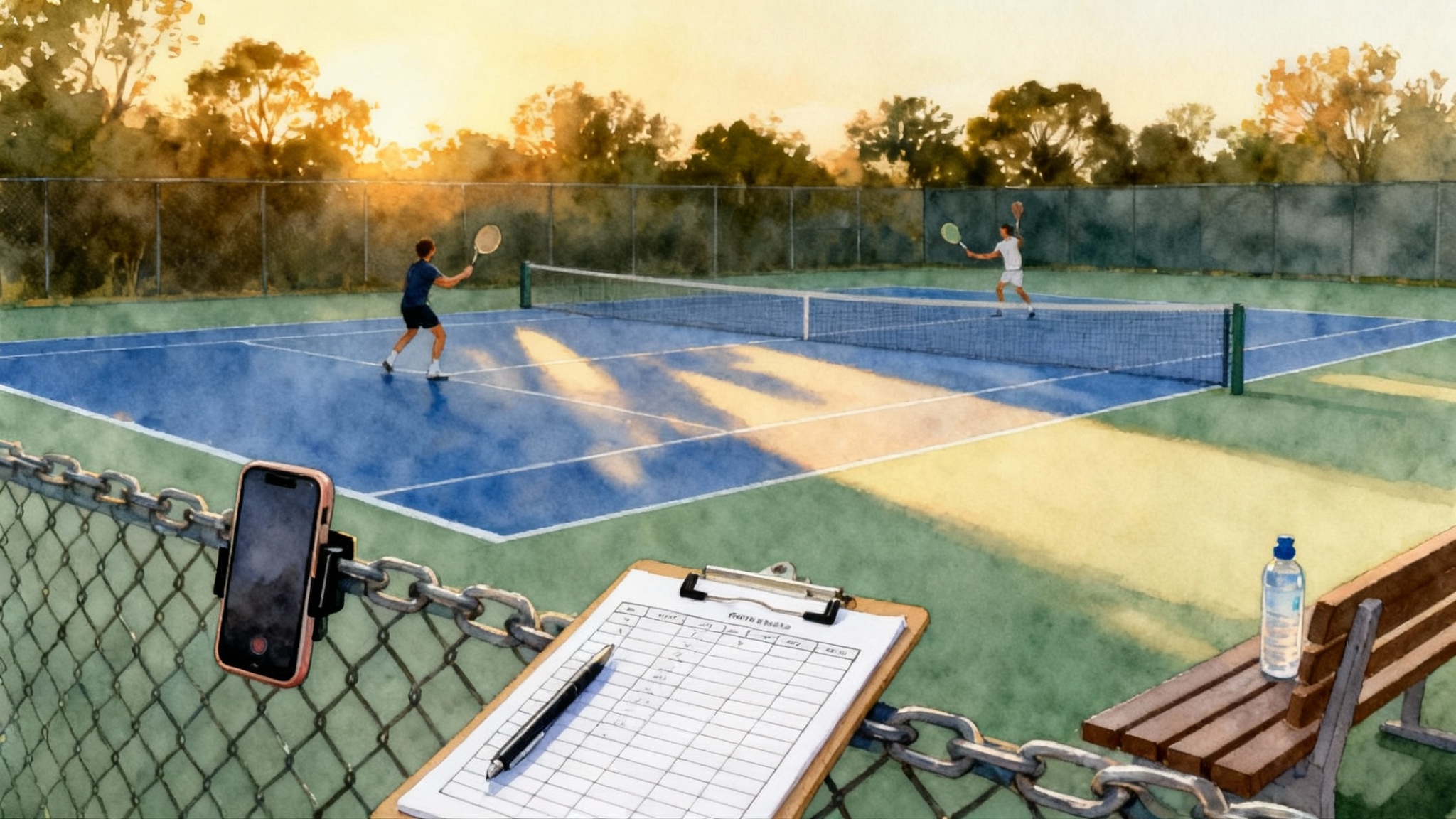
Use your phone at 60 or 120 frames per second if available. Keep clips short and label them.
- Serve
- Rear view: toss above front foot on flat, slightly inside on slice and kick, smooth knee bend and full extension, contact at full reach, land inside baseline on first serve
- Side view: racquet drop depth, trunk angle at contact, relaxed follow-through
- Forehand
- Rear view: unit turn before bounce, racquet below ball, contact in front of lead hip, balanced finish with chest toward target
- Side view: spacing check, left hand counterbalance, recover to split before opponent hits
- Backhand
- Two-hander: shoulder turn early, non-dominant hand drives through, contact in front, stable head
- One-hander: closed or semi-closed stance, contact out in front, high finish, no collapse of the wrist
- Net play
- Contact well in front, split step just before the opponent hits, first step forward on floaters, drop step on passing balls
Recovery that actually fits your life
- Sleep: set a fixed bedtime window and protect it. Juniors 8-9 hours, adults 7-9
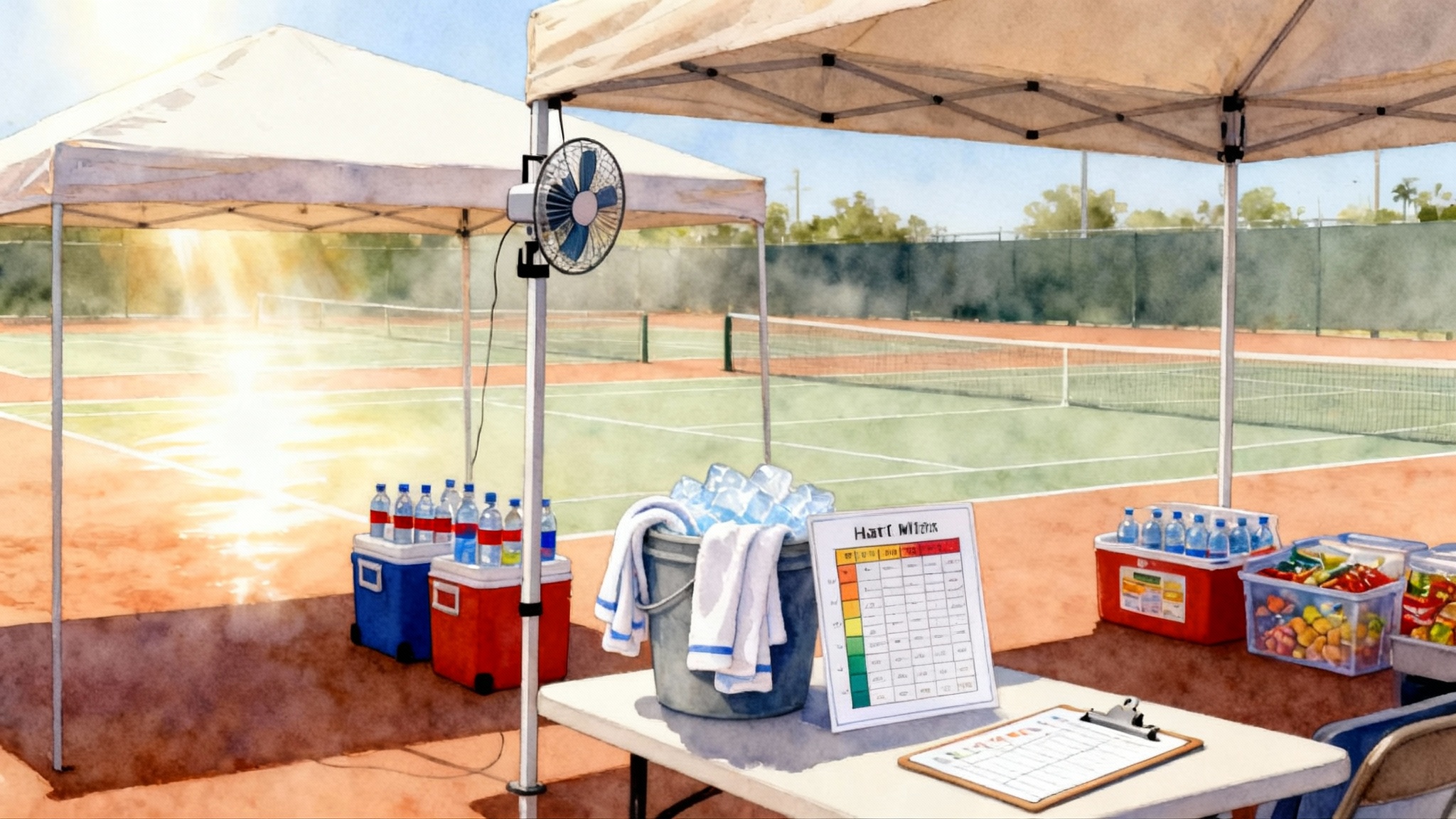
- Hydration: start practice already hydrated. Lightly salt meals on hot days
- Soreness check: if pain changes your movement, cut volume by 30-50 percent that day
- Growth spurts: for juniors, expect coordination to dip. Keep technique blocks shorter and cut serves by 20 percent for two weeks. See our growth-spurt tennis guide.
Quick self-audit for parents and players
- Did I keep two low days this week?
- Did any joint feel worse at the end of practice than the start?
- Were high days truly high and low days truly low?
- Did I hit my serve and live-ball caps?
- Did I film one key stroke and review it within 24 hours?
- Did I lift twice, even if short?
- Did I warm up for 8-12 minutes and cool down for at least 5?
- Did I sleep within my target range?
- Do I know my next match or league date and what pattern I will lean on?
If three or more answers are no, adjust the next microcycle before you push harder. If you are unsure how to adjust, that is a signal to get an expert eye.
Ready to personalize your microcycle
You now have a clear 7-day structure, level-specific caps, and filming checkpoints. The fastest gains come when a coach confirms the right cues and trims the noise. Book a focused evaluation so we can tailor this plan to your goals and schedule. Use our quick form to book an evaluation session. We will assess footwork, contact quality, serve mechanics, and strength anchors, then build your next four weeks so every session has a job and every rep has a reason.