Return of Serve Mastery: A Level-by-Level Playbook
Turn the return of serve into your quiet superpower. This step‑by‑step playbook covers reading cues, court positioning, simple targets, at‑home reaction drills, scoring games, a four‑week plan, and a clear path to a trial session.
 Tommy
Tommy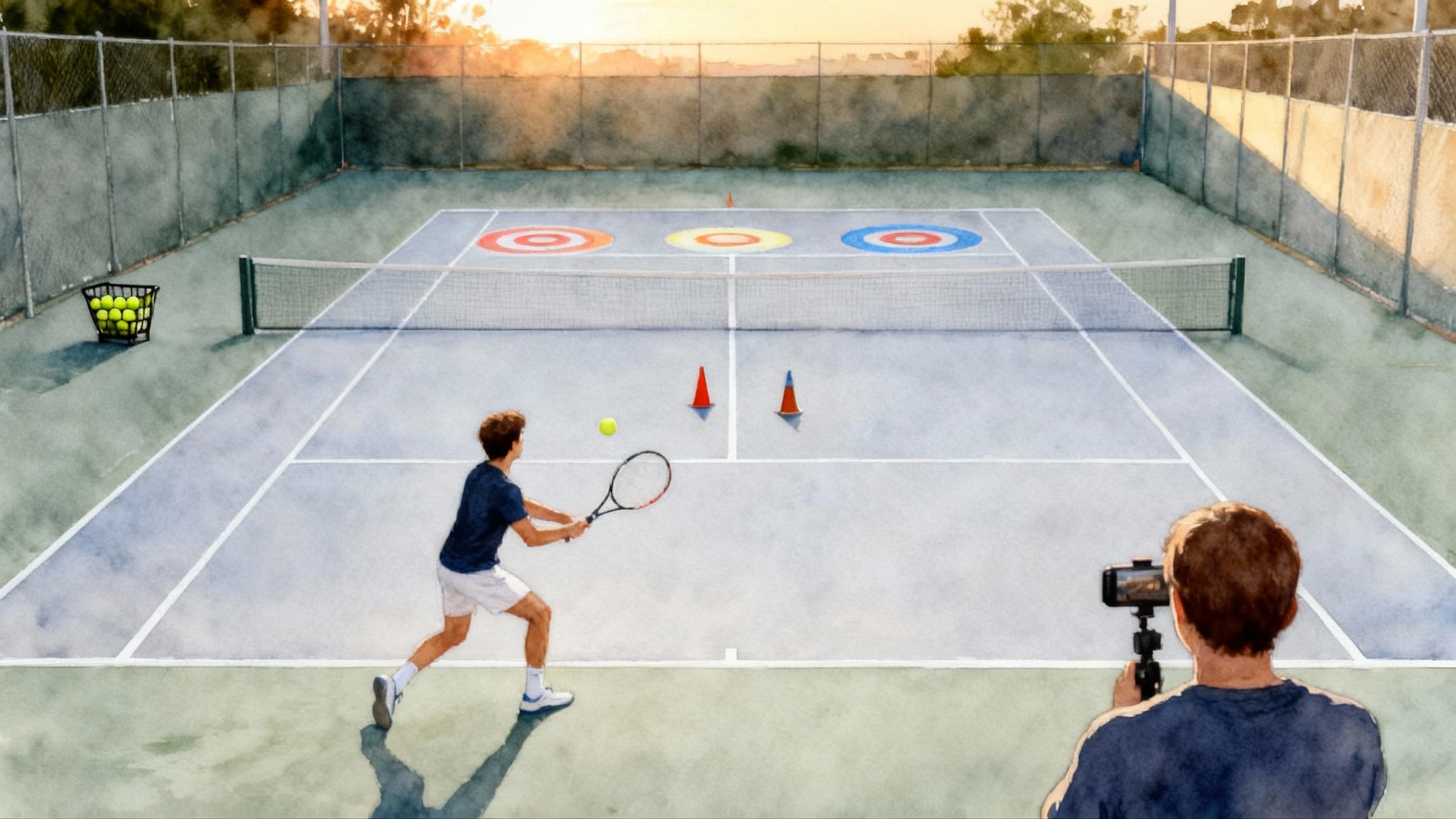
Why the return decides more points than you think
The return is the first chance to steal time, take space, and tilt a rally in your favor. Data from elite tennis suggests that deep, first-strike returns lower the server’s hold rate because the ball arrives sooner and shrinks their next-shot options. You do not need pro strokes to benefit from this. You need a plan: read the serve, move with purpose, and hit to big, repeatable targets. The rest is a progression you can follow.
To anchor this plan, we will align with the Red, Orange, Green, Yellow pathway for juniors and map it to clear steps for adult players by National Tennis Rating Program levels. For background on the junior pathway, see the red orange green pathway. For a concise summary of what makes a return effective at all levels, review the International Tennis Federation’s view on return of serve fundamentals.
The three-part return blueprint
Think of every return as a three-step sequence: Read, Move, Contact.
- Read: take in telltales before the serve. Where is the toss? How fast do the shoulders rotate? Is the server closer to the center mark or the sideline? What spin do they favor under pressure? You are not guessing. You are forming a first draft.
- Move: split step at the exact moment of the server’s contact. Land on the balls of your feet, then take the first step diagonally toward your predicted contact point. Your goal is a stable base with your chest roughly facing the server at impact. For deeper guidance on timing, review this split-step timing footwork fix.
- Contact: short backswing, firm wrist, and a long follow-through toward your target. Imagine you are catching the ball in front of your front hip and then pushing it with your strings toward a cone on the other side.
Positioning and targets that scale with the player
Use a simple targeting grid. Imagine three lanes on each half of the opponent’s court: crosscourt lane, middle lane, and line lane. Your default is middle lane, deep through the center hash, because it reduces the server’s angles and forces a neutral rally. When you read wide or body serves, shift the target to the appropriate lane.
Red ball juniors
Court: 36 feet. Goal: start the rally and control height.
- Stance and position: both feet inside the baseline. Racquet up like a shield. Split step as the ball leaves the hand on underhand serves, or as the racquet starts forward on overhead serves.
- Contact cue: catch the ball on the strings in front of the front foot. Think bump, not swing.
- Targets: middle lane, high net clearance, two bounces before the baseline. Count out loud “high and far.”
- Game: coach or parent feeds soft serves. Player must bump 8 of 10 returns into the middle lane to earn a sticker or point.
Orange ball juniors
Court: 60 feet. Goal: add direction while keeping height.
- Stance and position: toes just inside the baseline. Compact unit turn on both sides. Keep the racquet face slightly open on forehand blocks.
- Read: look at the server’s feet. If the front foot points toward the sideline, expect wide. If it points to the center, expect T.
- Targets: start middle lane. On wide serves, return crosscourt back behind the server. On T serves, return back through the middle.
- Game: “Two corners and a lock.” Earn 1 point for a middle lane return, 2 for crosscourt behind the server. First to 11.
Green ball juniors
Court: 78 feet, lower compression. Goal: learn to step in and drive.
- Stance and position: heels on the baseline, then step forward as the toss peaks.
- Read: track the toss line. Toss drifting right of the server’s head often means slice wide in the deuce court. Toss over the head often means T or body.
- Targets: add a flat drive to the deep middle. On slow second serves, choose a crosscourt lane at shoulder-high contact.
- Game: “Three in a row.” Player must hit three consecutive returns that land past the service line before swinging for crosscourt on the fourth.
Yellow ball juniors
Full compression ball. Goal: first-strike patterns.
- Stance and position: start one step behind the baseline against pace; move up on second serves.
- Read: watch the server’s shoulder speed to anticipate pace. Identify two patterns per opponent, such as slice wide on deuce or kick to the backhand on ad.
- Patterns: against slice wide, block crosscourt deep; against body, step off the line and return to the server’s weaker side. On slow seconds, drive deep middle and look to attack the next ball.
- Game: “Break or bust.” Returner starts 0 to 30 down. Win the game to earn 3 points. If you lose the game, but win two return points by depth past the service line, earn 1 point.
Adults by National Tennis Rating Program level
We will reference the National Tennis Rating Program and then use the abbreviation NTRP.
- NTRP 3.0: stand in a comfortable position two feet behind the baseline. Racquet up. Priority is contact in front and depth to the middle. Keep the backswing short. If the ball is fast, block. If it is slow, push with a longer follow-through.
- NTRP 3.5 to 4.0: start on or just behind the baseline. Time the split to server contact. Decide early: block to the middle or drive crosscourt. Add a backhand chip that skids low into the middle lane on second serves.
- NTRP 4.5 to 5.0: scout opponents. Shade your position to take away their favorite serve. Use a drive backhand return off shoulder-high kick serves. On second serves, step in, take the ball rising, and aim deep middle first. Mix a short angle to the open court once you have forced a defensive reply.
At-home reaction and reading drills
You can improve your return without a court. Use a 3 by 5 foot space, a wall, and a partner or parent.
- Toss tracker
- Partner mimics a serve toss with a ball. Call out “wide” or “T” based on the toss line. On the clap, perform a shadow split step and first step toward that direction. 3 sets of 60 seconds.
- Sock ball bump
- Put a ball in a sock. Underhand toss the sock; the player bumps it back with a forearm like a mini volley to a couch cushion target. Focus on contact in front and quiet head. 3 sets of 12 bumps each side.
- Color call
- Parent holds two colored cards. On “go,” parent flashes a color, then gently tosses a foam ball. Player must call the color and bump to match a color-coded target on the wall. This pairs visual recognition with contact.
- Drop and pop
- Hold the racquet in ready position. Drop a ball from head height, let it bounce once, then bump it up to a target on the wall at eye level. Focus on meeting the ball in front and finishing toward the target. 3 sets of 20.
- Mirror split timing
- Watch a recording of serves on a phone or laptop. Split step exactly when the racquet hits the ball in the video. This entrains timing with zero risk.
On-court scoring games that build match skill
These games turn practice into pressure.
- The 21 Return Challenge
- Server hits regulation serves. Returner scores 1 point for any return in play, 2 for a return that lands past the service line, and 3 for a return that lands in the deep middle box. First to 21 wins. Switch roles.
- Red and Orange: Two-bounce rally
- Server feeds gentle serves. Returner must make a high, arcing return that bounces twice before the baseline. Two points for success. One point for any return in play. First to 15.
- Green and Yellow: First Four Ball Ladder
- Play points where the rally is limited to the first four balls: serve, return, server’s next, returner’s next. Returner earns 2 points for winning within four balls and 1 point for forcing the server to hit up on the third shot.
- Adults NTRP 3.0 to 4.0: Middle lock
- Play games to 7. Returner only wins points if the return goes through the middle lane. This builds a stable default.
- Adults NTRP 4.5 to 5.0: Edge denial
- Shade one step toward the server’s favorite serve. If you guess right and make the return, you get 2 points. If you guess wrong but make the return, you get 1 point. First to 15.
- Three-box targets
- Place three cones in a line across the deep middle. Returns that hit within one racquet length of a cone are worth 2 points. Others in play are worth 1.
A simple contact menu for every level
- Block: against pace. Minimal backswing. Imagine catching and redirecting.
- Punch: against medium pace. Short unit turn. Drive through the ball with a firm wrist.
- Drive: against slow second serves. Compact turn and accelerate the racquet head through a long follow-through.
Switch tools, not bravery. The great returners do not always swing big. They pick the right tool for the incoming ball.
Four-week improvement plan
This plan fits juniors and adults. Frequency: two focused return sessions per week plus 10 minutes of at-home reaction work on two off days. Track three metrics: return in-play percentage, deep return percentage, and break points created per set from return pressure. For an easy framework, use these tennis match charting stats.
Week 1: Read and contact
- Two sessions. 60 total returns per session. Focus on timing the split step, first step speed, and contact in front. Use The 21 Return Challenge. Goal: 60 percent in play, 30 percent deep.
- Home work: Toss tracker and mirror split timing.
Week 2: Direction and depth
- Two sessions. Add three-box targets and middle lock games. Alternate block and punch. Goal: 65 percent in play, 40 percent deep, with 70 percent of deep returns through the middle.
- Home work: Sock ball bump and drop and pop.
Week 3: Pace and spin
- Two sessions. One against faster first serves, one against slower seconds. Practice shading position and using the chip on backhand. Goal: keep Week 2 percentages while adding one new return pattern on each side.
- Home work: Color call.
Week 4: Pressure and patterns
- Two sessions. Play First Four Ball Ladder and Break or Bust. Scout two serve patterns from an opponent or practice partner and pre-decide your counter. Goal: create at least two break points per set with depth and direction.
- Review: compile your weekly metrics and one video clip that shows improved contact or depth.
Parent filming checklist for fast progress
Parents are difference-makers when they film well. Use this checklist for a 10-minute capture that coaches love.
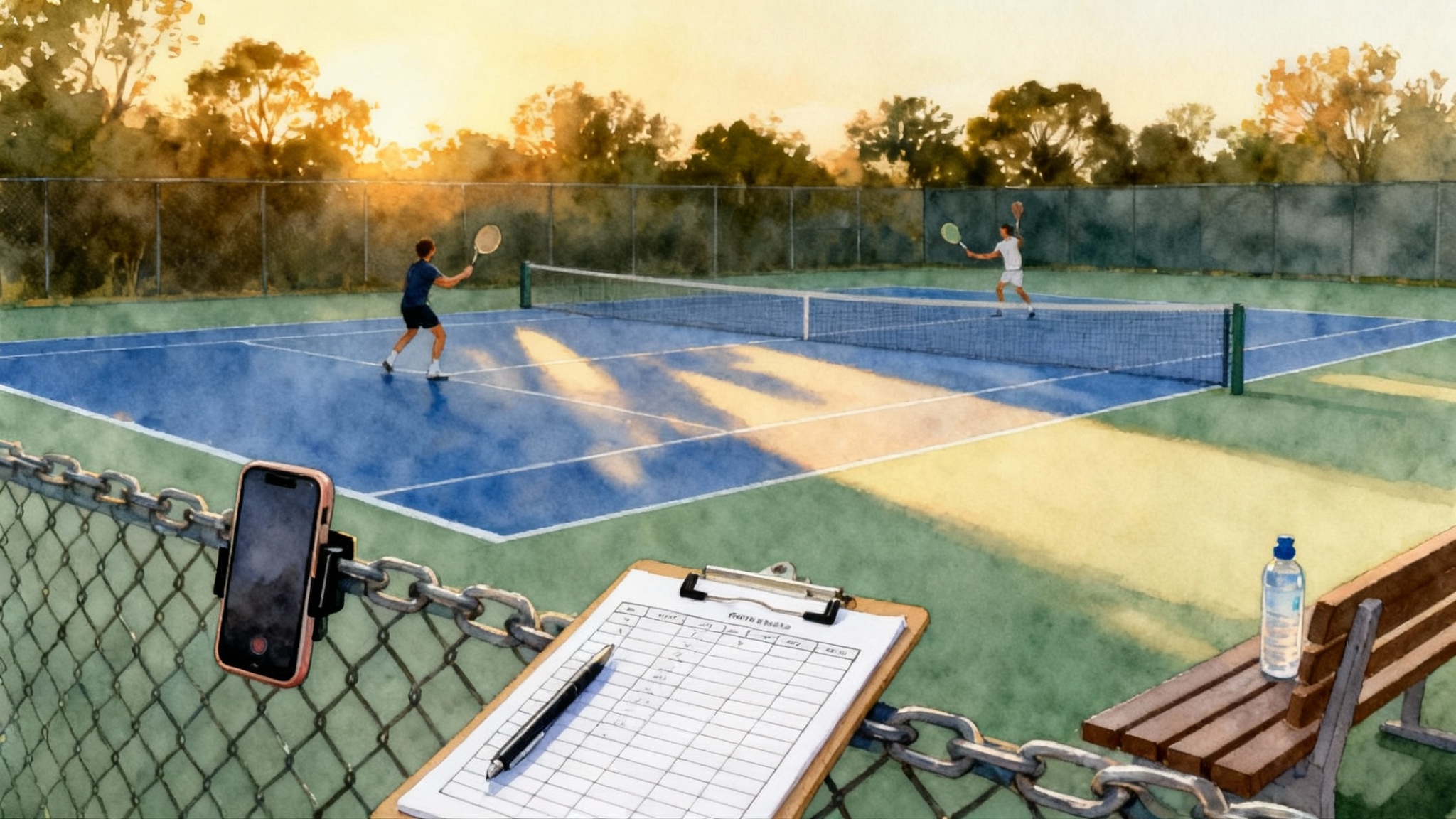
- Angle: stand 8 to 10 feet behind the returner, centered on the baseline so you can see both feet and the landing area of the return.
- Height: eye level. Rest the phone against the fence or on a small tripod for stability.
- Frame rate: 60 frames per second or higher if available. Use landscape mode.
- Clips: two clips of 6 returns on the deuce side and two clips of 6 on the ad side. Include both first and second serves if possible.
- Markers: place three cones across the deep middle to visualize targets.
- Sound: ask the server to call “hit” at contact. This helps time the split on playback.
- Label: after filming, name the files by date and side. Example: 2026-01-17_Deuce_Returns.mp4.
- Share: send to coach before the next session with one question and one win from the player. Example question: “How is my contact point on second serves?” Example win: “6 of 8 to the deep middle.”
Example pathway: from assessment to program at Legend Tennis Academy
Here is how a clear pathway can turn a good idea into steady results.
Step 1: Free assessment session
- A 20-minute on-court screen focused on the return. We measure split timing, first step speed, contact point, and targeting. We also record a short clip from behind. The player leaves with a one-page scorecard and a single focus for the week.
Step 2: Program placement by stage
- Red ball: one skills-based class per week that includes the Two-bounce rally game and high-and-far targets. At-home: Sock ball bump.
- Orange ball: one group class and one 20-minute return station. Emphasis on reading the toss and aiming behind the server. At-home: Toss tracker and Color call.
- Green ball: one group class and one sparring slot. Add First Four Ball Ladder and three-box targets. At-home: Mirror split timing.
- Yellow ball: two group classes or one class plus a match-play block. Use Break or Bust and edge denial games. Video review every second week.
- Adults NTRP 3.0 to 4.0: one group clinic and one serve-plus-return practice with a partner. Track in-play and deep percentages. Learn the chip return and the drive off slow seconds.
- Adults NTRP 4.5 to 5.0: one advanced clinic and one scouting session. Build two pre-planned return patterns per match. Add practice against kick serves and body serves.
Step 3: Book your trial
- If you are local and ready to put this playbook into action, schedule a short assessment and we will place you in the right class. It takes minutes to book at Legend Tennis Academy.
Practical cues that win more returns this week
- Eyes quiet at contact: lock your head and eyes as if balancing a coin on your cap. Moving eyes cause moving contact.
- Early decision: pick the shot type by the time you land from the split. Do not wait for the bounce.
- Big margin through the middle: on every tight point, choose the deep middle until the server proves you must change.
- Step in on seconds: move forward so the ball meets you earlier. The easiest way to take time is to take space.
- Make the server hit up: deep and through the middle forces the server to lift on ball three. That gives you the first offensive ball.
Troubleshooting table in words
- Returns floating long: check grip pressure. Squeeze at 4 out of 10 instead of 7 out of 10. Aim lower net clearance to the deep middle.
- Late on fast serves: start one step farther back and begin the unit turn as the toss starts to drop.
- Shanking wide on kick serves: let the ball rise to shoulder height and shorten the backswing. Use the backhand chip to keep the ball low.
- Great in practice, tight in matches: play The 21 Return Challenge with a teammate watching and keeping score. Add a small reward for the winner to recreate pressure.
Pulling it together
Great returners are not guessing geniuses. They are disciplined readers who move at the right time and send the ball to safe, useful targets. Build those habits with the blueprint above, match the game to your stage, film with purpose, and review weekly. If you want guidance from day one, we are ready to help you turn a first session into your best season. Book a short assessment, step onto the court with a plan, and start winning more return points next match.