College Tennis Recruiting 2026: Email, Video, Coach Calls Guide
A practical 2026 playbook for college tennis recruiting. Build a 90 second highlight video, track UTR and WTN, use proven email templates, follow a four week outreach cadence, and handle coach calls with confidence.
 Tommy
Tommy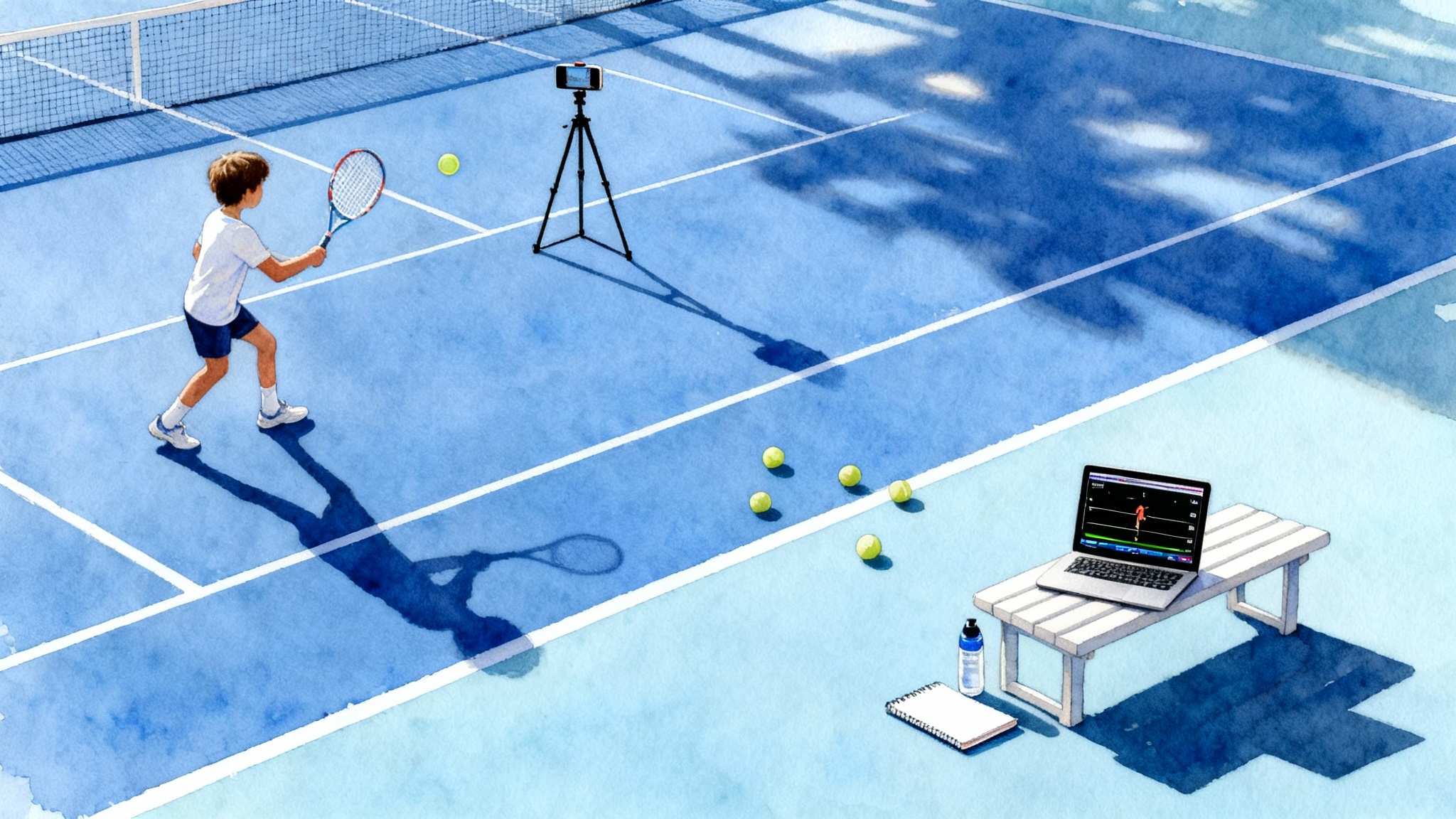
The 2026 recruiting reality
Hundreds of college tennis programs still need players every cycle, but inboxes are crowded and coaches have little time. Families that win at recruiting do three things well. They communicate clearly, they present verified skill and academics, and they follow up with a simple cadence. Before you do anything else, make sure you understand the rules that shape how and when coaches can respond. Read the official NCAA recruiting rules overview and then work your plan.
This guide gives you a complete outreach playbook for 2026. You will get a 90-second highlight video shot list, a stats checklist for UTR and World Tennis Number, subject lines and email templates, a four-week outreach cadence, call and Zoom etiquette, light compliance notes, a case study from Legend Tennis Academy in Spicewood, Texas, and advice for late starters and potential walk-ons.
What coaches need to see at a glance
Think like a hiring manager. Coaches skim first, then click. Your goal is to earn thirty more seconds of attention. Put these elements at the top of your email or recruiting profile and keep the format consistent.
- Full name, graduation year, city and state
- Height, playing hand, backhand type, current school, intended major if known
- UTR ID and current singles and doubles rating
- World Tennis Number singles and doubles
- Academic quick facts: unweighted and weighted GPA, test scores or test optional status, key honors courses
- Best verified results from the last six to nine months: level of event, round reached, notable wins, and surface
- A single link to your 90-second highlight video and a separate link to two full match replays
- Your current coach’s name, email, and phone
- Contact number for you and a parent, plus your best times to talk
Coaches want trustable signals. If a coach opens your email and can see your level, academics, and how to reach you in ten seconds, you are already ahead.
Your 90-second highlight video shot list
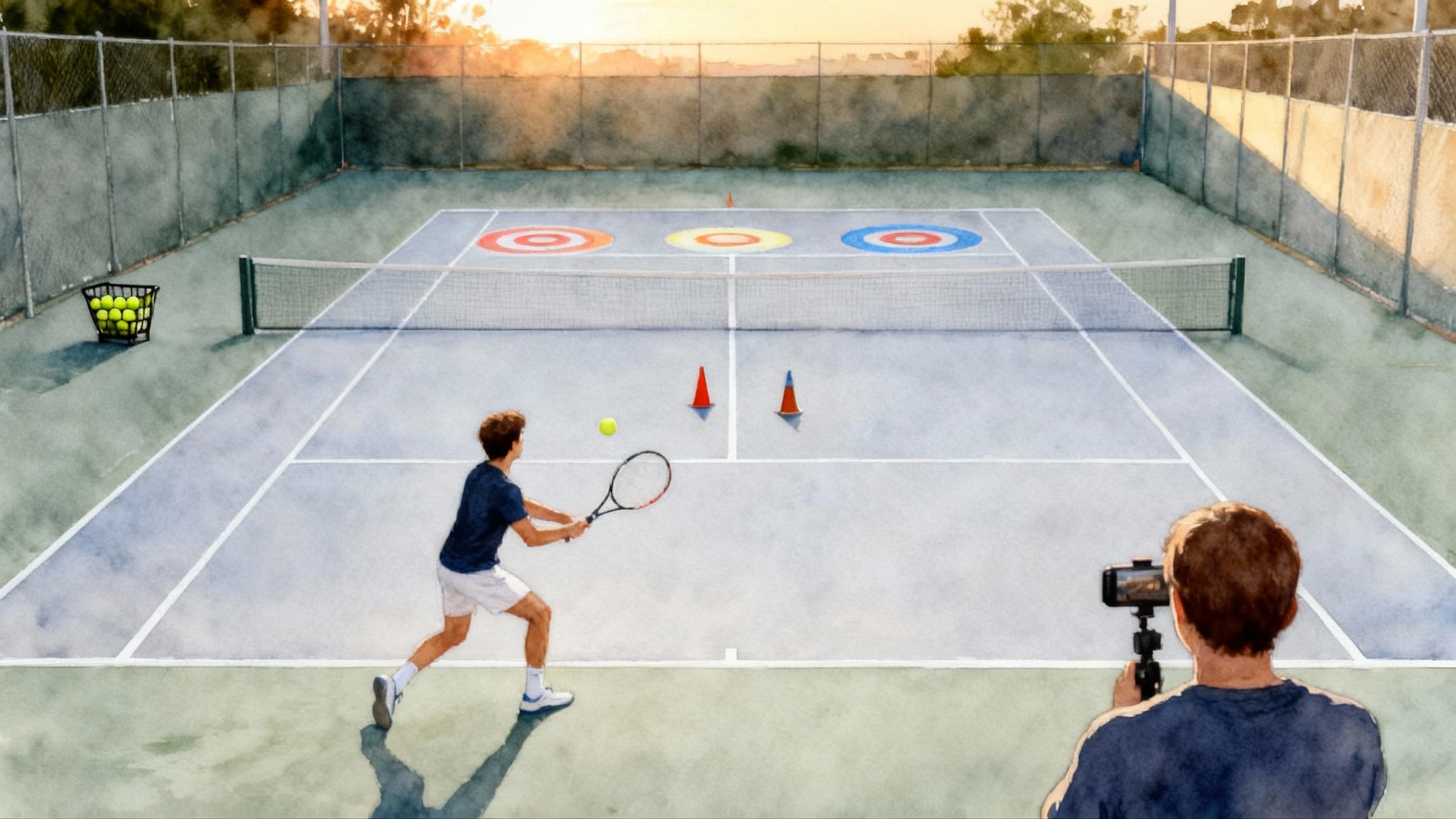
Ninety seconds forces focus. Keep the camera at a stable, slightly elevated angle from behind the baseline or high on the sideline. Use clear natural sound. Skip music. Add a simple opening slate with your name, grad year, UTR, WTN, and contact info for two seconds, then get right to tennis.
Shot list with time targets:
- 0:00 to 0:08 Forehand crosscourt rally at match tempo. Show four to six continuous balls.
- 0:08 to 0:16 Backhand crosscourt rally at match tempo. Two handed or one handed as you play.
- 0:16 to 0:24 Forehand down the line to a target. Two sequences of three to four balls.
- 0:24 to 0:32 Backhand down the line to a target. Two sequences of three to four balls.
- 0:32 to 0:40 Approach and volley pattern, forehand side, then a clean overhead.
- 0:40 to 0:48 Approach and volley pattern, backhand side, then an overhead.
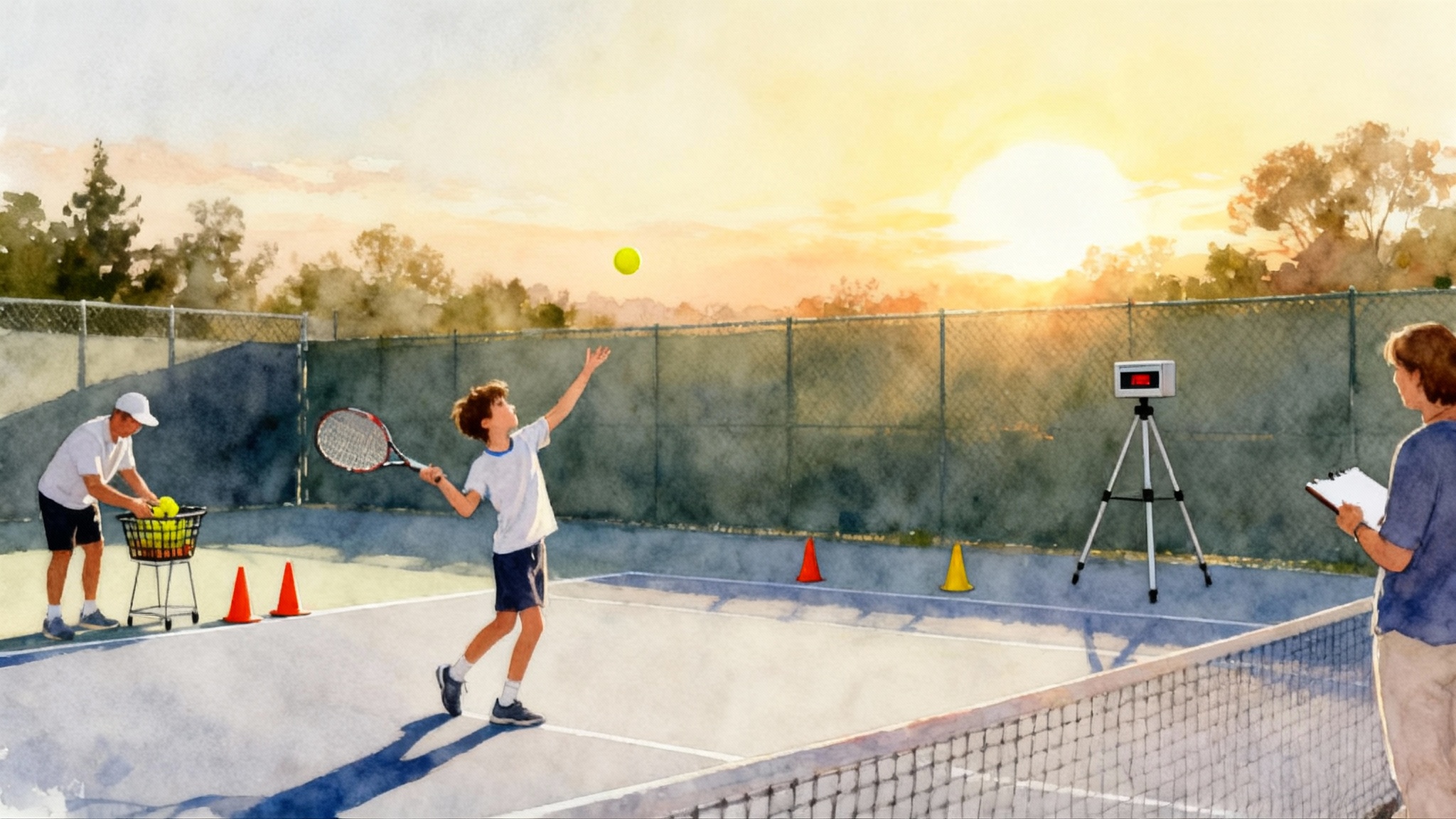
- 0:48 to 0:56 Serve from deuce side. Show one wide, one body, one T at match pace with a visible radar or on-court speed device if available.
- 0:56 to 1:04 Serve from ad side. Repeat one wide, one body, one T.
- 1:04 to 1:18 Return of serve. Alternate deuce and ad side, show both forehand and backhand returns with depth and height control.
- 1:18 to 1:30 Two live point play clips. Keep each point under six shots unless the rally is exceptional. Use unedited match footage if possible.
Tips that improve coach trust:
- Use a tripod and a phone or mirrorless camera in 1080p at 30 frames per second.
- If indoors, set white balance to avoid color shift. If outdoors, avoid harsh midday shadows and film in calm wind.
- Wear match kit with a uniform color. Avoid baggy sweatshirts that hide footwork.
- Show you can move between patterns. For example, drive a forehand, then defend with a high heavy crosscourt, then recover.
- Include a link to two full matches with the scoreboard in view. One on serve-heavy hard court, one on a slower surface if you often compete there.
UTR, WTN, and key stats checklist
Recruiting is a numbers game, but numbers only help if they are accurate and current. Use this checklist to keep the right data at the top of your messages and profiles.
- UTR: current rating to two decimals, singles and doubles. Include your UTR ID.
- World Tennis Number: singles and doubles numbers. Include your Player ID if you have one.
- Match volume: number of rated matches in the last 90 days and last 12 months.
- Best three wins by opponent rating and event level. Note surface and score.
- Physical markers: standing reach, vertical jump estimate, 20-yard sprint, and recent serve speed. Keep these honest and repeatable.
- Health and availability: training hours per week, any injuries resolved in the last year, and when you will be on campus for unofficial visits.
- Academics: unweighted GPA, core course GPA if you track it, test score breakdown or test optional status, advanced coursework, and any dual credit.
- Character signals: captain roles, community work, or part-time work that shows responsibility.
Update this every month. If a coach revisits your link and sees January data in April, you lose momentum.
Subject lines that get opened
Coaches triage by subject lines. Keep them factual, compact, and easy to sort. Use five to seven words plus your grad year.
- 2026 TX lefty 10.2 UTR 3.8 GPA
- 2026 GA 9.8 UTR WTN 19 strong returns
- 2026 CA 11.0 UTR 3.9 GPA highlights inside
- 2026 FL doubles specialist WTN 22 video
- 2026 Midwest 10.5 UTR top wins attached
If you are emailing about an upcoming event the coach may attend, add the event tag at the end. Example: 2026 NC 10.0 UTR Raleigh L5 Sat.
Email templates that work
Personalize every send. The goal is to show fit and make it simple to reply yes for a call.
Initial outreach
Subject: 2026 TX righty 10.1 UTR 3.7 GPA highlights
Coach [Last Name],
I am [Your Full Name], class of 2026 from [City, State]. I play [right or left handed] with a [one or two handed] backhand. My current UTR is [X.X] singles and [X.X] doubles. My World Tennis Number is [Number] singles and [Number] doubles. I attend [High School] and have a [GPA].
I watched your team’s [recent result or match clip] and I like the way your players build points and compete. I believe my game style would fit your program because [one sentence on patterns, fitness, or doubles instincts]. If returns are a strength, study our Return of Serve Mastery playbook to frame your clips.
Highlights 90 seconds: [link]
Full match 1: [link]
Full match 2: [link]
Recent wins: [three short lines with event, opponent rating, score]
Academics: [tests or test optional], intended major [if known]
I would love to schedule a 10 minute call next week to introduce myself and learn what you look for in 2026 recruits. My coach is [Name, phone, email] and is happy to share more.
Thank you for your time,
[Your Name]
[Phone]
[Email]
[City, State]
Polite follow up after one week
Subject: 2026 TX 10.1 UTR highlights and quick call
Coach [Last Name],
Checking in with my 90-second video and two recent wins. I would value a brief call to hear how you evaluate returns and transition play. My coach is copied here.
Highlights: [link]
Two recent wins: [one line each]
May I send you two match times to choose from for a 10 minute call next week?
Thank you,
[Your Name]
Tournament update
Subject: 2026 CA 10.7 UTR competing at [Event]
Coach [Last Name],
I will compete at [Event] in [City] on [dates]. If you plan to attend, I would appreciate a look. Here are my draw and most recent full match replay.
Draw: [link]
Full match: [link]
Thank you,
[Your Name]
A four-week outreach cadence you can keep
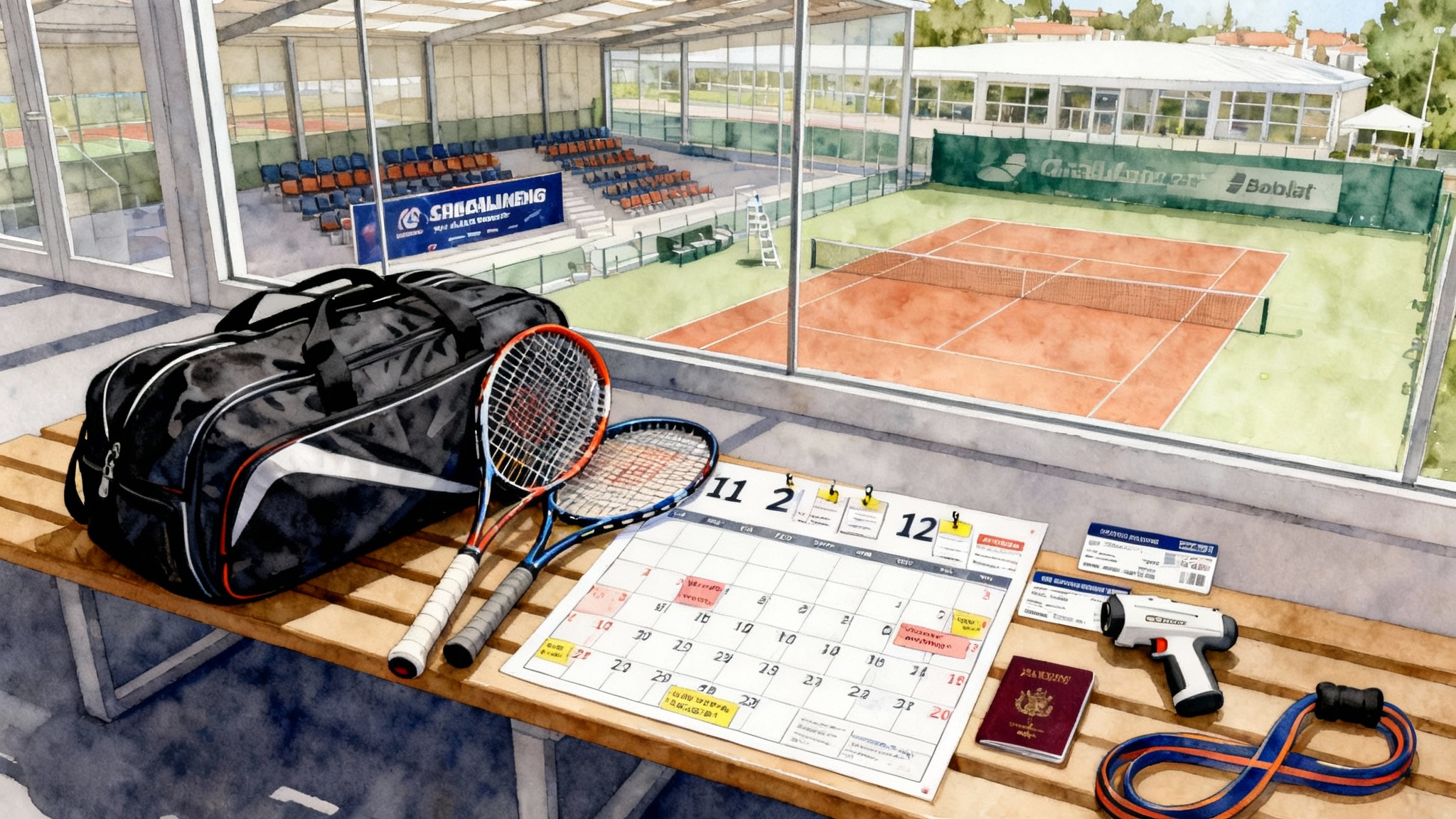
Consistency beats intensity. Use this light rhythm. Adjust the days to your school and tournament schedule. Build your tournament calendar with Smart 2026 tennis calendars.
Week 1
- Build your target list of 30 to 45 programs across Division I, Division II, Division III, and NAIA with a realistic spread of reach, match, and safety.
- Send the initial outreach email to 10 to 12 programs on Monday and Tuesday.
- On Thursday, send five more. On Friday, confirm that links work and track replies.
Week 2
- Send the initial outreach to the next 10 to 12 programs.
- Follow up with a short note to any coach who opened but did not reply. Keep it to three lines and ask for a 10 minute call.
- Film any missing video clips after practice. Replace one weak clip in your highlight reel.
Week 3
- Send the initial outreach to the remaining programs.
- Offer two specific times for a call to any coach who engaged. Example: I can do Tuesday 4:30 p.m. Central or Wednesday 7:45 p.m. Central.
- Share two match times if you have an event that week.
Week 4
- Send brief tournament updates to engaged coaches. One paragraph and a link to a fresh full match.
- For coaches who have not responded, send one last concise follow up. If there is no movement after that, pause for a month and focus on raising your level and results.
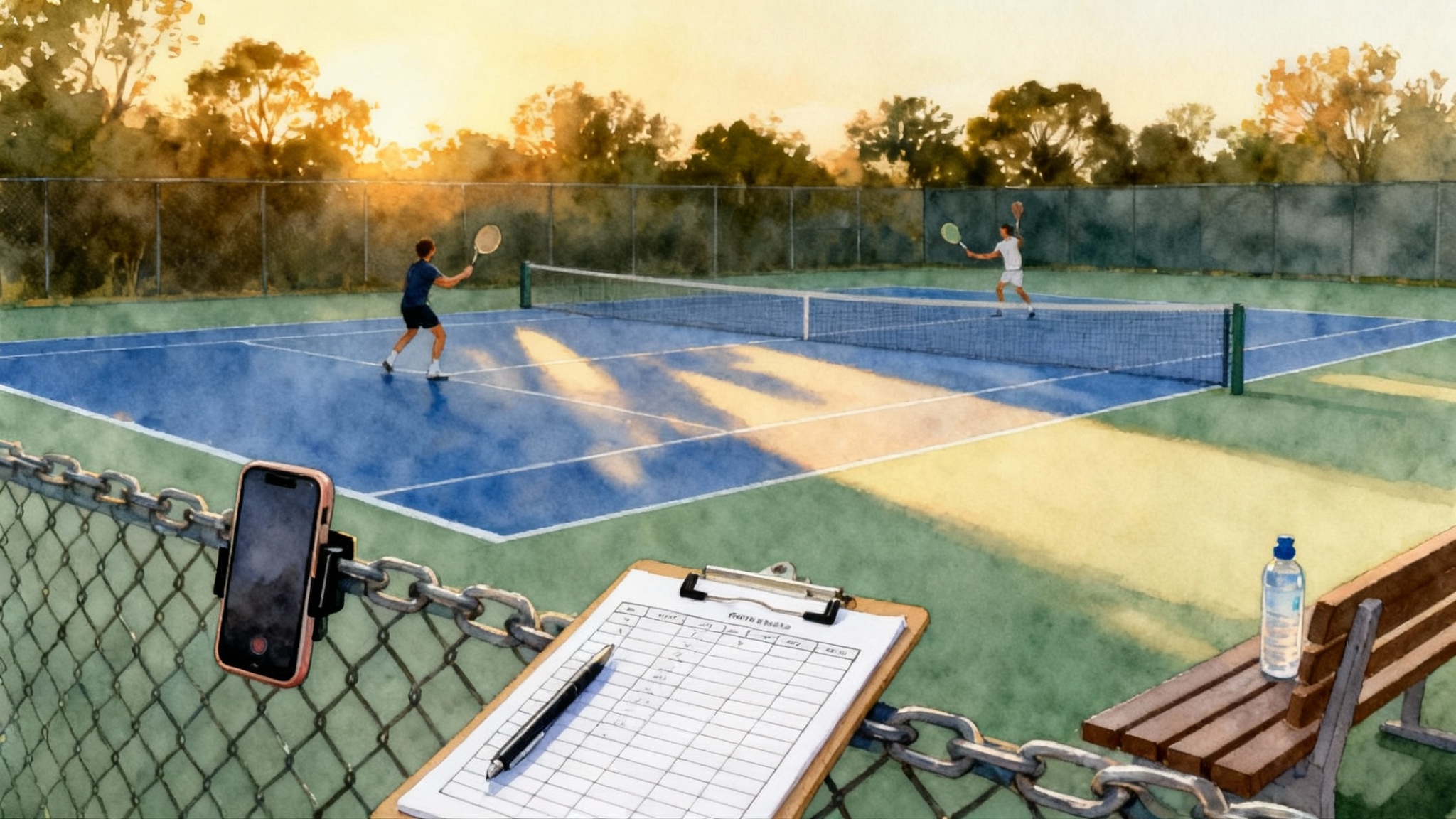
Track every touch in a simple spreadsheet or a lightweight customer relationship manager. If you want a ready-made sheet and templates, grab our internal kit at recruiting tools for families.
Phone and Zoom etiquette that makes a strong impression
You are not trying to win the call with perfect answers. You are trying to show self awareness and coachability.
Before the call
- Research the last season and the likely roster gaps by graduation year. Know who plays high in the lineup.
- Prepare a 30 second introduction. Name, school, playing style in one sentence, what you are working on, and what attracts you to the program.
- Set your device at eye level. Sit near a window or a lamp behind the camera. Wear a simple polo or training top.
- Keep a pen and a short list of questions in front of you.
During the call
- Be on time. Smile. Thank the coach for taking a few minutes.
- Keep answers to 20 to 30 seconds unless the coach asks for more.
- Use tennis language that shows understanding. Talk about patterns, first ball depth, neutral to offense, and how you build points.
- Ask one question about player development, one about academics, and one about the timeline for 2026 recruiting.
Good questions to ask
- What does a successful freshman look like in your program by January of year one
- Which two skills do you value most in your top three singles players
- How do you measure progress for doubles teams during the fall
- What does your strength and conditioning plan look like in season and off season
- What is your timeline for 2026 offers and visits
Close the call
- Thank the coach. Offer to send a full match from the last two weeks.
- Ask if a five minute check in after your next event would be helpful.
- Confirm best email for updates.
Light compliance notes for families
Rules change, so always read the current rulebook and your specific division guidance. For timelines, contact periods, and what counts as a recruiting conversation, begin with the official NCAA recruiting rules overview. For NAIA programs, create an account and review guidance at the NAIA eligibility center.
Key reminders
- Keep all communication truthful and student led. Parents can help coordinate but the athlete should send the email and speak on calls.
- Unofficial visits can be powerful. Ask what is permissible before you travel.
- Camps and clinics can be a path to evaluation. Treat them like tryouts and follow school payment rules.
Common mistakes to avoid
- Vague subject lines. Coaches should see class year, location or region, at least one rating, and a reason to click.
- Long videos with music. Keep it to 90 seconds and two full match links.
- Stale numbers. Update UTR, WTN, and wins monthly.
- No academic context. Include GPA and test info or test optional status in the first paragraph.
- Mass emails with no personalization. Write one sentence about why that program could fit you.
- Waiting for a coach to find you. You drive the process with weekly actions.
Case study: how Legend Tennis Academy helps families run the playbook
Legend Tennis Academy profile in Spicewood, Texas works with juniors from first message to first college call. Here is how a typical four-week block looks for their 2026 group.
Film week
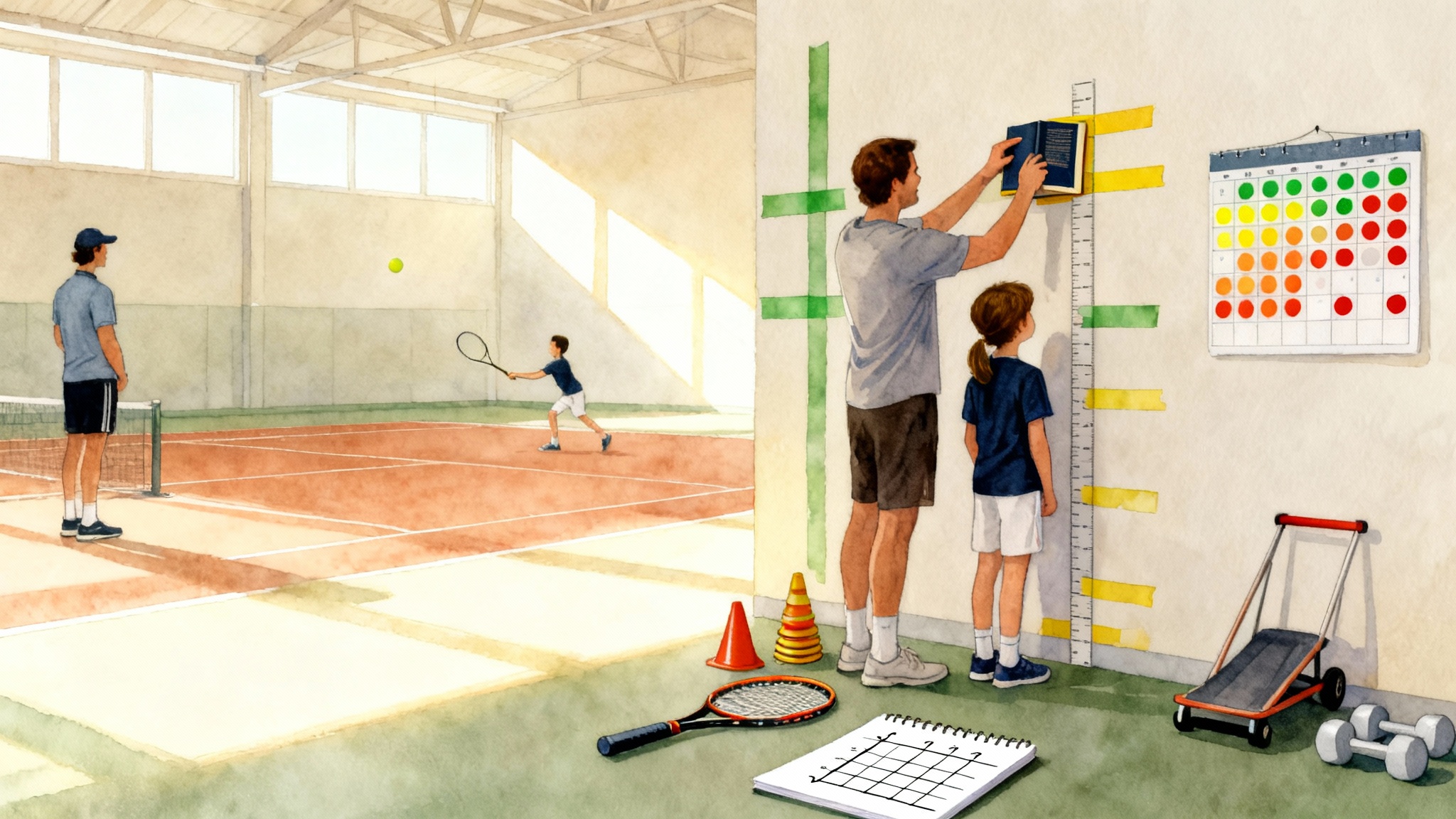
- The academy sets one afternoon for filming on courts with a permanent high angle camera mount. If the mount is not available, they use a telescoping stand behind the baseline.
- Players record the 90-second shot list in sequence. A coach stands off camera and calls out patterns and targets.
- Two match play sets are recorded that same week. The academy uses a simple scoreboard attachment so the score is visible.
Edit and verify week
- Staff trims each clip to the best clean reps. No slow motion. No music. Only an opening slate with name, grad year, UTR, WTN, and contacts.
- The head coach verifies the three best wins to ensure event, surface, and score are correct.
- Parents receive a one page profile draft with links and are asked to confirm academics and contact info.
Outreach week
- The academy runs a small workshop to draft subject lines and three personalized sentences for each program on the player list.
- Players send their first ten emails on Monday, five more on Thursday, then track opens and replies on Friday.
- The academy schedules three 10 minute practice calls where players role play introductions and answer common questions.
Follow up week
- Players send match updates with one line summaries of results and one new full match link.
- The academy helps players propose two specific times for a coach call and prepare a short list of questions.
- Parents get a checklist of travel options for any campus visits that may follow.
Two athletes from the 2026 group share similar outcomes. One doubles-first player with a strong return and net presence built interest from several Division II programs after coaches saw 45 seconds of crisp return points and a recent win over a higher rated pair. Another baseline-first player with a heavy forehand earned two Division III pre-reads after posting consistent academic updates and a clear plan to improve serve percentage. The common thread was structure. Film with purpose, present verified data, and follow up without drama.
Late starters and walk-on paths
If you are getting serious in 2026 and worry that you are late, here is how to move fast without cutting corners.
- Slim your list. Focus on 15 to 20 programs where your current level and academics likely fit. Include more Division II, Division III, and NAIA options.
- Play more rated matches in the next 8 to 12 weeks. Coaches trust recent data, especially if your trend is rising.
- Lead with academics and character. Coaches need reliable teammates who will thrive in class and do the work.
- Be open about development. Say exactly what you are improving right now and how you measure it.
Walk-on strategy
- Research how each program handles walk-on evaluations. Some teams run fall tryouts, others require coach approval and fitness benchmarks.
- Send a concise email in mid to late summer before you arrive on campus. Include your 90-second video, two full matches, and fitness measures.
- Offer to be a practice player if roster spots are full. Many athletes earn a walk-on place by being the most consistent competitor in the room.
Your next five actions
- Film or refilm your 90-second highlight with the shot list above.
- Update your UTR, WTN, and academics. Put them in your profile and at the top of your email draft.
- Write three subject lines and choose the best one.
- Send ten personalized emails to your top programs by Friday.
- Book two practice calls with a coach or mentor to rehearse your introduction and questions.
If you want ready to use templates, tracking sheets, and a video checklist, download the kit at recruiting tools for families. It includes a shareable profile format and reminders that keep you moving.
A final word
The best recruiting stories are not dramatic. They are disciplined. A clear video. Current and honest numbers. Short emails with a reason to click. A simple weekly rhythm. Respect for the rules. A steady voice on the phone. If you run this playbook for four weeks, you will have real conversations with real coaches. Run it for three months, and your options will be clearer than you expect.