Green to Yellow Ball in 6 to 8 Weeks: A Safe Junior Plan
A practical 6 to 8 week roadmap to move juniors from green to yellow balls with confidence. Readiness tests, technique cues, fitness benchmarks, gear setups, microcycles, and match-play ramps included.
 Tommy
Tommy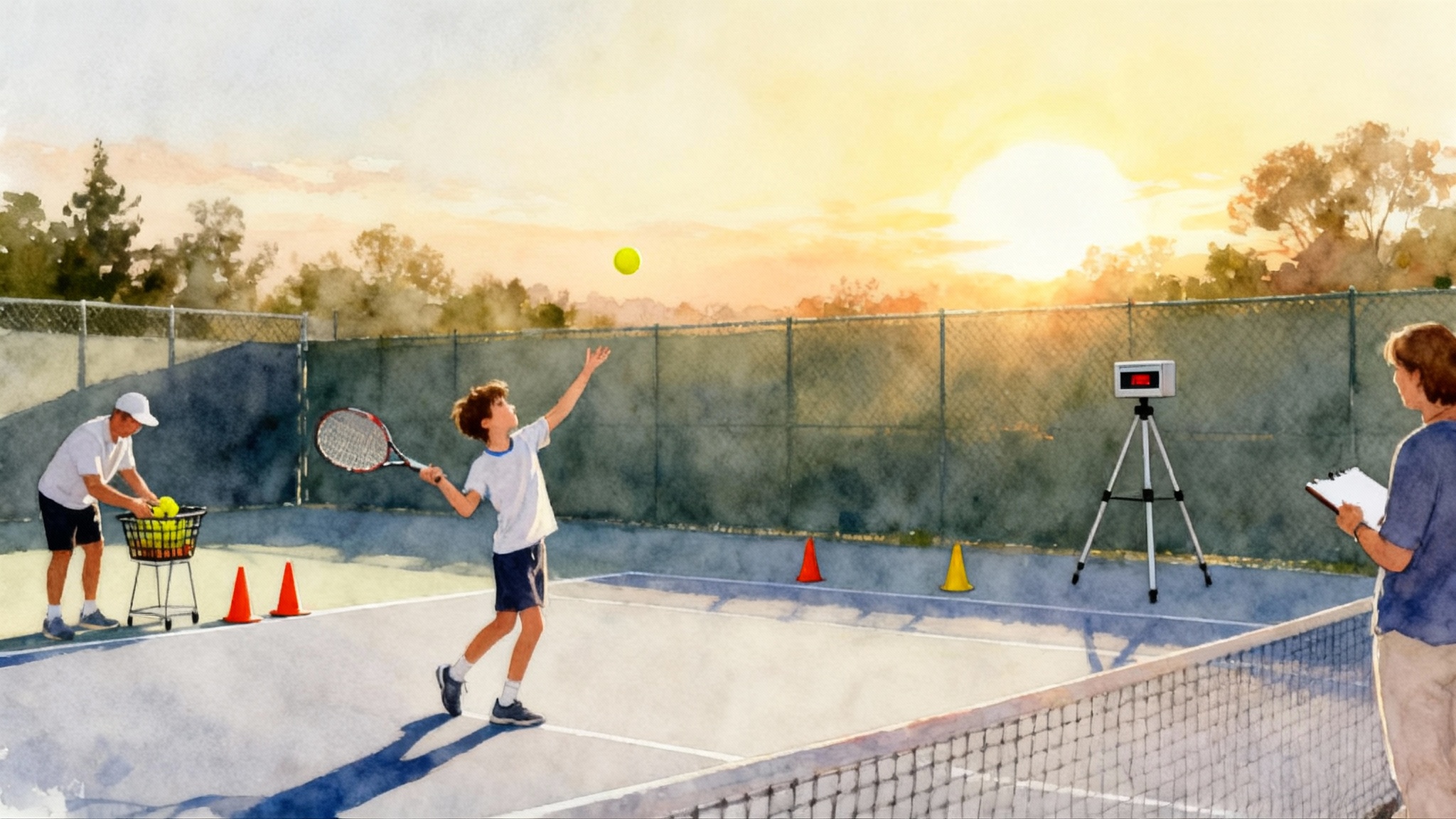
Why the green-to-yellow leap matters in 2026
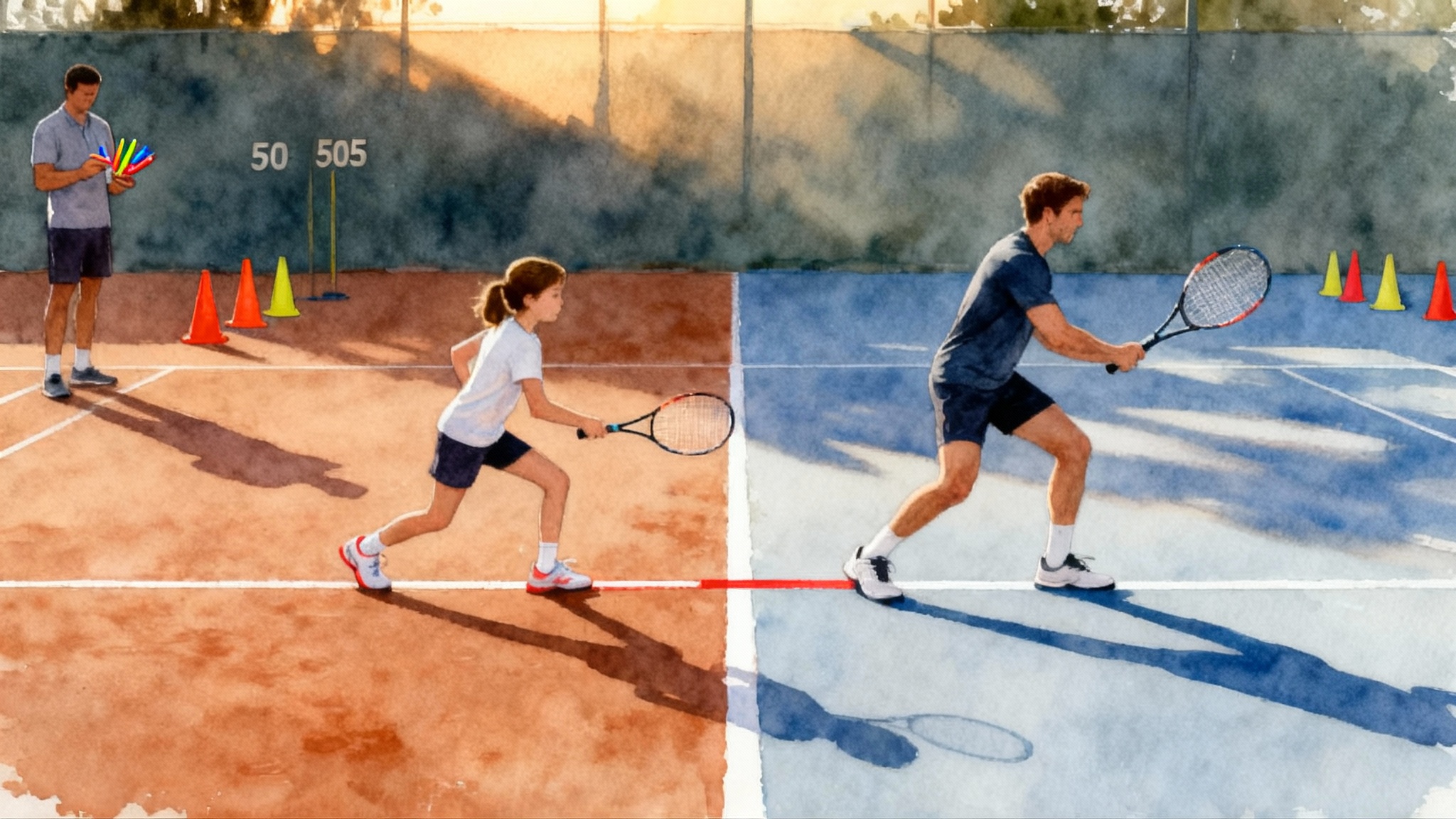
The jump from green-dot to yellow ball is small in color and big in load. A yellow ball is heavier, faster off the strings, and bounces higher. That extra bounce shifts contact above the comfortable window most green-ball players use, which strains timing, shoulder mechanics, and confidence. Governing bodies endorse a staged pathway for a reason. The USTA 10 and Under pathway exists to match ball flight, bounce, and court size to a player’s physical and technical capacities.
This article turns that guidance into a concrete 6 to 8 week plan. You will find objective readiness tests, the technique tweaks that matter most, age-appropriate fitness benchmarks, racquet and string setups, and a week-by-week microcycle. We also include a parent checklist, match-play ramping formats, and a peek at how an academy can run small-group transition blocks and evaluation days to personalize the leap.
Readiness tests before you switch
Think of readiness as a three-part gate: skill, ball-flight tolerance, and physical capacity. Check these boxes before making yellow the default in practice.
- Rally length test
- Goal: 14-ball rally crosscourt forehand and backhand at 60 to 70 percent effort with green balls, twice in a session.
- Why it matters: If timing breaks at rep 8 or 9 with a slower ball, the added speed and bounce of yellow will magnify errors.
- Contact height window
- Goal: On neutral balls, 70 percent of contacts between lower rib and shoulder line, measured over 20 feeds per wing.
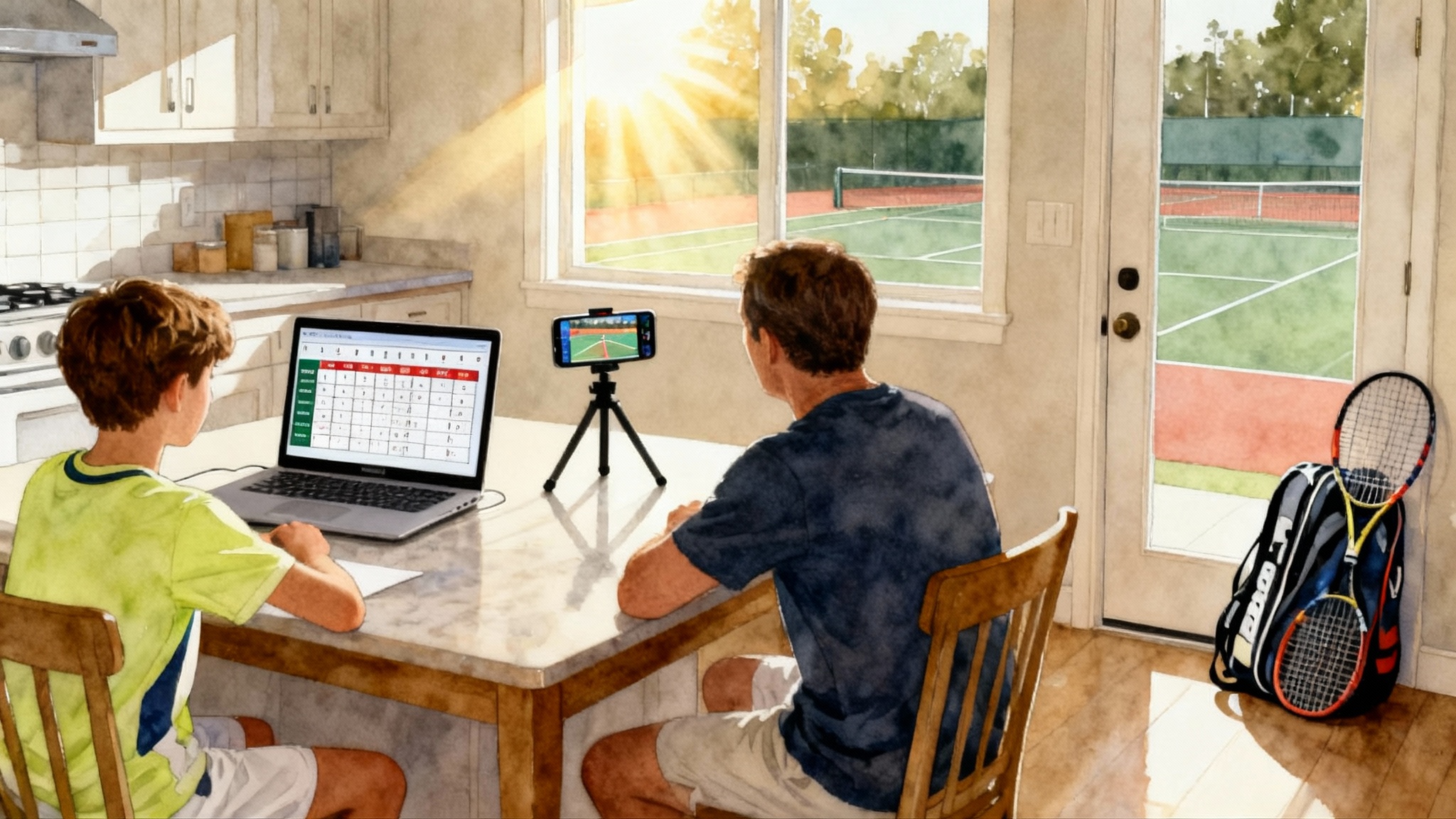
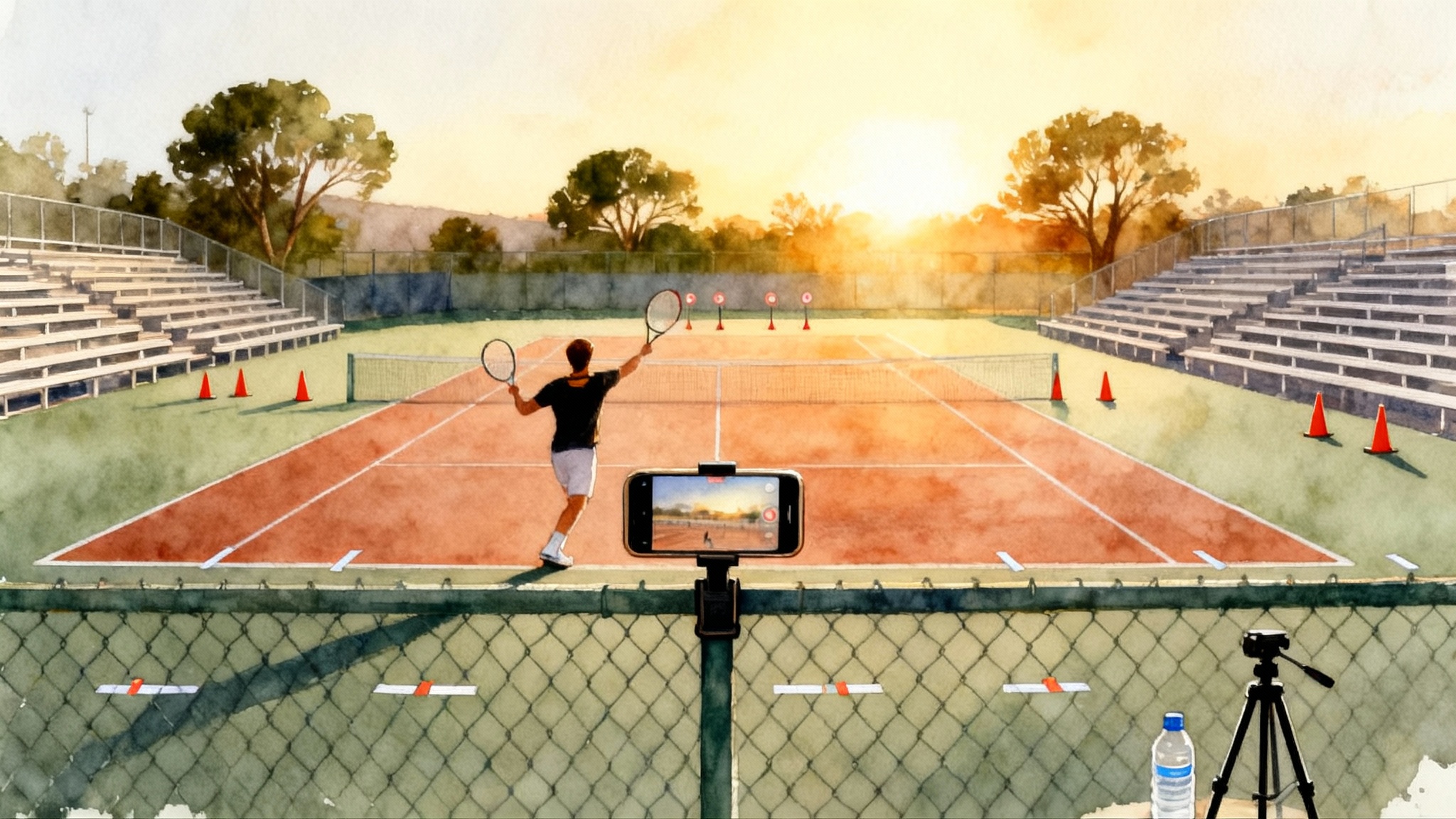
- How: Record with a phone from the side. Freeze at impact and tally contacts by height. If most hits are at face level, you will need spacing and vertical racket speed work before yellow. For better video habits, use our smartphone video analysis checks.
- Ball-speed tolerance
- Goal: Handle 10 consecutive neutral feeds at 35 to 40 miles per hour to the forehand and backhand without technical collapse or late contact.
- How: Use a basic radar, a ball machine setting, or a measured server. Note the miss pattern. Late and high equals spacing and unit-turn timing work.
- Serve baseline
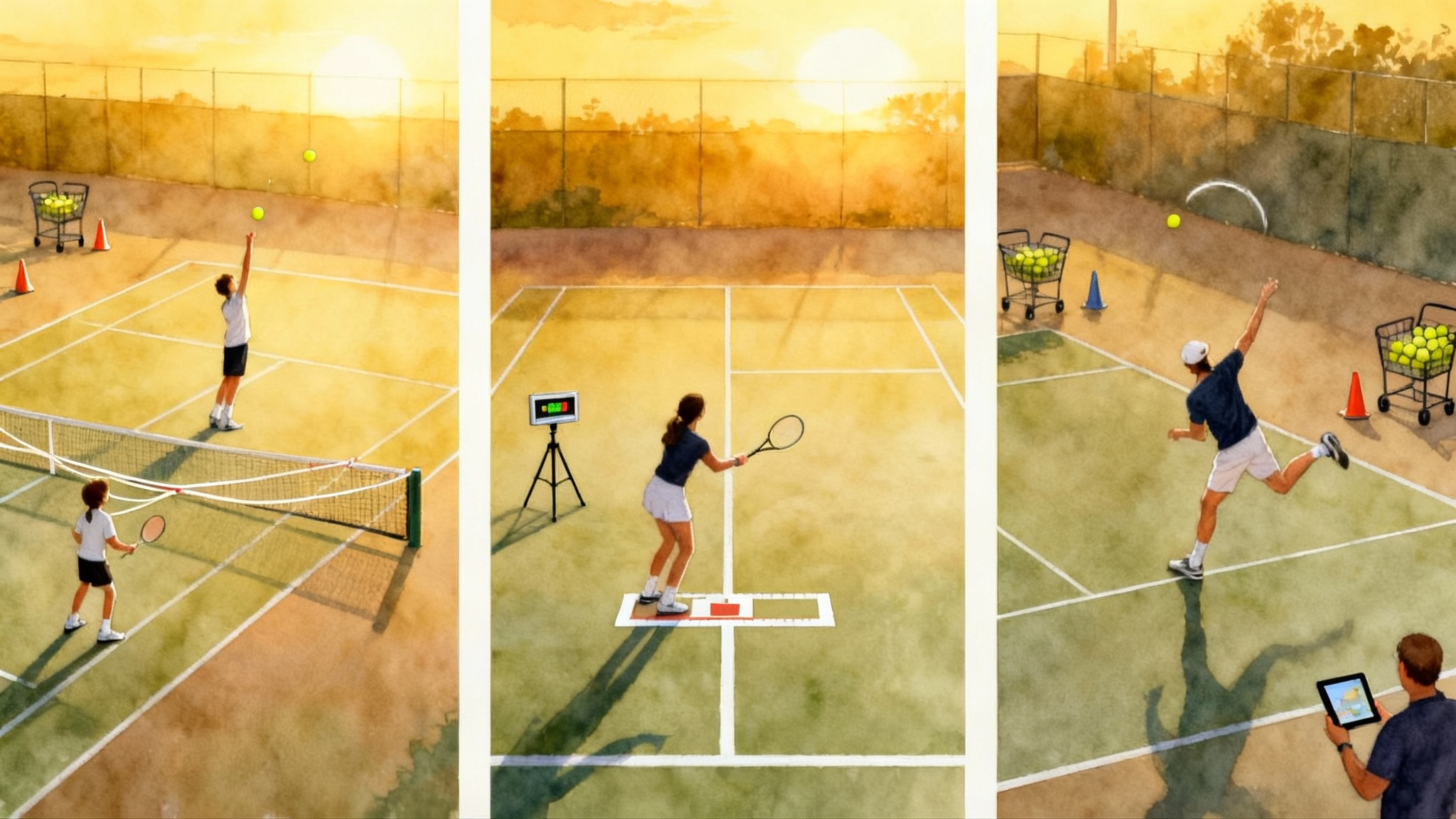
- Goal: With green balls, 7 of 10 first serves in from the baseline at 60 percent power, both deuce and ad sides.
- Why: Yellow punishes flat tosses and low contact. A consistent, slightly forward toss and a relaxed pronation pattern reduce elbow load during the switch. For age-tuned ideas, see serve power and spin by age.
- Movement and deceleration
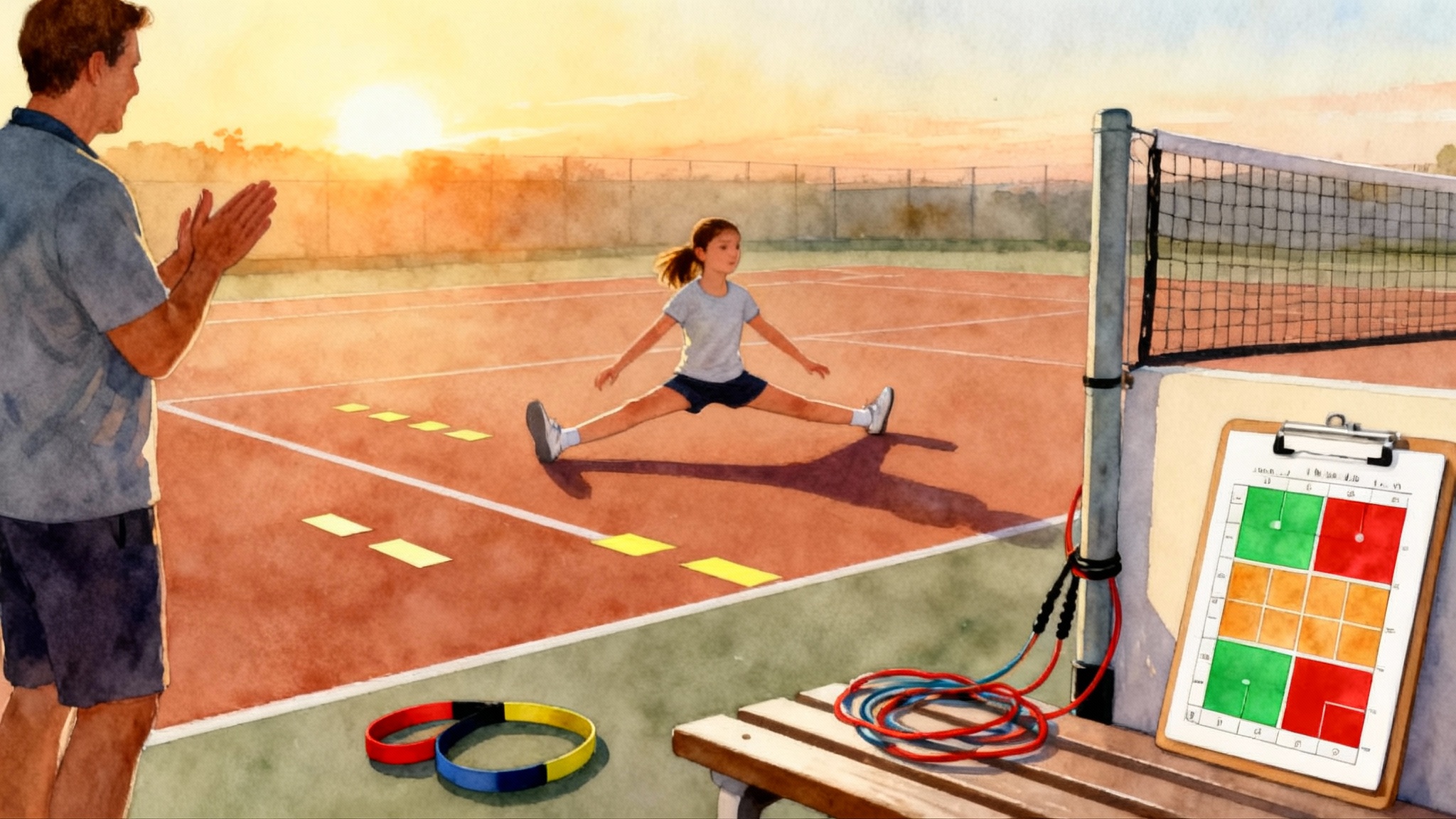
- Goal: Complete 5 shuttles of 10 meters in 35 seconds total with stable stops, plus 10 controlled split-step landings without knees caving inward.
- Why: Yellow rallies demand more abrupt stops. If deceleration is noisy or valgus appears, beef up landing mechanics first. Refine timing with our split-step timing blueprint.
If a player passes 3 of the 5, begin a blended phase. If they pass 4 or 5, they can start the full plan below and expect a smoother ride.
Technique tweaks that prevent overuse
Do not overhaul everything. Nudge the three levers that change outcomes fast.
- Grip comfort and spacing
- Forehand: For most juniors, a comfortable modern grip sits between semi-western and eastern. Cue “strings to the sky” in the unit turn so the racket face is not shut too early.
- Backhand: Two-hander players should feel the non-dominant hand lead through contact. Cue “left palm high and long” for right-handed players to hold spacing.
- Vertical racket speed
- High bounce means you cannot only swing forward. Teach a low-to-high arc that finishes above eye line on waist-high balls. Cue “brush the outside of the ball” and “elbow floats up after contact.” A simple shadow set of 12 reps per wing before each hit is enough to change the picture.
- Contact location and footwork
- Spacing: Two small adjustment steps before plant. Cue “one-two settle” instead of reaching.
- Contact: Forehand slightly in front of the lead hip; backhand in line with the front pocket. If video shows jammed contacts, draw a chalk dot a foot in front of the ideal strike zone and require the front foot to land near it before swinging.
- Serve shape first, speed later
- Toss: Slightly forward and to the hitting side. Cue “eyes up until ball drops” to protect the neck and keep posture tall.
- Spin: Teach a gentle topspin or slice shape. The outcome to chase is high net clearance, not pace.
Age-appropriate fitness benchmarks
These are benchmarks, not barriers. They help you choose the right workload.
Ages 8 to 10
- Movement: 5 by 10 meter shuttle in 40 to 45 seconds with soft landings.
- Core: Front plank 30 seconds with neutral spine.
- Power: Medicine ball chest pass with a 1 kilogram ball reaching 2.5 meters.
- Mobility: Overhead squat to a box with heels down and knees tracking.
Ages 11 to 13
- Movement: 5 by 10 meter shuttle in 35 to 38 seconds.
- Core: Front plank 45 to 60 seconds; side plank 30 seconds each side.
- Power: Medicine ball rotational throw, 2 kilogram ball to 4 meters.
- Strength: 8 controlled lunges per leg, bodyweight, with knee over midfoot.
Ages 14 plus
- Movement: 5 by 10 meter shuttle in 32 to 35 seconds.
- Core: Front plank 75 seconds; anti-rotation press 10 slow reps per side.
- Power: Medicine ball scoop toss, 3 kilograms to 6 meters.
- Strength: 6 to 10 split squats per leg holding light dumbbells without losing posture.
Use these to tailor off-court work in the microcycles below. Pain is not progress. Any joint pain that lingers beyond 24 hours after training requires a reduction in volume and an equipment check.
Racquet and string setups that smooth the switch
The goal is to keep the swing light, the stringbed plush, and the sweet spot generous while timing catches up.
- Head size: 100 to 105 square inches for most juniors in this transition.
- Length: Players under 5 feet 1 inch often fare better starting with 26.5 to 27 inches before committing to a full 27 inch frame.
- Static weight: 270 to 295 grams unstrung, depending on strength and injury history.
- Swingweight: 285 to 300 for most. Lighter than 285 feels fast but unstable in heavy balls; above 300 can burden the shoulder.
- Balance: 2 to 4 points head light to help accelerate without muscling.
- Strings: A multifilament or soft co-polyester hybrid works well. For full polyester, insist on a very soft model and monitor elbow and shoulder.
- Gauge: 17 or 18 for easier bite.
- Tension: 47 to 52 pounds on constant-pull machines, 2 pounds lower with a full polyester bed.
If you want a specification check against global standards, review the ITF ball compression standards. It clarifies why impact feels harsher as you move to yellow, which is reason enough to keep the stringbed forgiving at the start.
The 6 to 8 week plan
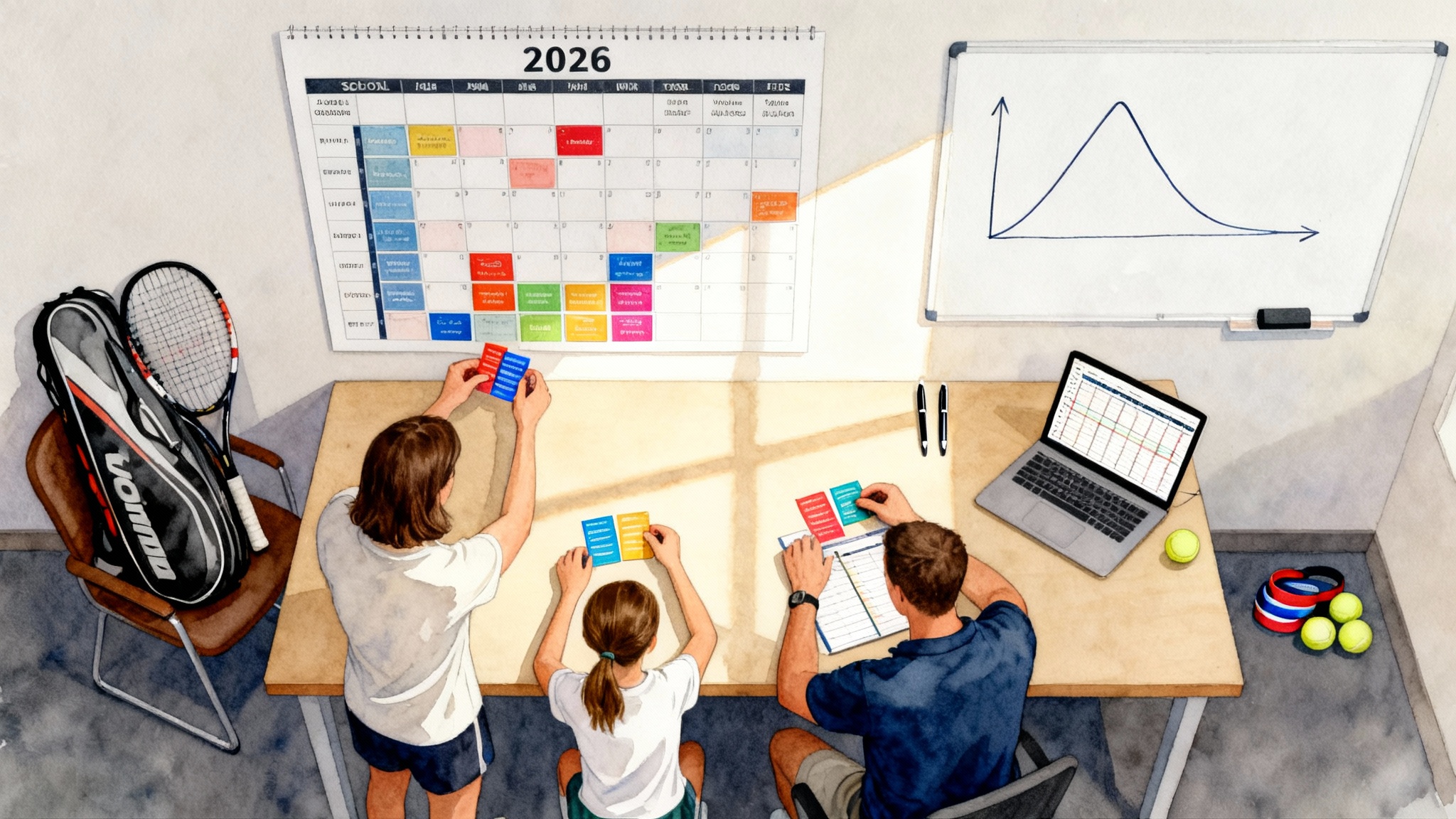
Each week includes three on-court sessions, one match-play slot, and two short strength sessions. Option A is a 6 week fast track for players who passed 4 or 5 readiness tests. Option B is an 8 week path with an extra blend phase.
Week 1: Blend and build
- Ball mix: 60 percent green, 40 percent yellow. Yellow only on serves and two-ball live points.
- Technical focus: Spacing and vertical racket speed. Two sets of 12 shadow swings per wing.
- Drills: Crosscourt 2-ball pattern. Player hits two crosscourt shots at 60 percent, then one direction change down the line.
- Serve: Spin-only first serves, targets inside singles boxes.
- Fitness: Landing mechanics circuit, 15 minutes.
- Match-play: Short set to 4 with green balls. Golden point at deuce to limit total points.
Week 2: Yellow under control
- Ball mix: 70 percent yellow, 30 percent green for rhythm.
- Technical focus: Backhand spacing and non-dominant hand lead.
- Drills: 3 and freeze. Third ball is a deep middle ball with a freeze at the finish for posture check.
- Serve: Second serve kick shape at 50 percent pace.
- Fitness: Core anti-rotation plus split squat patterning.
- Match-play: Two Fast4 sets with no ad scoring, both with yellow.
Week 3: Tolerate pace and height
- Ball mix: 85 percent yellow.
- Technical focus: Early unit turn on return and first step out of the split.
- Drills: Coach-fed high neutral balls to shoulder line. Player must shape the ball high over the net with depth.
- Serve: Target ladders. Hit 10 serves aiming middle third, then 10 wide.
- Fitness: Medicine ball rotational work and short shuttle repeats.
- Match-play: One set to 6, tie-break to 7 at 6 all. Manage between-point routines and hydration.
Week 4: Add patterns
- Ball mix: 100 percent yellow in all live play.
- Technical focus: Forehand plus one patterns and backhand line change on command.
- Drills: 2 crosscourt plus line change. Coach calls color to cue the change.
- Serve: First serve percentage challenge. Two ladders of 10 balls aiming for 7 makes in each.
- Fitness: Lateral bounding with stick landings.
- Match-play: Set to 6 with no ad scoring, play two sets if time allows.
Week 5: Stress without strain
- Ball mix: 100 percent yellow.
- Technical focus: Transition balls and mid-court finishing with shape.
- Drills: Approach and volley pattern with a recovery sprint back to the baseline to simulate point length.
- Serve: Mix first serve locations at 60 to 70 percent pace.
- Fitness: Tempo split squats, 3 seconds down, 1 second up, 2 sets of 8 per leg.
- Match-play: Two Fast4 sets, mandatory 90 second changeovers to practice recovery.
Week 6: Consolidate and test
- Ball mix: 100 percent yellow.
- Technical focus: Match identity. Identify one serve pattern and one baseline pattern that feel natural.
- Drills: Live points starting with serve plus one, then return plus one.
- Fitness: Deload week. Mobility and core only.
- Match-play: Full set to 6 with ad scoring, then a 10 point match tiebreak.
- Retest: Repeat the five readiness tests. Expect gains in rally length and serve percentage.
Option B extended path
If Week 2 felt rushed, insert two additional weeks before Week 3.
Week 2B
- Ball mix: 50 percent yellow, 50 percent green.
- Drills: Depth ladders with court targets.
- Serve: Spin serve confidence block, 30 balls only.
- Fitness: Landing and trunk control refresh.
Week 3B
- Ball mix: 70 percent yellow.
- Drills: Crosscourt consistency to 16-ball targets.
- Fitness: Add medicine ball work.
- Match-play: One Fast4 set plus a 7 point tiebreak.
Sample weekly microcycle
- Monday: Technique block 75 minutes. Spacing and vertical racket speed, 20 minutes of serves, 15 minutes of mobility and core.
- Wednesday: Pattern play 75 minutes. Two pattern choices, direction change rules, return practice, 10 minutes of medicine ball work.
- Friday: Live ball 60 minutes. Points to 11, must win by 2, with coach constraints for shape and height.
- Saturday: Match-play 75 to 90 minutes. Alternate formats weekly.
- Optional: Tuesday or Thursday 30 minute strength session at home. Split squats, single-leg hinge, planks, side planks, band pulls.
Match-play ramping formats and scoring
Use scoring to dose load and confidence.
- Fast4 sets: First to 4 games, tiebreak at 3 all, no ad. Great for week 2 to week 5.
- Short sets to 6 with no ad: Limits point count and keeps pressure on serve plus one.
- Timed match: Two 15 minute blocks where the score carries over. Helps serve routine and changeover timing.
- Tiebreak focus: Best of three 7 point tiebreaks. Useful for teaching momentum resets.
- Serve restrictions for learning: In early weeks, require all second serves to be topspin or slice to promote height and safety.
Parent checklist by week
Parents can reduce friction by controlling what they can control. Use this weekly list.
- Sleep: 9 to 11 hours for preteens, 8 to 10 hours for teens. Protect bedtime on match-play night.
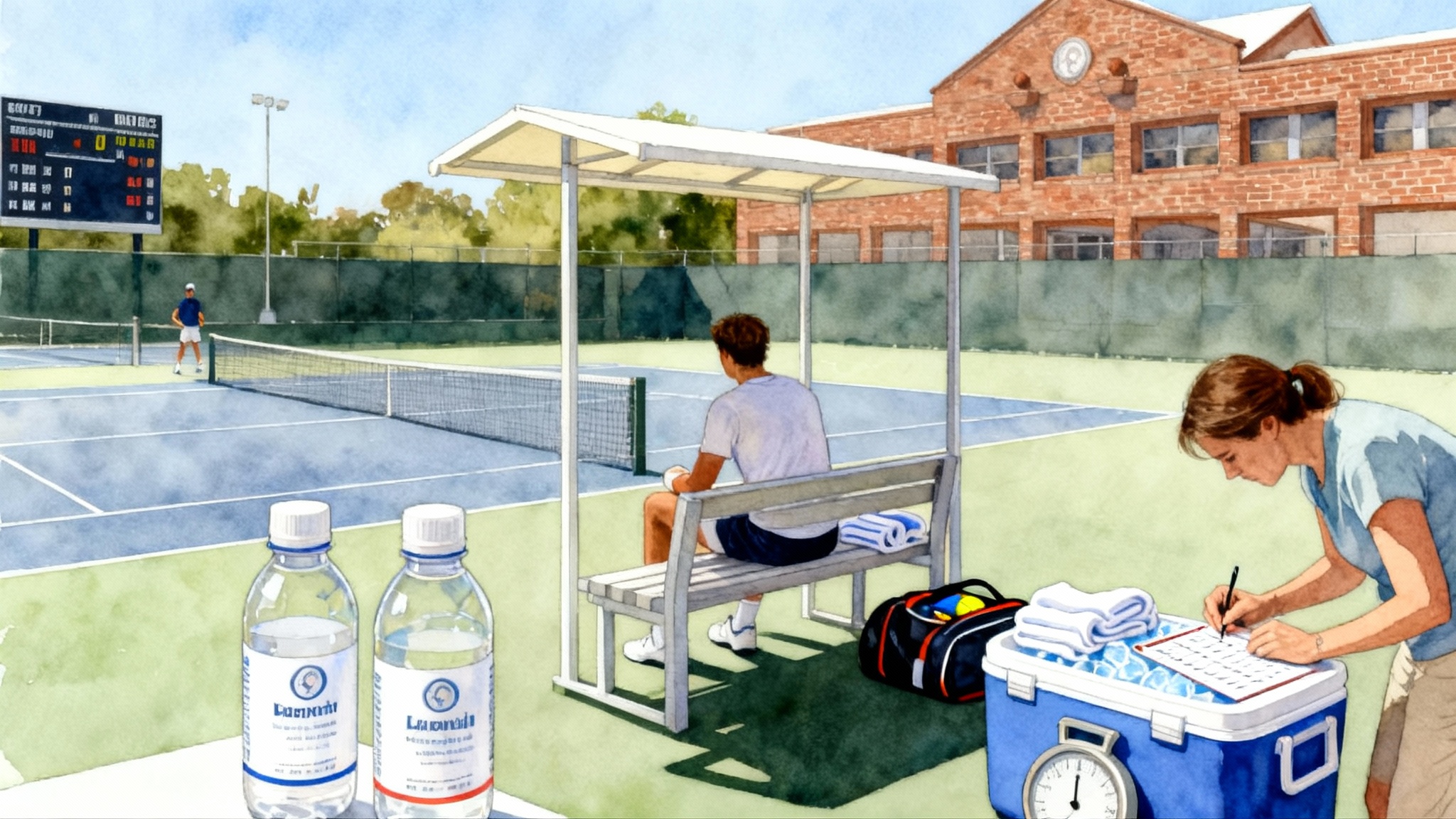
- Hydration: Clear bottle on court, 12 to 16 ounces per hour of play, add electrolytes in heat.
- Equipment: Check grip size and overgrip condition weekly. Frayed strings or hard notches mean restring now.
- Soreness log: The morning after each session, ask for a 0 to 10 rating at elbow, shoulder, knee, and lower back. Any 4 or higher triggers a lighter session.
- Video: One side view per week, ten forehands and ten backhands, same spot on the fence to compare.
- Mindset: Ask for one “I did well” and one “I will improve” statement after each hit. Keep it specific.
You can print a one-page version of this checklist for your player notebook and add the weekly soreness and sleep notes to it.
Adult return-to-play options in the same block
Adults who are returning from time off can ride the same structure with a slower gear early on.
Weeks 1 to 2
- Balls: Start with a hybrid session. Warm up with green, play with yellow, finish drills with green to control fatigue.
- Volume: 45 to 60 minute sessions with at least one rest day between.
- Technique: Emphasize contact spacing and a simple serve shape.
- Fitness: Add isometric holds for tendon health, such as 5 by 30 second mid-calf raises and 3 by 30 second forearm flexor holds.
Weeks 3 to 4
- Balls: All yellow for live play.
- Volume: 60 to 75 minute sessions.
- Extra care: Cap serves at 40 balls total per session. Use a soft string setup and check elbow comfort the next morning.
Weeks 5 to 6
- Play: Add league-style scoring or two Fast4 sets.
- Fitness: Introduce light tempo split squats and single-leg hinges. Focus on form over load.
- Goal: Finish the block playing yellow confidently without next-day pain beyond a 2 out of 10.
How an academy runs small-group transition blocks
Here is how a small-group block can look at a modern program such as Legend Tennis Academy in Spicewood, Texas.
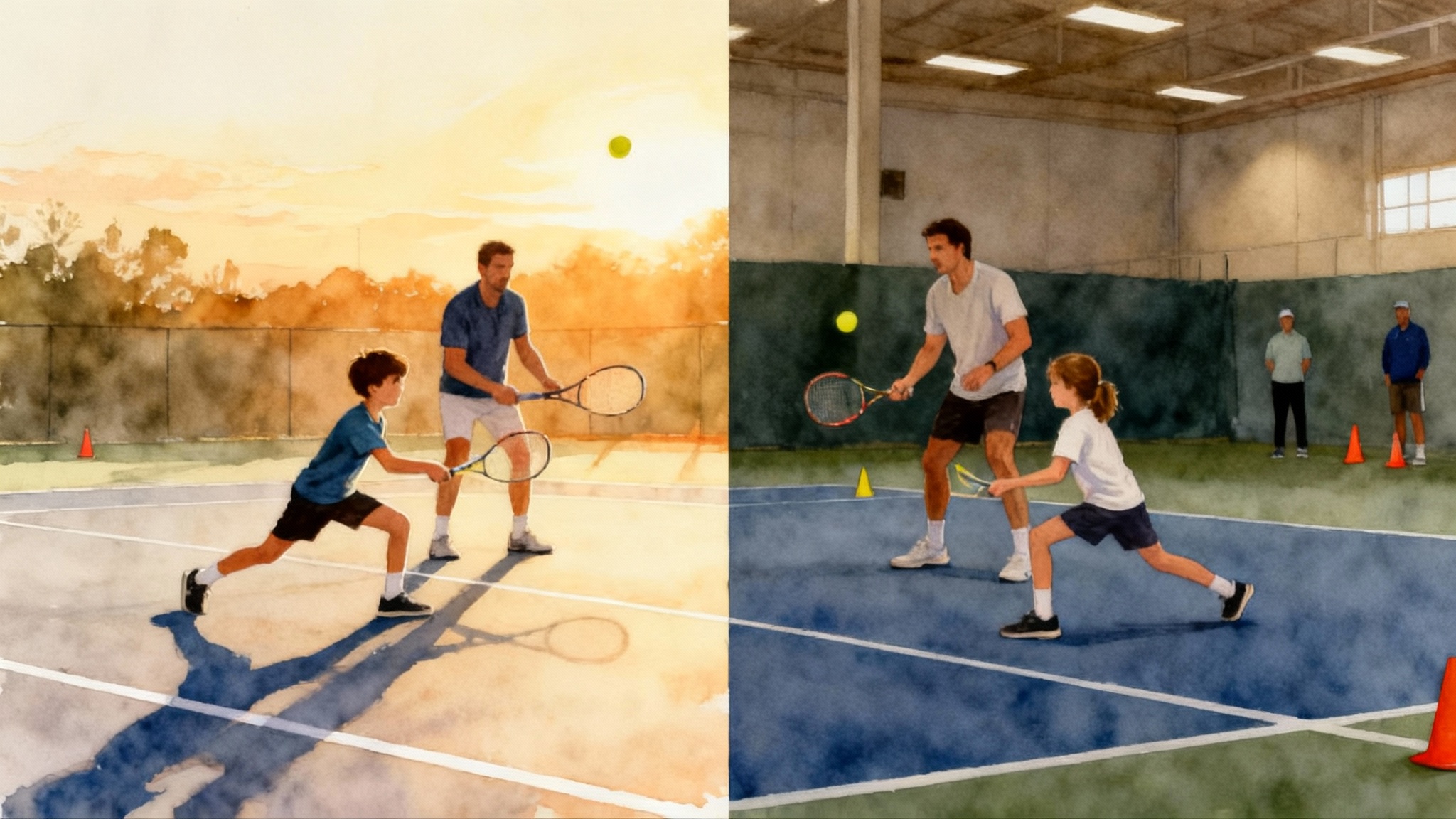
- Group size and lanes: 4 players per coach, grouped by rally length and height of contact rather than age alone. Two lanes on adjacent courts run the same drill with different feeds.
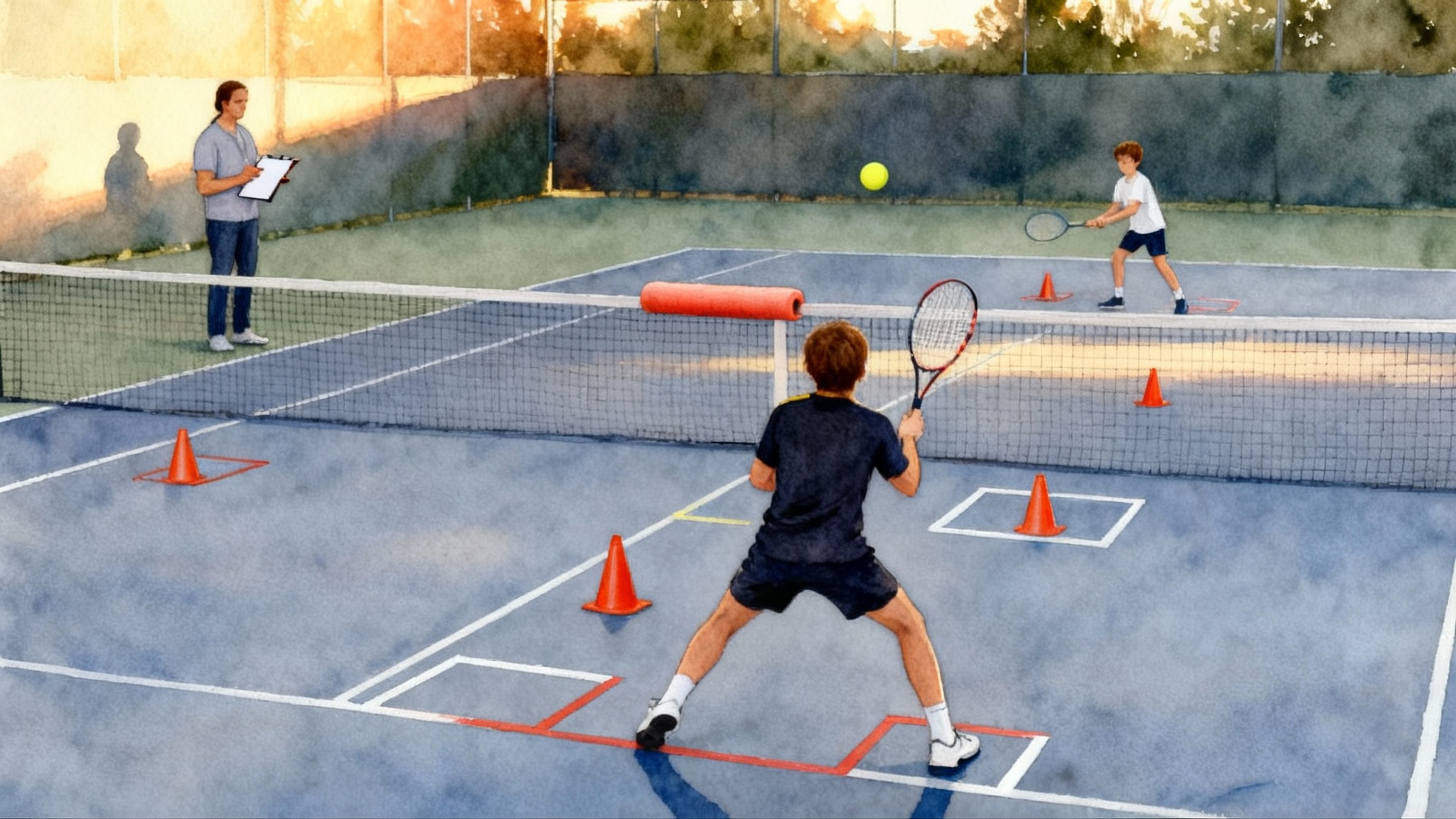
- Evaluation day: A 75 minute session with the five readiness tests, serve shape audit, and a short movement screen. Players receive a color-coded rubric and a ball mix prescription for the first week.
- Personal plans: Each player gets two technical cues, a stringbed recommendation, and a weekly volume cap. The cap might read 300 to 400 live balls plus 20 to 30 serves at the start.
- Data capture: Coaches log rally top length, serve percentage, and perceived exertion after the live block. If perceived exertion spikes while rally length falls, next session flips to a green-heavy blend.
- Match ramp: Weeks 3 to 6 move from Fast4 to one set to 6. Parents receive the scoring plan in advance to set expectations.
- Review day: In week 6, players redo the readiness tests and receive a go-forward plan for league or tournament entry.
This structure turns a vague transition into a measurable upgrade and keeps everyone aligned on the why and how.
Common pitfalls and how to avoid them
- Overstringing: A junior struggling with depth does not need tighter strings. Lower tension or softer strings first.
- Overvolume on serves: Keep counts. If you are not tracking, you are guessing.
- Pattern overload: Teaching five patterns at once dilutes learning. Pick one baseline pattern and one serve pattern per player.
- Ignoring deceleration: Knees and backs pay for poor landing mechanics. Add landing drills even if it reduces hitting time.
A quick checklist for coaches
- At the start: Confirm at least three readiness tests are green-lit.
- Each week: One technical cue per wing, one pattern to rehearse, one fitness focus.
- Each session: State the ball mix, outcome targets, and volume caps.
- Each month: Retest and update string and tension if the player’s contact window changed.
Your next step
Pick your start week, choose Option A or B, and set the first evaluation. If you are a parent, print the checklist and decide how you will track sleep, soreness, and strings. If you are a coach, block two evaluation dates now and invite a small group to keep ratios tight.
The green-to-yellow leap does not reward bravery without a plan. It rewards a plan that respects the physics of the ball, the mechanics of a growing body, and the psychology of confidence. Put the tests on the calendar, tune the racquet and strings, and let the schedule do the heavy lifting. In eight weeks, you will not be guessing whether it worked. You will have cleaner video, calmer points, and a player who wants to play again tomorrow.