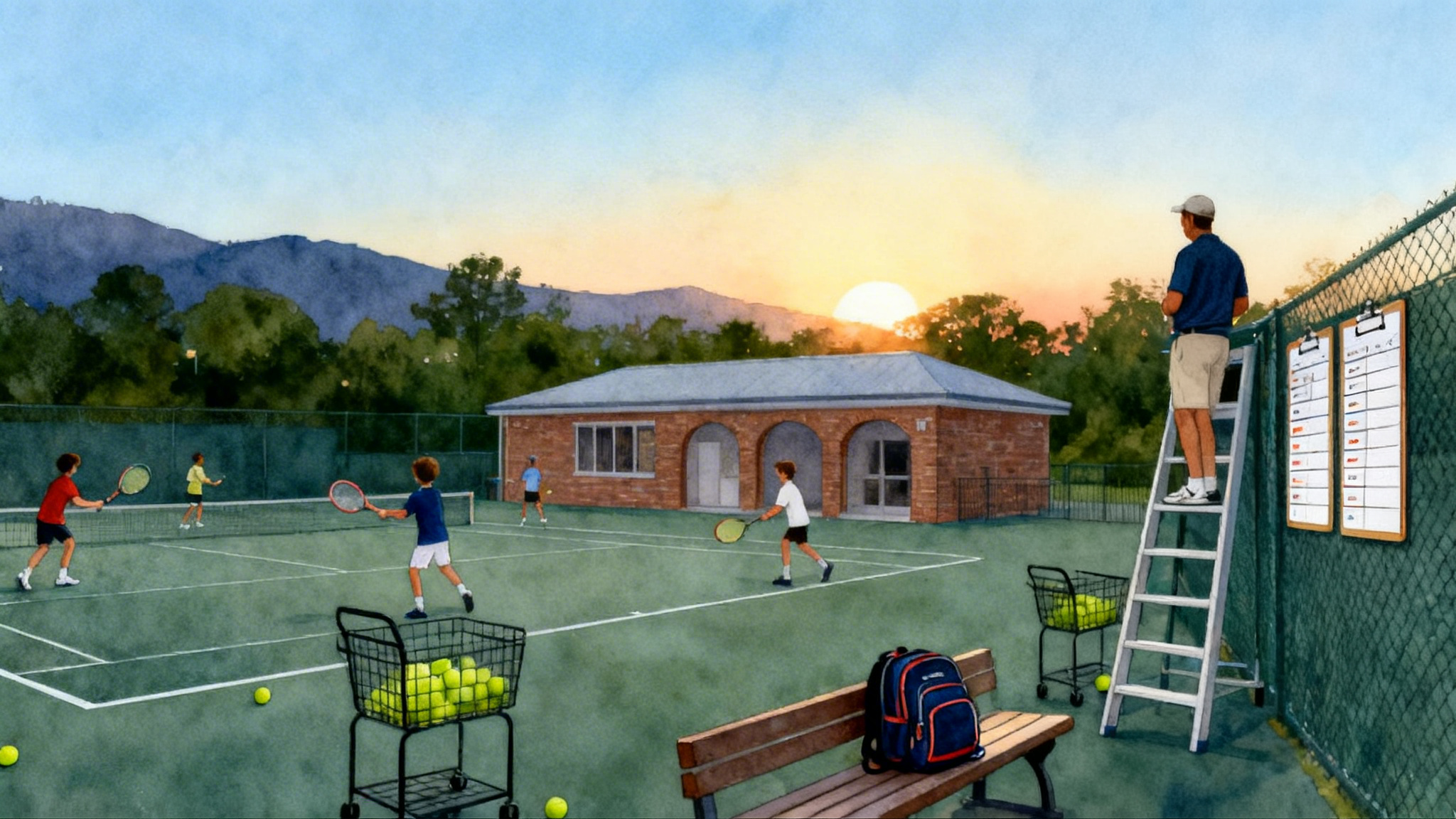
Design a 90-Minute Tennis Practice That Delivers Results
Stop wasting court time. Here is a complete 90-minute tennis session that turns drills into match-day wins. Clear blocks, precise goals, and practical coaching cues for every level, solo or with a partner.
 Tommy
Tommy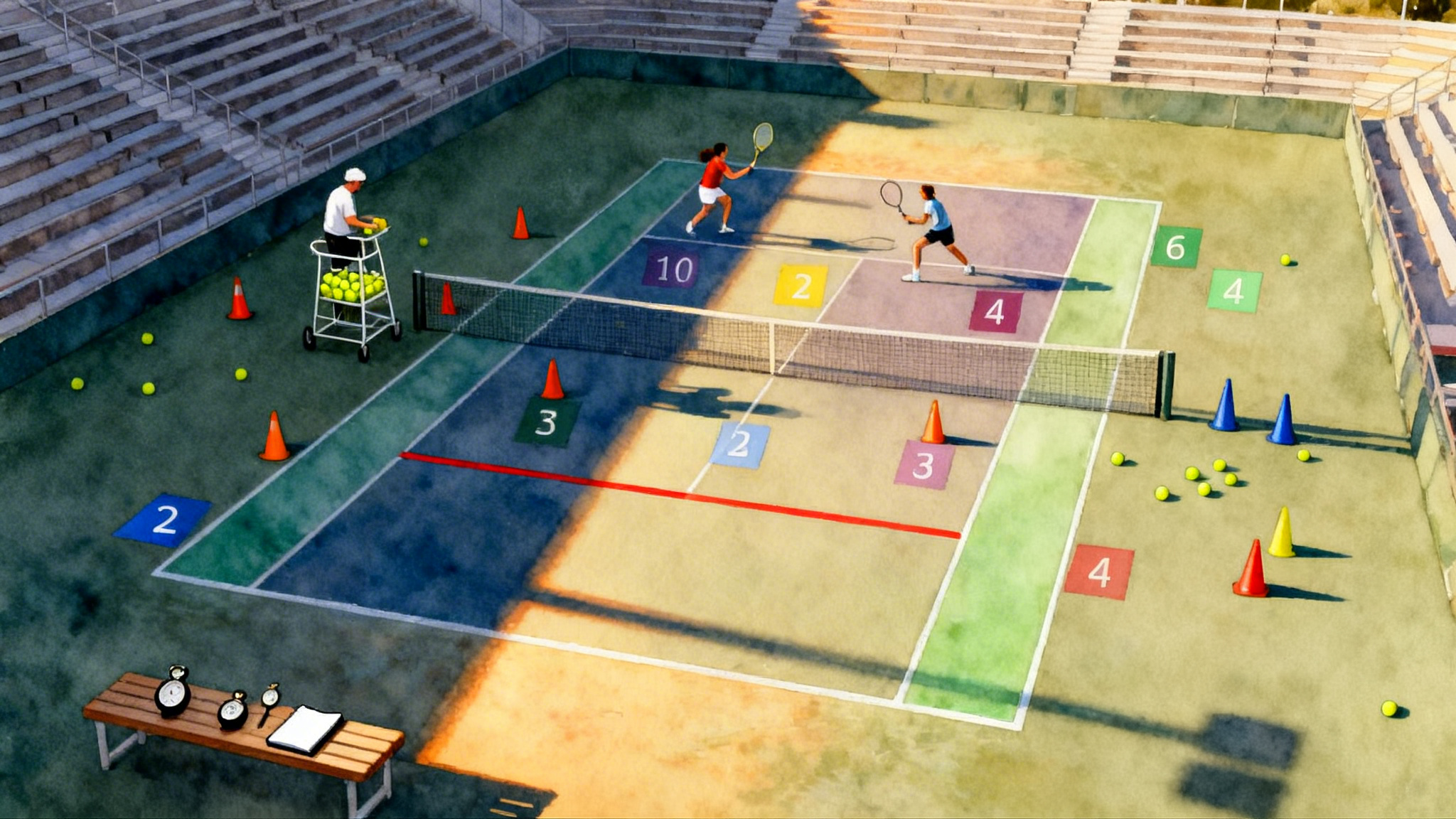
Why most practices do not translate to wins
If you have ever left a session feeling great only to play a sloppy match on the weekend, you are not alone. Many tennis practices fail for one simple reason: they reward looking good in the drill instead of solving the messy problems of a real point. A basket of forehands can groove contact, but it will not teach you to recover after a deep return, defend a high ball on the backhand, or close at the net under pressure.
A great practice blends three ingredients:
- Specificity: the work should look and feel like the situations you face in matches.
- Variability: you must face changing spins, depths, and speeds so your brain learns to choose, not just repeat.
- Measurement: you need numbers that show progress, not vibes.
That same spine shows up in Piatti’s work with Sinner and Equelite shaping Alcaraz, where sessions mirror match demands and progress is tracked.
This 90-minute blueprint uses those ingredients so you can step off the court confident that you built skills that hold up when the score gets tight.
The 90-minute blueprint at a glance
- Minutes 0–10: Dynamic warm up and hand feed activation
- Minutes 10–25: Technical groove with constraints
- Minutes 25–45: Pattern building and footwork
- Minutes 45–65: Serve and return under realistic pressure
- Minutes 65–80: Competitive games that mirror match stress
- Minutes 80–90: Fitness finisher and cool down review
You can run this with a partner, a small group, or even solo with a ball machine. The key is to keep a clock, set clear goals, and record one or two metrics per block. A small notebook or a notes app is enough.
Minutes 0–10: Dynamic warm up and hand feed activation
Your goal here is to raise temperature, wake up footwork, and find the ball early.
- 2 minutes: Jog the lines, side shuffles, carioca, and skips.
- 3 minutes: Mobility for ankles, hips, and thoracic spine; add three squat to reach flows.
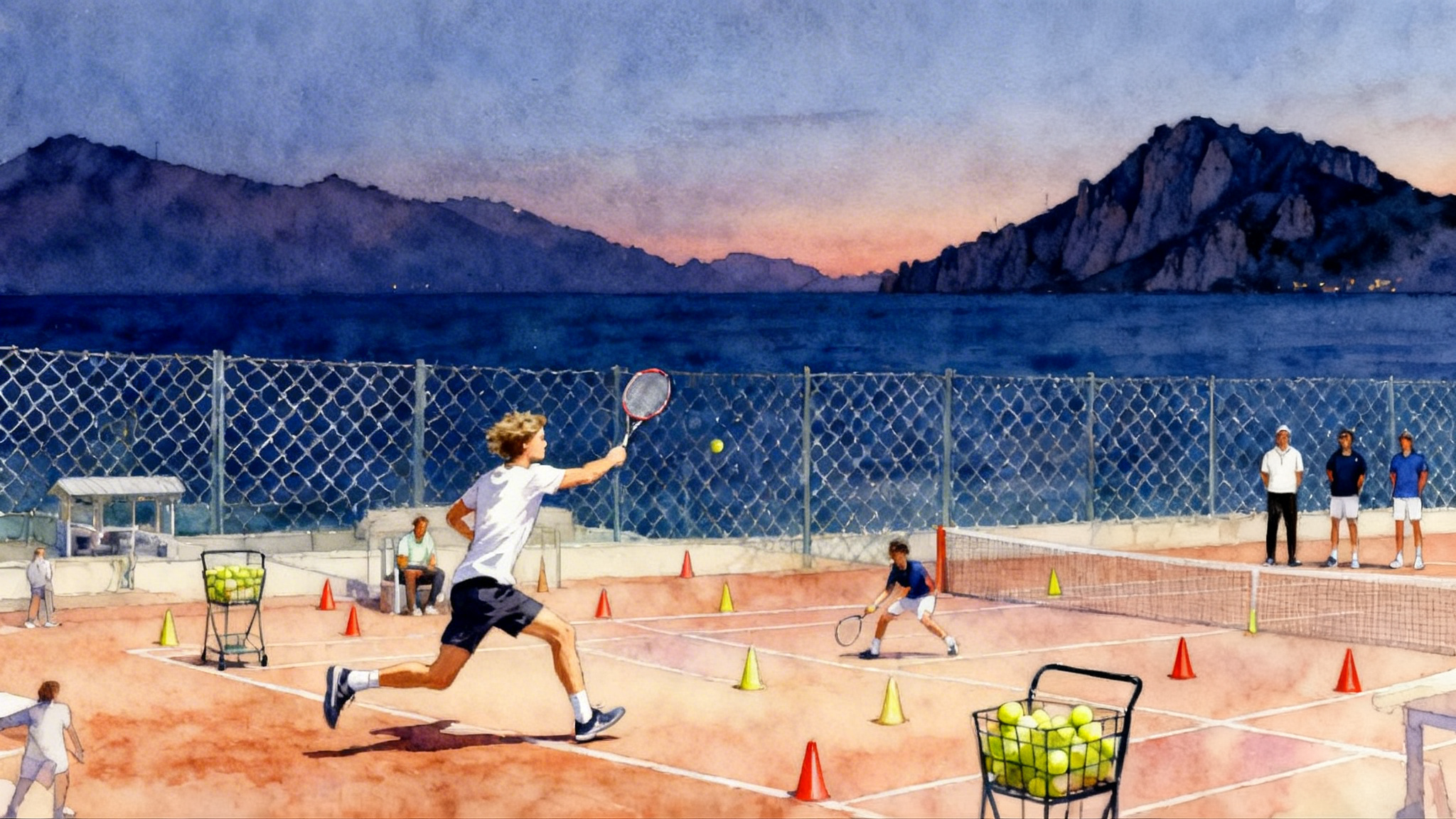
- 5 minutes: Hand feed sequence near the service line. Coach or partner feeds short hops alternating forehand and backhand. Focus on three cues: see the bounce, load on the outside leg, finish with a balanced hold for one second.
Metrics: Count clean contacts out of 20 balls on each side. Clean means center contact with a stable finish.
Why it works: Simple feeds tighten timing without grinding the shoulder. You start the day with wins, not mishits.
Minutes 10–25: Technical groove with constraints
This is not mindless basket work. You will use constraints that quietly force better mechanics.
Pick one stroke to prioritize per session. Examples by level:
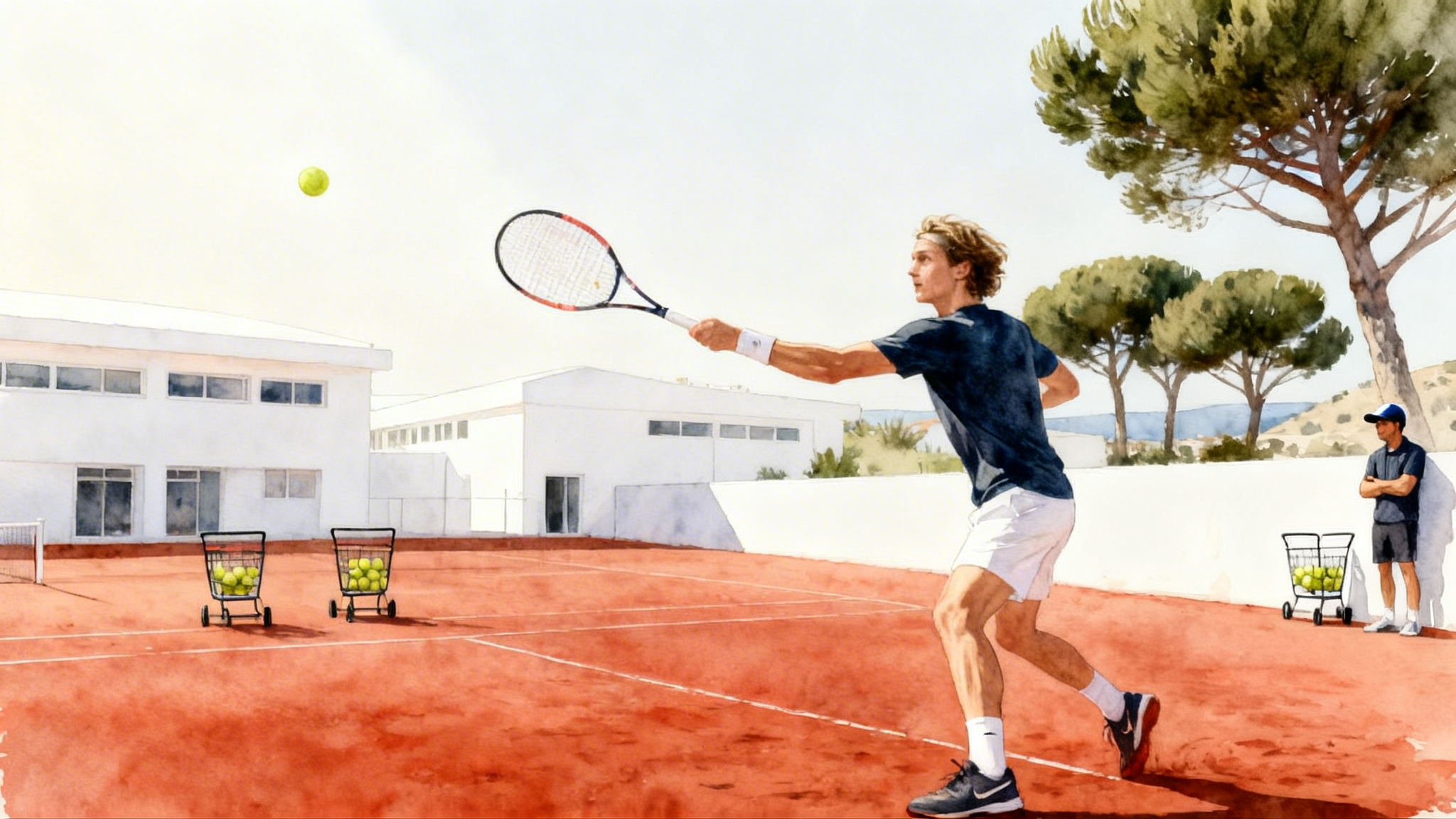
- Emerging players: Forehand with high net clearance. Constraint: aim to land past the service line with a target cone in the middle third. Cue: lift through contact, not around it. Scoring: 12 of 20 past the cone with at least net cord height equal to the top of your partner’s head.
- Intermediate players: Backhand timing against slight pace. Constraint: receiver must start with a split step and hit crosscourt only. Add a recovery line with tape two steps behind the baseline; the hitter must recover behind it after each shot. Scoring: two rallies of 8 balls or more.
- Advanced players: Forehand on the run. Constraint: feeder alternates deep crosscourt and short angle; hitter must defend deep, then attack short. Scoring: win 7 of 10 two ball patterns by placing the second ball to a down the line target.
What to avoid: Over coaching between reps. Give one cue for five balls, then switch. If you need a second cue, make it environmental. For example, move the cone wider to encourage contact in front rather than talking about early contact.
Minutes 25–45: Pattern building and footwork
Now you connect strokes to decisions. We will build common match patterns that appear at every level.
Pattern 1: Crosscourt before down the line
- Setup: Half court crosscourt rally to the deuce side for righties or ad side for lefties.
- Rule: You may only change down the line after landing two crosscourts past the service line.
- Goal: 6 pattern wins, where a win is a successful down the line change that forces a short ball or an error within the next two shots.
Why it transfers: Crosscourt buys height and margin. The change of direction happens from a strong ball, not a desperate one.
Pattern 2: Inside out forehand pressure
- Setup: Feeder sends a neutral ball to the middle third. Hitter runs around to hit inside out forehand to backhand corner. Next ball must be inside in to the deuce line.
- Goal: Make 8 of 12 two ball combos with recovery steps after each.
Why it transfers: Players often run around and then freeze. Forcing the second ball teaches commitment and recovery planning.
Pattern 3: Approach and first volley
- Setup: Feeder starts deep; on any short ball landing inside the service line, hitter must approach crosscourt and volley to the open court.
- Goal: 10 clean approach plus volley combos. Clean means approach lands deep, volley lands past the service line.
Footwork layer: Add a silent metronome. Call the rhythm out loud: load, plant, hit, recover. This prevents gliding through contact.
Minutes 45–65: Serve and return under realistic pressure
Most players serve well in baskets and return poorly in silence. We will fix both by adding stakes and structure.
Serve ladder
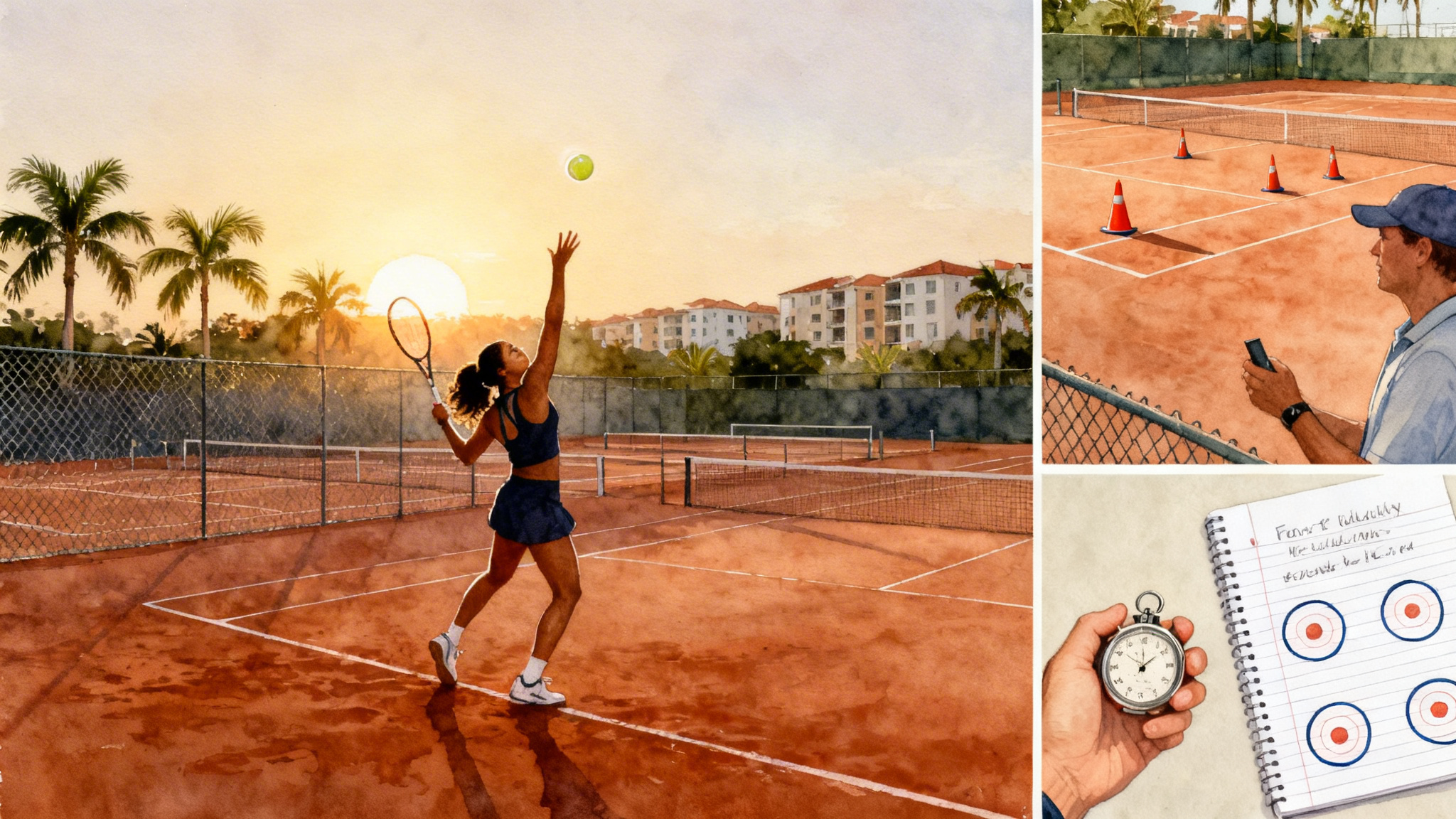
- Level 1: 8 of 10 first serves must land deuce side to a half court window. Track percentage.
- Level 2: Same window, but add a mandatory plus one ball to the open court. Count two ball success.
- Level 3: Alternate corners with a serve target card. Aim for 6 of 10 on target.
Return gauntlet
- Block A: Partner serves at 60 percent pace. Returner must clear the service line and aim crosscourt. Goal: 8 of 10 in, with at least 5 deep past the service line.
- Block B: Server mixes locations. Returner calls target before serve toss. Goal: 6 called targets hit.
- Block C: Score to four points. Server gets one serve only. Change roles and repeat. Note the score for each set.
Why it transfers: Scoring and declared targets increase arousal just enough to mimic a match without wrecking confidence. The plus one ball links serve to your most common decision.
Minutes 65–80: Competitive games that mirror match stress
Here you make choices under fatigue. Use one game per session and rotate weekly.
Game A: The 21 Rally
- Feed a neutral ball and play out the point. Winner gets 2 points for a rally of 6 balls or more, 1 point for a rally under 6. First to 21 wins.
- Coaching angle: This rewards building pressure rather than gambling. Long rallies teach patience; short wins still matter.
Game B: Breaker Builder
- Play only return games to seven points. Server gets one first serve and one second serve. If the returner wins the game, they get a bonus point.
- Coaching angle: Returning becomes a weapon instead of an afterthought.
Game C: Approach Only
- Any short ball landing inside the service line must be approached. Points won without approaching do not count.
- Coaching angle: Forces you to recognize short balls early and practice closing.
Metrics to track: total points played, first serve percentage during games, return in percentage, rally length peak. Pick one or two per day. Improvement is visible within two to three weeks when you stay consistent.
Minutes 80–90: Fitness finisher and cool down review
A short finisher cements footwork patterns without frying your legs.
Finisher menu
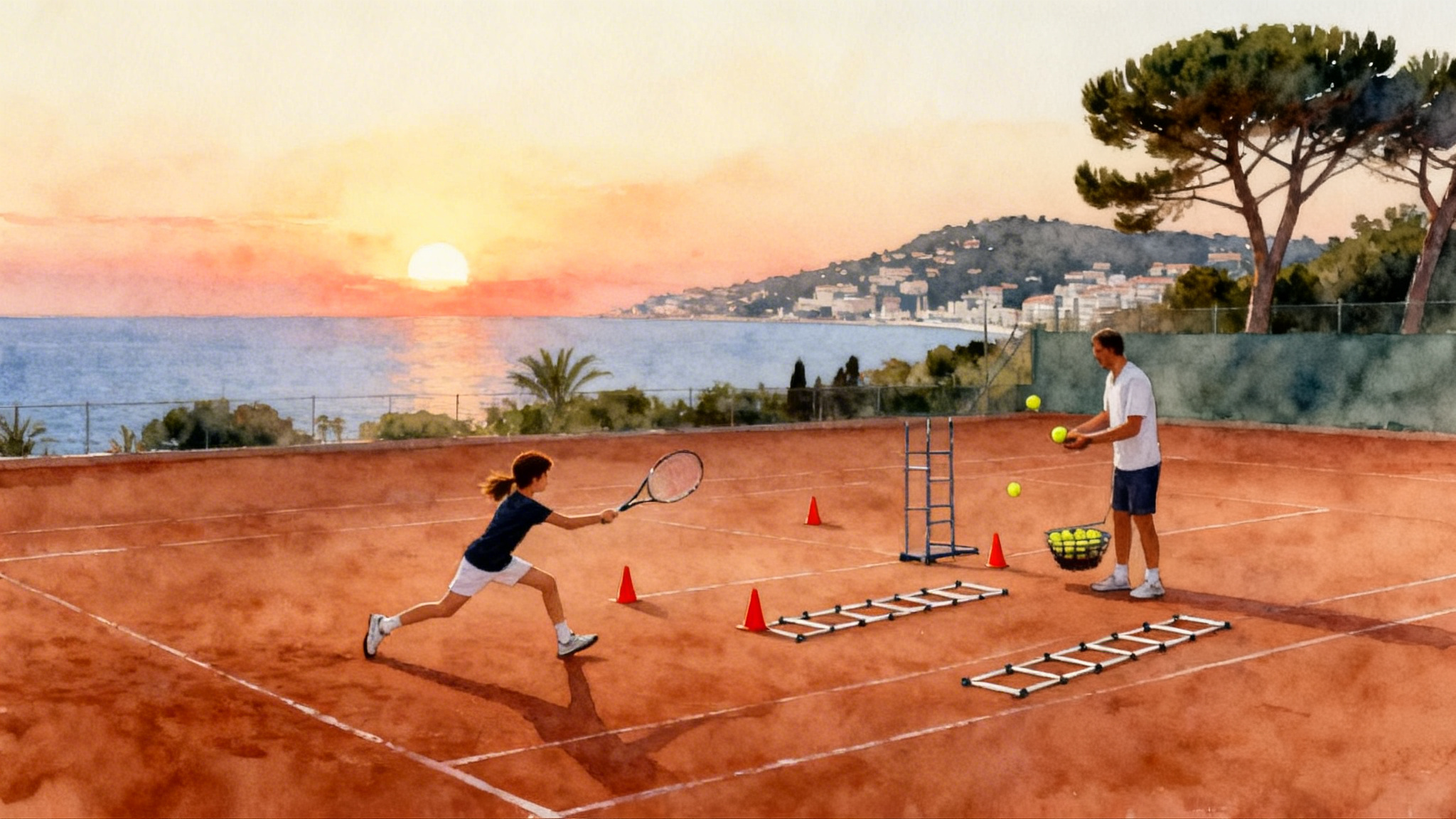
- Baseline box: Four cones form a rectangle. Shuffle, crossover, and sprint in a figure eight for 20 seconds, 20 seconds rest, repeat 4 times.
- Reaction taps: Coach points left or right from the net; player split steps and takes two explosive steps in that direction, shadowing a stroke. 6 sets of 15 seconds.
Cool down review
- Two minutes of light rally at half speed, focusing on length.
- One minute of deep nasal breathing and shoulder rolls.
- One minute review: write down two numbers and one sentence. Example: “First serve 60 percent to deuce window, 7 of 12 inside out patterns hit.”
Why it works: A quick finisher reinforces the movement library. The written review closes the loop, making the next practice easier to plan.
Solo, partner, and group variations
No partner today? Use a ball machine or a wall and keep the same structure. For serve and return, film your toss, track landing zones with chalk marks, and score your plus one ball off a hand feed. For competitive games, replace with time based challenges. For example, 10 minutes to land 12 serves deuce, 10 minutes for ad, and 10 minutes to hit 12 crosscourt backhands off the wall past a chalk line.
With a partner, alternate roles every 5 balls and share the same metrics. In a group of four, run two stations. Station A handles serve and return while Station B runs patterns, then swap at the half. If you want a model of this structure in a real program, study Legend Tennis Academy training.
How to pick your weekly focus
Trying to fix everything fixes nothing. Use a simple rotation:
- Week 1: Neutral rally tolerance and depth
- Week 2: Serve and first ball
- Week 3: Return and third ball
- Week 4: Net play and overheads
Within each week, keep the blueprint the same but shift the emphasis. For example, during Week 2 your pattern block leans toward plus one plays, and your games reward early initiative.
If you compete in a local league that uses the National Tennis Rating Program, set goals appropriate to your level. For example, a player in the middle recreational band might aim for 55 percent first serves in the deuce corner with a clean plus one forehand 7 of 12 times. An advanced adult competitor can chase 65 percent first serves with alternating targets and a plus one that pins the opponent wide.
Coaching cues that travel well
Skip fuzzy phrases like “watch the ball” or “bend the knees.” Use specific, sensory cues that you can feel.
- Contact: “See bounce, then strings.” Delay your head lift until you feel the strings brush the ball.
- Height: “Window over the net.” Aim your ball through an imaginary window above the tape, not at the court.
- Shape: “Heavy to the back fence.” Think of launching the ball so it arcs up and lands deep, bouncing toward the back fence.
- Recovery: “Two steps back.” Name your first two recovery steps out loud to lock in the habit.
Numbers that matter
There are hundreds of stats in tennis, but a handful drive outcomes across levels. Track these during the blueprint blocks and in matches.
- First serve percentage and location. A reliable 60 percent to primary targets is a strong baseline.
- Return in percentage on second serves. Climb above 75 percent and you control more points.
- Rally length to first error. If your average rally length in practice rises from 3 to 5, your match resilience grows.
- Pattern conversion. When you call a pattern, how often does it produce a short ball or an error within two shots?
Write them in your notebook. Numbers tell you what to train next, and they keep you honest when confidence wobbles.
Equipment that extends your practice
You do not need fancy gadgets, but a few tools multiply results.
- Cones and tape: define targets, recovery lines, and approach cues.
- A tripod and your phone: one side view and one back view reveal footwork and spacing.
- A simple heart rate strap or watch: useful during the finisher to keep intensity consistent across sessions.
- A ball machine if you often train solo: set mixed depths and spins rather than predictable feeds to build decision making.
Use video sparingly. Film two or three short clips per session and review them during the cool down, not mid block, so you do not break rhythm.
Common mistakes and quick fixes
- Mistake: Too much dead time between balls. Fix: Prepare two baskets and call the next feed before the previous ball lands.
- Mistake: Chasing perfect technique in isolation. Fix: After 10 minutes of work, add a decision. For example, alternate targets on command.
- Mistake: Practicing winners instead of building pressure. Fix: Use the 21 Rally game and reward longer rallies with extra points.
- Mistake: No written record. Fix: End every session with two metrics and one sentence about feel.
A sample week using the blueprint
Monday: Neutral rally focus
- Warm up and activation
- Technical block: crosscourt forehand height and depth
- Pattern block: crosscourt to down the line change after two balls
- Serve and return: deuce corner only
- Game: 21 Rally
- Finisher: baseline box
Wednesday: Serve and first ball focus
- Warm up and activation
- Technical block: rhythm on service motion with a pause at the trophy position
- Pattern block: serve plus one to open court
- Return gauntlet: call targets, track success
- Game: Breaker Builder
- Finisher: reaction taps
Friday: Net play focus
- Warm up and activation
- Technical block: half volley touch at service line
- Pattern block: approach and first volley
- Serve and return: body serves and blocked volleys
- Game: Approach Only
- Finisher: short shuttle sprints
Bringing it to life with planning
Consistency beats intensity. Put your sessions on a calendar before the week starts and treat them like meetings. Break each session into the same blocks so you never waste time deciding what to do once you arrive on court. If you use a planning app, create a template with the six blocks, add your chosen metrics, and attach your target photos so you can set up quickly.
One final tip: train with the player you want to become, not the player you are today. Choose constraints that nudge you one step up the ladder. A slightly smaller target, a requirement to recover behind a deeper line, or a rule that you must approach on any ball landing inside the service line will raise your standard without crushing confidence.
The payoff
A 90-minute session can go by in a blur or it can be the most productive part of your week. When you warm up with purpose, build technique through smart constraints, connect strokes to patterns, pressure your serve and return, compete with intent, and finish with a clear review, improvement compounds. The next time you walk on court, you will know exactly what to do and why. That is how practice turns into points, and points turn into matches that you control from the first ball.