From Belgrade to Bavaria: How Niki Pilic Forged Novak Djokovic
At 12, Novak Djokovic left Serbia for Niki Pilic’s academy near Munich. Inside those disciplined, mentor-led blocks from 1999 to 2003, his habits, tactics, and early match doors were built. Here is how families can apply it.
 Tommy
Tommy
A 12-year-old, a train ticket, and a plan
In 1999, with Belgrade still under the shadow of upheaval, a quiet decision changed the arc of men’s tennis. A 12-year-old Novak Djokovic began making regular trips from Serbia to Oberschleißheim, a town just north of Munich, to train at the academy run by former Davis Cup captain Niki Pilic. Across recurring blocks from 1999 to 2003, Pilic did more than refine strokes. He built a professional from the inside out.
Novak would later call Pilic his tennis father. It was a sharp phrase because it matched the reality on court and off it. Pilic chose the environment, set the standards, and created a pathway where discipline and opportunity were not opposites but partners. By the time Djokovic turned professional in 2003, the foundations for his jump into the men’s game were already wired into his day. You can verify the timing of that early transition in his ATP Tour player profile.
This is the story of how that pathway worked, and what families can learn if they are weighing the same choices today.
The move that mattered
Relocation in tennis is rarely a single suitcase and a goodbye. For Novak it was a series of training blocks that layered on each other. Serbia remained home, but Germany became the performance lab. Pilic’s academy offered three things Belgrade could not always guarantee in those years: predictable facility access, a tight ladder of competition, and a mentor with international reach.
- Predictable courts and coaching hours that did not bend to weather or infrastructure surprises.
- A daily training group that recalibrated what good looked like. Playing up in age is humbling; it is also rocket fuel.
- A coach who could translate ambition into planning and then into opportunities that tested the plan.
Families often think of relocation as a permanent move. The Djokovic family treated it as a series of blocks with a clear rationale. Train in Bavaria to get the habits and reps, return to Serbia to consolidate and compete locally, then come back to stretch again. That rhythm reduced risk and made costs more manageable while still raising the ceiling. For a modern parallel in incremental relocation, compare with Sinner’s Piatti pathway to ATP elite.
Inside Pilic’s day: order, clarity, and consequence
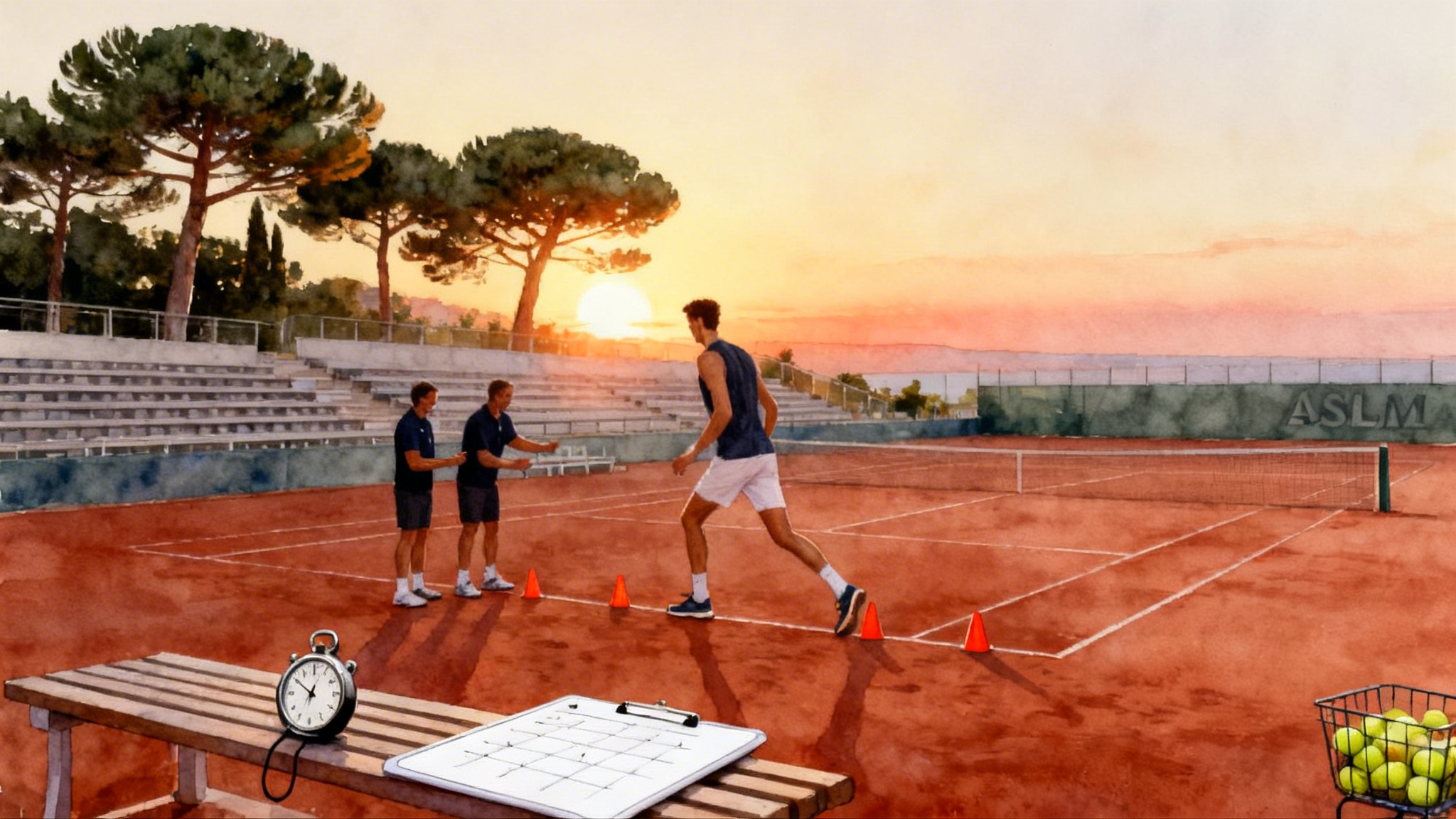
What did those days look like in Oberschleißheim? Alumni describe a culture that was direct, efficient, and competitive without being chaotic. The calendar gave shape to the work and the work had consequences.
- Morning court session focused on one technical theme tied to a tactical goal. For example, not just forehand mechanics but forehand depth to set up the next ball.
- Midday fitness with emphasis on movement quality. Think split step timing, first step acceleration, and directional changes in tight corridors that mimic the backcourt. For a deeper look at reaction timing, see our split step reaction timing.
- Afternoon drilling under constraints that forced decisions. Fifteen ball crosscourt with a zone target before permission to change line. Serve plus one patterns where a missed first ball restarts the sequence.
The key was not volume. It was the feedback loop. Sessions finished with short debriefs. What metric improved, what broke under pressure, and what gets repped tomorrow. Novak thrived in that rhythm because it made progress visible and demanded ownership.
Tactical drilling that travels to match day
Pilic’s drilling was famous for turning patterns into habits. Djokovic’s later trademarks did not appear by magic. They were rehearsed in drills that put a price on decision making.
- Depth tax. Any rally ball that landed short triggered an immediate disadvantage in the next feed. Players learned to buy themselves time with depth and height, then change direction only from a position of strength.
- Neutral ball honesty. Points started with neutral crosscourt exchanges. Changing line early without advantage cost you a point or sent you back to zero. It punished impatience, a junior habit that follows players into the pros if not addressed.
- Serve plus one lanes. First serves aimed at defined lanes, followed by a scripted first groundstroke to the opposite third. Miss either target and the rep did not count. The reward for precision was permission to improvise in the following ball.
These patterns travel because they reduce match day noise. When pressure spikes, players fall back on what they have scored a thousand times. By 2003, Novak had those sequences baked in.
The mentor effect: why Pilic mattered
Many academies can produce fit juniors with clean swings. Few can accelerate judgment. Pilic’s edge was the mentor model. He watched enough live points to understand a player’s competitive personality, then he coached that person, not an idealized version.
With Novak he amplified composure and patience without dulling ambition. Standards were explicit and personal. Be on court two minutes early. Count your own reps. Own your warm up. If you spoke about goals, you could expect a follow up next week. That accountability felt like family because it was consistent and it stored trust.
Mentors also open doors. Pilic’s reputation made it easier to arrange quality practice sets with older juniors and transitioning pros. He helped plan schedules that put Novak in the right matches at the right time. The goal was not to chase points but to chase the right learning stress. For another mentor-led pathway that balances standards and opportunity, study the All In Academy playbook for Fils.
Early match doors without shortcuts
There is a myth that the only way forward is a magic wildcard or a sudden leap. Novak’s pathway shows a steadier approach. Training blocks in Munich set the habits. Schedules then layered Tennis Europe events, national competitions, and selected entries that offered match play against older and stronger opponents. Strides were measured in the quality of decisions per point, not only in trophies.
Turning professional in 2003 did not erase the ladder. It made it more visible. The jump worked because the habits, patterns, and composure built under Pilic could withstand the faster ball. That is what families should copy. Not the results page, but the method that produced those results.
Lessons for families: how to decide, structure, and sustain
1. When to relocate
Relocation is an investment, not a rescue mission. Consider moving in blocks if three signals show up together:
- You cannot assemble three to four quality practice sets per week at home against equal or stronger hitters.
- Your player has plateaued on a clear metric for at least eight weeks. Examples include second serve points won, first strike depth, or unforced error rate in long rallies.
- A mentor led program elsewhere can name the precise skill they will raise in the next twelve weeks and how they will measure it.
Start with a twelve week plan rather than a permanent move. Review at week six and week twelve. If the needle does not move on the agreed metric, do not add time. Change plan or change environment.
2. How to choose a mentor driven academy
Pick people, not logos. Use this short due diligence playbook:
- Ask to observe two full sessions with the head coach on court. Watch how often feedback is specific and how often players self correct before the coach speaks.
- Request a written twelve week plan with two measurable targets. For example, improve forehand depth to an average landing of 1.5 meters from baseline in live drills and raise second serve points won to 52 percent in practice matches.
- Check coach to court ratio at peak hours. Anything above 1 to 4 for advanced juniors often dilutes feedback.
- Confirm weekly one on one check ins. Ten minutes with the head coach prevents drift.
- Look for a track record of placing players into tougher practice sets, not just collecting junior trophies.
Red flags include vague promises, heavy ball machine time without decision training, and a reluctance to measure anything beyond fitness tests.
3. School without sacrifice
Djokovic’s path worked because training was a block inside a bigger life, not a replacement for school. Families can mirror that balance.
- Choose a school model that flexes. Local partner schools with recorded lessons, accredited online programs, or hybrid setups give you options.
- Build a visible calendar. For each twelve week block, map school hours, travel days, and exam windows. Aim for 25 to 30 hours of learning time weekly for middle school ages, 30 to 35 for high school.
- Measure learning like you measure tennis. If grades or comprehension slip for more than four weeks, reduce tournament travel until the trend corrects.
A practical weekly template for a training block might look like this:
- Monday to Friday: two court sessions totaling three hours, one fitness hour, two to three hours of school before or after dinner.
- Saturday: match play in the morning, mobility and recovery in the afternoon, school catch up.
- Sunday: rest from tennis, long school session, and a walk or light bike ride to reset.
4. Financing the journey
Tennis development is not cheap, but it does not have to be opaque. Start with a three month budget and review after each block.
- Training fees and court time for a European academy block can vary widely. Families report ranges from several thousand to low five figures, depending on coaching time and housing.
- Housing options include dorms, shared apartments, or vetted host families. Host families can lower costs and improve language learning, but require careful screening.
- Travel is best grouped. Rather than four short trips, plan one longer stay with built in competition.
- Seek co funding. Local clubs sometimes cover partial fees if the player competes for their team in regional leagues. National federations have grants for promising juniors. Local businesses will sometimes sponsor travel in exchange for community events and social posts.
Treat money like training. Set a target cost per competitive match and per quality practice set, then compare across options. The cheapest month is not always the best value if the level is wrong.
5. Resilience by design
Relocation tests more than tennis. New language, new habits, and time away from home can stretch even the most mature junior. Build resilience into the plan, not as an emergency fix.
- Rituals anchor the day. Morning mobility for ten minutes, a short walk after dinner, and a three line training diary keep momentum.
- Use adversity drills. Play a set without the backhand slice for a week. Serve to the body only for three games. Constraints make the brain adapt.
- Separate worries. Technical notes live in the training diary. Other stress goes into a separate journal. Mixing them muddies feedback.
- Protect sleep. Keep bed and wake times steady, especially on travel days. No screens in bed. Simple rules outcompete strong intentions when you are tired.
A twelve week blueprint you can adapt
No family should copy a plan blindly, but it helps to see a structure. Here is a model that borrows the spirit of Pilic’s system while leaving room for individual needs.
Weeks 1 to 2: Assess and orient
- Baseline tests. Forehand depth charting across 50 live balls, serve speed and spot accuracy, and match play unforced error tracking.
- Fitness screens. Mobility, aerobic threshold via court based tests, and acceleration timing on ten meter sprints.
- School plan lock in. Confirm class access and exam targets.
Weeks 3 to 4: Pattern build
- Morning technique with constraints. Crosscourt forehand to a two by two meter zone before permission to change line.
- Serve plus one patterns with scoring. Ten successful sequences to earn five minutes of free hitting.
- Two practice sets per week with older or stronger partners. Film ten points for review.
Weeks 5 to 6: Stress and simulate
- Points starting from disadvantage. Feed short balls and force the player to defend into depth.
- Fitness mixed into points. After each long rally, add a sprint touch before the next feed to mimic heart rate spikes.
- First weekend trip. One low travel tournament to test routines.
Weeks 7 to 8: Consolidate and measure
- Repeat baseline tests and compare. If forehand depth and serve spot accuracy do not improve, adjust drills, not just volume.
- Add doubles. It improves return position and first step reads.
- School review. If academics slipped, reduce weekly match play until grades stabilize.
Weeks 9 to 10: Competition push
- Stack two events or one event plus scheduled practice matches with stronger players.
- Recovery rules. Ice baths are optional; sleep and nutrition are not. A simple protein plus carb snack within forty five minutes of sessions is more reliable than exotic supplements.
Weeks 11 to 12: Reflection and next steps
- Full retesting. Decide whether to repeat the block, move up a level, or change environments.
- Budget review. Compare actual costs to plan and calculate cost per quality match.
- Family debrief. What worked, what dragged, and whether the mentor relationship is getting stronger.
Common pitfalls and how to avoid them
- Coach shopping. Switching academies every eight weeks prevents compounding. Commit to a full block unless there is a breach of safety or integrity.
- Volume worship. More hours do not equal more progress if decisions are not trained. Prioritize drills that score choices, not just strokes.
- Tournament chase. Playing every weekend hides training gaps and drains school time. Every second or third weekend is plenty for most juniors in a development block.
- Communication gaps. If the head coach has not watched a full set in two weeks, they are guessing. Ask for scheduled set watching and feedback.
What Novak’s pathway really teaches
From 1999 to 2003, Djokovic used Oberschleißheim as a place to collect habits, not headlines. The academy gave him a daily contest against standards he respected. Tactics were rehearsed until they showed up under pressure. Early match doors were opened in a sequence that made each step feel hard but fair. None of this required magic. It required a mentor with a plan and a family willing to treat that plan like school.
Families do not need the exact same coach or town to follow the blueprint. You need a mentor who can name the next skill, a schedule that protects school, and a budget that you can explain on paper. Most of all, you need the patience to let standards do their slow work. That is how a boy from Belgrade grew into a player ready for the men’s game by 2003, and how your player can build a game that stands up anywhere.
Conclusion: Discipline is the quiet accelerator
The through line from Belgrade to Bavaria is not a single breakthrough. It is the discipline of days that make sense, watched over by a mentor who cares enough to demand more. If you decide to relocate, pick the person first, then the place. If you choose an academy, ask how they will score decisions, not strokes. Structure school and money with the same clarity you want from training. And when adversity arrives, do not add noise. Return to the plan, fix one thing, and start the next rep. That is how Niki Pilic helped forge Novak Djokovic, and it is still the most reliable way to turn potential into a professional life.