From Belgrade to Munich: How Niki Pilic Forged Djokovic
 Tommy
Tommy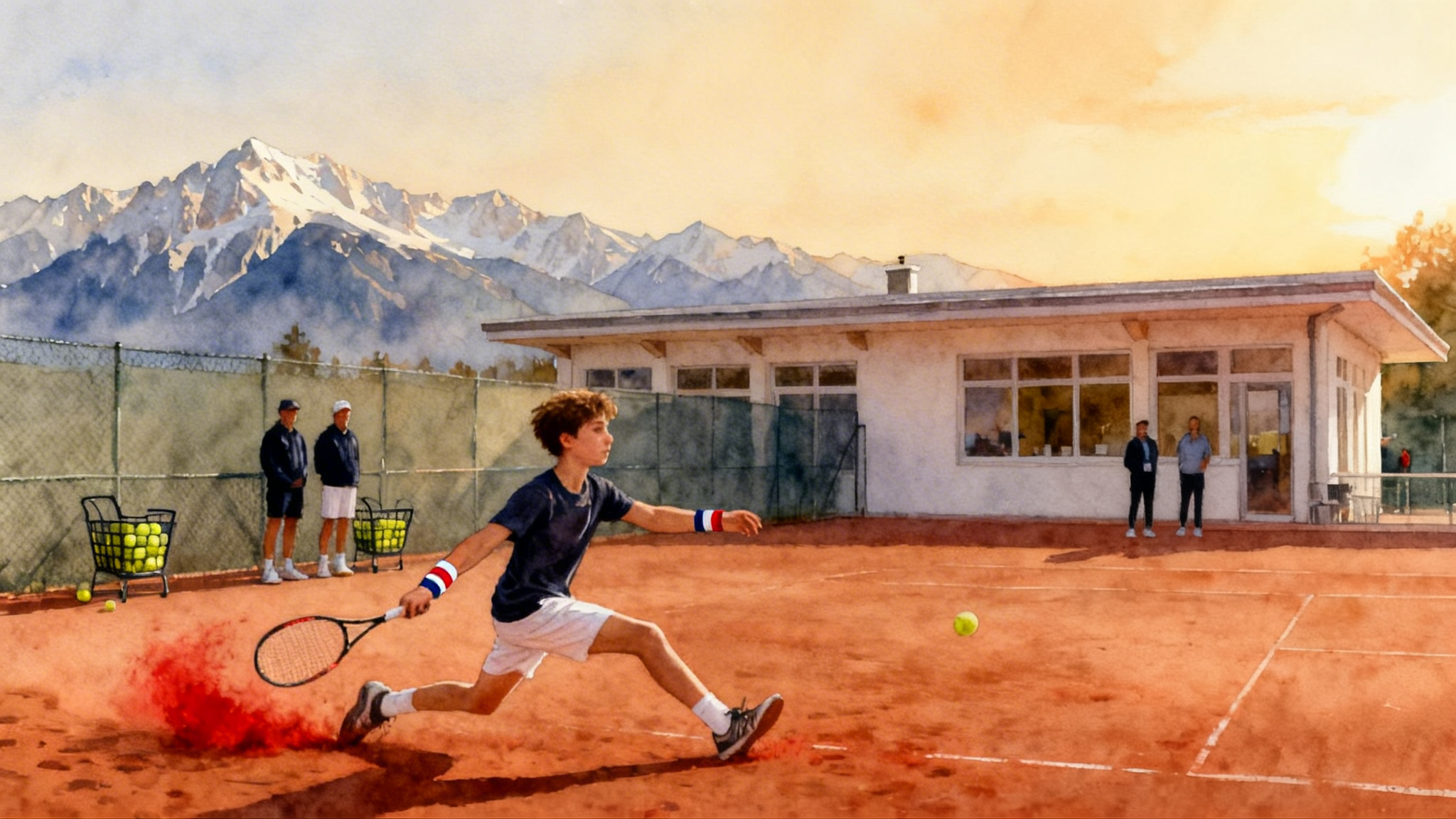
A boy from Belgrade finds a second home in Munich
Before the trophies and the packed night sessions, there was a Serbian teenager packing a single bag and stepping into the orderly world of a German academy. The decision to leave home for the Niki Pilic Academy was not glamorous. It was a family wager on long hours, red clay, and a belief that repetition builds champions. The Djokovic family carried that bet across borders, and the academy gave it structure.
This is the journey from Belgrade to Munich and the repeatable lessons inside it. Parents and coaches who wonder what truly changes a player at age 12 to 16 will find that the answers are not mysterious. They are specific, trackable, and often uncomfortable in all the right ways. For weekly planning ideas that fit real schedules, see how to design a 90-minute tennis practice.
Why leaving mattered: structure multiplied talent
In Serbia, Novak Djokovic learned the game and its joy. What he needed next was a system that could multiply skill with volume and accountability. The Niki Pilic Academy in Munich was designed to do exactly that. It took a promising player, placed him on clay almost daily, and measured everything. Ball tolerance, footwork discipline, and match play under pressure were not side activities. They were the spine of the week.
Leaving home also recast family life into a performance project. The Djokovics did not outsource responsibility to an academy. They collaborated with it. This clarity of roles mattered. The family supplied the unwavering commitment. The academy supplied a plan that never depended on good weather, perfect motivation, or a hot streak. It depended on clay, baskets, and standards.
Inside the Pilic philosophy: clay first, discipline always
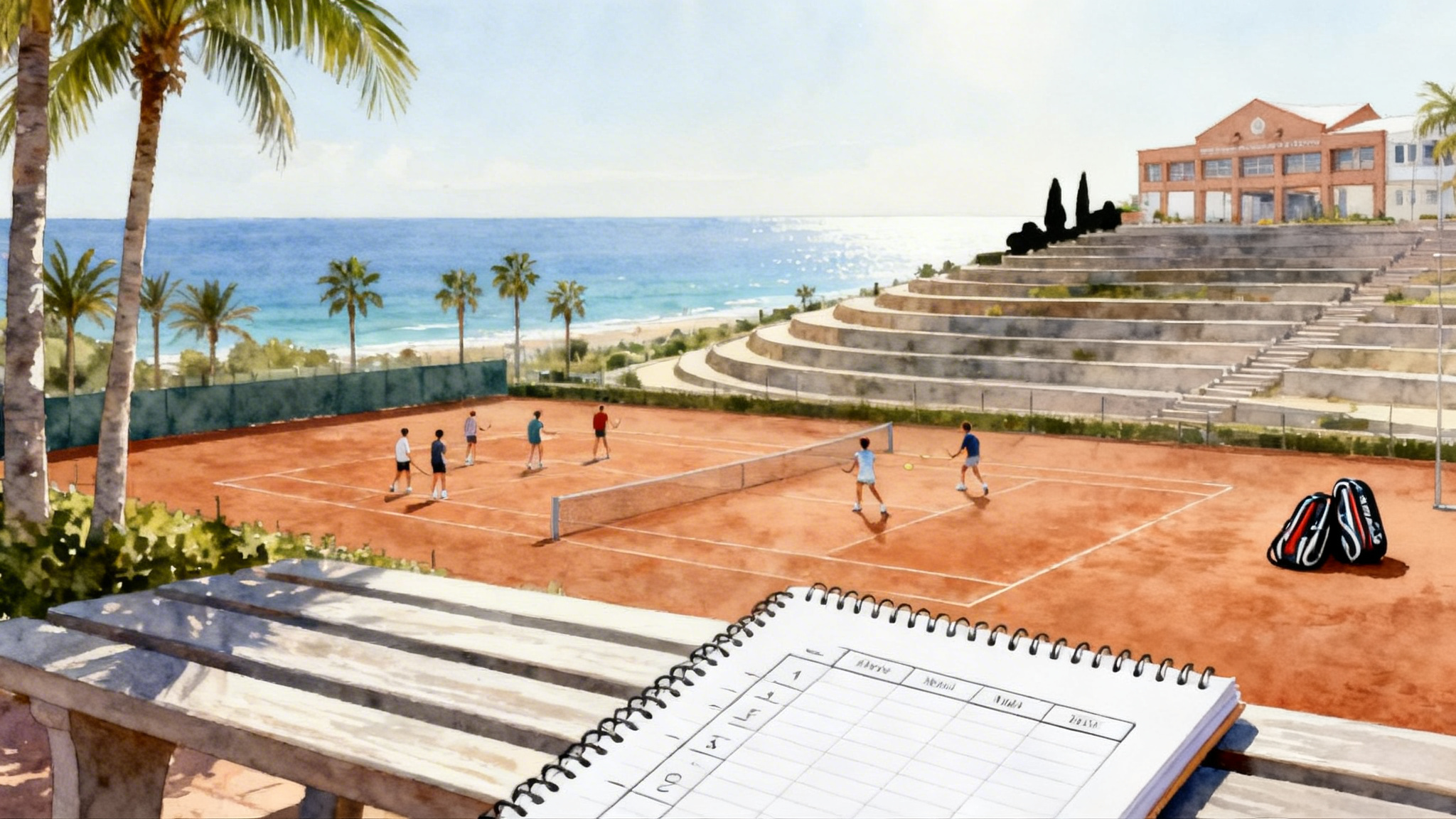
Niki Pilic built his academy on European clay because clay surfaces slow the ball and expose technique. Clay is a slow motion mirror. Every hurried step, every lazy recovery, and each imprecise contact shows up under a light that does not lie. Clay allows a program to repeat a movement pattern hundreds of times without pounding the body to dust. That invites volume.
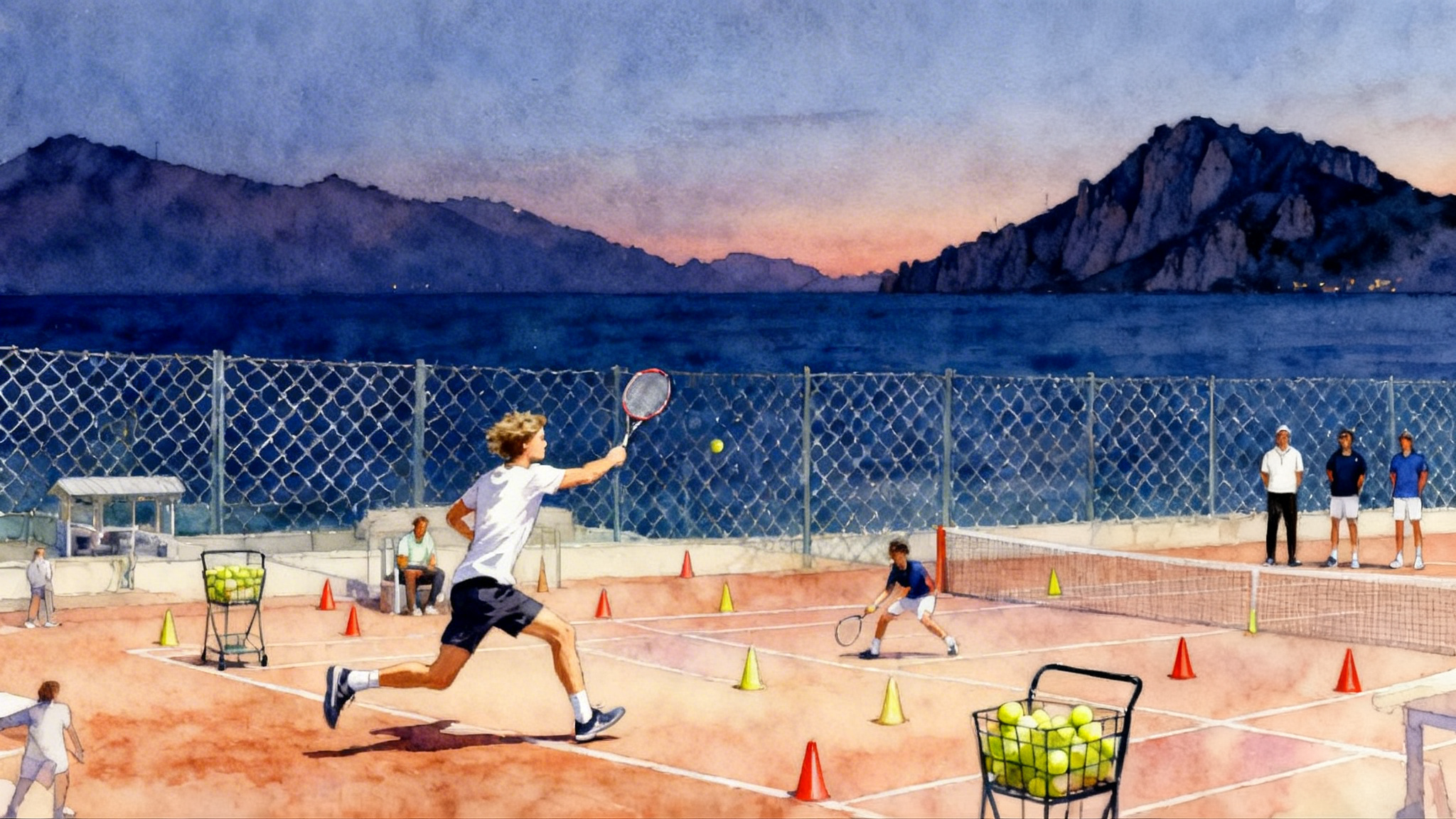
Discipline at Pilic’s place was practical, not theatrical. Players had arrival times, warm up sequences, and stroke checklists. Baskets were not for endless rallying without aim. They had targets, patterns, and progressions. If a player’s contact height drifted, a coach adjusted the feed. If a player’s distance to the ball was off, the footwork ladder and recovery cones returned the body to correct spacing.
A week looked like this in broad strokes:
- Five to six days on clay with at least two high quality hitting blocks per day
- One to two strength and mobility sessions built around hips, glutes, and thoracic spine rotation
- Daily return repetitions with specific serve types, especially body serves and heavy kick to the backhand
- Two to three formal match plays with score, consequences, and post match debrief
- One recovery and flexibility block, often with proprioception work to teach balance after slides
There was no confusion about the goal. Build a body that can slide, stop, and reaccelerate, teach eyes and hands to accept heavy spin and bad bounces, and engrain a return of serve that starts points on neutral or better.
How clay volume shaped elastic movement
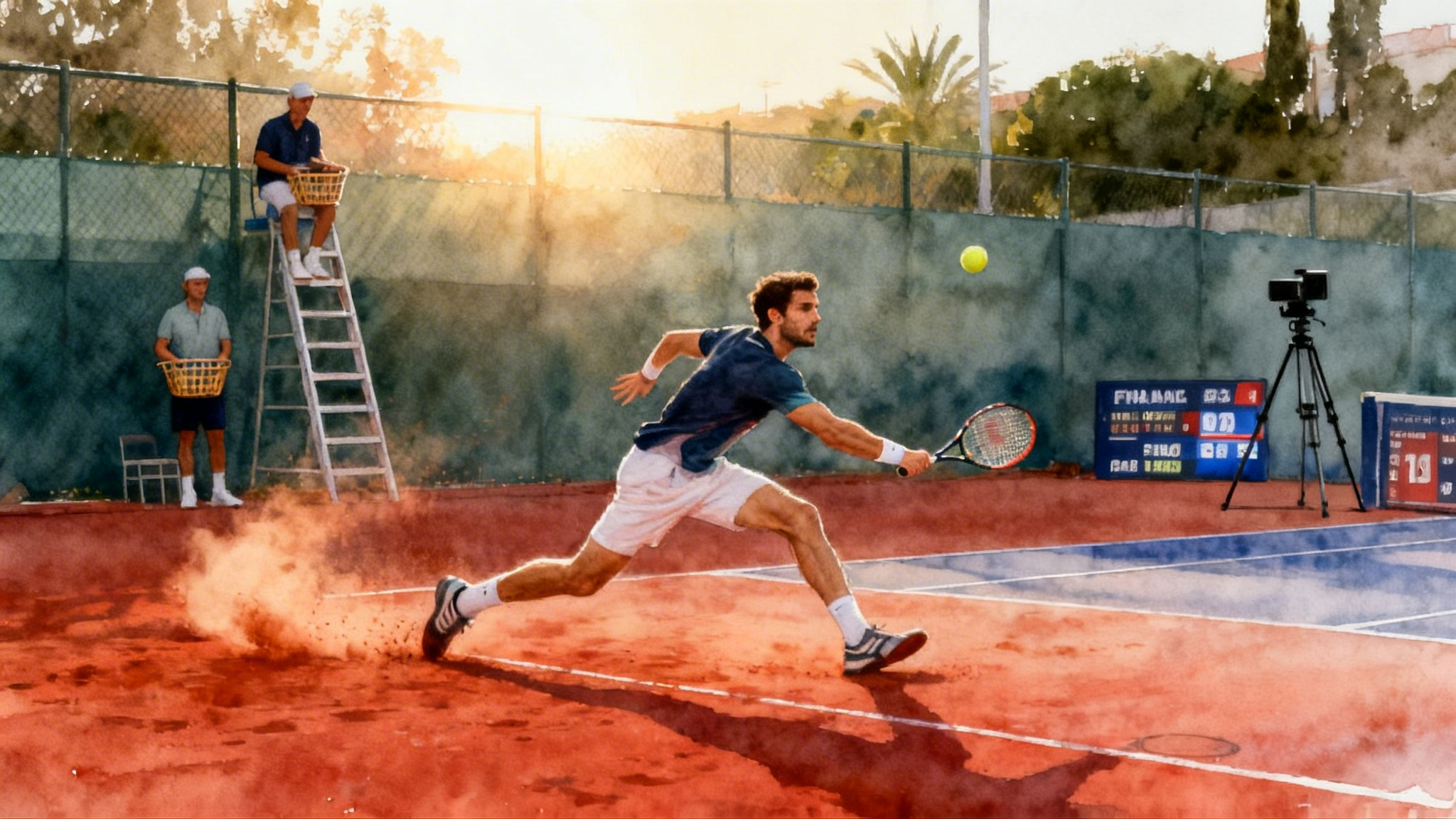
Watch Djokovic chase a wide backhand, slide, then plant and spring into the court. That is elastic movement. Think of a quality resistance band. It stretches without losing shape, stores energy on the stretch, and releases it on command. Clay is where that band was made.
- Deceleration mechanics: On clay, you must slow down before you fall down. Daily slide entries taught him to lower his center of gravity, angle the lead foot, and use the inside edge to bleed speed without panic. The outcome is control instead of chaos.
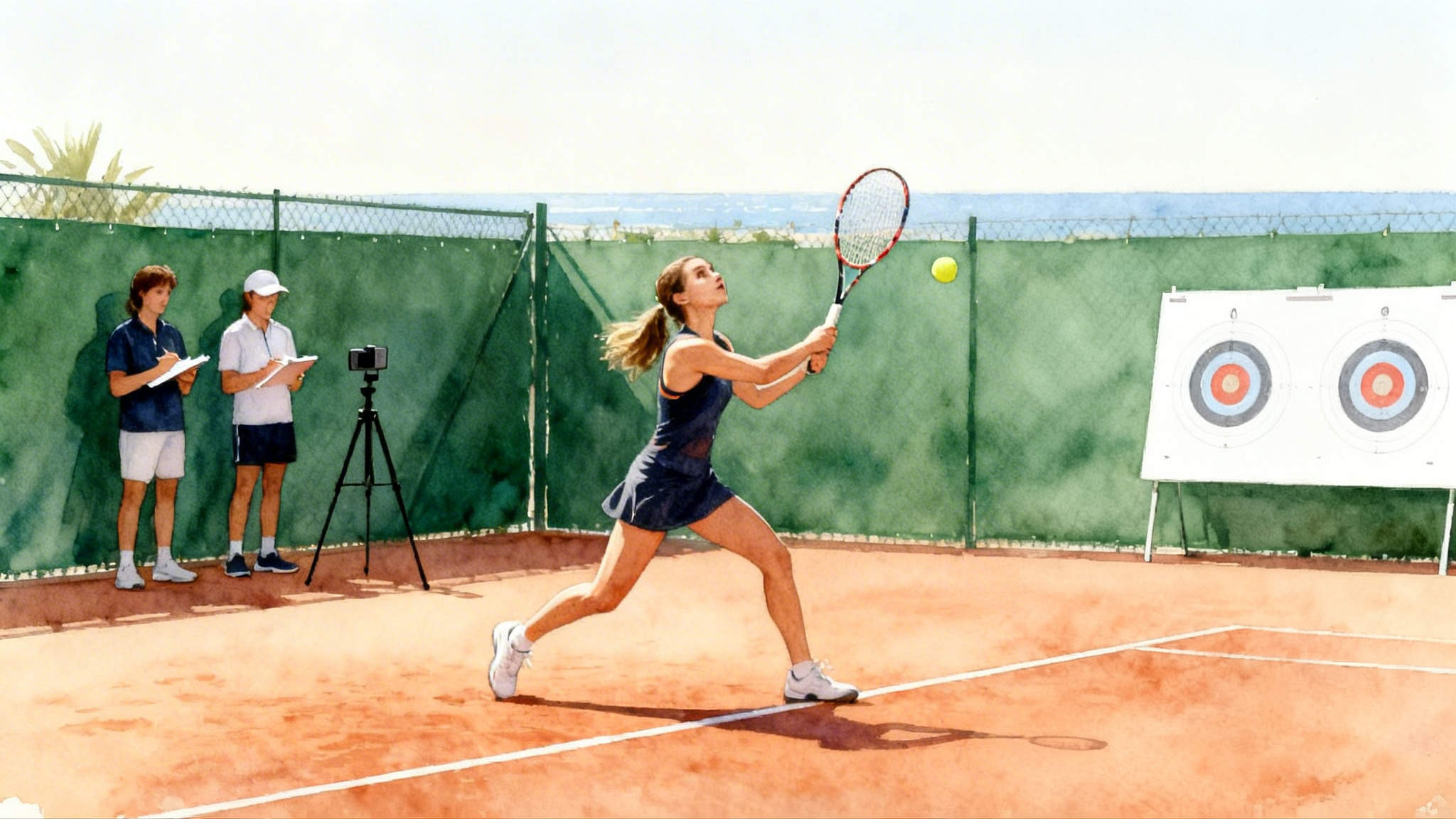
- Recenter discipline: After contact, players at the academy were timed back to a recovery marker. The message was clear. Ball one is not the point. Ball one plus the first two recovery steps is the point. Djokovic’s habit of arriving early to the next shot is not luck. It is measured recenter work stored in muscle memory.
- Balance under rotation: Clay feeds rotation. The academy loaded the hips and thoracic spine with med ball throws, open stance backhands, and cross under steps that preserve balance while turning. That mix creates a player who can hit hard without falling forward or backward.
Practical takeaway: If a program sells movement but cannot explain deceleration drills, recovery timing, and rotational balance with examples you can film and review, keep looking. For a modern German option to benchmark visits, consider Tomas Behrend’s ToBe Tennis Academy.
The return factory: patterns, not guesses
Djokovic’s return is a curriculum, not a gift. At the academy, serves were not viewed as random threats. They were buckets. Wide slider to the deuce side. Body first serve. High kick to the ad side. Each bucket had a default answer and a counter for the server’s adjustment.
- Split step timing: Players were cued to split when the server’s tossing arm began to drop, not at contact. This allowed a light landing that met the ball rise with forward momentum.
- Backhand block neutral: Against most first serves, the academy trained a compact backhand block to the deep middle. This shortened angles for the server and bought time to recover.
- Second serve attack windows: On second serves that landed shorter and kicked high, the plan was a shoulder height contact with a horizontal swing finish, aiming crosscourt to the largest court while stepping in.
- Body serve survival: The body serve was treated as a planned nuisance. The response was a pre commit step away from the toss side just before contact, freeing the hips for a compact redirect down the middle.
A good return program looks like chess openings. You do not guess the first three moves every time. You prepare them, then you play the person across the net. For another European clay blueprint built on first-step honesty and repeatable patterns, study How Piatti forged Jannik Sinner.
Relentless match play and real consequences
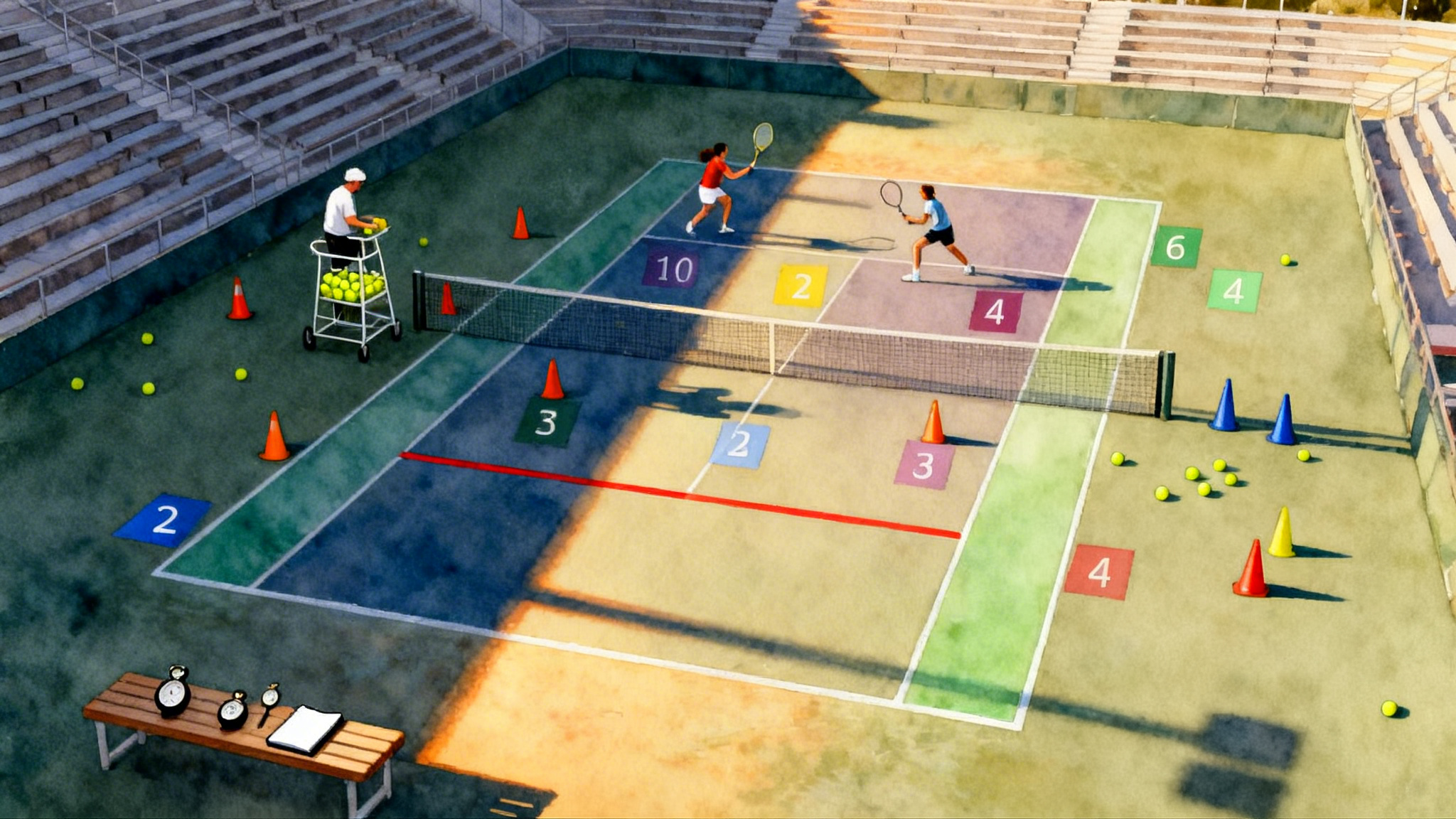
Drills built skills. Scoring tested them. The academy embedded pressure in plain view. Tiebreak ladders ran across courts. Losers moved down a court, winners moved up. Service games started at 30 all with a coach calling serve locations. Deciders were played with a two ball rule where a short ball had to be finished within two strokes or the point was replayed.
This rhythm taught composure. It also taught a boring truth. Confidence is not a feeling that floats in after a good warmup. Confidence is earned by surviving small consequences every day. Djokovic’s calm face in fifth sets was not a personality trait alone. It was the memory of thousands of scored repetitions that felt eerily similar.
Family sacrifice and the real cost of the bet
The Djokovics supported that program with real money and time. They changed work plans, found host families and cost effective housing, and learned to live on two calendars. One calendar belonged to school and the family. The other belonged to the academy schedule. Parents should hear the quiet message inside that story. Talent is multiplied by logistics, and logistics are hard.
The practical work looked like this:
- A travel budget and a monthly training budget that were reviewed together, not in isolation
- A housing plan that minimized commuting to leave energy for training
- A communication rhythm with coaches that was written in brief weekly notes with two or three priorities only
None of this is glamorous. All of it matters.
The handoff to Marian Vajda and what stayed
After the academy years, Djokovic began working with Marian Vajda. The collaboration would stretch across seasons of dominance and occasional breaks. The handoff was pivotal because it kept the core and refined the edges. Vajda sharpened serve patterns, refined point construction on faster courts, and helped manage the year so that peaks arrived at the right times. What did not change was the clay born spine. Elastic movement, return patterns, and calm decision making remained the base while layers of offense grew around them.
Parents should study this continuity. Great programs and great coaches do not reinvent a player every season. They preserve what is proven and add what is missing. If a new coach talks more about changing identity than extending strengths, ask tougher questions.
What parents can copy when evaluating European programs
You do not need Novak’s talent to use the same filters. Here are specific checks you can bring to an academy visit.
- Clay volume with dose control
- Ask for the weekly clay hours by age group and intensity level. A number is an answer, a paragraph is a deflection.
- Watch whether the last 15 minutes of a long rally block still shows clean spacing and posture. If technique collapses, the volume is not controlled.
- Movement that starts with stopping
- Request to observe deceleration drills. Look for slide entries with low hips, inside edge braking, and clear recenter marks on the court. If coaches talk only about first step speed, they have skipped the physics of stopping.
- A return of serve syllabus
- Ask to see the menu for returns against wide, body, and kick serves on both sides. There should be default placements and secondary plays. If the answer is only “take it early,” the syllabus is thin.
- Scored match play with consequences
- Sit in on match days. Are there tiebreak ladders, 30 all service game starts, or two ball finish rules. If matches are unscored and friendly, improvement will be slow and fragile.
- Technical language that travels
- Film a lesson and write down the three most used cues. Examples that travel well are “hit then recover two steps,” “see the logo to the ball,” and “finish above the shoulder seam.” Cues that are jargon heavy or constantly changing will not survive tournament stress.
- Mobility and strength that fit tennis
- Check if the gym session includes hip airplanes, lateral lunges, anti rotation core work, and ankle mobility. If you see a bodybuilder split routine and little balance work, the transfer to movement on clay will be poor.
- Feedback loops you can read
- Ask how progress is tracked. A good program will show target charts, serve percentage logs by location, and movement timing scores. If progress lives only in coach memory, it will fade when you need it most.
For a simple audit tool you can print and bring to a visit, try our internal guide, the European academy checklist.
A sample week parents can adapt
Here is a practical template that echoes what worked in Munich. Adjust hours for age and school load.
-
Monday
- Morning: Movement block with slide entries, three sets of eight per side, then recovery timing to cones
- Afternoon: Crosscourt forehand tolerance to 20 ball goals, return reps against body serves, match play first to seven tiebreak
-
Tuesday
- Morning: Backhand direction change drills, three to crosscourt then one down the line
- Afternoon: Strength and mobility, hip airplanes, anti rotation press, ankle mobility, then serves to three targets per side with logs
-
Wednesday
- Morning: Pattern play, inside out forehand plus inside in finish, recover to the middle marker every time
- Afternoon: Match play sets starting at 2-2, two ball finish rule on short balls
-
Thursday
- Morning: Return focus, kick serve to the ad side, shoulder height contact, deep middle placement
- Afternoon: Neutral rally games to ten with a minus one for unforced errors inside the first three shots
-
Friday
- Morning: Serve plus one, wide serve then crosscourt finish, body serve then deep middle rally to reset
- Afternoon: Tiebreak ladder, winners move up a court, losers move down, short cool down and flexibility
-
Saturday
- Morning: Light hit on clay, direction changes and short court accuracy, mobility circuit
-
Sunday
- Off or active recovery, long walk, breath work, and a 15 minute video review with written cues
If you need a printable version with checkboxes, see our weekly training worksheet.
The mechanism behind composure
Composure is not a speech or a quote on a locker. It is a mechanism with three parts.
- Prediction: When you have seen a serve type a thousand times, your body predicts well and stays calm.
- Preparation: When movement patterns are automatic, your mind does not waste energy on footwork decisions.
- Proof: When your practice day mimics score and consequence, your brain arrives at the match with proof that it has already survived this.
Panic is a cost. The Pilic method taught Djokovic to conserve it for emergencies only. Over time, the savings account became very large.
What the Pilic Academy did not do
It did not try to be everything. It did not chase trends. It did not swap a player’s identity every season. It built a body that could move under friction, a return that turned servers into rally partners, and a mind that respected score without fearing it. Later coaches, including Marian Vajda, could then add and subtract with precision because the foundation was visible and trusted.
Closing the loop, from Belgrade to Munich to your next visit
The old clay courts in Munich did not crown a champion by magic. They offered Novak Djokovic a plan that any serious program can mimic. Clay volume that reveals and repairs. Disciplined fundamentals that stand up to fatigue. Return patterns that start points one step ahead. Relentless match play that teaches the body to stay quiet while the brain calculates.
Parents have more choices than ever. Use the Pilic template to narrow them. Ask for numbers. Ask for drills you can film. Ask for scored games with small but real consequences. Then watch your player move, return, and compose themselves in ways that look familiar to a story that began in Belgrade and matured in Munich.