From El Palmar to Villena: JC Ferrero’s Equelite Built Alcaraz
At 15, Carlos Alcaraz left El Palmar for full‑time training at JC Ferrero Equelite in Villena. Here is how mentorship, pro‑style scheduling, and mixed‑surface blocks sped his rise from junior events to ATP titles, with repeatable steps for families.
 Tommy
Tommy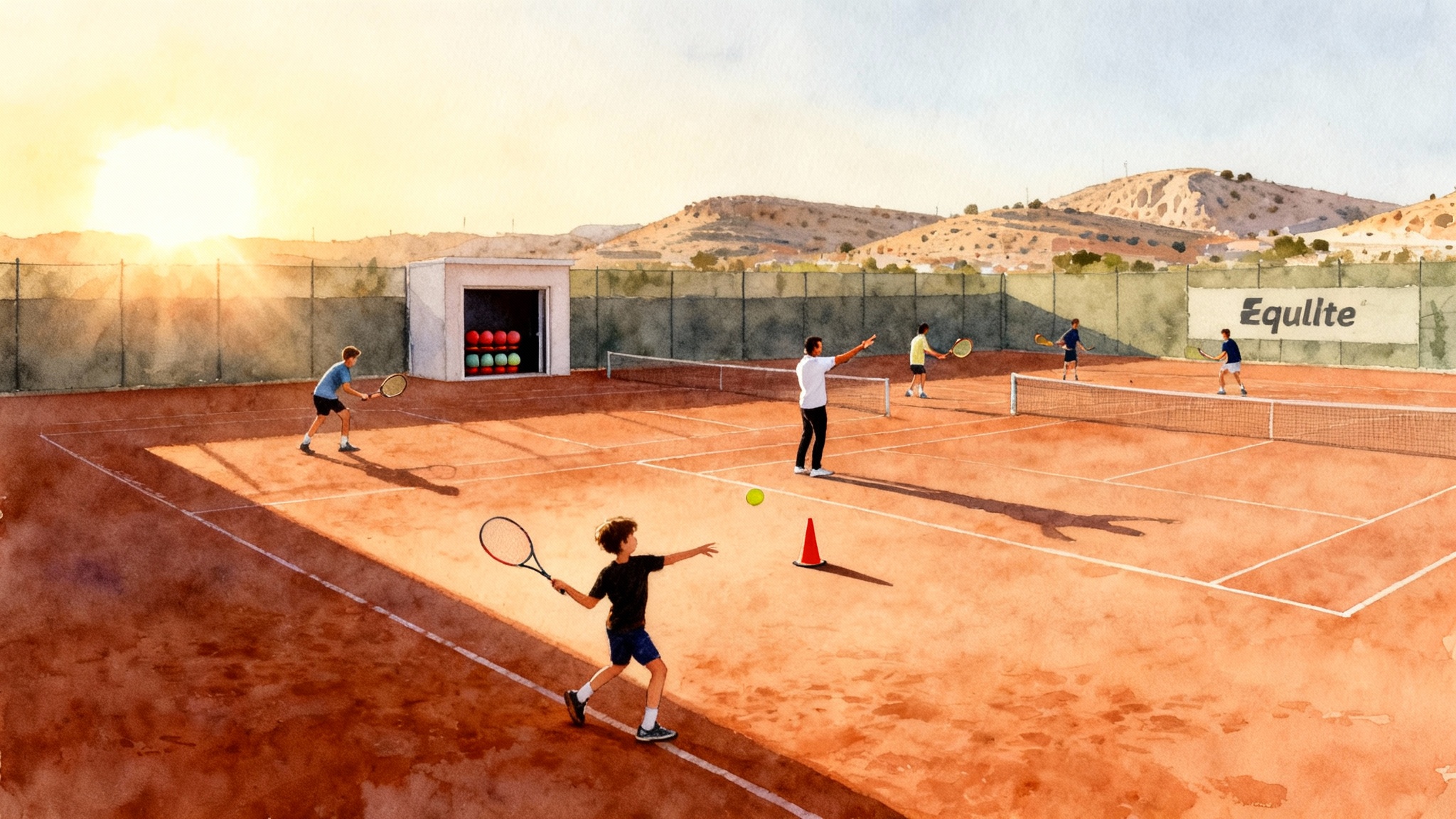
The moment a family bets on a slope, not a snapshot
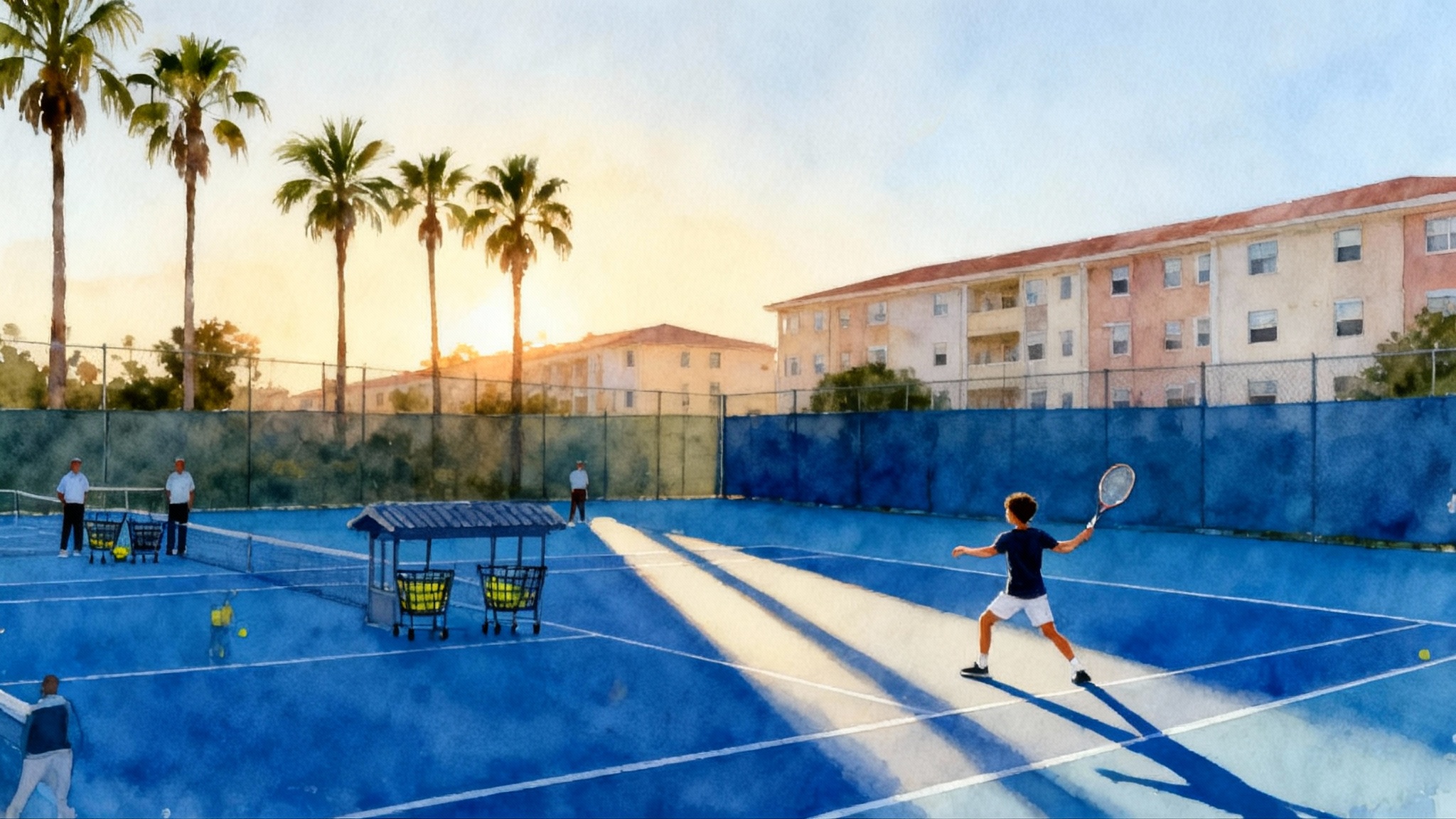
Every promising junior reaches a crossroads where the question is not whether the child is good, but whether the current environment can keep bending the improvement curve. For Carlos Alcaraz that moment arrived at 15, when his family chose to leave El Palmar in Murcia for full-time training at JC Ferrero Equelite in Villena. It was not a romantic leap. It was a measured bet on slope: daily habits, quality of hitting, and an academy that could compress years of pro learning into months.
The move put a former world number one, Juan Carlos Ferrero, within whispering distance of every practice court. It also placed Carlos inside a controlled schedule that looked like a pro’s calendar, not a junior’s. The result was a fast track from International Tennis Federation junior events to Association of Tennis Professionals main draws, without skipping foundational skills like transition play, drop-shot variety, and first-strike forehands. For comparison points on academy-driven acceleration, see Piatti’s system for Sinner and the Rafa Nadal Academy pathway.
This article unpacks how the academy structure made that acceleration possible, and it ends with practical checklists for families and for academies who want to replicate the pieces that really matter.
Why working with a former world number one changes the learning curve
A coach who has been number one brings more than authority. He brings constraints. The sessions are not built around random baskets but around patterns that win on Sunday. Ferrero’s influence showed up in three ways that any academy can adopt.
- Mentorship and modeling of pro behaviors
- Rehearsed warm-ups with time targets, not vibes. Ten minutes to raise core temperature, five minutes of mobility specific to the day’s emphasis, then three activation drills that link directly to the technical goal of the session.
- Hitting windows that mirror match rhythm. Rally speed increases every eight minutes, then resets. Young players learn to climb intensity on demand.
- Video review that is immediate and small; one clip per theme, one correction, one retest.
- A stable pool of high-level sparring
- Ferrero’s network guarantees older pros for sets, which forces juniors to locate balls deeper and earlier. The rally quality becomes the teacher, which speeds perception and decision making.
- A shared language for pressure
- The staff uses clear cues for patterns: “Serve T, inside-in hold,” “Backhand cross to short, attack middle,” “Drop from red, cover lob.” These shorthand tags make pattern rehearsal as automatic as a football audible.
The lesson for families: look less at the brand name of an academy and more at three things you can verify on a visit. Are there real pros on court during the week. Does the staff use a repeatable language for patterns. Does video lead to action within the same session, not a vague promise for later.
Pro-style scheduling before the ranking says pro
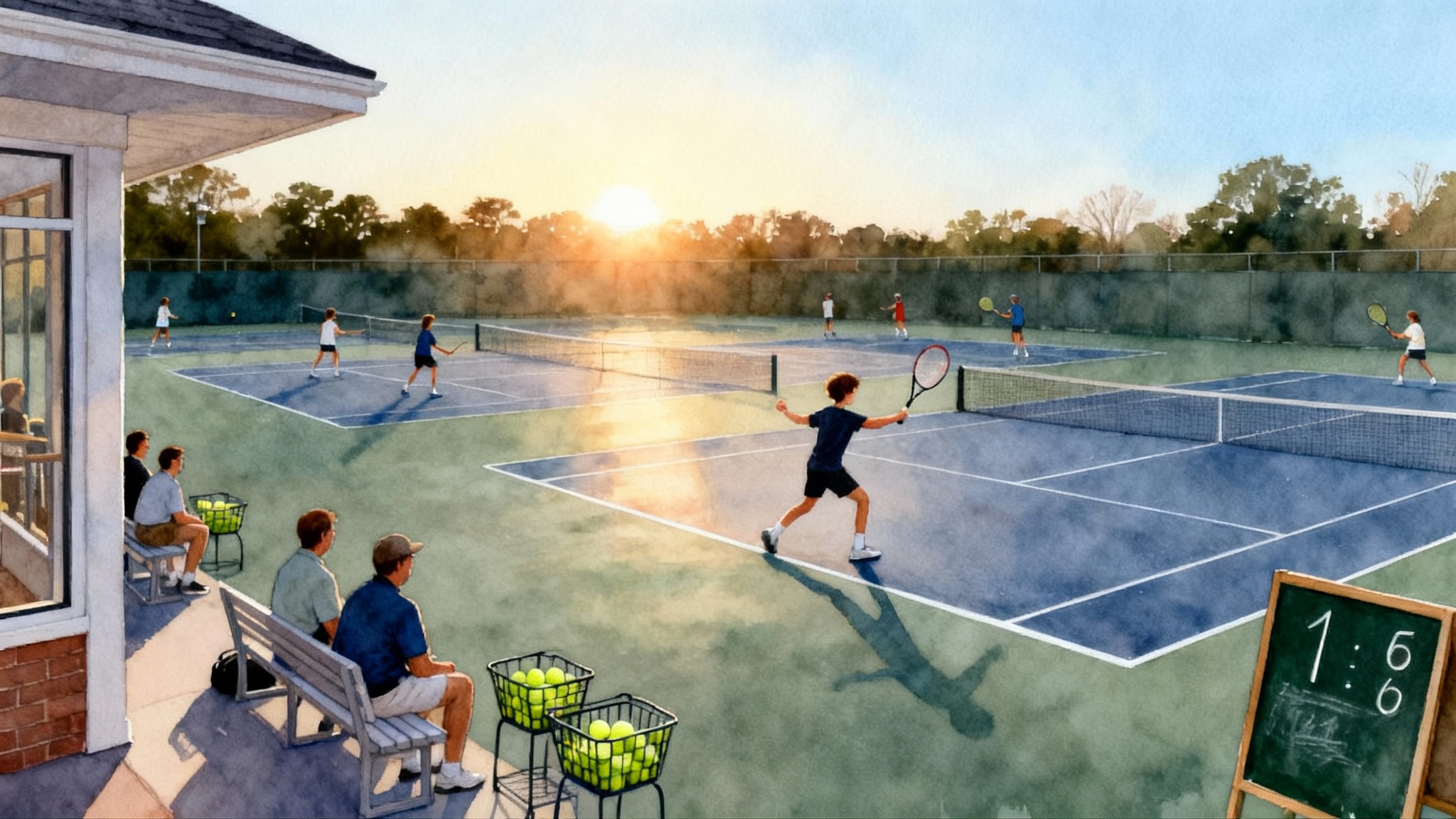
Juniors often live in a tournament trance, playing every weekend. Equelite flips that script. The calendar looks like a pro’s, with training blocks that outnumber match weeks and with surfaces that change inside the same month. This is what that looked like in practice for a 15 to 17 year old who intends to jump quickly.
- Micro-cycle design: two to three weeks of training, then one week of competition, then repeat. The training weeks have two strength days, one acceleration day, one endurance day, and two recovery days with mobility and medicine-ball work.
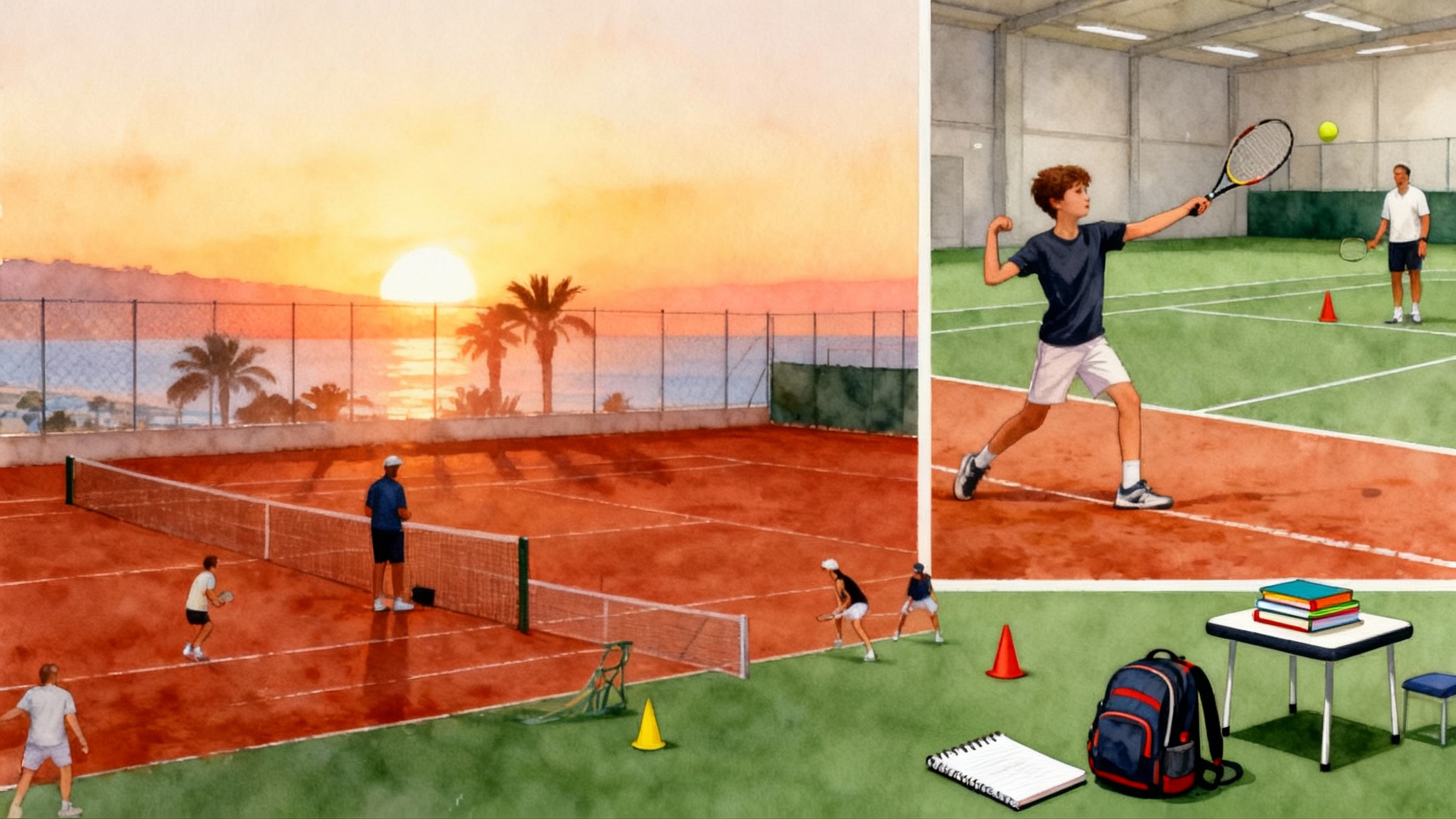
- Mixed surface exposure: if the next tournament run is on clay, the second week of the training block still includes two indoor hard sessions. This keeps footwork adaptable and prevents a single-surface bias.
- Travel discipline: no more than two back-to-back tournaments in different countries. The body learns more from a focused block at home than from another flight.
The result for a player like Alcaraz is not simply more fitness. It is schedule literacy. He learns how to show up fresh on Monday, how to peak on Friday, and how to reset by Sunday night.
Example calendar at 16 to 17, built for acceleration
Below is a sample version of the structure that helped turn a top junior into a Tour-ready teenager. You can adapt this to your local calendar and resources.
- Weeks 1 to 2: Training block on clay, two indoor hard sessions per week. Emphasis on first-strike forehand and depth tolerance on backhand. Strength in the gym on Monday and Thursday, acceleration mechanics on Tuesday.
- Week 3: Men’s Futures tournament within driving distance. Singles priority, one doubles entry only if the singles load is light. Objective: 65 percent first serves in, 60 percent of second-serve returns deep middle.
- Weeks 4 to 6: Training block with mixed surfaces. Serve patterns and transition game. Two practice sets per week against older pros. One day of return practice with eight second-serve reps per sequence.
- Week 7: Men’s Futures or early Challenger qualifying depending on results. Objective: hold serve above 80 percent, break 25 to 30 percent. If numbers fall below targets, step back to training rather than chase another event.
- Weeks 8 to 9: Recovery plus skill build. Mobility screens, single-leg strength, shoulders and rotator cuff endurance. Technical focus on backhand slice under pressure.
- Week 10: Junior Grade 1 or national championship only if it fits the goal of match reps. Use it to rehearse patterns under less stress and to build confidence.
This kind of season accepts that development is not linear. It repeats productive blocks even when rankings whisper for more travel.
Making the jump: from junior circuits to Futures to Challengers to ATP
Moving up too early wastes money and confidence. Moving up too late wastes time. Equelite’s approach is to promote based on reliable signals, not on hope.
-
From national junior to International Tennis Federation junior events:
- Trigger: two straight months with a hold percentage above 75 percent and a break percentage above 35 percent in national matches. Add a tiebreak record near even or better.
- How: enter higher-grade junior events with narrow travel. Keep training blocks between events.
-
From International Tennis Federation junior events to Men’s Futures:
- Trigger: ability to win service games in under 90 seconds twice per set at junior level, and a return depth that forces at least two neutral balls per return game.
- How: start with qualifying and accept that early exits are part of the data. Keep doubles light to protect the body.
-
From Futures to Challenger level:
- Trigger: three Futures semifinals or better inside twelve weeks, with at least a 20 percent break rate and 80 percent hold rate. If you are collecting points but winning only long three-setters, do one more strength block before moving up.
- How: enter one Challenger qualifying per month while still playing Futures for deep runs. Use the Challenger week for learning patterns against pace.
-
From Challenger to Association of Tennis Professionals main draws:
- Trigger: consistent wins over players ranked 200 to 300, plus one or two wins over 100 to 150. The goal is not a single upset but repeatable margins.
- How: plan a six-week window with two Challenger events and one Association of Tennis Professionals qualifying. Protect training time between the three.
These gates do not require expensive analytics. A parent or coach can track hold and break rates, tiebreaks, and average rally length with a simple match log.
Hard-wiring all-court patterns without breaking the body
Alcaraz did not become dangerous only because of racquet speed. He became dangerous because he learned patterns that work on slow clay and on fast hard courts. Academies can lock these in with targeted constraints.
- Transition game that travels
-
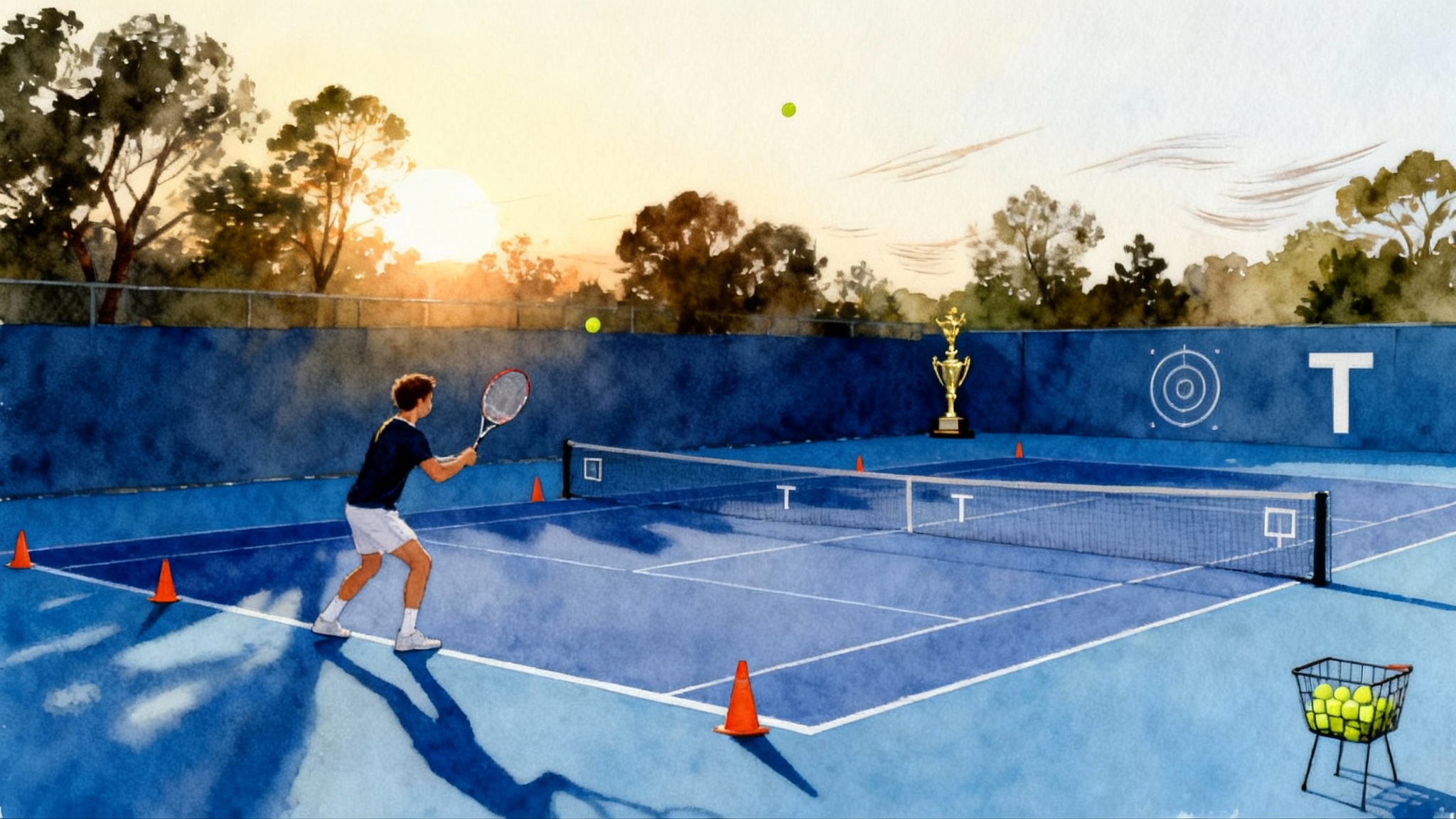
Drill: Crosscourt build and middle attack. Player A hits heavy forehands crosscourt, Player B sends back neutral balls middle. On the first short reply, Player A steps inside to attack middle, not corner, then closes for a volley. Score only if the volley lands within the inner third of the court.
-
Why it works: attacking middle steals time without risking sidelines. It is a safer on-ramp to the net for young players.
-
Drill: Two-touch approach. Feed a deep ball. Player loads, hits a heavy forehand to the corner, then must take the next ball as an approach regardless of height. Finish with a split step one meter inside the baseline and a first volley deep middle.
-
Why it works: the split and volley locations become habits. Transition depth becomes predictable in a good way.
- Drop-shot usage that is a decision tree, not a trick
- Cue: three conditions must be true before a drop shot is allowed. Opponent is behind the baseline, you have the ball above net height, and you are balanced. If any condition is false, you must either roll crosscourt or use a heavy inside-in.
- Drill: Red-zone tax. In practice sets, a drop shot scored from below net height costs you two points. One made from above net height gains a bonus point if followed by a successful cover of the lob.
- Why it works: juniors stop fishing for highlight plays, and they learn to pair the drop shot with the next movement.
- First-strike forehand that sets up patterns on both surfaces
- Drill: Serve plus one to two targets. Deuce side serves to the T, then inside-out forehand to the opponent’s backhand. Ad side serves wide, then inside-in forehand to the open court. Count only points finished within four balls. For deeper progressions, see serve technique and pressure proofing.
- Progression: after ten minutes, require a transition to net on any ball struck inside the baseline. Finish with five minutes of first-volley depth control.
- Why it works: it matches the pattern that wins most junior and lower-level pro points, and it scales to faster or slower courts.
- Backhand depth tolerance that keeps the forehand dangerous
- Drill: Backhand cage. Feed deep to the backhand for six balls, with the target two racquets’ length inside the baseline. Only then is the player allowed to run around the seventh ball for a forehand. If the backhand target is missed twice, the runaround is cancelled.
- Why it works: the forehand remains a weapon because it is earned, not chased.
Durability as a skill, not a trait
Talent is irrelevant if the player cannot stay on court. Equelite structures workload so that the body adapts without getting punished.
- Strength and capacity screens every six weeks: single-leg sit-to-stand to fatigue, Copenhagen plank holds, seated medicine-ball throw for upper-body power. Retest after each training block.
- Acute to chronic workload control: weekly on-court minutes should not jump more than 20 percent above the rolling four-week average. If a junior exceeds the cap during a tournament run, the next week becomes partial recovery with low-impact skill work.
- Red flags that demand a pivot: sleep dropping below seven hours for more than two nights, a two kilogram weight drop in a week, or the return of ball impact feeling heavy. These cues trigger an immediate scheduling change before injury knocks on the door.
School balance without a tug of war
The goal is not to prove that school is unimportant. The goal is to preserve cognitive bandwidth and social connection while pursuing a pro path.
- Block scheduling: classes or study blocks live in the afternoon on heavy training days and in the morning on lighter days. The same sequence repeats weekly so the brain knows when to switch.
- Micro-deadlines: instead of a single massive assignment per term, divide tasks into weekly deliverables. A study coach checks progress during the Sunday recovery block.
- Social oxygen: one set time per week for family dinner, one call with a friend, one activity away from tennis, even if it is only two hours. Protecting this time prevents burnout that shows up as lazy feet on Friday.
A family checklist: when it is time to relocate to an academy
Relocation is not a status symbol. It is a service decision. Use these signals to decide objectively.
- Training quality at home is capped by lack of variety. You cannot find peers or older hitters who expose weaknesses two to three times per week.
- The junior’s best wins come with patterns that are not challenged locally. For example, forehand inside-out winners against short balls that never arrive against pros.
- Tournament travel is chaotic. You are playing three straight weeks across multiple regions without training days and without a plan for recovery.
- The player has a coach who is committed but lacks a team. The academy can plug in strength, physio, and video support that a single coach cannot provide alone.
- The family can commit to a two to three year window, not a three month sprint. Development needs time consistency to pay off.
If you check most of these boxes, consider a visit. Watch three normal training days. Ask to see video review in action. Sit with the strength coach for fifteen minutes. The process should be obvious to an outsider.
How to phase up tournament levels without losing momentum
- Stay honest with thresholds. Hold rate above 80 percent and break rate near 30 percent are simple benchmarks that transfer from juniors to the lower rungs of the pro game.
- Keep doubles strategic. Use it when you need net reps, skip it when singles load is high. Doubles can sharpen first volleys and returns, but it should not steal recovery.
- Track travel fatigue. Use a basic one to ten freshness score each morning. If the score sits at five or below for two straight days during a tournament, pull back on warm-up volume and push recovery tools.
- Review weekly, not yearly. One page per week with match stats, two lesson bullets, and next week’s targets. Small course corrections prevent big detours.
What academies can borrow from Equelite right now
- Build a shared playbook. Give your patterns names and make every coach use them. Consistency in language speeds learning.
- Pair surfaces inside blocks. Two hard sessions inside a clay block, or the reverse, keeps movement adaptable and prevents surface-specific habits from hardening too soon.
- Professionalize the day. Time caps for warm-up and activation, specific goals for every drill, and real cooldowns. Young players learn that precision is a habit, not a mood.
- Measure the simple things. Hold rate, break rate, average rally length, and time per service game. These cost nothing and guide smart promotion between levels.
- Protect the athlete first. Keep work spikes under control, and use red flag rules that trigger immediate schedule changes. A healthy player learns. An injured player watches.
The Villena effect, explained simply
When Carlos Alcaraz left El Palmar at 15 and entered the daily rhythm of Villena, he gained an environment where every hour pointed at the pro game. Mentorship translated into decisions, sparring quality turned practice sets into mini finals, and a pro-style calendar made time an ally. He still needed the gifts, the mindset, and the grind. But the structure bent the curve.
Families do not need a famous surname on the gate to capture that effect. You need clarity about what to measure, discipline in how you schedule, and a coaching language that connects drills to matches. If you adopt those three pillars, the move from your hometown to a purpose-built program stops being a leap of faith and starts being what it was in Villena, a rational choice that turns potential into a professional game.
Closing thought
The pathway from a local club in Murcia to Sunday finals anywhere in the world is not magic. It is a set of blocks, repeated with care. Find the mentor who speaks in patterns, train like a pro before you are ranked like one, and mix surfaces until your footwork fits any court. That is how a teenager from El Palmar stepped into Villena and walked out with the tools to win when the lights got bright.