How Ferrero Tennis Academy Forged Carlos Alcaraz’s Rise
 Tommy
Tommy
From El Palmar to Villena: the decision at 15
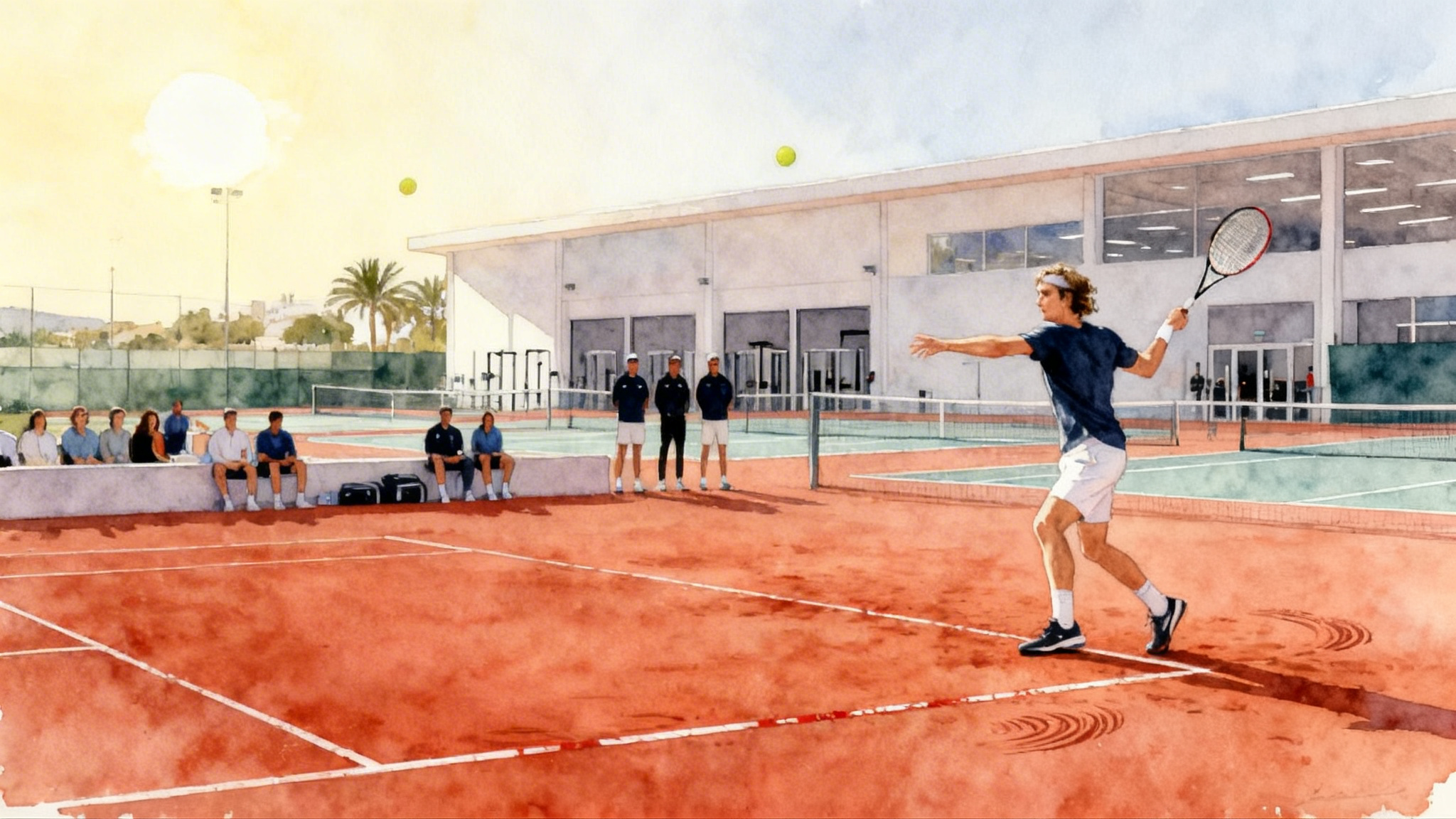
In September 2018, Carlos Alcaraz left his family home in El Palmar, Murcia, to live and train full time at Juan Carlos Ferrero’s academy in Villena, Alicante. He was 15. That choice compressed two worlds into one campus. Schoolwork, gym, meals, recovery, and most important, a stable daily relationship with the coach who would guide every key decision. Families often picture a move like this as a leap into the unknown. In practice it is more like switching from a local road to a controlled access highway. The destination is still far away, but traffic lights and side streets stop interrupting the drive.
At Villena, the cast around Alcaraz was tight and consistent. Ferrero set the technical and tactical path. A small, trusted support team handled strength and conditioning, physiotherapy, and logistics. Training partners rotated through, but the voice in charge did not. That continuity is the point. When a teenager’s body is changing fast, one tactical idea held steady by one lead coach is better than five ideas sampled for a week at a time. The academy environment made this possible because everyone worked under the same plan.
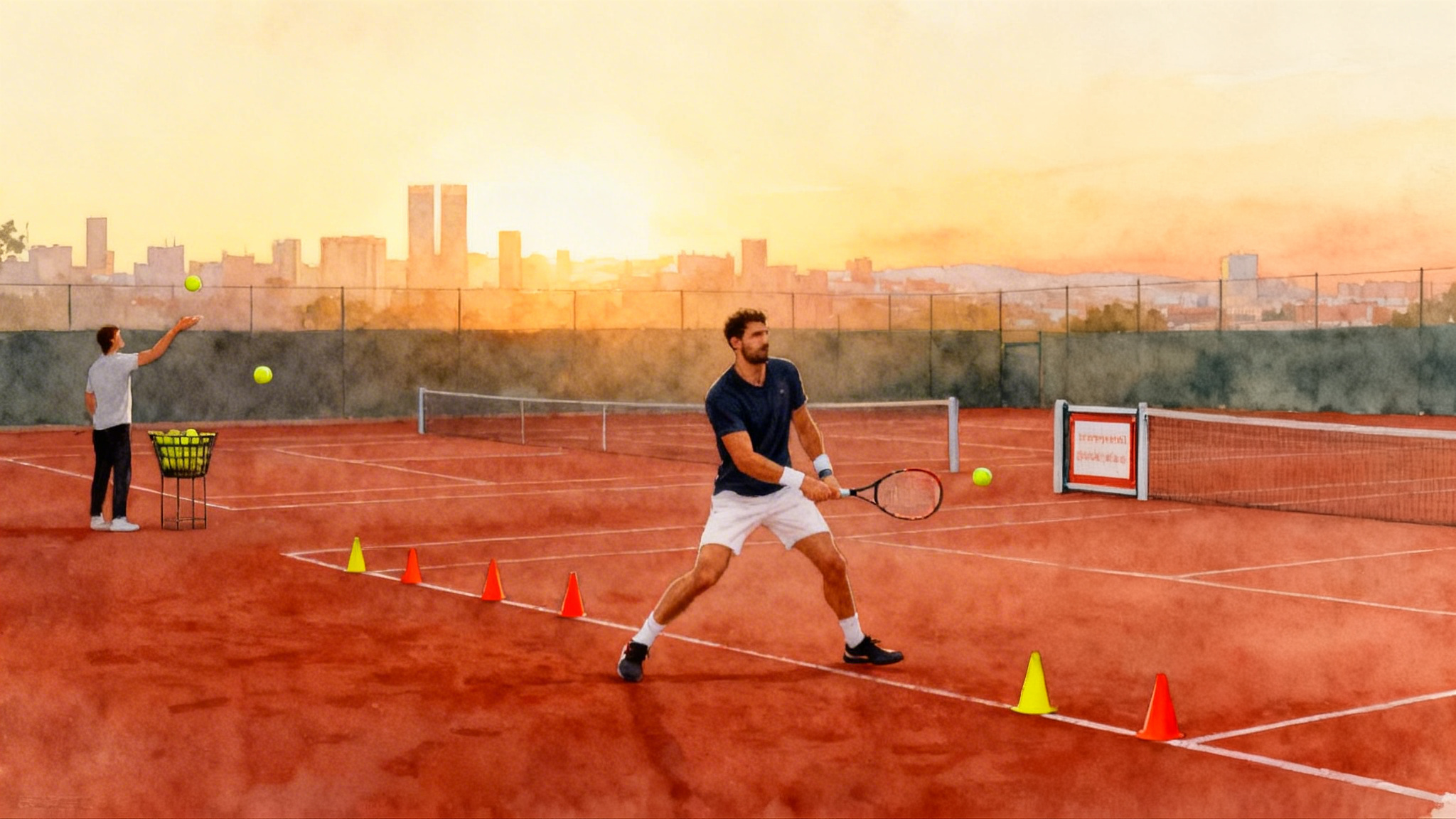
What did that plan look like? Long live ball sessions that built stamina and decision making. Two on one patterns that forced forehand and backhand acceleration under fatigue. Serve plus one and return plus one sequences repeated at the end of sessions, not the beginning, to simulate match pressure. Ladders, core, hips, and sprint mechanics in the gym, then court sprints that ended with a precise technical cue. Recovery was not a treat. It was on the schedule like any other drill.
2019 to early 2020: building a base with smart scheduling
The first test of the Villena blueprint was not an ATP breakthrough. It was event selection. In 2019 and early 2020, Alcaraz’s schedule stacked lower-tier professional tournaments close to home, with short travel and familiar beds. The goals were simple and measurable: raise serve hold percentage, convert more break points than the week before, and add match volume without getting injured. To families, this can look like under reaching. It is actually over delivering on the right priorities.
A practical example. A six week block might include two training weeks in Villena that start with three aerobic and movement heavy days, shift to two power and speed days, and end with a taper. Then comes a three week string of events at the same level so he can learn match to match without moving up or down. Finally there is a one week reset with light court work and strength maintenance. Everyone on the team knows the targets for the block, the expected workload, and how recovery will be handled. This is scheduling as development, not as sightseeing.
2020: a compressed climb from ITF to Challenger to ATP
The habits forged in Villena started paying out in 2020. Alcaraz won professional matches at the International Tennis Federation level and quickly backed them up with three ATP Challenger titles in Trieste, Barcelona, and Alicante, plus his first tour level match win in Rio de Janeiro in February at age 16. The pattern was not accidental. The academy matched his event level to his readiness, then upgraded only when performance data and training quality proved stable over several weeks. That is the opposite of chasing the biggest stage available. It is about earning the right to climb each rung. A detailed season snapshot from the sport’s governing bodies captured that mix in 2020, including early ITF wins and three Challenger trophies, as profiled in the ITF Class of 2020 feature.
On court, two elements stood out that year. First, stamina plus aggression. He could extend rallies on clay without playing safe. That balance comes from high volume, high quality live ball training under fatigue, rather than ball machine repetition in isolation. Second, purposeful variety. The drop shot that later defined his biggest wins was already part of the Villena playbook, but it was used as a pattern, not a party trick. Serve wide, bait the deep return, take a neutral ball early, then drop. Repeat it three or four times a match to force opponents into no man’s land.
2021: the first tour title and the value of continuity
In July 2021, Alcaraz collected his first ATP Tour title on clay in Umag at 18, beating Richard Gasquet in the final. Two details matter for families studying the pathway. One is the surface match. The academy spent most of his foundational time on clay, then let him express that base in an event that rewarded long points and heavy first balls. That was not an accident. The other is what did not change. He did not overhaul his coaching, technique, or fitness approach after a loss or a poor week. The same team rolled forward, with small adjustments to serve targets and forehand patterns. Stability is a competitive edge.
Late in 2021 he won the Next Gen ATP Finals in Milan. That event is played with format twists, like shorter sets and no let on serve, but the substance that won it was old fashioned. He started points with depth, finished with spin heavy forehands or backhand drives up the line, and absorbed pace without giving ground on returns. Those habits were written in everyday ink at Villena long before they appeared under bright lights.
2022: academy habits become a major blueprint
What changed in 2022 was not identity. It was scale. Masters 1000 titles arrived, then the season crescendoed in New York. Alcaraz won his first major at the United States Open, becoming the youngest man to reach world number one since rankings began in 1973, as recorded in the official US Open match report.
Similar academy-to-tour blueprints are explored in Piatti Academy forged Sinner and Rafa Nadal Academy fueled Ruud.
Zoom in on the habits, not the headlines. The Villena training pattern of finishing tired became a weapon in five set marathons. The academy insistence on patterns survived the noise. He kept winning with serve plus one forehands to the open court, backhand up the line changeups, backhand return blocks into the middle third that bought time, and timely drop shots that asked big men to move forward on concrete. Even the between point routine was familiar. Eyes down. Slow the breath. Quick look to the box for a cue, not for comfort. Then reset the grip pressure and play.
What families can actually use from this pathway
Below are specific, practical takeaways for parents and players who want to translate the Ferrero model into their own context. No prestige required. You can do most of this with discipline and clear choices. For families comparing programs, boutique setups like Gomez Tennis Academy in Naples often deliver the small-circle continuity described here.
1) Timing the move: make it a strategic on ramp, not a rescue
- Readiness checklist before relocating full time at 14 to 16:
- Daily independence: can your player handle schoolwork, sleep, and nutrition without constant reminders for a full month at a time?
- Injury history: have you tracked weeks on court and gym volume for at least six months, with one deload week every four to six weeks?
- Communication comfort: can your player articulate two strengths and two weaknesses in their own words after each match?
- Why 15 worked for Alcaraz: physically he was close to growing into the adult workload, yet young enough to hard wire movement quality. The academy then scaled volume in line with his development rather than chasing results.
- How to copy it: start with a three month trial block at an academy. Live on site or nearby. Let the lead coach run point on all tennis choices during that time. Parents can observe, but avoid double coaching. After three months, review data and decide whether to commit for the year.
2) Selecting coaching continuity: one lead voice, many hands
- Appoint a single lead coach. Everyone else supports that person’s plan. If you change coaches, make it during a planned off block, not in the middle of a match cluster.
- Insist on a written plan. The lead coach should produce a quarterly outline that states two technical priorities, two tactical patterns to emphasize, and three physical targets. If it is not written, it will drift.
- Keep the circle small. A good strength coach and a good physio who review the plan with the lead coach are more valuable than a large staff who operate in silos. Villena worked because the messages matched from court to gym to treatment table.
3) Structuring match blocks: climb rungs with rules
- Use a level rule. Stay at a level until you post a three week window with at least two of these three metrics: hold percentage above 70 percent, break conversion above 40 percent, and positive winner to error ratio in three matches in a row. Only then consider moving up.
- Calendar model for a player transitioning from national junior events to professional qualifiers:
- Weeks 1 to 2: training block. Three days aerobic and lateral movement focus, two days power and speed, one day rest. Serve targets daily at the end of the session.
- Weeks 3 to 5: three events within one region. Choose draws you can drive to in under six hours.
- Week 6: deload. One extra day off, two lighter court sessions, mobility every day.
- Week 7: review with video and data. Decide on the next rung.
- Why this works: learning compounds when opponents, courts, and travel stress are consistent. That is how 2020 clicked for Alcaraz across International Tennis Federation and Challenger levels.
4) Physical preparation: make the gym serve the game
- Weekly template used by many clay based academies for 15 to 18 year olds:
- Monday: lower body strength, eccentric focus. Split squats, hamstring sliders, deceleration drills. Court work ends with 10 to 12 accelerations to the forehand corner.
- Tuesday: conditioning and mobility. Intervals on court with medicine ball throws between sets. Emphasize nasal breathing to lower heart rate between points.
- Wednesday: upper body power and shoulder care. Push press, pull ups with tempo, scapular control. Serve speed sets only after stability work.
- Thursday: speed and agility. Short sprints with full recovery, crossover steps, and reaction cues. Court session focused on return plus one patterns.
- Friday: total body strength, lighter load. Farmer carries, anti rotation, calf work. Finish with 12 to 16 minutes of point play.
- Saturday: match simulation or tournament play.
- Sunday: complete rest or easy bike and mobility.
- Rules that preserve health:
- Never chase personal records in the gym during tournament weeks.
- Keep a pain log. Any joint pain that repeats for four sessions triggers a consult and a one week modification.
- Sleep is a training block. If sleep drops below seven hours for three nights, reduce volume 20 percent for the next three days.
5) Tactics that travel from academy to tour
- Serve plus one to the open court until the opponent moves early. Then run serve wide plus backhand up the line as the surprise, not the base.
- Two neutral ball speeds. A steady heavy ball that pins opponents, and a flatter changeup used only when you have a clear court target. Young players often blend these. Keep them distinct.
- Planned variety. The drop shot is a pattern. Use it after a deep cross court forehand to the backhand corner, or after a return block that forces a short neutral ball. Avoid using it from behind the baseline.
- Between point routine. Develop one reset you repeat regardless of score. Grip check, breathe, cue word, bounce. The routine is a performance anchor.
How the Ferrero model translated into wins
- Mentorship: Ferrero’s credibility as a former number one matters less than his insistence on one plan over time. Because the academy ran everything under that plan, small improvements in technique turned into big improvements in decisions under pressure.
- Competition planning: The 2019 and 2020 blocks built match volume with minimal travel. That produced confidence and data at the right speed. When results validated the work, the team upgraded the level and kept the pattern.
- Training environment: Villena’s mix of older hitting partners, live ball under fatigue, and end of session serving meant that five set points in New York felt like an extension of Tuesday afternoons. When the moment came in 2022, nothing new had to be invented. The same habits were applied at a larger scale.
A quick checklist for families considering a similar path
- Can we commit to one lead coach and a small staff for at least 12 months?
- Do we have a written quarterly plan with two technical goals, two tactical patterns, and three physical targets?
- Is our tournament calendar built around three to five week blocks, with a deload and a review at the end of each block?
- Are we tracking simple performance metrics every week: hold percentage, break conversion, and winner to error ratio?
- Do we have a non negotiable between point routine and a codified recovery plan?
- Is our move to an academy a strategic on ramp, not a reaction to a bad month?
The bigger picture
From the outside, 2018 to 2022 looks like a blur. A teenager leaves home, wins a few small events, lifts a first ATP trophy, then grabs a major. From the inside, it is a string of ordinary days executed with quality. One campus. One coach in charge. One schedule that matched event levels to readiness. One set of training habits repeated under fatigue until they could survive city noise, jet lag, and fifth set nerves. Families do not need a famous name on a gate to copy this. They need clarity about who leads, discipline about when to climb, and the patience to let habits compound.
That is the real pathway from El Palmar to Villena to New York. The road is not short. It is simply well marked. When you follow the signs with care, you arrive.