Haskovo to Barcelona: Sánchez-Casal Shaped Dimitrov’s ATP Return
How a teenage relocation from Haskovo to Barcelona set the footwork, patterns, and habits that Grigor Dimitrov later revived to surge back toward the Association of Tennis Professionals elite from 2023 to 2025.
 Tommy
Tommy
The quiet move that changed a career
Grigor Dimitrov’s resurgence in 2023 through 2025 did not come from a new trick. It came from dusting off an old manual. As a teenager from Haskovo, Bulgaria, he left home for the Sánchez-Casal Academy in Barcelona, where he absorbed a rigorous Spanish template built on tireless footwork, repeatable patterns, and a clear identity for how points should be constructed. Years later, when results wobbled and confidence flickered, his team steered him back to those early principles. The turnaround felt fresh on television, yet the blueprint was familiar to anyone who watched his junior years.
This piece traces three pivotal arcs. First, the decision to relocate from Haskovo to Barcelona, including what that change of environment actually delivered. Second, the foundation Sánchez-Casal laid in Dimitrov’s game, especially Spanish footwork habits and pattern play. Third, how reconnecting to those foundations under his current team powered a return toward the ATP elite, highlighted by a more measured first strike, higher rally tolerance, and smarter location choices on big points.
Barcelona, not as a postcard, but as a training lab
Relocating to a major academy is not about palm trees or cafeteria chatter. For a 14 to 16 year old prospect, it is about friction. Friction against better practice partners every day, friction against a detailed training plan that makes weaknesses impossible to hide, and the productive friction of weekly match play in a competitive region. Barcelona offered Dimitrov all three. For a women’s-side parallel in the same city, see GR Tennis Barcelona’s impact.
- Level of sparring: Spanish academies routinely stack courts with top juniors, hungry Futures players, and touring pros passing through between events. A teenager gets used to the speed of pro ball without waiting for a wildcard.
- Volume of competitive reps: Within a few hours’ drive, there are satellite events, Futures, and later Challengers almost every week. Travel is cheaper, scheduling is easier, and lessons are immediate.
- A coherent game model: Coaches teach the player to win points with a small set of reliable patterns, then test those patterns in live sets. The player learns to survive bad days by leaning on structure.
For Dimitrov, the change was practical. In Haskovo he was a prodigy. In Barcelona he was one more ambitious teenager, forced to prove it every hour. That pressure translated into habits, and the most visible habit was how he moved.
What the Spanish template really means
“Spanish tennis” is often reduced to topspin and grinding, which misses the point. The template is closer to a language for movement and decision making. You can see similar foundations at work in JC Ferrero’s Equelite model.
- Footwork before racket head: Players learn to solve the ball with their legs. The first instinct is to create space, then hit. The body gets to the right place early enough that the player can choose from two or three forehand options, not one. For the trigger that starts this, study split-step timing fundamentals.
- Crosscourt as home base: The crosscourt exchange sets height, shape, and depth. It is where safety lives. The change of direction is a conscious act, not a reflex.
- Patterns over plays: Instead of improvising each point, players carry a short menu of patterns they can repeat under stress. The menu is tailored to their identity.
At Sánchez-Casal, Dimitrov experienced this as a daily system, not a slogan. Three staples illustrate what he took with him.
-
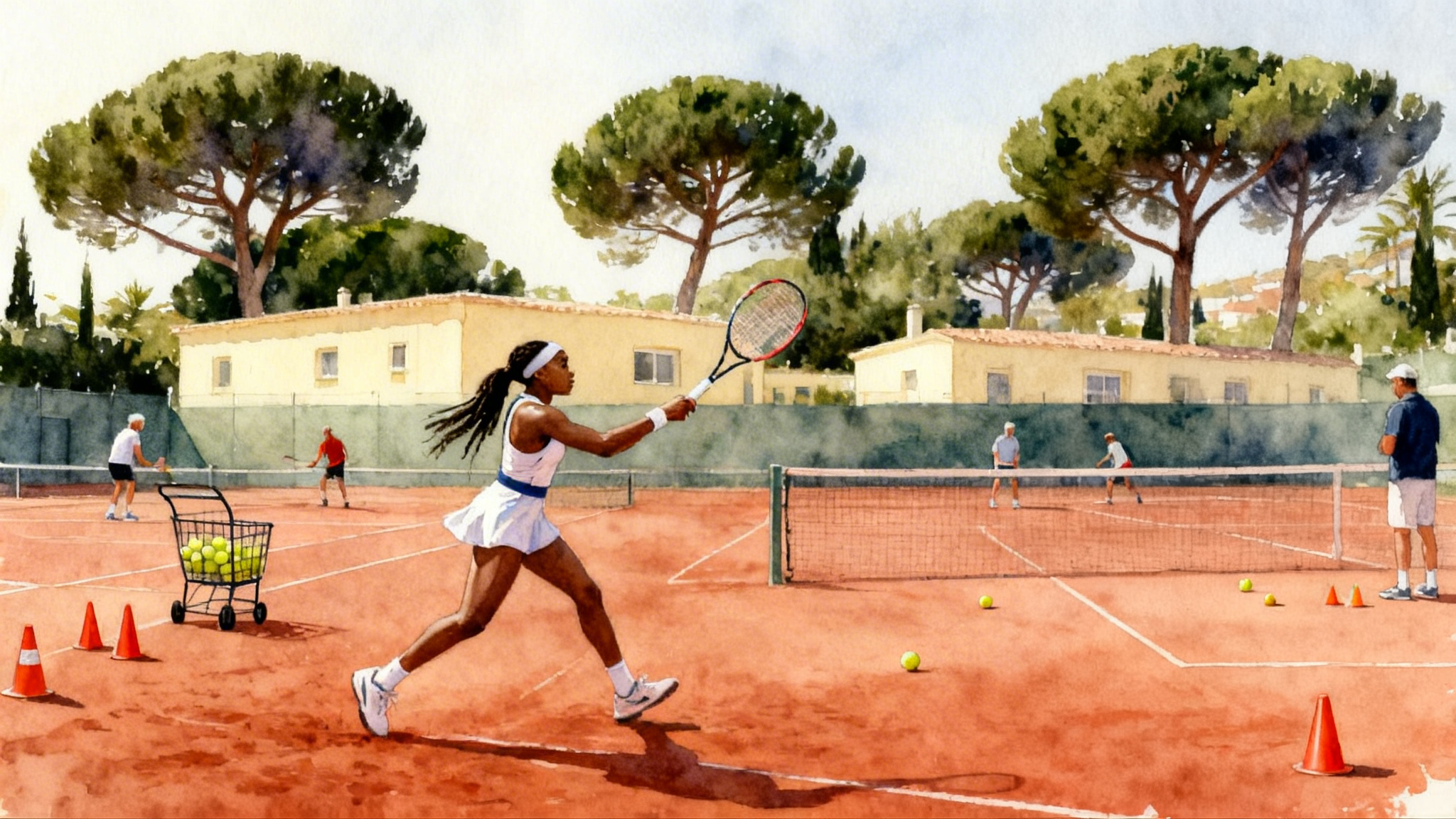
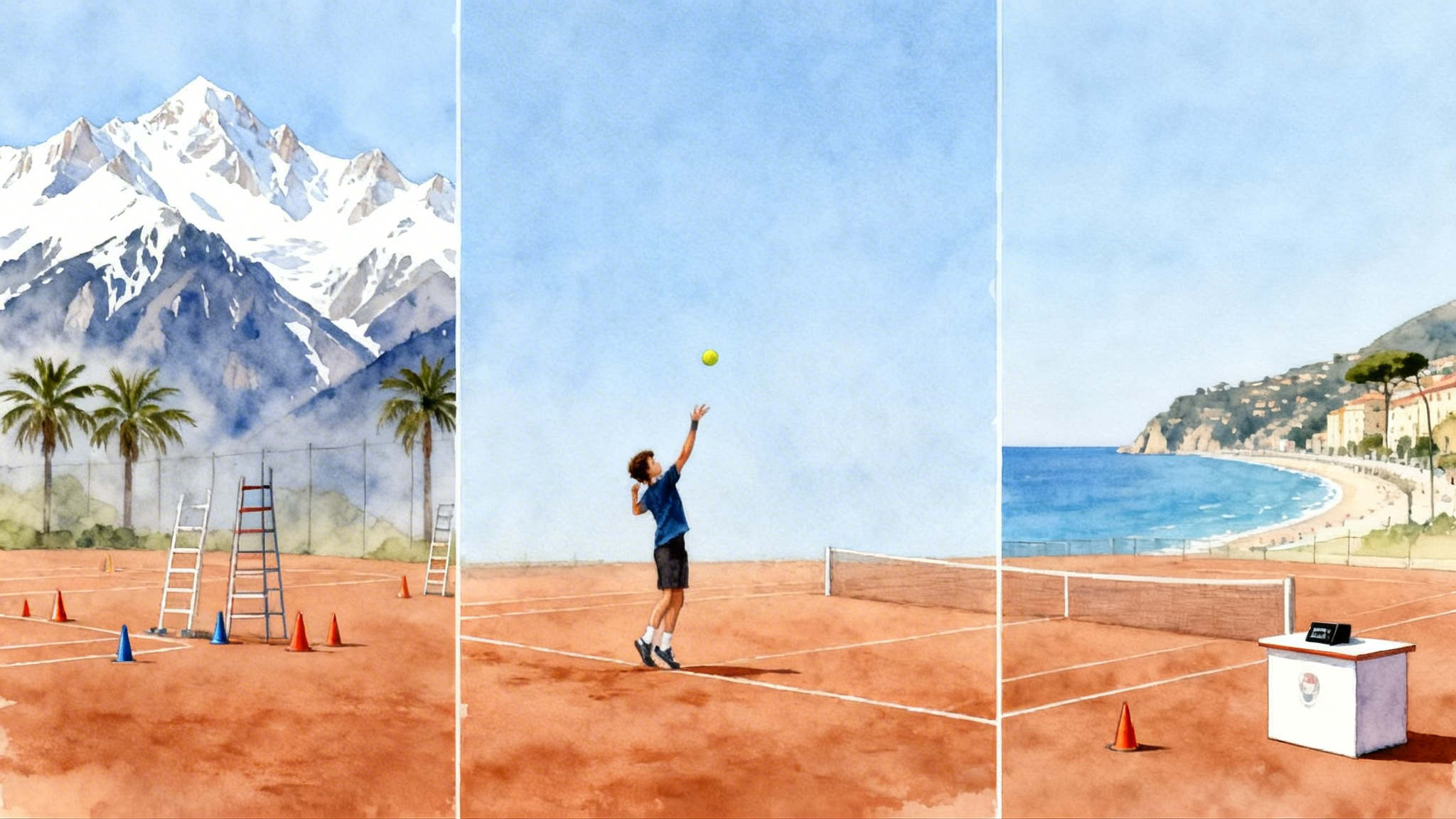
X-drill with depth gates: Forehand from the ad corner deep crosscourt to a cone target, recover, then backhand from the deuce corner deep crosscourt to a second cone. Every five balls, change down the line but only if the previous ball hit a depth gate. The rule bakes patience and discipline into the change of direction.
-
Two-to-one patterning: Two heavy crosscourt forehands, then one forehand inside-in to the deuce corner, finish by looking for a short backhand to take early. The drill trains the feet to expect the third-ball change, which later becomes serve plus one in matches.
-
Figure-eight recovery: Around cones set outside each sideline, players loop their recovery path after each swing. The exaggerated recovery makes the neutral position feel generous during points, which buys time on the next ball.
These are not circus drills. They are guardrails. With repetition, they convert uncertainty into routines, and routines into decisions that hold under pressure.
The junior pivot: balancing majors with pro reps
Dimitrov’s junior peak was spectacular, but the decisions around that peak mattered more than the trophies. He and his team did three things that parents often overlook.
- Alternating calendars: They paired bursts of junior majors with blocks of Futures and later Challengers. This rhythm protected ranking momentum while still exposing him to grown-man pace and decision making.
- Pattern integrity over novelty: Even as he moved up, he did not chase shiny tools. The focus stayed on crosscourt competence, a measured change of direction, and the serve plus one. The speed went up, the geometry stayed stable.
- Learning to win ugly: In satellite events the conditions are uneven, the balls fluff, and the courts play slower or faster than expected. The Spanish template traveled well across these variables because it was built on tolerance first, acceleration second.
By the time Dimitrov entered the upper levels, the foundations were not glamorous, but they were durable.
Transitions after Barcelona, and what stayed the same
Like most future top players, Dimitrov did not remain in one academy forever. He evolved through different coaches and environments, layering on strength work, serve variety, and tactical nuance. What survived every move was the idea that he could control points with his legs and shape, not only with flair.
- A cleaner first step: The earliest change a trained eye notices in any Dimitrov period of good form is how quickly his first step wins him the right contact point.
- Measured aggression: The best version of his forehand does not try to finish from neutral. It builds through depth, then takes the open lane down the line or inside-in. That is pure Sánchez-Casal logic.
- Backhand as a gear shifter: He does not force the backhand to be a hammer every rally. It is a steering wheel until the lane opens.
These carryovers explain why his later resurgence felt sustainable. They are not streaky assets, they are habits.
Reconnecting to roots, 2023 to 2025
The most striking aspect of Dimitrov’s recent rise is how close it looks to his teenage identity, only upgraded by a decade of experience. Three themes stand out.
- Rally tolerance built on spacing
Watch his best late-2023 and 2024 matches and count how often he hits one more deep neutral ball before taking the line. He is not deferring courage, he is buying accuracy. The feet get there early, the chest stays quiet at contact, and the change of direction comes from balance, not from arm speed. That one extra neutral ball raises his odds on the very next swing.
- Serve plus one with intent
His serve location supports the third shot instead of hunting aces at all costs. On the deuce side, a slider wide that drags the return outside the singles line, then a forehand inside-in to the open space. On the ad side, a body serve that jams the backhand, then a deep crosscourt forehand to reset the rally at his preferred height. The pattern choice says more about his improvement than any single winner.
- Backhand down the line as pressure valve
When opponents camp on his forehand corner, he is quicker to change line down the backhand side to make them move first. The ball does not need to be a winner, it needs to be early and deep. That change forces errors or shorter replies that feed his forehand.
Results alone never tell the full story, yet the pattern quality explains why big stages again looked reachable. Late 2023 delivered deep runs indoors, early 2024 brought a title and a major final run in a Masters event, and throughout that stretch his rally choices matched what he learned in Barcelona as a teenager. The engine under the hood was old, just well tuned.
What this means for parents and coaches
Parents often ask when to relocate, what to look for in an academy, and how to make sure the hours on a back court become wins on Sunday. Dimitrov’s path offers concrete filters.
When relocation makes sense
Consider relocation when at least two of these are true for six months in a row:
- Practice partners at home cannot reproduce the ball speed or depth your player will face at Nationals or on the pro circuit.
- Tournament travel from home is so costly or sparse that the player averages fewer than three matches per month.
- The home program cannot articulate a game model the player can explain back in one minute, including two or three patterns they rely on under pressure.
- Your player’s motivation spikes during training blocks away from home and sags on return, even after allowing for normal post-travel fatigue.
Relocation is disruptive. If two or more constraints are chronic, the upside of moving grows.
What to look for in academy culture
An academy cannot guarantee stardom, but it can guarantee clarity. Ask for proof.
- Game identity on a page: Can the head coach write the player’s patterns on one page, in verbs and locations, not clichés? For example, two forehands crosscourt, then inside-in to deuce, recover on the backhand hash.
- Constraint-led drills: Do practices set rules that teach patience and timing, like depth gates before line changes, or do they reward low-percentage winners?
- Match play with feedback: Are there structured set days with charting, video, and a debrief that ends in two practice targets for the next week?
- Transparent peer ladders: Can your player map out the next three practice partners they need to catch, and how that will be scheduled?
- Injury literacy: Are loading plans and recovery windows written and shared, or is it effort without dosage?
How to convert academy drills into durable match patterns
The single biggest mistake after a move is treating drills as fitness. Drills are language practice. To make them transfer, tie each to a point scenario, a score, and a cue.
- Tie the X-drill to 30-30 on return games: Require two deep crosscourts before any change of direction. The player learns patience under medium pressure.
- Tie two-to-one forehands to 15-0 on serve: Build momentum with a safe third ball inside-in, then recover through the backhand hash. The player leaves no space for a counterpunch.
- Tie figure-eight recovery to long rallies at 3-3: After every swing in practice, exaggerate recovery around a cone, then demand a deep neutral ball on the next shot. The player learns to reset the rally when lungs burn.
- Film and label: Put three labels on clips, such as Neutral Cross, Green Light, and Line Change. If a clip does not fit a label, the pattern choice was unclear. Repeat the drill next day with that clip in mind.
The goal is to make decisions routine. Once a pattern owns a score and a cue, it survives nerves.
A simple weekly template you can borrow
This is a sample week that mirrors the Sánchez-Casal style Dimitrov grew up with, scaled for strong juniors. Adjust court time to age and health.
-
Monday
- Morning: X-drill with depth gates, 30 minutes, then crosscourt live ball to 11 points where a change of direction is only allowed after a depth gate.
- Afternoon: Serve plus one on both sides, 30 minutes patterns, 30 minutes live baseline points starting with serve.
-
Tuesday
- Morning: Backhand down-the-line change on command, basket feeding with recovery cones, then crosscourt to line-change live ball.
- Afternoon: Sets to four games with one coach charting line changes and depth. Debrief with two targets.
-
Wednesday
- Morning: Movement ladders into open-stance forehand, emphasis on first step. Finish with two-to-one pattern to specific cone targets.
- Afternoon: Mobility and strength session, include split-step timing drills.
-
Thursday
- Morning: Return plus one, body and wide locations, then points starting with return only on the ad side for 20 minutes, deuce side for 20 minutes.
- Afternoon: Set play with a constraint, for example, no line change until ball three.
-
Friday
- Morning: Figure-eight recovery on both wings, then 21-ball rally tolerance drill where any ball under the service line restarts the count.
- Afternoon: Tiebreakers with charting of first four shots in each point.
-
Saturday
- Match play or a local event. If no event, play one full match that is fully charted, then spend 20 minutes filming only serve plus one patterns.
-
Sunday
- Recovery, light movement, video review, and a short goals meeting that maps three drills to three match moments for the coming week.
The template forces an identity. Your player should be able to say what they worked on, why it matters on points, and how it will show up at 3-4, 30-30.
Why Dimitrov’s arc is a useful case study
Dimitrov is celebrated for style, yet his return toward the elite from 2023 through 2025 was not about pretty tennis. It was about honest tennis. He re-embraced the system that made him reliable as a teenager. The outcomes that followed were byproducts of that reliability. He did not need a brand new weapon, he needed a stricter relationship with his old ones.
For parents and young players, that is the practical lesson. Before chasing novelty, audit your foundation. Do you move into contact early enough to have options? Do you own a crosscourt rhythm you can lean on under pressure? Does your change of direction come from balance, not hope? If you cannot answer yes to those, a relocation will not fix your tennis. If you can, the right academy can give those habits more speed, more fitness, and more reps until they hold against anyone.
Closing thought
From Haskovo to Barcelona and back again in spirit, Dimitrov’s story shows that progress is often a circle. The path forward was a return to first principles, upgraded by time. For families making their own decisions, begin with identity, choose environments that protect it, and build patterns that survive nerves. The rest, as Dimitrov proved, tends to follow.