How GR Tennis Barcelona Forged Zheng Qinwen’s Rise
Zheng Qinwen left China as a teenager to train in Barcelona under Pere Riba. This deep dive unpacks how Spanish clay-first footwork, scheduling, and training culture powered her WTA breakthrough and Olympic gold, plus practical steps for families.
 Tommy
Tommy
From Wuhan walls to Barcelona clay
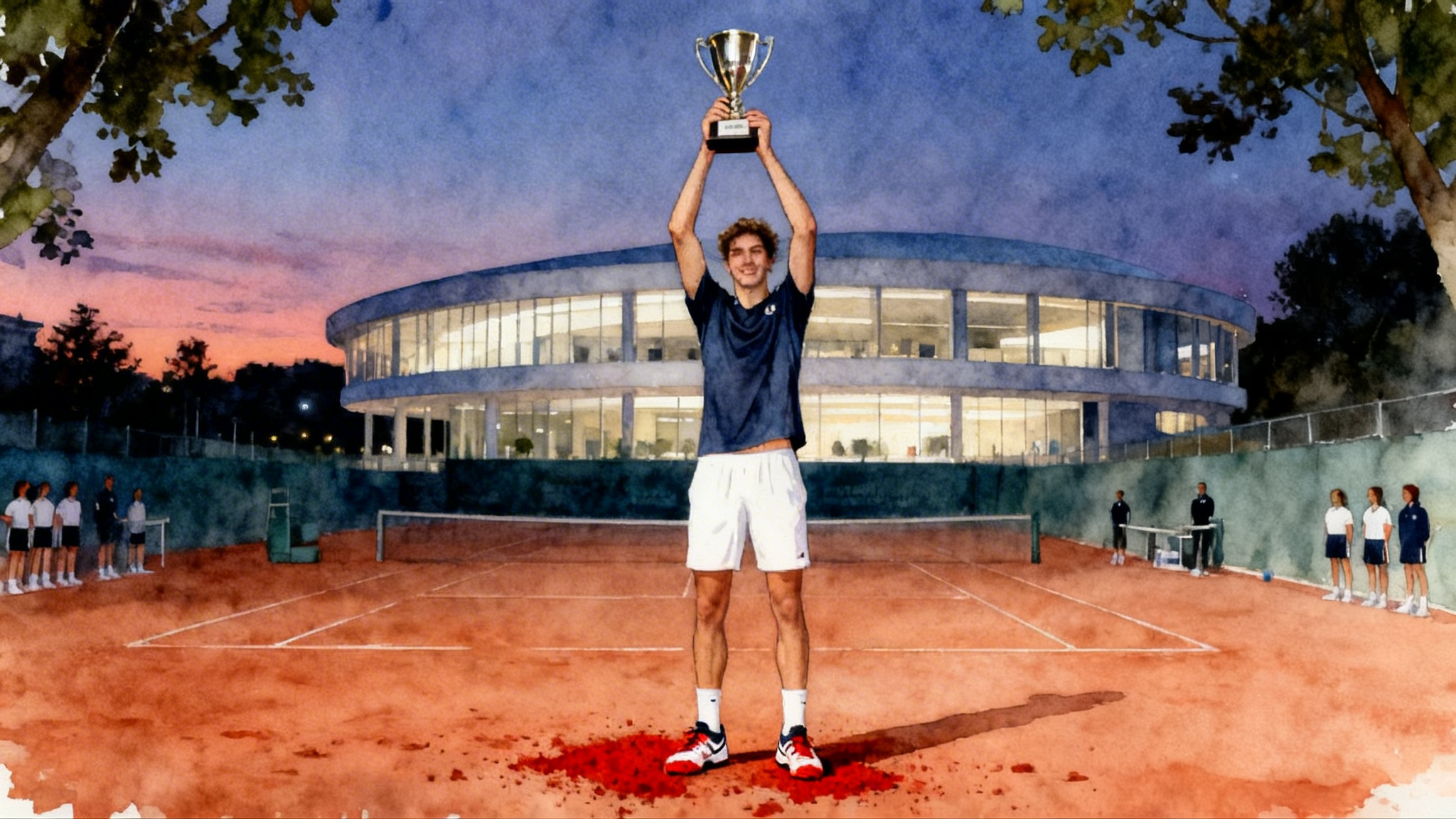
Before stadium courts and television trucks, there is always a wall. In Zheng Qinwen’s story, the wall stood in Hubei, where a kid with quick eyes learned to love the sound of the ball. The leap that turned those echoes into world-class tennis happened thousands of miles away, on the red clay of Barcelona. In Spain she built the engine that would carry her through long rallies, late-match resets, and a season’s worth of travel. That engine ran all the way to Olympic gold in Paris on the clay of Roland Garros, where she delivered one of the most consequential wins in modern Chinese tennis history, as documented by the International Tennis Federation’s coverage of the final against Donna Vekic in China’s first singles gold in Olympic tennis.
This article traces how the decision to train under Pere Riba at GR Tennis Barcelona set the base for Zheng’s rise. We will map the steps from academy to tour, the coaching handoffs that built on that base, and the practical lessons families can use when deciding whether to go abroad, how to vet an academy’s philosophy, and how to structure match play and fitness for sustainable progress.
Why Spain, and why GR Tennis Barcelona
Families who move a teenager across continents are betting on more than a coach. They are betting on a culture. Spain offers a distinctive training culture defined by four elements that matter for long-term development:
- Surfaces that teach balance: clay courts lengthen points, punish lazy footwork, and reward body control over raw power.
- Live-ball repetition: Spanish sessions string together long, live-ball drills so players learn to solve problems at rally pace rather than in isolated feeds.
- Volume with intent: more hours, yes, but stitched into blocks that target specific patterns such as inside-out forehand plus crosscourt recovery.
- A grounded lifestyle: school solutions, public clubs, and shared courts produce strong peer groups and healthy pressure.
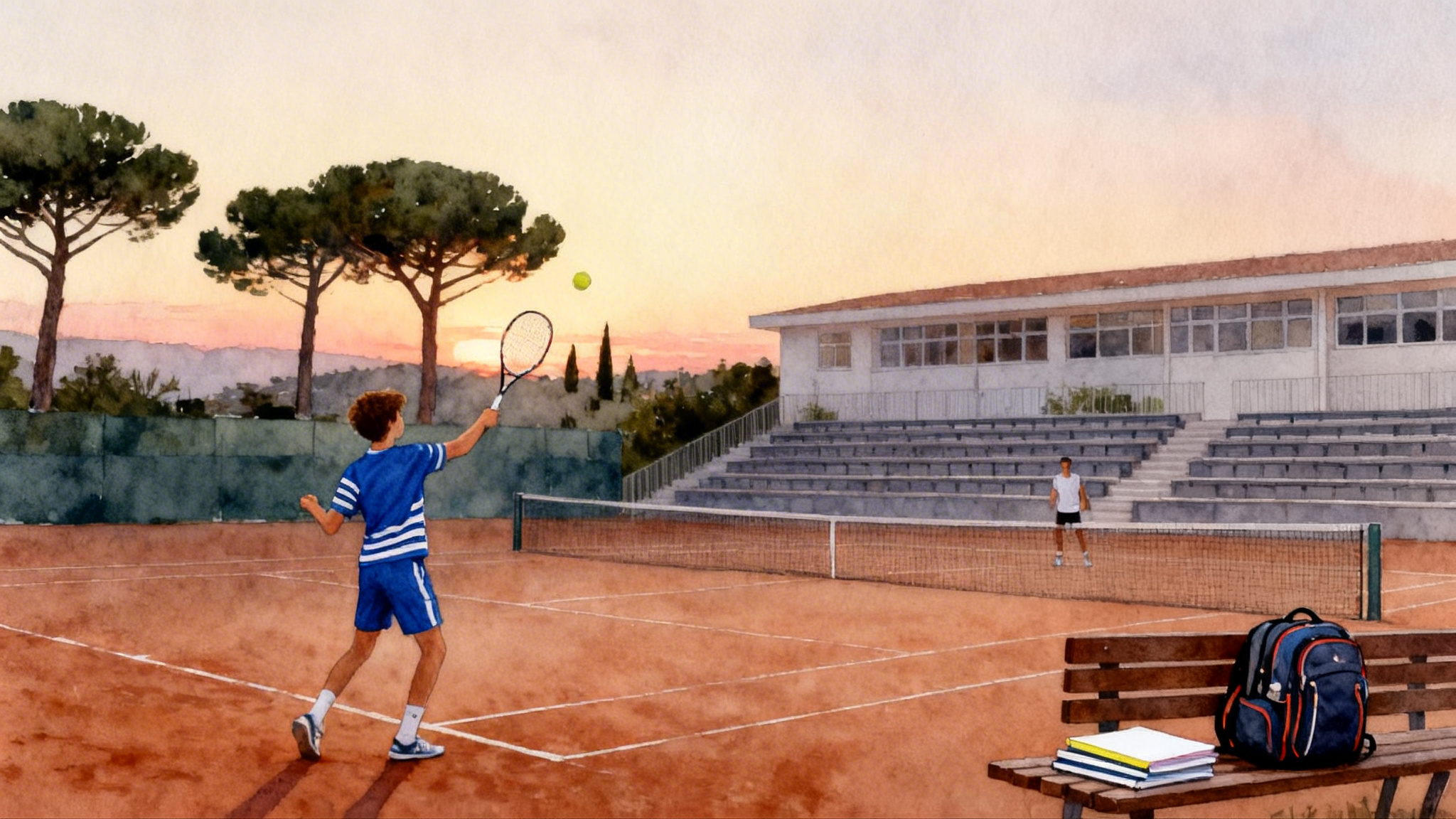
Zheng did not just dip into that culture. She moved into it and embraced its rhythm. On her regular spring swing in Spain, Zheng has spoken about what she calls the Spanish sense of balance between life and work, and how that balance supports the grind of tour tennis. The Mutua Madrid Open profiled that perspective, noting her move to Barcelona to work with Pere Riba and how the environment shaped her outlook in Spanish balance and outlook.
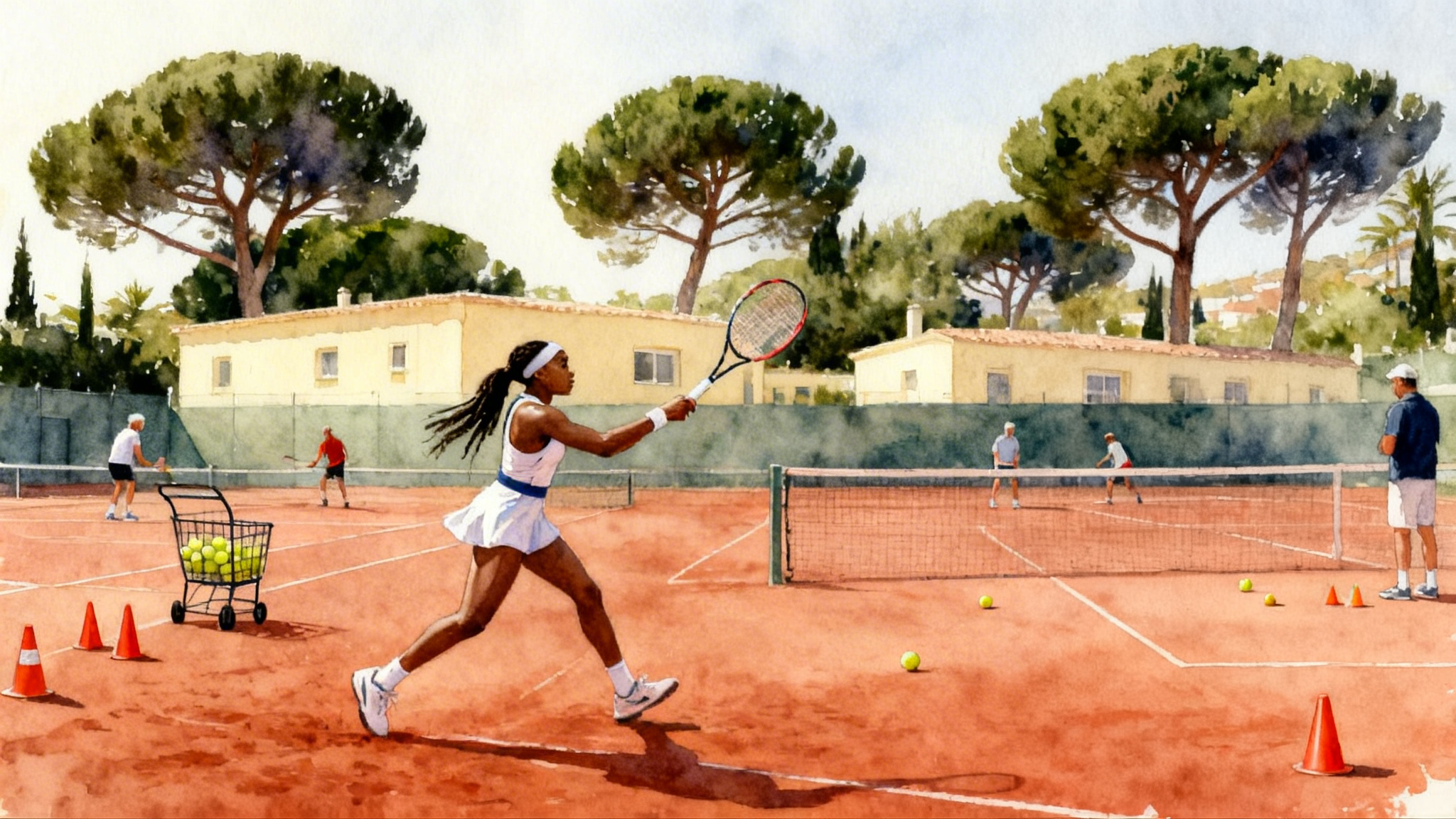
GR Tennis Barcelona, co-founded by coach Pere Riba, sits inside that ecosystem. The program is known for hands-on coaching, a tight player-to-coach ratio, and a training menu that looks unglamorous on paper and essential in reality: hundreds of well-placed balls, repeated patterns, and the constant demand to recover to a smart position before the opponent strikes. For more context on Spanish clay pathways, see our look at the Equelite and Alcaraz pathway.
Clay-first footwork: the superpower beneath the results
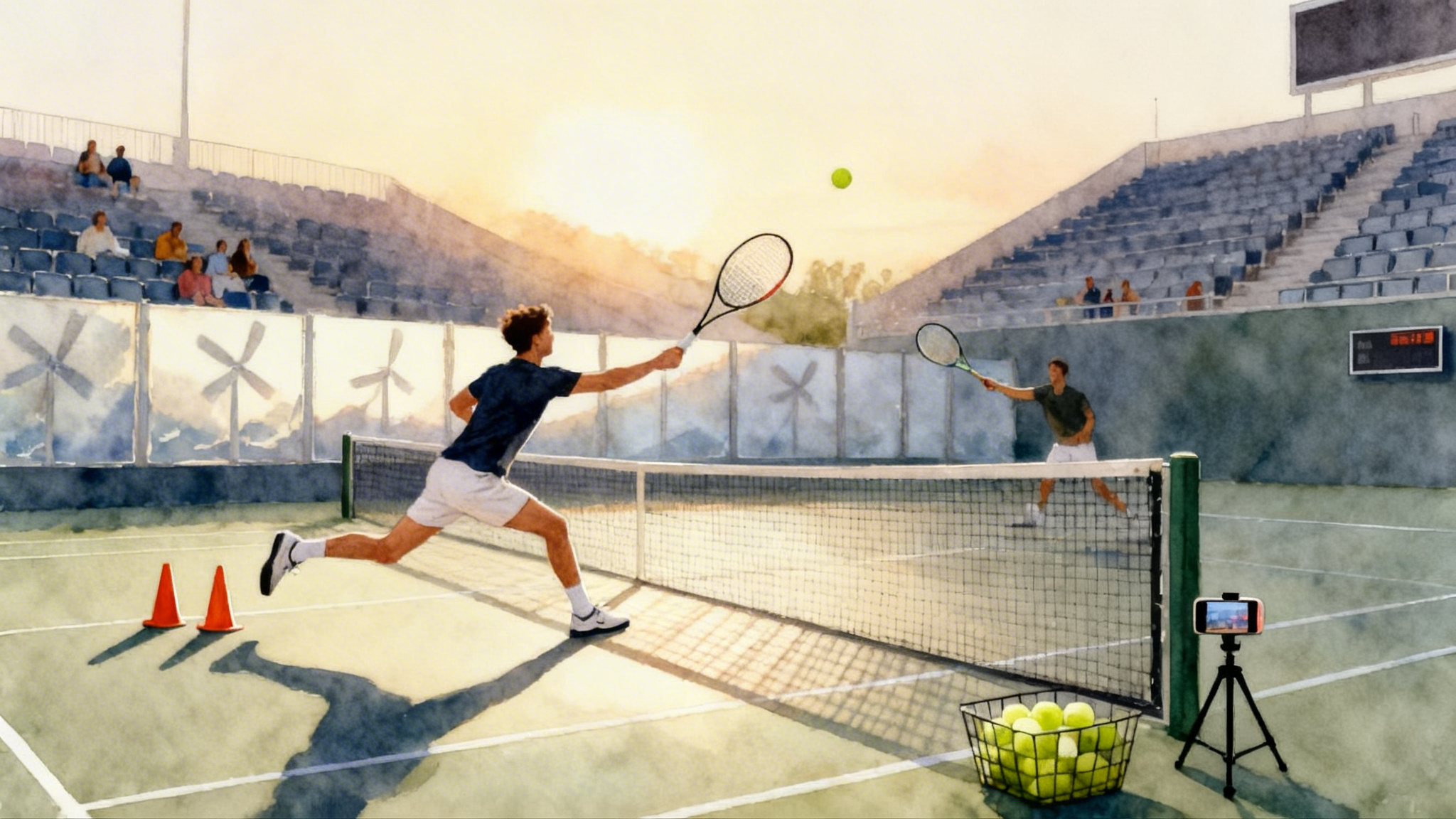
If you watch four points of a Zheng match from Barcelona training footage and then four points from her Olympic run, the continuity is obvious. The Spanish clay-first model built a superpower that travels to any surface: footwork under pressure. Here is what that looked like on court.
- The split step is a metronome: Zheng times her split not to where she wants to go, but to when the opponent is about to make contact. Clay exaggerates the penalty for late splits, so Spain forces precision. For a deeper primer, study our split step timing guide.
- The first step is decisive: open the hips, load the outside leg, and commit to the line of the ball. On clay, hesitation means you slide without purpose; on hard courts, it means you arrive off balance.
- The slide is a tool, not a trick: the cue is bend, plant, and glide at the right angle so the body stops early enough to hit through the ball. Spanish coaches teach how to close the slide with a strong core so the racket path stays calm.
- Recovery is a habit: finish the stroke with the center of mass already moving back to neutral, eyes checking the opponent early. On slow courts this saves meters over a session; over a season it saves matches.
These steps matter because they turn power into repeatable offense. Anyone can hit one big forehand. Footwork gives you the second and the third. Against elite defenders and in windy afternoon sets, that third ball is often the one that breaks the rally open.
Scheduling that compounds
The difference between a good week and a good year is scheduling. Spanish academies in general, and GR Tennis Barcelona in particular, insist on layered calendars that compound gains over time instead of chasing short-term thrills. A typical build for a developing player might look like this:
- Four to five weeks: base block on clay with heavy live-ball drilling, structured points, and targeted fitness.
- Two to three weeks: competition window, often a mix of national events, International Tennis Federation juniors or entry-level pros depending on the player’s level.
- One week: deload, focused on movement quality, flexibility, and match review.
- Repeat with small progressions: slightly more advanced patterns, more complex point construction, or an additional lifting session, never all at once.
Zheng’s team treated scheduling like a living document. The plan flexed for travel, for small injuries, or when a technical focus needed more time. What stayed constant was the pairing of training blocks with tournaments that rewarded those exact practice themes. If the block focused on forehand aggression plus middle-third recovery, tournament goals measured how often she earned the first strike with forehand location rather than only the final match score. That loop prevented the common trap of training one idea and then judging success by a metric unrelated to that idea.
What Pere Riba emphasizes on court
Parents often want to know what a coach actually does in a session. With Pere Riba, three habits stand out.
- Specific footwork language: rather than “move your feet,” cues are concrete. “First step to the line, no cross until you load,” or “close the slide early so the shoulders stay square.”
- Pattern plus purpose: drills finish with point construction. A crosscourt forehand exchange becomes crosscourt, change down the line, recover middle third, neutralize with a heavy lift, then restart. Players learn that a big shot is a door opener, not a finish line.
- Emotional routines: after errors players breathe, fix a single cue, and reset posture before the next point. That routine showed up on Zheng’s biggest stages when the volume of the moment was loudest.
Coaching handoffs that built on the base
No elite career is a straight line with one coach forever. The key is continuity of principles when the face in the box changes. Zheng’s story includes periods when she worked day to day with Riba and periods with other prominent coaches. What stayed constant was the Spanish-built movement base and the tactical belief that her forehand could control neutral balls once her feet were set.
That continuity matters for families because it shows what to protect through transitions. Keep the model of play and the development targets, even if new voices bring fresh drills or analytics. When Zheng’s team added specialists at different times, the foundation from Barcelona allowed those specialists to layer improvements without erasing what worked.
The academy-to-pro ladder: a practical map
If you are raising a junior with professional ambitions, it helps to visualize the climb. Here is a clean, practical map, with age ranges that are guidelines rather than rules.
- Ages 11–13: movement fluency
- Goal: fall in love with movement. Split step timing, first-step acceleration, outside-leg loading, and the ability to change direction without losing posture.
- Weekly structure: four on-court sessions focused on live-ball rallies at controlled speeds, two strength sessions built around bodyweight patterns, one play day with creative scoring.
- Checkpoint: can your player rally 15 balls crosscourt forehand on clay without breaking posture or dropping racket height under pressure?
- Ages 13–15: patterns and peer group
- Goal: build two reliable patterns on serve and two from the baseline. For example, serve wide on the deuce side plus forehand to the open court, or forehand crosscourt pressure plus backhand neutral.
- Weekly structure: five on-court sessions with one day devoted to match play, three short lifting sessions focused on mechanics, and daily mobility.
- Checkpoint: can your player execute a serve plus first ball to a target zone eight of ten times under a simple consequence like a sprint for misses?
- Ages 15–17: match craft and small tours
- Goal: learn how to win matches three ways. Win ugly with legs and depth, win clean with first-strike forehands, and win stubborn with height and margin on off days.
- Weekly structure: three training days, two competitive days, and two lighter days for analysis and recovery when on a mini-tour.
- Checkpoint: does your player track performance metrics such as first-serve location percentage, forehand plus one success rate, and neutral-ball error totals?
- Ages 17–19: pro transition
- Goal: move from junior points chasing to a blended schedule of International Tennis Federation and entry-level Women’s Tennis Association events that match the player’s game identity.
- Weekly structure: similar to above, but with targeted travel blocks and a true off week each month to prevent overload.
- Checkpoint: can the player repeat her best patterns in the third set, not just the first?
When to go abroad: a decision tree for families
Moving for tennis is a life decision. Use this decision tree to bring clarity.
- Are you clear on game identity? If your player’s default patterns are still changing each month, stay local a bit longer and experiment with styles.
- Do you have three non-negotiables? Examples: movement quality, a coach who tracks hitting loads, and a schedule that includes school planning. If an academy cannot meet your three, keep looking.
- Can you trial for four to six weeks? Short trials reveal more than glossy brochures. If possible, visit during a normal block, not a showcase week.
- Is there a viable school path? Many Barcelona-style programs partner with online schooling so athletes can keep academic doors open.
If you decide Spain is the right step, build a shortlist and visit. Our directory includes European options such as the All In Academy campuses, which can help you benchmark programs on facilities, staffing, and player pathways.
How to vet an academy’s philosophy
A good academy is not defined by its social feed. It is defined by boring excellence and consistent language across coaches. When you visit GR-style programs, bring these questions and look for specific answers.
- What is your footwork model and how do you teach it on day one? You want language about split-step timing, outside-leg load, and recovery lanes.
- How do you track hitting loads and high-intensity minutes? Tennis elbows and sore backs are often dosage problems disguised as technique problems.
- Show me a sample week for a player like my child. If the plan is copy paste, be wary. If it is adaptive and explains why each block exists, you are in better hands.
- How do you integrate match play? Ask to see the scoring formats used on practice match days and the conversion from drills to points.
- Who is accountable for feedback? You want one point person who synthesizes input from fitness, physio, and technical coaches.
Red flags include constant ball-feeding with little live-ball work, permanent court overcrowding, and vague talk about hustle without a plan for recovery.
Match play and fitness: a sustainable weekly plan
Here is a model schedule adapted from Spanish clay-first programs. Adjust for age and academic load.
Monday: technical plus aerobic base
- Morning: 90 minutes live-ball crosscourt to down-the-line patterns. Forehand cross 10-ball rally, switch line on coach’s call, recover middle third with a visible split.
- Afternoon: 45 minutes aerobic run or bike at conversational pace, plus 20 minutes mobility.
Tuesday: serve plus first ball and lifting
- Morning: serve location ladders, then serve plus forehand to zones. Finish with first-strike points to seven, server must win by two.
- Afternoon: lower-body lift built on goblet squats or trap-bar deadlifts, single-leg work, and core anti-rotation. Keep total volume under 45 minutes.
Wednesday: match craft
- Morning: practice sets with constraints. Set one, forehand must start crosscourt. Set two, backhand must neutralize with height over the net strap. Track neutral-ball errors.
- Afternoon: recovery swim or yoga. Ten minutes feet and ankle care.
Thursday: pressure day
- Morning: heavy-ball crosscourt exchanges, then laddered points starting at 15–0 against, so players learn to play from behind.
- Afternoon: upper-body lift focused on pulls, shoulder care, and medicine ball throws for rotational power.
Friday: patterns into patterns
- Morning: pattern stacking. For example, forehand inside in to backhand corner, recover, then next ball forehand inside out. Finish with tiebreakers to seven using those patterns only.
- Afternoon: sprint mechanics and short accelerations, six to eight reps of 10–20 meters, with full recovery.
Saturday: competition block
- Morning: official or practice match. Film the first four games for later review.
- Afternoon: light stretch, short debrief that identifies one movement cue and one tactical decision to carry forward.
Sunday: full rest or soft reset
- Optional walk, zero tennis. Real rest is a training day.
Key principles behind the plan
- One hard day, one light day: hard sessions pair with light fitness, and vice versa. This balances load and keeps the nervous system fresh.
- Film for feedback, not for social: ten minutes of early-match video is plenty for weekly adjustments.
- Numbers drive choices: track first-serve location, forehand plus one success, and neutral-ball errors. If neutral errors creep over 12 per set, cut patterns in half and rebuild simplicity next week.
What changed in Zheng’s game and how you can copy it
Three changes show up when you compare Zheng’s early European training years to her current tour level, and each is copyable.
- Forehand height control
- Early: flat pace that rushed opponents but sometimes clipped tape under stress.
- Now: same pace with an extra gear up in net clearance when needed. The higher heavy ball pushes defenders back and buys time to recover. Copy this by layering high heavy forehands into every live-ball drill, not just in isolated topspin sessions.
- Backhand neutral discipline
- Early: tried to turn defense into offense too quickly.
- Now: trusts a measured crosscourt to hold position until the forehand gets another look. Copy this by counting three solid backhands before allowing a line change, even in practice games.
- Serve choices by score
- Early: went for the perfect spot regardless of score.
- Now: hits big when ahead and chooses safer body or higher-percentage wide serves at deuce points when behind. Copy this with serve ladders that assign locations by score scenarios.
Budget, school, and life logistics
Spain is not only about training. It is also about building an adult life around a young athlete. In Barcelona-style setups, many academies operate inside multi-sport clubs where families can see the daily culture and where athletes bump into peers from different sports. Several programs partner with online schools, making it possible to protect study time during long tournament blocks. If you are evaluating offers, ask for examples of graduate paths and for contact with current families who can describe the real day to day. If you want a contrasting French model with strong schooling integration, review the All In Academy campuses.
The takeaway for families
- If your player’s game identity leans toward first-strike tennis, a clay-first base can still help by teaching balance and recovery so the big shots repeat late in sets.
- Move abroad when you can trial for a month, confirm school solutions, and see a plan that fits your player’s identity.
- Vet philosophy with concrete questions about footwork language, match-play integration, and load tracking.
- Structure each week with one clear tactical focus, pair hard days with light ones, and measure progress with three simple stats.
Conclusion: a red clay blueprint that travels
From Wuhan to Barcelona, Zheng Qinwen chose a path that turned promise into proof. The choice to live in a training culture where footwork is a language, patterns are habits, and schedules compound gains gave her a base sturdy enough to carry across surfaces and seasons. That base showed up in Paris when she made history on the biggest stage, and it shows up on ordinary Tuesdays when a boring drill demands the thousandth correct split step. Families do not need an Olympic moment to borrow this blueprint. They need clarity on identity, the courage to insist on a real plan, and the patience to let simple, good work stack day after day.