Junior Tennis 2026: Growth-Spurt Peak Height Velocity Guide
A parent-first playbook for ages 9 to 16. Learn how to train through rapid growth without wrecking technique: weekly plans by age band, match scheduling rules, strength and mobility tweaks, racquet updates, and clear red flags.
 Tommy
Tommy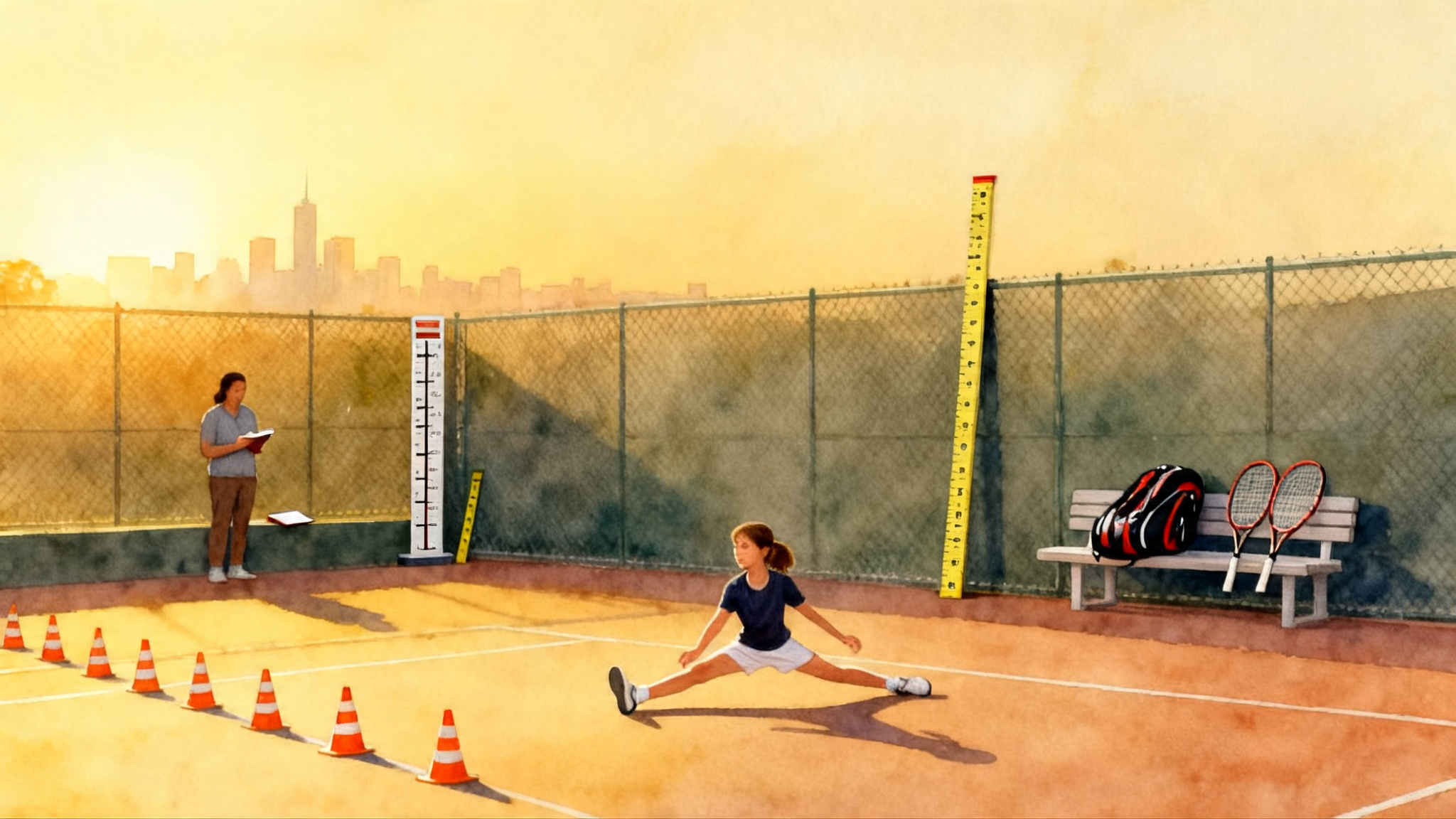
Why growth spurts change tennis
If your player is between 9 and 16, the fastest stretch of growth in their life is either coming soon or already underway. Scientists call it peak height velocity, or PHV, the window when an athlete gains height at the fastest yearly rate. Typical timing is earlier for girls than boys, but the real signal is the speed of change, not the birthday. Simple home tracking plus a few smart training pivots can protect joints, preserve timing, and even accelerate learning.
PHV is not guesswork. Parents can estimate where their child sits on the growth curve by using height, sitting height, body mass, and sex in established formulas that help predict peak height velocity. You do not need lab gear to benefit. A tape measure, a wall, and a logbook get you most of the way there.
What changes on court during this time
- Limbs get longer faster than tendons adapt. That makes strokes feel late and footwork feel clumsy.
- Growth plates are vulnerable. Repeated serves and heavy topspin can irritate knees, heels, elbows, and the lower back.
- Coordination dips temporarily. The brain must remap where the racquet, feet, and ball meet in space.
Your job as a parent is to reduce excessive loads, keep coordination drills crisp and frequent, and protect technique checkpoints until the body catches up.
A simple way to spot PHV at home
Use this three-part check each Sunday night.
- Measure and log
- Height against a wall with a book on the head. Shoes off. Same time of day. Round to the nearest millimeter if possible.
- Track weekly. A monthly average increase above 1 centimeter for three straight months, or a yearly rate above about 7 to 8 centimeters, suggests you are in or near the peak window.
- Watch coordination and size signals
- Sudden shoe-size jump, sleeves and pants going short, more mishits high on the string bed, and extra net tapes on the backhand.
- A new tendency to be late on high forehands or to over-rotate on serves.
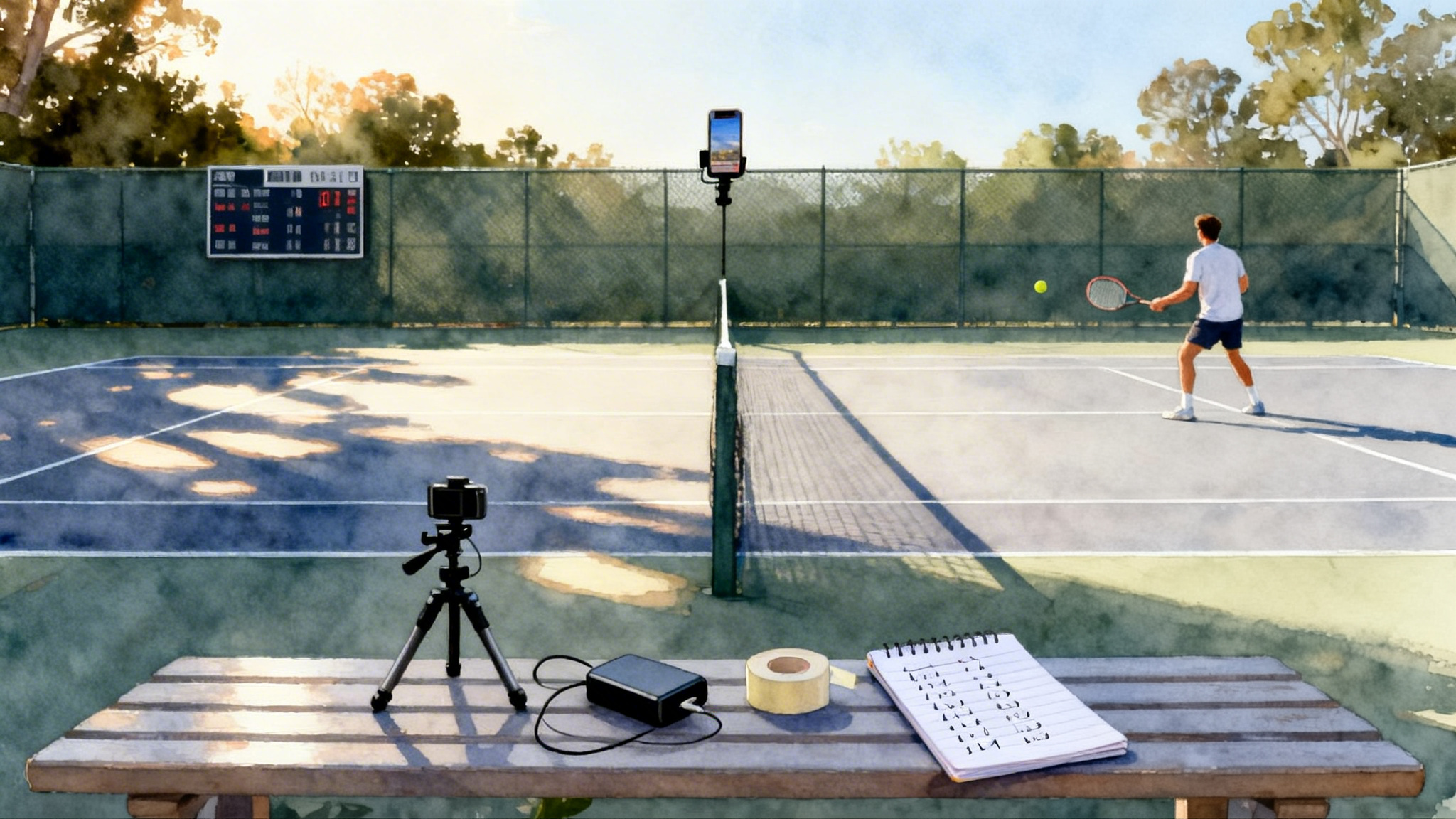
- Film from the side once a week to track toss height and contact. For setup tips, see film and analyze your tennis.
- Ask the body
- Any persistent heel pain after practice, knee pain on stairs, or morning back stiffness? If yes, you are likely over the safe load for the week.
Log height, training minutes, and any aches in the same notebook. That makes smart adjustments obvious.
The parent-first playbook: four levers you can adjust this week
Think of training as a mixing board with four sliders: strength, mobility, footwork, and matches. You will nudge them differently depending on whether your player is before, in, or just after PHV.
- Strength
- Shift from high-speed jumps to controlled isometrics and tempo lifts. Examples: wall sits, split squat holds, single-leg Romanian deadlifts with a slow three-second down.
- Keep ranges mid to comfortable, not to maximal depth, especially if knees or heels are cranky.
- Two to three short sessions per week, 20 to 30 minutes. Eight to ten total sets of lower body, six to eight sets of upper body, plus core.
- Mobility
- Micro-dose daily. Ten minutes in the morning, ten at night.
- Focus on ankles, hips, and thoracic spine. Examples: calf raises with slow lowers, hip flexor stretch with glute squeeze, 90-90 hip switches, open-book thoracic rotations.
- Add two minutes of soft tissue work for calves and quads after practice with a ball or stick.
- Footwork
- Keep the split step habit alive and simplify patterns.
- Use rhythmic patterns like split to quarter-turn to crossover rather than big bounding ladders.
- Three micro sets of 6 to 8 reps, three days per week, 8 to 12 seconds per rep, full recovery.
- Matches
- During the six to nine month window that straddles PHV, lower total competitive days and avoid back-to-back tournament weekends.
- When in doubt, favor one more technical practice over one more match.
Weekly plans by age band
Every player is unique. Use these as starting points and adjust for school load, travel, and how your athlete recovers. The first line is a steady week outside a big growth spurt. The second shows how to pivot during the heavy growth window.
Ages 9 to 10
Baseline week
- Court time: 3 sessions of 60 minutes, plus one fun play session of 45 minutes.
- Strength: 2 sessions of 20 minutes, bodyweight only, playful circuits.
- Mobility: 10 minutes after each court session.
- Footwork: 2 micro sets inside practice, short and crisp.
- Matches: One friendly match or orange or green ball play day two to three times per month.
In peak growth weeks
- Court time: keep three sessions, trim to 45 to 50 minutes with extra rallying and less serve volume.
- Strength: stay playful. Add isometric holds, keep jumps to 15 total contacts per session.
- Mobility: increase to daily 10 minutes morning and night.
- Matches: no more than one event in a two week span.
Ages 11 to 12
Baseline week
- Court time: 4 sessions of 75 minutes.
- Strength: 2 sessions of 25 minutes, light dumbbells or bands, 6 to 8 reps, slow control.
- Mobility: 10 to 15 minutes daily.
- Footwork: 3 micro sets, include split to crossover and shuffle to drop-step.
- Matches: One tournament or two match-play dates per month.
In peak growth weeks
- Court time: 3 to 4 sessions of 60 minutes, reduce serve and overheads by 30 to 40 percent.
- Strength: switch to isometrics and tempos, avoid max speed sprints. Keep total lower body sets to 6 to 8 per session.
- Mobility: daily 20 minutes, with extra ankle and hip flexor work.
- Matches: one event per month, avoid back-to-back days if possible. If you must play two days, shorten warm-ups and keep doubles off the schedule.
Ages 13 to 14
Baseline week
- Court time: 5 sessions of 90 minutes.
- Strength: 2 to 3 sessions of 30 minutes, hinge, squat pattern, push, pull, carry.
- Mobility: 15 minutes daily, add thoracic rotation work.
- Footwork: 3 sessions of 10 minutes, layer in first-step speed.
- Matches: One tournament per month, or two if there is clear recovery.
In peak growth weeks
- Court time: 4 sessions of 70 to 80 minutes with an emphasis on clean contact, spacing, and timing. Keep kick-serve reps very light.
- Strength: emphasize isometrics and controlled eccentrics. Example set: split squat hold 20 seconds per leg, 3 sets; single-leg calf raises 3 x 10 with 3-second lowers; plank and side plank 3 x 30 seconds.
- Mobility: 20 minutes daily, add hamstring sliders and adductor rock-backs.
- Footwork: keep reps low and quality high. 2 sessions of 8 reps, 10 seconds per rep, full recovery.
- Matches: one event every four to five weeks. Remove super long three out of five set formats for now.
Ages 15 to 16
Baseline week
- Court time: 5 to 6 sessions of 90 to 120 minutes.
- Strength: 3 sessions of 35 minutes. Progress loads if movement quality is solid.
- Mobility: 15 minutes daily with a focus on hips and thoracic rotation.
- Footwork: 3 sessions of 10 to 12 minutes.
- Matches: One to two events per month depending on recovery, school, and travel.
In peak growth weeks
- Court time: 4 to 5 sessions of 75 to 90 minutes. Keep serve buckets to 25 to 40 balls total, then switch to shadow and spin-feel drills.
- Strength: maintain, do not chase new personal bests. Tempo work and isometrics for two weeks, then reassess.
- Mobility: 20 minutes daily, keep hip flexors and calves happy.
- Matches: one event per month, no consecutive weekend events. If the first match runs past two hours, strongly consider withdrawing from doubles.
Technique protection checklist during rapid growth
Serve
- Keep toss height consistent by marking a visual cue above the baseline or filming from the side once weekly. For arm health and speed progressions, see the Serve Power Without Pain plan.
- Use 2 to 3 ball clusters rather than full buckets. Practice pronation and rhythm with shadow serves and slow-motion reps.
- Favor flat and slice variations while the spine adapts. Delay heavy kick serves if there is any back discomfort.
Groundstrokes
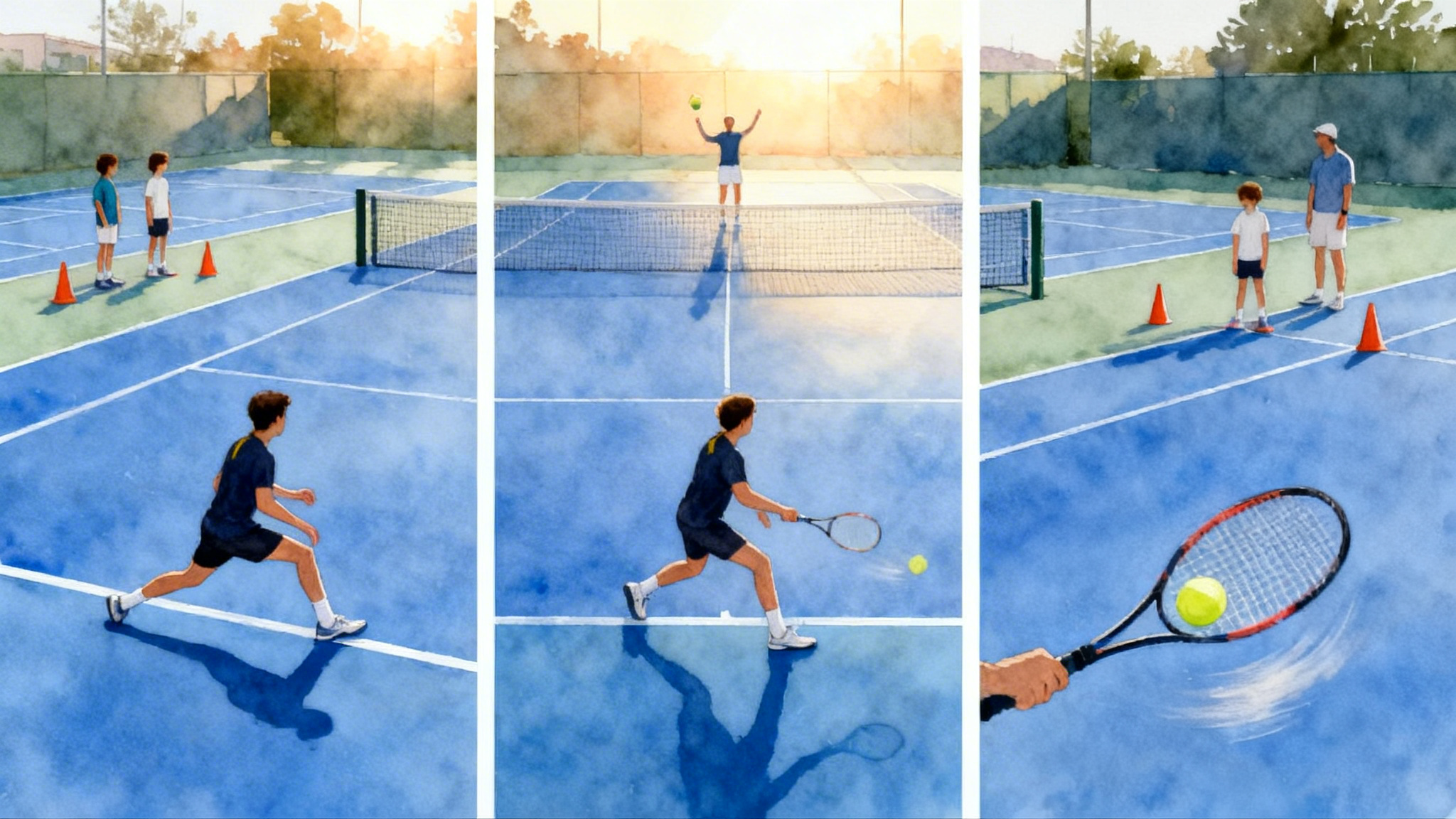
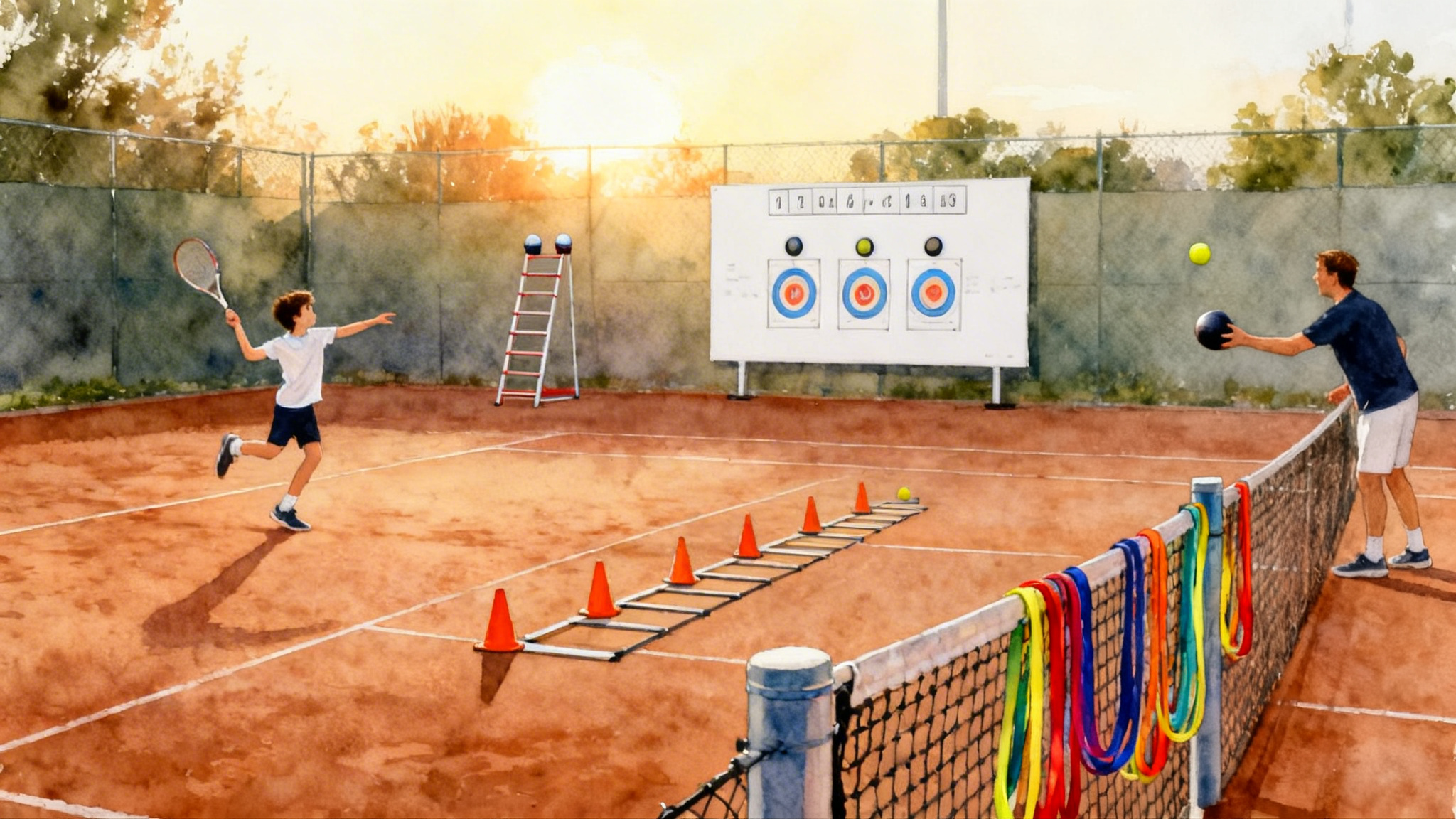
- Expect the contact point to rise. Use shoulder-height target cones and feed higher.
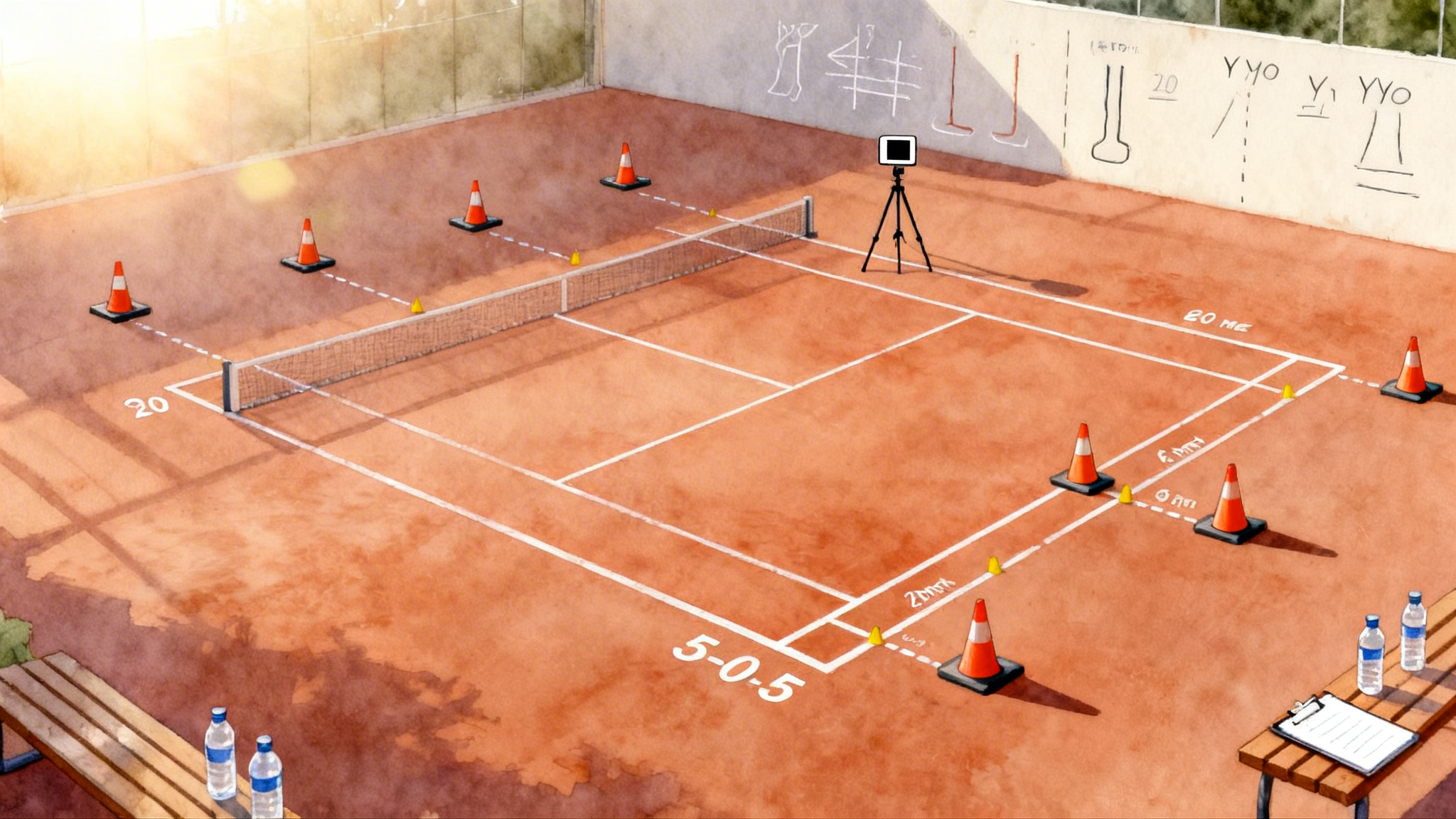
- Work on spacing. Place two cones on the outside of the ball path to teach early set up and side step. Keep rally pace at 6 out of 10.
- Use more rhythm drills and fewer violent open-stance scrambles during peak weeks.
Net game
- Short, frequent volley blocks. Ten balls, rest, then ten more. Quality over volume.
Racquet and shoe updates for growing athletes
Grip size
- Use the index finger test. With the player gripping the handle, the index finger of the other hand should slide snugly between fingertips and palm. If the gap is tighter than a finger, add a thin overgrip. If the gap is larger than a finger, consider a thicker replacement grip.
Racquet length and weight
- Ages 9 to 10: usually 25 to 26 inches works, depending on height and control. Prioritize maneuverability.
- Ages 11 to 12: 26 inches or a lighter 27 if strength and timing are solid.
- Ages 13 to 16: 27 inches. If contact drifts late during growth, consider adding 5 to 8 grams under the grip to keep the balance slightly head light, which can protect timing.
Strings and tension
- Use a soft multifilament or a soft co-poly hybrid. During rapid growth, drop tension by 2 to 3 pounds to enlarge the sweet spot and reduce harsh mishits.
- Restring as often per year as hours played per week. Eight hours a week means about eight string jobs per year as a starting rule.
Shoes and insoles
- Rapid growth changes foot shape. Check toe room weekly. Aim for a thumb’s width from the longest toe.
- Replace shoes when the outsole is bald under the big toe or lateral forefoot, or every 3 to 4 months in heavy training blocks.
- Consider simple off-the-shelf insoles if heel soreness appears. If pain persists, pull back and seek local clinical advice.
Red flags that mean pull back now
Overuse injuries become more likely during PHV because tendons and apophyses are under stress. The American Academy of Pediatrics explains how training errors and volume spikes drive many youth overuse problems and what to do about them. Read their guidance on overuse injuries in young athletes.
Stop and modify if you see any of the following for more than 48 hours
- Knee pain at the bump below the kneecap, or pain at the patellar tendon.
- Heel pain after practice, especially in the morning.
- Low back pain with extension or serving.
- Elbow pain on the inner side, or persistent shoulder soreness.
- A sharp drop in coordination, repeated framing of routine balls, or a clear change in serve rhythm.
- Mood changes, poor sleep, or morning resting heart rate 5 to 10 beats higher than usual for three straight days.
What to do next
- Cut total court time by 25 to 40 percent for one to two weeks.
- Remove doubles and any back-to-back match formats.
- Replace jump and sprint work with isometrics and mobility.
- If pain persists beyond a week or affects walking, book a clinical evaluation before returning to full play.
Match scheduling rules of thumb during the growth window
Use these guidelines as a floor for recovery, not a ceiling for ambition.
- No back-to-back tournament weekends during the heaviest three months of growth.
- One competitive event every four to five weeks for ages 11 to 14 if growth is rapid. Ages 15 to 16 can handle one per month if soreness clears within 48 hours.
- Limit total competitive days to three per month in peak weeks. If a day runs past two hours, skip doubles.
- Prefer formats with match tiebreaks in place of a full third set while the body adapts.
The home mobility micro plan
Use this ten minute template twice daily during rapid growth.
- Ankle rocks against wall: 1 minute per side
- Calf raises slow lower: 1 minute
- Hip flexor stretch with glute squeeze: 1 minute per side
- 90-90 hip switches: 1 minute
- Adductor rock-backs: 1 minute
- Open-book thoracic rotations: 1 minute per side
- Hamstring sliders or strap stretch: 2 minutes total
Set a phone timer for each drill and move on when it beeps. Consistency beats intensity.
How we screen and individualize at Legend Tennis Academy
A fifteen minute movement screen helps you decide what to dial up or down this month. At Legend Tennis Academy movement screen we look at
- Ankle dorsiflexion symmetry
- Single-leg balance and knee control
- Hip rotation and extension
- Thoracic rotation for serve and overhead
- Split step timing and first step
- Basic shoulder rhythm for the serve
You leave with a one-page plan that includes your player’s top three mobility targets, two isometric strength choices, a footwork micro set, and a match scheduling note for the next four weeks.
Ready to personalize the plan for your player
- Austin families: book a screen and get your player’s top three targets this month.
- Not in Austin: ask your local coach for a short Growth-Spurt Screen that covers the same checkpoints.
Quick answers to common parent questions
My 12-year-old suddenly frames forehands and hates the serve. What now?
- You are likely inside the growth window. Cut serve buckets in half for two weeks, feed higher balls, switch to shadow and slow-motion serves, and double down on ankle and hip mobility.
Is it okay to play two tournaments in a month if school is light?
- Maybe, if recovery is smooth and there are no red flags. For a player in peak growth, keep at least two weekends free from competition and monitor soreness the morning after matches.
Should we change to a 27-inch racquet as soon as my 11-year-old asks?
- Only if contact quality stays clean and the player can accelerate the racquet without late hits. If timing lags, return to 26 inches or add a few grams under the grip on the 27 to keep balance head light.
Do shoes matter that much?
- Yes. Foot pain is one of the easiest ways to derail consistency. Check fit weekly during rapid growth and replace shoes before traction is gone.
When do we push strength again?
- Two to three months after the fastest growth month, if movement quality looks good and soreness is minimal, slowly reintroduce faster jumps and moderate load progressions.
Turn growth into your advantage
Growth can feel like chaos, but it is also a built-in reset button. When you trim match volume, protect serve volume, and micro-dose mobility and isometrics, technique survives and often improves. Use the weekly plans in this guide to keep training aligned with the body your player has today, not the one they had last season. Track height, track how they feel, and make small course corrections fast.
If you want a confident start, book a short screen. Ten focused minutes of movement testing now beats months of guessing later. Local families can start with a Legend Tennis Academy movement screen. For remote readers, use our checkpoints with your coach and pair them with the 2026 Tennis Fitness Toolkit to track progress at home.